







Abstract

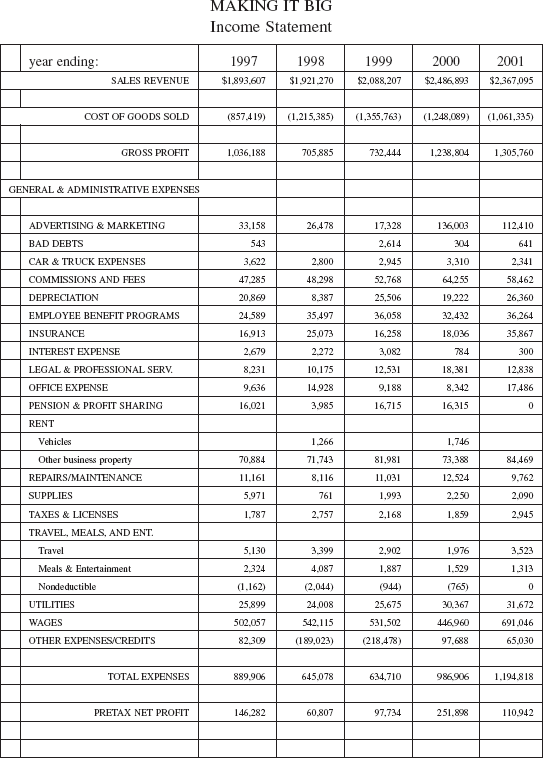
Five–Year Financial Summary
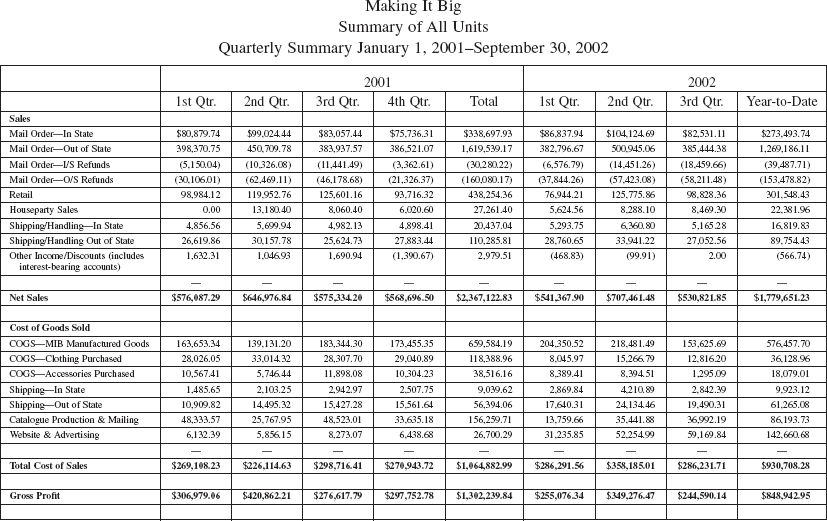
Quarterly Summary Comparisons 2001–2002
We are struggling to increase sales in both retail and mail order. It has been a difficult season and unexpectedly so. I think we are going to see a decrease in annual sales for the first time since 1995. This has put a crimp in our growing plans and overall morale. We were all set to move forward and instead find ourselves struggling to keep up with last fall, which after September 11 was not a pretty picture, but in fact superior to the current numbers. We just announced a wage freeze to be re–evaluated at the end of the first quarter of 2003.
Looking to grow, MIB had already embarked on new approaches—expanding its mail–order roster and beefing up its website—but they weren't panning out. “We took the steps traditionally used in mail order,” Cynthia explained. “We printed more catalogues, exchanged and rented mailing lists and have mailed the catalogues. The response has been far below expectations.” As for the attempt to increase website traffic, “We worked with a very savvy guy, put together what we all thought would be a mutually beneficial project—and it bombed. It makes no sense. He was able to get more potential customers to our site, but they didn't become buyers.”
Cynthia had started her business on the strength of a single inspiration—“a gift,” she called it—not as a calculated plan. She sensed that the company's improvisational style was a weakness. “This is one of the shortcomings of MIB, not having a strong vision that determines the changes to come,” she said. “I wouldn't say we are a boat askew on a tempestuous sea, but much of what actually happens derives from tangible events in the course of doing business,” rather than an overall strategy.
And the vision, she realized, would have to come from others besides Cynthia herself. “I don't think I can grow the company alone,” she said. “We are at the point where my skill set has reached its limits, and without an influx of new skills and information, nothing can really move forward the way it needs to. We need more skilled individuals who can take what we've built and propel us to the next level.” A strong–willed entrepreneur whose motivations were as much personal and political as monetary, Cynthia had long been the sole driving force behind MIB. Now, she saw, she needed others’ perspective and input to create a larger scheme. But who, and what?
Founder's Profile
Cynthia Riggs grew up in the suburbs of Los Angeles. She graduated from high school in January of 1974, a semester early, and worked to save money for college. She traveled that summer and entered Sonoma State University, north of San Francisco, in the fall of 1974, majoring in humanistic psychology.
It was the height of the women's movement, and during Cynthia's first semester she joined a consciousness–raising group and took her first women's studies class: “Our Bodies, Ourselves.” For a tall, big–boned girl whose mother went out of her way to make her feel like a “fat and unattractive child,” the new messages she was hearing were positively liberating. “I blossomed under the tree of feminism; it made so much sense and just seemed right,” she remembered. “It was validating as well as enlightening.”
In 1976, Cynthia joined a women's bookstore collective called Rising Woman Books in nearby Santa Rosa. Ironically, this countercultural endeavor taught her some very capitalistic lessons. “Even though in theory everyone had equal responsibility, I was given the leadership role in running the business,” she said. “I learned everything from ordering, advertising, promoting, [and] dealing with cash flow to balancing the books.”
Combining the empowerment she'd gained from feminist doctrine with a dose of business savvy, Rising Woman was “truly the beginning of my entrepreneurial endeavors,” Cynthia said. “It was the confidence I had developed while helping run the bookstore that enabled me to take the next step and begin my own business.”
But at the time, Cynthia didn't yet see herself as an entrepreneur. She graduated from Sonoma State in 1978 and began buying and selling vintage clothing, textiles, and collectibles at flea markets in order to make ends meet until she could find a “real” job.
I had no intention of going into business. I was moving in with a lover, and we had too much of everything except money! So we went to the flea market to sell off the excess. In the course of selling, which must have taken several weeks, I started to buy from other people who had come to sell off their stuff. I kept the choice pieces for myself and began to sell the rest. It soon became a steady source of income. Eventually, I began buying from a multitude of flea markets, garage sales, rummage sales, thrift stores; ran ads in the newspaper; and built a steady business, selling primarily at the local flea market. It was a very competitive and labor–intensive business, but required no terms or financing or overhead.
With her psychology degree, Cynthia had intended to pursue a career in social work. But an experience during her junior year discouraged her from following this path and made business seem more appealing by comparison. Working with juvenile delinquents in a residential rehabilitation facility had been challenging and rewarding, but her experience was soured by a critical, domineering director and bureaucratic city and county agencies.
So Cynthia was still making a living from her free–lance flea–market business when, in 1980, Cheap Frills, a small retailer of used clothing in nearby Cotati, offered its name, inventory, and location for sale. With encouragement from friends, Cynthia took the opportunity to buy the name and move into its existing storefront for $4,500, gradually changing its focus to high quality clothing and accessories, mostly vintage—a continuation of her flea market finds. The store's first–year profits were slightly more than $15,000.
The vision of Making It Big began on a trip up the California coast one winter day in 1982, when Cynthia stopped in a small used–clothing store and discovered a selection of drawstring Army surplus pants, which were 100 percent cotton, inexpensive, and dyed in fashionable colors. Not only did they fit her, they would easily fit much larger women. Cynthia knew from her own experience that large women would love the casual style, trendy colors, and flattering fit—she remembered being taken to “the ‘ladies’ stores” as a teenager “and forced to wear black, navy, maroon, and much plaid.”
I set out to find the supplier, because I knew these pants would be a hot item in Cheap Frills. I dogged the owner of the used–clothing store until she told me where to purchase the pants. Initially, I could only get them already dyed, but eventually I was able to find them untreated, at true Army surplus prices. I called them “parachute pants,” and bought them in large quantities. I had them dyed in bright colors, had pockets sewn on them and traveled across the country to women's fairs and music festivals selling them. Women of all sizes and shapes bought these pants, but it was clearly the big women who benefited the most. They were thrilled that finally there was something that fit them. I sold out at every fair I attended. Ultimately, the seed money and mailing list for Making It Big emerged from sales of these pants.
Cynthia's retail business, meanwhile, was thriving but labor intensive. “The sales [at Cheap Frills] came easy, but it took too much of my time just finding the right products to sell,” she recalled. As she contemplated launching a new company to cater to large women, she realized that she would need two things: a partner, and a way to reach customers all over the country. “At this point, I knew I didn't want to start another business alone. I wanted to share the headaches, financial woes, and responsibilities with other people,” she said. Through Cheap Frills, she had met Janet Sturdy, a single mother and part–time student at Sonoma State who had contacted Cynthia with vintage clothing to sell. Now she considered partnering with Janet for her proposed new venture.
Unsure how much longer she would remain in the area, Cynthia also sought greater flexibility and decided a mail–order business would be the easiest way to achieve it. With that vision in mind, she began researching and developing the mail–order concept.
In the spring of 1982, Cynthia began to get serious about her idea of a clothing company for big women. She started attending apparel shows and examining what was available for plus–size women. The “standard” range of sizes made by most manufacturers of “plus–size” clothing was 14 to 24; Cynthia wanted to go far beyond those sizes. After a year of extensive research, she came to the conclusion that what she was looking for did not exist, and that in order to obtain the products she needed, she would have to find someone to make the clothes for her.
She spent the next year trying to find manufacturers that would help her develop the line of clothing. This search proved fruitless. The order quantities they required were beyond the means of a start–up company that lacked a sure idea of what it could sell. Cynthia decided she would have to become a clothing manufacturer herself. The ingredients were falling into place: a partner, a catalogue, and some very large clothes.
Launching a New Venture
In the 1980s, there were few manufacturers of super–size clothing. Cynthia knew firsthand the frustration of large women whose choices were limited to poorly made polyester clothing, none of which was particularly stylish. “I had several friends who were very large women, and they couldn't find quality clothing,” she explained. “Super–size women”—sizes 28 and up—“were limited in choice to the point that many of them never left their homes, went to school, or felt able to get a job. They knew that people didn't accept them, and their lack of decent clothing only enhanced this reality.”
Cynthia had become involved with the National Association for the Advancement of Fat Acceptance, a national political and educational organization. She believed fat people, and especially women, were oppressed and made miserable by a society that stereotyped them as “lazy, out of control, obsessive eaters, couch potatoes, and the like.” The super–size women Cynthia got to know showed her that this wasn't the case. So she brought to her undertaking both entrepreneurial zeal and enthusiasm for a cause. “Making It Big gave me an opportunity to combine my personal goals with my political beliefs…. [It] evolved out of my belief that no one should be discriminated against because of his or her size. If adequate clothing would contribute to better self–esteem and make the lives of fat women easier, I felt it was worth a try.”
In 1984, at the age of 28, Cynthia had $20,000 in savings and revenues of $35,000 from Cheap Frills. She figured Cheap Frills could support her as she began a new venture. Not wanting to start another company on her own, Cynthia invited Janet Sturdy to become her business partner. Having operated a cash–based business that provided a steady income, and had required no terms or start–up financing, Cynthia had no experience in establishing credit or taking on debt. Janet, like Cynthia, did not have a financial history that enabled her to obtain credit or financing. The start–up was financed by Cynthia's savings, periodic loans from her grandmother, and Janet's inheritance from her father.
Cynthia hoped that Janet's sewing abilities would be an asset, as she herself hadn't sewn anything since the seventh grade. It turned out that having the skills oneself was irrelevant. What mattered was being able to find people who knew how to make clothes. “I set out to find individuals who knew how to do what we didn't,” she said. “As with most things, it was trial and error,” but after a couple of years, an expert seamstress who had been sewing for MIB began hiring other seamstresses to work for her and offering MIB more services. “She saw our business was growing and she saw a way to make money for herself,” Cynthia said. “She eventually became our production manager, although she remained an independent contractor. She remained in that role for many years and played a major role in helping us get the business off the ground.”
From her experience with the parachute pants, Cynthia decided that the way to proceed in developing a product line would be to create garment–dyed clothing—clothing manufactured in white or natural cloth then dyed to order in a variety of seasonal colors. This would serve several purposes. First and foremost, the customer could purchase her favorite item in different colors, creating multiple sales of one style. Secondly, the company wouldn't have to predict what would sell in what specific color and size. The inventory would be flexible; it could be carried over to the next season and still be considered a new item because of new color choices. Basically, MIB wouldn't have its money tied up in merchandise it couldn't sell. “Then began the search for fabric, notions, a pattern maker, seamstresses, the whole kit and caboodle,” Cynthia recalled.
Over the course of the initial four years, Janet and Cynthia each contributed $42,500 to Making It Big. Cash flow was a constant struggle. A manufacturing business requires credit terms, usually 60 days, in order to float the production of new goods before they are ready for the market. For the first two years, everything was purchased COD. Especially when it came to fabric purchases, this procedure was a hardship that hindered both growth and opportunity. Finally, Cynthia was able to convince one of her factors (a factor is the bank that buys the fabric company's receivables) to extend the company a small line of credit. This was a turning point for the young company, a modest start toward building a credit history. It took another two years to build a financial groundwork in which terms were extended on most purchases.
“Initially, we were very focused on finding and developing the product line and learning how to become a clothing manufacturer,” Cynthia said. Neither she nor Janet knew anything specifically about operating a mail–order business—or even that there was anything to know. They printed 3,000 catalogues and mailed 1,400 of them to a list of names Cynthia had compiled from her parachute–pants tour. Cynthia continued to travel each summer, selling MIB clothes and successfully expanding the customer base and mailing list. “We did some advertising, not much, so it was mostly by hitting the road and word of mouth that the initial mailing list and our sales expanded,” she said.
During these formative years, Cynthia said, “I was naïve in every which way you could have looked at the situation.” In fact, her very naïveté may have been an advantage in such an idiosyncratic, hitherto unexplored business, as she found out when she consulted with two women from another mail–order company. “They filled my head with all kinds of information, and they couldn't believe we had gotten as far as we had without following the rules of mail order,” she remembered. But when MIB turned to a conventional mail–order method, renting a defunct company's 5,000–name mailing list from a list broker, the mailing yielded exactly one response. The company also joined the Northern California Catalogue Club, a group of small and large businesses that provided networking, workshops, and information sessions. The club was “a good place to learn the nuts and bolts of running a catalogue business,” Cynthia said. But she also realized that hers was not a typical catalogue business, and that the “rules” of mail order didn't necessarily apply.
“We are defiantly renegade in our marketing practices and will probably always be. This is not so much out of choice but out of necessity,” Cynthia said. “Our niche market is very specific, and it is very hard to find new customers through the traditional marketing techniques. Fortunately, we have an incredibly loyal customer base.” But the company needed to figure out a way to find new customers without going through the usual channels.
Positioning for Growth
Cheap Frills had been located in an old house on the plaza in the small town of Cotati, California. Once Making It Big got going, Cynthia and Janet took over the back of the house, which had formerly been rented out as a residence. While both women were committed in principle to their new business, they soon found that their different personal situations affected the business and strained their personal relationship. Cynthia, single and childless, was poised for action, ready to tackle any task that arose. Janet, with young children at home, did not make business her first priority.
Cynthia realized this when, in April 1998, she was injured in a car accident. Bedridden after leaving the hospital, she tried to direct production of the coming catalogue, but it was soon clear that Janet couldn't do the rest without Cynthia there. Cynthia saw that “my commitment was greater then hers, as was my capacity to create this business…. I had wanted an equal partner and, other than financially, that wasn't Janet.” In October 1998, Cynthia bought out Janet, dissolved the partnership and became the business's sole proprietor.
That fall, Cynthia liquidated Cheap Frills's inventory, and MIB took over the location as an exclusive retailer of MIB clothing. The following year, MIB's administration, R&D, and mail–order operations moved to a larger, 3,800–square–foot facility. The original storefront, only a mile away from the new facility, was retained as a retail outlet, which proved valuable for testing new products and liquidating overstock merchandise. In 1992, 35 percent of total sales came from the retail store; by 2002 it contributed less than 20 percent of total sales.
Cynthia regularly attended trade shows to keep up with trends and to locate new products. All the garments were designed by a Cynthia, her staff, and a skilled pattern maker. Fabrics were obtained from several sources, depending on the materials desired. MIB manufactured more than 90 percent of the products it sold and purchased the remainder from selected local vendors. Catalogue design was contracted out, but was overseen and developed by Cynthia and the MIB staff.
MIB contracted with a network of seamstresses in Sonoma County and San Francisco to sew precut garments in lots of 12–48 per size. Each completed garment was inspected as it was received, to ensure quality and accuracy in sizing. Customers chose from eight to ten colors when placing orders. Then MIB sent the garments to a dye house in quantities of nine to thirty pounds. MIB inspected each garment again during the final steam pressing, when it was ready for delivery to the customer.
MIB offered a full line of clothing and accessories in four main categories: career wear, casual sportswear, formal wear, and outerwear (see Figure 3). Merchandise was sold directly to customers via a 32–page color catalogue (up from 24 pages until the late 1990s), the local retail store and, starting in 1996, a comprehensive website. A product's presentation in the catalogue directly affected its sales. For example, the particular color in which an item was photographed would generally outsell all other color choices for that item. The catalogue was structured in a “grouping” format, making it easier for the customer to find what she sought. Clothing selections were arranged by fabric groups or category, with accompanying accessories. Clothing and accessories were carefully chosen each season according to current trends, to appropriateness of style for large sizes, and by past acceptance of basic styling pieces. Best sellers would return season after season, with an occasional fabric change carried year round.
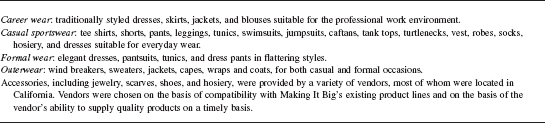
MIB Product Lines
MIB had launched its website as a showcase for its goods in 1996, and the following year added a shopping cart for online purchases. By 2002, nearly half of MIB's mail–order sales were from online purchases (see Figure 4). Most purchases were made in response to the catalogue mailings. Most of MIB's sales were from repeat customers. Local advertising was done via radio and newspaper. Figure 5 shows MIB's geographic reach.
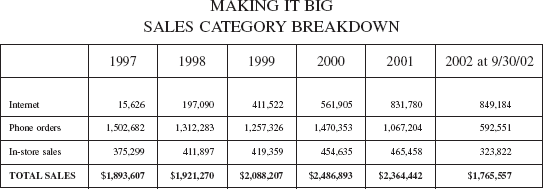
MIB Sales by Source
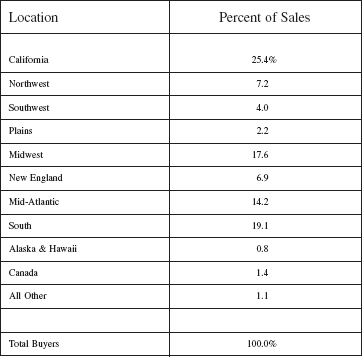
MIB Geographic Customer Profile
Additional sales came from “Houseparties.” Paulette, MIB's bookkeeper, explained, “Our Houseparties occur for a single day, three or four times a year. Retail merchandise is loaded into a rented truck and driven to Berkeley, where we set up shop in an old dance hall. Bay–area customers are contacted via direct mail as to time and date. It's been a success for years and our customers look forward to it.”
Serving the Plus–Size Apparel Market
Women's apparel was a highly competitive, global industry consisting of numerous manufacturers, importers, and retailers. In the early 2000s, the “plus–size” or “extended–plus size” market (sizes 28 through 72+) was the fastest–growing segment of the women's apparel market. U.S. retail sales for plus–size apparel alone were expected to reach $47 billion by 2005. The National Center for Health Statistics’ 1999 National Health and Nutrition Examination Survey revealed that 35 percent of adult Americans were overweight, with 26 percent qualifying as obese. NPD Group, a New York market research company, reported that 60 percent of American women wore size 12 or larger, and 16 percent of teenaged girls were overweight. Plus–size sales accounted for one–fifth of all U.S. women's apparel spending in 2001, a figure that was predicted to increase as the population aged.
Figure 6 provides a profile of distribution channels for women's apparel in the U.S. in 1997. Over one–third of large–size women purchased their clothing exclusively from companies specializing in large–size clothing. Charming Shoppes, Inc., the third–largest specialty apparel retailer in America, was the leader in plus–size women's apparel, with annual revenues exceeding $2.45 billion in 2001. Known for its Fashion Bug and Added Dimension chains, Charming Shoppes had recently acquired Lane Bryant and Catherine's Plus Sizes, bringing its retail business to 2,446 stores in 48 states in 2002. Many of the nation's best–known brands, such as Liz Claiborne, Tommy Hilfiger, and Old Navy, and department stores such as Nordstrom, Macy's, Bloomingdale's, and Saks Fifth Avenue, had recently begun to offer larger–size clothing due to the increased demand in this niche.
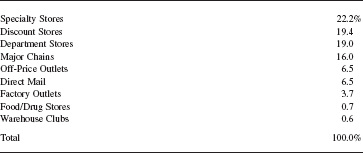
U.S. Retail Sales of Women's Apparel by Distribution Channel
Despite the proliferation of independent retailers in malls and on the Internet, there was increasing consolidation and branding in the apparel industry. According to Charming Shoppes, 1 the primary elements of competition were style, size, selection, quality, display, and price, as well as store location, design, advertising, and promotion and personalized service to the customers. Charming Shoppes had recently invested $8 million on a sophisticated computer–information system to keep detailed profiles on its customers, in order to refine its direct mail and adjust inventory for maximum profitability. 2
Charming Shoppes, Annual Report 2002.
Tatge, M. (March 18, 2002). Thinking Big. Forbes, 169(6), 82–83.
Most retailers of large–size clothing offered their goods through catalogues, and an increasing number had set up websites that created personal profiles for repeat customers. Nonetheless, “industry experts [claimed that] most retailers simply haven't figured out how to sell to larger customers,” 3 since fashion and fit were not always an easy combination. While shopping for clothes was a form of entertainment for many women, super–size women seldom enjoyed shopping of any sort. Large women found it hard to find clothing to fit their shape, having body proportions different from the “average size 14.”“Many of these women don't shop or go out of the house very often,” according to Annie Newman, editor of sizewithstyle.com, an online “plus–size” newsletter. Be that as it may, large women wanted to look good and wear fashionable clothes.
Wheat, A. (April 14, 2003). Plus–size prospects. Fortune, 147(7), 376.
In 2002, there were over 2,000 manufacturers of large–size women's clothing in the United States, few of which offered clothing in the super–size range. Mast Industries, with revenues of approximately $1.5 billion (roughly $2.5 to $3.5 billion at retail), was the leading contract manufacturer of regular and large–size clothing, using company–owned facilities, partnerships, and joint ventures worldwide. A subsidiary of The Limited, Mast Industries also produced clothing for New York & Company, Henri Bendel, Lane Bryant, Abercrombie & Fitch, Saks 5th Avenue, and Victoria's Secret.
Looking toward the Future
In 2001, Making It Big employed five managers, a three–person research and development team (patternmaker, sample maker, sample cutter), three supervisors, ten warehouse/fulfillment/production workers and five customer service and office personnel. Figure 7 gives brief profiles of the top management team, along with brief self–assessments of their strengths and weaknesses. Cynthia owned the company and had the title of CEO, but her activities focused more on sales and money management than on strategic planning. She considered cash flow management her area of expertise. She carefully monitored sales from the retail store, Internet, and catalogue, and kept a tight rein on the company's resources.
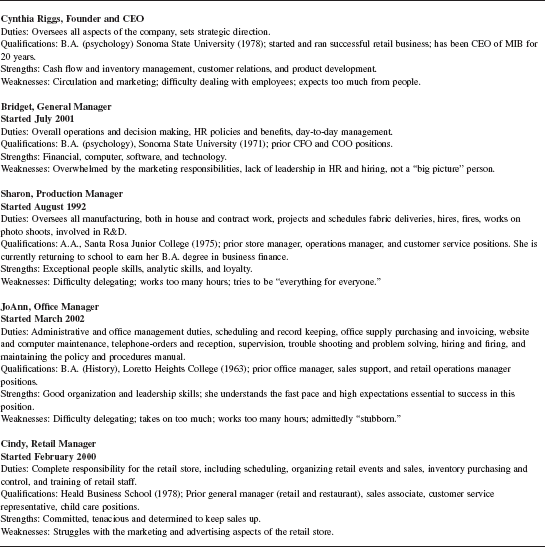
MIB Management Team as of November 2002
“MIB is a very labor–intensive business and everyone works exceptionally hard, at all levels,” Cynthia said. She described the search for a replacement for the company's office manager of eight years; the company went through three people before settling on JoAnn, a hard–working 60–year–old who, unlike the others, “really got what was going on.” Cynthia described JoAnn as enthusiastic, determined, and “a long–term and committed individual” who understood the “fast pace and high expectations” inherent to her position.
Likewise, one of MIB's longest–serving employees, production manager Sharon, shared Cynthia's commitment to the company and its concept. Sharon had risen through the ranks of a major department store chain to become a store's head manager when, in 1992, she stumbled upon MIB. “She wanted a change, wanted to see her children grow up, wanted to be closer to home,” Cynthia said, so Sharon took a significant salary cut to become the company's first retail store manager. “She did that for about a year and was then ready to move into an area that she perceived (accurately) to be challenging, and she then earned the title of production manager,” Cynthia said. “She learned the job from the ground up and developed the position to be what it is today.” Cynthia valued Sharon's loyalty to the company and her ability to take care of multiple tasks—in fact, Cynthia feared Sharon's huge load of responsibilities might eventually drive her away. “She really does too much, taking care of our entire production department,” Cynthia said. “I hope I don't lose her because I don't think anyone else could handle the job—certainly not all the balls she juggles at one time.” If the company weren't struggling, Cynthia said, she would like to allow Sharon to fulfill her desire of developing a new product line.
In 2001, the company hired Bridget for the position of general manager. Bridget updated MIB's computer network, changing its mail–order and customer–service software, installing a comprehensive accounting program, and generally improving its systems and making them more compatible.
Cynthia had started working with a business coach “to advance team building and communication among my staff.” She watched the company's margins and managed cash flow in a manner she called “pretty conservative.”“I don't drain the cash from the business, and we have developed excellent relationships with those that we do business with in order to call in favors when the cash flow is tight,” she explained. “We have a $100,000 line of credit that we use seasonally to keep ourselves up and running. In the good times, we barely touch the line, and in the not–so–good times we are more dependent upon it.” The company had no long–term debt and owned nearly all of its equipment.
The business, as Cynthia described it, was healthy but stalled. Growth was its number one goal but she was at a loss about how to achieve it. “I don't know where to go from here, and I'm hesitant to invest in new projects or marketing ideas, given the current business climate.” Given the organic way in which MIB had evolved into its current shape, Cynthia believed she needed “an experienced management team to help manage the risk that's needed to get to the next level.”
The Current Setbacks
The current decline in sales prompted Cynthia to reflect on her plans for MIB and her ability to execute those plans. She had begun the business as a partnership, and the burden of being the sole decision maker was starting to take its toll. She had hired Bridget as the general manager in July 2001, with the expectation that she would take over some of the daily operations and participate in personnel decisions. Cynthia was not surprised when, in October 2002, Bridget indicated that she would be leaving the following spring. Cynthia viewed this transition with a mixture of relief and concern. On the one hand, she thought Bridget was better suited to a controller or CFO position than to that of general manager—Bridget, Cynthia said, did not participate in human resources decisions and was “not a big–picture person.”
On the other hand, Bridget's departure was symptomatic of one of MIB's biggest problems. “Staffing on the management level is the most challenging issue” for MIB, Cynthia said. “It has proven difficult to find and retain the right people. I know I expect too much from people and sometimes don't deal well with employees…. We have a crew with an honorable work ethic. However, burnout seems inevitable.”
Especially with sales slipping, Cynthia thought the company sorely needed a dedicated, trustworthy marketing director—a capacity she had always filled herself, but in which she lacked background and confidence. “I thought I had been given good advice about our new catalogue and website, but now I'm not so sure,” she said. “When marketing plans don't pan out, it proves to be both expensive and depressing. It requires more money and renewed energy to try again.”
Cynthia mulled over her options. She knew that, even with 20 years as CEO of Making It Big under her belt, she still lacked essential skills. But she wasn't sure what Making It Big needed at this point—professional help, or just a few more committed, loyal employees? “Over the years, I've relied on the belief that we could teach anyone the nuances of our business if they were the ‘right person’ for the job,” she said. “I think this was true when the business was smaller, but we have probably failed in the past few years by adhering to this idea” rather than searching for a GM or CEO with a background in mail–order sales.
And Cynthia—who never expected MIB to last 20 years when she started it—still didn't have an overall strategy to drive the company forward, and was beginning to think she might not be the right person to come up with one. “When I met with my CPA last week and tried to explain my growth goals for MIB, he reminded me that more than 90 percent of entrepreneurs can't take their business to the ‘next level,’ that growing a business requires a different skill set than starting one,” she said. “So now I'm thinking that I should re–evaluate my options. Is it time for me to relinquish control and take a back seat after all these years?”
Cynthia built her business almost single–handedly, finding a niche no one else was paying attention to, canvassing at the grass–roots level and breaking all the rules—succeeding, she said, by “having a tenacious personality, youthful exuberance, and a tremendous amount of drive and desire.” But now those qualities were no longer enough, and Cynthia needed a new direction. “I know that in order for growth to happen the person at the helm needs the ability to see the business with a bird's–eye view,” she said. “Should I look for someone to share my commitment to the company—someone who can be a real partner in this operation? Or do I just need to renew my efforts to find a few key people to help me with marketing and strategic planning?”