







Abstract
The process of identifying, shaping, and pursuing market opportunities is emerging as a focal point in the field of entrepreneurship. Scholarly efforts to date have considered what happens during this process; it is time to turn attention to how and why. This article examines one such “how” question: how do entrepreneurs think and reason such that they identify innovative opportunities? Specifically, the cognitive processes of mental simulation and counterfactual thinking are proposed as mechanisms by which entrepreneurs identify and develop innovative opportunities. Propositions regarding the application of these cognitive processes to opportunity identification are presented and discussed.
Introduction
“You see things and you say ‘Why?’ But I dream things that never were and I say, ‘Why not?’ ” (Shaw, 1922). Dreaming of things that do not yet exist, bringing them into creation and gaining market acceptance are perhaps the most mesmerizing of all entrepreneurial behaviors. Certainly, they represent the foundation for modern conceptualizations of entrepreneurship (Stevenson & Gumpert, 1985) whether dramatically depicted as “creatively destroying” existing industries (Schumpeter, 1950, p. 8) or more humbly characterized as “the motivated propensity of man to formulate an image of the future” (Kirzner, 1985, p. 56). The process of identifying and shaping market opportunities is emerging as a focal point for the field of entrepreneurship (Gaglio, 1997b; Kirzner, 1979; Shane & Venkataraman, 2000; Venkataraman, 1997).
Early work in this area focuses on developing a comprehensive description regarding the nature of the process: is it serendipitous or systematic (Koller, 1988; Vesper, 1980)? Do opportunities appear full–blown like Athena from the head of Zeus, or do they emerge over time (Hills, 1995; Long & McMullan, 1984)? When looking for ideas, are some places better than others (Christensen, 1989; Long & Graham, 1988; Peterson, 1988)? Is there a difference between good ideas and opportunities (Hulbert, Brown, & Adams, 1997; Timmons, 1994)? The answer to all these questions is yes. At the very least, one can find anecdotal evidence to support any answer for any of these questions. It appears that the fundamental nature of the opportunity identification process is extremely diverse.
An emerging perspective shifts attention from the nature of the process toward its underlying dynamics. This perspective, entrepreneurial alertness, proposes that entrepreneurs perceive and reason in markedly different ways from other business people and these differences lead to the identification of innovative business opportunities first (Kirzner, 1979, 1985). There is some empirical evidence to support the claim that entrepreneurs do indeed think and reason differently with regard to opportunities (Gaglio, 1997a; Kaish & Gilad, 1991). These findings are consistent with other data indicating that the processes and products of entrepreneurial cognitions differ (e.g., Busenitz, 1999; Palich & Bagby, 1995; Simon, Houghton, & Aquino (1999). Not surprisingly, interest in the potential of entrepreneurial cognition for understanding entrepreneurial behavior is growing (e.g., Baron, 1998; Gaglio & Katz, 2001).
Preliminary evidence suggests that cognitive heuristics may play a key role in entrepreneurial cognition and therefore merit vigorous investigation. To date, much of the work regarding cognitive heuristics has tended to focus on the ways in which cognitive processes introduce bias and error into entrepreneurial reasoning—at least when compared to the normative model of rational decision making (e.g., Busenitz, 1999; Simon et al., 1999). The unstated implication is that this flawed reasoning may be associated with venture failure. However, the judgment and decision–making literature also notes that cognitive heuristics can have positive effects (e.g., Kahneman & Tversky, 1982) and can facilitate successful entrepreneurial activity.
The purpose of this article is to delineate the ways in which two cognitive heuristics, mental simulations and counterfactual thinking, may guide entrepreneurial reasoning and enhance the opportunity identification process. The article begins with a brief review of the cognitive dynamics associated with the opportunity identification process as described in the theory of entrepreneurial alertness. Then, the process and dynamics of mental simulations and counterfactual thinking are presented and applied to the opportunity identification process. Propositions regarding entrepreneurial opportunity identification cognitive behaviors are presented. Finally, additional implications for entrepreneurship theory and research are discussed.
Entrepreneurial Alertness and Opportunity Identification
Although many in the discipline use the term “opportunity” to mean the chance to start a business (e.g., Hills, Shrader, & Lumpkin, 1999; Long & McMullan, 1984), this article follows the tradition established by the discipline's leading theorists (Schumpeter, 1950; Kirzner, 1979) and defines “opportunity” to mean the chance to introduce innovative (rather than imitative) goods, services, or processes to an industry or economic marketplace.
Entrepreneurial Alertness
The theory of entrepreneurial alertness (Kirzner, 1979, 1985), summarized here, presumes that the driving force of all economic activity is decision making—usually, a decision about optimal resource allocation that maximizes return on investment. But in order to make optimal allocation decisions, one needs to know the context or framework that indicates the rules of the game (causal chain), the appropriate resources (means), and the index of value (ends). In real life, this context or means–ends framework is in constant flux, responding to numerous regulatory, economic, social, and technological changes. The quality of the decision making depends on what individuals make of these changes (see Figure 1). Kirzner argues that some people (i.e., entrepreneurs) possess a special alertness that predisposes them to be extremely sagacious about change: they are quicker to detect its signals; more accurate in sizing up its true significance; quicker to infer the full scope of its implications; and most important, more accurate in uncovering its commercial potential. Those who do not perceive the signals of change or misinterpret their meaning and implications do not identify innovative opportunities early enough to capitalize on them.
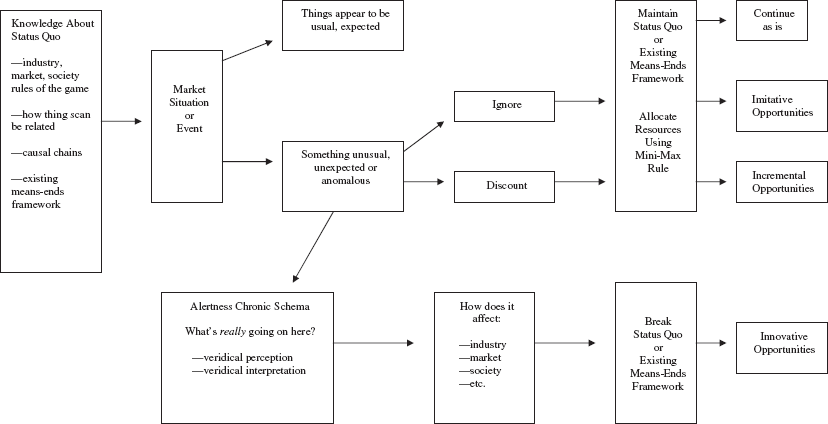
Alertness and the Opportunity Identification Process
Therefore, an individual's reaction to changing circumstances is pivotal. A person can perceive and interpret the situation or event as either normal or as unusual. If the perception and interpretation is that things are normal, then decisions are simply a question of optimal resource allocation (Figure 1). Insights about ways to improve the efficiency of return on those allocations may lead to the identification of imitative or incremental market opportunities. However, perception and interpretation of an event as unusual (whether positive or negative) prompts sensemaking rather than decision making. In some instances, as alert entrepreneurs assess changing circumstances, they feel they cannot ignore or discount what is happening and come to realize that it is no longer a question of optimal resource allocation but really a question of whether the existing way of doing things (i.e., the existing causal chain or the existing means–ends framework) still works. Kirzner (1979) considers this realization, hereafter referred to as “breaking the existing means–ends framework,” to be the quintessential entrepreneurial behavioral. When appropriate, alert entrepreneurs are willing to abandon the existing means–ends framework and develop new ones that represent their best guesses about the future. These guesses or visions, are realized as innovative products, services, or processes that then compete with existing products, services, and processes (i.e., the existing means–ends framework) as well as with alternatives offered by other entrepreneurs.
The identification or discovery of innovative opportunities, then, involves breaking the existing means–ends frameworks and creating alternative ones. Consequently, an explanation of the opportunity identification process from the alertness perspective must provide explanations for two key questions: how does the entrepreneur achieve the insight that the existing means–ends framework may no longer be appropriate; and how does the entrepreneur develop alternative frameworks? Kirzner stipulates several requirements regarding perception and reasoning that presumably lead to insights about the need to break the existing means–ends framework; these requirements are summarized by the concepts of veridical perception and veridical interpretation (Gaglio, 1997b). Veridical perception requires that the entrepreneur perceive the changing situation accurately and not be susceptible to the kinds of distortions that can arise from the uncertainty that change can produce. Veridical interpretation involves correctly determining the real causes for the change and correctly inferring their practical, social, and commercial implications while avoiding the delusion of seeing possibilities where none really exist.
The identification of such skills is an important step but it does not really represent an explanation. Given the emphasis on perception and reasoning, it is rather curious that the theory of entrepreneurial alertness does not consider how alert entrepreneurs actually break existing means–ends frameworks or how they develop useful alternatives. Kirzner simply assumes that this crucial cognitive work is performed and asserts that entrepreneurs do it faster. However, entrepreneurship scholars cannot accept such “black box” assumptions if opportunity identification is to be a focal point for the discipline and its advancement.
When Gaglio and Katz (2001) considered the plausibility of the theory of entrepreneurial alertness, they noted these theoretical gaps and argued that it may be possible to address them by considering alertness to be heuristically driven. Specifically, they proposed a chronic alertness schema as the heuristic driving an awareness that the existing means–ends framework may be inappropriate. Mental simulations and counterfactual thinking were proposed as the heuristics by which the existing means–ends frameworks are broken and alternative frameworks developed. The idea that the opportunity identification process is heuristically driven is especially attractive for proponents of entrepreneurial alertness because the use of heuristics would not only account for the theoretical gaps but would also explain why entrepreneurs may identify or discover opportunities before anyone else—heuristics typically speed cognitive processing as well as minimize cognitive load (Tversky & Kahneman, 1974). The next section explores the nature and dynamics of mental simulations and counterfactual thinking and elaborates on how they work in the opportunity identification process. 1
Those interested in developing the area of entrepreneurial cognition will appreciate the irony that the very act of thinking and writing the section is itself an example of these heuristics at work.
Mental Simulations and Counterfactual Thinking
As noted earlier, the perception and interpretation of an event as unexpected (whether positive or negative) typically prompts sensemaking and problem–solving activity. One of the most common ways in which we make sense of events is through the use of mental simulations, particularly counterfactual thinking (Kahneman, 1995; Lundberg & Frost, 1992; Olson, Roese, & Diebert, 1996). These tools can be employed in a wide variety of situations and help us anticipate the future as well as learn from past mistakes (Roese, 1994; Sanna, 2000; Taylor & Pham, 1996). The form and direction that these simulations and counterfactuals take influence whether a person can break the existing means–ends framework, develop alternatives, and identify innovative market opportunities.
Mental Simulations
Mental simulations are defined as imitative cognitive constructions of an event or series of events based on a causal sequence of successive interdependent actions (Sanna, 2000; Taylor et al., 1998; Taylor & Schneider, 1989). In short, we mull over what will happen or has happened in a given situation. This kind of thinking is a natural part of everyday life. For example, an entrepreneur will simulate one possible future by mentally rehearsing his or her sales pitch along with answers to possible objections while driving to a client meeting. An especially prepared entrepreneur will also mentally rehearse what he or she will do should PowerPoint fail during the pitch. Upon encountering a traffic delay, the entrepreneur will imagine alternative routes and quickly choose the most viable. On the drive home, he or she will mentally simulate the past by recalling a play–by–play version of the meeting and perhaps even altering the causal sequence of the meeting by deleting what was said and inserting what should have been said! As will be shown later, changing the causal sequence is an example of the type of mental simulation called counterfactual thinking.
Function.
The ability to mentally simulate past and future alternatives to reality is believed to serve two functions (Roese, 1994; Sanna, 2000; Taylor & Pham, 1996; Taylor & Schneider, 1989) that are not mutually exclusive. The first function, affective, allows emotions to be re–experienced and processed; this facilitates the ability to cope with an event, regulate emotional responses, or restore self–esteem. For example, if, while our entrepreneur anticipates or recalls the sales meeting, he or she simply vents his or her frustration or imagines ways in which the meeting could have been worse, the affective function is most evident—our entrepreneur is trying to find a way to feel better.
The second function mental simulations serve, the preparative function, enables us to anticipate physical and social environments and to imagine strategies and tactics that would lead to the achievement of our goals, motives, or purpose. It allows us to prepare different behavioral responses and by imagining what each response may produce, choose the one we think will most likely result in achieving our goal. Demonstrations of this function occurred several times in our example: first, when the entrepreneur mentally rehearsed the sales pitch, handling objections before meeting with the client, and later when the entrepreneur recalls the meeting in detail, noting what worked and what did not work. If, when imagining what should have been said, the entrepreneur changes his or her wording to develop better responses to objections or a better way to close the deal, then he or she is attempting to improve and prepare for future performance by learning from mistakes.
A less obvious but equally significant dimension of the preparative function is the use of mental simulations as a heuristic to estimate probability and causality. Kahneman and Tversky (1982) note that an individual tends to judge the probability of an event based on the ease with which he or she is able to roughly imagine the causal sequence that might bring it about. The easier it is to imagine (mentally simulate) an event, the more likely it is; the more difficult it is to imagine, the less likely. Numerous studies document the use of the simulation heuristic in planning and decision making (see Johnson & Sherman, 1990 for a comprehensive review of these data). As will be shown later, the use of mental simulations to estimate the likelihood of causes and outcomes plays an important role in breaking the means–ends framework and developing alternative causal chains.
Dynamics.
The fundamental dynamic for running mental simulations is deceptively simple: the basic strategy involves contrasting reality (what is or what was) with a mental image of what might have been or what could be (Sanna, 2000). To do this, one simply changes, alters, or mutates something in the chain of events. The change can be accomplished in a variety of ways, such as by changing the amount or degree of some element, deleting it altogether, substituting something else entirely different, leaving the original element in but adding more elements, and so on. Obviously, the effectiveness of alterations would depend on two assessments: the identification of the appropriate causal sequence for what was or what is and the identification of the appropriate causal sequence that will produce the desired future outcome. Some casual sequences are obvious and well known (e.g., eating quells hunger) but for most events in complex physical and social worlds, the best one can do is to make educated guesses, technically known as judgments under uncertainty (e.g., a good sales pitch may lead to a sale). Counterfactual thinking (e.g., when our entrepreneur mentally changed his or her responses by imagining what should have been said) is an effective cognitive heuristic for identifying causal sequences and developing those guesses.
Counterfactual Thinking
Definition.
Counterfactual thinking quite simply means thinking in a way that is contrary to existing facts (Roese, 1997; Seelau et al., 1995). However, cognitive psychologists (Markman & Weary, 1996; Roese, 1994; Roese & Olson, 1993; Swain, 1978) further define these contrary thoughts as logical statements that stipulate the cause, or antecedent, and the effect also called the consequent or outcome—in other words, these are statements about a means–ends framework. Counterfactual thinking is a useful heuristic for developing educated guesses about causal sequences because it explicitly focuses on causal connections: what must change (and how) in order to cause a different outcome.
Activation.
The counterfactual thinking process, like other mental simulations, can be conceptualized in terms of three sequential stages: activation, construction and evaluation (Dunning & Madey, 1995; Roese & Olson, 1995b). An individual activates the process of counterfactual thinking in response to some kind of stimulus. The stimulus can be real or imagined, internal to the person or external in the environment. Surprise or anything unexpected is believed to be the most common trigger (Kahneman, 1995; Kasimatis & Wells, 1995). If so, then it would seem plausible that an alert entrepreneur who, by definition, has a heightened sensitivity to the unusual or unexpected (Gaglio & Katz, 2001; Kirzner, 1979) will naturally activate the counterfactual thinking process, probably more often and earlier than nonalert individuals. Farris and Revlin (1989) may offer some empirical support for these assertions from their study of how people detect or discover rules or patterns in uncertain or ambiguous situations. The investigators found that those individuals who were able to discover the rules of the experiment tended to engage in counterfactual thinking sooner than those who failed to discover the correct rules. Furthermore, the discovery group tended to generate significantly more counterfactuals than the other group; indeed, the simple percentage of counterfactuals generated was the best predictor of discovering the correct rules in the experiment. 2
Propositions are constructed in terms of opportunity rather than entrepreneurship because, as noted earlier, the definition of opportunity is limited to the identification of innovative products, services, or processes. Entrepreneurship includes much more, such as decisions regarding the pursuit of opportunities, methods of implementation, and management—all of which are extremely important, but beyond the scope of this article.
While alert entrepreneurs may respond to change or surprise earlier, it is important to note that nonalert individuals are not completely oblivious to what is going on. It may take them longer to recognize such instances but when they encounter something unexpected in ways that are clearly and persistently signaled, even the most nonalert eventually adapt (Fiske, 1993). Research indicates a tendency among corporate managers to discount the meaning of change signals (Cowan, 1986), usually by seeing the changing circumstance as an exceptional, isolated event while the entrepreneurially alert see it as part of an emerging pattern of events (Johnson, Jamal, & Berryman, 1991). These different perceptions may influence the form their counterfactual thinking takes, which is important because each form, automatic and elaborative, tends to deal with change in substantively different ways.
Form: Automatic versus Elaborative Counterfactual Thinking.
From a psychological perspective, “automatic” means unintentional or without conscious direction (Bargh, 1984; Roese, 1997). Automatic counterfactual thinking is a spontaneous reaction, usually to a surprise (Kahneman, 1995; Olson et al., 1996), particularly a negative or undesirable one. Most empirical research in psychology focuses on automatic counterfactual thinking (Kasimatis & Wells, 1995; Roese, 1994, 1997; Roese & Olson, 1995b), particularly those instances involving regret, because such thinking can be easily induced and its ubiquity precludes accusations about hothouse methodology.
The empirical evidence about automatic counterfactual thinking indicates a tendency to undo unexpected outcomes by altering the unusual or exceptional antecedents (Dunning & Parpal, 1989; Roese, 1994). This strategy may expand beyond regret and may be one of the cognitive mechanisms used in discounting: undoing an unusual antecedent should restore things to normal (see Figure 2).
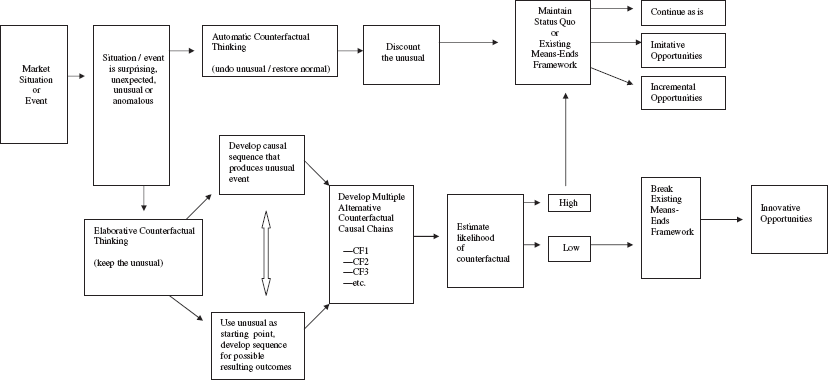
Counterfactual Thinking and Opportunity Identification
Baron (1999) demonstrates that entrepreneurs are not likely to engage in counterfactual thinking associated with regret and he extends this finding to assert that entrepreneurs are less likely to engage in counterfactual thinking. However, such a conclusion may be a bit premature. While entrepreneurs may not engage in automatic counterfactual thinking that ameliorates regret, their behavior regarding other forms of counterfactual processing, particularly elaborative counterfactuals is unknown and indeed, may be quite likely.
Elaborative counterfactual thinking is intentional, deliberate, and consciously directed. It too can be recruited in order to make sense of surprising or unexpected events (Markman et al., 1993; Kasimatis & Wells, 1995; Wells & Gavanski, 1989) but unlike the automatic form, elaborative counterfactual thinking seems more directed toward the preparative function. In fact, Kahneman (1995) argues that elaborative counterfactual thinking most clearly demonstrates how mental simulations help us anticipate or prepare for the future because one deliberately constructs and evaluates alternative sequences of actions and outcomes. This style of thinking would prove useful to those people who interpret an unusual event to be part of a new emerging pattern (Figure 2) because in order to infer a pattern, one would need to be able to mentally maintain the unusual antecedent and to imagine how the existence of the unusual antecedent will affect the rest of the causal chain, as well as to imagine a causal sequence that produces the unusual antecedent. Therefore, during the opportunity identification process, one would expect elaborative counterfactual thinking to play a more important role when making sense of an unexpected or surprising event because attention becomes focused on generating alternative causal hypotheses, rather than just regretting an unusual circumstance.
Whether an unusual event is maintained or discounted directs the course of how the rest of the counterfactual thought is constructed (see Figure 2); however, it is not the only factor that influences construction.
Counterfactual Construction.
Essentially, there are two ways to construct counterfactuals or any mental simulation (Kahneman & Tversky, 1982): working backward or working forward. When working backward, one begins by presuming a desired outcome and then imagines how to alter the sequence of events to lead to that outcome. When working forward, an actual or proposed starting point is assumed and the individual builds a sequence of events that can or will result because of that starting point. Whether one works forward or backward, antecedents (causes) and consequents (outcomes) are mentally changed; these changes can be differences in kind, in number, in degree, in timing, and so forth.
Psychologists have observed that constructing counterfactuals appears to be governed by three categories of constraints (Seelau et al., 1995). One category of constraints is the individual's understanding of natural and social laws (Read, 1987; Olson et al., 1996). After all, counterfactual thinking would have little value as a preparatory function if one could not determine causal antecedents; causality would be hard to identify if mental simulations did not generally follow the laws of physical and social worlds. However, another important category of constraints concerns one's purpose for doing counterfactual thinking (Olson et al., 1996). If one is looking to improve performance, then one will concentrate on those antecedents and outcomes that can be personally controlled or influenced rather than alter antecedents that enable pigs to fly. Conversely, if one's purpose is to write science fiction–fantasy, then one might begin by constructing counterfactuals that explain how and why pigs can fly. The third category of constraints involves availability, or the ease with which one can call to mind possible antecedents, sequences, and outcomes (Johnson & Sherman, 1990; Kahneman & Tversky, 1982; Seelau et al., 1995). Psychologists tend to view availability as a function of salience, recency, or familiarity. Familiarity includes the level of one's knowledge regarding the normal causal chain (existing means–ends framework) and the event. The more one knows, the more familiar it is and hence the more available it is.
If, as Kirzner suggests, alert entrepreneurs not only detect the signals of change earlier than other people, but also interpret those signals differently and draw different conclusions about their implications, it would seem likely that a major point of difference between those who identify innovative opportunities and those who do not can be found in the kinds of counterfactuals they construct in order to account for the exceptional or the unusual.
Another observed behavioral regularity in the generation of counterfactuals is that action is more likely to be changed or altered than inaction (Kasimatis & Wells, 1995; Markman et al., 1995; Roese & Olson, 1995a; Seelau et al., 1995). In addition, antecedents perceived to be controllable are more likely to be altered than antecedents perceived to be uncontrollable. Furthermore, antecedents that are perceived to be dynamic or fluctuating are more likely to be altered than antecedents perceived to be static (Roese & Olson, 1995b). Finally, there appears to be a preference to undo the antecedents that appear early in the causal chain (Roese & Olson, 1995b; Wells, Taylor, & Turtle, 1987).
Relative to the opportunity identification process, it would seem most important that the individual correctly identifies the causal chain (Wells & Gavanski, 1989), particularly the “causally potent antecedent” (Roese & Olson, 1995b, p. 171). As noted earlier, counterfactual thinking can be particularly useful in this regard because creating counterfactuals can “assist us in developing our ideas about how elements are connected and how results can arise. Counterfactuals can alert us to the possible operation of dynamics and pathways we would be prone to ignore” (Jervis, 1996, p. 310). Therefore, counterfactual thinking can improve veridical perception and veridical interpretation.
But in order for this heuristic tool to work effectively, it appears we must construct numerous counterfactuals and test many different causal alternatives. Evidence suggesting this comes from the Farris and Revlin's (1989) study about rule discovery in uncertain situations mentioned earlier. Recall their finding that successful individuals generate many more counterfactuals than those who are not successful. It appears that those who generate a large number of counterfactuals do so because they are actually testing different causal hypotheses. In each counterfactual, they vary the dynamics or the pathways, or something. In contrast, some among those who failed to discover the rules did generate counterfactuals (as opposed to doing nothing) but their counterfactuals did not vary the causal sequence; it appears they use a confirmatory strategy and merely extend the range of their first hypothesis. They also stopped their counterfactual generation sooner than the discovery group, probably because their feedback indicated no further need.
The pattern from these data suggests that we develop insights about causality by imagining a wide variety of scenarios that are contrary to the facts. However, the key to uncovering causality does not lie in simply generating a lot of counterfactuals; the key lies in varying or changing any or all of the antecedents in each new scenario. Then, by comparing the imagined outcomes over the range of counterfactuals generated, we develop a sense of where the leverage points (causes) are. The outcome of testing each antecedent is that one challenges the implicit assumptions; doing so increases the possibility of breaking the existing causal chain, also known as breaking the existing means–ends framework.
When applied to the opportunity identification process (see Figure 2), we suggest that alert entrepreneurs or opportunity finders who accept rather than discount unusual or unexpected events then have the additional cognitive burden of trying to make sense of the unexpected. Specifically, they try to imagine the causal sequence leading up to the unexpected event and try to imagine the consequences of the unexpected. In other words, alert entrepreneurs discover the new rules of the game when all they are presented with is an unexpected event. And so it seems likely that alert people construct numerous counterfactuals and multiple causal hypotheses (both backward and forward). As they do, they develop guesses about the new rules or new means–ends frameworks.
The second aspect of counterfactual construction that may be relevant to the opportunity identification process is how the individual alters antecedents when constructing counterfactuals. One can add antecedents (mental addition), delete antecedents altogether (mental subtraction), substitute an equivalent antecedent (mental substitution), change the amount or degree of the antecedent (addition, subtraction), change the temporal order, and so on. While most research on counterfactuals involves the psychology of regret and thus focuses on mental subtraction to undo a negative outcome (Dunning & Parpal, 1989), there is some evidence that counterfactuals constructed by using mental addition produce more creative and novel responses because they go beyond the facts of the original scenario (Roese & Olson, 1995b) and tend to include more causal agents. By adding more causal antecedents, the option set is expanded and there are more means–ends relationships to consider. There is also some evidence that people prefer to generate counterfactuals based on addition when creating simulations of future alternative realities (Dunning & Parpal, 1989). In the opportunity identification process, it is likely that people who develop creative innovative ideas about future products and services show a preference for counterfactuals constructed using mental addition. Certainly, if one maintains an unexpected event and tries to make sense of it, it would be more likely that one would add antecedents in order to produce that unexpected event.
Kahneman and Tversky (1982) note that in addition to mental addition and subtraction, one needs to look at the probability of the antecedents. They speculate that most people engage in what they term “downhill” counterfactuals, that is, most people subtract unlikely antecedents. Rarely, do people construct “uphill” counterfactuals, that is, introduce unlikely or surprising events. It may be possible that opportunity finders not only increase or add more causal antecedents, but because they have run scenarios that challenge existing assumptions, they may be willing to consider adding unlikely causal antecedents.
Actually, if we pause to think about what unlikely or surprising events may look like in the context of identifying entrepreneurial market opportunities, uphill counterfactuals may not be as strange as they sound and perhaps not that rare. Consider this example: a private practice nurse is in line at a bank waiting to deposit office receipts. While waiting she can see that the bank teller has complete account information at his/her fingertips—a normal, unsurprising fact for a bank. She wonders why doctors and nurses do not have such access in their exam rooms and imagines what would happen if they did. One of her first reactions is probably that computers in exam rooms are highly unlikely—the impersonal quality computers symbolize violates a norm for medical care.
The main point of this example is that technology transfers usually appear unusual or unlikely until they happen. Nevertheless, it was possible for the nurse to construct an uphill counterfactual about her industry. The second point of this example concerns how the nurse evaluates her unlikely counterfactual. She has several choices: dismiss it immediately as unlikely, fantasize about its feasibility someday in the future, or construct another counterfactual in which the outcome (computer stations in every medical exam room) is a given. In order to maintain the unusual outcome, she must then mentally construct at least one causal sequence that would lead to acceptance of computers in patient exam rooms (e.g., doctors talk rather than type). For each counterfactual in her imagination process, she always has at least three evaluation choices; how she evaluates her counterfactuals will impact her ability to generate multiple competing hypotheses, break means–ends frameworks, or find innovative market opportunities.
Counterfactual Evaluation.
Counterfactuals are evaluated for their plausibility, their likelihood, and their result: does the counterfactual produce a better, same, or worse alternative when compared to the prompting reality (whether normal or unexpected). It appears that most people do not do a thorough job of evaluating plausibility (Dunning & Madey, 1995) although counterfactuals that do not conform to natural law are summarily rejected (Read, 1987). 3 Kahneman and Tversky (1982) believe that the plausibility of a counterfactual is judged on the perceived weakest link in the causal chain, not on the total number of links in the event chain nor in the complexity of the steps. Unfortunately, there is no empirical evidence to support or refute this belief.
Unless, of course, one's purpose is to contradict natural laws.
The evaluation of the likelihood of a counterfactual is better researched and highlights a need to distinguish among different aspects of cognitive work. One aspect involves availability, that is, the ease or difficulty of imagining; availability heavily influences estimates or judgments of likelihood. If alterations are not easily available, that is, one cannot imagine how to undo and redo an event scenario, then the event is judged to be highly likely. However, if it is easy to imagine how to change a scenario (alterations are available), then it appears that the simple act of being able to imagine changes increases the perception of their likelihood as causally potent antecedents (Fiske, 1993; Johnson & Sherman, 1990; Kahneman & Miller, 1986; Koehler, 1991). However, as one then mentally simulates these antecedent options, one tests likelihood even further. If one imagines many possible alternatives to the original causal scenario, yet every imagined alteration appears to lead to the original scenario outcome, then the outcome is perceived to be highly likely and probably inevitable (Dougherty, Gettys, & Thomas, 1997). However, if each imagined alternative leads to a different outcome, then the perceived likelihood of any particular change is judged to be very low.
Another aspect of cognitive work that influences evaluation of the likelihood is the depth to which the counterfactual is elaborated. Many people stop constructing the counterfactual once they imagine the potent cause and the end result. However, taking that particular counterfactual further by imagining all the intermediate steps leading to the counterfactual's outcome requires more cognitive work. It appears that the more elaboration one does to construct the intermediate steps leading toward the counterfactual's outcome, the higher the perceived likelihood of that outcome (Kahneman & Tversky, 1982). 4
The mental construction of the intermediate steps in a causal chain is also known as a process simulation, (Taylor & Pham, 1996) which differs from an outcome simulation or imagining only the end result. Evidence indicates that people who construct process simulations are more effective and successful in achieving their goals (Cratty, 1984; Taylor et al., 1998).
Relative to the opportunity identification process, likelihood estimates play two roles. First, the estimates indicate whether it is even possible to break the means–ends framework. If every imagined alternative leads to the same outcome (high likelihood), then that particular means–ends framework is inevitable and cannot be “broken.” Conversely, when imagined alternatives have low–likelihood estimates, then the existing means–ends framework is merely a useful social convention that can be broken—at least in the ways just imagined. The second role comes into play when people decide what to do with the low–likelihood counterfactuals they generate; these counterfactuals may be analogous to competing hypotheses that Farris and Revlin found to be important in the discovery process. Research indicates that the typical person has a bias toward having a single plausible and likely counterfactual scenario rather than having several (Dougherty, Gettys, & Thomas, 1997; Kahneman & Tverskey, 1982). The contrast of this behavioral tendency with the behavior of rule/pattern discoverers (who had many competing causal hypotheses) suggests one behavior that may promote the identification of market opportunities.
Preliminary evidence from an experiment involving opportunity identification (Gaglio, 1999) suggests that nonfinders quickly reject their counterfactuals as implausible, unfeasible, unlikely, or difficult to do, while opportunity finders retain their counterfactuals and use additional counterfactual thinking to undo and redo the problematic parts. Weber (1996) cautions that when using counterfactuals to generate alternatives, one should not think too much about plausibility or likelihood because the point of the exercise is to blunt biases arising from the habitual use of the existing means–ends framework; this advice is remarkably similar to the first commandment of brainstorming: thou shalt not judge (deBono, 1978).
The evaluation of the desirability and perhaps the feasibility of any given counterfactual depends very much on the individual's perceptions and feelings about what the counterfactual is being compared to, that is, the standard or anchor used (Roese, 1997). However, Kahneman, and Miller (1986) point out that these anchors or norms are recalled on an ad hoc basis; this suggests that the comparison process depends on the availability of anchors and norms, as well as on the availability of counterfactuals. To complicate matters further, the generated counterfactual may itself become the anchor or standard for comparison (e.g., this is how it should be).
Very little is known about how anchors, norms, or standards are selected, although psychologists have been able to demonstrate the existence of biases based on framing effects (Dunning & Madey, 1995; Dunning & Parpal, 1989) or individual differences such as personality (Boninger, Gleicher, & Strathman, 1994; Kasimatis & Wells, 1995; Markman et al., 1993). Relative to the opportunity identification process, Johnson and Sherman (1990) demonstrate that when thinking about the future, the past and present act as such powerful anchors that they constrain counterfactual thinking; people expect the future to be too much like the present or the past. Recent experiences with the .com bust would suggest otherwise; people expected the near future to be radically different than the present—the Internet was going to radically change every aspect of everything—and it has yet to be so thorough. Perhaps the key insight is that anchors can bias our assessments about the impact and timing of change in either direction: we underestimate or overestimate. However, Kirzner (1979, 1985) argues that these are precisely the kinds of mistakes that alert entrepreneurs do not make because they accurately infer implications (veridical interpretation). This claim is not entirely without foundation as Galinksy and Moskowitz (2000) report that they were able to either bias or de–bias the causal attributions based on the kind of counterfactual used to prime their subjects for the attribution task. It is easy to see how one might avoid biasing anchors when generating and evaluating counterfactuals concerning the past or present; it is less clear how one can avoid mistaken estimates about the future. Nevertheless, it does represent an area for future research.
Mind Bending and Frame Breaking.
Cognitive psychologists (e.g., Fiske & Taylor, 1991; Tversky & Kahneman, 1974) tend to emphasize the ways in which reasoning and imaging do not follow the precepts of normative decision making, that is, rationality. Consequently, they focus on documenting and illustrating the ways in which heuristics and biases interfere with normative decision making and this leads to an unintentional tendency to equate usefulness and accuracy. Scholars in other areas of psychology and in other disciplines are less concerned with the truth or practicality of generated counterfactuals (Weber, 1996; Jervis, 1996). Counterfactuals are evaluated on whether they challenge assumptions, uncover potential underlying causes, generate useful questions, or raise provocative hypotheses about causality and intervening antecedents (McGuire, 1997). In this context, the conscious or unconscious purpose of counterfactual thinking is to break the mind set or means–end framework. It is in this spirit that this article is written and the spirit with which opportunity finders play with counterfactuals as they think and reason.
Implications and Future Research Directions
The purpose of this article is to outline the ways in which cognitive heuristics, such as mental simulations and counterfactual thinking, may drive the opportunity identification process and by extension, to better understand how entrepreneurs may think and reason. The propositions offered in this article not only develop theory but also represent a challenging research agenda for entrepreneurship investigators. In this instance, investigators start with a distinct advantage because valid operational definitions of simulations and counterfactuals have already been identified (Roese & Olson, 1995b) and in most cases, rely on natural language cues (e.g., “if only,”“at least,”“if …then,”“what if,”“even if,” and so on). As such, counterfactual thinking and mental simulations represent empirically definable and measurable features. With the right methodology, in which entrepreneurs do the thinking rather than recall previous experience (Ericsson & Simon, 1994; Gaglio & Katz, 2001), it becomes possible to punch a hole in the black box regarding the cognitive work associated with the opportunity identification process and to test the assertions made by the theory of entrepreneurial alertness. The area of opportunity identification can move beyond the descriptive phase and begin to consider questions about dynamics and contingencies. By looking at the number of counterfactuals, the kinds of counterfactuals constructed, the norms or anchor points used for comparison, the content, and so forth, we can develop a better understanding of how entrepreneurs think and reason, which is the first step toward developing a theory of entrepreneurial cognition.
While the propositions outlined are a rigorous application of the cognitive psychology regarding mental simulation and counterfactual thinking, they do not represent all the ways in which these cognitive tools may be used in the opportunity identification process, let alone the other ways in which these heuristics facilitate entrepreneurial thinking. The process and direction of mental play is virtually limitless and no single article or single study can accurately represent the full depth and range of these kinds of cognitive activities. Nor do these propositions represent all that is needed to advance our understanding of the opportunity identification process or entrepreneurial cognition. Over time, scholars need to incorporate many other variables, such as motivation and affect; these two factors exert tremendous influence on attention and information processing, but are rather neglected in the cognitive perspective. Equally important is examining how these processes work in the context of the other forms of intelligence; cognition is not limited to the verbal modality but much of the study of cognition and entrepreneurial cognition currently is.
Nevertheless, studying the role of mental simulations and counterfactual thinking in the context of the opportunity identification process has the potential to extend cognitive theory in both entrepreneurship and psychology by shifting the focus to the positive aspects of these heuristics and shortcuts. While it is extremely important to acknowledge the biases and errors these heuristics can produce, it is equally important that investigators do not themselves have a biased view. Counterfactuals and mental simulations have tremendous value in helping human beings create a better future, not only by correcting past mistakes, but by imaging even more desirable futures. After all, this is one of the most attractive features of entrepreneurship; it should be celebrated in theory and research and our insights shared with our psychology colleagues in order to advance their own theories.
Should these propositions demonstrate empirical validity, their implications extend beyond theory to practical training advice. Potential entrepreneurs are frequently admonished to “be creative!” and to “think outside the box!”—two intimidating phrases guaranteed to produce mental paralysis. Counterfactual thinking and mental simulations are two cognitive tools that help break the box, not just think outside it. These tools are easy to teach and easy to adapt to any given situation. The evidence reviewed in this article suggests that teachers and trainers should emphasize constructing counterfactuals that test many alternative causal sequences and they should explicitly point out that counterfactual thinking should be directed precisely to those simulation outcomes that seem impractical or unfeasible. These directives can help develop the veridical perception and veridical interpretation skills that facilitate testing and challenging means–ends frameworks.
It should be evident from the range of articles in this special issue that the area of entrepreneurial cognition represents a wide and deep research stream ready to plumb. It is hoped that this article prompts a fruitful line of research and debate that sharpens our theories of entrepreneurial cognition, opportunity identification, and entrepreneurship in general.