







Abstract
A social dimension to business development and inertia is currently acknowledged in several accounts of learning, business models, vision building, and innovation, and through more general concepts of networking, social capital, and embeddedness. Here a constructionist perspective is developed to improve our understanding of the interactions between entrepreneurs and stakeholders in all of these areas. This identifies narrative and dramatic processes that describe how notions of individual and collective identity and organization are coproduced over time. A framework is created to show how selective and emotional processes that produce storylines, emplotment, and narrative structure support sense making and action making.
Introduction
Understanding of the formation and development of organizations is frequently approached in two apparently contrary principles. The first relates opportunity realization to vision, self–belief, and adaptive learning (Bird, 1988; Rae & Carswell, 2000, 2001; Van de Ven, Huston, & Schroeder, 1984). The second relates organizational reliability and efficiency to accountability, legitimacy, path dependency, and inertia (Baron & Hannan, 2002; Baron, Hannan, & Burton, 1999; DiMaggio & Powell, 1983; Hannan & Freeman, 1984; Meyer & Rowan, 1977; Meyer & Scott, 1992). These two principles of adaptation and inertia are often juxtaposed sequentially. Hannan and Freeman (1984) argue that after an initial period of experimentation and learning, inertia increases with the age, size, and complexity of the organization. Punctuated equilibrium models (Gersick, 1991) describe alternating periods of learning and routinization. These may be normative–linear models (Greiner, [1972] 1998; Leontiades, 1979) or empirically derived accounts of less predictable patterns of upheaval and convergence (Hendry, Arthur, & Jones, 1995; Hurst, 1995; Pitcher, 1997; Tushman, Newman, & Romanelli, 1986). The problem with many explanations of the development of small firms according to Frank and Lueger (1997) is that: “Development analyses frequently focus on changes in variables and results of development processes. The process taking place between the two measuring points, however cannot be examined empirically” (ibid. p. 36).
We can illustrate this charge briefly by considering the major variables in recent examples of the adaptation and inertia principles. Rae and Carswell (2000, 2001) explain the process of organizational development by reference to the self–efficacy, values, personal theory, and relationships of the entrepreneur. Whilst Baron et al. (1999), refer to entrepreneurs’ organizational models or blueprints that reflect different assumptions about the control, selection, and attachment of employees (see Figure 1). Although the first approach stresses the adaptation of the firm and the second stresses the inertia of the firm, both approaches effectively make central recourse to the idea of a business model, which is a set of expectations about how the business will be successful in its environment (For a fuller account of the sense in which a business model is used here, see Bettis and Prahalad's [1995] concept of the dominant logic.).
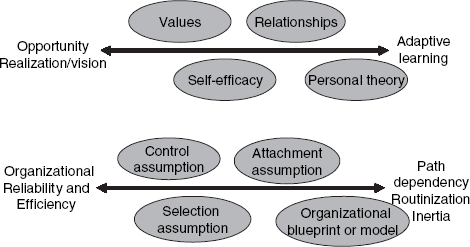
Principles of Adaptation and Inertia Theorized in Process of Organizational Development
In the former approach the model is conceived as a “personal theory” that is a product of the entrepreneur's active learning from experiences and relationships. In the latter the organizational model is described in detail, but the authors are more circumspect about its origins. It is said the model may be an outcome of the visions, values or strategy of founders or the economic, social, and cultural forces brought to bear on firms by venture capitalists, accountants, governments, and others. The authors note, “Our results demonstrate that those blueprints affect the pace of business bureaucratization, but they do not resolve the thorny issue of the distinctive contributions made by founders and other actors in building and changing organizations.” (Baron et al., 1999, p. 542).
This article addresses this “thorny issue” directly by focusing on the way in which entrepreneurs and stakeholders coproduce business models that is “the process taking place between the two measuring points” (Frank & Lueger, 1997). Currently this process is unclear, the authors noted immediately above refer to personal theory and business models but the explanation of the development of business models remains at a high level of abstraction. A relatively vague interaction between values, self–belief, and relationships or strategy and stakeholders is posited to produce change or continuity in business models. Frank and Lueger's (1997) response to what they saw as this imprecision in theorizing about firm development, is to focus on the rules that underpin the “social order” of the firm. They propose analyzing the social order in terms of a complex set of multi–dimensional rules with economic, political, cultural, and reflexive dimensions consistent with Giddens’ (1986) structuration theory. They suggest that the social order of the firm (the development object) is maintained by the constant reproduction of rules for actions/routines and generative rules that specify conditions under which rules for action can change (the development logic). These rules are in turn said to be subject to another set of rules (called development dynamics), which determine the way in which the social order adapts to economic, social, technical, and legal forces in the environment of the firm. This approach recommends qualitative research into “…rules that are established in the interactions within a business and between a business and its environment” (Frank & Lueger, 1997, p. 61).
This article shares Frank and Lueger's (1997) goal to elucidate the social order of the firm, and to show how this changes over time in a way that is consistent with Giddens’ structuration theory. However, the focus here is not on abstracting types of rules established in interactions, but rather showing how the narrative and dramatic dynamics of the interactions selectively and creatively produce and transform the rules and resources of the social order. The argument for moving beyond Frank and Lueger's (1997) analysis of rules in this way lies within the theory they are trying to operationalize, namely Giddens’ structuration theory. Structuration theory is a synthesis of many sources, including Garfinkel's (1967) concept of “knowledgeable” actors and Goffman's (1974) understanding of the dramatic enactment of notions of self and institution in “the interaction order” (1983). Thus Giddens talks about “rules and resources” as structures drawn upon by actors to reproduce and transform social order; the “duality of structure” refers to the way in which the same structures enable and constrain action (adaptation and inertia). As Tsoukas (1994) explains, actors in organizations have to constantly reconcile the particular event or contingency they face, with the institutionalized body of policies and rules. They do this by reference to stories that summarize custom and practice and help to “pigeon hole” the current experience in the “correct” category thereby enacting or constituting the thing that has been “described.” In later work this leads Tsoukas (1996) to conclude that these socially constructed realities (Berger & Luckmann, 1967) resemble “distributed knowledge systems” and Weick and Roberts's (1993) concept of “collective mind.” He stresses that tacit and explicit knowledge and individual and social knowledge is inseparable and that the challenge for research is to appreciate “…the character of the firm as a discursive practice: a form of life, a community, in which individuals come to share an unarticulated background of common understanding” (Tsoukas, 1996, p. 23).
Notions of entrepreneurs’ personal theory or organizational model suggest “an unarticulated background” but do not offer a detailed account of how this develops through a community of stakeholders. The analysis of narrative and dramatic processes developed here shows how this is sustained and transformed in interactions over time. It offers a view of the way in which social order and transformation is rooted in joint sense–making and identity–making work amongst people. These social processes logically precede and underpin accounts of organizational development couched in terms of punctuated equilibrium and changing business models as the result of the interplay of markets, culture, and large institutionalizing forces or networking, relationships, and personal learning. Currently within studies of entrepreneurship there are examples of work that show a sensitivity toward the joint social construction of reality through interaction and the duality of structure, but they lack any holistic analysis of the processes involved. Examples include some discussions of social capital, networking and social embeddedness, and studies of entrepreneurial vision and innovation. The framework developed later in this article provides a singular approach to advancing studies in all of these areas.
Thus the framework extends understanding of social capital (Coleman, 1988) as dependent on reciprocal social contracting to sustain mutually developed obligations, expectations, and sanctions (Starr & MacMillan, 1990). It extends the insight that this requires relationships that create “human moments” in which individuals are able to empathize with each other and jointly participate in making meaning prior to helping each other (Baker, 2000). It builds on understanding that entrepreneurship is embedded (Granovetter, 2000). That is, influenced by cultural understandings constituted through ethnicity and kinship, which create localized meanings and bases for trust and solidarity that “are shaped by and in turn shape structures of social interaction” (Granovetter, 2000, p. 256).
The framework developed here provides holistic concepts to investigate entrepreneurship as an intensely social activity based on culture as suggested by Lavoie (1991) and the anthropological study of Lindh de Montoya (2000). Here culture is viewed as an open–ended process of communication that shapes economics, politics, and social institutions. It follows that entrepreneurs are skilled at reading and influencing the “conversations of mankind” (Lavoie, 1991, pp. 49–50). “Entrepreneurial acts then,” Lavoie concludes, “are readings of and contributions to different conversations, and successful entrepreneurs can join these conversational processes and move them in particular directions.” (Lindh de Montoya, 2000, p. 343). Lindh de Montoya (2000) illustrates that the conversation is a multidirectional process and that stakeholders are active not passive in the process. They show that opportunity identification is rooted in a close understanding of the local culture. “But trust relationships are constantly in flux…. (and) exist within an ongoing process of renegotiation and redefinition” (ibid. pp. 347–348). Whilst Freddy (a focal entrepreneur) is seen as skilful at exploiting cultural codes and social obligations, so are his suppliers and customers. Over time there is a “tug of war” for the destination of profit. “Like the discovery of the profit niches themselves, the discussion over and eventual destination of these profits is culturally embedded” (Lindh de Montoya, 2000, p. 349).
Jack and Anderson (2002) reach a similar conclusion as they use Giddens’ structuration theory to illustrate the concept of embeddedness. They find that “Embedding is a way of joining the (local) structure; by joining the structure one enacts it” (Jack & Anderson, 2002, p. 484.) Two other subject areas in entrepreneurship that show a sensitivity to language that could be usefully developed by the analysis of dramatic narrative processes developed in this article can be mentioned briefly. These are the study of innovation (see Hill & Levenhagen, 1995), and the creation of support for entrepreneurial visions through use of metaphor, dramatic skills, integrity, audience involvement, and local knowledge (see Mintzberg, 1989, p. 122).
Figure 2 attempts to summarize some of the main points from this introduction. It sketches the nature of the contribution this article seeks to make and highlights some of the areas in entrepreneurship where this perspective could add value. Thus the contribution is the shaded area in the center of the figure: titled narrative and dramatic processes amongst entrepreneurs and stakeholders. This is perceived to be a gap in understanding and is represented as a “hole” in the “donut” of several current approaches to entrepreneurship. Currently the significance of these processes is suggested by some approaches to entrepreneurial social embeddedness, social capital, networking, vision building, and innovation but it remains a marginal consideration and is not well theorized. Immediately around the area of contribution is located the personal theory and organizational models identified in a discussion of approaches to organizational development based on principles of adaptation and inertia. It was suggested that these concepts resemble the notion of a dominant logic but that the way in which these concepts relate to the social order was poorly specified. We saw that it has been suggested that the rules underpinning the social order can be identified, but it was argued here that narrative and dramatic processes determine how rules are appropriated and interpreted selectively and creatively, it follows that these offer a better way of studying the process of organizational development. Thus the “development logic” of organizations (Frank & Lueger, 1997) is viewed as having a narrative structure that is subject to narrative and dramatic processes. Hence periods of organizational transformation and inertia can be explained by reference to narrative and dramatic processes.
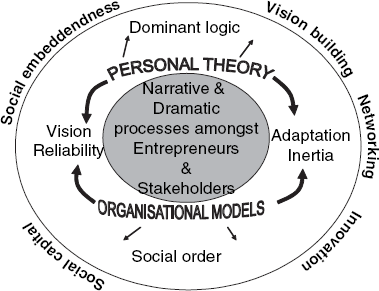
A Narrative Contribution to Entrepreneurship
Here we describe a holistic framework or approach to studying the narrative and dramatic processes amongst entrepreneurs and stakeholders that could be used in studies in all of these areas. It will be suggested that three related processes are observable: storylines, emplotment, and narrative structuring. It is argued that these processes identify regular patterns in the interactions of entrepreneurs and stakeholders that express emotions, establish identities and understanding, and enable coordinated actions. The next section shows the broad theoretical sources upon which this article's analysis of narrative and drama in interactions is based. This is followed by an elaboration of the narrative and dramatic framework. A discussion section then highlights some of the applications of the framework for studies of entrepreneurship by revisiting some of the areas raised in this introduction. The conclusion offers a brief summary and suggestions for future development.
Narrative and Dramatic Processes in the Coproduction of Organization and Identities
The broad theoretical roots of the approach to narrative and drama in this article are found in the seminal work of Berger and Luckmann (1967) and the central claim that reality reflects a dramatic enactment of roles within communicative networks. This suggests that identity (individual and collective) is produced simultaneously with institutions. “Institutionalization occurs whenever there is a reciprocal typification of habitualized actions by types of actors” (Berger & Luckmann, 1967, p. 72). Two quotations go some way to illustrate these points.
“The institution, with its assemblage of ‘programmed’ actions is like the unwritten libretto in a drama. The realisation of the drama depends upon the reiterated performances of its prescribed roles by living actors. The actors embody the roles and actualise the drama by representing it on a given stage. Neither drama nor institutions exists empirically apart from this recurrent realisation.” (ibid. p. 92)
“The significant others in the individual's life are the principal agents for the maintenance of his subjective reality. Less significant others function as a sort of chorus. Wife, children, and secretary solemnly reaffirm each day that one is a man of importance, or a hopeless failure; maiden aunts, cooks and elevator operators lend varying degrees of support to this” (ibid. p. 170).
The nature of this socially constructed reality or ontology is held to be a dialectical process comprising three “moments,” respectively “externalisation, objectivation and internalisation” (Berger & Luckmann, 1967, pp. 78–79). This describes how over time subjective meanings from typified ways of doing things take on an external, objective character that acts back on the producers of these meanings. Reification, the way humanity loses sight of the ways in which social order is a human product and the way it acts back on human consciousness is understood to be widespread. As soon as social arrangements have become objectivated, “the possibility of reification is never far away” (ibid. p. 106). The significance of this is that the structure of social order is viewed as “sedimented” or “crystalline” both enabling action and constraining action. As such the perspective is very well placed to study inertia and change in organizations. It is also quite consistent with the duality of structure proposed by Giddens (1986).
Further insight into the dramatic qualities of the coproduction of identities and institutions is found in much of Goffman's extensive writing (Goffman, 1959, 1961, 1968, 1970, 1974, 1981, 1983). This explores the dynamic, multiple, fluid, flexible, and fragile nature of realities and identities sustained in role–based interactions. So for example, the sense of reality and sense of self sustained in interaction can change rapidly as actors change the “frame” of sense making or change the emotional “key” for sense making, producing understanding that is more or less serious (Goffman, 1974). Goffman also shows how routine everyday interaction is animated by frames and genres imported from popular culture, like television and advertising (Goffman, 1974). Whilst Goffman refused to be classified (as a social constructionist or any other category of thinker) he does acknowledge the influence of “dramaturgy” (Goffman, 1959) and one can see the pervasive influence of dramatism (Burke, 1945) in this work. 1 Burke (1945) summarized dramatism as a perspective where “drama is employed, not as a metaphor but as a fixed form that helps us discover what the implications of the terms ‘act’ and ‘person’ really are” (ibid. p. 448). Burke suggests actors structure effective performance of the drama of interaction by use of a narrative structure known as the pentad. The five elements of agent, purpose, scene, agency, and act are used over time, to establish a tension and a transformation in an original situation. Goffman (1959) makes it clear that he is not saying life is like theater, rather, theatrical techniques “involve use of real techniques—the same techniques by which everyday persons sustain their real situations” (Goffman, 1959, p. 247). Thus Goffman's work is based in a “performative” understanding of language, where utterances constitute as well as describe action. It demonstrates reflexivity, the way that language is constitutive of action, words help formulate actions and situations they do not just describe situations. It also demonstrates indexicality the way that meaning is always filled in by people in different contexts.
Although Goffman has attracted criticism from both opponents and supporters of dramatism he seems to have a sophisticated understanding of the perspective (Burns, 1992; Downing, 1993; Drew & Wooton, 1988). Giddens (1989) argues that if Goffman's analysis is extended in time and space it is the basis of a theory of agency.
Rom Harré's development of Goffman's dramatistic approach in a linguistically informed constructionist psychology is another key source for the framework developed in this article. Harré sought to create an “explanatory”“psychology of action” that repudiated a naïve theory of personality based on supposed fixed traits. In its place, performative competence in interactions is conceived as ability to interpret scenes and scripts and “explicit knowledge of style and skilled manipulation of persona” possessed by individuals (Harré, Clarke, & de Carlo, 1985, p. 143). Davies and Harré (1991) develop this approach by arguing conversations develop storylines in which actors position themselves and each other. This positioning process is key to the development of identities (a diversity of selves), because stories position actors as various sorts of characters, taking certain actions and embodying specific moralities.
Davies and Harré (1991) argue that although storylines are jointly produced, positioning may be reflexive, positioning oneself, positioning another, or reciprocal. The meanings taken from positioning are often unintended, people may oppose positioning, feel powerless to resist or may not even understand them, due to the diversity of individual's past experiences and the complexity of social typifications, and the connotations of language and metaphors. The positioning concept is presented as an advance over Goffman's concepts of framing because it is thought to be clearer and unlike frames not transcendent i.e., existing independently of conversation. The development is also viewed as a move away from an overly structured “Burkian kind” (p. 54) of analysis in favor of a “poststructuralism (that) shades into narratology” (p. 46).
Another seminal source supporting the ideas developed by the framework in this article is Polkinghorne (1991). Polkinghorne (1991) draws on sources in cognitive psychology to explain the way in which human consciousness of time and identity is created through a narrative structure. It is held sense making and identity are constructed through a gestalt that fits parts and wholes together. The parts–whole structuring is largely achieved through the iterative best–fitting together of remembered episodes (parts) into plots (wholes). In life this process of “emplotment” (Ricoeur, 1984) occurs whether or not we verbalize a life story. Subconsciously we are always looking for a plot, to bring narrative coherence and meaning to the events in our lives. “Emplotment is a procedure that configures temporal elements into a whole by ‘grasping them together’ and directing them toward a conclusion or ending” (Polkinghorne, 1991, p. 141). Because there are often many projects in our lives that do not cohere easily together or interfere with each other, we may need multiple subplots to integrate our sense of self and meaning in life. When major life events, like divorce, retirement, or business failure undermine an existing narrative emplotment of beliefs and understandings, individuals feel angst, despair, and a loss of identity. The role of most psychotherapy after Freud is held to be to help individuals find a new narrative that makes sense of the individual's life. Life stories are not limited to self–centered accounts of “Who I am”; they will often expand to include loved ones, partners and communities, and this is attractive because it extends an individual's identity beyond the constraints of their own birth and death.
This section has shown that there is a coherent line of social constructionist theorizing that views a crystalline or flexible sense of reality as a product of interactions that constitute identities and institutions or organizations. It has also highlighted the three concepts that this article develops into a holistic framework to analyze the interactions of entrepreneurs and their stakeholders; that is the concepts of narrative structure, storylines, and emplotment. The next section shows how these concepts have been developed and interpreted to provide a framework that accounts for patterns in the expression of emotions, identities, understandings, and coordinated actions over time.
A Framework for the Analysis of Narrative and Dramatic Processes in Entrepreneurship
Within organization studies there is a large body of work concerned with the significance of stories in organizations. It needs to be noted that whilst social constructionism (Berger & Luckmann, 1967) is a central reference in much work in an interpretative approach (Alvesson & Willmott, 1992; Putnam & Pacanowsky, 1983) many other influences beyond dramatism pervade this interest in stories. The influence of symbolic interactionism (Blumer, 1969) (a more subjectivist philosophy that pays little attention to the objectivated and constraining nature of social structure) is often apparent, as is the influence of ethnomethodology (Garfinkel, 1967) and conversation analysis (Sacks, 1992). Other significant influences on the development of readings of organizational conversations, talk, discourses, texts, and stories include Saussure (1974) Barthes (1957), Lyotard (1986) Foucault (1984) and Derrida (1978) but these are clearly beyond the scope of this article. Instead the focus of the argument here is that there is merit for entrepreneurship studies in developing understanding of the way in which organizations and identities are coproduced by further narrative and dramatistic analysis. Thus the key concepts identified in the previous section, namely storylines, emplotment, and narrative structure, will be developed and shown to be linked aspects of people's interaction, which are significant in the formation and development of organizations.
The nature of the linkage made here and the scope of the contribution can be introduced by reference to recognized debates and foci within social constructionist accounts of the nature and significance of stories in organizations. For there is considerable debate on both the definition of a story or a narrative and the precise influence these have on organization, identities, and coordinated action. Tietze, Cohen, and Musson (2003) highlight the debate between Boje (1991, 1994, 2001) and Gabriel (1995, 2000). The former stresses the collective, dynamic, and fragmented nature of stories in organizations, which is “antenarratives” that are continuously in flux. The latter stresses these fragments or “terse tales” do not properly constitute a story, which is held to be a much more holistic, plotted and purposeful and complete individual achievement. Tietze et al. (2003) also highlight the major contribution of Weick (1995) creating a focus on stories as the basis for causality in both retrospective sense making and prospective enactment processes. The framework that is offered here (which has been developed in a grounded fashion) draws on these three aspects (collective storylines, emplotment, and causal narrative structure) and links them with other qualities in a distinctive manner. Although there are differences, the perspective developed here is closer to that of Boje and Weick in that the primary focus is on the collective, interactional and process aspects of stories, and the terms stories and narrative are used interchangeably. Six numbered points are made here to introduce the nature of the perspective proposed.
(1) The perspective is a narrative and dramatic view. With the notable exception of Czarniawska (see for example, Czarniawska, 1997, 1998, 1999) many writers on narrative often lose sight of the embodied, visceral, uncertain, engaging, dramatic quality of social life as it is constructed through narratives. (2) It is a longitudinal process view, predicated on the assumption that the nature of the narrative dramatic processes interact and vary consistently over time. (3) It is a view of the way in which narrative dramatic processes over time construct a crystalline social ontology, which demonstrates the duality of structure/the constraints on agency. (4) It is a view of the emotional and evaluative selective basis of narrative and dramatic processes. (5) It is a view of the possible (but not necessary) integration of individual and collective narratives and dramas. (6) It is a view of the transformation of generic plots into local, contextualized narrative structures.
This perspective is now distilled into definitions and a short discussion of the concepts of storylines, emplotment, and narrative structuring. The previous section identified these as key narrative dramatic processes influencing how people coproduce identities and institutions (coordinated organizational actions). This section shows how these concepts have been developed and integrated. Figure 3 attempts to show this framework schematically.
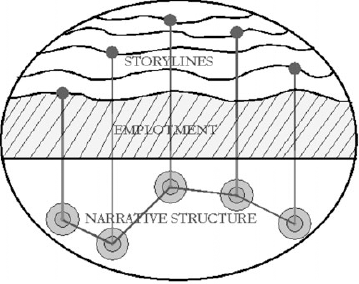
Narrative and Dramatic Processes amongst Entrepreneurs and Stakeholders
Storylines
Storylines are emotionally resonant stories that are remembered and repeated. They reflect actors’ positioning of individual and collective identities and understanding of actions and events.
Downing (1997) identified storylines as emotionally positive and emotionally negative remembered and repeated stories by drawing upon Collins's (1988) analysis of social movements. Downing (1997) also used Kirk's (1970) analysis of the content of myths to suggest that storylines would often have underlying themes of entertainment, problem solving, evaluative comparisons, and legitimacy. Here the concept is extended, by incorporating the argument that notions of individual and collective identity are positioned in storylines (Davies & Harré, 1991). Surprisingly Davies and Harré (1991) offer no definition of a storyline (as their focus is on positioning) so this would appear to be a conflict–free integration. The development is also warranted in the light of Martin et al.'s (Martin, Feldman, Hatch, & Sitkin, 1983) analysis of the content of organizational stories that concludes that stories express tensions between individual and organizational values. That it is stories allow stakeholders to explore and enact notions of individual and collective identity. The usage in Downing (1997) and here differs from Boje's (1991) use of the storyline concept in one significant respect. Thus whilst it is accepted that for some period of time storylines will be in a state of flux, as stakeholders put different interpretations onto events, it is argued, that eventually over time the storylines will take on an objectivated, typified, taken for granted character (Berger & Luckmann, 1967; Tsoukas, 1994). Although in principle storylines may always be reinterpreted, in practice groups of stakeholders are less likely to do this with the passage of time. Put another way, the emotional resonance of storylines will gradually recede as other actions and newer storylines express more emotional momentum.
Emplotment
Emplotment is a largely unconscious process of iteratively ‘fitting’ aspects of storylines into tacit plots with an expected pattern and conclusion.
Downing (1997) suggested how the emotional momentum in storylines could be enacted in plots. This analysis drew on literary criticism where a plot is a fairly abstract and generic patterning or structuring of action (Toolan, 1988). When one knows the plot, one knows, roughly, how things will turn out in the end—whether characters will fail, fight, succeed or fall in love. With different plots we expect a particular pattern of winners and losers to emerge. One authority (Barthes) has said that we have “a language of plot” within us before we approach any particular story (Toolan, 1988, p. 27). Thus Downing (1997) argued that plots are hidden or tacit dimensions of stakeholders’ interactions. Storylines help enact action because the emotions therein form a basis to select plots that shape current behavior and expected outcomes. Following the extended argument above, that storylines also express the positioning of identities we can also note, following Polkinghorne (1991) that the emplotment process also reflects human consciousness of time, sequence, and identity. Czarniawska (1999, p. 66) stresses that plots transform mere chronology into causality, as does Somers (1994). Somers (1994) also supports the idea developed here, that the selection of plots is fundamentally an emotional or evaluative process expressing notions of identity. Thus different plots offer “hypotheses” about causality between events but actors’ selection of plots is made through “evaluative criteria” or ideas such as “husbands as breadwinners” or “union solidarity” (Somers, 1994).
The idea that we are socialized to enact plots (Campbell, 1993; May, 1975; Polkinghorne, 1991) develops Goffman's (1974) observation that we habitually draw on genres from popular culture and advertising in our daily interactions. Given space constraints this article will briefly describe just four plots derived from the literary criticism of Frye (1957) and developed by Kilduff and Abolofia (1989). These are related to genres of romance, tragedy, melodrama, and irony. In the romantic plot labeled a quest here, a hero challenges the status quo, engages in various adventures, has setbacks, but ultimately succeeds in re–establishing harmonious relationships. In the tragic plot labeled a downfall here, the hero is overwhelmed largely by fate or external events. In a melodramatic plot labeled a contest, the hero is engaged in a struggle personifying right and wrong or them and us, which culminates in a battle where good triumphs over evil. In an ironic plot labeled a scam, the hero is revealed to be less than he claimed, and is found to be incompetent, perhaps a con–man. These plots are very fundamental sense–making devices, which most people readily recognize. Campbell (1993) has said that the romantic plot is the “monomyth,” which is the first story that appears in human mythology and from which all other stories can be seen to depart. Lyotard (1986) has identified a similar plot as the modern metanarrative of progress. Some of the appeal of the romantic plot or quest is suggested by Frye (1957) who says it is closely linked to wish fulfillment, and Lyman and Scott (1975) who show it is imbued with a sense of adventure and excitement.
Narrative Structuring
Narrative structuring is the process by which plots that have been tacitly selected are developed by elaborating and contextualising the structure.
A narrative structure provides chronology and perspective (Riessman, 1993; Toolan, 1988). A narrative structure refers to elements that allow us to perceive a story; it holds the story together and allows us to recognize an account as meaningful. The simplest narrative structure is “a beginning, a middle an end.” Emplotment provides a tacit generic narrative structure. It is held here that this generic and emotive patterning is insufficient for actors to construct identities and action so they need to further develop the narrative structure by making it explicit and contextualized. This important consideration is absent in Downing (1997). Whilst there are alternative conceptions of narrative structure, this article adopts Burke's (1945) pentad. This suggests that over time, individuals structure effective performance of the drama of interaction by creating a tension and a transformation in the five elements of agent, purpose, scene, agency, and act (See M. Gergen [1992] for an alternative narrative structure suggested for organizational analysis). Thus the argument is that groups of stakeholders and entrepreneurs elaborate and contextualize a tacit plot by recourse to the elements of the pentad. The narrative structure provides a degree of narrative integration; the extent of integration amongst actors in any given situation is an empirical question. Some integration is assumed in the constructionist perspective, as seen in sedimented typifications, but this should not be mistaken for uniformity of meanings. The whole framework presented here is based on selective appropriation of contested and multiple meanings. Different storylines reflect competing evaluations of actions and identities; emplotment is based on a selective appropriation of actions and identities from storylines; and narrative structuring involves a selective working–up of a cause–effect logic. Different groups of stakeholders may enact competing social dramas by drawing on different aspects of storylines, selecting different plots, and elaborating different narrative structures. Thus the framework shows shared means of making events intelligible rather than imputing shared meanings. Following Weick (1995) these processes are seen as facilitating enactment and retrospective sense making. As a means of abbreviation in the discussion below the framework will be referred to as the SENSE process or SENSE framework, an acronym standing for Storylines, Emplotment, Narrative Structuring Enactment.
The linkages made in this framework find support in Somers (1994) argument that a reframed narrativity has four dimensions, these are: relationality of parts (storylines), causal emplotment (emplotment), and selective appropriation and temporality, sequence and place (narrative structuring). Figure 3 attempts to show schematically the integrated aspects of the framework that have been presented. As the following discussion indicates the figure is a necessary simplification. The vertical lines attempt to show how one group of actors might select events or actions from storylines, how these enable actors to tacitly locate a plot, and how they then become elaborated in a narrative structure. The emplotment zone is shaded to indicate that unlike storylines and narrative structure this is a tacit or unconscious process. Figuratively five points in the narrative structure are shown to illustrate the elements of the pentad. Again figuratively isolated “points” taken from storylines have become points surrounded by circles of extra signification and meaning when they are elaborated in the narrative structure.
Discussion: The Social Construction of Entrepreneurship
The social construction of entrepreneurship arises from universal processes of social construction—the narrative dramatic means by which actors coordinate actions and identities. Entrepreneurship like the rest of social life is a collaborative social achievement. The interactions of entrepreneurs and their stakeholders sustain and transform the nature of entrepreneurship. The actors involved draw upon their experience and knowledge of institutionalized and canonical forms to make and remake what “small business” entails. Innovation, risk taking, and creativity are aspects of most economic definitions of entrepreneurship, but as yet the fundamental ways in which entrepreneurs apply these concepts to the social process of “new world making” (Czarniawska & Wolff, 1991) is poorly understood. However, the processes of “reality construction in, between and around organizations is poorly understood in organisation studies generally” (Karreman & Alvesson, 2001, p. 60). It is held here that the process of integrating storylines with tacit plots that are elaborated through a contextualizing narrative structure offers a practical way forward for research on processes of social construction. It could be argued further that because the entrepreneur and his or her stakeholders offers us a scene of a smaller more manageable size and complexity than large organizations it is extremely well placed to lead the development of understanding of social construction. Chia (1996) reminds us that the field of entrepreneurship has an inherent need for “intellectual entrepreneurship” and Swedberg (2000) argues that we need “practical knowledge” (Hayek, [1945] 1972) to better understand “the concrete ways in which entrepreneurs locate and exploit opportunities” (Swedberg, 2000, p. 10). The rest of this section aims to give a brief indication of how use of the storylines–emplotment–narrative structure framework could achieve these twin goals.
The SENSE framework offers a singular understanding of the social order as it is variously manifest in the concepts of social embeddeness, social capital, social networks, business models, entrepreneurial personal theory, vision, and innovation. All of these concepts can be viewed as products of entrepreneurs’ and stakeholders’ narrative and dramatic interactions. Each of these arenas reflects sense making and action making that is subject to actors integrating storylines with plots, contextualized in a narrative structure. The relative play of different storylines, plots, and narrative structure offers new insights into institutionalization and agency, or processes of cultural reproduction and creativity. The SENSE framework locates these dynamics in the positioning of individual and collective identities and the expression of emotions through narrative and dramatic processes.
Hence the SENSE framework can be used to rigorously analyze business development or inertia that is currently rather poorly “explained” by the presence or absence of social capital or social networks, or by the effectiveness or ineffectiveness of business models, personal theory, vision, or innovation. For any given social order we can ask; what is the narrative structure sustained by different actors? i.e., How are they making sense and making action through the elements of the pentad? (How are they enacting agent, purpose, scene, agency, and act?) How many different narrative structures are there amongst different groups of actors? What tacit plot does the narrative structure elaborate and contextualize? Which events and actions have been selected from storylines to sustain this particular plot and narrative structure? Which agents or identities have been most influential in this process? How were individual and collective identities characterized? Which emotions appear to have been most influential in the process? Which identities, emotions, and plots have been forgotten or excluded from today's narrative structure? How has the SENSE process changed over time?
Such empirical questions raise important theoretical debates about the nature of emotions, power, and narrative integration. Here it is only appropriate to make a few brief observations. The emotions (positive and negative feelings) that help generate storylines and guide the tacit selection of plots and via evaluative themes shape the narrative structure can be thought of as rhythms in the body, located in bodily experiences (Damasio, 1994). How emotional rhythms interact with narratives (following, leading, growing or subsiding for example) is an empirical question, but we might expect to find the influence of identity, values, relationships, and fantasy (Gabriel, 1995, 2000; Karreman & Alvesson, 2001). Emotions are central to Gergen's (1995) theory of relational power. Here, socially constructed local realities or ontologies produce understandings of what is right and good, and those who feel excluded from the social construction process are moved to subvert this ontology with an alternate reality, with competing notions of what is right and good. In other words these dynamics of inclusion and exclusion privilege participation in significant organizing narratives. In Gergen's (1995) view organizations need to be good at both developing local ontologies and listening to and adapting to alternative realities. Examination of the SENSE process should show how this is or is not achieved by entrepreneurs and their stakeholders. For example, periods of routinization and major adaptation or crisis may correspond with periods of consensus and conflict around the plot and narrative structure amongst groups of stakeholders. The interplay of emotions and relational power between groups is directly linked to the sense of drama theorized in constructionism. In so far as interpretations of the past, current, and future differ the absence of narrative integration ensures social drama. The narrative integration achieved in any narrative structure is a shared means of making events intelligible and does not necessarily imply shared meanings. Narrative structures are temporally and spatially bound phenomena. We should expect entrepreneurial firms to be associated with conflict and uncertainty as much as progress and harmony. In other words, engagement in downfalls, contests, and scams should be as familiar as engagement in quest plots.
It follows that it could be productive to view the “development logic” of the firm (Frank & Lueger, 1997) as a narrative structure created through the SENSE process. This claim can be illustrated by reflecting further on the contrasting principles of adaptation/active learning and inertia/routinization highlighted at the start of this article (Baron & Hannan, 2002; Baron et al., 1999; Gersick, 1991; Rae & Carswell, 2000, 2001). It was noted in the introduction, notions of personal theory and organizational models used to explain adaptation and inertia resemble the concept of “dominant logic” (Bettis & Prahalad, 1995; Prahalad & Bettis, 1986). The dominant logic is a prize–winning concept in the strategy field that is conceived as a cognitive filter that logically precedes organizational learning. It reflects managers’ experience, but is largely unrecognized by managers themselves, it is stored via shared schema, mind–sets, or cognitive maps, and is manifest in “the way in which managers (in a firm) conceptualise the business and make critical resource allocations” (Prahalad & Bettis, 1986). As such managers’ belief structures and frames of reference are intimate aspects of the dominant logic. Bettis and Prahalad (1995) argue that the dominant logic “is inherently non–linear, with impact often out of proportion to its inherently subtle nature” (ibid. p. 11). It should be thought of as an emergent property of a complex system alongside features like political coalitions and informal structure. It reflects a local equilibrium and change in the dominant logic requires unlearning, which is unlikely to occur without a substantial organizational problem or crisis. The SENSE framework provides a systematic approach to investigating the development, transformation, and variations within the shared schema, mind–sets, or frames of reference that underpin the dominant logic, or personal theory or organizational models of small businesses. This approach is a significant development over Rae and Carswell (2000, 2001) because the authors view “life stories” as a method for the researcher to capture individual learning. Here the SENSE framework is a systematic approach for capturing the collective positioning of identities and actions that establish ontology and precede collective learning or inertia. This also extends current accounts of inertia beyond reliance on political interests (Baron & Hannan, 2002; Baron et al., 1999) or conformance to externally legitimated templates (DiMaggio & Powell, 1983; Meyer & Rowan, 1977).
Beyond specific studies of learning and inertia in small firms the SENSE framework could equally be applied in broader studies of social capital and networking, and organizational development involving shared visions and innovation. Most of these topics share an interest in how trust is created (for example, see Larson, 1992; Larson & Starr, 1993; Nahapiet & Ghoshal, 1998). From the narrative view developed here, trust could be considered as an outcome of a skilled interaction that is manifest in the coproduction of storylines and narrative structure and the coproduction of notions of identity and organization. This view is quite consistent with the view that learning organizations coproduce visions (Senge, 1993) and very successful companies coproduce their business models by an extended iterative process of dialogue and action (Collins, 2001). Downing (2000) argued that only the quest plot would be able to sustain the trust needed to support learning or innovation to create a distinctive or core competence. This was because it was argued that different plots were associated with different core emotions: the quest with satisfaction/happiness, the downfall with fear, the contest with anger, and the scam with sadness. The consistency with which specific emotions are expressed with particular plots, the consequences for trust, innovation, learning, and shared vision represent significant questions for future research.
We saw in the work of Lavoie (1991) and ethnography of Lindh de Montoya (2000) a keen appreciation of entrepreneurship as intensely social activity, embedded in local cultures, ethnicity, and gender. The SENSE process provides a consistent approach to exploring just how entrepreneurs and their stakeholders participate in interactions that make new worlds, or confirm established ones—locally and globally. The universalistic claims of narrative theory offer great scope for international comparative studies and studies of gender–related differences in entrepreneurship. The SENSE framework could be used systematically to establish national and gendered variations in entrepreneurial identities and organizations. It could also be used to examine the way in which actors like governments, regulators, nongovernmental organizations (NGOs) or media legitimize new ways of socially constructing entrepreneurship. For example, furnishing concepts like social enterprise and sustainable enterprise. Agency depends in most circumstances on legitimacy. Until they are confirmed socially, entrepreneurs may appear to be cranks or misfits—once confirmed they appear visionary. We might suggest that for many entrepreneurs there is a fine line between the status of misfit and visionary, “failure” and “success.” For many these identities may be produced by their skilful participation in narrative and dramatic processes as much as the objective qualities of their products or services.
Conclusion
This article has developed a consistent constructionist perspective that has identified the narrative and dramatic processes amongst entrepreneurs and their stakeholders as a neglected but important subject of study. The SENSE framework was presented as a way of understanding regular patterns of interaction amongst entrepreneurs and stakeholders that jointly produce entrepreneurial identities and organizations. The framework shows how storylines are selectively integrated with tacit plots that are elaborated and contextualized by a narrative structure. Initial comments have been given on how these processes could enhance studies of business development and inertia, business models and learning, social capital, networking, vision building, and innovation.
Future conceptual development of the ideas in this article could usefully focus on “narrative voice” or rhetoric and the reflexivity of entrepreneurs, stakeholders, and researchers. This article has focused on regular patterns and flows in narratives amongst people. Emotional, identity and relational power based influences on these flows have been uppermost in the discussion. Another influence on this flow is rhetoric (Eccles & Nohria, 1992; Fairhurst & Sarr, 1996) can also be analyzed as narrative voice (Pentland, 1999 2 ). Downing (1993) found evidence that rhetorical skills defined within a dramatistic framework did distinguish between a small group of successful and less successful entrepreneurs and were related to self–efficacy. The integration of rhetoric within the SENSE process should offer an enriched and credible analysis of the duality of structure and agency.
Although Pentland draws upon an understanding of the elements of narrative that is similar to that developed here, he takes them in an explicitly structuralist direction for analysis of organizational processes. Apparently believing that factors like technology are a generative mechanism independent of social construction he makes distinctions between aspects of narrative that can and cannot be considered “deep structure.” These implications and the suggestion that researchers can create “whole stories” by assembling different participants views are rejected by the poststructuralist assumptions here.
A narrative dramatic perspective is well placed to consider the reflexivity of actors, but due to space constraints this issue has not been an integral part of the argument. Academics help constitute the canonical forms that provide typifications for entrepreneurs and stakeholders to appropriate in narrative structures and development logics. This is neatly illustrated in the “personal theory” of one entrepreneur studied by Rae and Carswell (2000) where an entrepreneur is quoted as saying:
“One of my favourite theories of business is that all businesses go through a cycle, and after a while lethargy sets in: you know it all, you've done it all before, you have got to be right and that leads to deterioration and at that stage a good entrepreneur has to identify that and has to do something about it” (ibid. p. 223).
As Jeffcutt (1994) has noted academics also construct identities and research projects in plots like those described here. Thus a richer understanding of the duality of structure and agency would arise from a larger cast of reflexive actors in the social drama of entrepreneurship.