







Abstract
Research In Motion is a small information technology firm located in Waterloo, Ontario. This case describes how this firm came to develop a new–to–the–market product and offers the opportunity to discuss the challenges a small firm faces in commercializing a new technology. Issues relevant to this case are legitimacy of a firm and technology, the implications of technology standards, network effects and complementary goods, and partners and social capital as resources.
Firm History
RIM was cofounded in 1984 by Dr. Michael Lazaridis and Douglas Fregin. It was located in Waterloo, Ontario, near two universities, one known for the quality of its technology program and the other for its business program. Its size and location in this small city meant that it was well–known to the residents of the city, but virtually unknown everywhere else.
Almost from its inception, RIM had focused on developing hardware and software for wireless data communication. Lazaridis emphasized from the beginning that the products RIM created would be as energy–efficient and simple as possible, and ergonomically ideal for the intended task, rather than emphasizing processor speed, memory, color, or complex features that were standard in the computer industry. This meant developing a completely different mind–set, problem–solving approach and resultant capabilities than all potential competitors. As a result of its activities, RIM developed a strong capability in producing wireless two–way data communication devices that were small, lightweight and energy–efficient, all three qualities being important factors in making useful and usable products of this category.
In 1990, RIM launched software that would allow users to send data on a wireless data network, but the software failed to generate business because it was too advanced for the market—consumers were not ready. In 1991, however, Ericsson licensed RIM's technology for their wireless modems for $250,000. Wireless data was beginning to emerge as a market. By the mid–1990s, RIM was producing wireless modems for computers, point–of–sale terminals and other appliances.
Meanwhile, although Dr. Lazaridis was a talented engineer and he and Fregin were able to address technical and manufacturing issues, they also knew their limitations on the business side. In 1992, Jim Balsillie was invited to join the company as co–CEO. A graduate of the Harvard Business School's MBA program, Balsillie had worked in corporate finance with Bay Street for several years. He was a talented business mind who would gladly and capably address the strategic and business issues that required attention. All were in agreement as to the direction and future actions the company should take, and worked very well together. Fregin became vice–president of Operations and a member of the Board of Directors, and Lazaridis became President and co–CEO.
RIM eventually established a relationship with BellSouth when that company purchased RAM Mobile and its Mobitex wireless data network. RIM had worked with RAM Mobile in creating wireless data communication products, and had acquired a great deal of knowledge and experience in wireless technologies as a result, developing needed hardware and operating systems upon which other organizations such as IBM built applications.
In 1995, as BellSouth was seeking ways to rejuvenate the mature pager market and capitalize on the underused Mobitex network it had acquired, Lazaridis and Balsillie convinced BellSouth that there was an opportunity in two–way messaging. BellSouth liked RIM's vision of new products—portable wireless devices that would be capable of receiving and sending data. This was an important improvement in the value of existing data communication products such as pagers, as two–thirds of pages received required a response but pagers were incapable of sending one. Although the engineering required to produce such a device was anything but trivial, many believed that RIM had the necessary capability to produce it. BellSouth agreed to expand its network coverage with a view to support the handheld devices. In 1997 RIM launched the first Inter@ctive pager—a wearable two–way pager that notified the receiver when a message arrived and allowed the receiver to respond to or initiate a message as well.
RIM's vision of the future did not end with the pager. It had its sights set on what it perceived as the emerging wireless e–mail market. It approached BellSouth and proposed to develop a product (the BlackBerry) that would capitalize on this market. This was not BellSouth's focus, but it had nothing to lose by allowing RIM to pursue the opportunity, and agreed to sell it wholesale airtime that could be used for such a product.
Firm Characteristics
Products
To protect its advantage as much as possible, RIM followed a very careful and consistent policy of securing as much patent protection for its products as possible, while continuing to push ahead with product development, continuously extending its technology and capabilities. Its current product offering is described below.
Inter@ctive Pager.
As described above, the Inter@ctive Pager allowed the user to respond to as well as to receive pager messages. The hardware design was a great success—it was roughly the size of a traditional pager, weighed only 4.1 ounces, and had a traditional miniaturized keyboard on which the user would type using his thumbs. Work with a wide variety of focus groups had indicated that, despite its small size, the keyboard was easily usable by people of all sizes and shapes (even university football players were recruited to ensure that large hands could use the product.) It ran on one AA battery that required replacement approximately every 500 hours—a significant improvement over all other wireless devices. In early 1998, BellSouth signed a contract with RIM worth $90 million for its two–way pagers.
In summer of 1998 RIM launched its next–generation pager—the RIM 950. This pager offered the additional capabilities of Internet connectivity such as the ability to send and receive e–mail and access Internet databases, as well as personal information management functionality (calendar, address book, etc.). RIM also had a marketing agreement with American Mobile Satellite Corporation (AMSC), operator of the DataTAC network. Both of these network providers bundled the pagers with their service and sold them to corporate and individual customers.
In developing and commercializing the Inter@ctive Pagers, RIM established significant relationships with BellSouth and Intel. RIM had approached and partnered with Intel to create and source a specially designed chip for the RIM 950, and had worked with BellSouth to determine the desired performance and functionality.
The Inter@ctive Pager won several awards from various computer and corporate magazines, including Andrew Seybold's OUTLOOK award. Andrew Seybold was a prominent wireless industry consultant and journalist, and the award recognized the pager as an important advance in mobile computing for its size, user–interface, and functionality. 1 By February 1999 the Pagers accounted for roughly 74% of RIM's total revenue and over 200 independent software developers were employing RIM's Developer Kit to write specialized applications.
1998 Awards. (N.d.). Retrieved January 22, 2004, from http://www.rim.net/news/awards/1998/index.shtml.
BlackBerry.
After its success with its Inter@ctive Pager, RIM had immediately put its energy and resources into developing a solution that focused on what it perceived as the significant, albeit still–emerging market for wireless e–mail messaging. The BlackBerry was launched in January 1999. Leveraging the same hardware platform as the Inter@ctive Pager (see Exhibit 1), RIM developed software that allowed the user to maintain a single enterprise e–mail account, eliminating the need to check numerous e–mail accounts. Messages sent to a user's enterprise e–mail address were automatically “pushed” to the BlackBerry handheld, where the user was notified of their arrival and could read and reply to them, the entire process occurring within minutes. This was a significant improvement in functionality as all other devices required the user to connect and “pull” e–mail to the device, often resulting in missed or untimely receipt of messages. Messages sent from the BlackBerry appeared as if sent from the user's enterprise e–mail account, including storing a copy of the message in the user's “Inbox” and “Sent Items” folders. The BlackBerry included personal information management functions such as an address book and calendar, and it could be synchronized with the user's desktop when placed in a docking cradle. Like the RIM 950, the BlackBerry could run for 500 hours powered by a single AA battery and weighed only a few ounces.
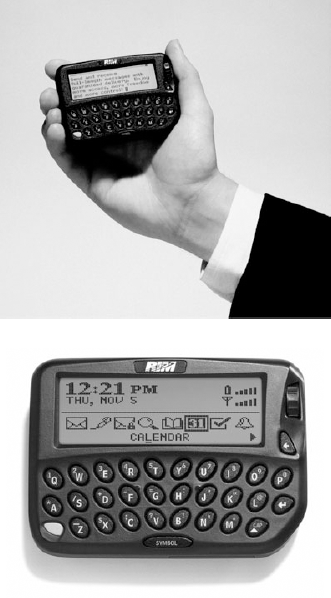
The BlackBerry
The BlackBerry was offered as an integrated solution consisting of the handheld device, the software that ran the device and redirected the e–mail to and from it, and network airtime. A diagram of the process by which e–mails were handled is provided in Exhibit 2. The result of this integrated solution was that the only thing the company or individual had to do upon agreeing to adopt the BlackBerry was to allow RIM to install its software that interfaced with the user's messaging system.
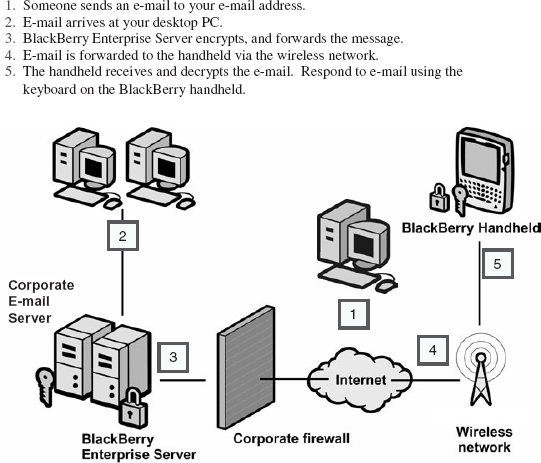
How the BlackBerry Works
The device sold for approximately US$399 including software, a very competitive price by industry standards. The wholesale airtime RIM acquired from BellSouth allowed it to provide unlimited messaging for approximately US$39 per month, a price that was in the same range as cellular phone plans, and a significant improvement over the usage–based billing of its closest rival—the Motorola two–way pager.
RIM identified corporations and their employees, particularly those handling time–sensitive information such as financial services, as its target market. Anyone who needed quickly to receive and react to new information was a likely customer for the product. Corporations were more likely both to find value in its product and to purchase it, whereas individual consumers would view it more as a luxury item. Furthermore, it would be easier to sell the BlackBerry to an organization given RIM's limited resources for marketing, as acceptance by an organization meant that many more users would potentially be adopting it with each agreement.
Because the security of information that would be transferred using these devices was a serious concern for corporate customers, RIM incorporated the most advanced encryption software to ensure the security of e–mails sent and received. Once again the company worked with Intel to create and source the specially designed chips. Intel was also pursued as a BlackBerry customer to ensure that the product would perform reliably and satisfy the strictest security needs.
Two versions of the BlackBerry integrated solution were created—the corporate or enterprise server version, and the Desktop Redirector. The Desktop Redirector was launched first (in January 1999) in order to encourage adoption of the BlackBerry and enter the market as quickly as possible. This version worked by redirecting e–mail from an individual user's desktop. It allowed RIM to enter the market that much earlier and provide trial products to influential individuals without having to deal with firms’ information technology (IT) departments. The corporate server version of the BlackBerry was scheduled for launch in late spring of 1999 and was designed to work with Microsoft Exchange, Microsoft's enterprise e–mail system. It encrypted and redirected e–mail at the corporate server. In addition to the functions of the Desktop version, the enterprise server version would allow the IT department to have more control over what was transmitted over the product, didn't require the user to leave the desktop running, and allowed the user to access the corporate server. RIM had negotiated and received Microsoft's support in designing the product to work with Microsoft Exchange. This system held approximately 35% of the market. Lotus Domino held another 35%, and the remainder of the market was employing a variety of other enterprise e–mail solutions. RIM had also approached the value added resellers (VARs) that sold and installed Microsoft Exchange to distribute the BlackBerry.
Capitalizing on the ever–expanding contacts of Jim Balsillie, RIM provided free Desktop Redirector versions of the BlackBerrys to various companies and company executives, persuading CEOs and members of the financial community to try the product. They expected that roughly half of the units would be returned. One executive who became an enthusiastic user was Jack Welch, CEO of General Electric, who carried and used it while golfing and during other out–of–office activities with other executives. RIM experienced a putback rate of near zero, indicating that almost everyone who tried the product chose to keep it.
As a result of its past product development and its efforts to develop the BlackBerry, RIM led its nearest rivals by 18 months to 2 years with respect to wireless data communication technology and product development. Furthermore, its early and extensive experience with its products and early–adopter customers had allowed RIM to correct many shortcomings of the technology and the product. The outcome was a product that was easy to use, even by those unaccustomed to handling their own e–mails, and simple but powerful enough to satisfy the “power–user.” One of the issues that had yet to be addressed, however, was what other functions should be included on the BlackBerry. Adding functions and features would reduce battery life but would make the product more attractive by reducing the user's need to carry other pieces of equipment.
Wireless PC Card.
The wireless PC card was a slide–in card with telescopic antenna that provided two–way wireless connectivity for computers and palm–sized devices. It was designed to be compatible with Microsoft's CE standard. It too was energy–efficient, lightweight, and reliable, and was designed to provide nationwide roaming on the Mobitex network. In 1997, RIM received the National Quality Institute's Canada Award for Excellence Trophy for Innovation for its wireless PC Card. The PC card represented roughly 5% of RIM's revenue in fiscal 1999.
OEM Radio Modem.
RIM's radio modem was a family of radio frequency transceivers designed for integration by original equipment manufacturers (OEMs) and VARs into products. They were integrated into products such as handheld devices, point–of–sale terminals, vending machines, and alarm systems. This product too was the smallest and lightest available on the market, as well as being energy–efficient and highly immune to radio frequency noise, offering significant advantages over competing products. The modems represented 20% of total revenue in fiscal 1999.
Organization
All employees of RIM carried BlackBerrys and used them religiously. The BlackBerry's usefulness and value were readily apparent, with many users finding its use so addictive that the nickname “Crackberry” was coined by Andy Grove of Intel Corporation. 2 Being able to use the product they were developing and selling created an electric atmosphere in the organization—employees were excited about their organization and actively sought ways to improve the product and increase its success. RIM's small size and lack of internal barriers or formal organization chart also created an atmosphere where communication, cooperation, and ideas flowed freely. The energy and enthusiasm were fueled by Lazaridis, who strongly believed in continuous research and development, always pushing the technology forward and learning about ways in which to increase its potential and value.
Stanford, J. (2001). Case study scenario, subject: RIM. Business, National Post, October, 47–48.
Because of RIM's size and location, the company faced some challenges in attracting personnel. However, because it was known for its work in a cutting edge domain that was only just emerging, RIM was the object of much curiosity and interest, particularly among students of the local universities. As a result, it had managed to recruit some significant and valuable talent (see Exhibit 3 for a breakdown of employee). Salaries were competitive, and all full–time, permanent employees were offered stock options.
Financial Statements
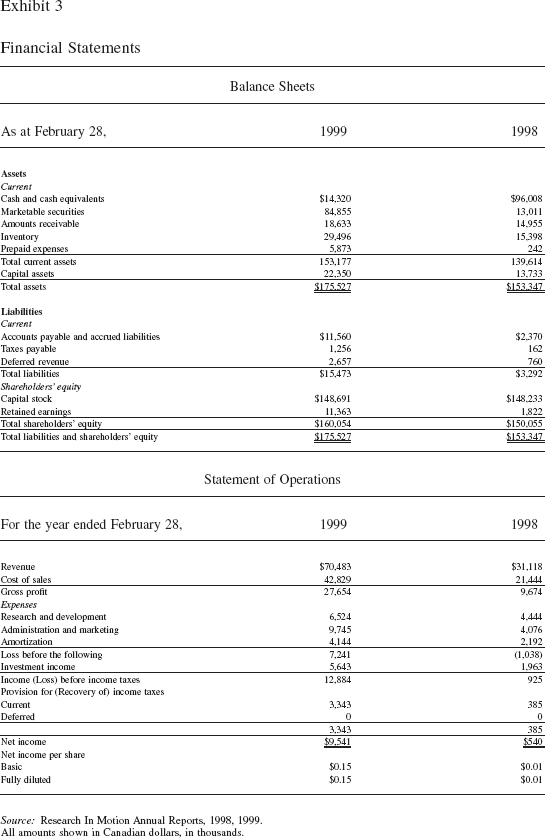
Source: Research In Motion Annual Reports, 1998, 1999.
All amounts shown in Canadian dollars, in thousands.
Manufacturing
RIM's manufacturing facilities were commissioned in 1996 and in early 1998 were able to produce 600 devices per day. They were expected to be capable of producing 4,000 per day by the end of 1999. RIM believed it should not outsource manufacturing to ensure strict control over quality and so that it could better integrate manufacturing with research and development.
Financial Resources
By January, 1999 RIM had completed a $105 million (Canadian) initial public offering, was listed on the Toronto Stock Exchange, and had applied to be listed on the NASDAQ. Intel had made a $4.1 million equity investment in RIM and Technology Partnerships Canada had announced a $5.7 million investment in R&D at RIM. Finally, RIM had also signed a number of significant purchase agreements for various products with a number of companies, was debt–free, and had $99 million cash. Ninety–five percent of RIM's revenues were generated in the United States, and the remainder were made in Canada and Asia. An overview of RIM's fiscal 1998 and 1999 financial results is presented in Exhibit 4.
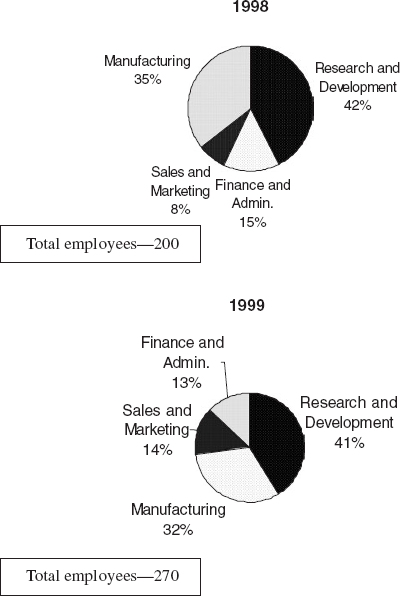
RIM Employee Skillset in Fiscal 1998 and Fiscal 1999
The Industry
Market Needs
In the early 1990s, as innovative means of communication such as cellular phones and other wireless communication devices improved in their performance, business practices followed, facilitating the productivity of mobile workers such as salespeople and field service personnel. Furthermore, as e–mail increased in popularity and wireless products achieved wider acceptance, the ability quickly to receive, react, and respond to new information became a new and significant source of competitive advantage, leading to a search for innovative ways to receive and transmit time–sensitive information accurately and securely. It was estimated that by 2001 wireless e–mail subscribers would increase to more than 10 million users (Anonymous, 1998, #930), and that the two–way pager market alone would have approximately 30 million subscribers. 3
Research In Motion 1998 Annual Report.
In late 1998, existing devices did not satisfy the needs of e–mail retrieval because the user somehow had to connect to the Internet. This required a laptop as well as access to a compatible phone system and phone plug. When wireless modems were used on laptops, the slow speed of the wireless network made the solution virtually unusable. Furthermore, the user would not know that e–mail had arrived until he accessed the e–mail account and retrieved it. Security and bulky equipment as well as missed messages were major concerns with both wireless and plug–in systems.
Competition
To Ray DePaul's knowledge, no other organization offered RIM's value proposition (a comparison of products and competitors is provided in Exhibit 5). Other products that offered wireless data were bulky or did not provide the desired security or integrated solution that differentiated the BlackBerry. DePaul viewed the laptop computer as the BlackBerry's most significant substitute product, as users were more likely to use laptops to retrieve and respond to e–mail, as well as to access and update personal calendars and other information. However, laptops required the user to dial into the office and manually check for e–mail, and the laptop was significantly larger than the BlackBerry.
Competing Products and Companies †
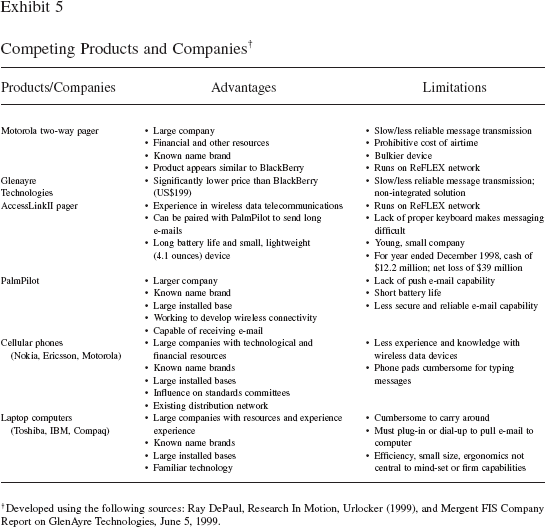
Developed using the following sources: Ray DePaul, Research In Motion, Urlocker (1999), and Mergent FIS Company Report on GlenAyre Technologies, June 5, 1999.
Both Nokia and Motorola were researching and making advances in wireless communications, but owing to their extensive investments and interest in wireless voice communication, they had put less effort than RIM into the development of wireless data. The comparatively lower returns offered by the small wireless e–mail market also encouraged these large companies to place less emphasis on data. Furthermore, voice communication was moving from analog to digital systems, forcing manufacturers of wireless voice communications products to focus on this change rather than on the development of data communications. DePaul observed that Motorola had begun to move resources from wireless data to digital voice communications in order to maintain its market share in the cellular telephone market. It was apparent to DePaul and the management of RIM that in the future these companies would develop the possibility of using cellular phones to receive and send text messages, but the cellular phone with potential data capabilities did not create much concern for them because of the awkwardness involved in typing e–mails on a numerical keypad and the lack of enterprise software that could push e–mails to phones.
Personal digital assistants such as the PalmPilot produced by U.S. Robotics were making their way into the market as essentially palm–top computers that could be used to digitally organize and store personal information such as task lists, calendars, contact information, and small files. These products were increasing in popularity as they were effective substitutes for bulky paper calendars, could be synchronized with desktop calendars by using a docking cradle, and could access and organize information in many ways. The makers of these products focused their efforts essentially on increasing the functionality and memory of the product. Although wireless plug–ins could be used to pull e–mail to the units, they did not have the technological capabilities for RIM's quality of wireless e–mail communication with respect to reliability and security. Next–generation products, however, would potentially address these shortcomings.
The two products that most closely resembled the BlackBerry were the AccessLink II and the Motorola two–way pager. The AccessLink II was a two–way pager produced by Glenayre Technologies and although it was similar in concept to RIM's BlackBerry, it lacked a proper keyboard, limiting its use to very brief replies. 4 It was also designed for the ReFLEX network that was much smaller and slower than the DataTAC and Mobitex networks upon which RIM's products ran.
Urlocker, Michel. (1998). Company report: Research In Motion. Credit Suisse First Boston, February 2.
Motorola's two–way pager appeared similar to RIM's, but it was bulkier, and message delivery was considerably slower. Furthermore, its pricing plans made this pager cost–prohibitive for use for anything but short, infrequent messaging.
Technology Standards
In late 1998, the three networks for wireless data communication were Mobitex, operated by BellSouth in the United States and Rogers Cantel in Canada; the DataTAC Network, operated by AMSC in the United States and Bell Mobility in Canada; and ReFLEX, operated by Skytel (Mtel). These networks were designed exclusively for data and were not capable of handling voice calls. Although Mobitex and DataTAC were fully deployed nationwide networks, they had very few users compared to the voice networks. Furthermore, their coverage was not as extensive as that of the voice networks, although both BellSouth and AMSC were investing to expand coverage. The ReFLEX network was limited in capacity relative to Mobitex and DataTAC and was therefore slower and more expensive to use. Motorola and Glenayre were manufacturing paging devices for this network.
Wireless voice communications such as mobile phones were made possible on three technology standards—GSM, CDMA, and TDMA. Both GSM and CDMA were working on developing and upgrading to new standards (GPRS and 1xRTT, respectively) that would also support wireless data communications. GSM was deployed in North America, Europe, and most of Asia, while CDMA existed predominantly in North America but nevertheless had a large network. Although popular in North America, TDMA networks did not have an upgrade path to support wireless data and DePaul believed they were seen as a dead end for most carriers looking for the additional revenue wireless data applications promised. Once the standards were upgraded to support data communication, DePaul suspected that they eventually would converge into a single worldwide standard. He thought that this convergence could be 3–5 years away. Future generations of networks would also support and therefore encourage the development of multifunctional devices that would combine e–mail, voice, and Internet connectivity, as well as allow for multimedia functions.
Industry standards committees essentially directed the development of technology standards and thereby influenced what products the industry would create and support. These committees consisted of industry leaders and significant stakeholders such as network providers. They discussed the strengths and weaknesses of new or existing technology standards, including the constraints these standards placed on future technological innovations, and agreed upon which standards to support so that the industry was not fragmented by too many standards. Such agreement reduced the risk to smaller industry participants of developing products conforming to standards that might later be abandoned (such as the famous example of the Betamax video format) because the number of options were reduced, although it did not guarantee that a particular standard would receive wider acceptance than another. The reduced risk also encouraged the development of complementary goods that further encouraged adoption and diffusion of information technology products.
In 1999, although RIM's technology was perceived as one of the few practical wireless data solutions, the company was too small to participate in the standards committees. However, BellSouth, Rogers Cantel, and AMSC were among the organizations that did participate on these committees.
Challenges Faced in 1999
Although almost all of RIM's revenues came from the United States, it was still largely unknown there. Its product, and in fact the entire product segment, were also completely new to the market. Potential users were unfamiliar with the BlackBerry's capability, value, and ease of use, and consequently would not readily allow a small company to become an element of their communication infrastructure unless they knew that company could deliver on its promises and would be in business for a very long time. Given the significant leap in technology and function that BlackBerry represented, most organizations did not even have resources budgeted to this type of product. They typically would have to shift resources from other areas in order to adopt the BlackBerry.
Meanwhile, most IT departments strongly resisted new products such as the BlackBerry as complicating an already complex environment. Particularly when the technology was unproven, their fear was that the product would create more problems than it would solve. On the other hand, overcoming the significant hurdle of IT acceptance was rewarded with the opportunity for widespread adoption within a company. How could the resistance of firms and IT departments be overcome?
To complicate matters further, because BlackBerry was so novel, no existing channels of distribution were ideal for the product. RIM did not have the needed sales force nor could it easily acquire them in order to approach companies individually and encourage adoption of the product.
Future product development was another issue that had to be seriously considered. Concerns of technological obsolescence would certainly affect the adoption of the BlackBerry. In 1999, RIM's products were compatible with the data–only Mobitex and DataTAC networks, although RIM was working on future products that would capitalize on the upgrade of the GSM standard to GPRS. Should the company focus further efforts on the international and next–generation GSM/GPRS networks, or should it divert some resources to ensuring compatibility with the CDMA network also? Waiting for standards to emerge would reduce the risks of wasting resources on dead–end technologies, but continuous product development in anticipation of new network deployment would mean that RIM could enter markets ahead of the competition. DePaul knew that once a consumer adopted a satisfactory product, the learning and cost involved in switching to another product represented a significant barrier for challengers to overcome.
BellSouth, meanwhile, had wanted to downplay RIM's brand in favor of its own, and RIM knew other partners would want to do the same, effectively private labeling the product. Given the size and strength of the larger partners, it had been difficult to resist this pressure, and the benefits and drawbacks of putting a known name on the product had to be considered. What did RIM have to gain by putting its own name on every BlackBerry? Should it reconsider this decision?
Finally, the dynamics of the IT industry would pose unique challenges for RIM and its pursuit of widespread adoption of the BlackBerry. Complementary products such as specialized applications would aid its adoption, but RIM lacked the resources to produce a wide variety of complementary goods. Meanwhile, as a result of the generally unsatisfactory performance of wireless data communication devices compared to voice and other means of communication, current consumer demand was relatively low. The lower demand exacerbated the availability of products because companies had few incentives to spend the resources on product development. This also reduced the interest of software developers and other producers of complementary goods in developing specialized applications that might make existing and emerging products more attractive to consumers. This dynamic created a challenging cycle for IT producers such as RIM. As data networks improved in coverage and performance and more and better–performing products became available, the dynamics would change, but competition was also sure to increase dramatically. What could RIM do to cope with these challenges and secure its position in preparation for increased competition?
Conclusion
DePaul enumerated the challenges created by RIM's size, location, and product. The desktop version of the BlackBerry had proved to be very successful, and RIM soon would be launching the enterprise server version, but was this enough to ensure the firm's survival and success? What capabilities and resources had led to RIM's success and might be of value in the future? What decisions had to be made because of network effects, compatibility issues, and the trajectory of technology standards? Should RIM delay product development and wait for standards to emerge or should it aggressively move into the market? Should RIM allow its network partners to private label its products? It was only a matter of time before Motorola and other large competitors would turn their attention to RIM's market: How could RIM survive this inevitable threat?