







Abstract
The article uses experiential learning theory to magnify the importance of learning within the process of entrepreneurship. Previous research details the contributions of prior knowledge, creativity, and cognitive mechanisms to the process of opportunity identification and exploitation; however, the literature is devoid of work that directly addresses learning. The extant research assumes learning is occurring but does not directly address the importance of learning to the process. To fully understand the nature of the entrepreneurial process, researchers must take into account how individuals learn and how different modes of learning influence opportunity identification and exploitation. This article makes connections between knowledge, cognition, and creativity to develop the concept of learning asymmetries and illustrates how a greater appreciation for the differences in individual learning will fortify entrepreneurship research.
Introduction
Eckhardt and Shane (2003) argue that studying the process of entrepreneurship is one of the most important directions for future entrepreneurship research. Additionally, opportunity is seen as the lynchpin around which the promise of entrepreneurship research is to be built (Shane & Venkataraman, 2000). In fact, it has been suggested that a better understanding of how individuals identify and exploit opportunities may provide the field with a distinct domain that separates it from strategic management, economics, and other social science disciplines (Venkataraman, 1997). In this article, I examine experiential learning within the context of opportunity identification and exploitation to better understand the process of entrepreneurship.
Shane and Venkataraman tell us that individuals must possess prior knowledge and the cognitive properties necessary to value such knowledge in order to identify new means–ends relationships. The warm reception that the work of Shane and Venkataraman has received has helped generate a great deal of interest in examining the entrepreneurship process from a cognitive perspective (Ardichvili, Cardozo, & Ray, 2003; Brigham & DeCastro, 2003; Gaglio & Katz, 2001; Keh, Foo, & Lim, 2002; Krueger, 2000; McCline, Bhat, & Baj, 2000). Together with the work of other leading “cognitive perspective” researchers (see the works of scholars such as Baron, Busenitz, Mitchell, and Gaglio), Shane and Venkataraman's article published in the Academy of Management Review in 2000 helped carve out a fruitful line of inquiry examining the concomitance of an individual's cognitive properties and his ability to identify, develop, and exploit opportunities.
The cognitive body of research contributes to our understanding of entrepreneurship by helping to explain how each individual's mental makeup is related to his or her ability to identify and exploit an entrepreneurial opportunity. The extant research suggests that recognition abilities differ because each of us has different pieces of the world's totality of information (Hayek, 1945), and we each rely on different cognitive mechanisms or heuristics (Baron, 1998; Busenitz & Barney, 1997). Related research supports the hypothesis that creativity, cognition, and opportunity identification process are correlated (Lumpkin, Hills, & Shrader, 2004; Ward, 2004). Taken together, this research provides an understanding of what attributes (prior knowledge, cognitive mechanisms, heuristics, or creative abilities) a budding entrepreneur needs to have; however, it speaks less to the process of acquiring such attributes (i.e., learning). Research suggests that differences in our knowledge stocks and the various manners in which each might process information are related to opportunity identification (Shane, 2000). However, what about the manner in which we each learn—the acquisition of new information? A search of the primary management and entrepreneurship journals shows no work that directly addresses the role that the process of learning plays in opportunity identification and exploitation.
The cognitive perspective on entrepreneurship is valuable and has helped us understand a great deal about how individuals identify and exploit opportunities. However, it needs to be fortified by investigations of the process of learning. Cognitive mechanisms and heuristics (e.g., overconfidence, counterfactual thinking, representation, small numbers) and an individual's existing stocks of knowledge are not synonymous with learning. Knowledge is a static concept that is activated when we put it into use. Cognitive mechanisms and heuristics are two ways in which we put our knowledge into action. In contrast, learning is a social process by which knowledge is created through the transformation of experience (Kolb, 1984). This article proposes that to better understand opportunity identification, exploitation, and the entrepreneurship process in general, current research must be augmented by a more fine–grained examination of learning.
Previous models (Long & McMullan, 1984; Teach, Swartz, & Tarpley, 1989; Timmons, Muzyka, Stevenson, & Bygrave, 1987) that attempted to define different aspects of the entrepreneurial process were developed before the “re–birth” of opportunity research that was sparked by Venkataraman (1997). None of these earlier discussions nor more current articles on the opportunity process (Ardichvili et al., 2003; Brigham & DeCastro, 2003; Keh et al., 2002; McCline et al., 2000) examine the effects of learning.
This article relies on experiential learning to fill the void. Experiential learning theory (ELT) tells us that the acquisition and transformation experience is central to the learning process (Kolb, 1984). ELT is an integrative perspective that combines the constructs of previous knowledge, perception, cognition, and experience (Kolb, 1984). As such, it provides us the opportunity to uncover why some individuals acquire and transform information in different manners, how they combine it with existing knowledge stocks, and why these behaviors result in different opportunity recognition and exploitation abilities. By mapping the learning modes of ELT onto the process of recognition and exploitation, we begin to better understand linkages between attributes, process, and entrepreneurial activity.
When brought to bear on the opportunity recognition process, ELT can provide some clarification as to why entrepreneurs develop certain cognitive behaviors and knowledge structures that have such a positive impact on their ability to recognize opportunity. This article explains that part of the variance in behavior and knowledge that affects the opportunity identification and exploitation process is based on the existence of learning asymmetries—i.e., individuals acquire and transform their experiences (learn) in different ways. By providing this connection, this article will: (1) enhance the richness of scholarly conversation by enabling a heightened understanding of the nuances between learning, cognition, and knowledge; (2) provide a more detailed understanding of the process of opportunity recognition and exploitation; and (3) facilitate entrepreneurship empirics by developing specific, testable hypotheses regarding learning effects and opportunity recognition.
The article proceeds by first providing a review of the pertinent opportunity identification work on cognition, knowledge, and creativity. This is followed by a detailed explanation of ELT that shows how this perspective can inform and further extend the body of research on entrepreneurial process and opportunity identification and exploitation. Testable propositions based upon experiential learning and the process of opportunity identification and exploitation are then provided. Finally, the implications of an experiential learning perspective for entrepreneurship research and practice are discussed.
Opportunity—Knowledge, Cognition, and Creativity
So, why do some people recognize opportunities while others do not? Why do individuals recognize different opportunities from the same stimuli (Shane, 2000)? Current theoretical conjecture and empirical investigations suggest that the answer to this question may be found by examining three broad concepts: knowledge, cognition, and creativity. The extant literature suggest that differences between individuals’ stocks of knowledge (Ardichvili et al., 2003; Shane, 2000) and their behavior are based upon their cognitive processing (Baron, 1998), and that these constructs are contributing factors as to why some people recognize opportunities while others do not. Additionally, a burgeoning stream of literature is examining the links between creativity, cognition, opportunity, and entrepreneurship (Hills, Shrader, & Lumpkin, 1999; Lumpkin, Hills, & Shrader, 2004; Ward, 2004). An overview of the contributions of each of these streams is provided below. Then, based upon this foundation, I provide an argument for an investigation of opportunity recognition from an experiential learning perspective.
Knowledge, Opportunity, and Entrepreneurship
While advocating for the importance of individuals within the evolution of economic markets, Hayek (1945) stated that knowledge is not given to anyone in totality. Hayek asserted that the “economic problem” was not one of allocating resources but instead is a problem of dispersion of knowledge and utilization of information. His assertion has provided the basis for entrepreneurship scholars (Ardichvili et al., 2003; Eckhardt & Shane, 2003; Shane, 2000; Shane & Venkataraman, 2000; Venkataraman, 1997) to investigate differences in knowledge as a cornerstone of their theoretical discussions of opportunity and the process of entrepreneurship.
Ardichvili et al. (2003) developed four specific propositions positing a relationship between knowledge and opportunity recognition. These authors theorize that individuals who have certain types of existing knowledge have a better likelihood of recognizing opportunities than those who do not have such knowledge. Specifically, Ardichvili et al. propose that: (1) special interest knowledge and general industry knowledge; (2) prior knowledge of markets; (3) prior knowledge of customer problems; and (4) prior knowledge of ways to serve markets will all increase the likelihood of successful entrepreneurial opportunity recognition.
Shane's (2000) empirical investigation of the discovery of entrepreneurial opportunities examined the last three propositions put forth by Ardichvili and his colleagues. By investigating a newly patented process that was exploited by a number of individuals each with different “stocks of prior knowledge,” Shane provides evidence for Ardichvili et al. propositions. Essentially, Shane showed that when presented with the same technological breakthrough, different individuals will recognize different opportunities due to their prior knowledge.
Knowledge, in the form of experience, has also been investigated as a primary factor in one's ability to identify opportunity. In a study of nearly 100 founders, Vesper (1980) noted that of these individuals cited serendipity as the main reason that they found the opportunity that eventually became their business. However, Vesper went on to show that work experience was the true factor in why these founders recognized business opportunities. Gilad, Kaish, and Ronen (1988) supported Vesper's findings and stated that experience is a significant factor that allows individuals to recognize potentially successful ventures. Ronstadt (1988) developed this work further and from his findings suggested the concept of the “corridor principle”—the fact that experience and knowledge gained from starting one business allows an individual to see opportunities for other businesses in a similar arena.
In summary, the literature on knowledge and opportunity provides us with evidence that knowledge asymmetries are important distinguishing factors with regard to who recognizes what opportunities and who does not. However, we are not “given” the knowledge to identify opportunities.
Venkataraman (1997) states that individuals must shape the information they are “given” to discover opportunities because opportunities are rarely presented in prepackaged form. He suggests that investigations of opportunity should revolve around the information individuals possess and how they process it. Shane and Venkataraman (2000) reaffirm this position by stating that the reason some people will discover opportunities while others may not hinges on two issues: “(1) the possession of the prior information necessary to identify an opportunity and (2) the cognitive properties necessary to value it” (2000, p. 222). Essentially, while we all possess different pieces of information (Hayek, 1945), we also all reason with it differently.
Cognition, Opportunity, and Entrepreneurship
Taking this cue, Baron (1998) states that entrepreneurs are more likely than nonentrepreneurs to think and reason using various cognitive heuristics and biases (self–serving bias, counterfactual thinking, etc.) due to the conditions that entrepreneurs are likely to encounter (high uncertainty, novelty, time pressure, and stress). Krueger (2000) argues that opportunities emerge based on the intentions of the individual and that intentions are derived from how people think. In summarizing the explosion of recent research on cognition and entrepreneurship, Mitchell, Busenitz, Lant, McDougall, Morse, and Smith (2002) concur and propose a theory of entrepreneurial cognition that states that the mental processes that occur within the individual have a relationship with the process of entrepreneurship.
Mitchell, Busenitz, Lant, McDougall, Morse, and Smith (2002) explain that cognitive psychology explores mental processes and how these processes evolve and change as an individual interacts with other people and the environment. Putting these concepts in the context of entrepreneurship, their theory states that “entrepreneurial cognitions are the knowledge structures that people use to make assessments, judgments, or decisions involving opportunity evaluation, venture creation, and growth” (2002, p. 97).
Empirical studies support the theory of entrepreneurial cognition. Busenitz and Barney (1997) demonstrated that in contrast to managers, entrepreneurs use heuristics (mental shortcuts) and biases in their decision making. The authors suggested that these shortcuts in the cognitive processes of entrepreneurs were important in allowing entrepreneurs to seize opportunity. Mitchell, Smith, Seawright, and Morse (2000) demonstrate that entrepreneurial cognitive scripts are consistent across cultures. Corbett (2002) explored the concept of cognitive style and found that the more an individual's cognitive processing style tended toward “intuitive” and away from “analytical,” the more opportunities an individual would identify. Brigham and DeCastro (2003) also examined cognitive style and investigated how an individual's cognitive makeup fits with his or her venture over time. They found that while an individual's cognitive style may work well during the initial identification of an opportunity, the entrepreneur may experience burnout or misfit as the venture matures and goes through exploitation phase. Keh et al. (2002) argue that cognitive biases have a direct impact on how entrepreneurs evaluate opportunities. Their study suggests that entrepreneurs tend to rely on potentially flawed small samples (law of small numbers) and an ill–place confidence in their abilities (illusion of control) when evaluating opportunities.
Knowledge, Cognition, and Creativity
Assimilating much of the above research in knowledge and cognition, Ward (2004) explores different cognitive approaches to creativity with the intent of developing opportunities for new businesses. Ward details different creativity–based cognitive approaches—including, conceptual combination, analogical reasoning, abstraction, and problem formulation—to show how novel ideas can emerge. By making the connection between knowledge and cognition, Ward not only demonstrates their importance to opportunity recognition, but by adding the concept of creativity, he also reveals their insufficiency. Ward explains that all knowledge are not created equal and that depending on how knowledge is processed and used (cognition), knowledge will either provide a bridge to a new opportunity (creativity) or construct a fence that will block its path.
Lumpkin et al. (2004) argue that knocking down fences and building bridges toward new opportunities is dependent upon one's creativity. These authors argue for a creativity–based approach to opportunity recognition and build a five–stage model that details how a creativity perspective can inform the opportunity recognition process. The Lumpkin et al. model is replicated in Figure 1.
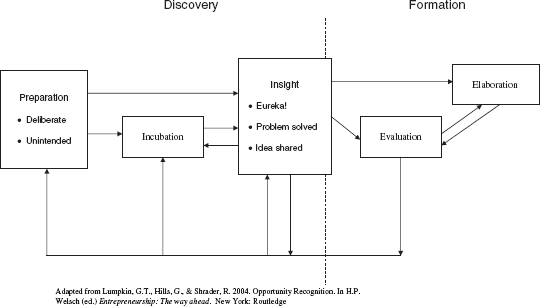
Creativity–Based Model of Opportunity Recognition
Their creativity–based model of opportunity recognition is based upon Csikszentmihalyi's (1996) basic elements of creativity—preparation, incubation, insight, evaluation, and elaboration. Corresponding to Shane and Venkataraman's (2000) primary components of opportunity recognition, Lumpkin et al. dissect their model into discovery and formation phases. The discovery phase includes preparation, incubation, and insight, while the formation phase includes evaluation and elaboration. As noted by the arrows, the model was built to represent an ongoing recursive process.
Knowledge, experience, and cognitive actions play primary roles during the discovery phase of this model. Lumpkin et al. explain that during preparation, individuals rely on their prior knowledge (Shane, 2000) but that this preparation process is neither planned nor intentional. Individuals may not know yet that they are going to start a venture so this preparation may in fact just be activities associated with their “normal” daily routines. During incubation, individuals cognitively process thoughts subconsciously (Csikszentmihalyi, 1996) while they are thinking about an idea or working to solve a problem. During insight, the individual has a breakthrough, “Aha!” moment. At this time, a cognitive shift takes place as the individual begins to consciously realize that he may have identified an opportunity to break an existing means—end relationship (Gaglio & Katz, 2001; Shane, 2000).
Lumpkin et al.'s formation phase includes the last two steps of the model, evaluation and elaboration. In evaluation, would–be entrepreneurs test the opportunity with regard to market acceptability, financial returns, and resource availability. During evaluation, entrepreneurs talk to many individuals in their network and try to assess whether the concept is worth pursuing. Lumpkin et al. state that during elaboration, the creative insight is actually realized. It is at this stage that true formal business planning may begin or the venture may be launched. Bhave (1994) reports that opportunity may be formally converted into a venture even though the details are not yet finalized; the organization will evolve and formalize over time.
A Learning Perspective
Baron (2004) states that everything we say, think, and do are affected by how we acquire, store, transform, and use information. He argues that the manner in which individuals differ with respect to these mental processes may affect entrepreneurial abilities. As shown above, the opportunity identification literature is replete with discussions of experience, creativity, knowledge, and cognition; and these works address how we “store, and use information” to pursue opportunities. There is little about how we transform information and nothing directly addresses how we acquire information, i.e., learn. Lumpkin, Hills, and Shrader build a recursive model that implies learning during the evaluation step but their focus is on the importance of creativity. To date, no one has directly addressed Hamel and Prahalad's (1996) question regarding the role that learning plays in finding and exploiting new opportunities. Using ELT, the current study augments the extant body of research by directly addressing how individuals acquire and transform information within the process of opportunity identification and exploitation.
Experiential Learning Theory and Entrepreneurship
Experiential Learning Theory
Kolb (1984) defines experiential learning as a process by which knowledge is created through the transformation of experience. Figure 2 is a representation of Kolb's model of experiential learning and shows that individuals learn through experience, reflection, thought, and experimentation (the outside loop). This cycle involves four learning modes—concrete experience, reflective observation, abstract conceptualization, and active experimentation. The inner poles refer to how one acquires and transforms information (on the vertical and horizontal axes, respectively) feeding into the process on the outer ring.
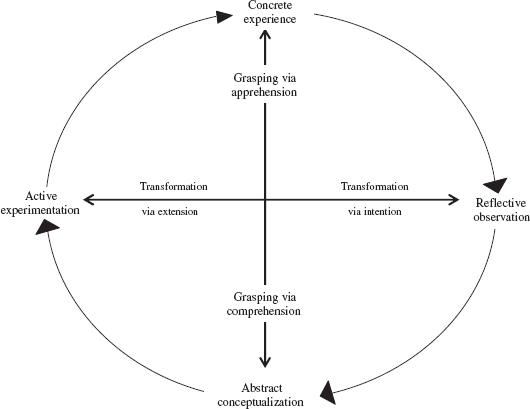
Kolb's Model of Experiential Learning
Kolb's concept of prehension, as reflected on the vertical pole in Figure 2, refers to the two different ways in which an individual can acquire information in the world—either through direct experience or through a recreation of experiences. Apprehension is a reliance on the tangible, felt qualities of immediate experience. Comprehension refers to a reliance on conceptual interpretation and symbolic representation. Kolb (1984) uses the example of what you are doing right now—reading—to illustrate the differences in these two concepts.
If you put down this book, get up from the chair, and leave the room, your apprehensions of that situation will vanish without a trace (substituted for, of course, by new apprehensions of the hallway or whatever new immediate situation you are in). Your comprehension of that situation, however, will allow you to create for yourself and communicate to others a model of that situation that could last forever. Further, to the extent that the model was accurately constructed from your apprehensions, it allows you to predict and recreate those apprehensions. (1984, p. 43)
Similarly, Kolb explains that the dimensions of transformation of experience that are expressed on the horizontal axis in Figure 2 are diametrically opposed. Some people tend to transform via extension, which means that they learn through actively testing their ideas and experiences in the real world. Others transform via intention where they internally reflect upon the different attributes of their experiences and ideas.
Taken together, Kolb shows that these two dimensions of grasping and transforming information result in four ways of learning and creating knowledge. When an individual grasps experience through apprehension and transforms through intention, he or she creates divergent knowledge. Experience grasped through comprehension and transformed through intention creates assimilative knowledge. When an individual grasps through comprehension and transforms through extension, he or she creates convergent knowledge. Lastly, when one grasps experience through apprehension and transforms it through extension, accommodative knowledge results.
Kolb and others (Kolb, Boyatzis, & Mainemelis, 2000; Mainemelis, Boyatzis, & Kolb, 2002) state that individuals learn best when they can cycle through all four forms of learning as represented by the outside curved arrows in Figure 2. Kolb also, however, provides typology of learning styles—the converger, diverger, assimilator, and accommodator—and suggests that individuals have a preference for one over the others. The assimilator grasps experience by thinking and theorizing and transforms it by watching and reflecting. The converger grasps by thinking and theorizing and transforms via doing and applying. The diverger grasps by feeling and doing and transforms by watching and reflecting. The accommodator grasps experience by feeling and doing and then transforms via doing and applying.

Kolb's Learning Styles
It should be reiterated that these learning modes are relatively fixed states. Individuals may acquire and transform information in all manners, but each of us tends to rely on one mode over the others. Kolb states, “Through their choices of experiences, people program themselves to grasp reality through varying degrees of emphasis on apprehension or comprehension” (1984, p. 64). Each individual also has a preference for transformation. Jung (1977) states that we all tend to have a preference for different learning mechanisms and that the complex interactions of our minds and the chaos of the environment in which we live help explain why there is great variability in the learning process.
Outer circumstances and inner disposition frequently favor the one mechanism, and restrict or hinder the other; whereby a predominance of one mechanism naturally arises. (Jung, 1977, p. 12)
Experiential Learning Theory and Entrepreneurship
Greeno, Collins, and Resnick (1996) report that theories of learning fall into three broad categories: behavioral, cognitive, and situative. Each of these learning perspectives frames knowledge and learning in different but complementary manners. Table 1 details the general tasks associated with each perspective as well as the environment in which each learning theory is best suited. ELT can be considered a cognitive and situative learning theory because individuals transform (using cognitive properties) their experiences (situative) into new knowledge. Theories of behavior tend to overemphasize outcomes, routine, and the importance of having one proper response to each stimulus. As Kolb notes, ELT is in stark contrast to behaviorist learning theories.
Tasks and Environment of Different Types of Learning
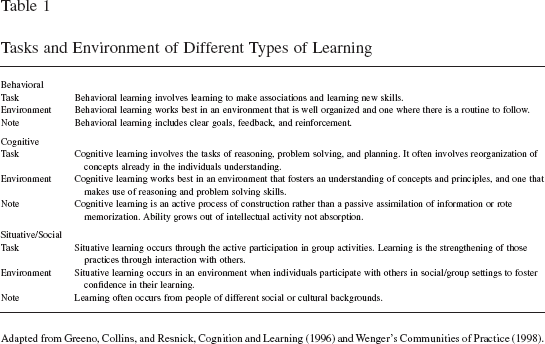
Adapted from Greeno, Collins, and Resnick, Cognition and Learning (1996) and Wenger's Communities of Practice (1998).
When viewed from the perspective of experiential learning, the tendency to define learning in terms of outcomes can become a definition of non–learning, in the process sense that the failure to modify ideas and habits as a result of experience is maladaptive. The clearest example of this irony lies in the behaviorists axiom that the strength of a habit can be measured by its resistance to extinction. That is, the more I have “learned” a given habit, the longer I will persists in behaving that way when it is no longer rewarded. (Kolb, 1984, p. 26)
The idea of transforming experience and not focusing on outcomes is crucially important as to why ELT fits well with entrepreneurship and behavioral theories do not. Behavioral theories may prove quite useful when an organization is trying to attain operational excellence in its processes or manufacturing. However, theories of this ilk reward those that follow the routine and status quo; these theories explain well the activities in organized and defined environments with clear goals, feedback, and reinforcement. This is the antithesis of entrepreneurship.
Both start–up entrepreneurs and those in charge of strategic renewal in large organizations cannot rely on behavior and habit if they intend on surviving. To succeed, they must learn through their experiences and seek out new opportunities. ELT relies on the cognitive and situative concepts of thinking, feeling, doing, and watching. ELT focuses on the process. By transforming experience into new knowledge, ELT allows individuals to discover new outcomes from their learning, which is just what entrepreneurs do when they are attempting to uncover new means—ends relationships (Shane & Venkataraman, 2000).
Realizing this, we can see why ELT may shed light on the process of entrepreneurship. However, not all experiential learning are the same; Kolb illustrates that individuals tend to have a preference for one of four different experiential learning modes. Taking all of this into account, I propose that individuals with different learning modes will perform better during different parts of the entrepreneurial process. Specifically, I detail in the next section how each of these learning modes maps onto different parts of the opportunity identification and exploitation process. Lumpkin, Hills, and Shrader model of the opportunity recognition process details four active steps (preparation, incubation, evaluation, and elaboration; I do not include the insight stage because it is more of a reaction to learning, a moment in time, not an active step) and suggests that each step requires different learning and knowledge expertise. By transposing Kolb's learning modes on Lumpkin et al.'s model, I illustrate the importance of understanding learning as part of the process of opportunity identification and exploitation.
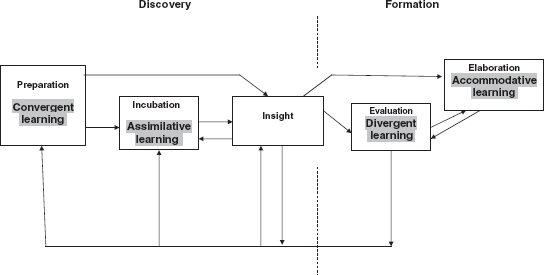
Creativity-Based Experiential Learning Model of Opportunity Recognition
Experiential Learning, Creativity and Opportunity
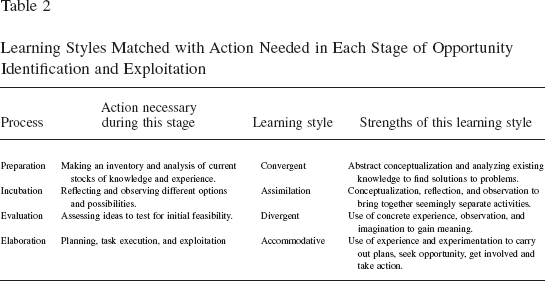
Lumpkin et al.'s model is designed to show that the process of opportunity recognition is inherently creative and that there are four subprocesses (preparation, incubation, evaluation, and elaboration) and one event (insight). While the authors’ focus is on creativity, the authors imply that learning is occurring throughout the model, as evidenced by the recursive lines. In the following sections, I augment the Lumpkin model to explicitly show what type of experiential learning is best suited for each part of the model and develop propositions based upon these connections. Table 2 illustrates how different types of learning matches with the required action needed in each phase of the Lumpkin's creativity model for opportunity recognition.
Learning Styles Matched with Action Needed in Each Stage of Opportunity Identification and Exploitation
Preparation and Convergent Learning
Lumpkin et al. explain that preparation refers to the stocks of knowledge that an entrepreneur brings to the process of opportunity identification. As other researchers have shown, prior knowledge is an important part of the entrepreneurial process (Ronstadt 1988; Shane, 2000). This knowledge can take many forms—work experience, training, knowledge of markets, knowledge of customer problems, and so on. The prior explanation of Kolb's (1984) theory of experiential learning shows that those who tend toward a convergent learning style may be best equipped to excel during the phase of preparation.
The convergent learning style relies on the abilities of abstract conceptualization and active experimentation. On first blush, Lumpkin, Hills, and Shrader's preparation stage might appear to be relatively passive and in contradiction to this active mode. However, while convergers are continually thinking and doing, they are not necessarily acting in relation to a specific idea or opportunity. The ongoing convergent learning is just preparing them to develop technical solutions and a platform for initial ideas. Convergers prefer to deal with technical tasks and problems as opposed to social and interpersonal issues (Hudson, 1966). These individuals are happiest when they are attempting to solve problems or find the “one correct” technical answer (Torrealba, 1972). People with specific technical knowledge are generally better equipped to discover initial technical ideas (Corbett, 2002). Convergers in the preparation stage will be able to find a solution that will become the idea or platform for later incubation into a true product or service opportunity.
Incubation and Assimilative Learning
Lumpkin's subprocess of incubation is the period when new combinations (Schumpeter, 1934) emerge from the simmering pot of prerecognition stew (Gaglio & Taub, 1992). This is not a problem solving stage but a time when options and possibilities are being considered (Lumpkin et al., 2004). The incubation period is marked by time when the individual is not specifically focused on the problem but reflecting, resting, or observing some other unrelated activity (Campbell, 1985).
Assimilators are excellent at pulling together disparate observations and building these seemingly separate activities into coherent models (Grochow, 1973). The assimilators’ dominant learning abilities lie in abstract conceptualization and reflective observation (Kolb, 1984). In this assimilative orientation, ideas are judged less by their practical value as it is more important that the theory behind the idea is logically sound and precise. As such, this perspective matches well with the incubation phase where ideas are still being “cooked” and the organization is still far from developing finished products that must meet the practical value of a demanding marketplace.
Evaluation and Divergent Learning
The evaluation period is where the rubber meets the road. Csikszentmihalyi (1996) suggests that this stage is the most challenging because it requires entrepreneurs to be brutally honest with themselves; they must assess whether they have just a good idea or a truly viable business opportunity. This is the stage were ideas are often tested through feasibility analysis, initial market testing, financial review, and feedbacks from trusted advisors within their business or personal network (Bhave, 1994; Gaglio & Taub, 1992; Singh, Hills, Hybels, & Lumpkin, 1999). Evaluation is the most explicit “learning” stage in the Lumpkin et al. model. Lumpkin et al. suggest that entrepreneurs can learn during evaluation and this learning can tell whether they can move forward or need to loop back to preparation and incubation.
Divergers have the opposite strengths of convergers: divergers emphasize concrete experience and reflective observation. They have strong imaginations and an ability to read people and situations through an awareness of meaning and values. Kolb (1984) tells us that divergers can take concrete situations from many perspectives and organize the many resulting relationships into a meaningful gestalt. With all of these traits and behaviors, divergers are well equipped to perform during the evaluation phase. They have “people–orientation” and should be able to take in all of the divergent information from the market testing, financial analysis, and so on to hone in on the fit between the opportunity and the marketplace.
Elaboration and Accommodative Learning
Business planning and tasks revolving around organizational structure are developed and modified during this stage (Lumpkin et al., 2004). Lumpkin, Hills, and Shrader also note that the elaboration stage can be viewed as the exploitation of the opportunity. Kao (1989) states that it is during this stage that value is captured from the creative act. In this stage, final options are selected and resources are organized (Csikszentmihalyi, 1996) for the going concern.
The strengths of individuals who tend toward the accommodative style are opposed to assimilators. Accommodators emphasize concrete experience and active experimentation—they are the doers! As Kolb notes, “The greatest strength of this orientation lies in doing things, in carrying out plans and tasks and getting involved in new experiences. The adaptive emphasis of this orientation is on opportunity seeking, risk taking, and action” (1984, p. 78). The learning style of these individuals is a tight fit with the task of exploitation.
In summary, it can be seen that certain learning styles can be more effective during different phases of the opportunity identification and exploitation process. The propositions put forth above illustrate, but by no means exhaust, the lines of inquiry that could be developed from applying ELT to the process of entrepreneurship. To the extent which all or any of these propositions can be verified in empirical research, they provide a foundation for more in–depth examinations of learning and the opportunity identification process.
Implications of an Experiential Learning Perspective for Entrepreneurship
Previous research has articulated the contributions of prior knowledge, creativity, and cognitive mechanisms to the process of entrepreneurship. Ward (2004) emphasizes that the way each individual creatively processes and uses one's knowledge affects the opportunities one can uncover. Baron (1998) and Mitchell et al. (2000) theorize that some people recognize opportunities where others do not due to their differences in cognitive processing. Shane (2000) tells us that people recognize different opportunities due to knowledge asymmetries—the fact that we have differing stocks of knowledge. But how do these knowledge asymmetries come about in the first place? Learning. Knowledge is a function of how we learn and I argue that in addition to knowledge asymmetries and differences in cognitive abilities, the entrepreneurship literature would benefit from a further investigation of learning asymmetries. By bringing a learning perspective to the process of opportunity identification and exploitation, this article demonstrates the likelihood that differences in learning matter! They matter with respect to an individual's ability to initially identify opportunities and they matter with respect to an entrepreneur’ ability to adapt and learn as he or she progresses through the process of entrepreneurship.
Specifically, the major themes of this article can be summarized in the following manner: (1) learning—the manner in which individuals transform their experiences, expertise, and prior knowledge into new insights and new knowledge—is an important and understudied aspect of entrepreneurship research; (2) individuals learn in different ways and these differences are important with regard to who identifies what opportunities; and (3) different learning styles may be more or less effective during different stages of the opportunity identification and exploitation process. That being said, even if these assertions are true, what is their value to the future of entrepreneurship research? Practitioners? Educators?
Research Implications
For researchers, the broad implication of this article is the need for more work examining learning and the opportunity identification process. This article proposes that individuals who rely on different manners of learning will be more or less effective during different stages of the opportunity identification process. Future work that attempts to validate these propositions is needed. Additionally, while the traditional view of experiential learning posits that each of us tends toward one preferred style, more recent speculation suggests a more complex approach (Kolb et al., 2000; Mainemelis et al., 2002). According to this view, individuals will tap each of the learning styles depending upon the context and content of what is being experienced. The flexibility and adaptability afforded to individuals from this perspective could provide great insights into the learning of entrepreneurs. Entrepreneurs have to wear many hats to be successful and future work examining the flexibility of entrepreneurs’ learning styles could help explain the variance between those who succeed and those who do not.
Additionally, while experiential learning was used in this article, tapping into the greater and more diverse body of learning research can provide entrepreneurship scholars with many new conceptual tools. Evidence that experiential learning and other learning perspectives may prove useful can be found by looking at other domains within the field of management. Theories from learning have previously been successfully explored and utilized in other areas within the field of management, such as organizational behavior (Cohen & Sproull, 1996), knowledge transfer (Argote, 1999), and corporate strategy (Quinn, 1980). There is no reason to believe that more in–depth studies of learning would not benefit the field of entrepreneurship.
In fact, Busenitz, West, Shepherd, Nelson, Chandler, and Zacharakis (2003) argue that future research needs to be at the intersection of individuals, opportunities, and their modes of organizing. It can be argued, and I believe, it is exactly at this intersection where learning occurs! As such, there seems to be no reason to believe that a learning perspective would not also help clear some of the fog that surrounds the process of bringing new ventures to light. Encouraging this broader stream of “entrepreneurial learning research” is one of the primary objectives of this article.
More specifically, the learning perspective put forth in this article has implications for other research domains within entrepreneurship including teams, corporate venturing, professional service providers (financiers, vendors, suppliers, and other partners), and serial entrepreneurs. Entrepreneurial teams, not individuals, drive the new venture– creation process (Kamm, Shuman, Seeger, & Nurick, 1990). Experiential learning and the model developed herein can be used to further explain why this is so. As discussed, we all learn differently and different learning modes work better during different parts of the opportunity identification and exploitation process. Perhaps, it is that we need all “types” of learners on our team to identify and successfully exploit opportunities. With regard to corporate venturing research, a learning perspective could help further the research that examines selection and recruitment to internal venture teams. Empiricists could examine the use of learning scales to select members to intrapreneurial venture teams. Research that examines an entrepreneur's successful use of his or her network of service providers could examine learning to understand its contribution to this success. For example, are certain learners more equipped than others to communicate their idea, negotiate terms, understand others needs, or simply get things done with the help of others due to the manner in which they transform their experiences and interactions with these partners (i.e., learn)? Lastly, cognitive style has been shown to be a contributing factor in why some entrepreneurs start more than one venture (Brigham, 2001; Brigham & DeCastro, 2003). The learning perspective put forth in this article could augment this research by examining the effect that learning has on an individual's decision to leave one venture and start another. As a venture matures and more routine practices are put in place, situative and cognitive learning may become less important than behavioral learning. A question for researchers to address could be: do serial entrepreneurs gravitate away from behavioral learning and does this contribute to why they exit one venture to begin another? In summary, by adding a learning perspective to each of these inquiries (and numerous others, no doubt), scholars should be able to better understand the entrepreneurial process.
Practitioners
The model developed herein can help aspiring entrepreneurs understand that how they learn is related to their abilities during the identification and exploitation process. Since most research shows that successful ventures are started by teams, this understanding can help nascent entrepreneurs as they build their teams. The importance of entrepreneurial (and intrapreneurial) team building combined with learning cannot be understated. Convergers and their ability to develop specific technical solutions are best suited for the preparation phase as research and development specialists. Assimilators, with their ability to pull together disparate ideas can perform the role of product development. Divergers are superior at developing specific alternatives and could play the role of market developers on an entrepreneurial team. Finally, the action focus and people perspective of the accommodators would be best suited for the task of sales and new business development. Understanding the differing learning styles of individuals is important for all practicing entrepreneurs working in teams because matching the learning orientations of individuals to specific roles could provide optimal results.
Entrepreneurial Education
The article demonstrates that learners of all types can find a role within the process of starting a new venture. Each of the learning styles has a fit with some particular function throughout the process of identifying and exploiting an opportunity.
While it is true that some entrepreneurs do not go through all of the phases detailed here when launching their venture (Timmons, 1994), this point should bolster the resolve of all nascent entrepreneurs and the educators who guide them. Since we all have a tendency toward one learning style, we are by definition less dependent upon the others. However, since all phases of the process (and all learning styles strengths) are not always required to launch a venture (perhaps because actions in the market or other actors have fulfilled a particular role), anyone who truly wants to be involved in starting a venture should have the learning ability to do so.
With regard to a learning perspective on entrepreneurship, the role of the educator should be to first help each student uncover their learning style strengths. Armed with this knowledge, the student can then focus on not just discovering new opportunities but also on searching for opportunities that best fit his or her strengths as a learner. Additionally, by just providing students with information on a learning perspective for entrepreneurship, educators can help understand the need for building a team with diverse learning styles.
Lastly, a learning perspective on entrepreneurship suggests that alterations to the current manner in which educators teach entrepreneurship is warranted. In addition to the current focus on developing ideas and crafting business plans, perhaps courses should focus more on the process and how ideas change shape over time. Venture capitalists and others that screen and validate entrepreneurial ideas constantly focus on the importance of the people on the team as opposed to the idea because they know that over time environmental forces will almost always change the an entrepreneur's original concept. Therefore, educators might consider balancing their curriculum to align their courses with this reality. Students should learn more about how to adapt their original ideas in response to market learning. Courses that focus more on learning, improvising, and adapting in reaction to changes suggested by potential customers and other actors in the marketplace may provide additional value to students. To do this, educators can test the students’ ability to learn in different manners by using scenarios, role plays, and experiences that tap each individual's ability to grasp and transform experiences in each of the four manners delineated in the experiential learning model. This focus on the process—and learning from market feedback—should complement well the educators’ other modules on creativity, scanning, business planning, and so on.
Conclusion
Many scholars have made important contributions to the understanding of the process of entrepreneurship by investigating various constructs related to knowledge, experience, cognition, and creativity. The heightened understanding that was provided in this article of the nuances between learning and these constructs gives scholars, practitioners, and educators an appreciation for the importance of learning within the entrepreneurial domain. Finally, I submit that the most important contribution of this article is its articulation of the concept of learning asymmetries and its importance to the entrepreneurial process.