







Abstract
The purpose of this study was to explore how three different human resource variables affect employment growth of small–scale enterprises: human capital of business owners, human capital of employees, and human resource development and utilization. The literature suggests different models of how these human resource variables affect business outcomes. Longitudinal data from 119 German business owners provided support for a main effect model indicating that owners’ human capital as well as employee human resource development and utilization affect employment growth. Moreover, human resources development and utilization was most effective when the human capital of employees was high. We conclude that human resources are important factors predicting growth of small–scale enterprises.
Introduction
The resource–based view of organizations explains variations in firm performance by variations in firms’ human resources and capabilities (Hitt, Bierman, Shimizu, & Kochhar, 2001). In entrepreneurship research, the human element has received attention recently and there is increasing research effort and theorizing on this topic. Human capital attributes (education, experience, skills), in particular those of the business owner, have been argued to be a critical resource in small firms (Pfeffer, 1994) that affects small business performance (Rauch & Frese, 2000). To achieve a competitive advantage, firms need to generate specific knowledge because specific resources are unique and difficult to imitate (Barney, 1991). One way to generate firm–specific resources is human capital development (Lepak & Snell, 1999). The research presented here contributes to the resource–based view because we try to specify relationships between human capital, human resource (HR) development and utilization, and business performance. By looking at the fit between persons and processes, this study tries to specify the intermediate and boundary conditions of human resources and small business success.
Thus, HR development and utilization helps small–scale enterprises to succeed. Our study analyzed the effects of human resources on entrepreneurial success, specifically on employment growth in small firms. Although some reviews concluded that sales growth is the best measure of growth in most situations (Davidsson & Wiklund, 2000; Weinzimmer, Nystrom, & Freeman, 1998), we think that employment growth is an important measure in our study. First, there is a theoretical link between the independent and dependent variable because both human capital and HR development and utilization refer to the people in the firm. Thus, we hypothesize that businesses interested in employment growth invest in human resources in the firm. Sales growth, on the other hand, can theoretically be achieved by strategies other than employment and human resources. Second, employment growth has a link to business success and is, therefore, an important criterion variable. Finally, employment growth is a criterion that reflects lagged performance. Sales change more rapidly with demands than do the number of employees and employment is likely to take place when sales levels become more stable (Delmar, 1997, p. 202). Since human resource strategies do not pay off immediately (Black & Lynch, 1996; Boxall & Steeneveld, 1999; Welbourne & Andrews, 1996), employment growth is an important variable for studying the long–term effects of human resources. These arguments imply that a cross–sectional study may not be able to detect the long–term effects of human resources. Therefore, this paper reports a longitudinal investigation of small–scale enterprises, which goes one step further in the causal analysis (Cook & Campbell, 1979).
Human resource issues have been mainly studied in larger firms. To our knowledge, there are no studies about the relationship between the human capital of business owners and employees, HR development and utilization, and growth of small–scale enterprises (up to 50 employees). It may pay off theoretically as well as methodologically to study human resources in small–scale enterprises. First, there are differences in human resource practices between firms of different sizes (Deshpande & Golhar, 1994). Second, small enterprises do not usually have different subunits with their own traditions of human resources practices. Third, small firms usually do not even have a human resources department, and information gathered from smaller firms may be less biased than data gathered from a larger firm's human resources department, biases which may also reflect “political” interests instead of implemented practices (Welbourne & Andrews, 1996). Finally, small enterprises show a high degree of variation in size and growth (Reynolds & White, 1997). Consequently, true effects appear more easily and cause and effects of relationships are easier to establish.
Theoretical Development and Hypotheses
Human Capital of Small–Scale Business Owners and Employees
Human capital relates to the human resources people bring to the firm (Wright, Dunford, & Snell, 2001). We conceptualize human capital as consisting of the education, experiences, and skills at a given point in time (Boxall & Steeneveld, 1999) that help in the tasks of getting one's work done. Traditional human capital theory research focused on employees’ human capital and its effect on earnings (Becker, 1980). Later the theory has been applied to small–scale businesses as well, where human capital is usually conceptualized as a characteristic of the business owner (Bruederl, Preisendoerfer, & Ziegler, 1992).
Relationships between education and experience of small business owners and success have been studied extensively (Cooper, Gimeno–Gascon, & Woo, 1994; Dyke, Fischer, & Reuber, 1992; Lussier, 1995; Reynolds & Miller, 1989; Van de Ven, Hudson, & Schroeder, 1984). A positive effect of human capital on small business success is empirically well established (see reviews by Cooper & Gimeno–Gascon, 1992; Rauch & Frese, 2000). We, therefore, hypothesize:
The theoretical assumptions of human capital theory should hold for employees as well. Human capital of employees leads to more efficient work and this should, in turn, affect business success. While entrepreneurship research studied human capital of business founders/owners, human capital of employees in small enterprises has been widely ignored. One study showed that the average educational level in private firms is related with business productivity (Black & Lynch, 1996). We, therefore, hypothesize:
HR Development and Utilization
HR development and utilization refers to the practices used for enhancing employee skills through training and other forms of knowledge and skill enhancement (Lepak & Snell, 1999). Therefore, HR development and utilization improves the human capital that people bring with them to the firm. The empirical literature does not agree on how to define human resource practices (Chandler & McEvoy, 2000, p. 45) and much of research on human resource practices in small–scale businesses is purely descriptive (see e.g., Golhar & Deshpande, 1997; Heneman, Tansky, & Camp, 2000; Hornsby & Kuratko, 1990; McEvoy, 1984). To conceptualize HR development and utilization, we draw on the resource–based perspective and human resources management. Both perspectives lead to similar conclusions regarding the management of internal resources. Additionally, both approaches focus on strategies and management initiatives to utilize and develop unique skills and on knowledge to achieve organizational goals and outcomes.
The resource–based perspective argues that traditional resources, such as financial capital or access to technology, are less important because they are easier to imitate than human resources (Neal & Hesketh, 2002). Thus, competencies that are rare, unique, nonimitable, and nontransferable help to achieve competitive advantages and facilitate business success (Lepak & Snell, 1999). Such competencies are developed internally and include processes such as cooperation, participation, and development (Boxall & Steeneveld, 1999). The aim is to create a talented and committed workforce.
Human resources management involves practices that ensure that firms’ human capital (i.e., employees’ knowledge, skills, and abilities) contributes to business outcomes (Huselid, Jackson, & Schuler, 1997, p. 171). The theoretical literature suggests that human resource management increases productivity by increasing employees’ skills and motivation (Huselid, 1995, p. 638). Research on larger companies supported the basic assumptions of human resource management theory (Arthur, 1994; Huselid, 1995; Huselid et al., 1997) and, more recently, research on smaller companies also indicated positive effects of human resource practices (Chandler & McEvoy, 2000; Welbourne & Andrews, 1996). Practices empirically related to success include employee participation, empowerment, communication, and development (Arthur, 1994; Chandler & McEvoy, 2000; Huselid et al., 1997; Welbourne & Andrews, 1996).
Based on the two approaches discussed above, this study relates four concepts to HR development and utilization: training/development of employees, decision–making involvement, support for personal initiative, and goal communication. Training and development of employees is important because the small firm is not likely to find specific and unique skills in the labor market (Lepak & Snell, 1999). Therefore, these skills need to be developed internally. Additionally, employee development helps to shape employees’ behavior and attitudes in such a way to make them consistent with organizational goals. Decision making involvement helps to create ongoing commitment from employees, which in turn affects performance (Arthur, 1994; Huselid et al., 1997; Lepak & Snell, 1999). Support for personal initiative can be seen as an attempt of empowering employees because personal initiative describes extra role behaviors such as having more responsibility, working independently, and controlling one's own work independently (Frese, Fay, Hilburger, Leng, & Tag, 1997). Empowering employees is related to business outcomes (Arthur, 1994; Huselid et al., 1997). Goal setting is a main motivator in organizational settings and predicts performance (Locke & Latham, 1990). The theory applies in small–scale enterprises as well (Baum, Locke, & Kirkpatrick, 1998). Baum et al. (1998) showed that the effects of goals are partially mediated by goal communication. Thus, at this point we hypothesize that:
HR Development and Utilization Mediating Human Capital–Success Relationships
Up to now our discussion has focused on the main effects of owners’ and employees’ human capital as well as HR development and utilization. While the positive effects of the human capital of business owners on business success are empirically well established (Bruederl et al., 1992; Cooper et al., 1994; Lussier, 1995), there is little empirical knowledge about “how” and “why” these effects occur. One theoretical assumption is that human capital acts as a resource to the small firm (Bruederl et al., 1992). It makes business owners/employees more efficient in doing their work, which results in business success. Thus, there are processes that are an outgrowth of education and experiences. We argue that the effects of human capital are mediated by HR development and utilization. Human capital by the business owner can lead to HR development and utilization because better–educated business owners emphasize education more and, therefore, provide more opportunities for their employees to develop than less educated owners. Moreover, they are better in employing strategies to utilize the knowledge of their employees. HR development and utilization leads to employment growth (Arthur, 1994; Huselid, 1995; Lepak & Snell, 1999). Employee human capital leads to a higher degree of HR development, because high knowledge and skills lead to motivation and knowledge about how to develop new skills and how to utilize these skills and knowledge more successfully. Thus, HR development and utilization mediates the relationship between human capital of employees and employment growth.
At first sight, our theorizing seems to contradict some reasoning in resource–based theorizing. We assume that the human capital of owners and employees affects HR development and utilization. This effect is usually not studied because most authors in the field assume the causal path to operate in the other direction: Human resources practices increase firms’ human capital (Boxall & Steeneveld, 1999; Way, 2002; Wright et al., 2001). While this position is plausible, we are studying a different mechanism that is also compatible with resource–based theorizing, namely the path from human capital to HR development and utilization. Both causal paths may operate at the same time in the form of reciprocal causation: high human capital may affect HR development and utilization, which in turn, may affect human capital. However, we were interested in precisely the path that is more rarely discussed and researched. Human capital at any one point in time can be a predictor and a result of HR development and utilization. In our study, we only examine the path from human capital to HR development and utilization. Methodologically, we cannot investigate the reverse effect in our study because we use schooling and experiences of the owner prior to self–employment as one main operationalization of human capital. Therefore, we hypothesize:
Human Capital as a Moderator of HR Development and Utilization
According to contingency theory, the effect of human resource practices depends on the context (Chandler & McEvoy, 2000). Most often the relevant literature reports studies of the fit between human resource practices and business strategy (Ferris, Hochwater, Buckley, Harrell–Cook, & Frink, 1999). We would like to complement this literature by looking at a different moderator: employees’ human capital. We argue that the effect of HR development and utilization on employment growth depends on the level of employees’ human capital already present in the firm: employees with higher levels of education have higher intellectual potential to learn and accumulate general knowledge (Hitt et al., 2001) as well as firm–specific skills and knowledge (D'Aveni, 1996). They also make use of HR development more effectively than employees with a low degree of human capital, for example, because they develop better goals and can better contribute to decision making. Therefore, business success (employee growth) is increased. At first sight, it may seem conceptually difficult that an independent variable now becomes a moderator. However, this is often the case (just think, for example, of gender) in many areas of research. The moderator effect is plausible only of employees’ and not of owners’ human capital, because HR development and utilization refers to the employees:
Alternative Models of Human Resource Effects on Employment Growth
As our hypotheses are in part rival, we will not test them all in one model. Instead, this study aims to test three different models of the relationship between human capital, HR development and utilization, and employment growth: a direct effect model, a mediator model, and a moderator model (Figure 1). These models are not contradictory but can all be partially true. The validity of the direct effect model (Model 1) is a prerequisite of the mediator model. However, the mediator model (Model 2) is the more parsimonious model because it reduces the number of causal paths although both a mediator and a moderator model (Model 3) may be valid (Baron & Kenny, 1986).
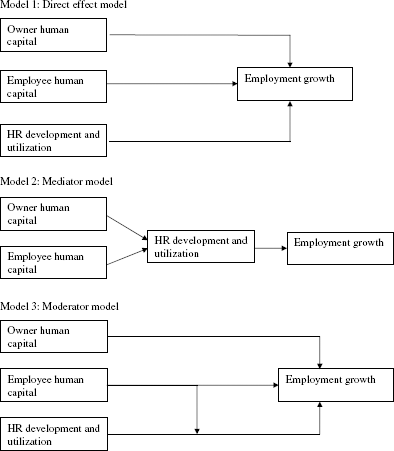
Three Alternative Models of Human Resource Effects on Employment Growth
Model 1 implies direct effects of the three constructs, owners’ human capital, employees’ human capital, and HR development and utilization, because they all contribute to the firms’ resource advantage and, thus, relate to business performance (employment growth). The mediation model assumes that the owners’ and the employees’ human capital act as a resource to make the development and utilization of HR more likely, which, in turn, leads to employment growth (Bruederl et al., 1992). Model 3 is a contingency model assuming that employee human capital acts as a moderator of the relationship between HR development and utilization and employment growth. This is a rather new approach since most contingency models by proponents of the resource–based view (Hitt et al., 2001; Wright et al., 2001) refer to human resource management— strategy interactions (Youndt, Snell, Dean, & Lepak, 1996). Model 3 assumes that this moderator effect of human capital appears because better educated people have a higher potential to learn and contribute to the success of the company.
Method
Sample
The first part of the study was conducted in 1993. The sample was drawn in Jena in East Germany and in Giessen in West Germany. Both cities are structurally similar: university cities with approximately 75,000 inhabitants. The participants were randomly chosen from lists provided by the local Chambers of Commerce (registration of enterprises is mandatory in Germany).
The participants were selected by using four criteria. First, the enterprise had to have at least one and at most 50 employees. 2 This corresponds to the European Union definition of small–scale firms. Second, the enterprise had to have been in operation for at least one year. This criterion was necessary to ensure availability of data about business outcomes. Since self–employment was hardly possible in the former communist East Germany, most enterprises were founded after German reunification in 1990. Third, the participant had to be the founder and owner of the enterprise and fourth, the enterprise had to be an independent or franchise business.
One enterprise had zero employees in 1993. However, this employee had just resigned recently and the owner indicated that he planned to replace him/her soon. Therefore, we kept this enterprise in our analysis.
In the first wave, 201 owners provided both questionnaire and interview data. The response rate was 58%. The second wave of the longitudinal study took place in 1997. Of the original sample, 58 enterprises could not be located again at the time of Wave 2 (experimental mortality 29%). They may have moved, changed companies’ names, or ceased trading. We attempted to locate them, partly by reviewing telephone books or by asking neighbors about the whereabouts of these enterprises. This procedure allowed us to establish that 27 of those enterprises had closed their company. The second wave of the longitudinal study consisted of 119 enterprises. Twenty–four enterprises rejected to participate in Wave 2. The response rate among firms contacted was 83%.
The sample represents relatively newly founded small enterprises. The age of the business ranged from one to five years (mean=2.31). Only one enterprise was founded in 1988, two years before German reunification. In 1993 the number of employees ranged from zero to 48 (mean=6.28). In 1997 the enterprises had 6.46 employees on average (range 0 to 40) and in 1997sales ranged between U.S.$36,361 and U.S.$4,542,756 (mean =U.S.$737,713). 3
In 1993, there were more than 50% missing values on sales figures, partially because these figures were not available in the very newly founded enterprises. Therefore, we did not use sales for analysis purposes.
Data Collection and Coding
The business owners participated in a 1–hour standardized, personal interview. Two raters independently coded the interviews on 5–point scales and their mean ratings were used. The raters were trained to use a coding scheme, which consisted of a definition of each category and anchors defining high and low values in a given category. Additionally, the raters learned to use the coding system by using sample interviews. To ensure independent coding the sample interviews were excluded from subsequent analyses. Inter–rater reliabilities were established using intraclass correlations (ICCs) (Shrout & Fleiss, 1979).
In addition to the interview, business owners were asked to fill in a questionnaire. The questionnaire was left behind after the interview and collected by the interviewer about two weeks later. Computed scales were divided by the number of items. Reliabilities were satisfactory for this type of study (Nunnally, 1978, p. 226); internal consistencies are displayed in the diagonal in Table 2 (in Results section).
Principal Component Factor Structure of HR Development and Utilization
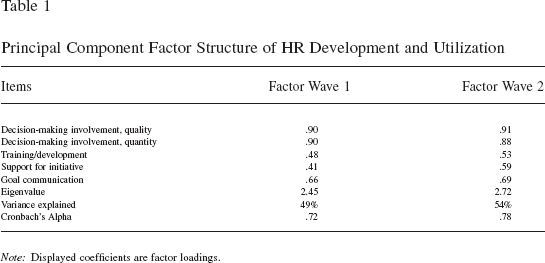
Note: Displayed coefficients are factor loadings.
Intercorrelations of Variables and Partial Correlation Matrix
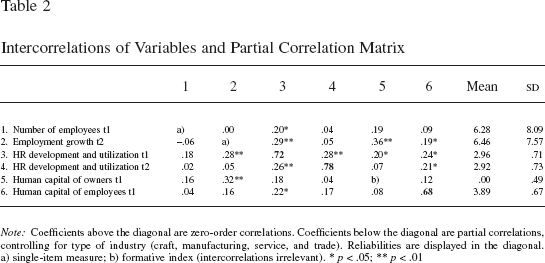
Note: Coefficients above the diagonal are zero–order correlations. Coefficients below the diagonal are partial correlations, controlling for type of industry (craft, manufacturing, service, and trade). Reliabilities are displayed in the diagonal. a) single–item measure; b) formative index (intercorrelations irrelevant).
p < .05
p < .01
Measurements
Owner Human Capital
We measured human capital of business owners in Wave 1. Seven measures related to human capital: in the questionnaire, owners indicated their school degree and degree of vocational training. Interview measures were on owners’ management experience, degree of vocational training of father, prior self–employment experience, prior self–employment in the same type of industry, and having a self–employed father. These measures are causal indicators of human capital, because they influence the amount of owners’ human capital. As a consequence, the measures of human capital are independent, and a change in one indicator does not necessarily imply changes in the other indicators. For example, the correlation between having a high school diploma and experience in prior self–employment is not necessarily high. Nevertheless, high values on the index reflect more knowledge and experiences, and therefore, high human capital. Since intercorrelations are irrelevant in such an index, we did not calculate internal consistencies of owners’ human capital (see for example, Schmidt & Kaplan, 1971, and Becker & Huselid, 1998, for a discussion of the strengths and weaknesses of using an additive index on human resource practices).
Employee Human Capital
To measure the human capital of employees, we did not use an index consisting of school degree and other experiences because business owners were simply not able to recall these facts for each employee. Rather we asked business owners whether or not their employees were qualified to do the work. In Wave 1, two questionnaire items asked business owners to indicate whether or not employees were well trained and qualified for their work. We used this measure as an indicator of human capital of employees and combined both items into a scale.
HR Development and Utilization
Is a factor with four indicators: training/development of employees, decision–making involvement, support for personal initiative, and goal communication. Training/development of employees was an interview measure that asked about courses and training programs provided for the employees. The raters coded the amount of training employees received (1=no training opportunities, 5=regular training opportunities provided for most of the employees). ICCs were .76 in Wave 1 and .80 in Wave 2. Decision–making involvement was measured by quality and frequency. We asked business owners to describe whether or not employees were encouraged to participate in business decisions. Ratings were given on the quality of decision–making involvement (1=no decision–making involvement and 5=involvement in strategic and operational decisions/decisions that concern the organization and not only their own daily work) and on the frequency of decision–making involvement (1=never or extremely rarely, 5=regularly, e.g., once a week in a meeting). ICCs for quality were .87 in Wave 1 and .75 in Wave 2; ICCs for frequency were .89 in Wave 1 and .80 in Wave 2. The degree to which employees were encouraged to take on responsibilities, to work independently, and to control their work themselves was measured by a 7–item scale of support for personal initiative (Frese et al., 1997). Finally, we asked business owners about their goals and objectives and how they communicate business goals and objectives to employees. The ratings were on the degree to which goals and objectives were made transparent to employees (1=no information about business goals and objectives and 5=regular information in meetings/involvement in goal development). ICCs were .73 and .81 for Wave 1 and Wave 2, respectively.
We explored the dimensionality of our HR development and utilization measure by using a principal component factor analysis. These analyses indicated a one–factor solution in both waves (Table 1). Therefore, we computed one scale, which was labeled “HR development and utilization.”
Employment Growth
The number of employees was measured in both waves. Employment growth in Wave 2 was the dependent variable, measured by the average yearly growth in the number of employees during the last three years. Different authors suggest measuring growth by absolute (t2–t1) and relative (t2–t1/t1) measures, respectively (Davidsson & Wiklund, 2000; Delmar, 1997). We decided to use absolute growth because both growth measures were highly correlated in our study (r=.53).
Control Variables
For hypothesis testing, we controlled for the number of employees at the time of Wave 1 when predicting employment growth in Wave 2. By using regression analysis to test our longitudinal hypotheses (Cohen & Cohen, 1975), we were also able to control for a potential overlap between predictor and criterion. For example, bigger enterprises and those planning to increase the stock of employees may place more value in HR development and utilization. Stepwise regression analysis controls for such an overlap between predictor and criterion by controlling for the interrelationship between HR development and utilization and number of employees at Wave 1.
Additionally, we collected control variables on company age and industry type (craft, service, trade, and manufacturing) by single items in the questionnaire. There is evidence that newly founded enterprises have a higher risk of failure than long established ones (Bruederl et al., 1992). Therefore, we controlled for company age. Additionally, our design included various industries and, therefore, we controlled for type of industry. Type of industry was dummy–coded as craft, trade, service, and manufacturing. We additionally tested two dummy variables to control for potential effects of our research design: East Germany/West Germany and independent/franchise enterprises. Since neither of the dummies affected reported results we did not include them as controls for hypothesis testing.
The Timing of Cause and Effects
Doing a longitudinal study requires one to make assumptions about the timing of effects. We argue in line with Welbourne and Andrews (1996) that HR development and utilization affects long–term performance. HR development and utilization is a long–term investment because it focuses on ongoing commitment (Lepak & Snell, 1999) and on knowledge that cannot be developed and transferred immediately or within a short period of time. Thus, developing a firm's human resources is time consuming and, consequently, effects on performance should occur long–term. We measured long–term effects of human capital and of HR development and utilization in 1997, thus, four years after Wave 1. In 1997, the age of the enterprises was on average 6.31 years.
Results
Intercorrelations of variables and descriptive statistics are reported in Table 2. As one can see from the correlation table, human capital of both business owners and employees was positively correlated with employment growth at t2. HR development and utilization at t1 was positively related to employment growth at t2 as well as to owners’ and employees’ human capital. Thus, bivariate correlations were in the expected direction. However, the more interesting result is whether or not HR development and utilization as well as human capital predict changes in employment when controlling for prior success and additional control variables.
Hierarchical regression analyses were used to test the causal hypotheses (Cohen & Cohen, 1975). The set of regression analyses displayed in Table 3 was used to test the direct effect model, the mediation model, and the moderator model. Regression 2 presents results of the main effects of human capital variables on employment growth. The dependent variable was employment growth at t2. Prior success (number of employees at t1) was held constant. Other control variables were included in a second step. In the next step, human capital measures were included into the equation to test whether or not this step leads to a significant R–square increment. Results indicate support for direct effects of human capital variables on employment growth, the overall effect was positive, significant, and increased explained variance was 12%. Supporting our first hypothesis, the human capital of business owners had positive effects on employment growth. The effect of human capital of employees was nonsignificant in multivariate analyses, and therefore, Hypothesis 2 had to be rejected.
Results of Multiple Regressions
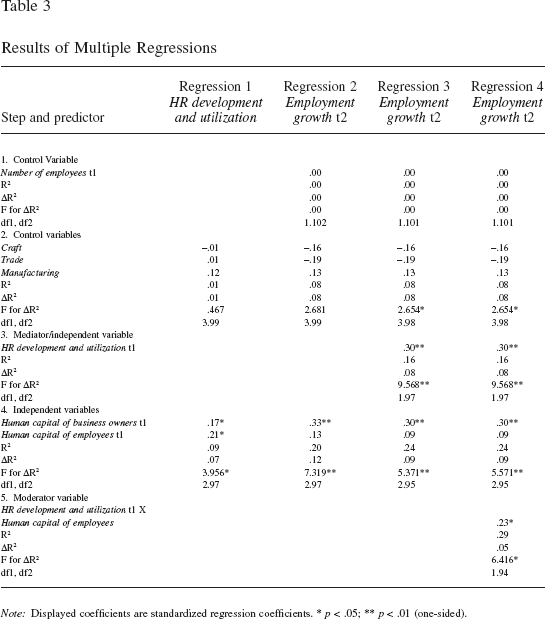
Note: Displayed coefficients are standardized regression coefficients.
p < .05
p < .01 (one–sided).
When we add HR development and utilization into the equation (Regression 3) we found that its effect on employment growth was significant and, therefore, supports Hypothesis 3. It is important to note that the three human resources variables explained 17% variance in employment growth, which indicates some support for the direct effect model.
Hypotheses 4 and 5 stated that the effect of human capital of business owners and employees on employment growth is mediated by HR development and utilization. We tested the mediation model with three regression analyses (Baron & Kenny, 1986). Regression 1 (Table 3) indicated that the human capital variables affect the mediator variable HR development and utilization (ΔR2=.07, p < .05). Regression 2 revealed that owners’ human capital affects employment growth and Regression 3 showed that HR development and utilization affects business success. Thus, the conditions necessary for mediation testing hold for owners’ human capital. As hypothesized, the effect of the human capital variables was less in Regression 3 than in Regression 2. Increased explained variance of human capital variables was 12% (Regression 2). When introducing human capital variables after the mediator variable, increased explained variance was only 9% (Regression 3). The mediation, however, was not perfect as the effect of human capital variables decreased only slightly and the effect of owners’ human capital remained significant after including the HR development and utilization variable into the equation. When we applied the Sobel (1982) test for testing the significance of the indirect effect of owner human capital on employment growth we found that the indirect effect was nonsignificant (z=1.46, p < .14). Therefore, the full mediation hypotheses (Hypotheses 4 and 5) must be rejected; the data give weak support that some mediation occurs alongside with direct effects.
Our moderator hypothesis assumed that high human capital of employees produces a higher effect of HR development and utilization on employment growth than low human capital does. To test this hypothesis, we included the interaction term between HR development and utilization and employee human capital in a fifth step of the regression equation (Regression 4, Table 3). The interaction term increased explained variance in employment growth by 5% (p < .05). It should be noted that interaction effects typically have low power and small effect sizes (e.g., Gully, Payne, Koles, & Whiteman, 2002, p. 149; McClelland & Judd, 1993). We therefore consider the identified moderation to be important (Evans, 1985). Indicating support for Hypothesis 6, HR development and utilization was more effective, when there was high human capital of employees in the firm.
To illustrate the direction of the interaction effect we generated a series of simple regression analyses of HR development and utilization on success at specific values of the moderator (Aiken & West, 1991). For calculating the two regression lines displayed in Figure 2, both HR development and utilization and employee human capital were plotted using one standard deviation above and below the mean. The increasing regression line in Figure 2 indicates that HR development and utilization was related to employment growth when employees were high in human capital. HR development and utilization was not related to employment growth when employees were low in human capital. Thus, our results supported the moderator model: the effect of HR development and utilization on employment growth depends on the level of employees’ human capital in the firm.
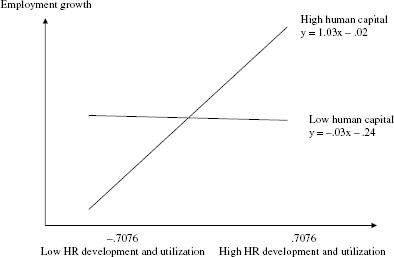
Human Capital of Employees Moderating the Effect of HR Development and Utilization on Employment Growth
Discussion
The aim of the study was to test three different models of the effects of human capital and HR development and utilization on employment growth: a direct effect model, a mediation model, and a contingency model. The results of this study provided strongest support for direct effects of both human capital and HR development and utilization on employment growth. The results provided no conclusive support for the mediation model. Finally, our research found support for the contingency model. Since these effects can plausibly be interpreted as causal effects, we conclude that human resources are important factors producing changes in growth of small–scale enterprises.
Human capital of business owners had effects on employment growth (Hypothesis 1). This replicates findings of other studies, which consistently found small and positive relationships between business owners’ human capital and small business success (Bruederl et al., 1992; Chandler & Hanks, 1994; Cooper et al., 1994; Preisendörfer & Voss, 1990; Sandberg & Hofer, 1987). Human capital of employees was positively correlated with success in bivariate analyses (Black & Lynch, 1996); however, when predicting employment growth in multivariate analyses, its beta weight was nonsignificant (Hypothesis 2). We relied on a global rating of the business owner about the human capital of employees. However, a more differentiated assessment of employees’ skills and knowledge might result in a more fine–grained analysis. For example, resource–based theories would argue that unique and specific knowledge is more important than general human capital. Thus, specific human capital of employees (e.g., industry specific experience) is more predictive for business success than general human capital (e.g., years of schooling or years of working experience).
HR development and utilization consisted of training/development of employees, decision–making involvement, goal communication, and support for personal initiative. These strategies also affected employment growth (Hypothesis 3). This is in line with other studies that show performance to be dependent upon personnel practices in small– and medium–sized enterprises (Chandler & McEvoy; 2000; Kotey & Meredith, 1997; Welbourne & Andrews, 1996). Our results indicated that HR development and utilization had effects on changes in employment up to five years later (Welbourne & Andrews, 1996). In supplement analyses, not reported here, we tested and did not find contemporaneous effects of HR development and utilization but only lagged effects. HR development and utilization is a long–term investment because it continuously trains employees by providing better information and more insight into business decisions as well as business objectives. Consequently, employees work more actively and more efficiently in the long run.
Furthermore, our research tried to specify mechanisms and conditions that affect human capital as well as HR development and utilization. We found no full mediation effect of HR development and utilization (Hypotheses 4 and 5). This is surprising given the assumption that human capital acts as a resource that helps to organize and manage a business more successfully. An alternative explanation of our results would be that the effects of human capital are due to selection effects. Empirical studies on human capital, unfortunately, have seldom analyzed the mechanisms through which human capital leads to business success. Nevertheless, two exceptions have shown that action planning strategies (Frese et al., 2005) and motivation (Baum, 2001) mediate the effects of human capital and owners’ competencies on success. Given this, it is possible that additional and multiple mediators are present. Thus, we need future research to fully reject the mediator hypothesis. An additional alternative hypothesis assumes reverse causality: HR development and utilization increases firms’ human capital (Boxall & Steeneveld, 1999; Way, 2002; Wright et al., 2001). While this causal path is plausible, we could not test this hypothesis because our study addressed the effect of knowledge and experiences developed prior to the business start–up. Further research may contribute to the resource–based view by studying the effects of HR development on the human capital in the firm.
Our study further indicates that moderator variables explain variance in addition to the main effects. We found that the effect of HR development and utilization on employment growth was moderated by the human capital of employees (Hypothesis 6). Thus, our results indicate support for a contingency approach to explain the effect of HR development and utilization on growth (Chandler & McEvoy, 2000). While most studies about human resource issues used business strategy as an important context condition (Boxall & Steeneveld, 1999; Way, 2002; Youndt et al., 1996), we studied the level of human capital as a context condition that affects HR development and utilization–success relationships.
Limitations and Strengths
This study has some limitations and strengths. First, we do not know whether or not owners’ intentions really translate into behaviors of HR development and utilization because we have only self–reported data from the business owners about HR development and utilization. It would be better to study employees’ reports of HR development and utilization because they may provide a more accurate picture of personnel practices in small firms. Second, we did not study the differential impact of specific components of HR development and utilization (cf., Arthur, 1994; Huselid et al., 1997) because we used an overall measure of HR development and utilization. We suggest that future studies develop a valid and differentiated conceptualization of human resource practices (Chandler & McEvoy, 2000).
We measured human capital of business owners with proxy measures. While we share this measure of human capital with a large part of the literature, it may be time to move forward to a more in–depth analysis of skills and knowledge. More direct measures of entrepreneurs’ current skills and abilities would allow to test additional hypotheses. For example, the effect of human capital may be due to cognitive ability. High cognitive ability leads to more learning and to more human capital. Thus, cognitive ability might be the factor behind human capital.
As with owners’ human capital, we did not measure skills and knowledge of employees directly, but asked business owners how well their employees are qualified and trained. As a consequence, this measure might be biased by the perceptions of the business owners. More direct measures of employees’ skills and knowledge would provide a more detailed analysis of the human capital in the firm.
Our variables predicted employment growth. Employment growth is frequently used in entrepreneurship research and is empirically highly related to sales growth. Depending on the formulas used, the correlations between sales growth and employment growth are between r=.57 and r=.90 (Delmar, 1997; Weinzimmer et al., 1998). On a theoretical level, however, the two concepts capture different aspects of growth. An individual firm may, for example, increase sales by employing fewer employees, by subcontracting, or by investing in a labor extensive machinery. It is unlikely, however, to increase the number of employees without increasing sales at the same time (or even before). Additionally, changes in employment are more stable than changes in sales (Delmar, 1997). Thus, employment growth is a conservative measure of business growth.
A final comment is needed regarding the magnitude of effects. Human capital and HR development and utilization explained 17% of variance in employment growth and the interaction term added an additional 6% in explained variance. These are strong effects given our longitudinal design allowed us to hold prior levels of employment constant. Thus, our analyses provide a conservative estimation of the human resource variables effects, as some of their impact may have been absorbed by the initial size variable.
Conclusions
Our results have practical implications for business owners and professionals in the field of entrepreneurship. The fact that many business start–ups have only a few employees does not mean that personnel practices can be ignored. In contrast, human resources are essentially important and an optimal utilization of skills and knowledge increases small business growth. Thus, one can improve the probability of success by increasing human capital in a firm and by developing and utilizing human resources. While our results concerning the direct effects of human resources justify such practical implications, the theoretical implications of our results are different. We found small moderator effects and some indicated mediation effects as well. We need to know more about mechanisms through which experiences translate into business outcomes as well as the situations where human resources make a difference. Otherwise, human capital theory can at best be seen as a descriptive theory.