







Abstract
In this article, we sought to empirically validate an instrument for measuring country institutional profiles for the promotion of entrepreneurship in a sample of 254 business students from three emerging economies: Bulgaria, Hungary, and Latvia. Results from the confirmatory factor analysis suggest high reliability, internal consistency, and construct validity of the instrument. Further, we find important differences in the three dimensions (regulatory, cognitive, and normative) of the institutional profiles across the three emerging economies, reflecting their idiosyncratic cultural norms and values, traditions, and institutional heritage in promoting entrepreneurship. Implications for future research, managerial practice, and public policy are discussed.
Introduction
The shape and pace of entrepreneurship in the emerging economies of Eastern and Central Europe is significantly determined by the dominant influence of the institutional environment (Ahlstrom & Bruton, 2002; Peng & Heath, 1996; Smallbone & Welter, 2001, 2006). On the one hand, sweeping institutional reforms made entrepreneurial endeavors possible, after decades of suppression of private initiative under the communist rule (Manev, Yan, & Manolova, 2005). On the other hand, the very same reforms, especially at the onset of the region's economic transition, created an institutional hiatus, which has severely constrained the entry and growth of new and small firms (Meyer & Peng, 2005; Peng, 2001, 2003). More than 15 years since the start of the reforms in the emerging economies of Central and Eastern Europe, it is still debatable how conducive the various institutional environments are for promoting entrepreneurship.
Surprisingly, empirical research to date has not yet come up with valid scales for measuring the complex effect of the institutional environment for unlocking entrepreneurial phenomena in emerging economies. A large part of the research has been either case–based (McCarthy, Puffer, & Naumov, 1997; Peng, 2001), or predominantly looked at the regulatory (formal) environment (Acs, Arenius, Hay, & Minniti, 2004; Djankov, La Porta, Lopez–de–Silanes, & Shleifer, 2002). This gap in extant research led to calls for the development of “good constructs and measures to capture countries’ informal institutions (in addition to formal institutions)” (Meyer & Peng, 2005, p. 613; and see Hitt, Holmes, Miller, & Salmador, 2006). Hence, in this study we validate an instrument developed by Busenitz, Gomez, and Spencer (2000) to measure a country's institutional profile for the domain of entrepreneurship in three emerging economies: Bulgaria, Hungary, and Latvia. In addition, we extend Busenitz et al.'s work by using their instrument to investigate the differences in the institutional contexts of the three emerging economies and to examine which national contexts are more favorable for entrepreneurship.
The rest of our article is structured as follows. After presenting the conceptual background for our research questions, we report on our methods and results from statistical tests. The confirmatory factor analysis reveals high reliability, internal consistency, and construct validity of Busenitz et al.'s instrument. Further, the analysis of variance shows significant differences in the institutional profiles of the three emerging economies. We conclude with a discussion of the results of the study and its implications.
Theoretical Background and Research Questions
Predictability of behavior in social interactions is achieved through a set of norms or expected standards of behavior, reinforced by a system of rewards and sanctions to ensure compliance, which over time become social institutions (Bierstedt, 1974; Merton, 1968; Meyer & Rowan, 1977). Institutions, in other words, can be described as relatively widely diffused practices, technologies, or rules of social interaction that have become entrenched in the sense that it is costly to choose alternative practices, technologies, or rules (Lawrence, Hardy, & Phillips, 2002). The institutional framework of a society comprises the fundamental political, social, and legal ground rules that establish the basis for production and distribution, and organizations must conform to it if they are to receive support and legitimacy (North, 1990). In addition, the institutional environment shapes the structure of political, social, and economic incentives, and thereby limits the scope of strategic choices available to individuals and organizations (DiMaggio & Powell, 1983; Roy, 1997; Scott & Meyer, 1991).
Building on work by DiMaggio and Powell (1983, 1991), North (1990) and Scott (1995) classified the formal and informal institutions that impact organizations and organizational actors into regulatory, normative, and cognitive categories. Regulatory institutions refer to the formally codified, enacted, and enforced structure of laws in a community, society, or nation. Less formal are the normative institutions, which typically manifest in standards and commercial conventions such as those established by professional and trade associations, and business groups. Last, but certainly not the least, cognitive institutions are the axiomatic beliefs about the expected standards of behavior that are specific to a culture, which are typically learned through social interactions by living or growing up in a community or society. Despite some “family quarrel” about its accuracy (Hirsch & Lounsbury, 1997), the three–fold categorization has been widely used in organizational research (Ahlstrom & Bruton, 2002; Ahlstrom, Bruton, & Yeh, 2007; Bruton & Ahlstrom, 2003; Bruton, Fried, & Manigart, 2005; Kostova, 1997; Parkhe, 2003).
For newly forming organizations, the institutional environment defines, creates, and limits entrepreneurial opportunities, and thus affects the speed and scope of entrepreneurial entry rates (Aldrich, 1990; Gnyawali & Fogel, 1994; Hwang & Powell, 2005). The institutional environment further determines the process of gaining cognitive and socio–political legitimacy, which is critical for entrepreneurial organizations to overcome the liabilities of newness (Stinchcombe, 1965) and smallness (Aldrich & Auster, 1986) and to increase their survival prospects (Freeman, Carroll, & Hannan, 1983). Legitimacy comes at a cost, however. Because entrepreneurial organizations need to behave in a desirable or appropriate manner within a socially constructed system (Suchman, 1995), or face sanctions for deviation from the accepted norms, the range of strategic options and the degree of individual agency available to the new venture is constrained (Ahlstrom & Bruton, 2002; Roy, 1997). Thus, the institutional environment exerts a powerful influence not only on entrepreneurial entry rates, but also on the ensuing trajectories of entrepreneurial initiatives. The powerful impact of the institutional environment for unlocking entrepreneurial phenomena prompted Aldrich and Wiedenmayer (1993) to assert that it could create or destroy entrepreneurship in a country. Baumol (1990) added that the institutional environment can promulgate productive, unproductive, or even destructive entrepreneurship.
Busenitz et al. (2000) followed the classification proposed by Scott (1995) and designed an instrument to measure a country's institutional profile for the development of entrepreneurship. In their instrument, they adopted somewhat narrower definitions than were originally intended. For instance, the cognitive dimension is defined as “the knowledge and skills possessed by the people in a country pertaining to establishing and operating a new business” while the normative dimension measures “the degree to which a country's residents admire entrepreneurial activity and value creative and innovative thinking” (Busenitz et al., 2000, p. 995). In our study, we seek to validate the instrument developed by Busenitz et al; hence, we adopted their definitions.
The Research Questions
Our first question deals with the appropriateness of the instrument developed by Busenitz et al. (2000) for the context of emerging economies. With respect to the formal, regulatory dimension, previous research noted the predominantly vertically oriented, state–centered institutional environment in emerging economies of Eastern Europe wherein a legacy of central planning is still powerful and permeates the business task environment through excessive regulation (Manolova & Yan, 2002, p. 177). Radical economic reforms in these countries led to excessive and persistent unemployment levels. As a result, the opportunity costs of self–employment decreased, leading to large–scale predominantly “necessity–based” rather than the more desirable “opportunity” entrepreneurship (Acs et al., 2004).
Moreover, during the institutional upheaval of the transition to a market, the formal bonds holding the economy together were uprooted; new ones have been slow to emerge. A World Bank study (Djankov et al., 2002) observed that the costs and time associated with establishing a new firm in emerging economies approach those of established market economy countries, but with some critical exceptions. For example, it takes 97 days at a cost of 54% of per capita GDP to start a new business in Russia. In contrast, in the United States, it only takes 4 days and 1.7% of per capita GDP (cf. Meyer & Peng, 2005). Thus, the high costs resulting from the regulatory regime could deter entrepreneurial entry rates in certain emerging economies. Yet another World Bank study (Broadman et al., 2004) found that economic growth in the emerging market economies of South Eastern Europe was impeded by the absence of effective market–based institutions to protect property rights, fair competition, and financial discipline, making the risk and costs of doing business excessively high. Not surprisingly, frustrated by the ineffective legal enforcement of contracts and property rights, private entrepreneurs depend to a large extent on informal norms for security (Peng, 2004) and actively seek to design alternative governance structures and contractual arrangements. Informal ties and relational governance fill in the “institutional voids” left in the formal institutional infrastructure (Khanna & Palepu, 1997; Ma, Yao, & Xi, 2006; Peng & Heath, 1996). Taken together, these characteristics of the formal, or regulatory dimension would profess predominantly necessity–based and mostly low–growth, short–term oriented entrepreneurship in emerging economies. Scase (1997) argues that the small business sector in the former socialist countries is composed mostly of those whose motivation is solely to carve out a niche of personal autonomy.
With regard to the effect of the cognitive dimension, researchers have argued that entrepreneurs in emerging economies with a socialist ancestry may possess high educational attainments but considerably lower levels of entrepreneurial knowledge and skills because of decades of suppression of private initiative (Smallbone & Welter, 2006). While entrepreneurs with greater training and professional experience bring better technology, enhanced professionalism, and thus legitimacy to their entrepreneurial initiatives (Peng, 2001), managerial experience and training gained under the erstwhile communist system might be less relevant to a market environment (Lyles, Saxton, & Watson, 2004) or might prove insufficient to guarantee short–term venture survival in an environment of turbulent institutional change (Smallbone & Welter, 2006).
Finally, in regard to the normative dimension, some authors argue that the prevailing cultural tendencies in the former centrally planned economies discourage the development of a strong entrepreneurial orientation (Lee & Peterson, 2000). The negative societal attitudes are to a large degree underpinned by a distinct institutional legacy. Socialist ideology associated private proprietorship with parasitism, exploitation, and profiteering, leaving a lasting stigma on individuals pursuing entrepreneurial opportunities (Aidis & Estrin, 2006; Hisrich & Grachev, 1993).
These idiosyncrasies in the institutional profiles of emerging economies contrast with those of the developed market economies, generally characterized by well established regulatory basis, a long tradition of management in a market–based competition, and societal acceptance and support for entrepreneurship. Before researchers could apply the theories and metrics developed for the developed Western economies to the institutional context of the emerging economies, they need to verify that they are universal rather than context–specific. This led us to ask the following research question:
Our second research question deals with the heterogeneity of the institutional profiles of the emerging economies in Eastern Europe. Notably, important cross–national differences may be embedded in historical experiences, institutional heritage, norms, or cultural values (Hohmann, Kautonen, Lageman, & Welter, 2002), providing idiosyncratic institutional milieus for entrepreneurial behaviors and strategies. Significant variation exists in the stage and pace of economic and institutional reforms in these economies. By 2001, for example, Bulgaria had reached only 74% of its pre–transition (1989) level of economic activity. In comparison, the five most developed Central European emerging economies (the Czech Republic, Hungary, Poland, the Slovak Republic, and Slovenia), who joined the European Union in 2004, had increased their combined output to 115% of their 1989 levels (The World Bank, 2005). The stage of institutional and market reforms directly affects the type of entrepreneurial initiatives and the choice of entrepreneurial opportunities available in a country. Thus, in early stages of economic reform, disequilibrium situations provide Schumpeterian opportunities for innovation through “creative destruction,” whereas in the later stage of the reform, entrepreneurs may act more as arbitrageurs “alert to profitable opportunities” (Smallbone & Welter, 2006). Additionally, as the reforms progress and market institutions become more established, entrepreneurs may be forced to shift from network–based to market–based sources of competitive advantage (Lyles et al., 2004; Peng, 2003). Finally, the very act of joining the European Union harmonizes the regulatory dimension of the institutional environment with the laws, rules, and regulations already in place in the developed market economies of Western Europe.
Considerable variation exists in institutional traditions and heritage of these economies. The affinity with European countries has led to a more western–oriented development in the Central European countries. In contrast to several former Soviet Union countries wherein communist politics resulted in the annihilation of private business culture, the memory of private enterprise as well as the retention of a small and limited private sector during the socialist period has resulted in the rapid development of the private sector after the reforms were initiated (Aidis, 2003). Significant variance also exists in the prevailing ethical norms and cultural values across the emerging economies. The value systems in Central European countries (and Lithuania) are shaped to a large extent by Catholicism whereas Latvia and Estonia are influenced by Lutheranism. The countries in South Eastern Europe share an Eastern Orthodox orientation with (occasionally populous) Muslim enclaves. These important variations led us to ask the following research question:
Methods
The survey, employing the Busenitz et al. (2000) instrument (reproduced in the Appendix), was administered during March–May 2006 in Bulgaria, Hungary, and Latvia. We chose these three countries because of noticeable variation in the influences on their institutional environments. While Hungary and Bulgaria retained nominal sovereignty, Latvia is a former member of the Soviet Union. Hungary and Latvia joined the European Union in 2004, and at the time of the survey Bulgaria was just about to ascend to full membership in 2007. We expected that these differences would allow us to compare and contrast the resulting institutional profiles for entrepreneurship in the three countries. The survey was administered in English in Latvia and in the respective local languages in Bulgaria and Hungary. Translation equivalence was established through back–translation (Brislin, 1980).
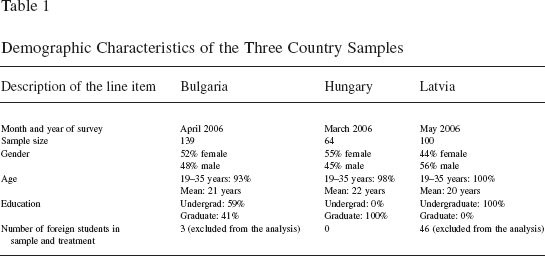
The initial sample included 303 students from random class sections in major business schools in the three countries. Employing a screening question on nationality, 49 foreign students (i.e., those whose nationality was different from the country surveyed) were filtered out, bringing our usable sample size to 254 (136 from Bulgaria, 64 from Hungary, and 54 from Latvia). The survey was administered in a classroom setting to maximize the response rate. The choice of business students was due to two reasons. First, as argued by Busenitz et al. (2000), business students who have not decided on their career paths are more representative of a cross section of the respective societies than entrepreneurs or company managers who have already selected their vocation. Second, since one of the objectives of our study is to replicate and establish the validity of the instrument in the context of emerging economies, we considered it appropriate to closely approximate the characteristics of our sample with those of the earlier study. The respondents in our sample were predominantly between 19 and 35 years of age (96.4%) and 50.2% were men. Similarly, 97% of the respondents in Busenitz et al.'s sample were between 20 and 35 years of age, and 53% were men. Respondent characteristics are summarized in Table 1 and descriptive statistics are presented in Table 2.
Demographic Characteristics of the Three Country Samples
Means, Standard Deviations (SD), and Correlations for All Countries *
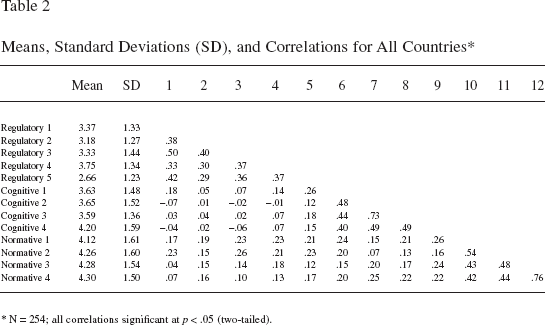
N = 254; all correlations significant at p < .05 (two–tailed).
Results
Research question 1 asked if the instrument developed by Busenitz et al. (2000) is valid for emerging economies. To answer this question, we employed structural equations modeling and performed a confirmatory factor analysis on the country institutional profile measure. The results of the confirmatory factor analysis are presented in Figure 1 and the model fit statistics are reproduced in Table 3. Cronbach's alphas for the scales were .75 for regulatory, .80 for cognitive, .81 for normative dimensions, and .79 overall, which are all well above the benchmark .70 indicating a high degree of internal consistency (Nunnally, 1978).
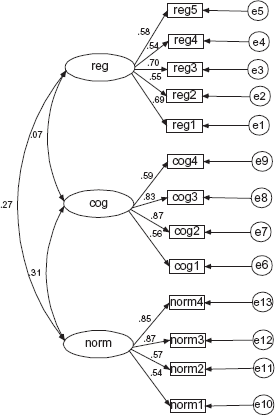
Confirmatory Factor Analysis Results
Model Fit Summary

In the model fit summary, we reported the fit measures for the Amos default model as well as two additional models—saturated and independence models. While the former is one with no constraints placed on the population moments and therefore would fit any data perfectly, the latter goes to the other extreme and assumes that the observed variables are not correlated at all, and as a result of the severe constraints provides a poor fit even when the data contains interesting relationships. The default model specified in Amos needs to be viewed and interpreted in the context of these two extremes. NPAR is the number of distinct parameters being estimated, CMIN is the minimum value of the discrepancy and P is the p–value for testing the hypothesis that the model fits the population perfectly. CMIN divided by its degrees of freedom (df) is suggested as a measure of fit. The closer it is to 1, the better the fit. Following the recommendation of Marsh and Hocevar (1985) that a ratio between 2 and 5 indicates a reasonable fit, we conclude that with a ratio of 2.33 the default model appears to be an acceptable fit for the variables measured by our data.
The Bentler and Bonett (1980) normed fit index (NFI) is a measure of the minimum discrepancy of the model being evaluated as a proportion of the baseline model while Bollen's (1986) relative fit index factors in the df. Although in our study both these indexes are slightly less than .90, the model fit is acceptable considering that Bollen's incremental fit index (IFI) is .92 and the Tucker–Lewis coefficient (TLI) is .90 (As a rule of thumb, the closer all these indexes are to 1, the better is the model's fit). This inference is reinforced by the fact that the comparative fit index (CFI) of our model is .92, well over the acceptable level of .90 in explaining a significant proportion of the variance. The root mean square error of approximation (RMSEA) of .07 is below the benchmark .08 and indicates a reasonable error of approximation (Browne & Cudeck, 1993).
Our model compares favorably with Busenitz et al.'s (2000) model in terms of factor loadings, scale reliabilities and goodness of fit indicators. Table 4 summarizes the relevant parameters of the two studies. We also assessed the model equivalency across the three country samples, performing factor analysis 1 on each country's sample separately. In each case, the loading patterns were similar, indicating identical factor structures across the three countries. These results suggest that Busenitz et al.'s instrument profiling institutional environments in industrialized countries is also valid for emerging economies in Eastern Europe, positively answering our first research question.
Model Statistics: Comparison with the Busenitz et al. (2000) Study

CFI, comparative fit index; NFI, normed fit index; IFI, incremental fit index; RMSEA, root mean square error of approximation.
Our second research question referred to the favorability in the institutional profiles of the three emerging economies with respect to entrepreneurship. To answer this question, we performed analyses of variance. The results are presented in Table 5. They show that while there are no significant differences in their overall institutional profile scores, there are important differences among the three countries along each of the three individual dimensions: regulatory, cognitive, and normative. We therefore inferred that although somewhat masked by the aggregate profiles, significant differences do exist in the underlying dimensions of the institutional environment for entrepreneurship in the emerging economies of Eastern Europe.
Means, Standard Deviations (SD), and Results of ANOVA
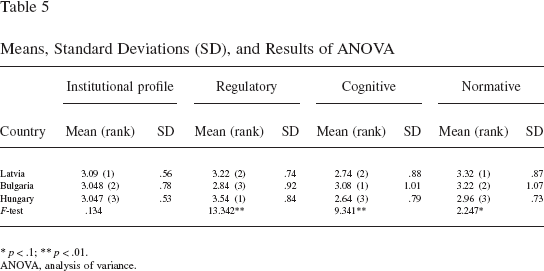
p < .1;
p < .01.
ANOVA, analysis of variance.
As for the favorability of the institutional environments, our results show that both the overall institutional profiles and each of the individual dimensions across the threecountries were deemed relatively unfavorable for entrepreneurship (rated below the neutral anchor 4 of the 7–point Likert–type scale). This is in contrast to Busenitz et al.'s (2000) study which found the overall institutional profiles of four of the six developed economies studied to be conducive to entrepreneurship (rated above the neutral anchor). Overall, Latvia emerges as the country most favorable (or, properly speaking, least unfavorable) to entrepreneurship, followed by Bulgaria and Hungary.
With regard to the effect of the individual dimensions, the normative dimension of the institutional environment in Latvia is the most conducive among the emerging economies studied, and makes a significant contribution in overcoming a somewhat restrictive regulatory and distinctly unfavorable cognitive environments as perceived by the business students. Although Hungary has apparently made rapid strides in loosening up the regulations relating to new businesses, the normative and cognitive dimensions of the institutional environment may inhibit people from pursuing new opportunities. Bulgaria, in contrast, has the necessary normative structure and cognitive skills to support entrepreneurship but the legal system seems to be lagging behind in responding to the aspirations of the people to start and grow new businesses.
Discussion
In this study, we set out to validate Busenitz et al.'s (2000) instrument to measure a country's institutional profile in the context of three emerging economies in Eastern Europe. We then used the instrument to explore the favorability of the institutional environments for promoting entrepreneurship. Our findings are recapitulated below.
The Busenitz et al. (2000) scale is an appropriate instrument to use in the context of emerging economies
Results from the confirmatory factor analysis suggested high reliability, internal consistency, and construct validity. Thus, our study provides support for the validity of a scale originally developed in the context of market economies with well established institutional and market governance mechanisms. Our study also suggests that Busenitz et al.'s country institutional profile scale can be effectively employed when conducting research on the impact of institutional environment on entrepreneurship in emerging economies.
Important cross–national differences persist in the institutional profiles of emerging economies
The results of our study suggest that the overall institutional environment as well as the three underlying dimensions were not favorable for entrepreneurship in any of the three countries. Despite the absence of any differences in aggregate institutional profiles, there were significant differences in the underlying dimensions comprising the institutional environment among the emerging economies studied. Thus, Latvia topped the list in the normative dimension, while Hungary scored the highest on the regulatory dimension and the lowest on the cognitive dimension, and Bulgaria scored the highest on the cognitive dimension and the lowest on the regulatory dimension. In short, even though respondents perceived the overall institutional environment for the development of entrepreneurship as less than favorable in all three countries, the underlying reasons were different. While respondents in Hungary and Latvia were worried about the availability of requisite knowledge and skills to engage in entrepreneurship, in Hungary they were also skeptical about societal attitudes toward entrepreneurship, whereas in Bulgaria the respondents were dissatisfied with the laws, regulations, and government policies promoting entrepreneurship. These differences suggest distinct and idiosyncraticinstitutional milieus for entrepreneurial behaviors and strategies in these countries, with implications for future theoretical development and empirical investigation. Importantly, aggregate measures of institutional environment for entrepreneurship may mask subtle and persistent differences, especially in the role of deeply embedded and less readily observable influences such as legal and cultural traditions, or social norms and values. Comparisons of the overall institutional framework across countries should, therefore, be used as a first approximation only and interpreted with great care. Our finding underscores the need for finer–grained and clearly defined constructs and scales to evaluate both the formal and informal aspects of the institutional environment (Meyer & Peng, 2005).
That each emerging economy fared better in a different dimension of the institutional environment awaiting the other dimensions to catch up has important implications for public policy, legal reform, and attitudinal changes in society. Thus, in Latvia, which has a value system to promote entrepreneurship and a regulatory regime slowly responding, there appears to be a need to initiate programs to upgrade the knowledge and skills of the people to actualize their entrepreneurial aspirations. In Bulgaria, where starting new businesses enjoys social approbation and people believe they have the required awareness and know–how, there seems to be an urgent need for legislation to catch up. Hungary seems to be in the most difficult position where the government has relaxed laws with a view to encourage industry and commerce but has not made adequate strategic investments to enhance entrepreneurial competencies and the social attitudes are not particularly supportive of new venture creation.
Institutional profiles and country entrepreneurship indicators
Our three country sample precludes rigorous statistical testing of the correlation between the findings of this study and indicators of entrepreneurship from other sources. Nonetheless, we note that the ranking of these countries in terms of their overall institutional profiles corresponds exactly to that of the World Bank's most recent “Doing Business” indicators (The World Bank, 2006): Latvia, Bulgaria, and Hungary were ranked third, nineth, and twelfth in “ease of doing business,” and second, eighteenth, and nineteenth in terms of the “ease of starting a business,” respectively.
Our results follow the World Bank's World Development Indicators for the regulatory dimension. For example, 49.5% of the respondents in Hungary compared to 51.3% in Latvia and 56.7% in Bulgaria expressed their lack of confidence in the ability of courts to uphold property rights (The World Bank, 2007). Similarly, in our study, Hungary, followed by Latvia and Bulgaria, emerged as the most favorable in terms of the regulatory environment.
With extant research on institutional environments largely focused on the regulatory dimension, we relied on available census and survey data for external validation of the cognitive and normative dimensions. Our study ranked Hungary the lowest in terms of both cognitive and normative dimensions. Comparing Bulgaria to Hungary, a World Bank study found that the rate of growth of private business formation in Bulgaria outstripped that in Hungary (The World Bank, 2000). Comparing Hungary to Latvia, a survey on entrepreneurship in Europe found that 48% of the respondents in Latvia indicated a preference to own and invest in a company as opposed to only 38% in Hungary, the lowest among 29 countries surveyed (European Commission, 2004). The Global Entrepreneurship Monitor (GEM) study ranked Hungary fifth among six East European countries surveyed in the level of nascent entrepreneurial activity (Bosma & Harding, 2007). Recent studies have attributed an insufficiently developed culture of entrepreneurship as well as the education system for the low and declining levels of entrepreneurship in Hungary (Acs, O'Gorman, Szerb, & Terjesen, 2007; Fogel, 2001).
Limitations and Implications
We are cognizant of several limitations of our study, which restrict its generalizability. First, the definitions adopted by Busenitz et al. (2000) to operationalize the three dimensions of institutional environment may not capture their rich connotations in the new institutional theory (North, 1990; Scott, 1995). As with any empirical work, we were faced with a trade–off between reliability and validity. Second, our data set comes from only three emerging economies in Eastern Europe, warranting further research before our findings could be extended to other countries. Further, although our results find some support from country entrepreneurship indicators of the World Bank and other sources, more evidence is required for rigorous validation of the findings. Finally, our study provides a snapshot in time, whereas institutional profiles of countries can change over time (Peng, 2001). As economic reforms gather pace and more entrepreneurs enter economic exchange, the role of the institutional environment in the development and growth of entrepreneurial ventures becomes as critical as the institutional barriers for entrepreneurial entry (Ahlstrom & Bruton, 2002). Future longitudinal studies could thus document the dynamic coevolution of the institutional environment and entrepreneurship in emerging economies.
This study has implications for entrepreneurship theory, managerial practice, and public policy. For researchers, our study validates for future use in the context of emerging economies a scale originally developed and tested for developed market economies. Our study also alerts small business owners and managers of the less than favorable conditions for private enterprise in emerging markets. They need to be wary of the numerous and often conflicting institutional pressures and constraints, and craft adequate responses to improve their firms’ survival and growth prospects. For public policy makers, the study suggests ways to enhance the institutional framework in order to support entrepreneurship. A country–specific mix of entrepreneur–friendly legislation, strategic investments to enhance entrepreneurial competencies, and promotion of positive entrepreneurial role models to influence social attitudes could help unlock entrepreneurial phenomena in emerging economies.
Appendix
Survey Items
Regulatory Dimension
Regulatory 1: Government organizations in this country assist individuals with starting their own businesses.
Regulatory 2: The government sets aside government contracts for new and small businesses.
Regulatory 3: Local and national governments have special support available for individuals who want to start a new business.
Regulatory 4: The government sponsors organizations that help new businesses develop.
Regulatory 5: Even after failing in an earlier business, the government assists entrepreneurs in starting again.
Cognitive Dimension
Cognitive 1: Individuals know how to legally protect a new business.
Cognitive 2: Those who start new businesses know how to deal with much risk.
Cognitive 3: Those who start new businesses know how to manage risk.
Cognitive 4: Most people know where to find information about markets for their products.
Normative Dimension
Normative 1: Turning new ideas into businesses is an admired career path in this country.
Normative 2: In this country, innovative and creative thinking is viewed as a route to success.
Normative 3: Entrepreneurs are admired in this country.
Normative 4: People in this country tend to greatly admire those who start their own business.
Footnotes
1.
Not reported here because of space constraints. Test results are available from the authors upon request.