







Abstract
Nine major entrepreneurship, international business (IB), and management journals used by the Financial Times to rank business schools were examined to see if the amount of international entrepreneurship (IE) research published in major entrepreneurship, IB, and management journals is increasing over time. Findings from two time periods spaced a decade apart indicate that although IE content more than doubled in the entrepreneurship journals, only a modest increase occurred in the international business journals and no increase occurred in the management journals. We proposed and found that: (1) entrepreneurship journals tend to favor replication studies while IB and management journals prefer nonreplications; and (2) because replication is straightforward while nonreplication is more difficult to conceptualize and execute, there are many more replication than nonreplication IE studies. As a result, IE studies appear more frequently in entrepreneurship journals. Managerial and scholarly implications are discussed.
How International is Entrepreneurship?
What role does international entrepreneurship (IE) play in international business (IB), entrepreneurship, and management scholarship? According to Shrader, Oviatt, and McDougall (2000), small firms are internationalizing at an increasingly rapid pace, but due to an emphasis on larger firms in the management and international business literature, IE research may not be keeping pace. If true, this is a shame, because as McDougall and Oviatt (2000, p. 902) point out, “the intersection of international business and entrepreneurship is of increasing importance for all those interested in either topic.”
Is the increasing importance of the international marketplace to entrepreneurs being reflected in international entrepreneurship scholarship increasing in importance, relevance, and frequency? Have the major entrepreneurship academic journals become more international over time? Is the role of IE research in major entrepreneurship, international business, and management journals increasing over time? How prevalent is international entrepreneurship research in top management and entrepreneurship journals? Are the types of IE articles published in entrepreneurship journals different from the types published in major management and IB journals?
In an effort to answer these questions, nine major entrepreneurship, IB, and management journals used by the Financial Times to rank business schools were examined for the amount and type of IE content in a systematic fashion, over two time periods spaced a decade apart. We show that (1) a dramatic increase occurs in IE content in the top entrepreneurship journals; but (2) only a modest increase occurs in the top international business journals and management journals. Why did this occur?
We suggest the following. IB research focuses on what changes/is different when a firm becomes international. Innovative IE research asks an additional question: how does IE differ from MNE practice and theory? In order to interest nonentrepreneurship audiences found in IB and management journals, IE scholarship finds itself in the difficult position of having to address both issues at once. Because replication is straightforward while nonreplication is more difficult to conceptualize and execute, many more replication than nonreplication IE studies are published. Because entrepreneurship journals welcome IE replication studies while IB and management journals prefer nonreplication studies, IE studies appear more frequently in entrepreneurship journals.
Defining IE Research
We begin by defining IE research. IB research is relatively well defined in the academic literature (focusing on what changes when a firm becomes international); IE is not. For this reason, we use IB scholarship to help define IE.
The “international” part of international business (and, also entrepreneurship) has been typically classified into two categories (Ricks, Toyne, & Martinez, 1990; Werner & Brouthers, 2002; Wright & Ricks, 1994). The first category is cross–national, in which business activity at the firm level crosses national borders. This category focuses on international issues that do not exist in the domestic market. Examples include the internationalization process, entry mode decisions, and impact of national culture differences (Brouthers & Brouthers, 2001). Comparative studies, the second category, involve comparisons of domestic business activity in two or more countries (McDougall & Oviatt, 2000). We use these two definitions to define IE research. IE scholarship deals with either cross–national and/or comparative entrepreneurship issues.
Identifying Top Journals
We chose to define our top journals based on the Financial Times (FT) 40 list. The list is used to compile worldwide rankings for business schools. As a result, many business schools use the FT 40 list to guide faculty publication. According to the Financial Times, top entrepreneurship journals include the Journal of Business Venturing, Entrepreneurship Theory and Practice, and Journal of Small Business Management, top IB journals include Management International Review and the Journal of International Business Studies, and top management journals include Strategic Management Journal (SMJ), Academy of Management Journal (AMJ), Academy of Management Review (AMR), and Administrative Science Quarterly (ASQ).
Similar to Werner and Brouthers (2002), we chose to review all of the articles in the nine selected journals over two 5–year time frames, 1986–1990 and 2000–2004. According to Werner and Brouthers “[a] five–year time frame appears to be a large enough window to balance out any single year anomalies, but not so large that the time frame's relevance can be questioned” (p. 584).
Werner and Brouthers (2002) used time frames separated by 16 years. However, due to entrepreneurship's relative “youth” as a field, we chose to use time frames separated by 10 years. Therefore, three major entrepreneurship, two major IB journals, and four major management journals were analyzed for articles with IE content from 1986 to 1990 and for 2000 to 2004. Articles were considered within the domain of IE if “either the entrepreneur or the venture had to cross national boundaries, or the author of the article had to make some international comparisons on entrepreneurial issues,” (Hisrich, Honig–Haftel, McDougall, & Oviatt, 1996).
Results
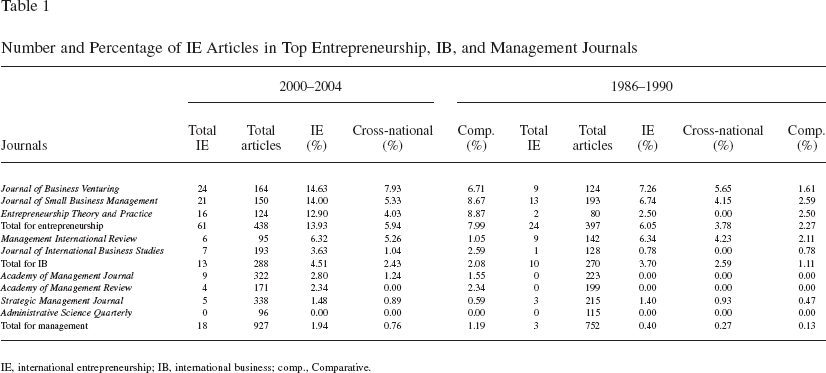
Table 1 shows the total number of articles appearing in the three entrepreneurship journals and two IB journals, as well as the number and percentage of IE studies during the two time periods. From 1986 to 1990, only 24 out of 397 articles in entrepreneurship journals dealt with IE issues; 3.78% were cross–national articles while 2.27% were comparative articles. International content in the three journals increased to 13.93% (61 of 438 articles) from 2000 to 2004. Cross–national content increased to 5.94% and comparative studies increased to 7.99%. Thus, the time period 2000–2004 showed a major increase in IE articles over the previous time period. From 2000 to 2004, 13.93% of the top three entrepreneurship journals articles had IE content, compared with 6.05% from 1986 to 1990. Thus, IE content in 2000–2004 was double that of 1986–1990.
Number and Percentage of IE Articles in Top Entrepreneurship, IB, and Management Journals
IE, international entrepreneurship; IB, international business; comp., Comparative.
The IE articles were spread fairly evenly. The Journal of Business Venturing had 14.63% IE content, the Journal of Small Business Management had 14% content, and Entrepreneurship Theory and Practice had 12.90% IE content. The Journal of Business Venturing had the greatest cross–national content (7.93%), followed by the Journal of Small Business Management (5.33%), and Entrepreneurship Theory and Practice (4.03%). Entrepreneurship Theory and Practice had the greatest comparative content (8.87%), followed by Journal of Small Business Management (8.67%), and Journal of Business Venturing (6.71%). Thus, IE appears to be growing as an area of interest within the field of entrepreneurship; all three top journals reflect this phenomenon.
The two top IB journals published only 10 IE articles from 1986 to 1990. Only 3.70% of the 270 studies published during this period were IE, with 2.59% being cross–national and 1.11% comparative. From 2000 to 2004, the percentage of IE articles published in the top IB journals increased to 4.51%. The percentage of cross–national studies remained virtually unchanged (2.43%), while the percentage of comparative articles increased to 2.08%. While the IB journals did publish more IE articles, the net gain was only a mere three articles. Thus, IE does not appear to have increased its importance in the IB journals to the degree to which it has in entrepreneurship journals.
IE Prevalence in Top Management Journals
The results for the four management journals are shown in Table 1. The four top management journals published only three IE (out of 752) articles from 1986 to 1990. This represents less than one–half of 1% (0.40%). Two of the articles were cross–national; only one was comparative. From 2000 to 2004, only 18 IE articles were published, 1.94% of total articles. Although the number of IE articles increased almost fivefold, IE content remained extremely low. Neither the AMJnor the AMR published a single IE article from 1986 to 1990. From 2000 to 2004, AMJ published nine IE articles (2.8%), split about evenly between cross–national and comparative. From 2000 to 2004, AMR published four IE articles (2.3%); all were comparative in nature. SMJ published three IE articles (1.40%) from 1986 to 1990. The percentage remained relatively unchanged (1.4%, five out of 338) for 2000–2004. Finally, ASQ did not publish a single IE article during either time period.
We conclude that IE research comprises a very small proportion of the research conducted in the domains of IB and management. Moreover, although the amount of IB research appears to be growing over time (based on Werner & Brouthers’ 2002 analysis) in top management journals, the same cannot be said for IE research.
Replication versus Innovation
What accounts for the lack of IE research in top IB and management journals? It may be due to self–selection; scholars in IE may prefer to publish in top entrepreneurship journals. It may be that there are systematic differences among editors and editorial boards that affect the amount of IE content. Or it may be simply a function of the number of international papers submitted to specific top journals.
Here we posit an alternative explanation: innovative IE research is inherently more difficult to do than IB research because IB research merely focuses on what changes or is different when firms leave their domestic environment. In contrast, innovative IE research has to simultaneously address a second question: how does the phenomenon of interest differentially impact entrepreneurship versus Multinational Enterprises (MNEs)? Thus, we suggest that in order to do innovative IE research, IE scholarship finds itself in the difficult position of having to address both issues at once. This increases the complexity of IE research, making it difficult for IE scholars to come up with topics of interest.
Replication represents an alternative research approach more readily accepted by entrepreneurship journals than by top IB/management journals. Replication IE research tends to concentrate on external validity issues: do Small and medium sized enterprises (SMEs) behave the same as MNEs with respect to a specific international issue? Such studies are less likely to be valued by major IB and management journals. Thus, we propose that the lack of IE research in major IB and management journals may in part be because much IE research merely replicates previous IB/management journal studies, substituting smaller/newer firms for larger ones.
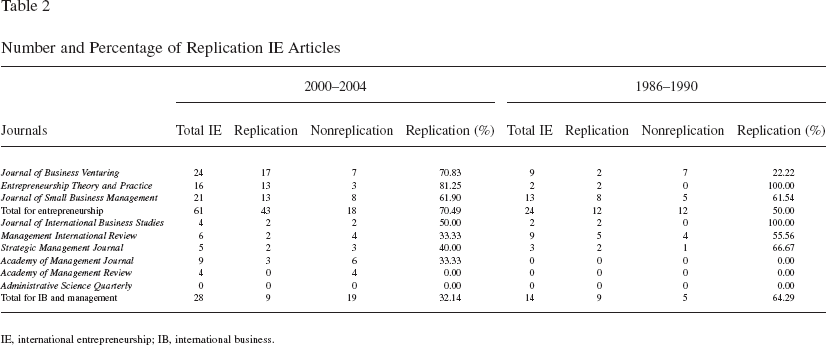
In an exploratory effort to examine this notion, we examined all 127 IE articles appearing in the IB and management journals during both time periods to determine whether they were replications of research conducted on MNEs or were strictly entrepreneurial in nature. An article was judged to be a replication if it merely dealt with a change in external validity; if an article dealt with a change in substantive domain from large to small entrepreneurial businesses without a change in theory or hypotheses, it was categorized as a replication. Results are presented in Table 2. Our results show that for the top three entrepreneurship journals, the percentage of IE replication articles increased from 50% during the time period 1986–1990, to 70.49% from 2000 to 2004. In contrast, the ratio of replication IE articles published in the six IB and management journals fell from 64.29 to 32.14% during the same respective time periods. The lack of interest in mere replication from major IB and management journals appears to be reflected in the lower rate of replication found in the IB and management journals; the percent of replication actually increased for the entrepreneurship journals. These results provide prima facie support for our conjecture; while IE scholars appear to be interested in external validity questions, IB and management scholars more commonly are not.
Number and Percentage of Replication IE Articles
IE, international entrepreneurship; IB, international business.
Discussion
The major entrepreneurship journals have become increasingly international over the last 18 years; they more than doubled the number of IE articles from 1986 to 1990 to 2000 to 2004. Entrepreneurship Theory and Practice showed a fivefold increase.
With respect to management journals, gains in IE research were modest: from 2000 to 2004, the highest percentage was 2.80%. ASQ still lacks any IE content. While IB journals published more IE research than management journals, IE research remained a very small percent of total publications (3.7%). Our most recent data show that about one in seven articles in top entrepreneurship journals address international entrepreneurship topics, while only one in 27 articles in the top IB journals address IE. Even more discouraging, only one in 51 articles in top management journals deal with international entrepreneurship topics.
Why does IE still play such a small role in IB and management research? We proposed and found that much IE research merely replicates IB and international strategy research, substituting smaller firms for larger ones. Top entrepreneurship journals appear to be willing to publish IE replication research while IB and management journals appear to be much less willing. Based on our findings, we suggest that in order to publish IE research in high–quality, nonentrepreneurship journals, IE scholars may need to focus on what is different about IE rather than on what is similar to MNE research.
Implications for Practitioners and Scholars
How useful is IE research for practitioners? Although beyond the scope of this paper, we propose an initial answer to the following question: how different should advice given to entrepreneurs/SME practitioners be from advice given to MNE managers? If entrepreneurs/SMEs are merely smaller versions of MNEs, then IE replication studies make sense academically, but offer little useful advice that is not already known about the MNE. However, if entrepreneurs/SMEs are different from MNEs, as many scholars suggest (Calof & Viviers, 1995; Chen & Hambrick, 1995; De Chiara & Minguzzi, 2002; Zacharakis, 1997), then mere replication that excludes crucial differences could result in inappropriate or misleading advice. Both types of studies are useful; they tell us how entrepreneurs/SMEs are both similar to and different from MNEs. By pursuing both lines of inquiry, IE scholarship can tell entrepreneurs/SMEs when to imitate MNEs and when to differ from MNEs in practice and strategy.
We conclude with a final suggestion for IE scholars. We suggest that they concentrate on how entrepreneurship activity at the firm level that occurs outside the domestic environment differs from MNE research. By doing so, IE scholars can advance IE knowledge in a manner that merits publication in top IB and management journals, as well as in top entrepreneurship journals.