







Abstract
This study presents a theoretical concept called the collaborative network orientation (CNO) and tests it using a sample of male and female small business owners. The CNO is based on (1) research that indicates female managers prefer to organize in cooperative network relationships and (2) conflict theory that indicates collaboration is preferred for both building relationships and achieving goals. Empirical tests revealed that female owners had a stronger preference for a CNO. A CNO was associated with business success for all owners, but it was significantly more positively associated with success for male business owners.
Research reveals that compared to men, women tend to have smaller businesses and less business experience (Fischer, Reuber, & Dyke, 1993), be undercapitalized (Carter, 2000; Carter & Marlow, 2003), prefer to grow their businesses slowly (Cliff, 1998; Orser & Hogarth–Scott, 2002), place a high value on family security (Olson & Currie, 1992), and generally have a “family first” orientation (Fitzgerald & Folker, 2005). Even with these apparent deficiencies, some studies reveal that female–run businesses perform relatively well compared to male–run counterparts (Chaganti & Parasuraman, 1996; Collins–Dodd, Gordon, & Smart, 2004; Fischer et al., 1993; Kalleberg & Leicht, 1991; Watson, 2002). What accounts for this performance?
One potential explanation was unveiled in a review of research (McKay, 2001). The review revealed that compared to men, women prefer to organize in networks that include a broad range of people and to create collaborative and cooperative relationships within those networks. These networks enable women to acquire resources to meet business needs.
The theoretical explanation for these tendencies among women is that they have a propensity to view the world holistically; they view business, family, community, and society as an integrated whole, not as a separate economic entity, as is the tendency among men (Aldrich, 1989; Brush, 1992). The feminine view is that the world is a network or web of relationships and that those relationships must be preserved (Bird & Brush, 2002). This view “colors or conditions perception, values, and behavior, and is likely learned through an interaction of biology and social influence” (Bird & Brush, 2002, p. 43).
The purpose of this paper is not to test underlying motivations for female orientations, but to formalize some of their preferred orientations into a theoretical construct and to test the construct on a sample of female and male business owners. The theoretical construct is based on the literature about female tendencies as managers and on theory about cooperative problem solving from the conflict and negotiation literature. Within the conflict and negotiation literature, collaboration is the approach that most successfully addresses all parties’ concerns and also maintains positive relationships. Collaboration seems to capture the manner in which women establish relationships in networks.
Therefore, in this study, we combine conflict management theory with organizing tendencies among women to create a theoretical concept called the collaborative network orientation(CNO). This theoretical concept was labeled an orientation to indicate that it is a fundamental worldview that exhibits itself in how individuals organize. Then, combining existing scales to form a measure, we test the construct on a sample of female and male business owners.
Tendencies in Female Managers
After reviewing the state of gender studies, scholars have argued that research should move beyond treating gender simply as a variable (Kantor, 2002) to recognizing feminine approaches to organizing and managing (Bird & Brush, 2002). Furthermore, researchers suggest that the gender literature should move beyond disparate commentaries to create theory and explain processes (Bird & Brush, 2002; Marlow & Patton, 2005).
The cooperative network orientation is a theoretical construct that captures what we believe is a feminine approach to managing and organizing small firms. While our discussion of such an approach is based on observed managing and organizing behaviors of female entrepreneurs and small business owner–managers, our assumption is that this approach might also be successfully used by male entrepreneurs and owner–managers (Marlow & Patton, 2005); that is, research about female entrepreneurs and owner–managers might help us develop theories that apply to both females and males (Bird & Brush, 2002).
A review of research revealed three tendencies among female managers. The first is that women tend to have collaborative and cooperative approaches to leading and organizing (Aldrich, 1989; Brush, 1992; Buttner, 2001; Goffee & Scase, 1983; Loden, 1985; Wajcman, 1998). Research suggests that women tend to be intuitive and cooperative (Brush, 1992; Loden, 1985), and to adopt a coordinator orientation (Aldrich, 1989; Brush, 1992; Goffee & Scase, 1983).
Furthermore, women tend to use relational skills to promote mutually empowering and collaborative relationships (Buttner, 2001), to prefer an interactive leadership style (Moore & Buttner, 1997), and to be inclined to consult employees in decision making (Machado et al., 2002). For example, a meta–analysis revealed that women prefer to be democratic and participative (Eagly & Johnson, 1990), and a survey of a large group of female managers indicated that women tend to be collaborative, cooperative, and participative (Wajcman, 1998).
Second, research indicates that in contexts beyond a manager's immediate work group or small business, women tend to create and coordinate a “web” of collaborative relationships (Brush, 1992; Gilligan, 1982; Helgesen, 1995). For example, one study of female–led nonprofit organizations found that most were hybrid organizations—neither bureaucracies nor collectives—and most were networks (Bordt, 1997). In addition, because women tend to value stakeholders more highly than men do (Posner & Munson, 1981), they develop a relatively broad network of relationships that interconnect family, work, and community (Gilligan, 1982; Hekman, 1995). These network affiliations have a significant effect on performance outcomes (Lerner, Brush, & Hisrich, 1997); they are essential links for establishing credibility, obtaining sounding boards, and gaining resource access (Moore & Buttner, 1997).
Third, research revealed that within their work groups or small businesses, female managers tend to organize as a network team; they place themselves at the center of cooperative teams (Loden, 1985) that could be described as a network of partnerships (Brush, 1992; Eisler, 1987; Gilligan, 1982; Gray, 1994; Halpern & Parks, 1996). These networked or cooperative teams (Chaganti, 1986; Loden, 1985) are frequently characterized by caring, people–related concerns and connectedness (Gray, 1994), which promotes working together as a collaborative team.
The previous summary suggests a feminine approach to organizing and managing. This includes (1) using collaborative approaches in working with internal and external stakeholders; (2) developing networks that include both professional and personal contacts inside and outside the business; and (3) creating a network team structure within the business. The glue that holds the networks together is collaborative relationships.
Below, we formalize the theoretical concept of CNO by integrating the apparently feminine approach to managing and organizing discussed earlier with the conflict management literature. Specifically, we formalize the theoretical concept of CNO and report an empirical test to determine whether a CNO is related to business performance, is significantly more prominent among female business managers, and is differentially influential of business success for women and men.
The CNO
The CNO has as its base a preference to build collaborative relationships among networks made up of customers, family members, community members, and, inside the organization, employees. Outside the organization, CNO managers tend to cast a relatively broad net when establishing themselves as the hub of collaborative networks. Inside the organization, they prefer to organize as a network team.
A Collaborative Orientation
The conflict management and negotiation literatures address collaborative and cooperative approaches to solving problems and building relationships. The most frequently cited conceptualization in these literatures is the dual–concern model (e.g., Thomas & Kilmann, 1974). Various versions of this model organize four or five conflict management approaches along two dimensions: concern for self and concern for other (Rahim, 1983). The concern for self dimension is also described as a concern for the production of results, personal goals, own outcomes, or substantive outcomes (Blake & Mouton, 1970; Hall, 1969; Pruitt, 1983; Savage, Blair, & Sorenson, 1989; Thomas & Kilmann, 1974). The concern for other dimension is also described as a concern for people, a concern for others’ outcomes, a concern for relationship, and a desire to satisfy others’ concerns (Blake & Mouton, 1970; Hall, 1969; Pruitt, 1983; Savage et al., 1989; Thomas & Kilmann, 1974).
Figure 1 summarizes the two basic dimensions of concern that are most relevant to this study: (1) concern for the self or for personal business success and (2) concern for the other or for relationships. Concern for the self or for business success is highly associated with competition (Sorenson, Morse, & Savage, 1998, 1999; Van de Vliert, 1997). Concern for the other or for relationships is positively associated with the cooperative approaches (Van de Vliert, 1997) of accommodation, collaboration, and compromise (Sorenson et al., 1998, 1999; Van de Vliert, 1997).
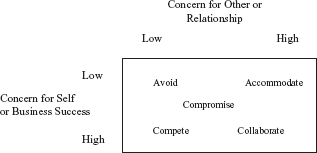
Underlying Dimensions and Conflict Management Approaches
Of the four approaches in the dual–concern model, collaboration appears to be most likely to build network relationships that yield the highest business success. The intent of collaboration is to establish positive relationships and find ways to achieve goals of involved parties. When network members see the opportunity for potential mutual gain, they will be more likely to share information, exchange resources, and engage in mutually beneficial activities.
Competition is focused only on personal goals, which would not likely establish enduring network relationships; potential network members would likely see little advantage in maintaining network relationships. Therefore, competition would yield limited access to network relationships and associated resources. Accommodation would likely build good network relationships. However, because accommodation meets others’ goals and not the goals of the business, it would likely limit personal business success. Avoidance neither seeks goals nor establishes relationships, and therefore, would not benefit the business.
Research among small family businesses supports the previous arguments (Sorenson, 1999). Collaboration was positively associated with both business success and favorable family outcomes. Competition and avoidance were somewhat negatively, although not significantly, related to business success and favorable family outcomes. Accommodation was positively associated with family outcomes, but not with business success.
Thus, as a general orientation, collaboration would likely produce enduring network relationships that contribute to business success. Collaboration (Thomas & Kilmann, 1974) and its variants—integrating (Rahim, 1983), problem solving (Pruitt, 1983), and synergism (Hall, 1969)—is an approach that focuses on helping involved parties discuss and find ways to address their concerns, personal desires, and business goals. Collaboration refers to the process of exchanging information, working together to understand problems, and bringing out all concerns so that problems can be resolved together in the best possible way (Rahim, 1983). Such an approach increases the likelihood of creating solutions that are supported by involved parties, promote positive relationships (Sorenson et al., 1998), and contribute to business success (Sorenson, 1999).
In the negotiation literature, collaboration is often described as a conflict management strategy in which involved parties engage in an interactive exchange designed to fully achieve involved parties’ objectives. Thus, a specific conflict episode would not be collaborative unless all parties achieve their objectives (see Savage et al., 1989). In contrast, a collaborative orientation, as used in this paper, emphasizes maintaining positive relationships and achieving the interests of network members over the long term and over a series of interactions. An orientation is consistent with the notion of a higher order operating philosophy or belief that encompasses and guides both values and behavior (Boyatzis, Murphy, & Wheeler, 2000). Thus, when a business owner perceives the feasibility (Pruitt & Rubin, 1986) of mutual gain over the long term, a collaborative orientation would allow for the use of other approaches in the short term.
Finally, while a CNO is a general approach for stakeholder management, it is not limited to stakeholders; that is, networks are not limited to stakeholders as defined in the management literature. Stakeholders have been defined as individuals who influence organizational objectives (Freeman, 1984), have a legitimate claim on the firm (Hill & Jones, 1992), or bear risk for the business (Clarkson, 1993). Within a collaborative network, business managers can function within the network to acquire information, knowledge, and resources from others who may not be stakeholders. As a CNO manager adds network members, some of those members may become stakeholders, but not all.
A Preference for an Inclusive Network
The second element of a CNO is building networks of collaborative relationships outside the organization—with customers, employees, and members of the family. Managers who have a high CNO value collaborative relationships (Posner & Munson, 1981) and, from an organizational perspective, also highly value relationships with individuals who become stakeholders. They seek input from these network members, and, when feasible within a collaborative framework, adapt to members’ concerns and desires.
Managers who have a high CNO would also likely encourage family members to be involved in the business, but these individuals must make positive contributions. Within a collaborative framework, anyone who participates must be a positive factor in the business.
Finally, managers who have a high CNO use involvement in the community to build networks. These networks provide opportunities to create collaborative relationships that hold the possibility of increasing knowledge, gaining influence, acquiring sounding boards, establishing credibility, and gaining resource access, any of which could be beneficial to the business (Lerner et al., 1997; Moore & Buttner, 1997). Within these networks, the overarching orientation of collaboration enables a business owner to build enduring relationships (e.g., Savage et al., 1989) while at the same time promoting personal business goals and network member interests.
A Preference to Organize as a Network Team
The third component of a CNO is organizing employees as a network team. Formal hierarchical organizational structure is de–emphasized in favor of developing collaborative relationships (Bird & Brush, 2002), which may also be characterized as a network of partnerships (Bird & Brush, 2002). The concerns and desires of both the business owner and employees are addressed. Thus, a manager with a high CNO interacts openly with team members (Moore & Buttner, 1997) to develop mutual understanding, which contributes to good human relations and cohesiveness.
Another characteristic of network teams is that they tend to be participative, flexible, and decentralized, which empowers employees (Buttner, 2001). Involvement in problem solving contributes to employee understanding and commitment, and gives managers the confidence to allow employees discretion in performing responsibilities. As managers who have a high CNO consult employees in decision making (Machado et al., 2002), the overall effect of a collaborative network orientation is fully realized: Managers access relevant employee perspectives to address issues and identify opportunities in external networks.
The network team approach to leading and organizing as described here has not been formalized in the literature as a theoretical construct. The leadership literature has identified leaders as being relationship oriented and participative, but primarily within hierarchical organization structures (for an extensive summary of research, see Bass, 1990). The orientation described here is one of building relationships within a network, which could exist with or without formal organizational structure.
Does a CNO Lead to Business Success?
Research about female managers provided a basis for the CNO construct, which leads to two questions. First, does a CNO result in business success for both female and male managers? Based upon our previous discussion, we theorize that, particularly in small businesses, a high CNO will contribute to business success, primarily because it would likely increase resources and business opportunities obtained through developing a network of collaborative relationships.
A CNO is a fundamental worldview that both establishes relationships and promotes the interests of parties involved in the relationships. Each collaborative relationship that is established outside of the firm holds the potential of promoting business interests, obtaining resources, exchanging resources, or expanding business opportunities (e.g., Garnsey, 1998; Pfeffer & Salancik, 1978; Starr & MacMillan, 1990). A business owner who consistently establishes a growing network of enduring, collaborative relationships is likely to expand opportunities to promote business interests more than an owner who does not build collaborative relationships. Thus, a CNO should contribute to business performance. Consistent with this view, research indicates that there is a positive relationship between access to resources through networks and firm performance (Zhao & Aram, 1995).
Within a firm, research indicates that collaboration both creates integrative decisions and maintains relationships, which enhance performance (Amason, 1996; Jehn, 1997; Rahim, 1983). A meta–analysis found that cooperation, compared with interpersonal competition and individual effort promoted achievement and productivity (Johnson, Maruyama, Johnson, Nelson, & Skon, 1981). In addition, research in family businesses found that collaboration was positively related to both business performance and positive family relationships (Sorenson, 1999). Thus, a CNO would likely increase performance.
Second, does a high CNO produce more success for women or for men? The studies we cited earlier of female entrepreneurs and business owners (Brush, 1992) and female managers (Aldrich, 1989; Goffee & Scase, 1983; Loden, 1985; Wajcman, 1998) indicate that a high CNO would likely yield success for women. However, although the CNO was first noticed and is likely more prominent among females, we theorize that males may also have a high CNO that may lead to business success. For example, a study that included primarily male business owners found that a general preference for collaboration was significantly related to small business success (Sorenson, 1999).
Some theory and research suggest that when women operate out of their preferred mode they are more successful than men (Loden, 1985). For example, Helgesen (1998) argues that team and network approaches to business lend themselves to women's integrated view of social life. But other theory and research suggest that men who have a high CNO will have more success (Wajcman, 1998) because they will have extended their management repertoire (Loden, 1985). We tend to agree with the latter argument.
We also theorize that men will focus more narrowly on business success than women, who tend to place a higher priority on maintaining a broad network focused on both business and nonbusiness interests (Fitzgerald & Folker, 2005). There is some research support for the argument that men who integrate their competitive nature with a collaborative orientation will have business success. Litz and Folker (2002) found that combined male and female management teams outperformed both all–female and all–male management teams. Thus, we theorize that the CNO will more positively impact performance for male managers.
We summarize our theoretical assumptions about the CNO construct in the following hypotheses:
Methodology
Sample and Data
Hypotheses were tested using data from small business owners who characterized their businesses as family businesses. This sample is particularly appropriate because not only is family business the dominant organizational form in the world, but a collaborative orientation may be particularly important in organizations that combine business and family elements. These characteristics are useful in testing our new theoretical construct, the CNO.
These were secondary data that were originally obtained from the Survey of Family Business, a 199–item questionnaire distributed to business owners from 1997 to 2000. In order to collect sufficient data to run statistical analyses, data were gathered using two sampling frames. The first was a traditional probability sample generated from chamber of commerce listings (e.g., Ambrose, 1983). Businesses in communities from across the United States were randomly chosen from directories, contacted by telephone, and invited to complete the survey. Twenty percent of these businesses completed the survey (n = 212).
The second frame consisted of businesses that were identified and first contacted by student informants who received class credit for their participation. The use of students as informants to identify and aid in data collection has been employed in severalentrepreneurship studies (e.g., Birley, 1986; Covin, 1994; Stewart, Watson, Carland, & Carland, 1999). Marshall et al. (2006) followed a similar procedure of combining data from both random and student–generated sampling frames in a recent study of succession planning in family businesses.
Although the second sampling frame was a convenience sample that was nonrandom and limited generalizability, it possessed advantages. Seventy–four percent of the 260 business owners students contacted agreed to complete the questionnaires (n = 193). This response rate was much higher than most entrepreneurship mail surveys, mitigating the possible effects of nonresponse bias. In addition, because of the length of the survey—199 items—researchers believed that owners contacted by students would be more willing to participate, are more accurate, and are more complete in their responses to the questionnaire.
The survey specified that the person completing the questionnaire should be a family member and a manager in the business. Those completing the questionnaire listed themselves as owner (38%), president or CEO (33%), manager (10%), vice president (9%), and various other (10%). Most (57%) had fewer than 10 employees (see Table 1). These organizations were primarily in the service industry (49%), followed by manufacturing/agriculture (32%) and other (19%). Most businesses (57%) classified themselves as privately held, followed by sole proprietorship (25%), partnership (11%), and other (7%).
Organization Demographics
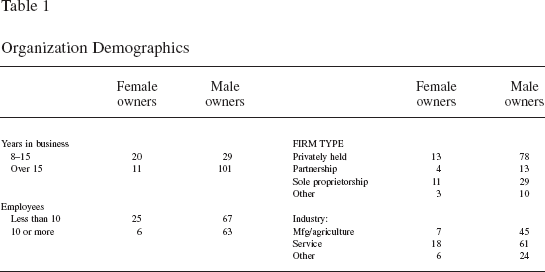
Tests (analysis of variance [ANOVA]) revealed no significant differences between the two data sets for the variables of interest in this study. Therefore, the data were combined to test the hypotheses. Three criteria were used for including businesses in the study. First, the dependent variable, business performance, inquired about performance over the last 5 years. Since new businesses often take 2 or more years to become profitable, only businesses that had been in operation more than 7 years were included in analyses. Second, the sample was limited to businesses that had 250 or fewer employees. Finally, because this study was designed to test for possible differences in female and male owners’ influence in the business, businesses that reported having high spousal influence and spouses working more than 30 hours a week in the business were not included in analyses. These criteria yielded a sample of 31 female–owned and 130 male–owned businesses.
Measures
Items relevant to the hypotheses were selected, factor analyzed, and included in measures if they loaded at .60 or higher. Item descriptive statistics for females and males are reported in Table 2. Because subscales had different ranges, they were standardized before being combined to create the overall measure of CNO. The means and standard deviations (SDs) reported in Table 2 are based on raw scores.
Means and Standard Deviations (SDs) of Measures for Female and Male Owners
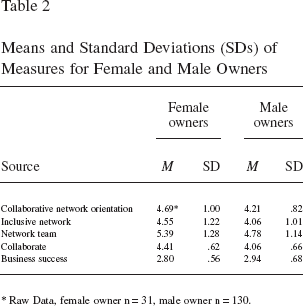
Raw Data, female owner n = 31, male owner n = 130.
The measure of CNO was made up of three subscales. The first subscale measured the collaboration dimension of the CNO (see Table 3), which included three of five items adopted from a scale developed by Rahim (1983). Due to the length of the Survey of Family Business (199 items), the author of the survey included only the three items that loaded highest on the five dimensions of the Rahim Organizational Conflict Inventory–R (Rahim, 1983). A previous study (Sorenson, 1999) indicates that the three items used to measure collaboration retain their factor structure and have high reliability (alpha = .79). Items were on a 5–point scale from “strongly disagree” to “strongly agree.” The measure consisted of three items (alpha = .72): “we exchange information to solve the problem together,”“we bring all our concerns out in the open so that the issues can be resolved in the best way,” and “we try to work with one another for a proper understanding of the problem.” A mean of these three items was used to create the measure.
Stems and Items Used to Measure Collaborative Network Orientation
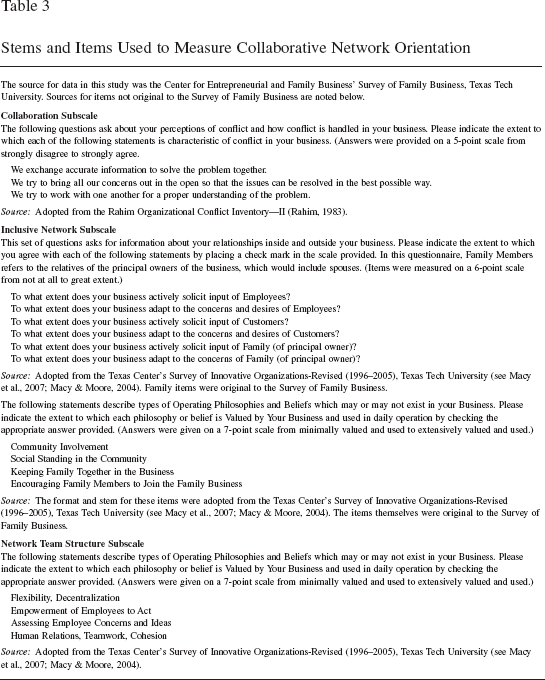
The second subscale measured the inclusive network dimension of the CNO. The items for this subscale were adopted from the Survey of Innovative Organizations–Revised (SIO–R, see Macy & Moore, 2004). Between 1996 and 2005, the SIO–R was used to gather data from organizational business units from the United States and Canada. Results from the SIO–R are forthcoming in Research in Organizational Change (Macy, Farias, Rosa, & Moore, 2007). Two items each addressed family members, employees, and customers, which had wording similar to the following: “To what extent does your business actively solicit input from employees?” and “To what extent does your business adapt to the concerns and desires of employees?” These items were measured on a scale from 0 (not at all) to 5 (very great extent).
The SIO–R was also the source of the format for the remaining four items employed to measure inclusive network. These items were adopted from the SIO–R to assess operating philosophies in small family businesses. Operating philosophies and beliefs are higher order orientations (see Rokeach, 1973) that encompass both values and behaviors, and provide a missing, higher order link between values and behaviors (Boyatzis et al., 2000). The stem for the items included in this study read as follows: “The following statements describe types of operating philosophies and beliefs which may or may not exist in your business. Please indicate the extent to which each philosophy or belief is valued by your business and used in daily operation.” The items were measured on a scale from 1 (minimally valued and used) to 7 (extensively valued and used). Two items assessed community involvement: “community involvement” and “social standing in the community.” Two items addressed family involvement: “keeping the family together in the business” and “encouraging family members to join the family business.” The mean of the 10 items (alpha = .79) were averaged to create the measure of inclusive network.
The third subscale measured the preference for a network team structure dimension of the CNO. These items were also adopted from the SIO–R and used the same stem and scale as described earlier regarding operating philosophies and beliefs. The four items were “flexibility, decentralization,”“empowerment of employees to act,”“assessing employee concerns and ideas,” and “human relations, teamwork, cohesion.” These four items (alpha = .85) were standardized and averaged to create a measure of team structure.
An overall measure of CNO was created by averaging the subscales for inclusive network, team structure, and collaboration. The reliability for the overall measure comprised of the three subscales was alpha = 69.
Business success was measured by five items (alpha = .77). The first item asked respondents to compare themselves to the major competitor in their industry and tell how their business has performed over the past 3 years from “much worse” to “much better” on a 5–point scale. The second asked whether their business had earned profits in the last 5 years. Responses ranged from “not in the last 5 years” to “all of the last 5 years” on a 4–point scale. The third question asked how the respondent would characterize profits from “declined somewhat” to “increased significantly” on a 4–point scale. The fourth asked respondents to characterize growth over the last 5 years from “size of business has decreased” to “size of business has increased significantly.” Finally, respondents were asked to characterize market share over the last 5 years from “market share has decreased” to “market share has increased significantly.” These items were standardized and then averaged to create a measure of business success.
Results
A one–way ANOVA was used to test hypothesis 1. Hierarchical regression analyses were used to test hypotheses 2 and 3.
Hypothesis 1 stated that female managers will have a stronger preference for the CNO than male managers will. The standardized mean score for female managers (M = 1.49; SD = .25) was higher than that for male managers (M = 1.37; SD = .25; see Table 2 for raw scores). A one–way ANOVA revealed a significant difference (F 1/168 = 6.91; p = .009) in CNO between female and male business managers. Thus, hypothesis 1 was supported.
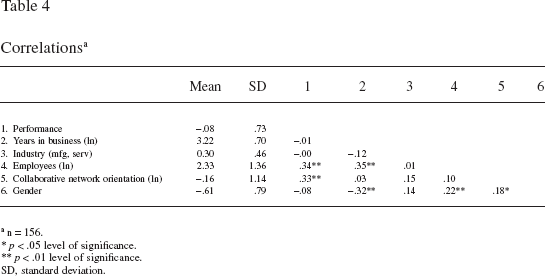
Because demographic analysis revealed some gender–based differences, industry (coded as 0 for manufacturing and 1 for service), number of years in business, and number of employees were added as controls to the regression model (see Table 3). A log transformation was used to help normalize number of years in business and number of employees. Means, SDs, and correlations are reported in Table 4.
Correlationsa
n = 156.
p < .05 level of significance.
p < .01 level of significance.
SD, standard deviation.
To reduce potential multicollinearity between the main effects and the interaction term, we followed procedures described by Aiken and West (1991). The main effect variable CNO was “centered” by using the standardized z score. The main effect variable Gender was coded (−1 = male; 1 = female) following the unweighted effects coding method recommended when including dichotomous variables in an interaction (Aiken & West, 1991). When testing for interactions, effect coding helps to protect against multicollinearity (Ebrahim, 1999).
We used SPSS variance inflation factor (VIF) tests to assess collinearity among the regression model predictors. The highest VIF for any variable in our models was 1.4. None of the VIF scores approached the commonly accepted threshold of 10 used to indicate potential multicollinearity problems (Tihanyi, Johnson, Hoskisson, & Hitt, 2003).
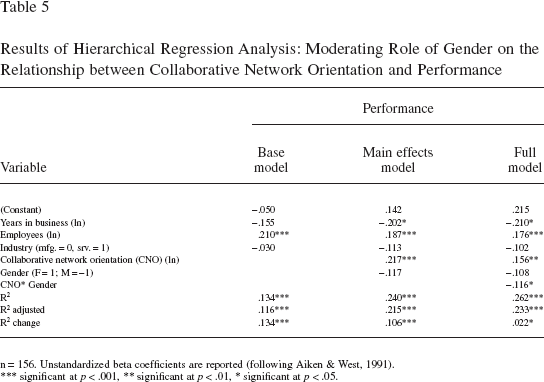
For regression analyses of business performance (see Table 5), the main effects model makes a significant contribution over and above the base model explaining an additional 10.7% of the variance in performance (ΔR2 = .107; p < .001).
Results of Hierarchical Regression Analysis: Moderating Role of Gender on the Relationship between Collaborative Network Orientation and Performance
n = 156. Unstandardized beta coefficients are reported (following Aiken & West, 1991).
significant at p < .001,
significant at p < .01,
significant at p < .05.
The main effect of gender was not significant, but CNO was a significant predictor (p < .001). With the inclusion of the interaction term, the full model makes a significant contribution over and above the main effects model (ΔR2 = .022; p < .05). The additional variance accounted for by the interaction term was 2.2%. This is consistent with interaction effect sizes in both the psychology and organizational behavior literature of 1–3% (Aiken & West, 1991). Interactions are very susceptible to measurement error and may greatly underestimate true effect sizes, and sample sizes of approximately 400 are recommended for detecting effects (Aiken & West, 1991). Given our relatively small sample size in the full model (n = 156), the detection of a significant interaction is encouraging. The overall R2 for the model was .262. The results as they apply to hypotheses 2 and 3 are summarized in the succeeding paragraphs.
Hypothesis 2 stated that the collaborative network orientation will be positively associated with firm performance. Regression results confirm this hypothesis. The CNO variable in both the main effects (p < .001) and the full model (p < .01) was positive and significant (see Table 4).
Hypothesis 3 stated that gender moderates the relationship between CNO and business performance and that the association between the CNO and firm performance will be more pronounced for male than for female managers. Table 4 shows that the interaction term in the full model was significant (p < .05). This confirms that there is a moderating effect of gender. To further understand the true nature of the interaction, we followed procedures described by Aiken and West (1991) for plotting and interpreting interactions. The plot of the interaction is displayed in Figure 2.
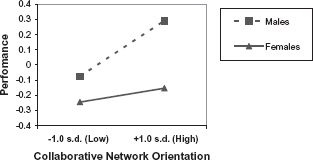
Plot of Collaborative Network Orientation × Gender on Performance
The slopes of both lines were positive, illustrating the positive relationship between CNO and business performance predicted in hypothesis 2. The plot is ordinal and indicates that for both low (−1 SD) and high (+1 SD) levels of the CNO, male managers had higher business performance than female managers, especially at higher levels of CNO. Thus, hypothesis 3 was supported.
Discussion
Based on gender research and conflict theory and research, we formulated a theoretical construct called the CNO. We theorized that a CNO would positively impact business performance, that women would prefer a CNO more than men do, but that as men increasingly prefer the orientation, their performance would increase more than that of women. Analyses of data from managers of small businesses support our theoretical assumptions.
The CNO
The primary contribution of this study is the introduction of a new theoretical construct. In developing this construct, we make two contributions to the literature. First, we have contributed a new combination of existing scales to measure this theoretical construct that integrates concepts about conflict management with concepts about the organization of external and internal networks. The theoretical assumption is that a relatively broad net is cast in establishing these networks and that an overarching collaborative orientation provides the basis for establishing relationships.
Second, the creation of the theoretical construct addresses the concern that gender literature move beyond treating gender as a variable to creating a feminine theory based on gender research (Bird & Brush, 2002; Kantor, 2002; Marlow & Patton, 2005). This paper combined female tendencies identified in gender studies with collaboration from the conflict and negotiation literature to create a new construct. This approach provides a means for theory creation based on gender research.
CNO and Business Performance
This study indicates that a CNO is positively associated with business performance for both female and male managers. A potential explanation for the impact of CNO is resource dependency theory. No organization is entirely self–sufficient. To survive and prosper, managers must obtain and exchange resources (Pfeffer & Salancik, 1978). Research shows a positive relationship between access to resources through networks and firm performance (Zhao & Aram, 1995). Specifically, research about young firms notes the dynamic relationship among networks, resources, and performance (Hite & Hesterly, 2001; Yli–Renko & Autio, 1998). Networks may include family members, who can be key sources for financial or human capital (Bruderl & Preisendorfer, 1998).
Researchers have found that entrepreneurs who have more cooperative orientations coordinate more effectively within networks in ways that contribute to business success (Tjosvold & Weicker, 1993). Because it is a fundamental worldview, an owner with a high CNO would likely be inclined to build relationships that provide a basis to promote growth, expand resources, and expand business opportunities (Garnsey, 1998; Starr & MacMillan, 1990). Future research might examine the relationship between a CNO and potential increases in business opportunities, available resources (including types of resources), and resources exchanged.
To be successful, business managers should obtain resources without becoming overly dependent on others (Scott, 2003). A CNO limits dependencies because collaborative relationships not only build strong ties, but also protect personal business interests. In addition, expanding network relationships may reduce dependencies by creating multiple options for resources. Researchers note that strong ties in networks tend to result in greater access to resources (Hoang & Antoncic, 2003). Future research could examine the relationship between a CNO and the extent of useful network ties that are external to the business.
While the resource dependency model and network literature generally focus on external relationships (Aldrich & Pfeffer, 1976), internal organizational networks, groups, and teams also play a role in small business and the venturing processes (Chrisman, Bauerschmidt, & Hofer, 1998). For example, research suggests that entrepreneurial teams are more likely to be successful than individual entrepreneurs (Kuratko & Welsch, 2004). A CNO promotes team participation and involvement. Research suggests that a collaborative approach to handling issues and problems leads to effective team performance (Alper, Tjosvold, & Law, 2000; Tjosvold, Poon, & Yu, 2005). Researchers might examine the relationship between a CNO and levels of team satisfaction and commitment, the extent of new idea creation within teams, the ability of teams to adapt to take advantage of new business opportunities, and team resilience in responding to environmental change.
Much of the previous discussion suggests that a CNO may not only promote business success, but also has the potential to promote entrepreneurship activity, innovation, and growth. Future research should not only examine these relationships, but also assess other activities related to entrepreneurship such as environmental scanning and open communication systems.
CNO, Gender, and Performance
Although a CNO was positively associated with business success for both female and male managers, the association was higher for males, especially at high levels of a CNO. Previous research sheds some light on these findings. Studies suggest that compared to men, women are not as interested in profit and growth (Brush, 1992), are more interested in customer satisfaction (Chaganti, 1986; Hisrich & Brush, 1987), are more inclined to use networks to obtain social and instrumental support (Smeltzer & Fann, 1989), and are more inclined to develop general connections among family, business, and community (Gilligan, 1982).
Thus, compared to men, women may implement a CNO for a variety of reasons not tied to business success. Future research should explore gender differences in the ways a CNO is enacted inside and outside an organization. For example, male managers may focus more on strategic business success. Female managers may focus more on quality of life and personal, family, and community interests.
Previous research shows that mixed–gender management teams are more successful than either all–female or all–male management teams (Litz & Folker, 2002). Future research might well address how the combination and synergistic effects of mixed–gender or copreneurial teams impact both the CNO and business success. In addition, in family firms, researchers could examine spouses’ influence on the CNO, especially in male–owned businesses.
Limitations
Our measure of performance included items that assessed market share and growth. Although this allowed for a broader definition of business performance, it may not adequately reflect the performance of women entrepreneurs who prefer smaller businesses and slower growth, and yet are still successful and profitable. In addition, while the sample was large enough to demonstrate an effect, the sample of women–owned family businesses was relatively small. Future studies would benefit by increasing the sample size.
Self–report data were used to test hypotheses. To check for possible common method bias, data were examined to see if a single factor emerged from an unrotated solution (Podsakoff & Organ, 1986), and items were correlated with age of the firm (de Vries, Roe, & Taillieu, 1998). Neither test revealed problems with common method bias.
Although this study provides evidence that a CNO contributes to business success in this sample of small businesses, there is much that we do not know that requires further research. For example, would a CNO yield success in older, larger, and well–established businesses that tend to develop hierarchical organizational structures? That may depend on the type of organization and the nature of business units in the organization.
Conclusion
The CNO was derived from research about female managers. However, this study suggests that the positive relationship between a CNO and business performance extends to small business managers in general. The CNO holds the promise of adding to our understanding of how individuals achieve business success. Future research should examine how a CNO is manifested both inside and outside the business. In addition, much of our discussion related to CNO has been about acquiring resources. For those interested in quality of life, a CNO may provide contacts and relationships that are personally rewarding. For those who are interested in business growth, a CNO may provide resources, identify and develop entrepreneurial opportunities, and fuel entrepreneurial growth.