







Abstract
Regional economic development policy is recognized as a key tool governments use to foster economic prosperity. Whether specialization (or diversity) of economic activities should be a regional development policy goal is often debated. We address this question in a local–diversity context, by reviewing traditional arguments in its favor, supplemented with evidence for more entrepreneurial concepts like industrial symbiosis and Jacobs externalities. We show that the context of entrepreneurship matters more to policy than the type and form of resulting industries. Policies enabling entrepreneurs to exploit opportunities in a context of spontaneously evolved industrial diversity are better facilitators of regional development.
Introduction
Regional development prescriptions based on the promotion of geographically localized, related, and interdependent firms can be traced back at least to the “growth pole,”“growth center,” and “industrial complex” strategies implemented in numerous countries in the 1960s and 1970s. While the main goals of these policies were to create agglomeration economies (or “external economies of scale”) and to increase productivity, more recent approaches—with Michael Porter's (1990) cluster strategy being by far the most influential—have emphasized the positive impact that a regional context made up of geographically proximate and industry–related firms and institutions can have on entrepreneurial and innovative activities. While the cluster strategy has been criticized on several counts, ranging from its fuzziness to its status as a rationale for supporting politically favored industries (Bathelt, 2005; Desrochers & Sautet, 2004; Rocha, 2004), it has nonetheless successfully overturned the previously prevalent diversification objective of most local development officials and established regional specialization as the preferred goal (Rosenfeld, 2001).
As Rocha and Sternberg (2005, p. 267) point out, however, research on the impact of local conditions on entrepreneurial behavior remains theoretically and empirically scarce due to “conceptual, theoretical, and methodological limitations.” Taking a broad view of entrepreneurial activities, which it defines as the creation of new economic activities and the pursuit of innovation, this essay aims to address this issue by suggesting that a “successful” policy push toward specialization might contain the seeds of its own demise by leaving regional economies more vulnerable to cyclical downturns and less likely to support the emergence of innovative practices and behavior, such as the development of interindustry linkages and new combinations of existing technologies and materials (“Jacobs externalities”). 1
The issue is not that regional specialization policies are developed at the expense of spontaneous industrial diversity. Indeed, the two can coexist. Rather, we argue that entrepreneurial activity is at the source of regional development and that theory and evidence seem to indicate that spontaneously developed industrial and economic local diversity typically provide a better substrate for entrepreneurs to innovate. While we do not argue the pursuit of diversity as a policy goal, we strongly emphasize the limits and problems inherent to regional specialization strategies by pointing out that a diverse environment is often a necessary precondition for the spontaneous emergence of diverse local specializations.
The paper is structured as follows. The first section reviews the main points of contention in a long–standing debate among academics, local development professionals, members of local business associations, and policy makers as to the respective advantages and pitfalls of the regional specialization and diversity of economic activities. The second section briefly evaluates whether planned regional specialization efforts, by far the most dominant perspective in recent years, have been successful. The remainder of the paper discusses four arguments that limit the case in favor of publicly planned regional specialization: (1) interindustrial linkages and industrial symbiosis (i.e., waste recovery linkages between different industries), (2) Jacobs externalities (i.e., knowledge spillovers between different industries), (3) local environment and proximity, and (4) the role of entrepreneurship.
This essay supplements the current literature on these topics in two ways. First, we survey a now largely forgotten body of historical evidence on by–product development that both supports the widespread nature of industrial symbiosis and discusses its rationale from the entrepreneur's perspective. We then describe how Jacobs externalities actually occur by synthesizing the main patterns of outcome observed in a qualitative survey of French–Canadian entrepreneurs. This material leads us to conclude that the regional setting most conducive to entrepreneurial activity is probably a diversified city made up of many specialized clusters, which is what most thriving cities have historically spontaneously evolved into.
Regional Specialization as Economic Policy
The geographical concentration of related manufacturing and service firms is probably as old as economic development. For example, Rogers (1884) refers to a document published around the year 1250 that documents the following localized English industries: schooling (Oxford), eels (Cambridge), scarlet (Lincoln), blanket (Bligh), burnet (Beverley), russet (Colchester), linen fabrics (Shaftesbury, Lewes, Aylesham), cord (Warwick, Bridport), hempen fabrics (Bridport), fine bread (Wycombe, Hungerford, St. Albans), knives (Maxstead), needles (Wilton), razors (Leicester), etc.
In later centuries, such geographical concentrations of economic activities would often be explained by applying the law of comparative advantage (Ricardo, 1817/1821) at the subnational level. In short, by specializing in the production of one type of good (e.g., automobile production) or one set of related goods (e.g., transportation equipment) for which they have a relative advantage (in terms of opportunity costs of producing the good), urban agglomerations or larger regions are made better off than if they only have access to autarkic production. This is said to be true whether a region or a city has an absolute advantage in only one good (the one it specializes in) or has an absolute advantage in the production of every good—as long as differences in opportunity costs in production make it advantageous for the city to specialize. 2 Not surprisingly, policy makers have long attempted to promote the development of what have most famously been labeled “industrial districts” (Marshall, 1890/1920). Perhaps the earliest interventions in this respect involved immigration policy. As Marshall (1890/1920, book 4, chap. 10, nonpaginated) observed several decades ago:
Very often the rulers deliberately invited artisans from a distance and settled them in a group together. Thus the mechanical faculty of Lancashire is said to be due to the influence of Norman smiths who were settled at Warrington by Hugo de Lupus in William the Conqueror's time. And the greater part of England's manufacturing industry before the era of cotton and steam had its course directed by settlements of Flemish and other artisans; many of which were made under the immediate direction of Plantagenet and Tudor kings. These immigrants taught us how to weave woollen and worsted stuffs, though for a long time we sent our cloths to the Netherlands to be fulled and dyed. They taught us how to cure herrings, how to manufacture silk, how to make lace, glass, and paper, and to provide for many other of our wants.
In the more recent past, policy prescriptions based on the promotion of geographically localized, related, and interdependent firms have included the “growth pole,”“growth center,” and “industrial complex” strategies implemented in numerous countries in the 1960s and 1970s (Chapman, 2005; Chapman & Walker, 1987; Hansen, 1996; Rocha, 2004; Wheeler, Muller, Thrall, & Fink, 1998). In short, growth pole strategies were centered around “clusters of industries” (Chapman & Walker, 1987, p. 216), including at least one “propulsive sector” that was said to quickly develop the main characteristics of modern large–scale industry and, being in an early stage of the product cycle, had higher growth potential than average for manufacturing. Because of its size, importance, and interconnections with other “affected industries” and activities, this key industry's growth benefited the local area through increased employment, purchasing power, and the attraction of other economic activities. Although the concept was originally dynamic and linked to innovation, in practice it was often restricted by “reliance on input–output analysis and a focus on large industries” (Chapman & Walker). Growth centers, for their part, were essentially means of organizing public infrastructure more efficiently by concentrating them geographically, a process which typically generated much political opposition from inhabitants of nonfavored areas. Finally, industrial complex strategies consisted of studies looking “at the location of a group of interrelated industries, looking at interconnections, the relative advantage of each component parts, and the attraction of locating a complex with or without its various component parts (Chapman & Walker, p. 217).
While the main goals of these policies were to create agglomeration economies and to increase productivity, more recent approaches—the most prominent being by far Porter's (1990, 1998, 2000a, 2000b) cluster strategy which revolves around the promotion and reinforcement of “a geographically proximate group of interconnected companies and associated institutions in a particular field, linked by commonalities and complementarities (2000a: 16)”—have emphasized the positive impact that a regional context made up of geographically proximate and industry–related firms and institutions can have on innovative activities (Bathelt, Malmberg, & Maskell, 2004; Cortright, 2006; Khan & Ghani, 2004; Rocha, 2004).
Spatial economic analysts have also long described the importance of some positive externalities such as localization economies that occur when firms involved in the same line of business are in close geographical proximity, allowing them to benefit from asset sharing, common labor pooling, better access to intermediate inputs, increased face–to–face communication (which facilitates the communication of tacit knowledge and the development of trust–based relationships), and knowledge spillovers on related technologies (Marshall, 1890/1920; Rosenthal & Strange, 2004).
Traditional Case against Regional Specialization
The idea that government–led regional specialization delivers the results claimed by its supporters has been challenged on several counts. A main theoretical argument in this respect invokes another class of externalities, urbanization economies, by which the geographical concentration of a wide variety of firms generates significant benefits across different lines of work. For example, software engineering, accounting, advertising, manpower, and catering firms, among many others, can often serve a different array of customers in a particular geographical area better and/or cheaper than if these firms were maintaining these functions within their corporate structure. Transport infrastructures, such as ports and airports, also benefit a wide array of localized businesses. A diversified local economic structure is also believed to generate a greater “multiplier” effect when new productive activities are added to the local mix, in the process providing new customers to a whole range of (as opposed to a few) local producers (Dicken & Lloyd, 1990; Hoover & Giarratani, 1984; Wheeler et al., 1998).
Another argument rests on the fact that diversified local economies have always been more stable and resilient than highly specialized regions whose fates rested on the ultimately temporary demand for a particular type of good or service (Chapman, 2005). This was certainly obvious to Alfred Marshall (1890/1920, book 4, chap. 10, nonpaginated) who observed that “a district which is dependent chiefly on one industry is liable to extreme depression, in case of a falling–off in the demand for its produce, or of a failure in the supply of the raw material which it uses,” but that this problem was “in a great measure avoided by those large towns or large industrial districts in which several distinct industries are strongly developed.” His contemporary, Malcom Keir (1919, p. 47), similarly wrote that few places were harder hit during difficult times than “every town whose industries are not diversified.”
Many studies have tried to estimate the extent, magnitude, and respective importance of localization and urbanization economies, but these measurements have always been problematic (Rosenthal & Strange, 2004; Siegel, Johnson, & Alwang, 1995), as has been the development of a workable concept of diversity. Indeed, according to Malizia and Feser (1999, p. 92), economic diversity can only be defined operationally as the presence of multiple specializations, a point that has always resulted in much analytical confusion. Furthermore, as Rocha and Sternberg (2005, p. 267) point out, while research on the impact of local conditions on entrepreneurial behavior remains both theoretically and empirically scarce due to a number of methodological, theoretical, and conceptual limitations, entrepreneurship and clusters are themselves “complex phenomena that defy definition, which in turn undermines theory building and testing.” Be that as it may, econometric studies supporting either the benefits of specialization or diversity can be found (Polese, 2005).
In spite of the theoretical and empirical difficulties to establish the actual impact of regional specialization on entrepreneurial behavior, we believe that another set of arguments can be used to evaluate the rationale underlying policy efforts to promote and reinforce the regional specialization of specific lines of work. Our case rests on the idea that economies, regions, and cities are self–organizing systems driven by entrepreneurial and innovative behavior, which is itself more likely to be stimulated in a more (as opposed to less) diverse environment. This idea will be explored in the context of four specific issues: (1) interindustrial recovery linkages, (2) Jacobs externalities, (3) the role of the local environment, and (4) the role of entrepreneurial activity.
Interindustrial Recovery Linkages
Urbanization economies can take many forms, including linkages between different types of industry that are created by entrepreneurs in order to turn the industrial waste of one into the valuable input of another. While the phenomenon was identified long ago (Renner, 1947), it was not until the last two decades that it began to generate sustained academic interest under the broad interdisciplinary umbrella known as “industrial ecology” (Ayres & Ayres, 2002). Industrial ecologists’ core insight is a simple one: Why could our industrial system not behave more like an ecosystem where the waste of one species is the vital input of another? Interestingly, some of them have looked into the physical exchange of materials, energy, water, and by–products among geographically proximate, but diverse, factories and plants, a phenomenon eventually labeled “industrial symbiosis” (Chertow, 2000).
In its current incarnation, industrial symbiosis first gained attention at the turn of the 1990s after Danish teenagers working on a high–school project noticed numerous waste–recycling linkages in their small, but economically diversified, hometown of Kalundborg. Further research later revealed that the city and its surrounding region were hosts to numerous water (seven), energy (six), and solid waste (six) symbiotic relationships (Jacobsen, 2006; Jacobsen & Anderberg, 2004). Among the entrepreneurial actions that created these linkages in the last four decades are the following. In 1972, a pipeline was installed that brought an excess amount of gas from the local Statoil refinery (that would have otherwise been burned as waste) to a Gyproc plaster board factory to dry their production. Following the first oil crisis, Danish power stations converted from oil to coal, in the process generating a large amount of fly ash, which the Kalundborg Asnæs station managers sold to cement companies. In 1976, managers at a local Novo Nordisk plant that produced insulin and industrial enzymes began selling its sludge–like biomass made up of dead microorganisms to local farmers for use as fertilizer. A few years later, power station employees made an arrangement to get their hands on the refinery's spent cooling water when they needed to expand their operations. Figure 1 describes most current linkages.
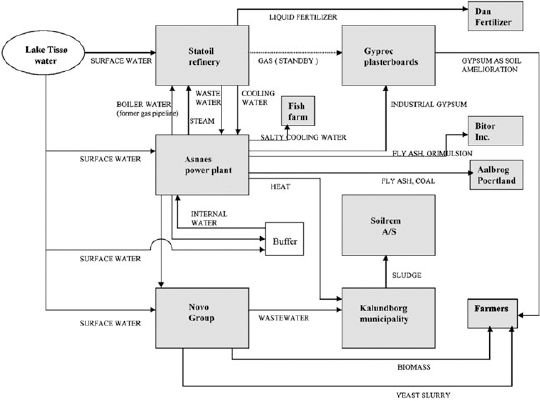
The Kalundborg Industrial Symbiosis (2002)
Perhaps the most striking feature of the Kalundborg case was that these spontaneous developments resulted from decentralized entrepreneurial actions that built on readily existing industrial diversity. Jorgen Christensen, a spokesperson for Novo Nordisk, was explicit on this point: “We didn't design the whole thing. It wasn't designed at all. It happened over time” (quoted in Lowe, 1995, p. 15). Henning Grann, a Statoil employee, reinforces the point: “The symbiosis project is originally not the result of a careful environmental planning process. It is rather the result of a gradual development of cooperation between four neighbouring industries and the Kalundborg municipality” (quoted in Garner & Keoleian, 1995, p. 28). In each case, some local managers and entrepreneurs were confronted with a particular problem—either the (often costly) disposal of potentially valuable resources or the constant need for better and/or cheaper inputs—and saw opportunities in the local diversified economy to improve the competitive stance of their operations.
Knowledge about the Kalundborg case inspired further research and the later “discovery” of similar spontaneous linkages in various regions of Europe and the United States (Desrochers, 2001b, 2002a; Wolf, Eklund, & Söderström, 2007). Despite widespread beliefs as to the novel character of such linkages (Desrochers, 2002b), much historical evidence suggests that they are probably as old as economic development and have certainly been widespread in all advanced economies in the last two centuries. Perhaps the best sources on the topic are a number of now largely forgotten compendiums whose aim was to provide concise overviews of the technical literature of their time by documenting thousands of profitable waste–recovery cases (Desrochers, 2007; Kershaw, 1928; Koller, 1918; Lipsett, 1963; Simmonds, 1876).
Whereas covering the entrepreneurial history behind successful attempts to turn wastes into by–products is beyond the scope of this paper, Talbot (1920, pp. 17–18) perhaps best summarized the dominant opinion on the topic in the late nineteenth and early twentieth century when he observed that “to relate all the fortunes which have been amassed from the commercialization of what was once rejected and valueless would require a volume” and that this would be “a story of fascinating romance and one difficult to parallel in the whole realm of human activity.” Indeed, Karl Marx (1894, Vol. 3, part 1, chap. 5, nonpaginated) shared this assessment when he wrote that capitalism extended “the utilisation of the excretions of production and consumption” and that the “so–called waste plays an important role in almost every industry.”
Several past commentators observed that the development of by–products, especially those that were difficult and/or costly to transport, often reinforced agglomerative tendencies. Ross (1896, p. 256) explained the geographical concentration of industries at least in part by “the cluster of side industries that grow up about packing establishments, refineries, or gasworks, engaged in turning refuse into by–products,” while Devas (1901, p. 98) highlighted the role of the “greater growth of subsidiary industries, such namely as supply materials and utilize refuse, to do which for a single factory would not be worthwhile.”Talbot (1920, p. 303) pointed out that, in order to be successful, “co–operative and individual methods [of resource recovery] … can only be conducted upon the requisite scale in the very largest cities where the volume of material to be handled is relatively heavy” because “waste must be forthcoming in a steady stream of uniform volume to justify its exploitation, and the fashioning and maintenance of these streams is the supreme difficulty.”
Keir (1919, pp. 39–40) similarly wrote that localization “attracts to itself plants whose business is the utilization of waste products” and that, for the factories, “the presence of the waste–using shops turns a loss into a profit, a charge into a credit or a liability into an asset.” He observed that each additional recovery plant added “an increment to the importance of a locality as the center of an industry,” for “by transforming liabilities into assets, and turning costs into profits,” they aided “in the defense of the community against the onslaughts of outside competition” and therefore augmented “the growth of the industry in the location where it is already rooted.”
He illustrated these processes with various cases, such as a great cement plant in Buffington, Indiana, that fed upon the slag (“the scum of impurities taken from the ore when it is melted”) of the largest steel mill in the United States located in the nearby town of Gary; the cap shops of New York City that were usually located next door to clothing factories in order to have easy access to their remnants; a glue and mucilage manufacturer in Gloucester, Massachusetts, whose main input was the heads and tails of fish from what was then one of the most important fishing ports in the world; and a “brass laundry” in Waterbury, Connecticut, whose employees recovered machine shop oil and separated brass from other materials collected from nearby businesses. Again, in each case, creative and entrepreneurial individuals saw opportunities in problematic situations and ended up creating what are now typically referred to as economy–environment “win–win” situations.
The recent rediscovery of industrial symbiosis paved the way for a few planning exercises through which public officials attempted to replicate the Kalundborg experience. While so–called “eco–industrial parks” are most likely unsound in theory (Desrochers, 2001c) and have typically failed to live up to expectations in practice (Deutz & Gibbs, 2004), their planning stage has nonetheless highlighted the fact that specialization–oriented cluster development is fundamentally incompatible with the spontaneous emergence of industrial symbiosis through decentralized entrepreneurial initiatives. As Chiu (2002) observes in the context of Asian initiatives in this respect, many investors complained that they were not allowed to pick their preferred location, while many estate managers claimed that they could not select the right industrial mix to further local economic development and symbiotic linkages.
The evidence seems to show that interindustrial recovery linkages emerge spontaneously shaped by the forces of entrepreneurial innovation. While industrial parks, growth poles, and other policies may vary significantly in the magnitude of their impact on local economies, we are not so much concerned in this paper with their relative effect, but rather with the idea that there exist better ways to foster local innovation and entrepreneurship than policies that deliberately aim to foster the regional specialization of economic activities. Industrial symbiosis is but one recent argument that shows the limits of such policies. Perhaps even more important is the concept now referred to as “Jacobs externalities.” We now turn to a discussion of this idea.
Jacobs Externalities
One of the least controversial aspects of technological change is that innovations are created through new combinations of previously unrelated things. As Babbage (1832, chap. 27, non–paginated) put it, the “power of inventing mechanical contrivances, and of combining machinery, does not appear, if we may judge from the frequency of its occurrences, to be a difficult or a rare gift.” For example, almost four centuries ago in the Netherlands, windmill technologies used for water pumping were adapted for wood sawing, while in the nineteenth century American telegraph companies borrowed the “template” developed by railroad companies to handle the flows of multiple messages to and from multiple locations (Bunker & Ciccantell, 2005). The first applications of diesel engines were in stationary uses (pumps and oil drills) and in heavy transport (boats and locomotives) (Smil, 2005), while “everything we eat, wear, and use” is now made with some help from electric motors (p. 79).
Building on this insight, urban theorist Jane Jacobs (1969) argued that economically diversified cities provide the best setting for “adding new work to old.” Although her theoretical framework is broader and encompasses factors such as access to capital, zoning regulations, and the importance of agglomeration economies for entrepreneurial start–ups, so–called “Jacobs externalities” are now broadly understood to mean “inter–industrial knowledge spillovers” occurring in economically diverse cities as a result of the interaction of individuals possessing different backgrounds (Algaze, 2005; Desrochers & Hospers, 2007). By contrast, a local economy that is not well diversified is obviously much less likely to promote the development of new combinations. Of course, individuals may move from one geographical area to another, or have sustained collaborations with other individuals in more remote locations, but this does not undermine the fact that a more diversified local economy increases the probability and ease of creating new combinations, although it is not an absolute prerequisite in this respect.
In the last decade and a half, the authors of several econometric papers have examined the concept by distinguishing between traditional “static” externalities (such as already existing agglomeration economies) and more dynamic ones, such as knowledge flows between firms and industries. They have attempted to test the relative importance of Jacobs externalities against the traditional view that regional specialization should be more beneficial in terms of innovative, and therefore commercially successful, behavior (Feldman, 2000; Glaeser, Kallal, Scheinkman, & Shleifer, 1992; van der Panne & van Beers, 2006). Reviewing these contributions, Duranton and Puga (2000, p. 53) conclude that the “link between innovation and diversity seems fairly robust” and that “highly innovative clusters cannot be bred in previously specialized environments.”
This literature, however, can be criticized on several counts. Perhaps most significant is that these studies rely on location quotients and similar relative measures of sectoral concentrations or diversity in large metropolitan areas that are then correlated (or not) with “outputs” such as innovations or new product advertised in the technical literature; patent data; answers to questionnaires enquiring about the adoption/introduction of new technologies; or employment, income, and productivity growth. Researchers then invoke localized knowledge spillovers when commenting upon their results, but these studies do not document them or even prove their existence (Breschi & Lissoni, 2001a, 2001b; Hansen, 2002; Quigley, 1998). Commenting on these and more qualitative studies on “learning regions” that emphasize the creative capacity of regions, networks, and informational technologies, Hansen (2002, p. 261) argues that more meaningful analyses of the topic “would require disaggregated empirical studies of how knowledge in fact passes among persons.”
While the actual processes through which these new combinations occur have rarely been discussed in any depth, 3 a case can be made that any innovative individual can only combine different resources through two basic processes. The first is to incorporate a new type of material/process/product (M/P/P) to a previously unrelated M/P/P, while the second is to find a new use for an existing M/P/P (Desrochers, 2000, 2001d). Examples of the former include Thomas Edison's idea of a screw base for his light bulbs that came to him in 1880 as he unscrewed the cover of a kerosene can (Smil, 2005), and the American container shipping pioneer Charles McLean whose inspiration can be traced back to his days as a trucker watching bales of cotton being hauled by sweating laborers, with the trailer eventually becoming the container (Jung, 2005). In a corporate context, some of the early success of the Ford Motor Company can be traced back to the successful integration of sheet steel punch and presswork technologies used in the bicycle industry and to the development of the assembly line through the adaptation of ideas and techniques previously used in the “disassembly lines” of meatpackers and in flour milling (Hounshell, 1991/1984).
Numerous examples of new uses found for existing know–how can be observed in the so–called “bicycle craze” that hit the United States in the late nineteenth century. In New England, numerous arms makers, sewing machine companies, and other small–item manufacturing concerns competed to enter this line of business. In the Midwest, bicycle builders “emerged primarily from the ranks of carriage– and wagon makers, wooden toy and novelty specialists, agricultural implement makers, or as totally new enterprises” (Hounshell, 1991/1984, p. 208). Another well–documented case is the rapid diversification of German synthetic dyes manufacturers in the early twentieth century which, in time, turn their basic raw material (coal tar derived from coal gasification) into a suitable input for the manufacture of products ranging from explosives, medicines, and perfumes to flavoring materials, sweeteners, disinfectants, antitoxins, and tracing and photographic agents (Beer, 1959/1981).
Perhaps the main reason for the paucity of detailed accounts of interindustrial knowledge spillovers in diversified cities is the difficulty of tracking a large number of individuals who move frequently between different lines of work and/or regularly borrow ideas from fields other than their own. Most individual innovators, however, tend to fit this profile (Brown, 1988). In a preliminary attempt to better understand the processes involved in the creation of new combinations in a diversified urban setting, semistructured face–to–face interviews were conducted with 45 southern Quebec (Canada) entrepreneurs, 43 of which were French–Canadians (Desrochers, 2000). What follows is a synthesis of the broader patterns observed in this group of individuals, along with a few illustrative examples. 4
Despite their very different characteristics and backgrounds, striking regularities were observed in all innovators’ creative processes, with individuals often going back and forth between the following steps: (1) problem identification; (2) examination of a wide range of potential solutions; (3) trial and error; (4) creation of a new combination; (5) new problem identification, as there can be never be a perfect artifact. Individuals had only two ways of creating new combinations of existing products, processes, and materials: (1) find a new use for something with which they were familiar; (2) incorporate something with which they were previously unfamiliar into something with which they were already familiar.
All individuals admitted that they frequently borrowed and adapted existing things in new ways, whether they were working on a particular invention or in production activities. The main processes in this respect follow one of three common patterns: (1) interindustry job mobility, (2) discovery of a new use, and (3) adaptation of technologies developed for other purposes. These processes will now be illustrated with a few examples of new combinations created between the early 1970s and the late 1990s.
Interindustry Job Mobility
A common process through which new technology combinations were created is job mobility between different industries. To summarize, technically creative individuals lacking the credentials or interest to climb a corporate ladder often changed jobs and industrial sectors. For example, a machinist moved between the steel, chemical, and aerospace industries before spending some time in porcelain making and real estate. A mechanical engineer got his start in an ore processing plant and later worked for a car plant, a truck plant, and a plastic manufacturer. He summarized the comments of several interviewees by pointing out the following: “I was never able to stay more than two or three years at the same place. After two or three years, I knew everything. I had done everything. I needed new challenges. I was soon looking elsewhere.” Job mobility in turn led to innovations in a new setting by building on past expertise. As the same engineer put it: “You always bring various experiences and know–how from one field to another whether in mining, plastic molding, car manufacturing. You need pumps, compressors, pipes, whatever… . You can often apply something that you learned in one place to another.” Among other examples, a machinist working in a cement manufacturing plant suggested a new way to clean tankers based on his previous experience in a newspaper printing plant.
Discovering a New Use
Another frequent mechanism by which new knowledge entrepreneurial opportunities are created is the discovery of a new use for an existing product or set of skills (Minniti, 2004; Shane, 2000). One individual adapted a signaling device he had created for a credit union for use in the restaurant business. Another innovator modified a measuring device, incorporating a number of electronic components originally developed to assess car crashes, in order to make it suitable for archeological excavations. In both cases, individuals noticed a problem (the first in person, the second while watching television) that was not directly affecting them, but for the solution of which they immediately saw a potential new use for one of their creations. Another innovator found that there was not much demand for a new type of ski rack he had designed for use in private homes, but that piling them on top of each other helped sporting goods store managers better display their merchandise. In this case, the suggestion came from a sporting equipment retailer who had no real interest for the innovation's original use, but who immediately saw how it might prove useful to him.
Adapting Technologies Developed for other Purposes
Many entrepreneurs adapted technologies they had observed in another setting. For example, one individual who was working on Christmas light decorations decided to create a Christmas tree made entirely of optical fibers after visiting an optical fiber display. Another entrepreneur adapted an agricultural equipment device mechanism to create a new type of four–wheeled bicycle. A baby blanket/bag producer modeled her small workshop on the division of labor observed in the kitchen of a large restaurant owned by one of her friends. As one individual put it: “You always adapt things that you see in other settings. Whether it is only a part of it or the whole thing, this happens every day… . You see something and you go: “Great idea! … And then you incorporate it. It's very common… . There is no point in reinventing the four–hole button. You must make the most out of what already exists.” Another entrepreneur concurs: “Sometimes I have ideas, but I don't know how to realize them… . When I see something, I tell myself that this is what I would need … I go copy elsewhere … I don't turn down what already exists, I won't reinvent the wheel. It's faster that way.” Of course, much development work often needs to be done once an idea for a new combination has been hit upon.
The existence of industrial symbiosis and Jacobs externalities tends to show that the best context for entrepreneurship is a diverse environment where old ways of doing things are likely to nourish new discoveries. This fact argues in favor of policies that emphasize the quality of the environment for entrepreneurship rather than planned regional specialization. In order to explore this tentative conclusion further, we now turn to a more detailed discussion of the role of the local environment and the importance of proximity.
On the Importance of Geographical Proximity
The role played by local diversity in facilitating new combinations is multidimensional. First, local diversity matters in terms of the kind of work experience individuals who remain for a significant period of time in a particular location are likely to acquire and in terms of the sectors in which they are likely to transfer or adapt it. 5 For example, some interviewees had worked in the car assembly and supply parts industries and gained specialized knowledge in that environment before applying some of it to other lines of work. This sector, however, is to a large extent being phased out of the Quebec economy. It is therefore less likely to provide learning opportunities in years to come. On the other hand, new sectors are emerging and are currently providing valuable know–how to a number of creative individuals and would–be entrepreneurs.
Another important dimension of local diversity is the network of experts and potentially knowledgeable people possessing the varied expertise that an individual builds over time, both within particular firms and with various customers and suppliers, which eventually act as either partners, occasional collaborators, mentors, or advisers. A recurring comment to that effect goes somewhat like this: I was looking for something that would do that. I talked about it to individual X. He thought about it for a while and said that I should look up that particular thing that can be found at this or that supplier or manufacturer. Of course, sometimes plain luck—such as talking to a person sitting next to you at a restaurant—also plays a role.
The importance of geographical proximity for communicating specific features and for conducting numerous experiments to “get a product right” cannot be overemphasized. Even what looked like very simple plastic devices frequently required more than 30 site visits on the part of an innovator to a mold–making shop. An extreme case is the inventor of a new board game who claims that he had to meet his graphic designer more than 1,000 times before a satisfactory result could be obtained. As could be expected, most entrepreneurs agreed that face–to–face communication between individuals possessing different expertise is even more crucial than for experts in the same field (although the latter is typically considered very important) because they do not share a similar background and technical language. Face–to–face interaction was also deemed crucial to built trust relationships and to select suppliers.
The importance of proximity results from the nature of knowledge, or perhaps more accurately, know–how. While new communications means have dramatically improved the flow of information and facilitated business interactions, widely publicized reports on the “death of distance” are greatly exaggerated (Morgan, 2004). In short, as Hayek (1945) argued, much of the knowledge that makes markets work is difficult to articulate and therefore not easily transmissible. Similarly, in urban environments, the crucial knowledge is not explicit, formalized, and easy to communicate, but rather nonstandardized and embodied in human capital (Desrochers, 2001a; Desrochers & Sautet, 2004). This largely intangible character of urban environments was described by Marshall (1890/1920, book IV, chap. X, nonpaginated) as being “in the air” and producing the effect that “if one man starts a new idea, it is taken up by others and combined with suggestions of their own; and thus it becomes the source of further new ideas.” Evidence seems to show that policy makers are not well placed to identify and enhance the flows of tacit knowledge that make the richness of prosperous urban centers for they lack the know–how, know–who, and experience acquired over time and in different workplaces by entrepreneurs, managers, and technicians. Regional development policies often ignore the importance of knowledge and its transmission. Instead, policies should focus on the quality of the institutional context in order to enhance the chances for entrepreneurs to discover new combinations and make the most of the knowledge lying around.
We now turn to the importance of entrepreneurial activity in the emergence of diversified urban centers.
The Entrepreneurial Process and Agglomeration Economies
Many individuals involved in entrepreneurial ventures to create and market their innovations deemed traditional agglomeration economies extremely valuable. To illustrate that an innovative idea is but one step in the creation of a marketable product, consider a small plastic flask whose only originality lay in its design. Its creator credited his ability to put his product on the market in a timely manner to the presence of the following local individuals and firms who all relied on a diversified customer base to stay in business: an industrial designer, a plastic molder, a plastic product specialist, a rope supplier, a cap supplier, a label maker, a shop to put everything together, a salesman, and a distributor. Countless examples such as these illustrate the truth of Thomas Edison's alleged observation that invention is 1% inspiration and 99% perspiration. Such entrepreneurial activities, along with the important role played by urbanization economies in this context, however, are typically missing from recent discussions of “Jacobs externalities.”
Building on the entrepreneurs study described earlier, and an eclectic literature review in several academic fields ranging from cognitive psychology to the history of technology, a case can be made that new technology combinations in the commercial realm typically occur under the following, often nonmutually exclusive, circumstances: (1) in multidisciplinary teams working within a firm; (2) when employees add to, or switch, their product line; (3) when individuals observe a product/process in another setting and incorporate it into their main activity; (4) when individuals move from one type of production to another; and (5) when individuals possessing different skills and working for different firms collaborate with each other (Desrochers, 2001d).
Most innovators who had lived in both a diversified city and an economically specialized (i.e., monoindustrial or resource–based) region agreed that the former provided an environment that not only gave them the opportunity to see more problems, but also a better opportunity to actually do something about them by providing easier access to a wider pool of expert knowledge and other resources. These observations support Minguzzi and Passaro's (2000, p. 181) suggestions that the cultural evolution processes observed in small firms are “strongly influenced by the type of relationships that they establish with the economic environment” 6 and that the resistance to change observed in some territorial and industrial contexts is often determined “by a cultural entrepreneurial homogeneity.” This latter point was certainly obvious to Keir (1919, p. 47):
From the point of view of employees, [geographically specialized] localization is bad because it also tends toward narrowing the minds of the townspeople. A young man brought up in Fall River [Massachusetts], say, has but little choice of occupation; he must become a weaver or a loom–fixer or some other artisan connected with cotton manufacture, because by upbringing, education and example he is forced into that path, and furthermore he goes to work at an early age. It may happen that many a square peg is rammed into a round hole in this way, or a life constricted which might under better conditions have expanded. There is something deadening to the human mind in uniformity; progress comes through variation, therefore in a town of one industry a young man loses the stimulus for self–advancement.
Interestingly, Michael Porter (2000a, p. 24) seems to have caught on to this rationale when he argues that when individuals in a cluster share “a uniform approach to competing, a sort of groupthink often reinforces old behaviors, suppresses new ideas, and creates rigidities that prevent adoption of improvements.”“Clusters,” it turns out, might also “not support truly radical innovation, which tends to invalidate the existing pools of talent, information, suppliers, and infrastructure.” While in these circumstances a cluster participant might not necessarily be worse off than an isolated firm because both can outsource, “the firm in an established cluster might suffer from greater barriers to perceiving the need to change and from inertia against severing past relationships that no longer contribute to competitive advantage.”
As we have argued throughout the paper, much evidence suggests that the environment in which entrepreneurs operate exerts much influence on their capacity to innovate. As William Baumol (1990) argued, the institutional environment has an impact on how socially beneficial entrepreneurial activity can be. We contend that policy strategies that deliberately reinforce regional specialization tend to impoverish the environment for entrepreneurs because they limit the probabilities of seeing and acting on new opportunities, whether through the development of new interindustrial linkages or new combinations. Entrepreneurial activity is at the source of diversified urban centers, which in turn become places where entrepreneurs often find the most conducive substrate for their activities. While much historical evidence demonstrates that economic specialization emerges spontaneously, however, local economies that fail to diversify over time typically develop much slower (if at all beyond a certain point) than local economies where entrepreneurs constantly generate new activities, a point made several decades ago by Chinitz (1961) in his comparative analysis of New York City and Pittsburgh. If, as theory and evidence suggest, the context in which entrepreneurship develops matters most to the development of healthy economic regions, then the case for planned regional specialization runs into problems which severely limit its potential success (Kirzner, 1979).
Conclusion
In the wake of the success of Michael Porter's cluster strategy and a long–held belief that the geographical specialization of economic activities is a desirable outcome of trade and the division of labor, regional development policy in the last two decades has heavily favored regional specialization at the expense of local economic diversity. While there is no doubt that the division of labor among individuals is beneficial for society at large (although it should perhaps be thought of more often in terms of skills rather than final products), the advantages of promoting regional specialization through public policy are less obvious. Indeed, much evidence suggests that specialization leaves regional economies more likely to experience severe economic downturns and is less conducive to the development of symbiotic linkages between diverse firms (including recycling linkages).
Furthermore, if innovation is understood as the socially beneficial combination of previously unrelated things by entrepreneurs, it is likely that a more diversified environment will increase the probability of combining existing skills and resources in different configurations by offering a greater number and variety of problems to be solved, as well as a much wider pool of expert knowledge and other useful resources to develop new solutions. This result, in part, rests on the nature of knowledge and its transmission. What matters to entrepreneurial discovery is not only explicit and easily transmissible knowledge, but also the knowledge that is tacit and harder to transmit. Proximity and diversity offer the context for entrepreneurs to build on explicit and tacit knowledge so as to create new combinations and thereby innovate. Much evidence confirms the crucial importance of agglomeration economies for innovative business start–ups.
The specific impact of local diversity on entrepreneurial activities, however, is not as easily assessed as that of a regionally specialized industry. Most of the innovations and entrepreneurial acts documented in our study were built on the foundations of Southern Quebec's economic diversity, but drew on the kind of materials, devices, and expertise that could be found in most important urban agglomerations (i.e., expertise in metals, plastics, electronic components, design, marketing, distribution, etc.). Be that as it may, it seems highly plausible that, as Aitken (1985, pp. 15–16) argued, “the points of confluence of information flows define the social locations where there is a high probability of new combinations being made.”
All this is not to say, of course, that specialized districts or clusters are bad things. After all, their historical importance and prevalence over time clearly demonstrates their intrinsic value. Furthermore, firms located in spatial concentrations of advanced technology activities do not constrain their knowledge inputs from within their local area (Breschi & Lissoni, 2001a; Britton, 2004) and it may be the case that much interindustrial collaboration can be achieved over long distances. Nonetheless, it seems plausible to suggest that face–to–face collaboration between individuals possessing different (explicit and tacit) knowledge bases might be even more useful than that between people sharing a similar professional background. In any case, if one recognizes some useful role for geographical proximity in terms of generating innovative behavior, then a good regional context for innovation would seem to be a diversified city made up of many specialized clusters—which is historically what most thriving cities have spontaneously developed into.
We believe the policy conclusion to be sufficiently robust. In most cases, what matters is the context in which entrepreneurship takes place rather than the type and form of industries that develop. General policies that enable inventors to become entrepreneurs by exploiting the commercial opportunities they have discovered are potentially the safest way to promote regional development—be it via diversification or specialization. The birth, life, and death of diversified urban centers are essentially part of a spontaneous order that rests on entrepreneurship, as clustering and regional specialization are ultimately the result of profit–driven entrepreneurial activity.
While we conclude that there seems to be no evidence to support regional specialization policy, this does not necessarily mean that regional diversification policies (whatever they may be) would work. In the end, while we do not support the implementation of policies that might foster the emergence of geographical agglomerations of diverse activities, we claim that promoting policies that encourage regional specialization may lead to counterproductive results. Indeed, it is difficult, if not impossible, to engineer symbiotic connections or knowledge spillovers between industries in a diverse environment. However, we make the case that purposefully promoting regional specialization at the expense of spontaneously emerging diversity is most certainly wrongheaded.
Footnotes
1.
In the following pages, we use Joseph Schumpeter's distinction between invention and innovation: An innovation is a socially beneficial invention. From this perspective, an innovator is also necessarily an entrepreneur. However, an entrepreneur is not necessarily an innovator.
2.
Ricardo and later mainstream economists assumed that only production costs mattered and ignored transportation costs. In recent years, the law of comparative advantage has been challenged by some economists opposed to the traditional free–trade perspective, on the grounds that political institutions should shape markets and that diversity matters more than efficiency. See Roberto Mangabeira Unger (2007) for instance.
3.
One exception is Goldfarb's (2005) short case studies on the diffusion of electric motors between 1880 and 1930 to urban transit, printing, and paper making.
4.
See Desrochers's (2000) doctoral dissertation for further justification of the choice of individual inventors, along with more detailed descriptions of the sample characteristics, methodology, complete results, and limitations of the study. In short, 45 Southern Quebec (Saint–Lawrence Valley) inventors were interviewed between 1997 and 1999 through a now defunct (and mostly) French–Canadian inventors association. Forty–three of the 45 interviewees were French–Canadians, a majority of which was, for cultural and linguistic reasons, reluctant to engage in long–distance business relationships with other individuals and businesses based elsewhere in North America. Original quotes used in this essay were translated from the (Quebec) French.
5.
While it seems obvious that some minority linguistic regions dominated by one large manufacturing center (such as Quebec and many small European countries) are less conducive to geographical mobility than large entities such as the United States, a case could probably be made that strong local ties, such as family and friends, favor interindustrial job mobility, if only because individuals possessing particular expertise might be less willing to move to other areas where there might be a demand for their particular skills after they have lost or quit their job.
6.
The economic environment as defined by these authors is made up of the following actors: clients/suppliers, competitors, central and local administration, and consultants. The “network of relations between the firm and the market” is represented by factors such as changing combinations of the firm size, market conditions, industry characteristics, and export processes.