







Abstract
In this commentary, I provide suggestions for further refining the way we view and apply the identity confirmation concept to family businesses. I distinguish different family types, such as the core family, the extended family, the patchwork family, and the multigenerational kinship family. In addition, I concentrate on crucial life cycle points in the sense that a business family stays and works together usually much longer than any other work–related group. From a dynamic perspective, certain opportunities and risks in applying the identity confirmation concept become obvious for families in family businesses. Different moderating variables might distinguish whether identity confirmation results in positive or negative outcomes. These moderators point to important future research projects in the area of family business.
Introduction
The family business field is interdisciplinary by nature (Pieper & Klein, 2007). In order to gain credibility, the majority of researchers have concentrated on the economic aspects of family business studies, applying, for example, agency theory to family business questions (Jaskiewicz & Klein, 2007; Lubatkin, Schulze, Ling, & Dino, 2005). Recently, studies based on theories from psychology and sociology have emerged (Björnberg & Nicholson, 2007; Kellermanns & Eddleston, 2004). Milton's (2008) article is another good example. The key contribution of her paper lies in the transfer of an accepted and validated concept from the organizational behavior field, identity confirmation, to the topic of succession in family business. Identity confirmation is hereby defined as “a state that exists when an individual's social … context is consistent with … his or her ‘self–defined’ identities” (Milton, p. 1065).
Identity confirmation stems from research on work groups (Milton & Westphal, 2005). While work groups consist of individuals with varying backgrounds, most families share a common value base stemming from shared day–to–day life and—in the case of business families—shared work experience. Therefore, in this commentary I will concentrate on the two elements that differentiate the family business setting from the mere work group: (1) The family itself and its different types, and (2) the long–term, yet dynamic character. These elements, among others, can work as moderators for the outcome of identity confirmation in the family business setting. By taking the family itself and the time component into consideration, I will extend the work of Milton (2008) by showing potential moderators such as family type, family complexity, or stage of family life cycle leading to either risks or opportunities. These moderators might become a starting point for future research in order to help family business families understand how to benefit from identity confirmation.
Family as the Main Protagonist of the Family Business
It is family influence that constitutes the family business (Klein, Astrachan, & Smyrnios, 2005). In order to discuss identity confirmation in a family business setting, we need to take a closer look at families. Due to the vast family literature, families are viewed through various theoretical lenses. I apply the open systems approach, which Parke (2004, p. 366) regards as the “most prominent approach to understanding families.” In this view, families consist of different subsystems acting as levels of analysis, such as the marital, parent–child, and sibling relationships, as well as the family itself. The family as a whole is an element of a broader system, be it the extended family, the local community, or society at large.
Different types of families result from different combinations of the familial subsystems. A family only consisting of a mother–child relationship differs from one that includes all the previously mentioned relationships. While single–child families do not incorporate sibling relationships, patchwork families might incorporate stepsibling relationships, and so–called multigenerational kinship families can be described as a complicated network of various familial subsystems. The basic properties describing these different forms of family are the number and diversity of members involved, moderated by the ability to communicate in an appropriate way. Diversity includes dimensions such as age/generation diversity, professional training and background, location of family members, level of dependence on the family business, values, and goals. The number and diversity in turn influence the complexity of the family (see Table 1).
Different Types of Families and Their Properties
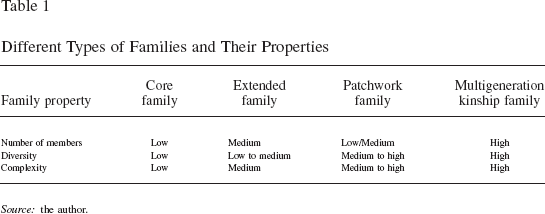
Source: the author.
I assume the role of identity confirmation to be different depending on the type of family. In the core family with low complexity, fewer differences need to be bridged. In this case, identity confirmation can be seen as a way to support the family members’ self–esteem and self–defined roles, which in business families can be imperative during succession. In core families where part of identity building is the positive interaction with the business, it is more feasible that a successor will seek and accept succession opportunities (Milton, 2008). Risks stem from either preventing changes or from false underlying assumptions. These assumptions might lead to confirming and stabilizing negative self–image or to manipulation.
When it comes to extended families or patchwork families, matters become more complicated. A constituting element of these families is that members stem from a larger variety of backgrounds. In this case, the primary foundation responsible for building the identities differs from the one where these identities are confirmed. On the one hand, identity confirmation is reported to be helpful in bridging diversity (Milton & Westphal, 2005), and thus identity confirmation may in fact breed a better work atmosphere through mutual understanding. On the other hand, negative identities can be confirmed as easily as positive identities. This means that a person seeing her/himself as a child from the least wanted branch of the family, the “bastard” or the stereotypical “typical female” might get this negative self–identity confirmed by members of the “better” family branch, such as the stepmother or a cousin. Here, identity confirmation prevents open communication and constructive ways to deal with conflicts, therefore creating a potential risk to the family business family.
In larger multigenerational kinship families with more than 50 or 100 members, identity confirmation creates more opportunities and risks. As the family grows and becomes geographically scattered, interaction becomes crucial in order to maintain cohesion (Pieper, 2007). To strengthen cohesion, the acceptance and the signal of accepting other family members within the group is important. Identity confirmation can play a crucial role here. It is an interesting path for future research to ask whether a joint core belief of these large multigenerational kinship families is moderating the level of identity confirmation.
Identity Confirmation at Different Stages of a Family Business Family
Families change over time and so do family business families. As families change, identity confirmation might play different roles and create different risks and opportunities. Key family protagonists will undergo the major crises of their lives, such as puberty, midlife transition, and late–adult transition (see also Bowen, 1978; Carter & McGoldrick, 1989).
Identity confirmation plays an important role in the process of building an identity. A child born into a core family learns to build several identities by interacting primarily with parents and siblings and later with other peer groups as well. In core families related to a business, the business itself often plays an important role for building identities. Unlike work groups, however, not only are identities subject to change (e.g., from son, rugby player, student, successor to husband, father, professional, CEO in the family business, etc.), but the role of identity confirmation also differs over time.
Identity confirmation during early childhood development helps to build the child's identity. Whether identity confirmation is good for the child depends on whether the parents try to support the emerging personality or whether they rather try to mold the child into their desired identity. As self–perception changes during puberty, identity confirmation is sought more from the peer group than the family. As in other life stages, the individual is seeking his/her place in society, and identity confirmation becomes vital for reestablishing a new equilibrium. At this point, an important question is whether both parents can accept the individual development of their child, and consequently, if they can also change.
The opportunity of identity confirmation lies in building high self–esteem and a clear personality through the parent–child relationship. Risk arises when a very precise identity of the individual is confirmed in a way that prevents both the incoming and older generation from adapting to necessary role changes. In the context of family businesses, succession requires role adjustment; a lack of identity confirmation combined with high intergenerational authority and less open communication might hinder successful succession (Björnberg & Nicholson, 2007).
Another risk of identity confirmation during the upbringing and education of family business siblings is whether the treatment from parents and peers is equal or unequal. It is reported that parents (both mothers and fathers) tend to confirm different identities for sons as compared to daughters (Lytton & Romney, 1991; Maccoby & Jacklin, 1974). At the same time, children tend to seek differentiation from their siblings by defining separate identities (e.g., “you are a great sports guy, I am a musician” or “you are just a girl, I am the successor”). Parents have the opportunity (and likewise the risk) to foster healthy or unhealthy relationships between siblings in terms of gender and birth order through identity confirmation. By working for the good of the family it can be assumed that identity confirmation not only leads to higher acceptance of the role of being a successor, but also to the acceptance of the successor by siblings. The acceptance of the successor by other involved stakeholders is one of the most critical success factors of succession.
Once the child has joined the family's business, there are potential conflicts in terms of differing roles when working together. Should a father/boss of his son/assistant confirm the parental relationship or the work relationship? By mixing the different and partly contradicting roles in public, the older generation might harm the identity of the younger generation. The classic example of this is when a father addresses his successor/son as his “little baby” instead of as his “skilled co–worker” in front of employees. By doing so, he harms both family and work relationships. In this case, role consistency and role adequacy are the important moderators leading to a positive or negative outcome of identity confirmation on the performance of a successor.
Conclusion
It is reported that identity confirmation leads to trust and improved communication as well as to higher performance in specific settings (Polzer, Milton, & Swann, 2002). In contrast, identity confirmation may be misused as a means for manipulation, especially when dealing with insecure or immature individuals. Whether individuals who are expected to confirm one another's identities try to manipulate each other depends to a high degree on their respective set of values. As agency theory describes, there are individuals who seek their own short–term advantage at the expense of others through opportunistic behavior. Such individuals might try to misuse identity confirmation to manipulate behavior in a family business setting, and by this endanger the success of the succession process or the successor's performance.
The larger the difference in awareness, skills, and power between the two protagonists, the easier it is to manipulate behavior. In the family business setting, imagine a mature, skilled, and independent but agency–oriented nonfamily manager who becomes the superior of a young and insecure family member and uses identity confirmation for manipulation. On the contrary, another individual in the same situation who is acting as a mentor will help the younger family member gain security and independence by confirming her/his identity.
Identity confirmation within families involves more than two protagonists and therefore might harm the group's relationship even if the interpersonal relationship gains from identity confirmation. If, for example, the father confirms the identity of his son as being the best of his children in math, a great soccer player, and the incoming successor, he might in the same moment harm the self–identity of his daughter who would like to be equally acknowledged. Identity confirmation within groups and families may harm the relationship of group members if not rooted in a shared set of values. In a family where the rule of primogeniture has been practiced over several generations, the identity confirmation of the father as described above is no surprise for the other children. In a family where the rule is that the “fittest” will take over, it might be harmful.
Identity confirmation bridges diversity. In confirming identity of another, we signal respect for their personality. By asking for identity confirmation from our peers, we ask for respect for our personality and self–identity; especially as older multigenerational family business families develop a very specific “family culture.” The family business field has only started to learn more about these extended families. Identity confirmation might be a valuable lens through which we can understand how specific family cultures are built and maintained. At the same time, identity confirmation research might highlight how specific family cultures influence the perception of family members from outside the family and/or the business.
Identity confirmation is a powerful lens to better understand the interactions within the family and the family business, and it might well be the starting point for more behavioral research in this direction. For example, cohesion as a moderator of the beneficial or detrimental effects of identity confirmation is a promising future research path. As strategic decisions need a minimum of cohesion of involved individuals and identity confirmation might be linked to cohesion, this offers interesting and relevant questions for future research.
Building a more in–depth understanding about the role of identity confirmation within the family business system would assist family members in better comprehending the interactions within their family and family business. Parents can employ identity confirmation in order to help build higher self–esteem among their offspring. Siblings are able to signal through identity confirmation that they accept differences among each other and by this lower the probability of destructive conflicts. This might help influence the family system in a way that ensures successful succession and reliable and long–lasting interactions with nonfamily managers and employees. By informing mentors about identity confirmation, the level of awareness for its importance will rise and the danger of being manipulated will diminish. Finally, in applying the validated concept of identity confirmation to one of the longest lasting groups, namely family business families, research will be able to extend the identity confirmation literature about the longitudinal effects in groups with a rather homogeneous background.