







Abstract
Although the survival of young firms is challenged by the liabilities of newness, there are numerous instances where these firms have been successful at commercializing disruptive technologies at the expense of much larger and stronger incumbents. This paper explores this phenomenon and argues that the characteristics that challenge young technology–venture survival are also potential sources of advantage when commercializing disruptive technologies. The propositions developed also identify the boundary conditions for the advantages by examining the context of commercialization that is created by four types of disruptive technologies. The contributions of this paper are relevant to the enhanced understanding of the liabilities of newness, as well as the commercialization of disruptive technologies.
The literature on young firms often describes them as entities whose survival is challenged by their lack of experience, lack of resources, and lack of legitimacy (Stinchcombe, 1965). However, in the research that addresses the displacement of large and experienced incumbents, there is no shortage of stories that represent the business version of David and Goliath (e.g., see Christensen, 1997; Henderson & Clark, 1990). These stories describe how young firms that commercialize disruptive technologies are able to challenge, and sometimes displace significantly larger and more powerful incumbents. How is this possible?
A variety of theories have been proposed to explain why the large firm may be displaced by smaller, younger challengers, such as large firm rigidities and bounded rationality, which limit the ability of large firms to recognize and respond to competitive threats (Christensen, 1997; Dougherty & Heller, 1994; Henderson & Clark, 1990). Despite the valuable insights provided by existing research, scholars continue to argue that the displacement of large incumbents is not fully understood and requires further exploration (Adner, 2002).
The purpose of this paper is to explore the role of young firm characteristics on the displacement of large incumbents. Specifically, it is argued that large firm displacement may also occur because the young technology–based venture's characteristics that are associated with the liabilities of newness also create potential sources of advantage when it is pursuing the commercialization of a disruptive technology. A framework and propositions are developed that examine the interaction between age–related characteristics and technology characteristics to identify sources and circumstances of young technology firm advantage. This is achieved by synthesizing and building on a considerable body of research on the liabilities of newness (e.g., see Aldrich & Auster, 1986; Freeman, Carroll, & Hannan, 1983), as well as research from several other research streams including the commercialization of disruptive technologies (Abernathy & Clark, 1988; Henderson & Clark, 1990), the dynamics of firm rivalry (Chen, 1996; Porac, Thomas, Wilson, Paton, & Kanfer, 1995), and the creation and implications of legitimacy (Aldrich & Fiol, 1994; Deephouse, 1999; Suchman, 1995).
It should be noted that the arguments advanced are not contradicting empirical findings that suggest that the young firm's survival is challenged by its characteristics. Instead, the propositions developed seek to extend understanding of young firm survival by recognizing some of the conditions in which these characteristics may be beneficial. This paper is in line with and incorporates insights of researchers such as Autio, Sapienza, and Almeida (2000) who confirmed that the lack of experience that sometimes challenges young firms can also create important learning advantages.
A potential criticism of relying on the synthesis of established theory and concepts may be that, individually, some of the propositions developed may not appear new. However, the arguments offer novel insights when taken as a whole, and in particular considering the extension of the liabilities of newness to a closer examination of four types of disruptive technologies.
In so doing, this paper makes several contributions. First, it extends understanding of young firm survival because it illustrates significant ways in which several liabilities of newness may be advantageous. Second, by considering four types of disruptive technologies—radical, architectural, modular, 1 and incremental—this paper adds to the literature on the commercialization of technology and addresses the concern that models that rely on the simple distinction between radical and incremental innovation provide little insight into why large firms are displaced (Henderson & Clark, 1990). Furthermore, in examining four types of disruptive technologies, understanding is gained about an important source of environmental variation—technology (Tushman & Anderson, 1986). Finally, insights are gained on both the environmental conditions under which pioneers, in this case young technology ventures, are likely to be rewarded (Covin, Slevin, & Heeley, 1999), and the boundary conditions for the advantages created by youth and its related characteristic of small size.
The words “modular” and “component” will be used interchangeably to describe an element of a larger product.
The next section provides a literature review of the liabilities of newness and the commercialization of disruptive technologies. This is followed by theoretical development, including propositions and a model. The paper concludes with a discussion of opportunities for application and extensions.
Literature Review
Liabilities of Newness
Literature on the liabilities of newness explores the challenges to survival that young firms face (Stinchcombe, 1965). Researchers have found that new organizations have higher failure rates than older counterparts, and that this rate declines with age (Freeman et al., 1983). Although failure may occur for many reasons, high failure rates of young organizations are frequently attributed to the internal factors of small size, organic firm structure, and lack of experience, and external factors such as limited network and market resources (Freeman et al.; Stinchcombe).
The small size that challenges survival and is frequently associated with young firms is largely the result of limited financial resources—the young firm often only has access to funds available from the founders and any family, friends, or other strong ties that are willing to lend money or invest in the firm (Aldrich & Auster, 1986; Freeman et al., 1983; Hite & Hesterly, 2001). The lack of experience, which is a natural corollary of youth, exacerbates the search for resources and challenges survival because the firm does not have the knowledge and routines needed to operate efficiently and effectively (Aldrich & Auster). As a firm faces and overcomes challenges, pursues opportunities, or circumvents threats, it develops experience that becomes a part of the “organizational knowledge” that is ingrained in its processes and values (Dougherty & Heller, 1994; Henderson & Clark, 1990), ultimately improving its chances for survival and success (Freeman et al.).
Young firm survival is also challenged by its limited contacts with external stakeholders. The network resources of a young organization are limited. It has not operated long enough to create a wide network of relationships that can connect the firm to other beneficial organizations and networks (Hite & Hesterly, 2001; Uzzi, 1997). As the firm ages, more information becomes available on its suitability as a network member, increasing its opportunities for interaction and cooperation with other firms, thereby increasing both its network resources (Gulati, 1998) and its chances of survival (Baum & Oliver, 1991). The limited contacts also result from the young firm's limited market exposure and connections (Aldrich & Auster, 1986). Young firms are often encouraged or even forced to market their products in small niches, in part to avoid competition, and in part due to their limited resources (Cooper, Willard, & Woo, 1986; Covin, Slevin, & Covin, 1990). The small market and limited time the firm has had to establish relationships with customers limit both the security of its market share (Lieberman & Montgomery, 1988) and the number of established and loyal customers upon which it can rely for information and support (Hannan & Freeman, 1984).
A significant liability of newness that is in part the result of the characteristics described above is lack of perceived legitimacy. Organizational legitimacy is the perception that an organization is meaningful, predictable, and trustworthy (Suchman, 1995) and determines the acceptance and support of an organization by its environment (Hannan & Freeman, 1976; Meyer & Rowan, 1977).
Despite the high failure rates of young firms that are attributed to their characteristics, researchers are increasingly noting that some of the liabilities of newness may also represent potential sources of advantage for young firms. For example, Autio et al. (2000) found that the lack of ingrained routines and mindsets created by age and experience also allow the young firm to explore and learn faster or more easily than larger, older counterparts. Fiegenbaum and Karnani (1991) found that, despite the inefficiencies associated with the organic structures of small firms, they provide greater flexibility, which can increase firm performance in volatile environments. Most recently, researchers have argued that the liability of newness may also be an asset of youthfulness that stakeholders value and are willing to support (Choi & Shepherd, 2005). Based on these and other research findings, it is believed that further exploration of the characteristics of the young firm and their potential advantages may yield additional insights into the success and survival of young firms when they are commercializing disruptive technologies.
Below, the characteristics of four types of disruptive technology are described. In the theoretical development section of this paper, their implications for the success of the young technology–based venture commercializing a disruptive technology will be explored.
Disruptive Technologies
A disruptive technology is one that significantly changes the price–performance frontier (Anderson & Tushman, 1990; Christensen, 1997). Its appeal over existing products rests on superior functional performance rather than cost (Abernathy & Utterback, 1988). An example of a disruptive technology is the calculator as a replacement for the slide rule. When a disruptive technology is first brought to market, it is not fully developed; the commercializing firm must therefore often introduce it in a smaller, peripheral market (Adner, 2002). As performance improves, the product comes closer to meeting the performance demands of the large, mainstream market. It enters the low–end segment of this market, moving steadily upmarket as performance continues to improve (Adner; Christensen).
Disruptive technologies can range from incremental to radical (Abernathy & Clark, 1988). Although many valuable insights have been gained by exploring these two dichotomies, researchers have commented that more research should incorporate the mid–range of innovations such as architectural and modular. The mid–range has significant competitive consequences, and considering only the simple distinction between radical and incremental innovations provides limited insights (Henderson & Clark, 1990). Accordingly, each of these types of innovations is described below.
The distinction between radical, architectural, modular, and incremental 2 innovations rests on how each conforms to existing knowledge. Product knowledge can be divided along two dimensions—knowledge of the underlying components (modular knowledge), and knowledge of how these components are linked (architectural knowledge) (Henderson & Clark, 1990). Table 1 summarizes how each of the four types of innovations explored in this paper is distinguished along the dimensions of architectural and modular knowledge.
All four types of innovations can vary in complexity and therefore imitability. It is assumed here that the disruptive innovation is at least moderately complex such that imitation is challenging although not impossible.
Comparison of Radical, Architectural, Modular, and Incremental Innovation
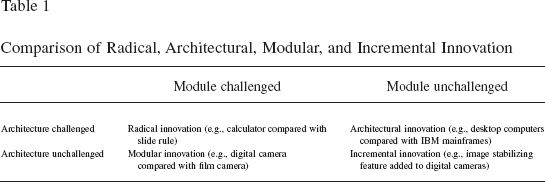
Radical innovations challenge both modular and architectural knowledge. They are based on a different set of scientific or engineering principles from those of existing products, and involve new components in a new architecture (Henderson & Clark, 1990; Tushman & Anderson, 1986). Radical innovations consequently render the incumbent's knowledge and structure obsolete, require the development of new capabilities and new relations with vendors, and often attract new customers with different needs (Abernathy & Clark, 1988). The calculator is an example of a radical disruptive innovation because the scientific principles on which it operates differ substantially from the slide rule it replaced, and has significantly different product components and architecture.
Architectural innovations leave the basic knowledge of how the product performs its intended task and the core design concepts largely unaffected, but change the way in which the components of a product are linked together (Henderson & Clark, 1990). Although some components within the product may change and be the trigger for an architectural innovation, the distinction between architectural and modular innovation is that the major change is occurring in the linkages rather than the components of the product. An example of a disruptive architectural innovation is the personal computer (PC) in comparison with the IBM mainframes that preceded them. Although the primary components of the computer were retained, and the components were already widely available and understood by the computer industry, their reconfiguration into a desktop unit that was relatively easy for ordinary consumers to use in their homes represented a substantial performance improvement over existing computers. The user no longer needed to know how to program the computer, and its physical appearance was both far more appealing and familiar than the large IBM computers that businesses used.
Modular innovations retain the linkages between core concepts and components, but require substantial new knowledge of some of the individual core concepts or components (Henderson & Clark, 1990). An example of a modular innovation is the digital camera. Although the core concepts and linkages of allowing light to flow through a lens and be recorded on something within the camera's body remained the same, the component on which the image was recorded in the traditional camera (film) was replaced with an electronic image sensor and memory chip. This represented a disruptive change in photography, as consumers could now view their images immediately and without requiring further processing, in addition to being able to store more images in the camera. The digital camera was initially introduced to and used by news photographers working in remote locations. They needed an easy and fast way to transmit their images, and were not as concerned with image quality as ordinary consumers might be because their images were being used in newspapers. As picture quality improved, digital cameras entered the mainstream consumer market.
Incremental innovations build on incumbents’ currently existing knowledge, and exploit the potential of established designs (Henderson & Clark, 1990; Tushman & Anderson, 1986). They reinforce and enhance the applicability of existing knowledge, strengthen ties with established customers, and use and extend established customer knowledge (Abernathy & Clark, 1988). An example of an incremental innovation is the optical image–stabilizing feature that has been recently added to digital cameras. This is achieved through a modification of the image sensor. Whereas image sensors are normally stable, those providing the image stabilization feature move to counteract the motion of the camera so that the image is less likely to be blurred. This feature has significantly improved the performance of digital cameras.
The discussion now moves to the potential advantages stemming from the age, size, market, and network of the young firm, and the implications of these for its success in commercializing radical, architectural, modular, and incremental disruptive technologies.
Theoretical Development
The propositions and model developed in this paper illustrate how young technology–based firm characteristics impact successful commercialization of a disruptive technology through their influence on the mediating variables of young firm visibility and legitimacy. More specifically, it is argued that the firm's age, size, market, and network lead to low visibility and a lack of legitimacy from the perspective of the large incumbent the young firm will eventually challenge. It is subsequently shown that low visibility and a perceived lack of legitimacy can lead to young firm success by giving the young firm time and opportunity to further develop its technology and gather valuable resources. The young firm can then enter the market of the incumbent from a position of strength so that it has an improved ability to challenge or at least withstand the eventual competitive response of the incumbent firm. It will also be argued that the extent to which low visibility and a perceived lack of legitimacy are advantageous to the young technology venture is determined by the nature of the disruptive technology. The relationships described in this section result in the model shown in Figure 1.
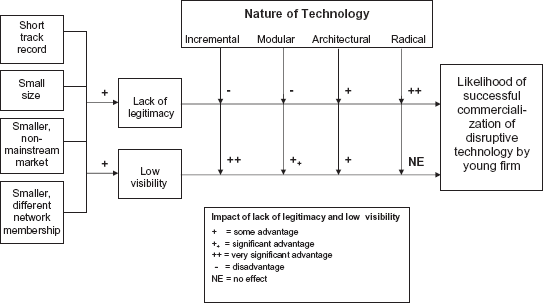
The Relationship Between Age–Related Characteristics of Technology–Based Ventures Commercializing Disruptive Technologies and the Likelihood of Success—A Proposed Model
Liabilities of Newness and Their Outcomes
Age
The age of the firm is defined as the length of time it has operated. Age influences the firm's chances of survival by impacting organizational reproducibility (Hannan & Freeman, 1984), the availability of information on the young firm within the competitive environment (Stuart, Hoang, & Hybels, 1999), and the ability to account rationally for one's actions (Hannan & Freeman) by virtue of the experience and track record it creates.
Perceptions of legitimacy are created when there is sufficient information to assess the firm, and it appears predictable and reliable (Suchman, 1995). A young firm has not had time to accumulate a track record for itself or its product when it is commercializing a disruptive technology, resulting in little information upon which to assess it (Stuart et al., 1999). Furthermore, young firms have not had the time to develop organizational decision rules, routines, and sequences that can be applied and consistently reconstructed, and are therefore faced with novelty in production and inexperience in many other areas (Choi & Shepherd, 2005). These factors lead stakeholders to feel uncertain about the young venture's reliability, which leads to perceptions of lack of legitimacy (Choi & Shepherd; Suchman).
The short track record and consequent lack of information also limit the visibility of the young firm's activities from the perspective of the large incumbent. Organizations are faced with vast amounts of information, requiring them to be selective about what information they will seek, and what information they will pay attention and react to. The limited information available due to the short track record of the young firm will make it difficult to notice from the perspective of the large firm. Furthermore, this limited information also reduces the large firm's ability and likelihood of interfirm comparisons (Porac et al., 1995). The diminished opportunity to make interfirm comparisons reduces the likelihood that the young firm, if noticed, will be identified as a threat worthy of the incumbent's attention (Chen & Hambrick, 1995). The result will be that the young firm will be treated by the incumbent as though it is invisible.
Size
Size is defined as the amount of financial resources held by the firm. Although size variation can exist at birth (Freeman et al., 1983), most young firms come into existence with limited resources and are therefore small in size (Aldrich & Auster, 1986).
Organizational size is a characteristic that is used by external stakeholders to assess legitimacy (Baum & Oliver, 1991). Size affects legitimacy because the larger the firm, the more visible its actions (Chen & Hambrick, 1995), thus making more information available about the organization, and increasing the possibility of favorable assessments of legitimacy (Stuart et al., 1999; Suchman, 1995). Furthermore, size is viewed by external stakeholders as an outcome of past success (Baum & Oliver) and creates an “aura of inevitability” (Hannan & Freeman, 1984) that leads to perceptions of legitimacy. The small young firm is therefore likely to be perceived by large incumbents as lacking legitimacy since it lacks the large size as an indicator of past success and its small size means its actions create less information on which it can be assessed.
However, the small size of the young firm also allows it to maintain low visibility from the perspective of the incumbent it will eventually challenge. While large firms will be attended to by both large and small firms, small firms may go unnoticed because they are not intimidating to the large firm's strategists (Baum & Korn, 1999). Furthermore, firms notice and attend to the actions of firms they identify as members of their strategic groups. Size is a major determining factor of membership within a particular group; the large firm is therefore unlikely to identify the small firm as a member of its strategic group (Porac et al., 1995), and therefore notice or attend to its actions. Finally, even if the actions of the small firm are visible and noticed by the large incumbent, it is highly likely that the large incumbent will continue to behave as though the small firm's actions are not visible because large firms do not perceive small firms as powerful rivals (Chen, 1996; Miller & Chen, 1996). These observations lead to the following proposition:
Market Choice
The market a firm pursues can be described along two dimensions—its breadth, defined as the extent to which it offers multiple variations of its products thereby meeting the needs of multiple customer segments (Sorenson, McEvily, Ren, & Roy, 2006), and the extent to which it overlaps with the mainstream customers of a particular group of incumbents (Cooper et al., 1986).
With few exceptions, young, small organizations are single–market, frequently single–product entities with limited geographic purview because they do not have the resources needed to pursue a broad product line approach (Sorenson et al., 2006). With respect to the specific target market to pursue, there has been a great deal of debate about whether young firms should choose to immediately enter the mainstream market, or try to avoid direct competition by pursuing niche market segments (Cooper et al., 1986). It is important to note that, with respect to disruptive technologies, firms often have little choice but to initially commercialize them in peripheral rather than mainstream markets, as these products initially satisfy a different, smaller set of customer needs compared with the established mainstream customers addressed by large incumbents (Abernathy & Clark, 1988; Adner, 2002). Consequently, although the market any firm addresses is a matter of choice, limited resources stemming from small size and the nature of disruptive technologies suggest that the young firm is more likely to initially offer its product in a narrower, nonmainstream market in comparison with that of the large incumbent.
The young firm's market is likely to create perceptions of lack of legitimacy from the perspective of the large incumbent for several reasons. First, the young firm and its disruptive innovation are relatively new to the market, and neither will have existed long enough to develop a widely known brand name (Choi & Shepherd, 2005), have established customers (Hannan & Freeman, 1984), or a track record with buyers (Yli–Renko, Sapienza, & Hay, 2001). Second, the young firm's market is peripheral in comparison with the incumbent's; the incumbent is therefore less likely to be fully cognizant of the activities of the young firm (Chen, 1996). Perceptions of lack of legitimacy are also likely because the markets for disruptive technologies are viewed as less valuable by large incumbents (Christensen, 1997); firms that pursue activities that are not viewed as creating substantial value are perceived as lacking pragmatic legitimacy (Suchman, 1995). Finally, the young firm is less likely to be perceived as legitimate because the disruptive technology it is commercializing does not fit into the incumbent's paradigm of market and technical possibilities (Aldrich & Fiol, 1994; Dougherty & Heller, 1994).
The young firm's narrower, nonmainstream market in comparison to the incumbent's also creates low visibility. Established firms are attentive to the demands and needs of their primary and most important customers, which limits their ability to be attentive to smaller or more peripheral consumer groups (Dougherty, 1990; Hannan & Freeman, 1984), such as those that would be interested in the disruptive technology (Adner, 2002). The young firm is therefore less likely to be visible to the large incumbent as its activities are not being conducted or attracting the attention of the customers in the large firm's target market (Chen & Miller, 1994). Furthermore, a firm is more likely to be noticed and categorized as a competitor, and its activities scrutinized by a firm's strategists when the markets of the two firms overlap substantially (Chen, 1996; Porac et al., 1995). The limited market overlap between the young firm and the large incumbent it will eventually challenge will consequently make the young firm's activities less likely to be noticed by the incumbent.
Even if the large firm should notice the market activities of the young firm, it is more likely to behave as though the young firm's actions are not visible. This occurs for two reasons: The young firm is currently not threatening to the large firm because it is not attracting the mainstream customers of the incumbent (Chen, 1996; Chen & Miller, 1994), and the expected pay–offs to the large incumbent that would be obtained from entering the smaller and less valuable market of the young firm are small (Chen & Miller).
Network Creation
The young firm's network consists of friends and relations (their social network) as well as suppliers, buyers, and other firms with which they do business (Lechner, Dowling, & Welpe, 2006). These early networks tend to be smaller, less diverse, and more redundant than those of larger, older firms (Hite & Hesterly, 2001; Yli–Renko et al., 2001). The majority of the young firm's network ties stem from preexisting relationships with social, family, or historically long–held sources (Hite & Hesterly). Outside firms are less likely to include the young firm in their network membership because they find it difficult to judge it due to its short track record, and perceive it as having a highly uncertain future and low likelihood of reciprocation, with generally less to offer (Hite & Hesterly; Yli–Renko et al.). The young firm's network of distributors and suppliers is also likely to differ from that of the incumbent because the commercialization of disruptive technologies must initially be pursued with customers that are different from those of the mainstream market, and the disruptive innovation often involves different components from the incumbent's product it will ultimately displace (Christensen, 1997).
The young firm's network membership has implications for its legitimacy and visibility from the perspective of the incumbent it will eventually challenge. Membership within a network affects an organization's legitimacy with other network members in two ways: First, members act as conduits that provide valuable information on the firm's quality, reliability, and reputation as a potential partner, enabling assessments of legitimacy (Choi & Shepherd, 2005; Gulati, 1995; Suchman, 1995). Second, ties to well–regarded network members influence a firm's legitimacy by acting as endorsements of the firm and its activities (Stuart et al., 1999). The endorsements and information are particularly important to outside firms evaluating a young firm due to the absence of other information resulting from its short track record (Stuart et al.).
The substantially different and smaller network membership of the young firm means the large incumbent will have less information on the young firm than it would have had they shared more network ties (Gulati, 1998), thereby reducing the likelihood that the large firm will perceive the young firm as legitimate. Furthermore, although the young firm may have endorsements from important organizations within its own network, it is unlikely that these organizations are important members of the large firm's network. Their endorsements will therefore be less influential to the large incumbent than those that might come from important members of its own network (Vanhaverbeke, Duysters, & Noorderhaven, 2002), and are therefore less likely to create perceptions of legitimacy of the young firm.
At the same time, its substantially smaller, different network membership compared with that of the incumbent means the young firm may not be visible to the large incumbent. As discussed above, network membership is important for obtaining and disseminating information about a firm. The young firm's significantly smaller and divergent network membership compared with the incumbent means less information will be transferred to the incumbent on the activities of the young firm. This allows the young firm to maintain low visibility.
Even when the incumbent does receive information on the young firm, its strategists are likely to disregard it. The incumbent is most likely to receive information on the young firm through more distant, indirect ties because the networks of the two firms are significantly divergent. Researchers have found that information obtained through distant ties is regarded as lower quality than that obtained through closer or direct ties (Vanhaverbeke et al., 2002). Finally, even if the activities of the young firm do become visible to the incumbent as the result of information shared through network ties, because the dissimilarity in size and substance of network membership reduce the likelihood that the young firm will be categorized as a rival (Chen & Hambrick, 1995; Porac et al., 1995), the incumbent's strategists are likely to continue to behave as though the young firm's actions are not visible.
The implications of lack of legitimacy, and low visibility from the large firm's perspective will be discussed below.
Legitimacy, Visibility, and Successful Commercialization of Disruptive Technologies
As indicated in Figure 1, legitimacy and visibility mediate the relationship between young firm characteristics and its successful commercialization of a disruptive technology. Thus far it has been argued that the inherent and chosen characteristics of young firms that create liabilities of newness reduce the likelihood that they will be perceived as legitimate or will be visible to the large incumbent they will eventually challenge. The next section explores the effects of low visibility and perceptions of lack of legitimacy specifically when the young firm is pursuing the commercialization of a radical, architectural, modular, or incremental disruptive technology. The effects described below are summarized in Table 2.
The Benefits of Lack of Legitimacy and Low Visibility When Commercializing a Disruptive Technology
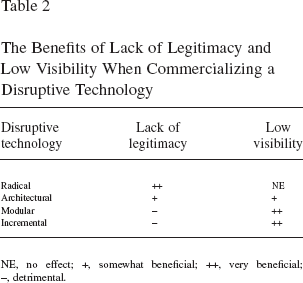
NE, no effect; +, somewhat beneficial; ++, very beneficial; −, detrimental.
Legitimacy
Legitimacy is important to organizations because it deflects questions about their ability to provide specific products or services (Oliver, 1991), and improves access to resources such as valuable relationships which aid survival and growth (Meyer & Rowan, 1977; Stuart et al., 1999).
On the other hand, a lack of legitimacy can differentiate and cognitively distinguish a firm and its products from preexisting regimes (Elsbach & Sutton, 1992; Suchman, 1995). Researchers have also found that perceptions of lack of legitimacy of a new product reduce the likelihood that other firms will choose to pursue the development and commercialization of their own version of the innovation (Adner, 2002; Christensen, 1997; Dougherty & Heller, 1994). In the context of this paper, this would delay the competitive response of the incumbent to the activities of the young firm, particularly while the young firm operates outside of the incumbent's mainstream market. Below it is argued that the extent to which these and other outcomes of perceptions of lack of legitimacy of the firm and its products may be beneficial or harmful to the young technology–based venture, particularly once it enters the mainstream market of the incumbent, will depend on the nature of the disruptive technology it is commercializing.
When commercializing a radical innovation, the young firm is likely to benefit from lack of perceived legitimacy for several reasons. The lack of legitimacy will reduce the likelihood that the incumbent will decide to develop its own version of the innovation (Aldrich & Fiol, 1994), and will instead focus its efforts on the products that are already familiar and legitimate from its perspective. Christensen (1997) and others have provided numerous examples of incumbents choosing to move upstream with their existing products rather than developing their own version of a radical innovation, even when it has entered their mainstream market. The delayed response of the incumbent created by the lack of perceived legitimacy allows the young firm commercializing the radical disruptive technology more time to capture a greater share of the incumbent's market and establish brand equity before the incumbent responds with its own version of the product.
Lack of legitimacy also cognitively distinguishes the firm and its products from preexisting regimes (Suchman, 1995). This increases the likelihood that the organization and its activities will be noticed by important outsiders (Elsbach & Sutton, 1992) such as early adopters. The first consumers within the mainstream market that purchase a radical innovation tend to be early adopters because this group perceives relative advantage from a new idea, practice, or object and exhibits strong affective congruence to innovation and newness (Choi & Shepherd, 2005).
Lack of legitimacy of the young firm and its product is also beneficial when the young firm is commercializing an architectural innovation, although for different reasons and to a lesser extent than with radical innovations. Architectural innovations are not perceived as legitimate because they violate the incumbent's linkages between the expertise of different functions of the organization and to a certain degree, the incumbent's product to resources linkages (Dougherty & Heller, 1994; Henderson & Clark, 1990). As with a radical innovation, the incumbent is therefore less likely to be motivated to explore and pursue the development of its own architectural innovation. Furthermore, should it decide to pursue its own version of the innovation, the incumbent will have to incorporate and legitimate new linkages (Dougherty & Heller). Creating legitimacy for unfamiliar practices and structures is a time–consuming and uncertain activity (Aldrich & Fiol, 1994). The young firm benefits from the delay in competitive response created by the time it takes for the large firm to come to the conclusion that the new configuration of components is legitimate, and to create and legitimate the new linkages required.
However, unlike a radical innovation, the cognitive distinctiveness created in the minds of consumers by a lack of legitimacy is not beneficial. An architectural innovation reconfigures existing product components to serve familiar purposes; recall the example provided earlier was moving from a mainframe to a user–friendly desktop computer. Cognitively distinguishing one product from the other is of little value, as both products serve the same purpose—storing and processing information. Although early adopters were still the first to be interested in the newness of a user–friendly computer, the recognized usefulness and familiarity of the product ensured a faster adoption rate among mainstream consumers than would have been the case if mainstream customers had to first be educated about what the product did. Scholars have long argued that the acceptance of a product or firm by the broader institutional context will be hastened by promoting its familiarity and similarity to existing products or firms (Aldrich & Fiol, 1994).
In contrast to radical and architectural innovation, perceptions of lack of legitimacy with respect to modular and incremental innovations can be detrimental. The value of a modular innovation is maximized when it is connected to other components within existing architectures. The young firm therefore has the choice of either attempting to bring the component to the mainstream market by embedding it within its own version of existing products, or by partnering with and persuading incumbent firms to incorporate the innovation in their product architectures. The young firm with limited resources faces a substantial disadvantage when competing against large firms that already possess valuable complementary resources (Covin et al., 1999). The wiser choice for the young firm in these circumstances would be to seek partnership. However, perceptions of lack of legitimacy are likely to lead incumbents to believe the knowledge inherent in the new innovation is inferior to their own (Galunic & Rodan, 1998), and therefore not worthy of adoption (Suchman, 1995), and that the young firm may not be a worthwhile partner (Hite & Hesterly, 2001). These perceptions will reduce the access of the young technology–based venture to relationships and complementary resources that could be beneficial (Hannan & Freeman, 1984).
Similar arguments apply in the case of an incremental innovation. An incremental innovation benefits from existing structures, enhances the value of existing capabilities, strengthens ties with established customers, and builds on established distribution networks (Abernathy & Utterback, 1988; Henderson & Clark, 1990). Its successful commercialization is therefore enhanced when it is aligned within preexisting structures and markets. Scholars have repeatedly pointed out that incremental innovations are a natural extension of the incumbent's activities, and it has the complementary resources and structure to capture value from them (Abernathy & Utterback; Dougherty, 1990). The perceived lack of legitimacy will consequently be detrimental to the success of the young firm because it will hinder attempts to embed its innovation within the product structures of incumbents and will diminish the young firm's ability to create relationships with consumers and firms with valuable complementary resources.
Visibility
Highly visible firms are more likely to elicit competitive responses (Chen & Miller, 1994). Research has shown that the more responses a firm's actions provoke, the worse its performance (Chen & Hambrick, 1995; Chen & Miller). The visibility of the young firm consequently affects its success and survival by increasing the amount of time it is able to operate without provoking a competitive response. During periods of low visibility, the young firm has the opportunity to become stronger both technologically and from a resource perspective, improving its ability to withstand the competitive response of the incumbent once it occurs (Lieberman & Montgomery, 1988). Time to develop the technology is particularly important when pursuing a disruptive innovation because the technology is not initially well–understood or developed (Anderson & Tushman, 1990), and gaining technological and customer knowledge is important to successful development and commercialization (Abernathy & Utterback, 1988). However, the extent to which low visibility is likely to be helpful to the young firm depends on the type of disruptive technology it is commercializing.
With radical innovations, the low visibility of the young firm's activities is not as strategically valuable as with other types of innovations, primarily since the incumbent's response will be delayed in any case by the implications of the radical innovation itself. Research has repeatedly shown that, when faced with a radical innovation, the incumbent's ability to respond is slowed by the substantial changes that it must make to its structure and knowledge assets, and the additional knowledge and capabilities that it must develop (Abernathy & Utterback, 1988; Christensen, 1997; Dougherty, 1990; Henderson & Clark, 1990). Furthermore, these efforts are significantly hindered by the existing structures and unlearning that must occur before the new capabilities and learning can occur (Dougherty & Heller, 1994; Henderson & Clark).
Low visibility is slightly more beneficial when the young firm is pursuing an architectural innovation. The incumbent's response is delayed because it often misidentifies architectural innovations as modular innovations, and consequently underestimates the magnitude of changes it must make to existing knowledge and structures until it has experienced significant failures in trying to respond to the architectural innovation (Henderson & Clark, 1990). As with a radical innovation, its response is also delayed by the need to learn about and develop the new architecture, reconfigure the linkages between its expertise in various functions of the firm, and redefine work roles and relationships (Dougherty & Heller, 1994), and the fact that these activities will be hindered by the existing filters and structure of the old architecture (Henderson & Clark). However, unlike radical innovations, the incumbent need not develop a new understanding of the underlying scientific principles of the product (Henderson & Clark). Consequently, low visibility is more beneficial with architectural than with radical innovations, because the lag time between incumbent motivation and ability to respond is shorter than with a radical innovation.
Low visibility becomes significantly more important with modular innovations. As discussed earlier, modular innovations retain the underlying scientific principles and architecture of the product, and involve substantial changes only in one or a few components of the product (Henderson & Clark, 1990). Incumbent firms spend the majority of their time and efforts developing component knowledge (Henderson & Clark). They therefore have much of the expertise needed to develop their own versions of the modular innovation, unhindered by organizational resistance, as is the case with an architectural innovation.
If the young firm is able to maintain low visibility long enough to fully develop its product and secure the resources needed to convince outsiders of its ability to reliably deliver a good quality product, it can then approach the incumbent with its innovation, and either license it or sell it. The incumbent is more likely to purchase or partner with the young firm if the young firm has something valuable to offer (Ahuja, 2000), particularly if it can minimize the time and uncertainty of pursuing its own version of the innovation (Dierickx & Cool, 1989). Alternatively, the young firm can use the period of time when it has low visibility to obtain the needed complementary assets—researchers have argued that, particularly when imitation is feasible, the benefits to innovation are more likely to go to those that hold the complementary assets, rather than those with superior innovative capabilities (Teece, 1986).
The arguments and benefits associated with low visibility when the firm is pursuing the commercialization of an incremental technology are similar to those of the modular technology. The structural and knowledge–based delays and challenges created for incumbents by radical, architectural, and modular innovations do not exist with incremental innovations. Furthermore, incremental innovations build on and reinforce the applicability of existing knowledge, capital, skills, and architecture (Abernathy & Clark, 1988). Low visibility can therefore be very helpful to the survival and success of the young firm, because the incumbent's lack of awareness of the young firm will give the young firm the opportunity to create barriers to entry or imitation such as patents or a strong brand name or capitalize on its technological lead to stay ahead of the competition (Lieberman & Montgomery, 1988). Recent research has shown that a new entrant can survive competitive retaliation when it has an innovation advantage, because it can continue to generate rents, albeit at a declining rate, even after other firms have entered the market (Adner & Zemsky, 2006).
Discussion and Conclusion
Previous work examining the displacement of large incumbents has shown that these firms are sometimes overtaken by young newcomers because they were late in recognizing and responding to technological threats (Christensen, 1997), or had difficulties making the structural changes required by the disruptive innovations (Henderson & Clark, 1990). What has yet to be explored is the role that the young firms play in the displacement of the large incumbents.
The model and propositions developed in this paper theoretically explore how young technology–firm characteristics may be advantageous when commercializing disruptive technologies. The contribution of this paper rests on an integrated examination of several liabilities of newness and their potential effects on the legitimacy and visibility of the young firm, and the extension of these outcomes to predicting the young firm's successful commercialization of four types of disruptive technologies. The model presented is more detailed than prior work in that it examines several liabilities of newness and encompasses the mid–range of architectural and modular innovations in addition to the extremes of incremental and radical innovations.
The theoretical implications of the propositions developed in this paper are that one should expect young firms to be successful commercializing radical and architectural innovations, but are less likely to challenge incumbents with modular and incremental disruptive innovations. The low visibility and lack of legitimacy coupled with the enormous knowledge and structural changes demanded of large, established organizations by radical innovations give the young firm the time and opportunity to develop and establish its innovation before the incumbent can respond. On the other hand, the success of large firms with incremental innovations is not surprising given the value of their complementary assets, and that the lack of legitimacy of the young firm impedes access to these.
Similarly, with a modular innovation, although low visibility will allow the young firm to develop its innovation unhindered by competitive attacks, its lack of legitimacy will again impede access to valuable complementary assets, posing a challenge for success. Furthermore, the existing in–house expertise and valuable complementary assets of the large firm means the young firm's technological and market lead can be quickly diminished. As stated earlier, when imitation is feasible, the benefits to innovation are more likely to go to those that hold the complementary assets, rather than those with superior innovative capabilities (Teece, 1986).
The young firm is more likely to be successful with an architectural innovation. Although lack of legitimacy may mean the large incumbent won't invite the young firm to access its complementary resources, the architectural innovation is likely to have diminished the value of many of those resources in any case. Furthermore, the structure and many complementary assets of the large firm will impede the large firm's ability to accommodate and therefore react to the architectural innovation. Meanwhile, the learning advantages of young firms identified by Autio et al. (2000), and the superior ability of young, small firms to accommodate changes in their activities due to their lack of ingrained routines (Fiegenbaum & Karnani, 1991) allow the young firm to more easily make the changes demanded by an architectural innovation. The substantial head start afforded by the young firm's low visibility subsequently becomes challenging for the large incumbent to overcome.
The propositions developed in this paper also imply that the young technology–based venture should try to strategically manage its visibility and appearance as a strategic threat when it cannot create barriers to entry such as patents to protect its innovation or its market, particularly when commercializing incremental and modular innovations. When the innovation cannot be protected, the young technology–based venture should capitalize on its low visibility to build its resources, and use this lead time to continue to innovate and stay ahead of the incumbent. This strategy is consistent with Lieberman and Montgomery's (1988) recommendations on how first movers can reduce the likelihood of being overtaken by followers.
It should be noted that, although legitimacy and visibility are explored here as independent mediating variables between young firm characteristics and their success, they are not entirely independent of each other. Although it is possible to be visible and still lack legitimacy, as visibility increases, so too does the possibility of being perceived as legitimate. Similarly, a firm is visible to those that perceive it as legitimate. This interaction may have some unpredictable effects with respect to modular and incremental innovations. As indicated in Table 2, although low visibility is highly advantageous, a lack of visibility is problematic. Success of the young firm becomes an issue of sequence. The young firm must maintain low visibility long enough to develop its modular or incremental innovation, and then pursue legitimacy aggressively to access valuable complementary assets. If it is perceived as legitimate, and therefore is visible before its innovation is fully developed, the young firm is more likely to be overtaken by the large incumbent.
There are several managerial implications that can be derived from the propositions and arguments developed in this paper, particularly for pioneering firms. First, a young firm commercializing a disruptive technology must consider how it conforms to existing knowledge, and what the implications of this are for the sources of advantage that the young firm may possess and be able to capitalize on. The insights provided on the delays and benefits created by lack of legitimacy and low visibility when commercializing four different types of disruptive technologies support and extend Covin et al.'s (1999) arguments that the best tactical determinants and discriminators will vary with the environment. Second, a young firm seeking legitimacy must do so strategically, both with respect to by whom and when it seeks to be viewed as legitimate. For example, the arguments presented on the benefits of lack of perceived legitimacy when pursuing a radical innovation imply that the young firm should not try to align its product and firm operations with that of incumbents in order to achieve legitimacy through isomorphism. This strategy complies with the arguments of Deephouse (1999)—being different can be competitively valuable in some circumstances.
The insights of this paper can be applied to addressing several debates in current research, particularly with respect to pioneering and first–mover advantage. There has been a long–standing debate on who is likely to perform better (pioneers or late movers), and what qualities a successful pioneer must have. Covin et al. (1999) show that pioneers versus followers have different advantages in hostile versus benign environments. More specifically, they find that, in a hostile environment, a pioneer is wiser to offer a narrow product line that creates a tight fit with customer needs rather than a broad product line. The propositions developed in this paper identify new dimensions of the environment as defined by the type of disruptive technology. By examining the qualities of the firm and how they are likely to aid success, the model can be used to predict who is likely to succeed as a pioneer versus follower, and what actions a firm may take to increase its chances of success when pioneering a disruptive technology. For example, an early mover pursuing the mainstream market with a radical technology is more likely to succeed because resource–rich incumbents will face difficulties in trying to follow. However, an early mover into a broad segment with an incremental product is more likely to be overtaken by late–entering incumbents as the incumbent has an existing brand and reputation, as well as vital complementary assets.
The model presented in this paper can also be used to explore the notion that first–mover advantage dissipates over time but is enhanced by longer lead times before competitive entry (Lieberman & Montgomery, 1998). Two potential sources were identified for increasing lead times—low visibility and lack of legitimacy of the young firm and its products, in addition to the rigidities in the large firm that may hinder its ability to respond.
Another meaningful question to which the propositions can be applied is how to pioneer effectively (Covin et al., 1999). For example, when the young firm is pursuing an incremental innovation, the propositions suggest it should retain low visibility as much as possible until its technology is developed, and then quickly approach large organizations for adoption of the product into their own systems.
The literature on market niche is also an area of relevant application for this work. Research on market niche strategies and whether new entrants to an industry should employ a broad or niche market strategy has resulted in mixed conclusions. Some research has indicated that the appropriate strategy depends on industry conditions (Covin et al., 1990). The insights generated can be used to further understand niche strategies and identify additional contingencies under which broad versus narrow market strategies are more appropriate by using the nature of the technology as an industry condition variable. Finally, the model developed can be applied to the question of when to transition from a narrow to a broad market. The insights in this paper suggest that the young firm may begin in a narrow market, and develop the technology such that it can be more broadly appealing and the young firm can also withstand the competitive reaction of the large firm when the product enters the mainstream market. Extending the framework presented here to this domain of market strategy can enhance understanding of the strategic and organizational transitions of the young firm over time.
Although this paper makes several contributions and has offered a framework that can be applied to other areas of research such as those described above, its insights can be expanded in several ways. First, and most obviously, the model's value would be enhanced by empirically examining its propositions, and using the insights gained to extend it. Several scholars have suggested approaches that would be appropriate. Aldrich and Fiol (1994) point out that including groups of firms that struggled and did not succeed in becoming institutionalized provide the best historical record for testing ideas about the social context of industry formation. Golder and Tellis (1993) performed detailed analysis of historical information in books and periodicals in their study of the success and market share achieved by pioneers versus followers. Their approach was intended to overcome the shortcomings of retrospective assessments, and to include non–survivors to limit the bias in the data. A similar approach could be used to empirically test the propositions developed in this paper, identifying and categorizing a number of different types of disruptive innovations, then identifying the qualities of both successful and unsuccessful young firms that pursued them, as well as the responses of the large incumbents they challenged.
Apple's commercialization of the PC offers an example of a disruptive technology and firm to study. Apple was young, small, and initially offered its product in a nonmainstream, small market while being connected to a network of suppliers and other firms that were not strongly connected to IBM. By the time IBM entered the PC market, Apple was developing its third generation of PC and had established a network, acquired financial resources, and had developed valuable and significant relationships.
Apple's survival is no small accomplishment given that IBM's entrance into the PC market has been described as the equivalent of “an American carrier fleet sailing into a Third World port” (Ferguson & Morris, 1994, p. 21). On the other hand, other PC pioneers such as Wang and Commodore no longer exist.
Valuable extensions of this work could also be achieved by extending the factors that it incorporates. For example, Zahra, Sapienza, and Davidsson (2006) show that age is related to dynamic capabilities and flexibility. Flexibility in both production and learning, as well as the ability and willingness to develop new capabilities, is important when pursuing the commercialization of disruptive technologies (Abernathy & Clark, 1988). Examining how the characteristics of the young firm can create advantages in flexibility and the development of new capabilities may therefore provide additional valuable insights on the success of the young firm at the expense of the incumbent. Another dimension could be added to the framework by further considering the interaction of the incumbent to its environment. Pfeffer and Salancik (1978) show that firms vary in the intensity and rigor of their environmental scanning, while Chen and Hambrick (1995) show that firms vary in the aggressiveness of their responses to challengers. Both of these factors would likely have a moderating effect on the relationship between the young firm's characteristics and its likelihood of success as they would impact how quickly the young firm's actions are noticed despite its efforts to maintain low visibility, and the probability of response once the incumbent notices the young firm.
As stated in the Introduction, the phenomenon of large firm displacement by young challengers is both interesting and relevant to understanding the challenges and advantages of youth versus experience and the effects technology has on sources of competitive advantage. Although this paper represents a starting point rather than an exhaustive analysis of all liabilities of newness and their potential benefits, the arguments developed offer some new insights into the issues of commercialization of disruptive technologies, and young firm success and survival.