







Abstract
As environments become more dynamic and increasingly competitive, organizations must become more entrepreneurial. To explain how and why an organization becomes more (or less) entrepreneurial over time, we investigate the interrelationship between the psychology of individuals and the culture of organizations. To that end, we develop the notion of entrepreneurial spirals—enduring, deviation–amplifying loops—that serve to link the manager's mindset to his or her organization's culture and vice versa. We investigate how entrepreneurial spirals start, perpetuate, and stop, and detail the implications and insights suggested by entrepreneurial spirals for the relationship between managerial mindset and organizational culture.
In response to business environments increasingly characterized by rapid and discontinuous change, it has been suggested that organizations need to become more entrepreneurial (Hitt, 2000). Scholars have described an entrepreneurial organization as one that acts to “repeatedly initiate new product or service ideas . . . reconverting their people and assets to new uses, bringing new ideas from many sources into good currency. Ideas must be generated, resources assembled, the new product or services produced and delivered to users by organization–wide redirection and cooperation,” and, importantly, the “organization must sustain such effort again and again” (Jelinek & Litterer, 1995, pp. 137–138). In a similar vein, organizations that function in dynamic environments need to act entrepreneurially so as to adapt to changing conditions and to grasp fleeting opportunities (Shepherd, McMullen & Jennings, 2007), and firms in more hypercompetitive environments need to become more entrepreneurial to adapt to emerging threats (Covin & Slevin, 1991) and/or to stay ahead of competition (Zahra, 1993). Conversely, organizations that become less entrepreneurial in such environments will likely realize declining performance (e.g., organizations can become less entrepreneurial as they age and formalize with larger size [Ahuja & Lampert, 2001]).
From the entrepreneurship literature, we have a considerable understanding of why some individuals are more entrepreneurial than others (e.g., Krueger, 2000; McGrath & McMillan, 2000; McMullen & Shepherd, 2006), and why some organizations are more entrepreneurial than others (e.g., Ahuja & Lampert, 2001; Kuratko, Montagno, & Hornsby, 1990). For example, scholars investigating entrepreneurship at the individual level of analysis, and adopting a cognitive lens, have suggested that those who act more entrepreneurially have a more entrepreneurial mindset (Krueger; McGrath & McMillan; McMullen & Shepherd). Scholars focused on entrepreneurship at the organizational level, and adopting a corporate entrepreneurship lens, have suggested that those organizations that act more entrepreneurially have a more entrepreneurial culture (e.g., Chandler, Keller, & Lyon, 2000; Hornsby, Kuratko, & Montagno, 1999; Ireland, Hitt, & Sirmon, 2003).
Although these studies of the entrepreneurial mindset and organizational culture suggest which individuals and organizations are more entrepreneurial—and therefore more likely to engage in entrepreneurial action—they do not explain how and why entrepreneurialness changes over time as a function of reciprocal relationships between the two levels. If we acknowledge that environments change, and such change requires individuals and organizations to become more entrepreneurial to survive (as it appears they do [Covin & Slevin, 1991; Shepherd et al., 2007]), then it is important to understand the mechanisms of underlying changes to their entrepreneurialness. The term “entrepreneurialness” refers to how entrepreneurial either an individual's mindset or an organization's culture is—the higher the entrepreneurialness, the more entrepreneurial the mindset and culture, respectively. In this article, we focus on the interface of individual human thought and organizational culture to help explain how and why actors (top managers and organizations themselves) become more (or less) entrepreneurial over time. Theories and empirical findings from cultural psychology suggest that there is an important link between the psychology of the individual and culture that can help explain change (Fiske, 2003; Lehman, Chiu, & Schaller, 2004).
We adopt a cultural psychology framework to develop a model of an entrepreneurial spiral. An entrepreneurial spiral is an enduring, deviation–amplifying relationship between the entrepreneurialness of the manager's mindset and the organization's culture. A deviation–amplifying relationship between variables means that an increase in variable one causes an increase in variable two, which in turn causes an increase in variable one. This deviation–amplifying relationship is enduring when there is a pattern of three or more consecutive feedback loops from the manager's mindset to the organizational culture and from the organizational culture to the manager's mindset. A pattern of three or more increases or decreases to characterize a spiral is consistent with Cronbach and Furby (1970); Lindsley, Brass, and Thomas (1995); and Nesselroade, Stigler, and Bakes (1980). For the purposes of this model, when we refer to individuals and organizational culture, we are describing the entrepreneur as top manager (nested) within his or her organization in question.
The notion of an entrepreneurial spiral offers three primary contributions. First, we bridge the literatures focused independently on entrepreneurial mindsets (e.g., Krueger, 2000; McMullen & Shepherd, 2006) and entrepreneurial organizations (e.g., Chandler et al., 2000; Hornsby et al., 1999; Zahra, Hayton, & Salvato, 2004), by developing a dynamic model of the cause and effect relationships between cognition and culture. This framework not only connects relatively disparate literatures, but also more importantly extends our thinking across levels toward new insights about change only enabled by a dynamic multi–level perspective. We embrace the notion that individuals andorganizations exist together within a complex system, where the actions of one have enduring and sometimes profound impacts on the other. The underlying premise of this research is that to understand the workings of any complex, human system, it is necessary to understand the behavior of the system in the context of its component parts (across levels).
Second, scholars have recently focused their attention on the individual and organizational attributes associated with the development of an entrepreneurial mindset among managers in organizations (Hornsby et al., 1999; Hornsby, Kuratko, & Zahra, 2002). Given their purpose, it is not surprising that these theories (and their empirical tests) have focused on a single cause and effect relationship, and/or on a single feedback mechanism. Because one of the primary challenges for entrepreneurial organizations is to sustain entrepreneurial efforts and actions “again and again” (Jelinek & Litterer, 1995), we are interested in exploring enduring relationships—entrepreneurial spirals that have multiple (at least three) cause and effect relationships linked through two feedback mechanisms: (1) a top–down feedback loop where an increase in the entrepreneurialness of a manager's mindset will cause the feedback effect of an increase in the entrepreneurialness of the organization's culture; and (2) a bottom–up feedback loop where an increase in the entrepreneurialness of an organizational culture will cause the feedback effect of an increase in the entrepreneurialness of the manager's mindset.
Finally, while the cross–level, co–evolutionary process perspective of entrepreneurial spirals developed in this article is generally consistent with how others have conceptualized deviation–amplifying relationships, we make an important and novel contribution to this literature. To date, scholars have focused primarily on the normative implications of spirals in terms of performance, characterizing spirals as virtuous (good) or vicious (bad) (e.g., Lindsley et al., 1995; Ropo & Hunt, 1995). In this article, we purposefully make no such distinction between spirals, but instead focus on identifying the attributes and processes (both individual and organizational) likely responsible for starting, perpetuating, and stopping the spiraling relationship. The insights suggested by our framework offer a deeper understanding of what Ropo and Hunt describe as a changing opportunity structure. For example, while considering performance as an outcome of the spiral allows future research to explore the implications of the nature of different entrepreneurial spirals, understanding those mechanisms that serve to start, perpetuate, and stop a spiral—regardless of whether vicious or virtuous—represents a powerful conceptualization of how and with what impact the individual and the organization may interact to sustain (or not) entrepreneurship in organizations.
The article proceeds as follows: First, we selectively detail the theoretical foundations of cultural psychology as a dynamic link between the individual's mindset and the organization's culture, and then move to present the enduring, deviation–amplifying relationship between the two that we describe as an entrepreneurial spiral. Finally, we discuss the implications of the spiral for performance, outline opportunities for future research, and offer some concluding remarks.
The Nature of Entrepreneurial Spirals
Cultural Psychology: Linking an Individual's Mindset to an Organization's Culture
Cultural psychologists present the relationship between an individual's psychological processes and organizational culture to be reciprocal: the psychological processes of an individual bounded within an organization influence the organizational culture, andorganizational culture influences the psychological processes of that organizational member. While there are a number of alternate explanations for why culture changes (e.g., Terror Management Theory [Greenberg, Solomon, & Pyszczynski, 1997], satisfying epistemic needs [Hardin & Higgins, 1996], and Dynamic Social Impact Theory [Latane, 1996]), these different approaches explain primarily how psychological processes exert influences on culture in general (Lehman et al., 2004).
However, research suggests that organizational culture also exerts powerful influences on psychological processes. “Culture represents an inescapable fundamental element in individuals‘ physical and social environments, and so—through the mechanisms of cultural learning—has enduring consequences on individuals‘ thoughts, feelings and behaviors (Fiske, 2003)” (Lehman et al., 2004, p. 695). Such an acknowledgement led Lehman et al. (p. 703) to conclude that “individual thoughts and acts influence cultural norms and practices as they evolve over time, and these cultural paradigms influence the future thoughts and actions of individuals, which then influence the persistence and change of culture over time.” Specific to entrepreneurship, Ireland et al. (2003, p. 971) suggested that interdependencies exist between the entrepreneurialness of the manager's mindset and the entrepreneurialness of his or her organization's culture such that “entrepreneurial culture and entrepreneurial mindset are inextricably interwoven.”
In this article, we employ a spiral to link the manager's mindset to the organization's culture, in the context of entrepreneurship. We define an individual's entrepreneurial mindset as the ability and willingness of individuals to rapidly sense, act, and mobilize in response to a judgmental decision under uncertainty about a possible opportunity for gain. 1 An entrepreneurial organizational culture is “one in which new ideas and creativity are expected, risk–taking is encouraged, failure is tolerated, learning is promoted, product, process, and administrative innovations are championed, and continuous change is viewed as a conveyor of opportunities” (Ireland et al., 2003, p. 970). We thus define an entrepreneurial organizational culture as the coalescence of these behavioral norms and cognitions shared by organizational members (Lehman et al., 2004, p. 690). Given the importance of entrepreneurialness to performance (Covin & Slevin, 1991; Wiklund & Shepherd, 2003), it is important to understand the cross–level, dynamic relationship between the entrepreneurialness of the manager's mindset and the organization's culture.
The enduring, deviation–amplifying relationship between mindset and culture is manifest as an entrepreneurial spiral, of which there are two general patterns: enhancing entrepreneurial spirals and diminishing entrepreneurial spirals. In Figure 1A, we illustrate the positive relationship between the manager's mindset and organizational culture as an enhancing spiral where an increase in the entrepreneurialness of the individual's mindset causes an increase in the entrepreneurialness of the organizational culture, and this effect causes an increase in the entrepreneurialness of the individual's mindset, and these feedback loops between bottom–up and top–down continue as an enduring relationship. In Figure 1B, we present a diminishing spiral where a decrease in the entrepreneurialness of the manager's mindset causes a decrease in the entrepreneurialness of the organizational culture and this effect causes a decrease in the entrepreneurialness of the individual's mindset, and these feedback loops between bottom–up and top–down continue as an enduring relationship. Finally, in Figure 1C, we illustrate a steady state as an example of a nonspiral; in this example, neither are increasing or decreasing. 2
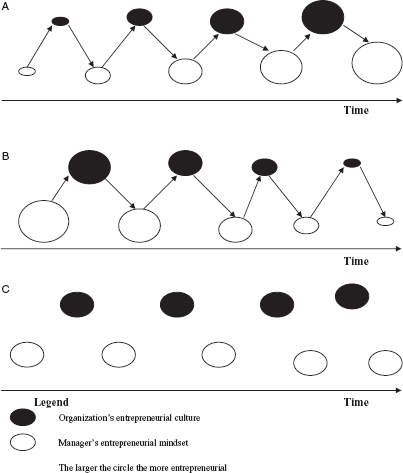
The Dynamism of Entrepreneurial Spirals: (A) Enhancing Spiral, (B) Diminishing Spiral, and (C) No Spiral (Steady State)
Before developing the model further, we acknowledge that an increase in one variable might cause a decrease in another. However, cultural psychology theory suggests this is unlikely owing to the positive interdependence of an individual's mindset and the organizational culture in which the individual is embedded.
We also acknowledge the following boundary conditions. First, we focus on changes in organizational culture, which may or may not apply to the creation of a culture in a new organization. In addition, we focus on the level of the individual (the manager's mindset) and the organization (organization's culture). We do not focus on higher levels of analysis including the industry, community, society, nation, and so on. These higher–level variables may influence the manager's mindset and/or the organization's culture but are unlikely to confound the entrepreneurial spiral proposed here. Finally, we are silent on the relationship between an entrepreneurial spiral and performance (at both the individual and organizational level). However, we acknowledge that entrepreneurialness has been found to have an overall positive relationship with performance (Deeds, DeCarolis, & Coombs, 1997; Zahra, 1993) and more positive in some environments than others (Zahra; Zahra & Covin, 1995). We also acknowledge a small number of studies that suggest that, at least at the individual level, more entrepreneurialness may not always be better (Kets de Vries, 1985; Shepherd & Haynie, 2007). We ask that future research extends these boundaries to further develop our understanding of entrepreneurial spirals and to explore the relationship between entrepreneurial spirals and performance, especially when that relationship may be negative. We detail these opportunities for future research in the discussion.
Antecedents of an Entrepreneurial Spiral
In Figure 2, we present our model of an entrepreneurial spiral. The model includes contributors to the enduring, deviation–amplifying properties—they influence either the manager's mindset or the organizational culture. These factors are analogous to mechanisms that apply force. The mechanisms that apply force to a standing object to put it into motion (start) can be the same mechanisms used to keep the object in motion counteracting friction (perpetuate). The mechanisms that provide an opposing force to stop an object in motion (stop enhancing spiral) could be the same that send the object in motion in the opposite direction (start diminishing spiral). In Figure 3, we illustrate when and how these factors influence an enhancing entrepreneurial spiral. The initial conditions are the level of entrepreneurialness in the manager's mindset and the organization's culture prior to the start of the spiral. In Figure 3, the manager's mindset and the organization's culture are represented in equilibrium—a steady state—where neither are increasing or decreasing and therefore one is not exerting an influence for change on the other. Then an event triggers the start of the spiral. Factors then perpetuate the spiral. Then an event triggers a stop to the spiral. Our figure illustrates a steady state after a spiral has been stopped; however, these factors that stop an enhancing spiral could start a diminishing spiral.
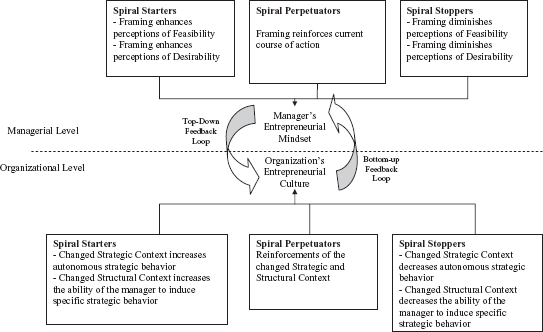
Triggering, Perpetuating, and Ceasing Entrepreneurial Spirals
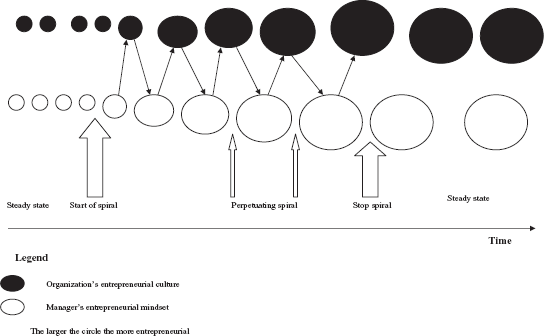
Start, Perpetuation, and Stop of an Enhancing Spiral
An Individual's Mindset as Contributor to an Entrepreneurial Spiral
Starting a Spiral
An entrepreneurial spiral can be started as a result of an increase in the entrepreneurialness of the manager's mindset that is sufficient to cause an increase in the entrepreneurialness of the organization's culture, leading to an enduring, deviation–amplifying relationship. The formation of individual beliefs with regard to the feasibility and desirability of entrepreneurial action represent the basis for characterizing the “entrepreneurialness” of the individual's mindset (Krueger, 2000; McMullen & Shepherd, 2006). The formation of such beliefs—and also the impetus for changes in these beliefs—may be driven jointly by changes in individual knowledge (both specific to entrepreneurial action, and/or more general knowledge), and also by changes in how the manager frames the likelihood of positive outcomes (success) resulting from entrepreneurial action.
Through the manager's actions, his or her increasingly entrepreneurial mindset impacts other organizational members. For example, if a manager with an increasingly entrepreneurial mindset is prepared to communicate and act upon this new knowledge (Simpson, French, & Harvey, 2002), those actions may result in knowledge spillover from the manager to organizational members (Audretsch & Stephan, 1999). In that case, organizational members will also perceive entrepreneurial action as more feasible, and thus the new “shared” knowledge will impact the organization's culture (Weeks & Galunic, 2003) in a way that enhances its entrepreneurialness (changing how organizational members frame the likelihood of success). Further, when the manager perceives entrepreneurial action as more feasible, he or she may convince organizational members of this feasibility (cf. Bandura, 1977). To the extent that these perceptions of feasibility become widely accepted, the manager's entrepreneurial attitudes can trigger a change in organizational culture so that these shared attitudes are reflected in defining the appropriate attitudes and behaviors that guide organizational members (O'Reilly, Chatman, & Caldwell, 1991).
The manager's knowledge specific to entrepreneurial activities can increase as the result of education programs and training focused on creativity (Amabile, 1988), project management (Webber & Torti, 2004), and/or the development of entrepreneurial scripts (Mitchell & Chesteen, 1995). As such, the completion of an advanced course or degree may trigger the formation of beliefs about the feasibility of entrepreneurial action (changing how the manager frames the likelihood of success). In addition, the salience of past entrepreneurial successes can also influence how one frames the likelihood of feasibility of future entrepreneurial action, thus enhancing the entrepreneurialness of the individual's mindset. For example, managers who were successful in the past likely underestimate failure risks in the future (Levinthal & March, 1993) and tend to attribute these successes to their own abilities (Staw, McKechnie, & Puffer, 1983), which makes participation in risky entrepreneurial projects more likely (Hayward, Shepherd, & Griffin, 2006). Therefore, success with a recent entrepreneurial project will increase the manager's perceptions of his or her abilities to be successful at entrepreneurial tasks (Krueger, 2000), enhancing the entrepreneurialness of his or her mindset. Thus,
How the manager perceives the desirability of entrepreneurial action also contributes to initiating an entrepreneurial spiral. As the perceived desirability of engaging in entrepreneurial action increases, so do the manager's entrepreneurial intentions, which relate positively to action (Krueger, 2000). Changes in the perceived desirability of entrepreneurial action may be driven by changes in personal goals, motivations, and intrinsic reward systems such that the manager is focused on opportunities (cues from the environment) to enact those goals and motivations through entrepreneurial action (Shepherd et al., 2007). In a similar way, the desirability of acting entrepreneurially—and thus a change in the entrepreneurialness of the manager's mindset—may also result from external factors, such as market competition, technology, or changes in the supply chain. An individual's beliefs about the desirability of an object can influence others‘ beliefs about the object (Lynch, 1996). For example, when the manager considers entrepreneurial action as more desirable because of salient entrepreneurial outcomes, he or she can draw the attention of organizational members to these outcomes and maybe advertise the desirability of these outcomes. Thus, the desirability of entrepreneurial action becomes more shared by members of the organization, which can trigger a change in the organizational culture (Cannon & Edmondson, 2001).
Perceptions of desirability can be enhanced by a change in the framing of entrepreneurial outcomes. A manager's framing of the potential rewards resulting from entrepreneurial action can change as a result of, for example, a change in lifestyle that alters one's attitudes toward risk. Individuals are considered to have a more entrepreneurial mindset when attitudes are less risk–averse (Douglas & Shepherd, 2000, 2002). Increased tolerance for risk has been associated with finding a social partner (no longer being single) (cf. Baker & Haslem, 1974; Sung & Hanna, 1996), becoming more personally secure (Grable, 2000; Shaw, 1996), and when entering specific “transition” points in one's life (Jans, 1989). Similarly, a role model's recent successful experiences with new entries change the way that a manager may frame outcomes enhancing perceptions of the desirability of entrepreneurial action (Gnyawali & Fogel, 1994; Krueger, 2000) (and potentially perceptions of feasibility [Scherer, Adams, Carley, & Wiebe, 1989]), which makes the manager's mindset more entrepreneurial (Krueger).
Changes in the manager's attitudes toward risk and change can influence organizational members‘ attitudes to risk and to change (Bandura, 1977; Bommer, Rich, & Rubin, 2005). Consistent with social contagion theory, research has shown that individuals that are in frequent contact with each other develop similar perceptions of risk, when compared with other individuals that are not in frequent contact (Scherer & Cho, 2003). As the manager's attitudes to risk and change become shared more broadly throughout the organization, his or her mindset can influence the organizational culture to reflect these attitudes (see Dynamic Social Impact Theory; Latane, 1996). Thus,
Perpetuating a Spiral
An entrepreneurial spiral can be perpetuated by factors that make the manager's mindset receptive to changes in the entrepreneurialness of the organizational culture, that is, provide the conditions for the organizational culture “cause” to have a continued mindset “effect.” Thus, the manager's mindset catalyzes the development of a more entrepreneurial culture and reinforces the current trend of an increasing entrepreneurial mindset. According to theories on the escalation of commitment, individuals are more likely to reinforce their current course of action when that action is framed as a decision characterized by high sunk costs, high personal investments, and ambiguity in assessing task performance (Staw & Ross, 1987).
First, managers‘ perceptions of high sunk costs in entrepreneurial projects are likely to perpetuate an entrepreneurial spiral. Since changing a particular organizational culture (such as toward more entrepreneurialness) can be difficult and require substantial investments of top managers (such as time and effort, Ogbonna & Harris, 2003), these sunk costs will enhance their commitment to entrepreneurial projects (Arkes & Blumer, 1985) and increase the receptivity of their mindsets to aspects of the organization's culture that have become more entrepreneurial (cf. Platt, 1973; Staw & Ross, 1987). Second, perpetuation of an entrepreneurial spiral is likely when being entrepreneurial is an important part of the manager's self–identity. Individuals feel better when they perceive their identity as positive (Taylor & Brown, 1994), and one way of achieving this is to act as others expect based on their observations of the individual in the past (Jones & Davis, 1965). Enhancing their commitment to entrepreneurial actions as a response to a more entrepreneurial organizational culture will allow managers with a strong entrepreneurial identity to meet others‘ expectations and perceive their identity as more positive, thereby reinforcing their change in frame toward perceptions of desirability of entrepreneurial action. Finally, when managers perceive their performance at a current entrepreneurial project as ambiguous, managers will more likely rely on the influence of others and adopt their assumptions and values (cf. Dunnegan, Tierney, & Duchon, 1992) in trying to assess their own level of performance. Thus,
Stopping a Spiral
An entrepreneurial spiral can be stopped by a decrease in the entrepreneurialness of an individual's mindset that is sufficient to mean that there is no longer an individual mindset “cause” to generate an organizational culture “effect”—a break in the bottom–up feedback loop. A change in the framing of the likelihood of success can lead to diminished perceptions of the feasibility of successfully engaging in entrepreneurial action, thus decreasing entrepreneurial intentions and the likelihood of action (Krueger, 2000; Krueger, Riley, & Carsrud, 2000). When the entrepreneurialness of the organization's culture increases, which would normally further increase the entrepreneurialness of the manager's mindset as part of the enduring relationships of the entrepreneurial spiral, a factor that diminishes the personal belief that one can be successful in his/her entrepreneurial actions could counter act the organization's entrepreneurial culture “cause” such that there is no manager mindset “effect.” The manager's mindset will not become more entrepreneurial because he or she does not consider more entrepreneurial action as feasible, even though organizational members will act more entrepreneurially and motivated and maybe try to convince the manager to engage in more entrepreneurial action. It breaks the bottom–up feedback loop.
Framing of the feasibility of a task is influenced by fundamental assumptions about the self and the salience of cues about the difficulty of the task (Ayers & Kaplan, 1993). First, the self–esteem of the manager can be threatened by external events, hindering any further increases in the entrepreneurialness of his or her mindset (Robinson, Stimpson, Huefner, & Hunt, 1991). Self–esteem has been shown to decrease with decreases in individuals‘ socioeconomic status (e.g., with a decline in income or occupational status [Malka & Miller, 2007; Ranchor & Sanderman, 1991]), when they suffer a disease (Nicolson & Anderson, 2003), when they are dissatisfied with their current romantic relationship (Hendrick, Hendrick, & Adler, 1988), and after major events with potentially life–threatening consequences for the future, such as the 9/11 terrorist attack (La–Greca, Silverman, Vernberg, & Roberts, 2002). Second, an individual's framing is influenced by the salience of cues about his or her immediate external environment. For example, salient role models can highlight the negative consequences of failures and point to possible future disasters (Lockwood, 2002), as the manager's mindset is less influenced by increases in the entrepreneurialness of the organization's culture. This reduced influence of organizational members—and thus culture—on the manager could be sufficient to terminate the spiral. Although these frames may not be directly related to work, they can diminish the manager's perceived feasibility of the task such that further increases in the entrepreneurialness of his or her mindset are unlikely. Thus,
A change in the framing of the likelihood of success can lead to diminished perceptions of the desirability of engaging in entrepreneurial action, thus decreasing entrepreneurial intentions (Krueger, 2000; Krueger et al., 2000). This might be sufficiently impactful that it counteracts the effect on the manager's mindset that an increasingly entrepreneurial organizational culture would otherwise have. That is, when the manager experiences diminished perceptions of desirability with entrepreneurial tasks, he or she will become resistant to encouragement by organizational members to act entrepreneurially, thereby disrupting the entrepreneurial spiral.
Framing of desirability is influenced by fundamental attitudes of risk and the salience of cues about the attractiveness of the external environment. For instance, being reminded that one is ageing (such as becoming a grandparent for the first time) may diminish the manager's risk tolerance, because age is often associated with more risk averse behavior (Palsson, 1996; Rees & Shah, 1986). A lifestyle change that increases risk aversion may make the manager less receptive to encouragement by organizational members with respect to more risk–taking behavior such as entrepreneurial action. Further, although a single failure or other form of negative feedback may have a motivating effect (Kluger & DeNisi, 1996; Van–Dijk & Kluger, 2004), several consecutive failures are more likely to stimulate the manager to reassess key assumptions about the self and one's ability to successfully complete the task (Campbell, 1992; Lindsley et al., 1995; Smith, Kass, Rotunda, & Schneider, 2006). These “mindset” consequences of consecutive failures can counteract other motivating influences (Shane, Locke, & Collins, 2003). Thus,
An Organization's Entrepreneurial Culture as Contributor to a Spiral
Starting a Spiral
At the organizational level, an entrepreneurial spiral can be started by an increase in the entrepreneurialness of the organization's culture, which in turn increases the entrepreneurialness of the manager's mindset, leading to an enduring, deviation–amplifying relationship. The entrepreneurialness of an organization's culture is influenced by its: (1) strategic context, and (2) structural context (Burgelman, 1984a, 1984b). The strategic context of an organization “encompasses the activities through which middle level managers question the current concept of strategy and provide top management with the opportunity to rationalize, retroactively, successful autonomous strategic behavior” (Burgelman, 1984a, p. 156). Changes in the strategic context of an organization can change the values and attitudes that the manager holds.
Strategic contexts more likely to promote autonomous, entrepreneurial behavior are those that have the resources to promote experimentation, and those that engage in project championing to mobilize organizational resources (Burgelman, 1984b).
Experimentation and the creation of new ideas is an expensive and time–consuming endeavor (March, 1991) and can also be triggered by a competitor's new entry (Ilinitch, D'Aveni, & Lewin, 1996), the need for strategic renewal (Guth & Ginsberg, 1990), and/or declining profitability in established markets (Miller & Friesen, 1985). Resource availability facilitates the development of values and attitudes that define an entrepreneurial culture (Hornsby et al., 2002; Ireland et al., 2003). Special emphasis has also been given to middle managers (and even those at the operational level) that act as champions for entrepreneurial action (e.g., Kuratko, Ireland, Covin, & Hornsby, 2005; Shane, 1994). In a strategic context where champions “sell” new entrepreneurial endeavors to the top manager, championing provides a mechanism that influences the entrepreneurial values and attitudes of the top manager—the entrepreneurialness of his or her mindset. Empirical studies support this notion by showing that “innovation champions” are critical to enhance the acceptance of entrepreneurial action (i.e., the development of an entrepreneurial culture) and for it to be included in the strategic thinking of top management (e.g., Burgelman, 1984b; Markham, 1998; Shane). Thus,
The structural context of an organization refers to “the various administrative mechanisms which top management can manipulate to influence perceived interests of the strategic actors at the operational and middle levels in the organization” (Burgelman, 1984a, p. 155). Structural contexts that are more likely to induce entrepreneurial behavior in managers are those corporate ways and means that increase the attractiveness of creative independence and increase managers‘ understanding of the importance of entrepreneurial actions for satisfying corporate development needs (Burgelman, 1984b). When these administrative mechanisms are adopted by a large number of organizational members and/or are communicated and transferred from one organizational member to another (Bandura, 1977; Pfeffer, 1981) within the organization, they become part of the organization's culture. Managers‘ mindsets become more entrepreneurial when they take in values, attitudes, or regulating structures of their organizations (consistent with changes in an organizational culture stimulated by extrinsic rewards), and transform them into an internal regulation (consistent with an individual's mindset) which no longer requires the presence of the organizational influences (Gagné & Deci, 2005, p. 224).
Three such mechanisms are the reward structure, communication mechanisms, and structural organicity. First, formal reward structures signal to organizational members which actions are desirable, thereby changing their behavior, which subsequently leads to an adaptation of basic assumptions and values (Beck, 1987; Cohen, Birkin, Cohen, Garfield, & Webb, 2006; Mike & Slocum, 2003). In an environment where rewards for entrepreneurial behavior are provided, this facilitates the development of more entrepreneurial values and attitudes, and increases the entrepreneurialness of the organization's culture (Hornsby et al., 2002; Kuratko, Hornsby, Naffziger, & Montagno, 1993). Second, a structure that provides for clear, open, and effective channels for communicating a new organizational vision and/or strategy presents a powerful influence on an organization's culture. The values and attitudes communicated in the new vision, and reflected by changes in the organizational culture, can in turn influence the manager's personal vision (Ireland & Hitt, 1999; Schein, 1999)—one that coheres with the organization's new (more entrepreneurial) culture (Melewar, Karaosmanoglu, & Paterson, 2005). Finally, organizations adopting an organic structure can enhance the culture's entrepreneurialness. Organic structures are loose and flexible, have decentralized decision processes, encourage participation of organizational members in decision making, and have less coercive rules and regulations (Burns & Stalker, 1961; Pillai & Meindl, 1998). Thus, an organic structure facilitates change and enables organizational members to develop and realize their own ideas through participation in organizational decision making, thereby triggering a more entrepreneurial organizational culture (Ireland et al., 2003; Slevin & Covin, 1990). Thus,
Perpetuating a Spiral
An entrepreneurial spiral can be perpetuated by factors that make the organizational culture receptive to changes in the entrepreneurialness of the manager's mindset, that is, provide the conditions for the manager's mindset “cause” to have a continued culture “effect.” A spiral is perpetuated when changes to the strategic and structural context are reinforced and thereby help maintain the deviation–amplifying properties of the culture–mindset relationship. That is, when changes in the organization's strategic and structural context encourage autonomous, entrepreneurial behavior shared across the organization, these changes serve to legitimize the development of more entrepreneurial attitudes and values (Lounsbury & Glynn, 2001), thus making it easier for the manager with an existing, entrepreneurial mindset to influence the assumptions and values of organizational members toward being more entrepreneurial.
First, changes in the strategic context are reinforced when activities by which middle level managers (and those at operational levels) display autonomous behaviors question the current concept of the top manager's strategy, and when those autonomous behaviors are celebrated as stories and folklore. Such stories and folklore within an organization reinforce the organization's culture as more receptive to individual action (Boyce, 1996; Deetz, 1985). Second, communication and mutual influence between the manager and organizational members is stronger within a given (sub)culture than across cultural boundaries (Liu, 2003; Pearce, 1989), thus an organization with many subcultures likely limits the impact of the manager's entrepreneurial mindset to one or two subcultures rather than the whole organization (Larsson & Finkelstein, 1999; Liu). Finally, when the manager is trusted by organizational members, these members will assume that the manager acts in a way that is consistent with their needs and interests, and they will likely change their beliefs, attitudes, and intentions according to this trusted manager (Rafferty & Simons, 2006). In a culture characterized by high levels of trust between the manager and organizational members, managers with a more entrepreneurial mindset will be more able to influence the values and beliefs underlying the entrepreneurialness of the organizational members—such as risk taking, creativity, tolerance of failure, and learning (Ireland et al., 2003)—and thereby enhance the entrepreneurialness of their organization's culture. Thus,
Stopping a Spiral
An entrepreneurial spiral can be stopped by a decrease in the entrepreneurialness of an organization's culture, sufficient that there no longer exists an organizational culture “cause” to generate a manager's mindset “effect.” A change in the strategic context that obstructs autonomous strategic behavior can decrease the entrepreneurialness of an organization's culture (Burgelman, 1984a, 1984b). Thus, diminishing strategic support for autonomous, entrepreneurial behavior will encourage the manager to stop, or not initiate new, explorative activities signaling that further experimentation, risk taking, and innovation—which are essential ingredients of developing a more entrepreneurial culture (Ireland et al., 2003)—are not desired.
Specifically, middle level managers (and those at the operational level) are less likely to challenge the current concept of strategy by engaging in entrepreneurial behavior when there are fewer slack resources to fund this sort of behavior. When the strategic context changes such that resources are diminished, organizations typically focus on exploitation rather than exploration activities (March, 1991; Sena, 2006). Similarly, when qualified personnel are not available to the organization, innovation is difficult to pursue because its success depends on the skills of the organizational members (Leiponen, 2005). In a strategic context that begins to emphasize exploitation over exploration, champions will face difficulties in finding support of top management, which is a prerequisite to successfully championing innovations (e.g., Burgelman, 1984b; Markham, 1998; Shane, 1994). If the strategic context of the organization obstructs championing activities, discouraged champions likely either stop or diminish their activities, or leave the organization to promote their ideas elsewhere. To the extent the manager incorporates diminished entrepreneurial values and experiences fewer organizational stimuli for entrepreneurial ideas, a further increase in the entrepreneurialness of his or her mindset is obstructed. Thus,
A change in the structural context that decreases the ability of administrative mechanisms to induce entrepreneurial strategic behaviors can decrease the entrepreneurialness of an organization's culture (Burgelman, 1984a, 1984b). In a changing structural context that obstructs more entrepreneurial strategic behavior, managers have fewer abilities to influence the organization's culture by inducing specific strategic actions and attitudes. This can counteract increases in the entrepreneurialness of the manager's mindset (Burgelman) and stop the spiral. As for starting an entrepreneurial spiral, three such administrative mechanisms are the reward structure, communication mechanisms, and structural organicity.
First, punishment and sanctions influence the behavior of organizational members (Lieberman, 1993) and subsequently their assumptions and values (Beck, 1987; Cohen et al., 2006). 3 Not only direct experience with sanctions, but also verbal reports and personal observations cause fear among organizational members (Lieberman; Reiss, 1980) and influence their collective attitudes toward taking fewer risks and avoiding failures (Appelbaum, Bregman, & Moroz, 1998). Second, less open and effective communication makes it more difficult for managers to unambiguously and consistently communicate a vision of their organization and thereby influence the attitudes and behaviors of organizational members (Guth & Ginsberg, 1990; Schein, 1999). Third, a change toward a more mechanistic structure represents a structural context that is rigid and resistant to change and suppresses organizational responses to individual action (Tosi, 1992) such as the allocation of financial and human resources to new and innovative projects (Pillai & Meindl, 1998). As the structural context changes as previously detailed, the influence of the manager's mindset on organizational culture is likely diminished (Burgelman, 1984a, 1984b; Tosi), and stops the spiral. Thus,
Discussion
One of the closely held assumptions of entrepreneurship research is that there exists an “entrepreneurial environment.” Scholars represent entrepreneurial environments as inherently uncertain, dynamic, and novel. In recent years, process models have played a central role in advancing the field. For example, process models have been recently brought to bear to advance our understanding of corporate entrepreneurship (Dess, Lumpkin, & McGee, 1999; Russell, 1999) and opportunity recognition (Lumpkin & Lichtenstein, 2005; Shepherd et al., 2007). While disparate in terms of research context, this research shares in common an explicit acknowledgment that entrepreneurship represents a dynamic process, defined by multiple actors, and situated in a social context. Nonlinear relationships, and recursive feedback loops characterize process research and frameworks. The notion of entrepreneurial spirals—as presented in this research article—represents an example of the “next step” in the maturing of approaches to entrepreneurship research consistent with a process model framework. The extension of previous studies to cross–level spirals highlights the importance of frameworks that can capture the dynamic nature of a process, which once started, can be enduring and deviation amplifying. Cross–sectional and single feedback loop approaches to understanding the entrepreneurial process (theoretical and empirical) are likely to miss out on (deemphasize) the enduring aspects of this dynamic dimension.
In one of the first applications of spirals to entrepreneurship, Ropo and Hunt suggest that researchers extend the insights of their grounded theory–building approach toward developing a “more specific, sophisticated, and comprehensive framework” to investigate how entrepreneurship may unfold as a deviation–amplifying spiral (1995, p. 107). Like Ropo and Hunt, we employ the spirals model to bridge the individual and organizational levels in the entrepreneurial context, and in doing so, offer a dynamic explanation of entrepreneurial action that extends our understanding beyond the insights available from static, single feedback looped, and within–level explanations that currently dominate the existing literature. Unlike prior applications of the spirals to entrepreneurship focused on performance, however, our purpose is to identify those attributes and processes at the interface of the individual and the organization that are likely responsible for starting, perpetuating, and stopping the spiraling relationship. Doing so has important implications for managerial action, but also suggests a basis for future research focused on understanding how to change the “trajectory” of an entrepreneurial spiral in the face of a dynamic environment. Fundamental to the work of Ropo and Hunt is the notion of dynamism at the interface of “organizational and individual characteristics across time” (p. 94). Implicit in this notion is the acknowledgement that a virtuous spiral is virtuous only as long as the configuration of individual and organizational capabilities represented by the spiral advances organizational ends—a variable exogenous to the spiral. The insights suggested by our model focused on the attributes and processes that may start, perpetuate, and stop the entrepreneurial spiral, and offer a strong theoretical framework from which future research can theorize and test explanations of variance in performance across organizations in the face of changing organizational goals, markets, customers, and a host of other environmentally defined variables.
Furthermore, we suggest that our conceptualization of the entrepreneurial spiral has the potential to extend and offer deeper insights into concepts and findings central to entrepreneurship. For example, consider the work of Alvarez and Busenitz (2001) and others that focused on the role of heuristics in entrepreneurship. Our conceptualization of an entrepreneurial spiral suggests a means by which individual level heuristics might become embedded in the organizational culture in the form of routines, and reciprocally how organizational routines that promote entrepreneurial action may become adopted at the individual level as heuristics. In addition, an entrepreneurial spiral provides an explanation for how both individual heuristics and organizational routines may be informed by each other and evolve over time.
Further, scholars have focused considerable attention on the factors and routines (at both the individual and organizational level) that characterize those high in entrepreneurialness—and in turn encourage entrepreneurial action. An important and interesting extension of this work relates to our suggestion that once started, entrepreneurial spirals may endure even in the absence of the factor or attribute that initially triggered the spiral. An entrepreneurial spiral, by definition, results in enduring change. Although we already know a great deal about the factors associated with the entrepreneurialness of an individual's mindset and an organization's culture, there is an opportunity to build on these factors to gain a greater appreciation of the multiple feedback mechanisms at work, and to empirically test the deviation–amplifying effect of these variables to understand how and why managers‘ and organizational culture's entrepreneurialness change over time. Specifically, do the previously specified cause–and–effect relationships trigger, say, a top–down feedback effect, which triggers a bottom–up feedback effect, which triggers a top–down effect and so on? The empirical challenge is to deal with the temporal issue necessary to determine a cause–and–effect relationship. While this challenge is not unique to spirals, it is complicated given the multiple feedback effects. Perhaps experimental designs are best suited to explore the temporal dimension of these multiple cause–and–effect relationships.
For practicing managers, our study is interesting because it suggests that they have some discretion over the development of entrepreneurial spirals and emphasizes the potential consequences of these spirals. For example, at the organizational level, efforts of cultural change toward more entrepreneurialness (e.g., by providing appropriate rewards or communicating an entrepreneurial vision) can start a self–perpetuating spiral which makes the organizational culture more and more entrepreneurial beyond the level of entrepreneurialness that the manager intended to achieve. This appears particularly likely when spiral perpetuators such as organizational stories and folklore support spiral endurance. When managers recognize this development, they can stop the spiral and achieve a steady state, for example, by allocating less resources to entrepreneurial projects or sanctioning an overly ambitious project that ended in failure. At the individual level, our article demonstrates to managers when they are particularly likely to start, perpetuate, and stop spirals, and this may help them to better understand their decision policies and thus make more accurate decisions with respect to promoting or diminishing the entrepreneurialness of their organization.
Future Research
As described here, an entrepreneurial spiral exists when both the manager's mindset and his or her organization's culture become more and more entrepreneurial. It does not indicate whether or not this entrepreneurialness is a “good thing.” The relationship between the spiral and performance presents a fertile area for future research. For example, future research can empirically investigate the entrepreneurial spiral–performance relationship based on (moderated by) differences between firms in the entrepreneurialness of the managers‘ mindset and the organizational culture when the spiral was triggered. The entrepreneurialness of an organization's culture can be captured by existing measures such as organizational climate (Anderson & West, 1998; Patterson et al., 2005), entrepreneurial management (Brown, Davidsson, & Wiklund, 2001), and/or entrepreneurial orientation (Covin & Slevin, 1991). The research on entrepreneurialness of an individual's mindset is still in emergence but could involve assessments of an individual's scripts (arrangement, willingness, and ability—see Mitchell, Smith, Seawright, & Morse, 2000) or cognitive adaptability (Haynie & Shepherd, 2007), regulatory focus (McMullen & Zahra, 2006), and/or reliance on effectual reasoning (Dew, Read, Sarasvathy, & Wiltbank, 2008).
Second, future research can empirically investigate the rate at which the spiral increases the entrepreneurialness of the manager's mindset and of the organizational culture. We have proposed how an entrepreneurial spiral starts, is perpetuated, and stops, but future research can explore the factors that impact the rate of change in entrepreneurialness created by an entrepreneurial spiral. This presents a more fine–grained analysis of spiral perpetuation where the spiral continues but rather than increasing (for an enhancing spiral) at a constant rate (say 20% for each iteration), the level of entrepreneurialness of the manager's mindset and of the organization's culture increases at an increasing rate (20%, 25%, 30%, and so on for subsequent iterations). The dynamic nature of entrepreneurial spirals requires researchers to measure both aspects of the spiral (entrepreneurialness of the manager's mindset and organizational culture) over time.
Third, future research can empirically investigate the limits of the entrepreneurial spiral as a function of performance. That is to say, might there be a point at which the entrepreneurial spiral becomes dysfunctional and inappropriate given: (1) the nature of the industry, (2) the environment, or (3) the lifecycle of the firm? We hope that scholars will explore the optimal level of entrepreneurialness and the factors that influence the location of the optimal point. For example, are the factors that determine the location of an optimal point the same as the factors that explain the strength of the relationship between entrepreneurialness and performance and/or the factors that explain the acceleration or deceleration of an entrepreneurial spiral and/or a combination of both? This and other questions focused on the extent to which entrepreneurialness is “good”—another closely held assumption in the entrepreneurship literature—present opportunities for impactful research enabled by the framework presented in this article.
These future studies will need to rely on longitudinal methods (perhaps using experiments) to empirically test the proposed relationships. We also hope that scholars use qualitative research to further build theory on entrepreneurial spirals.
Conclusion
We suggest that the notion of entrepreneurial spirals presents a process mechanism positioned to relate the psychology of individuals to the culture of organizations and vice versa. In this article, we develop the logic for why these spirals exist in the context of entrepreneurship, and detail the enduring implications entrepreneurial spirals may have on managers‘ mindsets and their organization's culture. This research presents a first step toward a robust, multi–level model positioned to understand how—in the entrepreneurial context—the manager impacts the organization's culture, and in turn how the organization's culture informs the entrepreneurial mindset of the manager in the form of an enduring relationship. We suggest that variations in entrepreneurial action reflect the nature of the entrepreneurial spiral, and investigate how these spirals start, perpetuate, and stop at both the individual and the organizational level. In the end, we are hopeful that our approach will motivate additional, cross–level research focused on understanding how and why individuals and organizations become more (or less) entrepreneurial over time through multiple feedback loops.
Footnotes
1
Adapted from Ireland et al. (2003) and McMullen and Shepherd (2006).
2
These three categories are not exhaustive. For example, an increase in the entrepreneurialness of the individual's mindset can lead to the increase in the entrepreneurialness of the organizational culture but this increase in the entrepreneurialness of the organizational culture does not lead to an increase in the entrepreneurialness of the individual's mindset. In this example, the relationship is not in equilibrium (not a steady state) but not enduring (not a spiral).
3
Formal sanctions in organizations such as dismissal, demotion, and suspension are introduced to achieve conformity between the behavior of organizational members and organizational goals (Hollinger & Clark, 1982). This need for conformity can be triggered by increasing size (Gooderham, Nordhaug, & Ringdal, 1999), the development of a governance structure (Buck, Filatotchev, Demina, & Wright, 2003), and/or to satisfy new stakeholders (Cyr, Johnson, & Welbourne, 2000).