







Abstract
To sense and adapt to uncertainty may characterize a critical entrepreneurial resource. In this research, we employ a metacognitive lens toward the development of a 36–item inventory designed to assess cognitive adaptability, defined as the ability to be dynamic, flexible, and self–regulating in one's cognitions given dynamic and uncertain task environments. Construction of the inventory, and subsequent factor analysis, is confirmatory in nature based on five theoretically justified dimensions of metacognition. We describe the development of the instrument, discuss its implications for entrepreneurship, and finally offer suggestions for further development and testing.
Introduction
Entrepreneurship scholars suggest that cognition research can serve as a process lens through which to “reexamine the people side of entrepreneurship” by investigating the memory, learning, problem identification, and decision–making abilities of entrepreneurs (Mitchell, Busenitz, et al., 2002, p. 93). This research is positioned to further such inquiry, through the development of a measure appropriate to investigate individual differences in cognitive adaptability in an entrepreneurial context. We define cognitive adaptability as the ability to effectively and appropriately change decision policies (i.e., to learn) given feedback (inputs) from the environmental context in which cognitive processing is embedded. Research suggests that while such a cognitive task is difficult to achieve (Rozin, 1976), it is positively related to decision performance in contexts that can be characterized as complex, dynamic, and inherently uncertain (Earley & Ang, 2003). The entrepreneurial context exemplifies such a decision environment.
Although measures exist that capture some elements of flexibility and self–regulation at the firm level of analysis (e.g., measures of strategic posture [Covin & Slevin, 1986, 1988, 1989; Miller, 1983] and in entrepreneurial management practices [Brown, Davidsson, & Wiklund, 2001]), to advance the study of cognition in entrepreneurial environments requires measures of cognitive adaptability focused at the individual level of analysis. Such measures should be positioned to explore heterogeneity in an individual's performance across a wide variety of entrepreneurial tasks and situations. Currently, the most widely employed measure focused on individual self–regulation in entrepreneurship is based on Higgins's (1997) Regulatory Focus Theory, and is focused on self–regulation as a motivation to reduce some disparity or discrepancy between a current state and some desired end–state (Higgins). In the development of the measure of cognitive adaptability proposed here, rather than a motivational approach, we focus on cognitive processes and employ metacognitive theory. Metacognition describes a process which incorporates self–regulation, but yet advances regulation to also describe the process through which regulation informs the development and generation of new sense–making structures (heuristics) as a function of a changing environment (Flavell, 1987; Nelson, 1996). Research indicates that individuals who are more metacognitive in the way that they approach a task or a situation are: (1) more likely to recognize the fact that there are multiple decision frameworks available to formulate a response; (2) more likely to engage in the conscious process of considering those multiple alternatives; and (3) more likely to be sensitized and receptive to feedback from the environment and to incorporate that feedback into subsequent decision frameworks (Melot, 1998; Schraw & Dennison, 1994). It is the purpose of this article to develop a measure of cognitive adaptability grounded in metacognitive theory that is appropriate for use in an entrepreneurial decision context.
This article proceeds as follows. In the next section we introduce metacognition as the theoretical perspective for developing a measure of cognitive adaptability. We then describe the construction and evaluation of a 36–item “Measure of Adaptive Cognition (MAC).” We conclude with a discussion of the opportunities and limitations inherent in both the measure of MAC and methods employed in its development
Metacognitive Theory and Cognitive Adaptability
Metacognition describes a higher–order, cognitive process that serves to organize what individuals know and recognize about themselves, tasks, situations, and their environments in order to promote effective and adaptable cognitive functioning in the face of feedback from complex and dynamic environments (Brown, 1987; Flavell, 1979, 1987). To think metacognitively describes such activities as “to be self–aware, to think aloud, to reflect, to be strategic, to plan, to have a plan in mind, to know what to know, to self–monitor” (Guterman, 2002, p. 285). Metacognition is considered to be, at least in part, a conscious process (referred to as metacognitive awareness [Flavell, 1979; Nelson, 1996]) that is situated within a social context (Allen & Armour–Thomas, 1993; Jost, Kruglanski, & Nelson, 1998) and different from cognition. Indeed, empirical studies indicate that metacognition is separate from other cognitive constraints on learning, such as intelligence, and that an individual's development and application of metacognitive processes cannot be predicted “with even a moderate degree of accuracy” from domain knowledge (Glenberg & Epstein, 1987; Haynie & Shepherd, 2009).
An Entrepreneurial Example
To differentiate metacognition from cognition, we offer an example both situated in the extant entrepreneurship literature, and also in an entrepreneurial decision context: Consider an entrepreneur who is tasked with proposing a marketing strategy for a new venture. Before the entrepreneur is prepared to evaluate alternative marketing strategies, the entrepreneur must first formulate a strategy to frame how he or she will “think” about this task. This process is metacognitive. Suppose that the entrepreneur identifies an effectual reasoning strategy as appropriate to apply to the cognitive task of developing and evaluating alternative outcomes (Sarasvathy, 2001), he or she then applies an effectual reasoning strategy to consider the entrepreneurial task, and that strategy (effectuation) defines the set of available, alternative outcomes from which the entrepreneur will ultimately select a response (the selection of a causal strategy to “think” about the entrepreneurial task would likely result in a very different set of alternative strategies). The process responsible for ultimately selecting a response (e.g., a guerilla marketing campaign from other marketing campaigns) is cognitive. Thus, to study metacognition is not to study why the entrepreneur selected the guerrilla marketing strategy (cognition), but instead to study the higher–order cognitive process that resulted in the entrepreneur framing the task effectually and subsequently the guerrilla marketing strategy being included in a set of alternative responses to decision task (metacognition).
Important here is the recognition that the thinking of individuals, when faced with a cognitive task, can be both constrained and propelled by metacognition; that is to say that metacognition describes the process through which individuals are aware and reflect upon the range of strategies (or create new strategies) appropriate to apply to a given task, and consider each relative to its utility in addressing the decision task at hand (Ford, Smith, Weissbein, Gully, & Salas, 1998; Staw & Boettger, 1990). Objectively, the entrepreneur could have applied any number of strategies to frame how to think about the entrepreneurial task. A metacognitively aware entrepreneur will recognize this fact, engage in the process of identifying alternative strategies that maximize the likelihood of achieving his/her goal (in this case, identifying the most appropriate marketing strategy). Alternatively, studies have demonstrated that individuals constrained in their metacognitive abilities are less likely to engage alternative strategies and are therefore less adaptable when the decision context changes, or when the decision context is novel and uncertain (Earley & Ang, 2003). The implications of this process for dynamic, adaptable thinking are important, in that metacognitive processing is responsible for formulating the set of available alternatives from which the entrepreneur considers when faced with a decision task. Scholars doing research in this area focus empirical tests on questions such as the extent to which the entrepreneur may have reflected on past events, drawn on experiences, intuition, or specific knowledge in the processing of formulating a strategy to “think about” the task at hand.
Based on metacognition research, and integrated with related work in social cognition (selectively reviewed below), we conceptualize cognitive adaptability as the aggregate of metacognition's five theoretical dimensions: goal orientation, metacognitive knowledge, metacognitive experience, metacognitive control, and monitoring. Theory suggests that these five dimensions encompass metacognitive awareness([Griffin & Ross, 1991; Schacter, 1996, goal orientation]; Flavell, 1979, 1987; Nelson; 1996). In Figure 1 we present our conceptual model, describing cognitive adaptability as composed of the set of interrelated processes that together describe metacognitive functioning. Our core assumption—that metacognitive awareness represents a bridge to cognitive adaptability—is based on the following logic: (1) individuals perceive, and subsequently assign meaning, to the characteristics of the environment in the context of their own goal orientation; and (2) individuals subsequently draw on metacognitive knowledge and experiences to generate multiple, alternative decision frameworks focused on interpreting, planning, and implementing goals to “manage” a changing environment. From this set of alternative decision frameworks, a particular framework is (3) selected and employed (metacognitive control) and (4) elicits some outcome (cognitive: i.e., comprehension, understanding; and/or behavioral: action). Those outcomes are (5) assessed in relation to the individual's goal orientation, and this monitoring serves to inform subsequent generation and selection of decision frameworks. The greater an individual's metacognitive awareness, the more adaptive the individual is given a changing decision context. We now proceed to describe each of the dimensions represented in the process model (presented in Figure 1) in the context of cognitive adaptability.
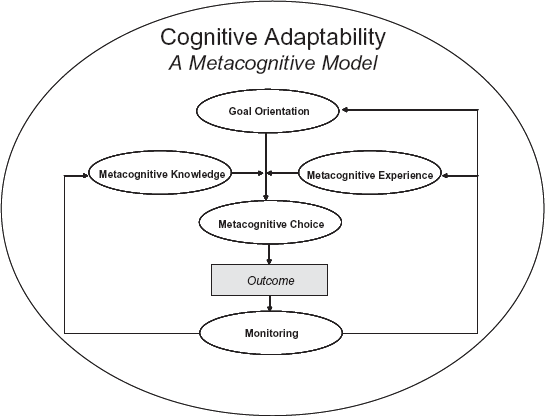
Conceptual Process Model
Goal Orientation
Motives influence how context is perceived and interpreted (Griffin & Ross, 1991; Schacter, 1996) and at the same time, context may define an individual's motives (Wyer & Srull, 1989). Thus, we suggest that this interaction serves as the basis for the development and employment of metacognitive strategies focused on satisfying some motivation, or realizing some cognitive outcome. In an entrepreneurial context, these motivations may be, for example, to improve market share, enhance manufacturing efficiency, or increase annual revenue. Put simply, the goals entrepreneurs pursue are interpreted as a function—or as a consequence—of the environment in which those goals originate. As such, we describe the origins of cognitive adaptability as resulting from the conjoint effects of (1) the context in which the individual functions, and (2) the motivations of that individual through which context is interpreted. To capture this interaction of context and motivation, we offer the term goal orientation, which we define to be: the extent to which the individual interprets environmental variations in light of a wide variety of personal, social, and organizational goals. Goal orientation serves to engage the metacognitive resources of metacognitive knowledge and metacognitive experience.
Metacognitive Knowledge
Metacognitive knowledge refers to one's conscious understanding of cognitive matters as they relate to people, tasks, and strategy (Flavell, 1987; von Wright, 1992) and can be internally and externally directed. Metacognitive knowledge can be focused both internally (self) and externally (the environment). Metacognitive knowledge focused internally relates to an understanding of one's own preferences and values (e.g., an entrepreneur is aware that he or she enjoys dealing with external constituents more than employees); knowledge of one's strengths and weaknesses at certain tasks (e.g., better dealing with “hard numbers” than with people issues); and knowledge of personal strategies to cope with a changing environment (e.g., self–reflection, rational, information gathering). Metacognitive knowledge focused externally relates to knowledge of how other people (such as potential customers, competitors, and investors) think about their firms and their environments; knowledge of how and when to perform certain tasks (such as preparing a financial statement, writing a marketing plan); or knowledge of different strategic approaches to adapting to a changing environment (i.e., incremental innovation, discontinuous change). Thus, we define metacognitive knowledge to be the extent to which the individual relies on what is already known about oneself, other people, tasks, and strategy when engaging in the process of generating multiple decision frameworks focused on interpreting, planning, and implementing goals to “manage” a changing environment.
Metacognitive Experience
Metacognitive experiences are those that are affective, based on cognitive activity, and serve as a conduit through which previous experiences, memories, intuitions, and emotions may be employed as resources given the process of making sense of a given decision context (Flavell, 1987). For example, a person has a metacognitive experience if he or she has the feeling that a particular task is difficult to comprehend, and then draws on past experience with such difficult–to–comprehend problems to inform the generation of a decision framework for approaching this new, but related, task. As with past experiences, emotions and intuitions related to past events can serve to inform the development of decision frameworks focused on new and novel decision tasks. For example, emotions such as anger, fear, grief, or joy that are cognitively associated with a past event may inform—at a metacognitive level—the process of generating future decision frameworks for use with new tasks, events, or situations related to those from which the emotions originated. Intuitions play a similar role in the metacognitive development of decision frameworks. For example, an entrepreneur may make a strategic decision based on a “hunch,” reflecting reliance on intuition (Miller & Ireland, 2005). Put simply, metacognitive experiences allow individuals to better interpret their social world (Earley & Ang, 2003) and, along with metacognitive knowledge, serve to inform the selection of an individual's decision framework. We define metacognitive experience to be the extent to which the individual relies on idiosyncratic experiences, emotions, and intuitions when engaging in the process of generating multiple decision frameworks focused on interpreting, planning, and implementing goals to “manage” a changing environment.
Metacognitive Choice
Metacognitive knowledge and metacognitive experience serve to inform strategies to “think about thinking,” such as specific types of reasoning, memory retrieval processes, or the accessing of specific schema or heuristics (Schacter, 1996; Wyer & Srull, 1989). It is then in the context of the individual's goal orientation that a specific decision framework (drawn from the available set of alternatives) is selected and used by the individual to plan and implement goals to “manage” a changing environment. Consider this selection from multiple decision frameworks as analogous to a golfer selecting a specific club, given his/her goals for a particular shot. Each club in the golfer's bag represents an alternative path to action and realizing goal; getting the ball to the green and into the hole. However, given the characteristics of the particular shot at hand (in a sand trap vs. on the fairway), there is a “most appropriate” club for that shot—the club that most effectively facilitates the golfer to realize his/her goal. A cognitively adaptable individual, drawing on metacognitive knowledge and experience, has generated multiple, alternative decision frameworks as options to make sense of a changed reality (different clubs), and then selects from that set of available options the most “appropriate” framework in light of his/her goals to realize that goal. Thus, we conceptualize metacognitive choice to be the extent to which the individual engages in the active process of selecting from multiple decision frameworks the one that best interprets, plans, and implements a response for the purpose of “managing” a changing environment.
Monitoring
The implementation of the selected decision framework will lead to action that provides feedback to further adapt cognitions (Flavell, 1979, 1987). Our model includes mechanisms to assess the outcome of the implementation of a given decision framework relative to goal orientation, metacognitive knowledge, and metacognitive experience (Flavell). Monitoring of an individual's own cognitions occurs both during and after the process of interpreting, planning, and implementing a response to a changed reality. Specifically, depending on the relationship between current performance and an individual's goal orientation, monitoring of this relationship may cue the individual to reevaluate his or her motivation (Locke, Frederick, Lee, & Bobko, 1984; Locke & Latham, 1990; Nelson, 1996; Nelson & Narens, 1994) and/or reassess his or her metacognitive knowledge, metacognitive experience, and/or the selection of the specific decision framework employed given the environment at hand (metacognitive choice). Thus, we define monitoring as seeking and using feedback to reevaluate goal orientation, metacognitive knowledge, metacognitive experience, and metacognitive choice for the purposes of “managing” a changing environment.
Research Method
Participants
Participants in this study included 432 undergraduate business students enrolled at a large western university. Administration of the instrument was done as part of a specially scheduled session outside of the normal class period. The mean age of the sample was 20.3 (standard deviation 1.28), and business majors represented 64% of the sample (the remaining 36% were representative of psychology, economics, political science, and undeclared majors who were enrolled at the time in a business course).
Although there have been some criticisms of the use of students in behavioral (Copeland, Francia, & Strawser, 1973) and entrepreneurship (Robinson, Huefner, & Hunt, 1991) research, it is relatively common in the investigation of basic cognitive and psychological questions (e.g., Colquitt, 2001; Epstein, Pacini, Denes–Raj, & Heier, 1996; Harkness, Tellegen, & Waller, 1995), including those for use in management (e.g., Brock & Sulsky, 1994; Kacmar and Carlson, 1997; Van der Vegt & Van De Vliert, 2005). Given the psychological nature of the constructs examined in this study, precedent exists for utilizing student samples for this type of research even within management literatures. For example, Audia, Locke, and Smith (2000) asserted that student samples represent a meaningful “first step” in exploring the psychological basis for managerial behaviors.
The use of a student sample is desirable in this particular study. First, metacognition develops throughout childhood, and matures in early adulthood (Schraw, 1998). Thus, the dimensions of metacognitive processing are generally stable and defined in a population of undergraduate students. Importantly, with age and experience, it is likely that individuals generally rely more heavily on automatic, heuristic–based processing at the expense of purposeful “thinking about thinking.” This, of course, is an empirical question that can ultimately be addressed with our measure of cognitive adaptability. However, it also suggests that a sample of undergraduates is ideal for developing such a measure because the full range of metacognition dimensions is likely present (which may or may not be the case with increasing levels of entrepreneurial expertise).
Second, and related to above, a student sample likely provides greater heterogeneity in metacognition than a sample of entrepreneurs. Greenberg (1987) argued that the homogeneity typical of samples constrained to actors within “productive–economic organizations” challenges the assumption of generalizability beyond a very narrowly focused population. This notion is consistent with Dipboye and Flanagan's (1979) content analysis of the I/O psychology literature. The authors found that laboratory research that relied on mostly college students “provides a firm basis for the generalization to the population of working people and adults” (Dipboye & Flanagan, p. 147), whereas those that relied on contextually grounded samples (managers, CEO, team leaders) were exceedingly homogeneous (male, professional, educated, etc.), and therefore potentially constrained in their generalizability. We suggest that a sample of entrepreneurs would be similarly constraining to the empirical investigation of a basic psychological process like metacognition. Such constraints would adversely impact the usefulness of a metacognitive measure, such as testing differences in cognitive adaptability across different levels of entrepreneurial nascency, including those that have not taken any steps toward entrepreneurial action.
Instrument
Construction of our MAC began with adaptation of an instrument proposed by Schraw and Dennison (1994). Schraw and Dennison developed an inventory to assess metacognitive awareness embedded within an educational context. As argued above, entrepreneurship—different from an educational environment—represents a context that is defined by a myriad of tasks and potential outcomes (see Hitt, Keats, & DeMarie, 1998). Therefore, while a specialized measure of metacognitive awareness is appropriate given discrete tasks such as reading comprehension and mathematics, a generalized measure is required to capture cognitive adaptability in the entrepreneurial context. Thus, we began by rewriting Schraw and Dennison's original items to remove the implication of an education context from each item (i.e., … When reading a book chapter in preparation for a test. . . .) and refocused the questions on generic tasks and/or situations. Nine of Schraw and Dennison's original items were dropped entirely based on the inability to disentangle the substantive focus of the item from the educational context. Eleven additional items were created and added to the adapted inventory, based on the theoretical dimensions described above. The resultant, initial item pool included 54 questions.
The scale was constructed as an 11–point, semantic differential measure (Heise, 1965), anchored on the left with the statement “not very much like me,” and on the right with the statement “very much like me.” The instrument included a brief set of instructions describing the purpose of the experiment, a description of the rating scale, as well as a sample question designed to reinforce the mechanics of the scale. The instructions also included a statement highlighting that this experiment was anonymous and confidential. Further, a series of additional scales were included in the questionnaire designed to assess nomological validity (described below).
Confirmatory Factor Analysis (CFA)
We proposed a priori five dimensions that aggregate to form MAC—representative of goal orientation, metacognitive knowledge, metacognitive experience, metacognitive monitoring, and metacognitive control. The theoretical model proposes dimensions aggregate together (positively correlate) to represent the higher–order construct. It is the purpose of this study not only to develop a measure representing the five dimensions, but also to construct an instrument consistent with the conceptual model that captures a unified construct of cognitive adaptability. Given our a priori five dimensions, CFA was employed to validate the solution and to determine model fit as depicted in Figure 2.
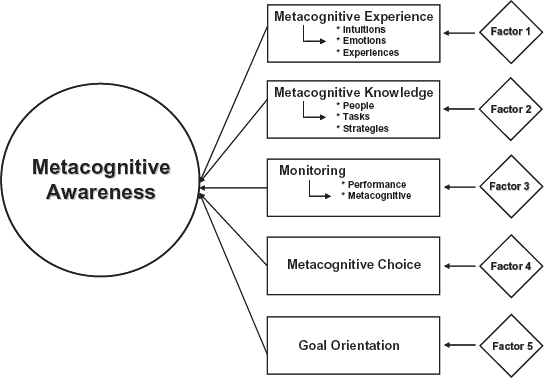
Hierarchical Dimensions of Metacognitive Awareness—5–Factor Solution
The parameters in CFA are typically estimated by maximum likelihood (ML) analysis. ML extraction allows computation of assorted indices of goodness of fit (of data to the model), and the testing of the significance of loadings and correlations between factors. ML estimates are consistent and efficient, that is, they are asymptotically unbiased and converge more quickly to their population values than most other estimators if the hypothesized model fits the data better than plausible alternatives. ML analysis requires, however, the assumption of multivariate normality (Wegener & Fabrigar, 2000). Bernstein (1988) suggested that to assess whether multivariate normality has been violated, the researcher should “compute the means and standard deviations of the items on each factor. If you find large differences in means there is strong reason to attribute the factors to statistical rather than to substantive bases” and assume a violation of multivariate normality (p. 398). We adopted this approach and using a two–sample t–test found that there was no statistically significant difference between the means (p > .10). Therefore, because multivariate normality is not violated, ML is used in this study to determine the initial solution. Further, additional pretests were performed on the data to assess the structure of the data matrix to determine its suitability for ML analysis. Specifically, measures of sampling accuracy (MSA), which quantify the intercorrelations among inventory items, were evaluated using an anti–imaging correlation. In a similar way, the Bartlett's Test of Sphericity determines whether the correlation matrix is an identity matrix, which would indicate that the factor model is inappropriate. Specifically, the Bartlett's Test of Sphericity is used to test the null hypothesis that the items in the population correlation matrix are uncorrelated (Nunnally & Bernstein, 1994). The significance level gives the result of the test, such that small values (p < .05) indicate that the data do not produce an identity matrix and hence are suitable for factor analysis. Larger values indicate that the data more likely produce an identity matrix and hence are less suitable for factor analysis. As a result of these pretests, 12 of the original 54 items were removed from the item pool and subsequent analysis. The MSA statistic for the remaining set of 42 items was .848, indicating that the data is highly suited for the application of factor analysis techniques (Hair, Anderson, Tatham, & Black, 1998). Further, the Bartlett's Test of Sphericity demonstrated a significance level of .000, and thus small enough to reject the hypothesis that the variables are uncorrelated (Nunnally & Bernstein, p. 469).
We define an individual's level of cognitive adaptability as the aggregation of five dimensions (goal orientation, metacognitive knowledge, metacognitive experience, metacognitive control, and monitoring), suggesting correlation between the dimensions. Given our approach, we use oblique rotation—specifically a promax rotation—because it offers the best description of correlated factor patterns. Employing promax rotations (i.e., oblique), rather than arbitrarily constraining the factor rotation to an orthogonal (90–degree angle) solution, the promax solution identifies the extent to which each of the factors are correlated. Rummel (1970) suggests that “oblique rotation has greater flexibility in searching out patterns regardless of their correlation” (see also Reis & Judd, 2000, p. 417).
In assessing the significance of factor loadings, it is reasonable to adopt an approach similar to determining the statistical significance of correlation coefficients. However, Hair et al. (1998) note that factor loadings have significantly larger standard errors than typical correlations; thus, the significance of factor loadings should be interpreted at considerably stricter levels and care exercised in distinguishing between statistical and practical significance. The authors suggest that only those loadings “sufficiently strong” to distinguish themselves as a true factor should be interpreted as being practically significant. As such we employ the idea of statistical power analysis, given the inflation of the standard errors in factor loadings, to determine the appropriate level of significance. Assuming the standard errors to be twice those of standard correlation coefficients, given a sample n = 432, a power level of 80%, and a significance level of .05, Hair et al. (table 3.2, p. 112) indicate that loadings of .45 or higher are required for significance. This standard was applied only as a minimum standard given the discussion of practical versus statistical significance described above. In some cases, measures which loaded significantly given the .45 threshold, but that represented an outlier given the other loading values in a particular factor, were classified as not practically significant and were thus eliminated.
Analysis
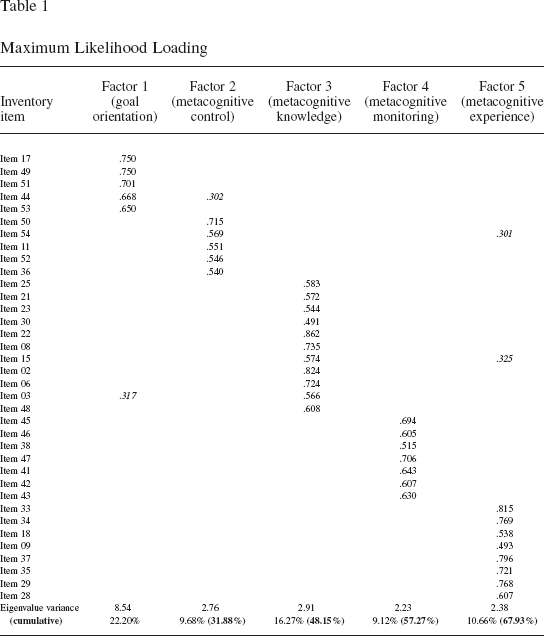
A restricted analysis employing ML and a promax rotation generated a five–factor solution as determined by eigenvalues greater than 1. In addition, an examination of the resulting scree plot confirmed this finding. This solution explained 64.93% of the variance over the five proposed dimensions. The “goodness of fit” of a factor model is assessed by comparing the observed covariance with the covariance predicted by the model. Large discrepancies between the observed covariance, and the covariance predicted by the model is indicative of poor model fit. The ML algorithm used to estimate the parameters in the model minimizes a chi–square statistic that compares the observed and predicted covariance. We found the goodness–of–fit test to be significant (p < .000), and therefore we have no basis to reject the null hypothesis that the discrepancy between the observed and predicted covariance is equal to zero. Six items did not significantly load on any one factor (or were deemed practically insignificant) and were subsequently eliminated from further analysis, resulting in a 36–item measure. In Table 1, we report the factor loadings, eigenvalues, and variance explained statistics, as well as all loadings greater than .30 such that cross loadings are apparent. The 36 items that constitute the MAC are listed in the appendix.
Maximum Likelihood Loading
To determine how these five factors aggregate together, we used structural equation modeling (SEM) to investigate both the significance level and direction of the correlations between the factors, as illustrated in Figure 2. Findings indicate that the five dimensions are significantly correlated (p < .05), and those correlations are positive indicating that these five dimensions work together to capture general cognitive adaptability. Further, by employing SEM, we are able to compare our 5–factor model to possible alternative interpretations of the correlations within the data matrix. Specifically, we collapsed our five dimensions to represent a single construct (a 1–factor model). Fit statistics for both the 5–factor and 1–factor model are reported in Table 2. We examined several recommended measures of goodness of fit including the normed–fit index (NFI), the root mean squared error of approximation (RMSEA), and the ratio of chi–squared to degrees of freedom (χ2/df), the adjusted goodness–of–fit index (AFGI), and the goodness–of–fit index (GFI). Values exceeding .90 are generally accepted to indicate good model fit for the NFI and GFI (Hatcher, 1994). Hu & Bentler (1999) suggested that an appropriate “cutoff” for the RMSEA is approximately .06. Finally, values less than 5 are indicative of good model fit based on the ratio of chi–square relative to degrees of freedom (Wheaton, Muthen, Alwin, & Summers, 1977).
Goodness–of–Fit Statistics
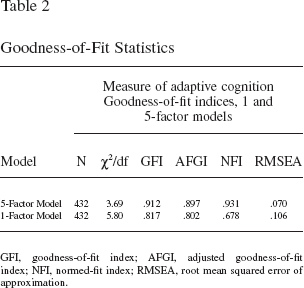
GFI, goodness–of–fit index; AFGI, adjusted goodness–of–fit index; NFI, normed–fit index; RMSEA, root mean squared error of approximation.
Reliability
Reliability describes a condition where the scale yields consistent measures over time (Straub, 1989). The literature offers several types of reliability. Internal consistency tends to be frequently used in the social sciences. In this study we tested internal consistency using Cronbach's alphas, which are calculated based on the average inter–item correlations. There is no standard cutoff point for the alpha coefficient, but the generally agreed upon lower limit for Cronbach's alpha is .70 (Nunnally, 1978). As stated by Straub (p. 151), “high correlations [.80] between alternative measures or large Cronbach's alphas are usually signs that the measures are reliable.”Nunnally and Bernstein (1994, pp. 264–265) adopted a more lenient criterion when they stated that “in the early stages of predictive or construct validation research, time and energy can be saved using instruments that have only modest reliability, e.g. 0.70.” They also stated that “It can be argued that increasing reliabilities much beyond 0.80 in basic research is often wasteful of time and money” (p. 265). Our findings indicate the following reliabilities for each of the five dimensions of cognitive adaptability: goal orientation is .822, metacognitive knowledge is .726, metacognitive experience is .718, metacognitive choice is .742, and monitoring is .764. Further, the Cronbach's alpha value for MAC (across all items) was .885, indicating a high degree of internal consistency in this measure.
Validity
Robust tests of validity focus on validity both within the measure (between factors) and between measures (through comparisons with other, distinct measures). Tests of validity that were performed focused both within MAC (between factors) and through comparisons between MAC and other measures (nomological validity). The ultimate solution demonstrated both within and between structural validity.
Within structural validity is demonstrated when the measures that are theoretically supposed to be highly interrelated are demonstrated to be highly interrelated (Nunnally & Bernstein, 1994). Within structural validity of the measure is established because all the items loaded more strongly on their associated factors (loading > .50), and because each of the factors loaded stronger on their associated factors than on any other factors (Chau & Tam, 1997). Between structural validity is demonstrated when the researcher can show that measures that should not be related to each other are not and is assessed by comparing the average variance extracted (AVE) values associated with each construct to the correlations among constructs (Staples, Hulland, & Higgins, 1999). AVE “measures the percentage of variance captured by a construct by showing the ratio of the sum of the variance captured by the construct and its measurement variance.” In Table 3, the diagonal elements show the square root of the AVE, whereas the off–diagonal elements show the correlations among dimensions. In order to claim between structural validity, the diagonal elements should be larger than any other corresponding row or column entry (Staples et al., 1999) which is the case here.
Statistical Structure Analysis
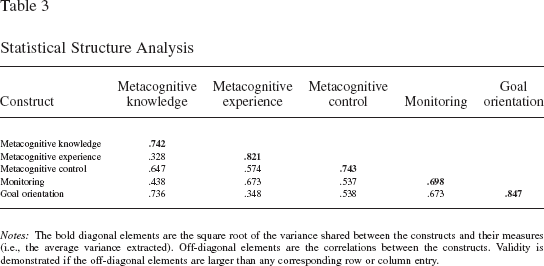
Notes: The bold diagonal elements are the square root of the variance shared between the constructs and their measures (i.e., the average variance extracted). Off–diagonal elements are the correlations between the constructs. Validity is demonstrated if the off–diagonal elements are larger than any corresponding row or column entry.
Finally, nomological validity (between measure validity) was established by comparing the correlations between MAC and the additional scales included for this purpose, specifically a Need for Cognition (NFC) scale (Cacioppo, Petty, & Kao, 1984), and a Conservatism–Liberalism scale (Mehrabian, 1996). Theoretically, we would expect that individuals‘ MAC score should be correlated with scores on the NFC scale. Cacioppo, Petty, and Kao's NFC scale represents an individual difference measure that captures the extent to which individuals enjoy “effortful” cognitive activity, such that a high score on the NFC is indicative of an individual that engages in—and is satisfied by—challenging cognitive tasks. By its very nature, to engage metacognitive processes implies an intrinsic motivation toward “effortful” cognitive activity, and thus we expect the NFC scale to be positively and highly correlated with the MAC. This was the case with a correlation of .295 (p < .01) establishing “between measure” validity. Mehrabian's Conservatism–Liberalism scale represents an individual difference measure that captures political orientation (either conservative or liberal political views). As this measure is theoretically unrelated to metacognitive processes and cognitive adaptability, we expect to find a nonsignificant correlation. We found a low, nonsignificant correlation between MAC and the Conservatism–Liberalism scale (p > .10).
Discussion and Conclusion
Early entrepreneurship research adopted a psychological lens to study individual entrepreneurial characteristics (Carland, Hoy, & Carland, 1988; Hornaday & Aboud, 1971; McGrath, MacMillan, & Scheinberg, 1992). However, addressing the utility of that research in entrepreneurship, Shaver and Scott wrote that “not even the most resolute advocate for “enduring personality differences between entrepreneurs and non–entrepreneurs” would argue that a complete map of the human genome will revel a specific gene that can separate new venture founders from everyone else” (1991, p. 32). Recently, however, entrepreneurship scholars have returned to their psychological roots to focus on cognitive processes of the entrepreneur (Baron, 1998; Mitchell, Smith et al., 2002; Shepherd & Krueger, 2002). Beginning with McGrath and MacMillan's (2000) conceptualization of the entrepreneurial mind–set, strategy scholars have embraced the notion that dynamic sensemaking and decision processes are central to success in an entrepreneurial environment (Ireland, Hitt, & Sirmon, 2003). That said, there has been a notable absence in the literature of work focused on somehow capturing and quantifying the cognitive underpinnings of the entrepreneurial mind–set, and other similar conceptualizations of entrepreneurial cognitions. We suggest here that cognitive adaptability enabled by metacognition may be an important cognitive process in the entrepreneurial context. While cognitive approaches to entrepreneurship have devoted considerable energy to defining “entrepreneurial cognitions” based on knowledge (Shane, 2000) or heuristics (Alvarez & Busenitz, 2001), cognitive adaptability, as a process–orientated, individual difference measure is new to entrepreneurship. It is our hope that the development of the MAC will motivate future research directed toward the role that cognitive adaptability plays relative to performance, given entrepreneurial tasks such as opportunity recognition, discovery, and new venture creation.
For example, a noteworthy contribution of this scale may relate to advancing work focused on the role that heuristics play in information processing in an entrepreneurial context. Existing research on heuristics has increased our understanding of information processing (especially cognitive load and speed) and decision errors. With regard to entrepreneurship, this work has highlighted the decision errors entrepreneurs may commit due, in part, to their extreme environmental conditions (Baron, 1998). An investigation of the types of cognitive strategies available to the entrepreneur could extend the entrepreneurial heuristic research. In a sense, metacognition serves as a psychological mechanism that bridges the divide between the biases embedded in individuals‘ cognitive mechanisms, and a state of cognitive adaptability that facilitates functioning in a dynamic environment. Metacognition can help individuals compensate for limitations to decision making brought on by heuristics and biases in decision making. This compensating effect of metacognition may be especially important for entrepreneurs who often need to access different cognitive strategies given their dynamic and challenging environment.
Further, the ability to sense and adapt to uncertainty may characterize a critical entrepreneurial resource. Like for knowledge (Zahra & George, 2002), cognitive adaptability represents an individual difference variable that may help explain the assimilation of new information into new knowledge, and “enhance our understanding of the cognitive factors that influence key aspects of the entrepreneurial process” (Baron & Ward, 2004, p. 553). For example, our measure of cognitive adaptability may facilitate research focused on better understanding the role that environmental feedback plays in the decision–making process. Little attention has been paid to the role of processing feedback in entrepreneurship in general, and specifically to individual differences in one's ability to “make the most” of feedback. For example, why are some individuals more adept at utilizing feedback—integrating the relationships between the task, the feedback, and their own decision policies—in a way to promote cognitive adaptability and thus normatively “better” decisions? We suggest metacognitive awareness as a partial explanation. The development of this measure allows for the empirical investigation of the role that metacognition may play in the effective incorporation of decision feedback into subsequent decision policies, suggesting an explanation for variance in decision outcomes across entrepreneurs, given homogeneity in terms of feedback from the environment.
Finally, the measure has implications for the pedagogy of entrepreneurship and teaching in general, and these implications can be realized given that research has repeatedly demonstrated that metacognition can be taught, and cognitive adaptability enhanced (Mevarech, 1999; Nietfeld & Schraw, 2002; Schmidt & Ford, 2003). In the classroom, the concomitant consideration of cognitive adaptability in the design of curriculum and teaching methodologies can enhance learning and propel “adaptable” thinking—an attribute that this study demonstrates will pay dividends once our students become managers or entrepreneurs themselves.
Potential Limitations
The principal limitation of this study is also the principal limitation of factor analysis, which relates to methodological approaches to data reduction and analysis: specifically the appropriateness and utility of certain extraction and rotational methods given the purpose and nature of the analysis (exploratory vs. confirmatory; correlated vs. uncorrelated). As inventory items are reduced to factors, relations between the factors begin to define the relations in the items they represent (Goldberg & Digman, 1994). Thus many suggest that the technique only creates hypothetical and tentative relationships as the observed data is decomposed. We note this debate as a limitation, while also highlighting that our methodological choices (as to extraction method, rotation, etc.) were based on the most accepted assumptions about factor analysis techniques in cognitive and social psychology (consistent with Reis & Judd, 2000).
Conclusion
In this article we conceptualized cognitive adaptability as the extent to which individuals are dynamic, flexible, self–regulating, and engaged in the process of generating multiple decision frameworks focused on sensing and processing variations in environments, then subsequently selecting among those multiple alternatives to effectively interpret, plan, and implement a wide variety of personal, social, and organizational goals in the context of a changing reality. Drawing on existing theory and empirical work from both cognitive and social psychology on metacognition, we developed a 36–item MAC and found it to have good psychometric properties as evidenced by its factor structure and its validity. Using a sample of 432 individuals, we confirmed that: (1) the factor structure was consistent with five theoretically derived dimensions, (2) MAC was highly correlated with an a priori related measure (need for cognition measure), and (3) MAC was not highly correlated with an a priori unrelated measure (a political philosophy measure). We believe that MAC “opens up” numerous opportunities for important empirical testing of cognitive adaptability in entrepreneurial contexts.
Appendix: Items of the “Generalized Measure of Adaptive Cognition” *
I often define goals for myself. (17)
I understand how accomplishment of a task relates to my goals. (44)
I set specific goals before I begin a task. (49)
I ask myself how well I've accomplished my goals once I've finished. (51)
When performing a task, I frequently assess my progress against my objectives. (53)
I think of several ways to solve a problem and choose the best one. (2)
I challenge my own assumptions about a task before I begin. (3)
I think about how others may react to my actions. (6)
I find myself automatically employing strategies that have worked in the past. (8)
I perform best when I already have knowledge of the task. (15)
I create my own examples to make information more meaningful. (21)
I try to use strategies that have worked in the past. (22)
I ask myself questions about the task before I begin. (23)
I try to translate new information into my own words. (25)
I try to break problems down into smaller components. (30)
I focus on the meaning and significance of new information. (48)
I think about what I really need to accomplish before I begin a task. (9)
I use different strategies depending on the situation. (18)
I organize my time to best accomplish my goals. (28)
I am good at organizing information. (29)
I know what kind of information is most important to consider when faced with a problem. (33)
I consciously focus my attention on important information. (34)
My “gut” tells me when a given strategy I use will be most effective. (35)
I depend on my intuition to help me formulate strategies. (37)
I ask myself if I have considered all the options when solving a problem. (11)
I ask myself if there was an easier way to do things after I finish a task. (36)
I ask myself if I have considered all the options after I solve a problem. (50)
I re–evaluate my assumptions when I get confused. (52)
I ask myself if I have learned as much as I could have when I finished the task. (54)
I periodically review to help me understand important relationships. (38)
I stop and go back over information that is not clear. (41)
I am aware of what strategies I use when engaged in a given task. (42)
I find myself analyzing the usefulness of a given strategy while engaged in a given task. (43)
I find myself pausing regularly to check my comprehension of the problem or situation at hand. (45)
I ask myself questions about how well I am doing while I am performing a novel task. (46)
I stop and reread when I get confused. (47)
Footnotes
*
Items are presented in this Appendix grouped based on the dimensions of metacognitive awareness described in this article. It is recommended that items be randomized when administering the instrument.