







Abstract
How do entrepreneurs working across multiple countries leverage individual experiences and institutional environments to pursue international markets? This research utilizes Bourdieu's theory of practice as a sensitizing framework to explore transnational entrepreneurs‘ internationalization strategies. Four case studies reveal the ways in which transnational entrepreneurs rely on diverse sets of resources—economic, social, cultural, and symbolic capital—to navigate multiple institutional environments—cultural repertoires, social networks, legal and regulatory regimes, and power relations—when making strategic decisions about internationalization. Transnational entrepreneurs are uniquely positioned to internationalize directly and, in many cases, as an intermediary for local firms. As such, transnational entrepreneurs pursue a modern middleman role that transcends the multiple institutional environments in which they are embedded.
Introduction
Research in management explores several important questions regarding the variety and effectiveness of internationalization strategies among firms. The ability to internationalize is critical to firm growth (Lu & Beamish, 2001) and can significantly contribute to the economic development of the local environment (Girma, Greenaway, & Kneller, 2004). Establishing transactions, partnerships, and operations in foreign countries can open access to new markets, less costly sources of labor, and other resources. Further gains are realized from exposure to new product and service ideas, as well as new technologies and workplace innovations (Zahra, Hayton, Marcel, & O'Neill, 2001).
Compared to managers of large, established multinational enterprises (MNEs), entrepreneurs are typically regarded as resource–constrained, lacking the market power, knowledge, and resources to operate viably overseas (Acs, Morck, Shaver, & Yeung, 1997). Despite liabilities of newness, small size, and foreignness, an increasing number of entrepreneurs pursue international markets for selling their goods and services (Rugman & Wright, 1999), and may do so through intermediaries (Hessels & Terjesen, 2009). Evidence suggests that many of these new ventures are started by “transnational entrepreneurs” who undertake cross–border activities (Özden & Schiff, 2005).
Despite the increasing phenomenon of transnational entrepreneurship and a growing appreciation of migration as a positive force for both home and host countries (Economist, 2008), academic research is limited, fragmented, and lacks rigorous development and testing of theory (Drori, Honig, & Ginsberg, 2006). Transnational entrepreneurs are a heterogeneous lot—hailing from many countries; crossing ethnic, immigrant, and minority boundaries; and possessing different motivations and experiences (Portes, Haller, & Guarnizo, 2002; Wadhwa, Saxenian, Rissing, & Gereffi, 2007). There is substantial anecdotal evidence that immigrant entrepreneurs are involved in the intermediation of trade across countries (Saxenian, 2002); however, not all transnational entrepreneurs are immigrants. In effect, we have very little understanding about how entrepreneurs arrive at and pursue internationalization strategies.
Even more troubling is the inability of existing international business theories to explain entrepreneurship (McDougall, Shane, & Oviatt, 1994; Yeung, 2002). Furthermore, ethnic middleman theory (Blalock, 1967; Bonacich, 1973) has proved useful for understanding immigrant entrepreneurship and, in some cases, ethnic entrepreneurship, but does not explain transnational entrepreneurship generally, nor does it provide any basis for understanding internationalization strategies. Scholars have called for new theories of the internationalization of new ventures (Autio, 2005; Keupp & Gassmann, 2009), especially multi–level models given the complex process of business creation (Davidsson & Wiklund, 2001).
In this paper, we address the theoretical gap in the transnational entrepreneur literature. Building on a sociological perspective of embedded social action, specifically Bourdieu's theory of practice (Bourdieu, 1998), we explore how distinctive worldviews (as an approximation of habitus) and resources sets (forms of capital) uniquely position transnational entrepreneurs to pursue international markets and meet the navigational requirements of multiple institutional environments within a subjective field of economic activity. The present study is guided by the research question: How do transnational entrepreneurs‘ individual experiences and resources shape venture internationalization strategies and provide singular competitive advantages across multiple institutional environments?
Our paper contributes to the literature in several important ways. First, we answer the call for better theory of transnational entrepreneurship and internationalization strategies by providing a rich, thick description of how transnational entrepreneurs interpret their reality and mobilize available resources. Second, we answer an additional call for the full set application of Bourdieu's theory of practice (habitus, field, forms of capital) to the study of organizations (Dobbin, 2008; Emirbayer & Johnson, 2008). This novel theoretical approach illustrates transnational entrepreneurs‘ unique positioning and the means by which they structure their environment. Finally, from a practice perspective, we highlight the similarities and differences among transnational entrepreneurs, with the intent of stimulating a broader and deeper understanding of the phenomenon of transnational entrepreneurship. In short, our cases illustrate the powerful way in which transnational entrepreneurs of all types are uniquely positioned to serve as direct buyers/sellers and as intermediaries who broker in knowledge economies.
Transnational Entrepreneurship and Intermediation
Early sociological studies of what may loosely be termed “transnational entrepreneurs” identified these individuals as immigrant minority entrepreneurs, describing their economic role as “middlemen” in certain trade and commerce occupations, primarily as agents, labor contractors, money lenders, or brokers (Blalock, 1967; Bonacich, 1973). This early generation of middlemen, or transnational entrepreneurs, were known for their bilingualism, international social networks (with enforceable trust), business skills, and ability to quickly perceive new business opportunities (Light, 2008). More importantly perhaps, Bonacich's concept of “middleman minorities” has been applied to numerous communities around the world including the Chinese in Southeast Asia, Parsees of India, Sikhs of East Africa, and Jews of Europe and North Africa (Light).
Traditionally, ethnic middlemen are depicted as “lackeys” of the ruling class who work hard for their special status. For example, Bonacich (1987, p. 461) describes the middleman as “the person who fronts for the big oppressors and does their bidding” and is often a sojourner or temporary resident. Middleman minorities also speak both ethnic and host country languages, facilitating communication across linguistic barriers that stymied others. This communication process enables transnational entrepreneurs to readily perceive entrepreneurial opportunities for goods and services across borders.
This early view of transnational entrepreneurs captured how middlemen were able to identify trading partners abroad and to develop international social networks with enforceable trust. In colonial Africa, for example, Asian minorities acted as middlemen between the native population and the white settlers, aided by their language skills, strong communities, awareness, ability to interact with multiple cultures, and inability to access traditional employment (Bonacich, 1973). Bonacich makes a distinction here between immigrants and middleman minorities. While immigrants (or settlers) assimilated, the middleman minorities were successful in resisting assimilation and, as a result, remained bi–cultural in mono–cultural civilizations (Light, 2008).
Modern transnationalism is facilitated by “advances in communication and transportation technologies and changes in the structure of technology markets and competition” (Saxenian, 2002, p. 184), including e–mail, low cost jet travel, host country multi–culturalism, home country retentionism, and entrepreneur visas (Light, 2008). Just as yesterday's middleman minorities brokered across many vendors in a market, today's transnational entrepreneurs piece components together and are “astronauts” spending a lot of time on airplanes, moving almost as quickly across areas as within them (Saxenian). Thus, the global economic market is ripe for the expansion and development of cross–border trade. Light expects that globalization creates a new transnational for every transnational who finally assimilates; thus, while transnationals ultimately assimilate, transnationalism persists.
Moreover, transnational entrepreneurs can use direct and intermediate modes for their venture internationalization strategies and serve as intermediaries for other entrepreneurs‘ innovations. A growing body of research explores entrepreneurs‘ indirect paths to internationalization (Acs et al., 1997; Peng & York, 2001). In this complex entrepreneurial process, intermediaries take advantage of knowledge spillovers, help overcome knowledge gaps, find customers, and reduce uncertainties and risks associated with operating in foreign markets (Balabanis, 2000; Terjesen, O'Gorman, & Acs, 2008). This indirect brokering is often a precondition for connections to be initiated and to be successful (Trabold, 2002). Extant studies of intermediation have focused at the firm level, on forms such as export intermediaries (Peng & York), multinational firms (Kuemmerle, 2002) and their subsidiaries (Acs et al.; Terjesen et al.). However, the network brokering activities involved in intermediated entrepreneurship are undertaken by individuals, the research focus of the present study.
Research on entrepreneurship makes clear distinctions between transnational entrepreneurs and terms such as immigrant entrepreneurs, ethnic entrepreneurs, enclave entrepreneurs, minority entrepreneurs, and international entrepreneurship (Aldrich & Waldinger, 1990; Drori et al., 2006; Portes et al., 2002). Portes et al. offer a very general definition of transnational entrepreneurs as individuals who traveled abroad at least twice a year for business and whose success depends on regular contact with foreign countries. In contrast, Drori et al.) define transnational entrepreneurs as “individuals who migrate from one country to another, concurrently maintaining business–related linkages with their countries of origin and current adopted countries and communities . . . travelling both physically and virtually . . . [to] engage simultaneously in two or more institutional environments, allowing them to maintain critical global relations that enhance their ability to creatively and efficiently maximize their resource base” (p. 3).
Improving on Portes et al.'s (2002) definition, Drori et al. (2006) explicitly introduced the importance of migration experiences, ethnicity in the host country as well as regular international travel, international business transactions, and navigation in multiple institutional environments. In reference to common descriptions of immigrant entrepreneurs, we further refine our definitional preferences in relation to definitions of middlemen minorities as those bound by class or minority considerations to serve the host country elite (Bonacich, 1973, 1987). In the end, we reject the notion of transnational entrepreneurs as bound by class, location, and residence in ethnic enclaves (Light & Gold, 2000). At the same time, we feel strongly that migration experiences provide a special sort of advantage in terms of social and cultural capital.
Today's transnational entrepreneurs have similar diasporic advantages as those once observed among middleman minorities. Entrepreneurs who do business internationally often create new combinations of activities across multiple countries and regions (Yeung, 2002). Indeed, individuals may require unique aptitudes to act entrepreneurially (Schumpeter, 1942), particularly when pursuing international markets with unfamiliar sets of institutions and potential lack of critical knowledge and networks (Yeung). Access to asymmetric information and other types of critical resources is a precondition for entrepreneurship generally and is greatly facilitated by individuals who easily move across countries.
Moreover, as transnational entrepreneurs travel frequently, they represent a pattern of “brain circulation” as opposed to “brain drain” (Saxenian, 2005). In so doing, transnational entrepreneurs can take advantage of knowledge which spills over from different environments. The knowledge spillover theory of entrepreneurship (Acs, Audretsch, Braunerhjelm, & Carlsson, 2005) focuses on individual agents who possess new knowledge, often developed by a third party and initially geographically bounded (Audretsch & Feldman, 1996), that may or may not be economically valuable. This uncertainty, paired with asymmetries that the agent possesses, leads to variations in the gap of this knowledge and its value. In this sense, we propose that transnational entrepreneurs are individuals with unique perspectives and resources who are especially well equipped to navigate multiple institutional environments in the interests of transacting international business.
In this study, we take a qualitative approach, involving four case studies of transnational entrepreneurs, to illustrate the diverse ways in which individuals come to and engage in transnational entrepreneurship. We use Bourdieu's (1977, 1998) practice theory to highlight the similarities and differences across the selected cases. In the following section, we describe the qualitative methodology that guided the collection and selection of the four exemplar cases of transnational entrepreneurship, followed by detailed descriptions of the individual cases.
Methodology and Data
As entrepreneurship is a young field characterized by a heterogeneous phenomenon with a “process” character requiring close–up analysis, qualitative approaches are useful (Davidsson, 2004). The case method is considered the most appropriate tool for examining the early phase of new management theory and in close interaction with practitioners (Eisenhardt, 1989; Yin, 1994). Adopting a qualitative approach, the present study analyzes the narratives produced by four case studies with particular attention to the individual–, institutional–, and meso–level factors, including individual (economic, social, cultural, and symbolic capital), venture firm (e.g., location, industry, resources), and national environment (e.g., policies, level of economic development, available infrastructure, institutional norms). Furthermore, prior research suggests that multi–level frameworks can expand our understanding of firm internationalization (Andersson, 2000).
In this study, we combine the use of interview narratives to describe the subjective positions from which modern “ideal type” transnational entrepreneurs pursue key venture strategies and navigate multiple institutional environments with a sense–making interpretive framework in order to develop a novel theoretical view of modern transnational entrepreneurship. Taken together, the two methods overcome the problems of using them independently—e.g., the possibility of generating an “idiosyncratic story of marginal interest” (Langley, 1999, p. 697), or, developing dense theory that is difficult to move to “substantive theory” (Langley, p. 700).
Narratives are often used to explore how individuals view their surrounding environments (Boje, 1991; Drori, Wrzesniewski, & Landau, 2007). As data, narratives describe the contexts through which individual actors in a community define aspects of their identity and occupation for internal and external purposes and are especially well–suited to the analysis of situations which breach social order (Bruner, 1986). Narratives enable individuals to draw on memory and current experience, thus bridging the past and present (Bartel & Garud, 2009). Although narratives represent post hoc sense–making (Weick, 1996), the technique has been successfully used in entrepreneurship studies to develop multi–level, grounded theory views of the links between entrepreneurs and their venture strategies and relations with the surrounding institutional environment (e.g., Maguire, Hardy, & Lawrence, 2004; Martens, Jennings, & Jennings, 2007). Entrepreneurs are accustomed to storytelling. More importantly, the storytelling aspect of narratives can impact entrepreneurs‘ resource acquisition through entrepreneurial identities, strategy/risk rationales, and links to familiar and unfamiliar venture strategies (Martens et al.). Narrative analysis has also shown how the subjective positions from which entrepreneurs act, the negotiated social construction of the venture among diverse stakeholders, and the institutionalization of the venture through linkages to existing organizational routines and stakeholder values are critical to the entrepreneurial endeavor in emerging fields or markets.
We followed a step–by–step qualitative methodology as described by Glaser and Strauss (1967) and further refined by Strauss and Corbin (1990). In the first stage, we conducted a broad literature review in fields related to the phenomenon of transnational entrepreneurship. These fields included sociology, international business, and entrepreneurship. This reading aided the identification of a set of working ideas which were weighed against case evidence. The researchers also became aware of potential themes to probe in the interviews. For example, readings on the brokering activities of middleman minorities suggested the link to trade intermediation. After a preliminary analysis of the case data, we chose Bourdieu's theory of practice (1977, 1998) as a sensitizing framework as it enabled the exploration of individual and environmental contexts, especially in terms of clarifying the connections between factors at multiple levels of analysis.
In parallel to the literature review, potential case studies were identified through the first author's extended network of entrepreneurs and individuals with transnational profiles on LinkedIn.com, an internet–situated global database of professionals. Given the relative newness of the study of transnational entrepreneurship, care was taken to focus on “ideal” cases of transnational entrepreneurs. The first author provided Drori et al.'s (2006) definition of transnational entrepreneurship and invited interested parties who met the definition and wished to participate in the research to contact the first author. The 23 individuals who expressed an interest in participating were subsequently asked to provide more detail about the scope of their transnational entrepreneurial activities. The first author then screened to identify the set of entrepreneurs who best represented transnational entrepreneurship by Drori et al.'s definition, eliminating individuals who had little or no international travel, few international business transactions, limited contact with institutional environments, and no migration experience. Although transnational entrepreneurship does not refer directly to multinational corporation (MNC) employees and we concede that some MNC employees act in an entrepreneurial capacity for their firms and travel across countries, MNC employees were excluded from the study. Furthermore, we included only individuals who were principal founders or co–founders of their firms. This screening narrowed the “ideal” cases to 12, who were subsequently screened by internet searches and either e–mail or phone to ascertain personal and firm demographics.
We followed Yin (1994) and Eisenhardt (1989)'s guidance to select unique case studies. To gather viewpoints from different types of transnational entrepreneurs, the four cases selected vary by industry, firm age, entrepreneur age, gender, home and host countries, and other aspects. As depicted in Table 1, the entrepreneurs‘ ages range from 30 to 70, education levels from only high school to graduate degrees in business, law, and physics. Other differentiators include birth country (Canada, France, India), firm headquarters (India, Mexico, UK, United States) and industry (hedge fund, precious gems, tuna growing, venture capital).
Case Study Descriptions
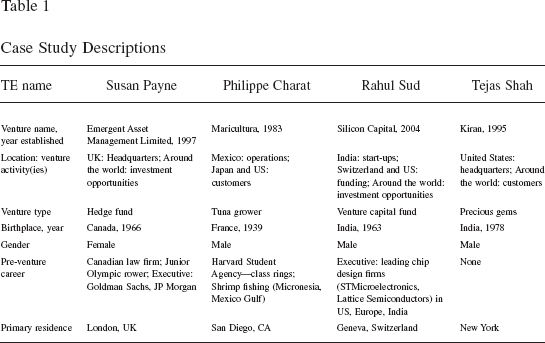
While four or more carefully selected cases can be analytically generalized (Eisenhardt, 1989), the case selection is subject to certain potential biases. First, as with all case studies and convenience sampling, findings are not statistically generalizable to the whole population (Yin, 1994). Second, internet sampling methods are subject to an assortment of selection biases related to the skills and resources required for regular internet activity. Third, the sample has a success bias, including only those who achieved transnational entrepreneur status, and not those who tried but failed or sold their businesses, etc. A fourth limitation is the response bias of only those individuals who were interested in participating in the research. Finally, the retrospective nature of the narrative interviews is susceptible to recall bias. Taken together, these biases prevent us from observing the full range of values on outcome variables; however, the methodology is suitable for our purpose of exploring the way transnational entrepreneurs are positioned relative to the contexts in which they operate.
The first author conducted a 60–90 minute semi–structured, in–depth interview with each transnational entrepreneur. The interview began with open–ended questions to facilitate the sharing of narratives including, “Can you tell me about your upbringing?”; “Where were you raised, by whom and how do you feel this has shaped you as a person?”; “Can you tell me about your career to date?”; and “Can you tell me about your venture?” As the entrepreneurs shared observations, they were asked further questions to gather more details and rich descriptions and to understand better why the experience was important to the entrepreneur. At the conclusion of the interview, the interviewee was asked to share any other thoughts or information that seemed relevant to the interview.
The narratives captured the entrepreneurs‘ life histories. Interviews were recorded and transcribed verbatim to systematically analyze the raw data. The entrepreneurs were also asked to provide electronic copies of press coverage which they felt was relevant to their career and venture. Two entrepreneurs, unprompted, also shared slides from recent presentations to customers. Secondary data about the entrepreneurs and their ventures was gathered through biographies and press from news media via Google and Lexis/Nexus searches. The triangulation of narratives and artifacts resulted in a file of rich, thick descriptions for each entrepreneur.
All of the interview transcripts, press reports, and presentations were read repeatedly by the first author throughout the analysis process. The first author made notes in the margins of the printed pages about key themes in the entrepreneurs‘ observations; for example, childhood, family, education, and culture. As a primary research focus is on how individual experiences and institutional environments shape venture internationalization strategies, the first author initially focused on identifying conceptual categories related to this act. The researcher did not have a priori categories and instead sought to document the entrepreneurs‘ interpretation of their reality. Themes were sought in the interviews (within–case analysis) and also across the complete string of other entrepreneurs‘ cases to seek patterns (cross–case pattern search). If a major category was identified across cases, a unique color coding marked the relevant text excerpts. Sub–categories were also noted. For example, social networks was a major category observed by all four entrepreneurs, and sub–categories related to types and sources. Categories were continuously modified with emerging evidence from primary and secondary data.
During the data analysis stage (approximately 6 months after the initial interview), the first author re–interviewed all four entrepreneurs (20–40 minutes each), asking more probing questions related to key experiences. This second set of interviews focused on concrete aspects of present experiences (Seidman, 1998) and again encouraged life history narratives following the above methodology. After a lengthy review and analysis of the data, it became apparent that the narrative data would benefit from the application of a sensitizing framework. The individual–level data seemed to offer a view of entrepreneurship consistent with Bourdieu's theory (Elam, 2008). As a result, the data were re–coded in terms of Bourdieu's theory of practice (1977, 1998) and Drori et al.'s (2006) characterization of institutional environments. Throughout the stages of this iterative process, care was taken to elicit the underlying themes and question the “truth” shared in the narratives. The four case studies are briefly profiled in the next section, and followed by a description of the sensitizing framework and theoretical propositions developed from the cases.
Case Study 1: Susan Payne
Canadian–born Susan Payne is the Principal of UK–based Emergent Asset Management Limited, a hedge fund specializing in emerging markets which she co–founded in 1997. Following high school in Rome, Italy, and summers at her grandparents‘ ranch in Western Canada, Susan completed undergraduate and graduate law degrees at McGill and Oxford. She also studied at St. Andrews University, Scotland; University of Perugia, Italy; and Tel Aviv University, Israel. While in Canada, Susan was a member of the national rowing team to the World Championships and interned with former Canadian Prime Minister Pierre Trudeau's law firm. She began her finance career in London at JP Morgan in 1986 and became one of the original eight members of the Emerging Markets Group. In 1993, Susan joined Goldman Sachs as an Executive Director and Head of Sales and Trading for emerging markets debt in Europe. At Emergent, Susan is responsible for fund management and strategic partnerships. She was recently recognized as one of the Top 100 Women in Finance in Europe by the Financial News and given a “UK Women of the Future Award” by Shell. Susan speaks fluent English, French, and Italian, and is regularly invited as a keynote speaker at conferences around the world.
Susan discussed the importance of her family and early experiences living abroad in shaping her perspective,
My father traipsed around the Philippines, India and Africa his whole career. I feel like I have emerging markets in my DNA. I was exposed early and really benefited from that. As time goes on, you recognize that but not really even consciously. Subliminally from a young age, it's part of you. I did know in high school because when my Dad suggested that I go to an Ivy League university, I refused to even try. I wanted to find a place where English wasn't a native tongue.
Susan continues to seek challenging environments in which she is a minority. For example, as Emergent CEO, Susan spent the first quarter of 2008 traveling to Africa, India, Australia, the Middle East, Europe (twice), Canada, and Singapore. She describes her role brokering clients and investments around the world:
My early banking career required me to speak French and Italian to cover investor bases in those countries . . . now I spend all of my time connecting. I connect people with people, jobs, and now social responsibility . . . You can't connect people without listening and understanding what they want . . . I call this sort of cross–fertilization or cross–pollination where I really enjoy taking ideas from different places and seeing how they work in different places.
Clearly, Susan is actively strategizing and seeking new opportunities. In working across countries, she acknowledges the importance of legal training in several countries:
I think what is really important for me is that I have a couple of law degrees. What you learn very quickly is that you have to have a very good grasp of legislation. When comparing countries and how the opportunities lay, you don't know what you are missing if you don't know what you are missing.
Susan is particularly passionate about her latest project, a leveraged fund that invests in agricultural projects in sub–Saharan Africa. In parallel with the expected returns from land price and crop yield increases due to improved farming technologies and the expected future shortfall in food/grains, the fund exemplifies socially responsible investment and provides training for farmers, child–specific nutrition programs, rural education, and water and electricity infrastructure development. Susan partners with a South African agriculture firm and resources consultants from Accenture offices in Australia. She describes the opportunity as “amazing” and is excited that “my little firm” could have so much impact through her networks.
Case Study 2: Philippe Charat
Philippe Charat is the founding CEO of Maricultura, a tuna–farming facility in Ensenada, Mexico, which exports primarily to the United States and Japan. Philippe was born in France in 1939 to Jewish parents who fled Nazi–occupied Europe and the Holocaust, escaped to Cuba, immigrated back to France, and then to the United States. Philippe grew up in Dallas, Texas, and completed his undergraduate and MBA degrees at Harvard. Philippe describes his personal background:
I am Jewish although I didn't know I was a Jew until we got to the US. I was educated by Catholics in Switzerland and Texas. I am fluent in English, French and Spanish. I am at ease culturally in French culture, the American culture, and the Mexican culture in a certain chameleon–like capacity. And I am comfortable everywhere and faithful to everywhere and faithful to nowhere because I am capable intellectually of functioning in a neutral way.
Philippe describes his ability to facilitate new combinations from different places as evident from an early age:
I matriculated to Harvard when I was 17 and noticed that no one was wearing a class ring. I had just graduated from high school in Texas where class rings, especially with sports or military paraphernalia were a big thing. So I asked a few students and they said they didn't like the design. I went up to Balfour [class ring manufacturer] and designed a ring that they manufactured for me. It was a signet ring that just had the Harvard shield of three books and the motto of Veritas. It didn't say Harvard or the year. I figured that this would satisfy the more Anglophile bent of a lot of the students at Harvard who came from prep schools. We sold a lot of rings. I didn't realize at the time that the rings weren't available at Yale, Columbia or anywhere else, so I didn't try to design others. I should have gone into the jewelry business.
In the shrimping business, Philippe initiated a joint venture in Micronesia where he learned about the tuna business and returned to Mexico to develop the concept of tuna farming. He recalls that he was told
that this couldn't be done in Mexico for a variety of reasons, but now there is a whole industry there and it shows that it can be done . . . including families. There are 16,000 people in Ensenada who eat because of our industry.
Philippe's tuna–farming techniques are being utilized by competitors operating elsewhere in the world. When working across cultures, Philippe reports that he relies on his values:
I was never destined to be a gazillionaire because I like to be successful but I will not fight to the death and run over people's backside for another buck. There is an aspect of me which is still very grounded in the concept of honesty, honor, and transparency.
Case Study 3: Rahul Sud
Punjabi–born Rahul Sud is General Partner of Silicon Capital, a venture capital firm which invests in semiconductor start–ups and specializes in Europe and India. Rahul grew up in Punjab and India, graduating first in his class at the University of Delhi in Physics, and then completing his Masters in Physics at Florida Institute of Technology, Masters in Electronic Engineering at UC Berkeley, and PhD at Stanford University. He served as Director at Intel, Group Vice President at STMicroelectronics and founding President of Lattice Semiconductors. Rahul has directed the generation of over 200 flash memory patents and over 120 field programmable gate array patents. As General Partner at Silicon Capital, he focuses on developing new technology and companies. Rahul's primary residence is Geneva and he speaks fluent Italian, French, English, Hindi, and Punjabi. Rahul was named “Man of the Year” at Semiconductor Memories and awarded a TOBIE (Technology or Business Innovation in Electronics). Rahul described the impetus of his transnational bent:
My father was an Indian Army officer who earned only 400 rupees—about $10—a month. He was wonderful and lived life to the fullest. I heard that when I was born, he told the bartender to buy a drink for every man sitting in the Officer's Club. He spent two months‘ salary so we couldn't eat. He was the first Army officer sent to the US and he did a short course in radar and electronics at Fort Monmouth. It changed his life and mine. He came back so full of America and with so many good friendships . . . He always told me ‘America has the best technology in the world so you go there’.
Rahul is passionate about establishing India as a hub of intellectual property for the semiconductor industry, leveraging labor arbitrage as well as relationships to benefit investors and economic regions:
We use an India–centric design platform to drastically lower the amount of venture capital required to go from start–up to sales and profits. A chip that costs 30 to 40 million dollars to develop in Europe will cost only 15 to 30 million dollars to develop in India. We provide value for our investors and enhance India's intellectual capacity.
Rahul sees himself as a broker of these relationships as well as technology products:
I have a global footprint. I have been working across the US, Europe and India for thirty years and building cross–border teams . . . At STMicroelectronics, I led an India–based initiative to create a global open–source semiconductor movement. I believe that start–up success rate can be increased by having specialized sector knowledge and high level global relationships.
One of Silicon Capital's start–ups is India–based RF Logic, a firm whose first customer is a Swiss company for which it is designing a mobile TV chip. Rahul describes how networks enabled RF Logic to provide a full range of services:
RF Logic didn't just provide design to this customer, they chose the foundry and took the customer to meet the IBM people in Burlington and helped them to establish a strategic relationship.
Case Study 4: Tejas Shah
Mumbai–born Tejas Shah graduated from HR College in Mumbai at age 17 and left for New York with a $30,000 loan from a friend in India who inherited it from his grandfather's estate. Tejas‘ goal was to help his father sell diamonds and other gems in the United States and repay his friend's generous loan, which Tejas did within 2 months. Tejas began selling niche and fancy–shaped gems to middlemen and wholesalers and now has 450 customers with over 6,000 stores in the United States. Tejas recalls early troubled encounters:
When I came to the US, it wasn't easy. The first four months I wanted to go back. I sent a parcel with 100 carats to a customer, and he took out 20 and sent it back. I was really hurt that people aren't honest out here. Back in India, it's a handshake. I owe you $10,000, no paperwork. In the initial stages, when I didn't know the [American] market, I was very naïve. After I got hit a few times, I got more confident. The first month I made $8,000 but there was a bad debt for $7,000 so I couldn't eat. But then you roll with the punches.
To overcome exploitation and customer bias in the United States that “an Indian company wouldn't be professional enough to work with,” Tejas reports:
We worked with middlemen who taught us the business at first. The ultimate customer won't tell you what to do or what to make. The middlemen said, ‘Why don't you build this for me, why don't you make this for me?’ If the total margin is our cost, we were working at 10%, letting the middlemen make 10%. Eventually when we knew better, we decided to go direct because if we didn't, we would lose the customer and the middleman anyway. When we first started, there were two people in the middle, then one person. For the last three years, we have sold directly.
Tejas described how this experience facilitated entry into other countries:
We spent a good 6–7 years in the US and we understand what the jewelry is all about. So when we went to the next country, we didn't have to go through that process of starting at the bottom and selling to an intermediary. We are intermediaries for the consumers and retailers. We buy rough diamonds from the mines, cut them in our own factory and mount it into finished jewelry and it all comes here and gets distributed in the retail stores.
Tejas also acts as an intermediary for an Indian firm that lacked the sales and marketing support to sell directly. The arrangement also works for Tejas as he secures a consistent supply of about 200,000 rough stones a month.
To support recent sales expansion in the Middle East, Tejas set up a gem processing factory in Bangkok to provide the cleaner, lighter stones desired in the Middle East. As Tejas put it, “In the US, it's flash for cash because they want a bigger look than what they pay for, but in Dubai they want something that is one of a kind.” Tejas‘ latest challenge is forward integration with his customers:
We used to sell to retailers. Now we partner with them. We are making sure that we do X% of their business and support their bad inventory. We will buy it back and remelt it. You basically get a chunk of their business and manage it for them, rather than going out, making a sale and coming back. This is changing our business drastically. I don't see it very far that eventually we will have to become the retailer by default. Say I am heavily involved in the retailers and they are having difficulties managing the business. I need to say, you know what, we'll take a stake in the business.
Sensitizing Framework
To guide the discussion and interpretation of the cases presented, we draw on Bourdieu's (1977, 1998) theory of practice and related applications of this theory in entrepreneurship studies (Drori et al., 2006; Elam, 2008). Bourdieu (1998) referred to his theory as a theory of “cultural–structuralism,” but it is more popularly considered part of a larger set of “practice theories” in the fields of anthropology and sociology (Ortner, 1993; Swartz, 1997). Practice theories, in general, and Bourdieu's theory, especially, are essentially relational theories that link actors to the contexts in which they are embedded (Dobbin, 2008; Emirbayer & Johnson, 2008).
Three key concepts define Bourdieu's practice theory: habitus, field, and capital (Bourdieu, 1986, 1998). Habitus refers to the habituated and transposable dispositions, mental structures, or cognitive schema that guide the thoughts and actions of actors in a given field of play and is most similar to what is colloquially referred to as worldview (Dobbin, 2008; Elam, 2008). Field describes the social structure in which action takes place and, in a strict Bourdieuian sense, is really a subjectively defined social space (Emirbayer & Johnson, 2008), much like prevailing definitions of institutional environments (e.g., DiMaggio & Powell, 1991; Drori et al., 2006; Swidler, 1986). According to Bourdieu, four forms of capital—economic, social, cultural, and symbolic—constitute “the relational world of objects” that define the social structure and, consequently, the positions from which actors take action (Bourdieu, 1993). In our interpretation of Bourdieu's theory, the forms of capital may be viewed according to the following definitions: economic capital refers to money and other material possessions that hold immediate economic value; social capital refers to the relationships or network ties held; cultural capital refers to the education, experiences, and learning attained; and symbolic capital refers to the legitimacy or credibility held by an individual. For each individual, these forms of capital are tied strongly to one's habitus, thereby constituting the practical and psychological context from which he/she may act.
Dobbin (2008, p. 53) neatly summarizes the importance of these concepts for the power of Bourdieu's theory: “. . . Bourdieu's great power comes from its integration of a theory of the individual (habitus), a theory of social structure (field), and a theory of power relations (forms of capital).” In this sense, Bourdieu's theory of practice goes beyond the usual dichotomous agency–structure framework (Dobbin; Elam, 2008; Emirbayer & Johnson, 2008). The four forms of capital serve as both the social structure that enables and constrains individuals, but also as the resources that individuals use to act.
Of particular importance in this theory is the concept of habitus. The habitus, conditioned by cultural legacies, previous experience/learning, and current realities, guides an individual's decision making in largely unconscious and conditioned ways (Elam, 2008). In fact, Bourdieu's original intention was to explain social reproduction that results from a complexity of structural constraints and cultural programming that shape individual actions in patterned ways (Swartz, 1997). Nevertheless, his theory of practice holds out the possibility for social change and innovation through individual agency and strategic action. For example, in so far as the forms of capital mediate the relationship between the individual habitus and the field of action, individuals are typically conditioned to recreate their circumstances. As such, if the field or institutional setting changes (e.g., one moves to another country), or, if an individual's total capital changes (e.g., one wins the lottery or makes a new friend), or, if an individual habitus holds some particular bent towards the pursuit of adventure or change, then innovation becomes possible.
Another key component of Bourdieu's theory of practice is the proposition that the forms of capital are all convertible and reducible in the purest form to symbolic capital, also known as legitimacy, power, status, prestige, influence, honor, etc. (Bourdieu, 1986, 1990; Swartz, 1997). In this sense, individuals are economic agents who are knowledgeable, reflexive, and strategic within a social structure of opportunity and constraint. Applied to the context of entrepreneurship, the theory of practice enables a multi–level approach to include perceptions, other psychological measures, and the macro–level institutions which define a field of action (Elam, 2008). In the case of transnational entrepreneurship, the relevant practices are based on the intersection of social location defined by total capital sets within multiple fields or institutional contexts.
As such, in this study, we define entrepreneurship as a “practice,” i.e., the pursuit of new business activities shaped by the dual and complementary set of “habitus” and “field” which structure entrepreneurially activity (Drori et al., 2006; Elam, 2008). Entrepreneurship can, thus, be understood as a practice or action strategy in which decisions are based on an individual's responses to his/her context, given one's habitus and capital resources, as determinants of one's social position in the field of play (DeClercq & Voronov, 2009; Drori et al.; Elam).
According to Drori et al. (2006), a transnational entrepreneur's habitus includes “individual and collective experiences, perceptions, and norms that provide a reference for action” (p. 14) in dual contexts and “reflects the ability of agents to adopt, advocate and introduce preferential scripts and worldviews into their institutional field” (p. 22). Thus, a transnational entrepreneur is embedded in two or more distinct institutional contexts and is challenged in terms of interpreting and navigating potentially conflicting views of acceptable operations. The present study is guided by an adaptation of Drori et al.'s interpretation of field as defined by distinct sets of institutional structures in the macro–environment, including cultural repertoires, legal and regulatory regimes, social and professional networks, and power relations, as depicted in Figure 1.
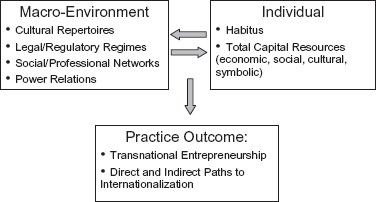
Model of Theory of Practice on Firm Outcomes
In this study, we illustrate how transnational entrepreneurs‘ propensity to guide direct and intermediated internationalization strategies can be understood by examining the four ideal cases through the lens of Bourdieu's four forms of capital—i.e., resources that provide possible sources of competitive advantage to transnational entrepreneurs. As evidenced by the application of these theories to our cases, we argue that modern transnational entrepreneurs hold distinct mindsets (i.e., habituated dispositions or habitus) and, consequently, use the resources available to them in ways that provide a clear competitive advantage across the institutional settings of their home and host countries. In this sense, venture internationalization strategies, of both direct and intermediated means, result from the interaction of the transnational entrepreneur's habitus and the corresponding collection and use of capital in multiple institutional environments (or fields of play). It is this unique intersection of habituated mindset, resources, and institutional environments that produce a competitive advantage for transnational entrepreneurs. In other words, having the right mindset or the right resources or choosing the right set of institutional environments to couple commercially will not guarantee competitive advantage, but the particular combinations of these factors together will produce competitive advantage. In the next section, we explore the resources, practices, and strategic actions that characterize the business activity of our four transnational entrepreneur cases. The application of sensitizing framework to the four cases can be found in Table 2, followed by a discussion of the theoretical application.
Application of Sensitizing Framework to Case Studies
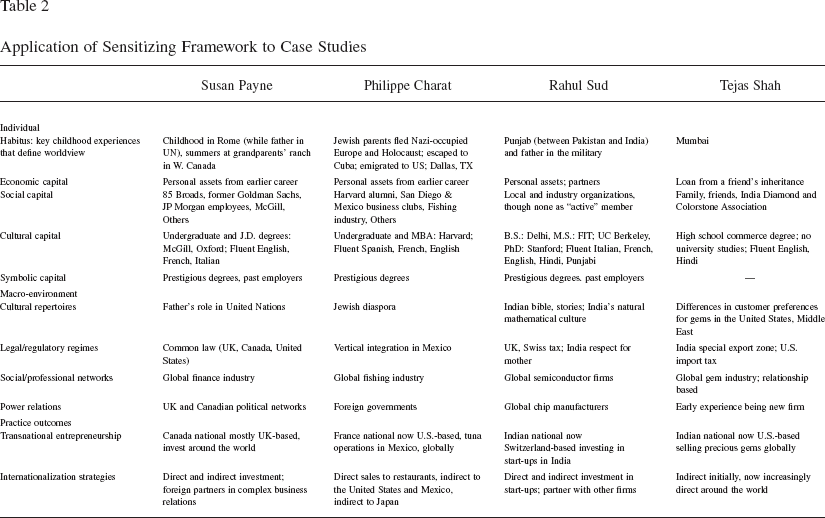
As shown in the table and illustrated below, each individual possesses a unique set of resources in terms of economic capital, cultural capital (education, experience), social capital, and symbolic capital (legitimacy). For each individual, the resource holdings and related habitus provide competitive advantages for negotiating multiple institutional environments, placing them in unique positions regarding the pursuit of transnational entrepreneurship and intermediation strategies. Bourdieu's practice theory provides us with a strong holistic model for understanding how factors across field, capital, and habitus influence transnational entrepreneurship. However, Bourdieu's (1977, 1998) theory lacks a concrete characterization of the field. For that reason, we draw on Drori et al.'s (2006) model of the key aspects of the field: cultural repertoires, legal and regulatory regimes, social and professional networks, and power relations.
Cultural Repertoires
Cultural and societal views shape entrepreneurial activity (Schumpeter, 1942) by affecting an individual's propensity to create or adopt particular practices and organizational structures. Deep cultural logics aid thinking and guide reactions to situations. Extant studies of culture and entrepreneurship focus on economic–type variables and fail to explain how culture actually works (Elam, 2008). At the field level, culture exists as a more or less measurable set of institutionalized artifacts. In a given institutional context, individuals employ a set of cultural repertoires drawn from the larger field of cultural artifacts to which they only have a certain degree of exposure through local network ties (Swidler, 1986). To this extent, cultural repertoires describe how individuals operate in differing cultures, including the mobilization, use, and linking of cultures to enact strategies to access resources and exploit opportunities (Drori et al., 2006).
For transnational entrepreneurs, familiarity with different cultures increases trust (Mizrachi, Drori, & Anspach, 2007) and lowers transaction costs associated with doing business across multiple countries. In this sense, transnational entrepreneurs operate in a global arena that transcends local cultures and may be uniquely positioned to utilize multiple cultural toolkits in different settings (Drori et al., 2006). Thus, a transnational entrepreneur's venture perspective is a product of his/her understanding about what is right and appropriate under the current circumstances and not confined to a particular cultural institution in a given local area. Transnational entrepreneurs‘ ability to adapt to or adopt existing cultural repertoires and create new ways of doing business enables them to intermediate trade, directly and indirectly.
In the interviews, entrepreneurs relayed stories that illustrate a special set of abilities and cultural toolkits to navigate successfully in both familiar and unfamiliar cultural settings.
Rahul credits his family and cultural upbringing for providing him with a powerful and effective set of cultural frames through which to navigate the world:
My grandmother used to read the Indian bible to me at night . . . A child's brain is a white piece of paper when he is born. And the influence is so strong that it's like a computer program. It's a database that you just can't wash away. And that database basically judges each and everything in life based on that.
This early life training may have provided Rahul with a particularly effective set of “transposable dispositions” or mindsets with which to navigate the world. Rahul further shared:
Do you know the story of the elephant and the six men? 1 Well, you know it is about six men who touch an elephant and each says something different about it. Each looks at it differently but it doesn't change the reality of what that thing is. Someone like me who has lived in different places can see those different sides. I see all these sides that other men can't.
The story of the blind men and the elephant originates from India and the best–known Western version is John Godfrey Saxe's 19th century poem. Saxe describes how a group of six blind men each touch a different part of the elephant. One touches the leg and says it is like a pillar; another touches the tail and says it is like a rope. A third man touches the trunk and says it is like a tree branch while the fourth man touches the ear and says it is like a hand fan. The one who touches the belly says it is like a wall while the final man touches the tusk and says it is like a solid pipe. The poem's story is frequently used to describe how reality may be different depending on one's perspective and that absolute truths are relative.
In this sense, Rahul expressed the advantage that previous global experiences have provided him. In fact, all the entrepreneurs in our cases had significant global travel and migratory experiences. Some of these experiences were part of their upbringings—e.g., Susan discussed her “global DNA” as an outcome of her father's United Nations work—while others were gained as adults, through advanced education or career experiences.
Our cases also speak to the importance of social capital. In an interview in Hedgeweek, Susan describes the influence of her husband and business partner David's multi–cultural experiences in the mid–1980s working for a seismic exploration company in Papua New Guinea:
During this period, he lived and worked with local tribes in the Sepik Basin and started to formulate his theories on collective emotional behavioral patterns. That kicked off his theories on price as the purest barometer of behavioral patterns.
Whatever the source, transnational entrepreneurs benefit significantly from skills and abilities gained through early life experiences and work experiences, especially travel, migration and those providing flexible worldviews. These types of experiences provide entrepreneurs with decided skills and abilities that help them gain access to and mobilize the resources required for successful internationalization strategies. For example, in reference to his experiences navigating multiple cultural settings across the United States and India, Tejas mentions the importance of objective assessment across international markets:
I think what has really helped is I know how to do business here. I have to go out there and catch the trends and the designs early and source the right diamonds at margins that give me more room to sell to customers . . . The Asscher cut is really popular because of Sex and the City. Sarah Jessica Parker got engaged with this stone. You can appeal more to the masses . . . In the Middle East though, you have to have something exclusive.
By purposefully marking trends across cultural settings, Tejas gains a unique understanding of how cultural differences play into his business model and adapts accordingly. Of course, sometimes, transnational entrepreneurs face challenges understanding and adapting to very different cultures. As mentioned in his case description, Tejas learned the hard way the importance of paper trails and contracts in transacting business in a new country. Philippe encountered a resistance to direct selling in Japan. As a result, Philippe's prized bluefin tuna is sold directly to restaurants and indirectly through intermediaries in the United States and Mexico but only indirectly to Japan. Philippe explains:
I am a duck out of water in Japan. I have a very close relationship with the Japanese and I have been doing business with the same people for ten years . . . To understand Japanese culture in the Japanese way, you really have to live there. I have learned a lot but it is a culture I am not part of. The Japanese distribution system is a series of concentric circles and it is reserved for the Japanese. I send my fish to one of the four companies that has the right to auction fish on the Tsukiji market floor. Now because we produce so much fish, it is also sold face–to–face in a direct sales arrangement that is non–auction that they do for me. They charge me a commission.
Philippe's experience with the Japanese market highlights the importance of migration experiences for Philippe's indirect model co–exists with the direct process he employs when selling to the United States and the domestic sales within Mexico.
The role of cultural repertoires in the transnational entrepreneurs‘ lives leads to our first proposition:
Legal and Regulatory Regimes
Individuals also operate within frameworks of legal and regulatory regimes that govern economic activities. Resources and institutions vary across time and place, impacting the type and scope of entrepreneurial activity (Baumol, 1990). A large body of research correlates entrepreneurial activity rates with particular sets of institutions such as welfare provision and government regulation (Reynolds, Bygrave, & Autio, 2004; Yeung, 2002). For example, some national economies established policies intended to assist the development of “home grown” export–oriented ventures. Resource scarcities force individuals to pursue new innovations that use alternative resources (Pfeffer & Salancik, 1978). In countries with limited local resources, transnational entrepreneurs may utilize personal resources or those acquired from other countries through favorable laws or personal networks.
Local firms have “home court advantages” in terms of knowledge of laws and regulations and relationships with local players including customers, governments, and other businesses (Dunning, 2003). To compete in these markets, foreign firms must possess and leverage information–based intangibles. Thus, a transnational entrepreneur would need to understand and be embedded in multiple sets of “rules of the game” in order to pursue internationalization activities. Transnational entrepreneurs can select the best institutional arrangements to work within, combining favorable sets of ownership patterns, ease of start–up, established management practices, transparency, industrial relations, intellectual property rights protection, production costs, and resource availability.
Rahul warns that institutions can change and is constantly seeking the right location of business activities:
What created the success of the US in the 1940s is now going the wrong direction with overregulation, too much government involvement, but there are still good frameworks to operate in like Delaware . . . In Switzerland it's very regulated but not bureaucratic. The rules are very clear and transparent. The British tax code is 2,000 pages; the Swiss tax code is 300 pages . . . In Switzerland, everyone follows the rule and pays the tax, no one evades it. You can negotiate with them. You can say, ‘I am being taxed too much, I would only like to pay this much tax’ . . . The rules in India are quite bureaucratic but that's improved since 1991 . . . The good thing in India though, is that if someone is going to steal your IP and sell it, you must have a willing seller and willing buyer. But in India, a high regard for the mother is ingrained. The first person who is going to steal it would be slapped by their mother.
Tejas also offered his take on the changing regulations in the US, particularly a newly imposed six percent duty on diamond imports. In contrast, India is supportive, offering special export zones that don't tax profits. Tejas also noted how culture impacts regulations:
In India, when it's on a handshake, people never lose money. The average debt in our industry in India is .025%, compared to 2% in the US which has all this paperwork . . . Our values aren't flexible. We stick to our policies wherever we are.
Among the four cases, Susan, who possesses law degrees from the UK and Canada and is familiar with legal regimes around the world is perhaps the most advantaged. Susan offers, “If you know the law and travel as much as I do, then you can assess them effectively and that's my job.”
Philippe also reflected on his special knowledge and foreigner's lack of understanding of business models and laws:
I was the first guy on the block and knowing Mexico the way that I know Mexico, I am vertically integrated. There were Australians and Japanese who saw what I was doing and came in but now they are gone. Now there are Icelandics who come with their vision and culture without truly understanding what Mexico is like and expose themselves to risks that I was not willing to be exposed to. They are usually out after a few years.
Philippe also describes a moral compass across countries, reflecting on a time in the late 1970s when one of his major financiers, a Luxembourg–based bank, went bankrupt. Philippe owed the bank and was advised by others “not to repay and just say ‘I'm in Mexico, you are in Luxembourg—just try to find me.’ ” Although he could easily have “walked away with several million dollars,” Philippe felt honor bound to repay his banker friend and did so.
These insights illustrate several important aspects about the way in which individual resource sets and related mindsets help transnational entrepreneurs to effectively navigate the legal and regulatory environments. These narrative excerpts describe the extent to which transnational entrepreneurs experience/observe differences across countries and how those observations influence their business models and internationalization strategies, as well as how their cultural capital and related mindsets influence the ways in which the transnational entrepreneurs navigate these institutional systems. As a result, we propose:
Social and Professional Networks
Although entrepreneurs possess unique resources as individuals, they require access to complementary resources such as information, exchange, and influence in order to establish and run their businesses (Aldrich & Zimmer, 1986; Davidsson & Honig, 2003). Individuals who are acquainted with an entrepreneur are more likely to pursue an entrepreneurial career (Reynolds et al., 2004). Diverse network ties enable entrepreneurs to access more information about markets, innovations, capital, investors, and other key business inputs (Low & Macmillan, 1988). Highly embedded and reciprocal social networks facilitate trust (Coleman, 1990) and defray the risks associated with operating in international markets. Entrepreneurs with greater access to “proprietary networks” are more likely to start international new ventures (McDougall et al., 1994). Compared to their domestic–focused counterparts, firms that export are significantly more likely to have older principal founders, greater resources, denser information and contact networks, management expertise, and industry know–how (Westhead, Wright, & Ucbasaran, 2001). Networks facilitate rapid internationalization and influence entry mode and market selection patterns (Coviello, 2006).
Social capital is particularly critical for transnational entrepreneurs at a number of levels (Drori et al., 2006). In her discussion of the importance of social capital in transnational technical communities, Saxenian (2002, p. 185) notes, “The scarce resource in this new environment is the ability to locate foreign partners quickly and to manage complex business relationships across cultural and linguistic boundaries.” Transnational entrepreneurs may possess greater social networks compared to domestic entrepreneur counterparts (Portes et al., 2002), but they are still limited with regard to the available social network structures, defined by both cultural and material factors. Transnational entrepreneurs‘ personal connections may also enable them to act as intermediaries.
Thus, social networks can enable transnational entrepreneurs to develop innovative products and critical resources for direct internationalization and to play an important role as intermediaries for other ventures. Within these networks, transnational entrepreneurs can more quickly raise capital, assemble management teams, and develop partnerships.
Rahul regularly seeks the advice of “Chino,” an elderly Italian:
He always says speak your mind but do it an educated or polite way. And you should express it immediately . . . He knows nothing about technology but is a simple–minded guy, spending his time gardening and puts things in a very clear perspective in two sentences.
Tejas speaks of the “family driven” jewelry trade in the Middle East and his experiences selling through social networks:
You basically go there with your bag. You open it and you show your diamonds. He buys based on if he likes you or not. He doesn't check his records like they do in the US to see what he bought or what he sold and replenish that or to see if anything sold at all. It's all based on a relationship . . . We found the same thing selling into the Caribbean islands.
Susan also highlights the important skills required of this project and generally for her line of work:
If you have this very creative approach, you might come up with a very innovative idea but you have to be able to actually bring others along with you. The key for entrepreneurs like me is innovation and execution. If we don't have innovative products, we will get swallowed or stamped by our competitors. We have very good ideas, and then we also have the foresight to execute them.
Susan further comments on the importance of professional network associations for her transnational business activities. Susan is Head of the London Chapter of 85 Broads, the world's largest professional women's network organization. Susan recently met with Margaret Thatcher and Cherie Blair. She describes her high–level networking as essential for personal growth as well as opportunity evaluation and identification.
This leads to our third proposition.
Power Relations
A fourth component of the field, power relations, captures the extent to which resource holdings mediate individuals‘ ability to pursue internationalization strategies. In Bourdieu's theory (1977, 1998), power is the exercise of symbolic capital (legitimacy or status). Other forms of capital may confer various sources of legitimacy on the holder and that legitimacy provides a distinct leverage, influence, or power in the pursuit of strategy. Power is, by definition, possessed by few. Individuals with high levels of power have specialized human capital and social capital and can access even greater information asymmetries. Individuals who possess particular sets of rare and inimitable resources may formulate more sustainable strategies.
In the case of transnational entrepreneurs, access to power relations may hinge on the ability to be understood by players in both environments. Certain institutions mediate power relations. For example, power and status can be reinforced through cultural and institutional artifacts such as awards and keynote presentations.
As transnational entrepreneurs work across several institutional environments, they may have access to a greater number of powerful players. Transnational entrepreneurs may then select individuals and firms to facilitate the trade of their goods. As transnational entrepreneurs gain power and legitimacy, they reach power positions and may be approached by other firms seeking overseas trade. In exchange for these intermediary acts, transnational entrepreneurs can extract appropriate transaction costs and rents. Through this involvement, transnational entrepreneurs amass greater symbolic capital.
Philippe reports that after receiving his Harvard MBA, he explored the possibility of applying a U.S. business model to Mexico and quickly discovered the value of power:
I was 23 when I landed in Mexico City and there was a new idea in the US called leasing. To get it going . . . requires a lot of leverage . . . I had done work for Professor [Raymond] Vernon the summer before in Mexico and learned that the national agency wouldn't touch me with a ten foot pole because of the leverage required. I explained to my professor what the problem was and how if the national agency wanted to promote exports, it was going about it backwards. He then set up an appointment for me with the president of the national agency. Through him, I was able to get the red carpet rolled out for me. I learned the rules of thumb. It's about what are you exporting and what is the strength of the person signing the leasing contract, and how well drafted the contract is.
The lesson Philippe learned from Professor Vernon on the value of power came in handy twenty years later in 1981–1982 when the Mexican government nationalized the shrimping industry, leaving Philippe “broke, for all intents and purposes.” Philippe had invested in some tuna boats and required a guarantee to cover the last 10%. He eventually secured support from the government through contacts with the development bank, ministry and undersecretary of the treasury. Today Philippe is nonchalant about the material artifacts of his power, “I have been decorated by foreign governments and given medals to hang but I don't even know where the bloody medals are.” He does, however, use his power to modernize international fishing regulations:
I have spent the better part of the week in a meeting with 25 people from the World Bank trying to make use of a model here in the eastern tropical Pacific for the management of tuna. In the early 1990s, the US declared dolphin–safe tuna. It is a hoax and has no basis whatsoever. I knew that and with my own money, I decided to fight it. It had become a law and I was Don Quixote charging at windmills. I was able to convince my industry and my government [Mexico] and eventually they convinced other governments and eventually this dolphin safe has been modified.
Rahul also reflects on learning the importance of power when he founded his first firm:
It was a great education—what they don't teach you at Harvard Business School. You have to go to one university called ‘Screw U’ where you thank all the professors that screwed you and you learn so much from them. The only way to learn is through a little bit of pain and no gain.
Rahul reports having learned to access power networks and trade on this basis:
Knowing so many people helps in getting deals done and not spending in advance of earning it. If you didn't have those, you would have to raise $60 million from outside investors and bank loans. I'm like an investment banker. That's the big value for our customer. We don't ask them for any money but we bring them the deal . . . Due to our relationships, we find out what they are making and can connect them with a new way to manufacture their chips which will cut their costs in half that will double the productivity . . . Global networks are the main value that Silicon Capital brings.
These examples illustrate the extent to which transnational entrepreneurs understand the importance of legitimacy, or power, in their pursuit of internationalization strategies. We further see evidence of the ways in which symbolic capital may be collected and used by transnational entrepreneurs. Social ties to key others of high status or with valuable knowledge, money, or relationships can provide gains in power. Cultural capital credentials or experience also serve as an additional source of legitimacy. The transnational entrepreneurs in our study use the symbolic capital they collected to expand their businesses globally and to pursue both business and social goals. As such, we offer the final proposition:
Conclusion
Today's transnational entrepreneurs can be found outside ethnic enclaves and serve as bridges across communities of great geographic, cultural, and psychological distance. Transnational entrepreneurs are often intermediaries, serving as agents of the practice of entrepreneurship when extended across national boundaries. In this study, we explored the ways in which capital resources and mindsets constitute the constraints and advantages of assuming intermediary or middleman entrepreneurship roles relative to specific features of the multiple institutional settings.
Although the modes of transnational entrepreneurship vary across cases, common denominators include entrepreneurial orientation, innovation, communication, and execution. Transnational entrepreneurs in these cases all played a key role in facilitating the recombination of ideas to generate innovations in their industries and their communities. The innovations were then made comprehensible and accessible across multiple countries. Furthermore, transnational entrepreneurs play an under–examined role in connecting others to entrepreneurial opportunities. Our findings offer a number of important contributions for theory, practice, policy, and future research.
Implications for Theory
First, Bourdieu's theory of practice along with Drori et al.'s (2006) institutional framework provide a firm foundation for the study of how individuals approach and experience transnational entrepreneurship. Transnational entrepreneurs benefit greatly from certain sets of capital resources, particularly those that allow for the transfer and recombination of information and assets across national borders. This sustainable competitive advantage is partly based on the individual's ability to access unique bundles of knowledge and other capital resources across different environments and partly on the habitus or worldviews that lead the entrepreneurs to pursue the strategies they select. The cases illustrate how transnational entrepreneurs gather and access resources across multiple international fields and present evidence to suggest that multiple institutional contexts provide transnational entrepreneurs with unique sets of tools.
Moreover, we show how economic agents are knowledgeable, reflexive, and strategic within a given social structure of opportunity and constraint. Entrepreneurship is best understood as a practice, or strategy of action, that allows a given actor the means to maximize his/her legitimacy, which, in turn, is convertible into other forms of capital. Institutions shape, but do not determine transnational entrepreneurs‘ actions as transnational entrepreneurs leverage their unique capital holdings to access multiple and often vastly different institutional environments. For example, Rahul uses his network broker role and experience in different institutional environments to be entrepreneurial in the Schumpeterian fashion—recombining factors of production like cost–effective Indian labor with American technological advances which he says gives him a real advantage moving from start–up to sales growth.
This theoretical perspective provides a nuanced and holistic view of transnational entrepreneurs. Transnational entrepreneurs rely on physical and virtual social networks and structure these networks so as to bridge new opportunities and often position other actors as intermediaries. As such, transnational entrepreneurs are uniquely positioned to identify customers, financing, and distribution infrastructure providers for their businesses and for others‘ businesses. Within these networks, transnational entrepreneurs develop narratives which enable coordination and also create a common ground for social action. In so doing, many transnational entrepreneurs gain a celebrity–like status which becomes part of their social identity. Transnational entrepreneurs‘ reputation as impressarios or promoters of entrepreneurship ultimately confers status advantages (symbolic capital) that are convertible to other forms of capital/resources such as revenue from customers/clients, contracts from partners, and support from other key social ties.
Implications for Practice
The theory–building nature of this research enabled us to investigate transnational entrepreneur strategies. Our findings suggest that transnational entrepreneurs make strategic decisions about venture internationalization based on a distinct habitus or transposable disposition that allows them to distance themselves from institutional norms and pursue creative strategies. We find, for example, that transnational entrepreneurs are uniquely positioned to use knowledge spillovers to establish new innovative enterprises. Our cases provide substantial evidence that transnational entrepreneurs act as intermediaries for other ventures‘ paths to new markets. Thus, at the intersection of multiple fields, transnational entrepreneurs play an intermediary role “linking individuals and organizations that would otherwise not have been connected” (Peng & York, 2001, p. 328). Transnational entrepreneurs act as intermediaries for entrepreneurs and firms in multiple countries. In some cases, the transnational entrepreneur's primary business model is one of intermediation (as illustrated by Rahul and Susan) but in others, intermediation is one of many strategies (as illustrated by Philippe and Tejas).
In several case studies, transnational entrepreneurs report honing their skills in early experiences living or studying abroad followed by early careers at multinational enterprises. Through this experience, transnational entrepreneurs acquired knowledge and relationships which facilitated the development and transfer of resources and people across communities. In their own entrepreneurial activities, transnational entrepreneurs further refine these practices and develop hybrid management systems and other new ways of doing business which change the rules of the game and ultimately become new institutions. This is institutional entrepreneurship. The transnational entrepreneur trend is likely to grow at an increasingly fast rate as individuals across the world increasingly gain experience living and working outside their home countries—as students pursuing part or all of their degree studies overseas (Institute for International Education [IIE], 2006) and as managers devoting substantial time and energies to overseas projects. Through this experience, would–be transnational entrepreneurs are exposed to new possibilities. As such, transnational entrepreneurs will no doubt play an even greater role in the future economy.
Implications for Policy
Policy makers may become more aware of the key role that transnational entrepreneurs will increasingly play in connecting people, information, and product across great distance and facilitating the globalization and transfer of financial capital, knowledge, and product. Policy could pursue a number of directions. For example, to encourage development of transnational entrepreneur populations and to take advantage of knowledge spillovers, policy makers could target highly skilled individuals who have lived in other countries (e.g., for doctoral studies in engineering or work at leading knowledge–driven multinational firms) to start new firms. For example, China has actively pursued a policy of integrating returnee entrepreneurs into high–technology parks (Wright, Liu, Buck, & Filatotchev, 2007). In government and academic realms, leaders may wish to install transnational entrepreneurs in residence to inspire and advise, further promoting transnational entrepreneurship and ensuring that academic institutions are part of future conversation and action.
Future Research
Our findings suggest a number of implications for future research. First, we offer a set of testable propositions that could be empirically confirmed or disproved. Although the four case studies come from distinct business fields, further work could investigate other transnational entrepreneurs such as artists, musicians, and sport stars. Third, as some transnational entrepreneurs operate across three or more countries, future research could explore the dynamics of highly diversified transnational entrepreneur activity. Research could also attempt to quantify transnational entrepreneurs‘ sociocultural and economic impact, for example in transforming major industry models and institutional environments. Finally, as this study examined only transnational entrepreneurship success, future work could explore intersections of individual mindsets, resources with various institutional contexts, answering questions such as: Are some individuals more adept at using available skills and resources to commercial advantage? And are some host countries more amenable to the transnational entrepreneur brand of habitus? Many transnational entrepreneurs in today's global marketplace follow in this tradition, combining adventurous and innovative mindsets with new opportunities for the transfer of ideas and business models across institutional environments.