







Abstract
We conceptualize a learning–based model of international new ventures (INVs)’ post–entry internationalization speed focusing upon two measures: country scope speed and international commitment speed. We contribute to a deeper understanding of the pace of international expansion of the new venture once it has become an INV by articulating the role of (1) the speed of learning, influenced by social capital and absorptive capacity, and (2) the content of learning represented by knowledge accumulation. We also offer a more refined perspective on organizational learning, which indicates that different stages in the process of exploitative learning require different forms of social capital.
Introduction
The renaissance of Edith Penrose's (1959) scholarship has influenced many domains of study in recent years, notably including research on internationalization as a “strategy of fast growth” (Vermeulen & Barkema, 2002, p. 649)—and in particular, research on the international new venture (INV). A Penrosian perspective is clearly evident from the initial theorizing of Oviatt and McDougall (1994) through to their more recent model of internationalization speed (Oviatt & McDougall, 2005). By exhibiting early and accelerated internationalization, INVs seek greater international growth (Sapienza, Autio, George, & Zahra, 2006).
Despite the considerable research attention paid to accelerated internationalization, an unanswered question is: what explains differential internationalization speed among INVs, after their initial entry into international markets? We therefore distinguish between initial entry and post–entry speed. We draw upon the original Oviatt and McDougall (1994) definition of an INV as an enterprise that, from inception, aims to generate competitive advantages from the use of resources and revenue generation in multiple countries. During this initial or early entry period, INVs will expand rapidly into multiple markets to achieve growth in their narrow, niche markets; and to recoup high development costs and exploit short windows of opportunity arising from the speed of competition and product obsolescence (Autio, 2005; Preece, Miles, & Baetz, 1999). Our particular interest is in understanding what happens subsequently—in the post–entry period. Early expansion will be facilitated by existing resources represented by stocks of knowledge and capital. What is at least as important, however, is how the company handles the challenges of dissipation of its resource base and derived competitive advantages, which effectively may require the firm to renew itself to secure survival and continued growth.
Arguably, internationalization speed is, to some extent, a performance variable in itself, given INVs’ typically short product/technology cycles (Jones & Coviello, 2005; Knight & Cavusgil, 2004). However, in a broader sense, speed is primarily relevant to the extent that it improves INV performance, which we regard as the achievement of growth while ensuring survival (Autio, 2005). Although speed may be linked to success through the “learning advantages of newness” (Autio, Sapienza, & Almeida, 2000), it may also lead to survival risk and failure through the “liabilities of foreignness” (Sapienza et al., 2006). Identifying the factors influencing post–entry speed may help prepare firms for the dangers of over–rapid expansion in the initial entry stage; and more positively assist in the generation of new resources leading to innovative internationalization pathways and the continuance of rapid international growth in the post–entry development phase (Autio; Morgan–Thomas & Jones, 2009). Such outcomes can help INVs achieve competitive advantage (Oviatt & McDougall, 1994; Zahra, 2005). Thus, this topic of the determinants of post–entry speed has a significant contribution to make to the international entrepreneurship literature, as well as to practitioners.
In this study, we develop a conceptual model of post–entry internationalization speed, in which pace of internationalization varies according to INVs’ relative capabilities in accumulating and utilizing knowledge through exploitative learning. A distinction is made between the speed of learning (influenced by absorptive capacity and social capital) and content of learning (represented by knowledge accumulation). We make three principal contributions to the literature on INVs. First, we contribute to a deeper understanding of the international expansion of the new venture, in terms of learning, once it has become an INV. We develop a conceptual, learning–based model to understand the factors differentiating among INVs in respect to post–entry internationalization speed, incorporating the role of absorptive capacity in speed of learning and including the influence of social capital on post–entry speed (Autio et al., 2000; Cohen & Levinthal, 1990; Nahapiet & Ghoshal, 1998). Second, we contend that social capital has a lead role in the learning process, and we present a broader perspective on the role of social capital by identifying the virtue of certain strong ties. Third, we offer a more refined perspective on organizational learning that potentially holds relevance at the strategy/entrepreneurship interface more generally; particular contributions concern the nature of knowledge and its accumulation, and the relationships between social capital types and absorptive capacity (Adler & Kwon, 2002; Zahra & George, 2002).
Background
Time is a central issue in the internationalization of the firm, and speed of international development is arguably the most important time–based dimension. One of the earliest contributions on the timing of foreign direct investment (FDI) is the classic economics work of Buckley and Casson (1981) which models the “optimal” timing of a switch from exporting to FDI. Although focused on established multinationals (MNEs) rather than INVs, this work has some resonance with our purposes, notably in terms of the notion that faster speed translates into higher rates of geographic growth. More recent significant contributions on Penrose from an MNE perspective suggest that growth rates of internationalized firms are reduced as firm–specific advantages decay when applied in distant markets (Pitelis & Verbeke, 2007). Hence, common Penrosian roots are evident from the convergence between MNE theorizing and the INV emphasis on the role of technological knowledge and product innovation (e.g., Buckley & Casson, 2007).
Attention to the internationalization speed of INVs specifically derives from Oviatt and McDougall's (1994) pioneering framework which emphasized the early and rapid internationalization of certain new ventures, leading to the generation of significant competitive advantages. Interest in the topic of INVs is reflected in the review of 38 studies from a decade of academic research by Rialp, Rialp, and Knight (2005), and reiterated in Keupp and Gassmann's (2009) analysis of 179 articles on international entrepreneurship. But despite numerous empirical studies and some conceptual contributions referring to pace or speed of internationalization, the topic of post–entry speed is little researched or understood.
To simplify empirical testing, various authors (e.g., Knight & Cavusgil, 2004; McDougall, Oviatt, & Shrader, 2003) have defined INVs (or their equivalent) in terms of number of countries/continents entered, and proportion of international revenues achieved and/or sourcing of inputs. However, there is no agreement on the criteria. Other empirical studies relating to speed (e.g., Autio et al., 2000; Morgan–Thomas & Jones, 2009) focus on international growth from first market entry abroad. There is, therefore, little empirical research on the post–entry period. A notable exception is Preece et al. (1999, p. 1) who supported the notion of small technology firms being “instant internationals,” but suggested that progressing to the next stage—achieving global diversity—“requires significantly greater time and resources.”
Both the conceptual work of Jones and Coviello (2005) and the Rialp et al. (2005) synthesis of academic research proposed knowledge—and social capital—as important drivers of speed. However, internationalization speed was not to this point formally modeled. Reflecting this deficiency, Oviatt and McDougall (2005) presented a general model of “entrepreneurial internationalization speed,” incorporating moderating factors pertaining to knowledge and network relationships, with three dimensions of speed. Although this pioneering model sheds important light on accelerated internationalization, it appears to blur the distinction between initial– and post–entry speed.
We include two of the Oviatt and McDougall (2005) dimensions, namely, market scope and international commitment, as measures of post–entry speed, which we define as the pace of international expansion of a new venture once it has become an INV. In our conceptualization, rather than focus on a precise distinction between initial and post–entry, which is empirically desirable but not always clearly identifiable in reality, we are concerned with international entrepreneurial dynamics (Mathews & Zander, 2007, p. 393). These authors’ distinction between the three milestones of (1) opportunity discovery; (2) resource deployment in exploiting these opportunities; and (3) the engagement with international competitors, is significant; the distinction between the latter two milestones parallels our initial/post–entry categorization. Mathews and Zander (p. 395) argue that these pathways are “open to almost infinite variation and disaggregation.”
The distinction between initial and post–entry speed is particularly critical for the long–term growth and success or failure of knowledge– and technology–intensive INVs. In the post–entry period, efforts must be made to deepen market penetration through acquiring new customers and widening country scope (Jones & Coviello, 2005). While entrepreneurs are generally dependent upon strong ties at start–up, building weak ties and increasing the network range and social capital are important to sustain internationalization speed (Oviatt & McDougall, 2005). Consistent with other scholars (e.g., Fan & Phan, 2007, p. 1114), we take new ventures to be independent “corporate entities that have no prior corporate history in the industry”; thus excluded from our scope would be merged, rebranded, or spun–off ventures. By implication, the factors influencing post–entry speed are unlikely to have existed during initial entry; they are more likely to have been developed subsequently.
Theory
A useful theoretical starting point is the work of Penrose (1959), which has to a great extent influenced the resource–based view (Barney, 1991) and dynamic capability perspective (Teece, Pisano, & Shuen, 1997). Consistent with Penrose, knowledge can be seen as a vital driver of firm behavior and growth (Pitelis & Verbeke, 2007). Ricardian rents are argued to accrue most commonly from firms’ knowledge especially through the productive integration of disparate bodies of specialized knowledge (Grant, 1996). New ventures require knowledge in various forms, notably market and technological knowledge (Wiklund & Shepherd, 2003). However, it is relatively difficult to transfer tacit knowledge embedded in skills, know–how, and contextual knowledge (Kogut & Zander, 1993; Teece, 1977). Kogut and Zander's (1992) view of firms as social communities implies that the creation of knowledge is enhanced by reducing the risk of opportunistic behavior and encouraging cooperative behavior. Of vital importance in this regard is the goodwill fostered among social actors (Adler & Kwon, 2002). This is represented by social capital, defined as “the sum of the actual and potential resources embedded within, available through, and derived from the network of relationships possessed by an individual or a social unit” (Nahapiet & Ghoshal, 1998, p. 243).
The knowledge–based perspective is reflected in the internationalization and international entrepreneurship literatures (Autio, 2005; Johanson & Vahlne, 2003, 2006; Oviatt & McDougall, 1994, 2005; Zahra, Ireland, & Hitt, 2000). Knowledge has a central explanatory role, both technological knowledge derived from INV theory (Autio et al., 2000), and market knowledge derived from internationalization process (IP) theory (Johanson & Vahlne, 1977, 1990). 1 Closely related to knowledge is the notion of learning, which is the dynamic “process of assimilating new knowledge into the organization's knowledge base” (Autio et al., p. 911). Learning has an important influence on the internationalization process in general and internationalization speed in particular. Sapienza et al. (2006) note that the key to INVs’ ability to learn is their dynamic capabilities. Specifically, absorptive capacity (Cohen & Levinthal, 1990) is of considerable relevance. Absorptive capacity is “a dynamic capability pertaining to knowledge creation and utilization that enhances a firm's ability to gain and sustain a competitive advantage” (Zahra & George, 2002, p. 1852). 2 Zahra and George identify four processes that constitute absorptive capacity and cumulatively facilitate rapid learning, as follows. First, knowledge acquisition is the ability to identify and obtain external knowledge. Second, knowledge assimilation relates to comprehension of the acquired knowledge through analysis and interpretation. Third, knowledge transformation entails combining newly assimilated knowledge with existing knowledge stocks. Finally, knowledge exploitation involves the application of transformed knowledge to improve existing capabilities and to create new ones.
Absorptive capacity allows INVs to create and use the requisite knowledge to develop competitive advantage. The development of absorptive capacity is cumulative and path dependent, building upon prior efforts to absorb new knowledge (Cohen & Levinthal, 1990). Since many INVs operate in technology–based industries, they are likely to be pressurized into accelerating their learning efforts because of competitive dynamics, shortened product life cycles, and client demands. A central premise of our conceptualization is that absorptive capacity facilitates the accelerated accumulation of INVs’ market and technological knowledge. Below it is argued that post–entry speed is a function of (1) the rate or speed at which they learn in international markets and (2) the content of what INVs learn. To avoid overcomplexity, we do not include moderators in our model (Figure 1). However, we identify several contingencies in our discussion section.
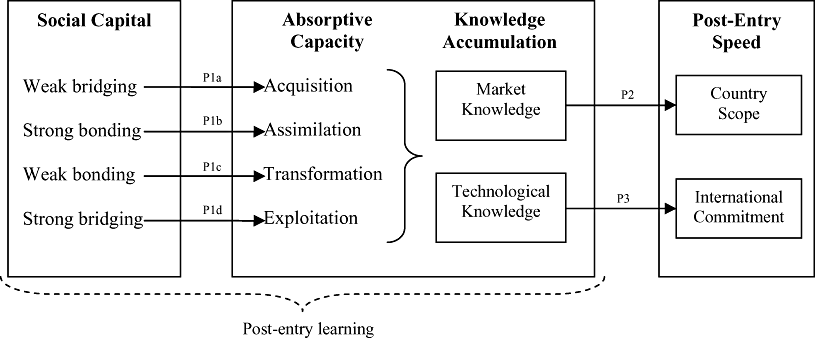
Post–Entry Speed: A Conceptual Model
Speed of Learning: Social Capital, Absorptive Capacity, and Post–Entry Speed
Networks and social capital represent a critical asset for INVs (Coviello, 2006). The initial social capital of the firm may be substantially embodied in the entrepreneur or a very small team in early start–ups (Autio, 2005). Oviatt and McDougall (1994, 2005) draw attention to the importance of the entrepreneur's past experiences in gaining access to existing networks as well as in assembling resources. Nahapiet and Ghoshal (1998) argue that firms are better able to share and exchange knowledge—in other words, learn more efficiently—through the development of social capital. We suggest that social capital could facilitate absorptive capacity; specifically, various social capital types can help INVs enhance the four processes associated with absorptive capacity.
Two major distinctions among network relationships can be found in the international entrepreneurship literature. First is the distinction between strong and weak ties. Tie strength is a function of “the amount of time, the emotional intensity, the intimacy (mutual confiding), and the reciprocal services which characterize the tie” (Granovetter, 1973, p. 1361). Weak ties are thus characterized by infrequent interaction and little emotional commitment; however, these ties also require less effort to maintain. Moreover, weak ties are associated with low information redundancy, that is, there is a lower chance of overlap among weak ties in comparison with strong ties (Granovetter). In other words, weak ties may be a conduit of new information (McEvily & Zaheer, 1999). A relatively small subset of weak ties may strengthen over time such as when acquaintances turn into friendships. Strong ties warrant considerable effort and emotional investment. However, they allow the exchange and transfer of complex information and, furthermore, information benefits from strong ties are more likely to be timely (Krackhardt, 1992).
Second is the distinction between internal (intraorganizational) and external (interorganizational) social capital. Adler and Kwon (2002, p. 21) refer to the former (relationships within an organization) as bonding social capital, and to the latter as bridging social capital. Bridging (external or interorganizational) social capital developed with other firms, such as suppliers and customers, can be an important source of external knowledge about, for instance, industry trends (Bapuji & Crossan, 2005). Social capital enhances such interactions and can assist the formation of strategic alliances (Inkpen & Tsang, 2005). Interorganizational social capital can also facilitate collaborative activity that exploits new knowledge through new product development (Yli–Renko, Autio, & Sapienza, 2001). Firms do not have an equal capacity to learn from all other organizations, and social capital can promote effective interactive learning outcomes by building trust and familiarizing partner–firms with the ground rules of knowledge processing (Lane & Lubatkin, 1998). Bonding (internal or intraorganizational) social capital, emanating from relationships within the firm, can also contribute to absorptive capacity through informal social integration. This facilitates greater information sharing, thereby ensuring that acquired and assimilated knowledge is transformed and exploited (Zahra & George, 2002). Social capital increases the chances that valuable network resources, notably information (Gulati, 1999), are shared and exchanged by fostering trust and lowering barriers to communication. Given INVs’ youth, resource scarcity, and small scale relative to established firms, such mechanisms will tend to be informal rather than formal and systematic.
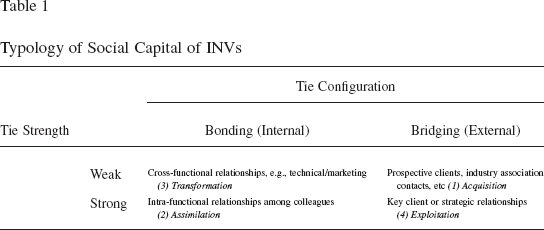
Combining the above distinctions, Gratton (2005) has argued for a four–fold classification of social capital, as depicted in Table 1. In the context of INVs’ internal relationships, it is speculated that relationships among employees in the same or similar function will tend to be strong owing to a greater frequency of interaction in comparison with cross–functional relationships, which are therefore more likely to be weak ties. Even in small and new firms, individual employees are likely to interact more frequently with, and therefore forge stronger ties with, other employees in their own (or related) functions. A distinction can usefully be made between market–oriented and technology–oriented functions (e.g., sales and R&D, respectively). In terms of INVs’ external relationships, ties with lead clients or strategic partners are likely to represent strong ties owing to “durable and repetitive interactions abroad” (Eriksson et al., 1997, p. 354). Conversely, the majority of ties, such as those with prospective customers and trade bodies, are likely to be weak. Below we discuss how social capital types 3 contribute differentially to the four processes that constitute absorptive capacity viz. acquisition, assimilation, transformation, and exploitation.
Typology of Social Capital of INVs
Knowledge Acquisition
In terms of acquisition, access to international markets offers a range of new knowledge sources. Zahra and George (2002) acknowledge interorganizational relationships as an important antecedent of absorptive capacity. Pertinent to post–entry speed is Zahra's (2005) suggestion that building relationships can expedite INVs’ learning. Particularly relevant, it can be argued, are weak bridging ties in exposing the INV to diverse and new information sources (Granovetter, 1973; Oviatt & McDougall, 2005). Such ties may be formed with a wide range of existing and prospective customers, acquaintances made through industry forums, and wider social contacts including, for example, embassies and trade bodies. The frequency of interaction may be relatively low, yet these ties could be a source of novel information (Gulati, 1999), which in turn allows access to innovative knowledge about new market and technological trends (Bapuji & Crossan, 2005). As pointed out, weak ties do not require high degrees of effort to maintain, and therefore it may be feasible for INVs to cultivate multiple weak ties. Moreover, weak ties that bridge organizational boundaries are much more likely to result in a greater breadth of new knowledge, potentially haphazardly but nonetheless with useful learning potential (Zahra et al., 2000). Thus,
Knowledge Assimilation
Assimilation is enhanced by social capital emanating from strong bonding ties. Such ties tend to be formed among colleagues who work together closely over a period of time, typically in similar areas of expertise or functional areas that represent the substantive capabilities of the INV (e.g., sales and R&D). Such social capital has the potential to be characterized by trust, and hence provides a greater propensity for the sharing of relevant information (Krackhardt, 1992). Colleagues with similar knowledge bases are likely to display “cognitive simpatico,” and are more likely to have the time and emotional commitment to invest in developing and maintaining strong ties (Lane & Lubatkin, 1998). Knowledge can be assimilated most easily when it relates to prior knowledge, primarily because of the commonality of the stock of knowledge shared by these individuals (Cohen & Levinthal, 1990). It thus seems likely that market knowledge about competitor strategies or consumer behavior, for example, will tend to be accumulated by employees in market–oriented functions (e.g., sales); and technological knowledge concerning emergent technologies, for instance, by technology–oriented functions (e.g., R&D). Hutzschenreuter, Pedersen, and Volberda (2007, p. 1060) point to the importance of “how organizational members notice and interpret information and knowledge, and how they use it to reconsider the appropriate mode of internationalization.” Individuals are more likely to exchange complex and tacit knowledge in the context of strong relationships. Such exchanges are of importance for INVs, which commonly operate in dynamic and unpredictable environments where complex problems arise (Zahra et al., 2000). Hence, we posit:
Knowledge Transformation
Transformation of knowledge is vital in ensuring the efficient use of accumulated knowledge and when this occurs, post–entry learning speed is enhanced. Transformation is heightened when there is social capital arising from weak bonding, specifically through cross–functional interaction. Colleagues in differing functions tend to interact much less, thus developing relatively weak ties that have the advantage of less information redundancy (Granovetter, 1973). Also, importantly, there is greater scope to combine different types of knowledge, notably market knowledge and technological knowledge, which is important to firms in achieving innovation and competitive advantage (Dougherty, Borrelli, Munir, & O'Sullivan, 2000). Zahra (2005, p. 24) sounds a note of caution in his observation that “experience might induce rigidity” whereas “experimentation is essential”—such rigidity may be less likely among weak ties, where there is a lower risk of “groupthink” (Granovetter). The synthesis of new and past knowledge could contribute to the development of market and technological knowledge that is generalizable to a variety of contexts. The top management team or CEO may have a key role to play in bringing together employees from different functions by reinforcing organizational cohesiveness and collective goals (Adler & Kwon, 2002). This may be particularly challenging in technology–based INVs where organizations are frequently “technology–led,” and where, indeed, there may be imbalances in management teams. When there is clarity about organizational goals, then the relative weakness of these ties can be a strength by ensuring that a diversity of knowledge sources are collated, integrated, and transformed. Moreover, these ties require relatively less effort to maintain, and yet can be productive as long as their collective identity continues to ensure commitment to the knowledge transformation process. In summary,
Knowledge Exploitation
INVs also build a smaller set of strong bridging ties, particularly as they achieve “closeness to customers” (Zahra et al., 2000, p. 929). Certain key client relationships may emerge through which substantial learning is achieved (Yli–Renko et al., 2002). As Oviatt and McDougall (1994) note, INVs frequently use network governance mechanisms to establish a presence in foreign markets. Thus, they may often form alliances with strategic partners who can play an important role in the INVs’ exploitation of knowledge in international markets. Such strong ties, we argue, are especially relevant in the context of exploitation. Joint activity with trustworthy partners having shared visions may be necessary if knowledge resources are to be effectively shared and leveraged in, for example, efforts to develop new products and commercialize new technology (Yli–Renko et al.). Strong bridging ties are also conducive to more rapid resolution of disputes (Gratton, 2005). Strategic alliances yield and utilize knowledge through social capital, which can enable boundary–spanning roles. Individuals in such roles potentially bridge disparate networks across the organizations involved, thereby leading to the identification and exploitation of complementary capabilities (Inkpen & Tsang, 2005). This in turn could result in INVs exploiting new knowledge to a greater extent and at a faster pace than they could on their own. To summarize,
Content of Learning: Knowledge Accumulation and Post–Entry Speed
The speed of learning apart, it is important to consider the content of learning. Drawing upon the INV and IP frameworks both technological and market knowledge are vital in influencing initial entry speed. Technological knowledge could lead to technological breakthrough, optimal product design, and rapid response to competitive pressure (Wiklund & Shepherd, 2003), and is an enabling resource for INVs (Autio, 2005; Oviatt & McDougall, 2005). Market knowledge leads to awareness of client problems, a more accurate valuation of the market potential of new technologies, and access to innovative ideas from lead users or key clients (Wiklund & Shepherd); such knowledge regulates the investment of resources in international operations (Johanson & Vahlne, 1977). Both forms of knowledge can be added to existing stocks as a consequence of internationalization. As they are accumulated following initial market entry, these knowledge types have differential predominant effects on the two dimensions of post–entry speed, viz. speed of country scope (number of countries) and speed of international commitment (percent of international revenues).
Market Knowledge
As a consequence of their internationalization process, INVs experientially gain country–specific knowledge—such as that concerning competitors and prospective customers, and cultural, institutional, and business norms—in the international market(s) that they initially enter (Barkema & Drogendijk, 2007; Eriksson et al., 1997; Fletcher, 2007). Such knowledge can enable INVs to penetrate their extant markets, and increase international revenues through more effective sales efforts resulting from, for example, improved segmentation of potential clients or more culturally sensitive promotion.
As INVs systematize and abstract their country–specific market knowledge, they could develop “country–neutral” market knowledge about how to develop and execute an international business strategy, which Eriksson et al. (1997) refer to as “internationalization knowledge.” Such country–neutral market knowledge is concerned with the general principles of achieving competitive advantage in international markets through practices ranging from opportunity identification, country market screening, and evaluating strategic partners and distributors through to customs operations and foreign exchange management (Welch, Benito, & Petersen, 2007). It is a versatile, generalizable form of knowledge that can be applied to expand geographic diversity by enabling INVs to astutely and systematically determine the nature and magnitude of business opportunities in a range of country markets, leading to strategic market entry decisions (Fletcher, 2007). This form of market knowledge thus involves “knowing the procedures for how to do things and arises from experience with similar situations” (Wiklund & Shepherd, 2003, p. 1308).
Country–specific market knowledge is experiential and tacit (Eriksson et al., 1997), and part of the process of generating country–neutral knowledge involves the establishment of procedures to transform this experiential, tacit knowledge into objective and explicit knowledge. Enhanced market knowledge results in the reduction of perceived risks associated with international expansion (Eriksson et al.) and could thus encourage INVs to expand their portfolio of country markets by applying general strategic and entrepreneurial principles of market entry and development in new country settings. In other words, country scope speed may be enhanced. In summary,
Technological Knowledge
Zahra et al. (2000) have demonstrated that INVs can accumulate technological knowledge as the INV comes into contact with new technology trends and innovation systems in international markets. Technological learning may thus occur internationally. This is very relevant since many (although not all) INVs operate within knowledge–intensive sectors (Oviatt & McDougall, 1994). Given the complex and dynamic nature of technological knowledge, its accumulation is challenging and can be time–consuming (Hitt, Ireland, & Lee, 2000). One such barrier to accumulation is the “spatial stickiness” of knowledge and innovation (Howells & Michie, 1998; Inkpen & Tsang, 2005). But when achieved, technological learning that builds upon existing stocks of technological knowledge (Cohen & Levinthal, 1990) can be useful in combating competitive pressures and penetrating deeper into existing markets by adapting the technological offering to local conditions (Zahra et al.). This can help INVs to increase the sales revenues obtained from their existing international markets as a consequence of sales of new versions of the technological offering or reputation effects; and both through repeat business and an expanded customer base.
Technological learning may well be a necessity if the INV is to avoid stagnation within existing markets. By increasing sales in these markets, technological learning will likely increase the proportion of revenues accruing from international business. 4 Country–specific market knowledge can be a precursor to technological knowledge since, with greater country–specific knowledge, INVs will be able to tailor their sales and marketing efforts and their client interactions based upon a more nuanced understanding of local conditions. As Shane (2000) argues, knowledge of customer problems and of serving markets increases the chances that technological solutions will be developed. As such, we argue:
Discussion
Internationalization constitutes one route to what Vermeulen and Barkema (2002, p. 649) refer to as a “strategy of fast growth.” Perhaps nowhere is this more evident than in the case of INVs. However, explanations of accelerated internationalization have been limited by a focus on the initial entry of INVs. We shed light on the subsequent international expansion of INVs by developing a model of post–entry internationalization speed. We build upon Oviatt and McDougall's (2005) general model of internationalization speed, which includes initial entry as well as post–entry speed. Our approach is different in terms of our specific focus on post–entry speed and dynamics. In addition, post–entry learning has a more central explanatory role with social capital and absorptive capacity as the mechanism for both acquiring and assimilating and transforming and exploiting knowledge (Zahra & George, 2002). Below we discuss implications and contributions of our work.
Theoretical Implications
Our model, which brings together important strands on INVs, international entrepreneurial dynamics, and learning (Autio et al., 2000; Jones & Coviello, 2005; Mathews & Zander, 2007; Sapienza et al., 2006; Yli–Renko et al., 2002) has significant theoretical implications. First is the relationship of post–entry speed to INV performance. This is an important consideration since, from the outset, Oviatt and McDougall (1994) emphasized the derivation of significant competitive advantage as an integral objective of INVs. While some scholars posit an unequivocal positive relationship between accelerated internationalization and performance on the basis of first–mover advantage (Rialp et al., 2005), others appear less inclined to suggest this is inevitable (Oviatt & McDougall, 2005). For our part, we conceptualize performance of INVs as the achievement of growth while ensuring survival. The implication of our conceptualization is that there is a curvilinear relationship between post–entry speed and performance (as we define it). Internationalizing too slowly may mean lost growth opportunities but internationalizing too rapidly could be fatal (Sapienza et al.).
Second, a key theoretical implication of our work concerns the nature of “initial entry” in the context of early internationalization. The variety of INV definitions renders difficult the task of determining when a new venture may be deemed to have become an INV. Our work raises the question: is there in fact a rigid cut–off point that marks the completion of initial entry? Although some researchers assess speed in relation to first market entry (Autio et al., 2000; Morgan–Thomas & Jones, 2009; Oviatt & McDougall, 2005), conceptualization on international entrepreneurial dynamics (Mathews & Zander, 2007; see also Jones & Coviello, 2005) suggests that early internationalization may be less an “event” and more a “process”; that is, behavior (accumulation of actions or events) over time. For us the process is particularly important: post–entry speed becomes relevant when technological advantage begins to decay; when entry into new markets perhaps associated with client followership becomes more challenging; and when there is greater need to generate new technological advantages and new market knowledge. This is when the real challenge for INVs begins, necessitating the need to leverage social capital to accumulate new stocks of market and technological knowledge as conceptualized in our model. Much of the literature focuses on early expansion—the latter may be the “easy part” given competitive advantage derived from existing resources of knowledge and social capital.
Third, while for the sake of brevity our model does not include moderators, prior research suggests that there are important contingencies moderating the explanations for post–entry speed in our conceptual model, as follows:
Foreign country effects: of particular relevance here is the contingent effect of country similarity to the home market (e.g., a U.S. INV entering Canada may face a very different challenge when entering China). Clearly, cultural distance is an important moderator to consider in future empirical tests. Indeed, Oviatt and McDougall's (2005, p. 541) definition of country scope explicitly incorporates this aspect: “… how rapidly are countries entered that are psychically distant.” We note, however, that some INVs possessing “domain–specific knowledge” (i.e., those specializing in a given niche area) may traverse cultural distance with relative ease (Fan & Phan, 2007, p. 1129). Also, the existence of lead foreign market(s) (their number, size, and strategic importance) will affect firm strategies in respect to country scope and global diversity. Similarly, the size and internationalization of customers will influence the choice and range of foreign markets, as evidenced in follow–the–client strategies (Bell, 1995). These will facilitate rapid internationalization up to a point (in both revenues and countries), but thereafter produce a requirement for unlearning and relearning. Finally, it is useful to distinguish between “market driving” and “market driven” internationalization. Entry into less developed economies may be market driving in the sense that it is addressing latent rather than expressed needs (e.g., mobile telephony is a case in point).
5
Home country effects: the size of the domestic market (in the product/service area) is likely to influence the speed of cross–border activity post–entry, particularly in respect to the country scope measure of internationalization (Preece et al., 1999). Manufacturing versus service industries: there is extensive evidence that service firms internationalize differently than their manufacturing counterparts (Erramilli & Rao, 1993; Rialp et al., 2005). Knowledge–intensity of the industry and firm: Autio et al. (2000) draw attention to the especially positive impact of technological knowledge on sales in industries experiencing substantial innovation (e.g., high–tech industries) and ones requiring knowledge–assimilation (e.g., professional services) because of a requirement for continual knowledge–upgrading consequent on evolving customer needs. The contrast is with stable manufacturing industries where increases in knowledge–intensity may raise costs and prices compared with competitors. Mode of internationalization: Zahra et al. (2000) found high control modes of internationalization associated with faster technological learning, since they were conducive to the creation of firm–internal social capital (Yli–Renko et al., 2002). Firm–specific factors: these include first mover vs. follower advantages (Rialp et al., 2005), imitability effects (Autio et al., 2000), and push/pull or proactive/reactive motivations.
These contingencies have clear implications for the design of empirical studies to test the conceptual model presented here, as well as for INV research in general. In this regard, attention should be paid to operationalization and measurement. The intention of this paper is to drill down into the dynamics of the INV growth process, and as such it both draws upon and develops some novel concepts. We are, moreover, dealing with a process–related phenomenon; and distinctions between initial and post–entry speed will need to be investigated as part of internationalization pathways rather than as rigid cut–off points. This certainly poses challenges for empirical study, and the approach we advocate is to initiate qualitative and case study research to identify and refine the measures that will be formally tested subsequently. Nevertheless, there have been numerous studies of strong vs. weak ties (Coviello, 2006) and some limited work on bridging and bonding social capital (Yli–Renko et al., 2002).
Furthermore, efforts have been made by Jansen, van den Bosch, and Volberda (2005) to operationalize the variables related directly to Zahra and George's (2002) four processes of absorptive capacity (and see also Lane, Salk, & Lyles, 2001, on absorptive capacity, learning, and performance). In addition, there is a range of studies which measure internationalization speed (see the Rialp et al., 2005, review of INV research). Hence, some prior scales are available for quantitative testing of the propositions and conceptual model. Techniques like structural equation modeling will be necessary to test the model holistically and the propositions developed. But other options exist, for example, separating out different components of the model such as the relationships between social capital and absorptive capacity, and between knowledge accumulation and speed. The speed–performance relationship is also worthy of further investigation. Further questions about the accelerated internationalization phenomenon could be fruitfully addressed: e.g., what competitive advantages do firms possess at initial internationalization compared to post–entry? What evidence exists of multiple entries over the first 3 to 6 years (as per INV definitions)? Are there different international pathways? What are the differential effects of various dimensions of market and technological knowledge on post–entry speed?
Contributions
First, we contribute to a deeper understanding of the growth and speed of the INV beyond initial entry through our learning–based conceptualization. The model assumes that following initial foreign entry, an INV possesses resources and associated competitive advantages which will only sustain international expansion for a relatively short time period. “Exploitative learning” (Lane et al., 2006, p. 856) is required to generate further international expansion; and thus post–entry speed will vary according to INVs’ relative capabilities in accumulating and commercializing knowledge through exploitative learning. We distinguish between the content of learning (represented by knowledge accumulation) and the speed of learning (involving absorptive capacity and social capital) in determining post–entry speed in terms of country scope and international commitment. Thus we build upon Autio et al.'s (2000) foundational thesis that the speed of learning drives the speed of internationalization, but go further to argue that this varies even among INVs. Knowledge accumulation derives from both market and technological knowledge following the approaches of the IP and INV frameworks. But we emphasize the distinction between country–specific and country–neutral knowledge, in respect to market and technological knowledge. Learning from internationalization requires a capability to generalize from knowledge generated in one market segment or country to another. It is also proposed that market and technological knowledge are interrelated, since knowledge of customers and markets increases the likelihood of developing new technological solutions (Shane, 2000).
Second, we present a broader perspective on the role of social capital—arising from both strong and weak ties—thereby transcending the more narrow focus on the utility of weak ties in the international entrepreneurship literature (e.g., Oviatt & McDougall, 2005). We contend that social capital has a lead role in the learning process rather than a moderating influence (along with knowledge) as in the Oviatt and McDougall model. We distinguish between strong and weak ties and bridging and bonding social capital (Gratton, 2005). Our argument is that the four dimensions of absorptive capacity are influenced differentially by these social capital types. The following positive associations between social capital types and absorptive capacity are proposed: (1) weak bridging social capital and accelerated knowledge acquisition; (2) strong bonding social capital and accelerated knowledge assimilation; (3) weak bonding social capital and accelerated knowledge transformation; and (4) strong bridging social capital and accelerated exploitation of new knowledge. Thus, we go beyond Oviatt and McDougall's emphasis on weak ties to also depict when and how strong ties can influence post–entry speed. This contribution is important because scholars like Presutti, Boaria, and Fratocchi (2007, p. 39) have argued that for internationalizing new ventures “weak ties … are more important than strong ties.” Our conceptualization shows that this is certainly true of some, but not all, aspects of accelerated learning and therefore speed and growth for INVs.
Third, and related, we offer a more refined perspective on organizational learning that is relevant to research in strategy and entrepreneurship beyond the confines of international entrepreneurship. We extend Zahra and George's (2002) work on absorptive capacity which represents the dynamic capability to acquire and assimilate and transform and exploit knowledge. We build upon their useful delineation of four absorptive capacity processes. We integrate insights from social capital research to argue that the different absorptive capacity processes require different forms of social capital: the knowledge acquisition stage requires access to diverse and novel information sources, which can provide innovative knowledge; speedy assimilation of this knowledge will be facilitated by strong bonding ties among close colleagues; knowledge transformation, by contrast, requires the cross–functional interactions arising from weak bonding ties; and, finally, closeness to customers and trustworthy partnerships and alliances become critical at the knowledge exploitation stage. These are ideas that could potentially apply to organizational processes other than internationalization. Facing a highly competitive global economy with rapid product obsolescence and high development costs for technology–intensive projects (Preece et al., 1999), accelerated learning (as well as its knowledge content) is critical not only for speed of internationalization but also other organizational processes, such as new product development. Thus we also make a more general contribution about the relationship between social capital and absorptive capacity.
Managerial Implications
Together, social capital, absorptive capacity, and knowledge accumulation determine post–entry speed and growth, a topic that is an extremely important one from the perspective of practice. The implications are that the management of post–entry learning becomes even more critical than that linked to initial entry. While some INVs may have well–organized processes, conclusions for practice imply a requirement to further systematize learning processes. This means establishing procedures to ensure that tacit knowledge is transformed into objective knowledge, and that both country–specific market and technological knowledge are generalized and integrated. In a similar vein, Yli–Renko et al. (2002, p. 284) have argued for knowledge integration to make international learning “an integral component of the routines that guide the firm's international expansion decisions.” The systematization process also requires that relationships are effectively and “intentionally managed” (Coviello, 2006, p. 725). This is particularly important when diverse forms of social capital are required at different stages in the absorptive capacity process.
Footnotes
1.
The international entrepreneurship literature (e.g., Autio et al., 2000; Oviatt & McDougall, 1994; Yli–Renko, Autio, & Tontti, 2002) often refers to technological knowledge as knowledge–intensity. As Yli–Renko et al. (p. 283) state, “In our terminology, knowledge–intensity would reflect the accumulation of primarily technological learning.” The internationalization process literature uses the terms foreign organizing knowledge and market knowledge interchangeably (Eriksson, Johanson, Majkård, & Sharma, 1997; Johanson & Vahlne, 1977). For clarity and consistency, in this paper we use the terms technological knowledge and market knowledge, respectively.
2.
A fuller definition of the absorptive capacity construct has been developed by Lane, Koka, and Pathak (2006, p. 856): “Absorptive capacity is a firm's ability to utilize externally held knowledge through three sequential processes: (1) recognizing and understanding potentially valuable new knowledge outside the firm through exploratory learning, (2) assimilating valuable new knowledge through transformative learning, and (3) using the assimilated knowledge to create new knowledge and commercial outputs through exploitative learning.”
3.
It is worth pointing out that locationally as well there will likely be a difference in tie configuration i.e., between bonding and bridging social capital. As conceptualized here, whereas bridging (external) social capital is based primarily in international market(s), bonding (internal) social capital is likely spread across both the INV's domestic base and international market(s). Thus, post–entry learning efforts within the INV in its local milieu should not be discounted (see Prashantham, 2008).
4.
Of course the situation would be different if all of the INV's revenues are accounted for by international business; based on prior empirical research (e.g., Autio et al., 2000; Knight & Cavusgil, 2004; Zahra et al., 2000), we take the view that that seems plausible but is generally untrue of INVs.
5.
We thank an anonymous reviewer for this helpful suggestion.