







Abstract
To sense and adapt to uncertainty by leveraging prior entrepreneurial knowledge is a critical ability. However, for many individuals, prior entrepreneurial knowledge is absent or underdeveloped. We investigate the ability of individuals without prior entrepreneurial knowledge to effectively adapt decision policies in response to feedback, while performing an entrepreneurial task. We model 10,000 “entrepreneurial decisions” nested within 217 individuals, to demonstrate how differences in metacognitive ability and feedback type promote (or alternatively impede) cognitive adaptability. Our findings suggest insights into the interplay between knowledge, learning, and cognition that are generalizable to activities and actions central to the entrepreneurial process.
Introduction
Scholars have focused considerable effort toward understanding the antecedents to “success” in entrepreneurship—why are some individuals more adept at discovering, evaluating, and exploiting opportunities than others? While different answers have been proposed to this question, a strongly supported proposition relates prior entrepreneurial knowledge to a myriad of positive outcomes in entrepreneurship (Shane, 2000). For example, empirical studies have consistently found that prior knowledge is related to the discovery of opportunities (Ucbasaran, Wright, & Westhead, 2008), firm growth (Cooper, Gimeno–Gascon & Woo, 1994), and overall venture success (Romanelli, 1989). Alternatively, studies demonstrate that those individuals with no prior business ownership experience detect fewer entrepreneurial opportunities (Baron, 2006), are less likely to gain the support of investors (Wright, Robbie, & Ennew, 1997), and are generally less successful (Westhead, Ucbasaran, & Wright, 2005) than those with domain–specific experience in entrepreneurship. In fact, a lack of domain–specific knowledge has been demonstrated to predict business failure (Ucbasaran et al.; Shepherd, 2003; Song, Podoynitsyna, van der Bij, & Halman, 2008).
Thus, while the importance of prior knowledge has been the focus of much investigation, few researchers have purposefully investigated the other side of the “knowledge coin”—that is, what attributes or abilities of the individual might mitigate the seemingly negative consequences of a “knowledge deficit” and promote effective entrepreneurial decision making? We suggest that such a focus would complement extant literature that relates prior knowledge to important entrepreneurship outcomes, and would provide insight into how and why certain “outsiders” are able to develop more innovative offerings (Cliff, Jennings, & Greenwood, 2006), including those that fundamentally alter the nature of the industry (Christensen, 1997). One attribute that prior scholarship implies, as positioned to mitigate the challenges to effective entrepreneurial decision making in the face of a deficit of prior knowledge, is cognitive adaptability: the ability to effectively and appropriately evolve or adapt decision policies (i.e., to learn) given feedback (inputs) from the environmental context in which cognitive processing is embedded.
Cognitive adaptability is important in an entrepreneurial context because contemporary business environments are characterized by rapid, substantial, and discontinuous change (Hitt, 2000). To realize and sustain a competitive advantage in such a context, one must respond strategically and iteratively to changes in the organizations’ environment (Hitt; Ireland & Hitt, 1999). To this end, Ireland and his colleagues describe the importance of cognitive tasks focused on self–reflection and adaptation, and cognitive strategies based on revisiting “deceptively simple questions” about what one believes to be true about markets and the organization (Ireland, Hitt, & Sirmon, 2003). Entrepreneurs must “rethink current strategic actions, organization structure, communication systems, corporate culture, asset deployment, investment strategies, in short every aspect of an organization's operation and long term health (Hitt, Keats, & DeMarie, 1998, p. 26).” Thus, it is important for entrepreneurs to cultivate a mindset that enables adaptable decision making; a mindset that is both self–reflective and self–regulatory, and that allows the individual to think beyond biases embedded in existing sense–making mechanisms so as to appropriately interpret the cause–effect relationships represented by environmental feedback (Hitt; McGrath & MacMillan, 2000). While the discussion above highlights the important role that cognitive adaptability may play in the entrepreneurial process, findings from both the management and entrepreneurship literatures suggest that realizing an adaptable mindset is difficult.
For example, studies of counterfactual thinking (Baron, 2000), biases in scripts and schema (Mitchell, Smith, Seawright, & Morse, 2000), the extensive use of heuristics (Alvarez & Busenitz, 2001), and overconfidence bias (Busenitz & Barney, 1997; Hayward, Shepherd, & Griffin, 2006) suggest that entrepreneurs often rely on previously learned responses in the face of dynamic decision tasks. To date, psychologists investigating adaptable reasoning in a managerial context have focused on differences between individuals in terms of the detection and interpretation of information about change (Aguilar, 1967; Dutton & Duncan, 1987), problem formulation and sensing (Keisler & Sproul, 1982; Lyles & Mitroff, 1980), normative models of strategic diagnosis (Ansoff, 1979; Nutt, 1979), and the effectiveness of the behavioral response (Dutton & Duncan; Dutton & Jackson, 1987). This research generally centers on individual differences in terms of how decision makers gather and assign meaning to decision cues, and does not specifically address the mechanisms that relate to how information is processed and subsequently incorporated as part of an iterative decision process. In the current study, it is our purpose to focus on the cognitive mechanisms that might represent, at least in part, the origins of cognitive adaptability—therefore, we pursue a different approach relative to much of the literature cited above.
As a first step toward investigating the antecedents to cognitive adaptability, we build on theory and findings that relate cognitive adaptability to metacognitive processing (Earley, Connolly & Ekegren, 1989; Haynie, Shepherd, Mosakowski, & Earley, 2009). Metacognition represents the control that individuals have over their own learning and cognitions, as a function of a differing ability (between individuals) to be self–reflective and consider alternative cognitive strategies in light of a changing environment (Flavell, 1979, 1987; Schraw & Dennison, 1994). Specifically, we investigate the conjoint influence of metacognitive ability (Flavell) and feedback type (Balzer, Doherty, & O'Connor, 1989) on the adaptive decision making of 217 individuals engaged in a dynamic, entrepreneurial task—importantly, a task in which our sample has no prior experience. A lack of prior knowledge of the entrepreneurial process is an important characteristic of our sample because such prior knowledge would likely confound the true nature of the theoretical construct, which is the focus of our investigation; that is, the concomitant role that metacognition and feedback type play in facilitating cognitive adaptability. In terms of our research design, we respond to calls from Baron and Ward (2004) to apply both measures and methods developed in the field of cognitive science to further the field's understanding of cognitive processes central to entrepreneurship. To that end, we design a complex laboratory experiment that requires respondents to engage in a series of entrepreneurial decision tasks. Importantly, we highlight the environmental cues that should be considered relevant in their decisions, and we also specify how those cues are to be interpreted by way of feedback provided to each participant throughout the experiment. This feedback is based on our analysis of the decision policies of a large sample of expert entrepreneurs that performed each of the decision tasks represented in the experiment. This design allows us to focus very precisely on differences across individuals in terms of the ability to effectively adapt existing decision policies in response to feedback when performing an entrepreneurial task, as a consequence of differences in metacognitive ability, and the type of feedback available to the decision maker (experimental manipulation: cognitive feedback vs. outcome feedback). We suggest that this study represents a first step toward teasing apart the complex interplay between knowledge, learning, and cognition in an entrepreneurial context. Our findings are broadly generalizable to a myriad of activities and actions central to the entrepreneurial process, and we highlight two important contributions of this research.
First, this article makes a contribution to the entrepreneurial decision–making literature, specifically related to the role of prior knowledge in decision processes. Research in this area has increased our understanding of the role of pattern recognition (Baron, 2006; Baron & Ensley, 2006), reasoning strategy (Sarasvathy, 2001), and heuristics based on knowledge structures and schemas (Mitchell et al., 2000). In the current study, we complement and extend these studies by investigating individual differences in metacognitive ability as impacting cognitive adaptability when facing a dynamic, iterative decision task. We represent metacognitive ability as an attribute that might mitigate the seemingly negative consequences of a “knowledge deficit” to promote effective entrepreneurial decision making. We find that an individual's metacognitive ability helps explain why some individuals inexperienced in the entrepreneurial process are better able to use feedback than others, to appropriately adapt their decision policy consistent with the decision policies of a sample of expert entrepreneurs. Metacognition represents an individual difference variable that can help explain the assimilation of new information into new knowledge, and extend our understanding of the cognitive factors that influence entrepreneurial decision making.
Second, this research extends our understanding of the role that environmental feedback plays in the entrepreneurial decision–making process—specifically decision making under conditions of dynamism. Although the benefits of cognitive over outcome–type feedback are established in the literature (e.g., Balzer et al., 1989; Remus, O'Conner, & Griggs, 1996), little attention has been given to individual differences in entrepreneurs’ ability to “make the most” of feedback. For example, some individuals might be more adept than others at learning from cognitive feedback by integrating the relationships between the task, the feedback, and their own decision policies. We hypothesize that the answer to this question is “yes,” and suggest differences in metacognitive ability as a partial explanation. By both controlling for, and also manipulating feedback in a controlled, experimental setting, we are able to empirically illustrate the role that metacognitive ability plays in learning how to adapt when performing an entrepreneurial task.
In what follows, we discuss the application of metacognition in the context of decision making and learning, and then focus specifically on the interplay between metacognitive ability and environmental feedback in promoting (or impeding) effective adaptation in the context of a dynamic, entrepreneurial decision task. Specifically, we propose a series of hypotheses positioned to investigate the role of metacognitive ability and feedback type on the cognitive adaptability of individuals inexperienced in the entrepreneurial process, and then report the results of our tests of these hypotheses. Finally, we offer a concluding discussion on implications and future opportunities given the findings of this research.
Theoretical Background and Hypotheses
Metacognition and Adaptable Decision Making
Schraw and Dennison (1994) define metacognition as the ability to understand, control, and reflect upon one's learning. Research focused on the role that metacognition plays in reasoning and cognitive functioning suggests a cognitive hierarchy, with metacognition describing the process of formulating strategies for processing a changing reality, which in turn serves to elicit a cognitive response. Metacognition captures cognitive processing at a more general, abstract level than cognition. Metacognitive abilities begin to develop at a very early age; research demonstrates that children as young as 4 years old begin to exhibit metacognitive abilities focused toward judgments about learning and self–regulation (Schneider, Visé, Lockl, & Nelson, 2000). The accuracy of metacognitive processing tends to increase with age (Koriat & Shitzer–Reichert, 2002), as metacognitive abilities continue to develop rapidly throughout childhood and adolescence. Metacognition assumes a central role in information processing by early adulthood (Zhang & RiCharde, 1999). Individuals vary in their metacognitive ability (Allen & Armour–Thomas, 1993), and there is evidence suggesting that metacognition can be developed through training (Schmidt & Ford, 2003). Further, Schraw and Dennison (p. 461) cite empirical studies indicating that metacognition is “separate from other cognitive constraints on learning” such that an individual's development and application of metacognitive processes cannot be predicted “with even a moderate degree of accuracy” from domain knowledge (Glenberg & Epstein, 1987) or intelligence (Sternberg, 1986).
The ability to understand, control, and reflect upon one's learning has important implications for decision making. Scholars have demonstrated that metacognition is related to the identification of multiple alternatives for framing a problem or decision task (Glasspool & Fox, 2005; Higham & Gerrard, 2005), and both the education and psychology literatures link metacognitive ability to creativity and the cognitive application of knowledge (Schraw, 1995, 1998). These same literatures also suggest that individuals who access metacognitive processes are more adaptable given dynamic and uncertain contexts (Earley & Ang, 2003), which can translate into superior performance (Garner & Alexander, 1989). For example, Staw and his colleagues demonstrate that metacognitive ability is positively related to selecting the most appropriate/effective strategy to pursue a given goal in light of the individual's motivations and environmental context (Staw & Boettger, 1990; Staw, Sandelands, & Dutton, 1981). Most recently, metacognition has been suggested to represent the cognitive basis of the “entrepreneurial mindset” (Haynie et al., 2009). Ultimately, the theorizing and findings detailed above relate metacognition to learning and effective decision making and is suggestive that decision makers who engage in metacognitive processes are more likely to: (1) recognize that there are multiple ways to analyze a situation, (2) consciously consider those alternatives, and (3) learn from feedback so as to inform future decisions.
Importantly, variability exists between individuals in metacognitive ability. One source of this variability can be represented by capturing differences between individuals in what the literature describes as metacognitive resources, specifically metacognitive knowledge, and metacognitive experience (Flavell, 1979, 1987). These metacognitive resources are the “building blocks” of one's metacognitive ability—the more developed, robust, and accessible these resources, the greater the metacognitive ability. This is because metacognitive knowledge and metacognitive experience contribute to “qualifying the implications of thought content” (Sanna & Schwarz, 2007, p. 173) as applied to a particular problem or situation given what an individual understands about people, tasks, strategy, themselves (intuitions, emotions, experiences, memories), and their own cognitive processes (Schraw & Dennison, 1994). Given the management literature's focus on knowledge and experience as related to decision making and performance, we focus our attention specifically on the role that metacognitive knowledge and experience play in informing metacognitive ability. Building upon the work of Flavell and others, in what follows, we distinguish between the two inputs to metacognitive ability: metacognitive knowledge and metacognitive experience.
Metacognitive knowledge refers to one's conscious understanding of cognitive matters as they relate to (1) people, (2) tasks, and (3) strategy (Flavell, 1987). Metacognitive knowledge of people reflects perceptions about how people think. Importantly, such knowledge reflects knowledge of others (i.e., a belief about how another person thinks, and knowledge that other people make mistakes in their thinking) and also knowledge of self (i.e., a belief that one is good at dealing with the “hard” numbers of a business and less competent in the “softer” tasks of human resource management). Metacognitive knowledge of tasks refers to the nature of information acquired by an individual given a task at hand. Metacognitive knowledge of tasks, in turn, influences how information is used in various contexts. For example, an entrepreneur may be required to prepare his or her pitch to a potential investor. The entrepreneur recognizes (metacognitive knowledge) the significance of the task with regard to the future of the venture, and therefore, invests considerable time and effort toward preparing the presentation. Less time will be invested when the same entrepreneur prepares a similar “pitch” for a banker, since this pitch is recognized (metacognitive knowledge) as less significant because the banker will base the decision primarily on the business's historical financial statements and less on the entrepreneur's vision.
Finally, metacognitive knowledge of strategy refers to procedures for ensuring that a cognitive strategy is appropriate for achieving some desired goal. The selection of a metacognitive strategy incorporates metacognitive knowledge of people and tasks. For the example of the entrepreneur preparing his or her first pitch to a potential investor, metacognitive knowledge of strategy might lead the entrepreneur to focus only on the size and growth of the market targeted by the new technology as the best way to highlight the venture's upside potential and capture the potential investor's attention. The ability to access and draw upon one's understanding of cognitive matters as they relate to people, tasks, and strategy provide important inputs to effective comprehension of new information (Flavell, 1979) and performance on new tasks (Ford, Smith, Weissbein, Gully, & Salas, 1998). Metacognitive knowledge is likely an important resource for an individual facing a learning opportunity. Thus:
The second type of metacognitive resource, metacognitive experience, represents past events that are affective, based on cognitive activity, and serve as a conduit through which memories, intuitions and emotions may be employed as resources given the process of making sense of a given task (Flavell, 1987). Metacognitive experience might include emotions like surprise, ease or difficulty of processing new information, or ease or difficulty of recalling information from memory or generating information about events (Sanna & Schwarz, 2007). Importantly, metacognitive experience serves to “qualify” judgment because such affective responses influence the content to thought processes (Sanna & Schwarz; Schwartz, 1998, 2004). For example, a person has a metacognitive experience that something is hard to do or comprehend; therefore, that metacognitive experience qualifies and influences how the individual will approach the task at hand. Another example is experiences of knowing how some set of actions is likely to evolve.
Metacognitive experience allows individuals to better interpret their social world (Earley & Ang, 2003) and, therefore, along with metacognitive knowledge, help control an individual's cognitive response to a given cognitive problem. People tend to draw more heavily on metacognitive experience if a cognitive task is uncertain or novel (i.e., when metacognitive awareness is heightened). For example, consider a student pilot faced with the novel task of learning to make sense of the control mechanisms of an airplane. It is possible that he or she will equate flying an airplane as analogous to driving a car, and therefore, draw on past experiences, memories, and intuitions about driving a car to facilitate cognitive sense–making relative to the act of flying an airplane. Similarly, metacognitive experience plays a significant role in cognitive strategy formulation when the consequences of failure are great (Flavell, 1987). For example, consider an entrepreneur faced with the task of evaluating expansion into a new market. The risks of failure, given the required capital investment of such an expansion, are very high. Therefore, it is likely that he or she will consciously consider such a move in the context of past events, intuitions and memories of similar past events (Förster, Higgins, & Idson, 1998).
Finally, conflict, contention, competition, and rivalry also trigger metacognitive experience in the form of emotion. Intuition, memory, and emotions color how people choose to perceive the appropriateness of a given cognitive response to a particular situation or cognitive problem. Building on the example of the entrepreneur considering the prospect of expanding into a new market, the more hostile the business environment, the more likely it is that his or her emotions concerning that threat will influence the choice of metacognitive strategy to make sense of the prospect of market expansion. Ultimately, we suggest that metacognitive experience likely plays an important role in facilitating cognitive adaptability. Metacognitive experience is constantly being “revised” as a result of performance outcomes related to a specific cognitive task (Akama & Yamauchi, 2004) in a way that brings those informed past events to bear on subsequent tasks, presumably with the effect of maximizing performance relative to some cognitive goal or objective. As result, metacognitive experience is likely an important resource for an entrepreneur facing a learning opportunity. Thus:
While the relationship between metacognitive resources and the ability to appropriately interpret and incorporate feedback is important in the face of dynamism, to advance theory more completely we must concomitantly focus on how the type of feedback available to the decision maker may influence the relationship between metacognition and effective adaptation.
Metacognitive Resources, Feedback Type and Adaptation
The extant literature generally characterizes environmental feedback as being either outcome–based or cognitive in nature (Balzer et al., 1989; Brehmer, 1995). Outcome feedback is defined as feedback that provides the decision maker with performance–oriented information relative to some objective standard (Brehmer, 1987, 1990; Sterman, 1989a, 1989b). For example, simply indicating that a student scored a 6 out of a possible 10 points on a quiz is representative of outcome–based feedback. Outcome–based feedback provides few to no contextual cues to the receiver as to the relationship between individual performance, the task, and subsequent adaptation. Across repeated studies, findings suggest that outcome–based feedback is only marginally related to meaningful improvements in performance on iterative decision–making tasks (Brehmer, 1980; Einhorn & Hogarth, 1978). In fact, Castellan (1974) found that outcome–based feedback framed as a “percentage correct” score actually had a detrimental effect on subsequent decision performance. In an entrepreneurial context, an example of outcome–based feedback may be the entrepreneur's inability to set up a meeting with a potential customer, or a drop in the firm's profits resulting from a particular marketing campaign that fell well below projections. In both cases, because the feedback to the entrepreneur is represented by only some outcome, absent are cues as to the relationship among performance (no meeting/poor return), the task (obtaining a meeting/realizing sales targets), and subsequent action (how to adapt). Further, the limitations of outcome–based feedback for entrepreneurs are particularly salient because of the dynamic nature of the business context; research focused on the utility of outcome–based feedback in environments characterized by discontinuous change (such as often faced by entrepreneurs) suggests that outcome feedback is a sub–optimal decision aid in contexts involving complex or dynamic tasks (Brehmer; Castellan; Einhorn & Hogarth; Gonzalez, 2004; Hammond, Summers, & Deane, 1973; Lerch & Harter, 2001). To be balanced in our treatment of outcome feedback, it is important to acknowledge that some individuals may make relational inferences given the outcome feedback—inferring relationships between some outcome and their own decisions and actions based on intuitions and experiences; however, such inferences are often biased and inappropriate (Gentner & Collins, 1981).
In contrast to outcome feedback, cognitive feedback involves information conveyed to the decision maker about the “relations in the environment, relations perceived by the person, and relations between the environment and the person's perceptions” (Balzer et al., 1989, p. 410). More precisely, cognitive feedback contains three types of information: (1) Task Information (TI) that describes the objective (normative) relationships between the decision criteria and the decision outcome; (2) Cognitive Information (CI) that provides information about the individual's own decision policy, and the decision outcome; and (3) Functional Validity Information (FVI), which provides information about the relationship between the task and the strategy employed by the individual to arrive at a decision. Cognitive feedback has been demonstrated to significantly improve performance on judgment tasks compared with performance after outcome–based feedback (Balzer et al.; Remus et al., 1996). Specifically, cognitive feedback serves to aid the decision maker in appropriately interpreting how the decision criteria relevant to a given task holistically relate to each other in the context of the decision outcome. In an entrepreneurial context, an example of cognitive feedback may be a long–standing customer that meets with the entrepreneur to explain why he or she has decided to take their business elsewhere. Presumably, individuals inexperienced in the entrepreneurial process with insight into the how and why a given set of decision criteria relate to some desired outcome are better positioned to learn, and subsequently respond appropriately, as the means to achieving a desired outcome change over time. Thus:
As detailed previously, the positive implications of cognitive feedback for learning have been found across numerous studies, performed in disparate decision contexts (Brehmer, 1980; Einhorn & Hogarth, 1978; Remus et al., 1996). However, these studies do not specifically address if everyone who receives cognitive feedback benefits equally. Are some individuals more adept at utilizing cognitive feedback—integrating the relationships between the task, the feedback, and their own decision policies—in a way to adapt their decision policies toward normatively “better” decisions? Such a question cuts to the core of cognitive adaptability, and we propose that the answer is yes. Further, we suggest that one of the origins of this individual difference is heterogeneity in metacognitive resources. Recall that research has found that decision makers who engage metacognitive processes are more likely to: (1) recognize that there are multiple ways to analyze a situation, (2) consciously consider those alternatives, and (3) learn from feedback so as to inform future decisions (Earley & Ang, 2003; Garner & Alexander, 1989; Staw & Boettger, 1990; Staw et al., 1981). We posit that those individuals with a more developed and accessible stock of metacognitive resources are more apt to recognize some discontinuity between their own cognitions, the attributes of a given task, and the desired outcome, in order to use the relational attributes of cognitive feedback to effectively evolve their decision policies accordingly. Put simply, the benefits of cognitive–type feedback (over outcome feedback) with regard to effectively adapting to a changing decision environment are more pronounced for individuals with robust and accessible stocks of metacognitive resources than for others. Thus:
Methods
Conjoint Analysis
We employ metric conjoint analysis to determine the respondents’ decision policies in the context of performing an opportunity evaluation task (an important entrepreneurial task [Choi & Shepherd, 2004]). Conjoint analysis is a technique that requires respondents to make a series of judgments based on profiles from which their “captured” decisions can be decomposed into their underlying structure. According to Green, Krieger, & Wind, (2001, p. 56), “thousands of applications of conjoint analysis have been carried out over the past three decades.” Conjoint analysis was developed from the empirical research focused on how people actually make decisions (Green, 1984), and it has been used to study the individual strategic decision making of CEOs of manufacturing companies (Priem, 1994) and to quantify the importance of factors in entrepreneurs’ go/no–go decisions in hypothetical corporate ventures (DeSarbo, MacMillan, & Day, 1987). In addition, conjoint analysis allows for the investigation of contingency relationships (two–way interactions [Priem & Harrison, 1994]) among the research variables. Because we hypothesize a contingent relationship between metacognitive resources and feedback type, metric conjoint analysis is a highly appropriate method to investigate evaluation policies without relying on the respondents’ introspection, which has been found to be often biased and inaccurate (Fischhoff, 1982; Priem & Harrison). For our purpose, metric conjoint analysis is preferred over policy capturing because conjoint designs call for full replication of profiles, thus providing for greater statistical power at the individual level of analysis (Priem & Harrison). In what follows, we provide an overview of the experiment and the assessment task, and then proceed to describe the progression of the experiment in two “parts,” consistent with how the exercise was experienced by the participants.
Experimental Design
Participants in the study are tasked with evaluating the “attractiveness” of a series of hypothetical “new venture” opportunities (profiles). Each opportunity profile is based on a discrete set of decision attributes (which taken together define the opportunity), and each profile differs based on a unique combination of the decision attributes. Consistent with most metric conjoint analyses, each of these decision attributes is operationalized at two levels (Priem & Harrison, 1994), either high or low. In the context of the evaluation decision, “attractiveness” is defined as the potential of the opportunity to successfully bring into existence future resources—products and/or services—that can be exploited in either existing markets or in new markets.
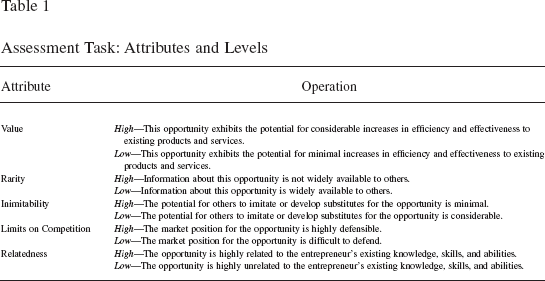
Instructions to the participants are described in detail later in this section; however, it is important to note here that each individual was told to “assume the role” of an entrepreneur when performing the evaluation task. The decision attributes used in this experiment were derived from the resource–based view (Barney, 1991; Wernerfelt, 1984), a commonly applied framework in the strategic management literature positioned to evaluate the strategic resources available to the firm. In total, there are five decision attributes utilized in this study that focus on resource dimensions of the opportunity. Operationalizations for each attribute—at both high and low levels—are described in Table 1. Further, an example of an opportunity profile in the form that it was presented to the respondents is at Appendix 1.
Assessment Task: Attributes and Levels
In designing the experiment, we utilize an orthogonal fractional factorial design from Hahn and Shapiro (1966). In an orthogonal design, inter–correlations between the variables are zero (orthogonal), which means that multicollinearity is not an issue and “increases the robustness of the conjoint by making it less likely that coefficients have counter–intuitive signs” (Huber, 1987, p. 8). Throughout the experiment, the profiles are presented to the respondents on a computer screen and they are asked to indicate their assessment electronically. The scale used to capture the respondents’ evaluations of opportunity attractiveness is an 11–point Likert–type measure, anchored by the end points “not at all attractive” and “very attractive.” In what follows, we describe the administration of the experiment and the assessment task consistent with how it was experienced by study participants—in two “parts.”
The Assessment Task—Part 1
In Part 1 of the experiment, the respondents’ evaluations of opportunity attractiveness are based on three (of the five available) decision attributes. Given three attributes at two levels, our fractional factorial design (Hahn & Shapiro, 1966) required respondents to evaluate four profiles in order for us to test all main effects. We fully replicated our design at each stage of the conjoint study. Full replication of the profiles in the experiment allows a comparison of the original profiles with the replicated ones to test reliability and provide the error term necessary to conduct analysis at the individual level. In addition, each experiment included, as the first evaluation task, a “practice” profile, which was excluded from analysis. Therefore, in Part 1 of the experiment, each participant evaluated a total of 17 profiles: nine profiles prior to receiving feedback (four unique profiles, fully replicated, plus one practice profile), and eight profiles following feedback (four unique profiles, fully replicated).
After each evaluation, a decision is made. The respondents receive computer–generated, cognitive–type feedback that is designed to provide a basis for comparing their own decision policies with what they are told is an “optimal” model of opportunity assessment. That is, the feedback is designed to direct respondents to use all three decision criteria, and to weight them in a way consistent with the feedback presented. Given this feedback, participants then continue the opportunity assessment exercise and evaluate additional sets of opportunity profiles, all the time continuing to receiving cognitive–type feedback in response to their decisions. The purpose of Part 1 of the experiment is to facilitate the development and internalization of a simple decision policy of opportunity assessment. The extent to which this “simple model” is internalized by the respondents is called pre–change accuracy; the smaller the gap between respondents’ decision weights and the weights represented by the feedback model, the more accurate the decision policy. Pre–change accuracy is determined using conjoint analysis and ordinary least squares (OLS) regression. This pre–change accuracy represents the point from which adaptation—motivated by a change in the feedback model employed in Part 2 of the study—will occur and be captured.
The Assessment Task—Part 2
In Part 2 of the experiment, the assessment task becomes more complex. Specifically the respondents’ evaluations are now based on five decision attributes (as opposed to only 3 in Part 1), and they are also instructed that the impact of certain criteria (on their evaluation of the attractiveness of the opportunity) depends on the level of another criterion (three two–way interactions). For example, they are instructed that high levels of “value” are most important when limits on competition are also “high.” In addition, the “simple” model of evaluation learned in Part 1 of the study is abandoned, in favor of a more “complex” model of opportunity assessment. Put differently, the relationships between the decision attributes and the “appropriate” assessment of the opportunity that were reinforced in the form of decision feedback in Part 1 of the study, are now wholly inappropriate in Part 2 of the experiment. This more complex model is reflected in the feedback the respondents receive throughout Part 2 of the experiment. This new feedback model is based on the aggregated decision policy of a sample of experienced entrepreneurs (avg. experience = 7.8 years; n = 73) that were asked to evaluate each opportunity scenario. 1 Finally, as an experimental manipulation, in Part 2 of the study, individuals randomly receive either cognitive or outcome–based feedback relating their evaluations to the more complex feedback model.
Because in Part 2 we investigate a set of five evaluation criteria, each at two levels, our fractional factorial design required that each respondent evaluates 16 profiles. Each of the profiles was then fully replicated such that, in total, each individual evaluated 33 profiles (including one practice profile) before receiving a feedback condition, and 32 profiles (no practice profile) after the feedback. Thus, each respondent evaluated 65 profiles in Part 2 of the study. Regression analysis was used to decompose decisions into their underlying decision weights. We subsequently investigate the role that both stocks of metacognitive resources, and also feedback type play in promoting adaptation away from the “simple” model of opportunity evaluation learned in Part 1, toward the “complex model” presented in Part 2 of the experiment. We use hierarchical regression to test the role that metacognitive resources and feedback play in inhibiting or promoting effective adaptation.
Instructions to Participants
The instructions to participants were designed to control for unobservable effects on their evaluations, and also to highlight the entrepreneurial nature and context of the task. The respondents were instructed that the purpose of this research is to better understand the decision policies of individuals when assessing the potential of entrepreneurial opportunities. Each participant was told to assume the role of entrepreneur—an individual responsible for the discovery, evaluation, and exploitation of opportunities to bring into existence future goods and services (Venkataraman, 1997)—and instructed that that they will be asked to evaluate a series of entrepreneurial opportunities. Their assessment was to be based only on the criteria presented to them during the experiment. The participants were also informed that the study would take place in two parts, and that they would receive feedback during both Part 1 and Part 2 of the study. This feedback, they were told, would compare their decisions to those of expert entrepreneurs that had also completed the study. The only indication to the participants of the transition from Part 1 to Part 2 of the study involved the presentation—on the computer screen—of a short passage that they were instructed to read that was materially unrelated to the study. To further focus the respondents’ evaluations and also make more “real” the entrepreneurial context, the participants were told to assume the role of the founder/owner of a new venture (less than 5 years old), and also to assume the following: (1) that you are interested in exploiting new opportunities, (2) that the time horizon for exploitation of the opportunity is 2 years, (3) that there are no capital constraints (i.e., funding is available), (4) that exploitation of the opportunity can occur either within an existing company or through the formation of a new venture, and (5) that these opportunities will/could be exploited in the present U.S. economic environment. They were also instructed to consider each opportunity as a separate situation, independent of all others. Further, because the study was computer–based, it was impossible for respondents to refer back to previous profiles for comparison.
Sample
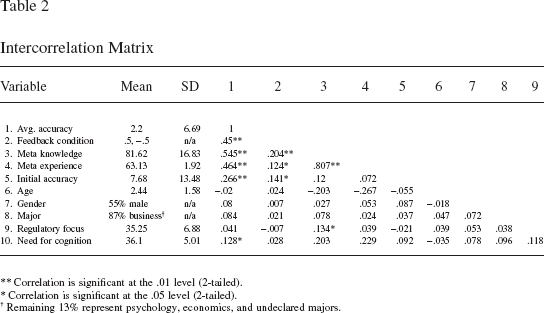
The primary sample for this study was drawn from students enrolled in an established research–subject pool at a large public university in the United States; specifically, 217 undergraduate business students—all in their final year of study. Administration of the experiment was accomplished in a laboratory setting where conditions can be controlled. Fifty–five percent of the sample were male, the average age was 20.44 (SD = 1.48), 87% were business majors, and none of the sample had taken entrepreneurship courses. Additional demographics of the sample are reported in Table 2, columns 2 and 3. We characterize this sample as consistent with individuals inexperienced in performing opportunity evaluation tasks and more generally the entrepreneurial process. Although there have been some criticisms of the use of students in behavioral research (Copeland, Francia, & Strawser, 1973), it is relatively common in the investigation of basic cognitive and psychological questions (e.g., Epstein, Pacini, Denes–Raj, & Heier, 1996; Harkness, Tellegen, & Waller, 1995), including those for use in management (e.g., Brock & Slusky, 1994; Kacmar & Carlson, 1997; Van der Vegt & Van De Vliert 2005). Further, as we highlighted to open this article, there has been significant attention paid in the entrepreneurship literature to the role of prior knowledge and experience in the entrepreneurial process. However, few researchers have looked purposefully at the other side of the experience/knowledge “coin”—that is, what might differentiate those entrepreneurs with no prior experience that are successful at important entrepreneurial tasks (like the one represented in this study), from those that are not? This is a critical question for entrepreneurship scholars, given the importance of understanding new entry and venture creation for economic growth (Wiklund & Shepherd, 2003). As the aim of this study is to explore cognitive adaptability enabled by metacognition and feedback in the performance of a dynamic entrepreneurial task, a sample with limited/no prior knowledge or experience in performing opportunity assessments serves to mitigate potentially confounding effects that such prior knowledge and experience may have on the dependent variable—cognitive adaptability. 2 Thus, we suggest that a student sample is suited for our purposes.
Intercorrelation Matrix
Correlation is significant at the .01 level (2–tailed).
Correlation is significant at the .05 level (2–tailed).
Remaining 13% represent psychology, economics, and undeclared majors.
In addition to the student sample, 73 experienced entrepreneurs completed the conjoint study, and their decision policies represented the basis for the feedback model presented to the student participants in Part 2 of the experiment. Of the sample of entrepreneurs completing the instrument, 38% of the sample were women, the mean age range of the entrepreneurs in the sample is 35–44 years (standard deviation [SD] = 1.58), and the mean years of entrepreneurial experience is 14.2 (SD = 15.9). Seventy–two percent of the entrepreneurs were founders of the firm that they are currently associated with, and all remain involved in the management of their current firms. The mean age of the firms was 11 years (SD = 9.85), and 87% of those firms reported that they were actively seeking new opportunities to exploit at the time we contacted them. All respondents represented ventures that were, at the time of their participation in this study, producing and selling some product or service. Each entrepreneur evaluated each opportunity scenario presented to the individuals inexperienced in the entrepreneurial process, and their decision policies were decomposed using hierarchical linear modeling (HLM) and subsequently transformed to represent “weights” for each of the decision criteria represented by the scenarios. We have a strong basis to assume that the entrepreneur's responses were reliable, and that the conjoint task was performed consistently by the entrepreneurs. Ninety–eight percent of the individual evaluations explained a significant proportion of variance (p < .05), with a mean R2 of .83. Further, Pearson R correlations were computed between each entrepreneur's evaluation of both the original and replicated profiles. 89.3 percent of the entrepreneurs were significantly reliable in their responses (p < .01). The mean test–retest correlation for the sample was .79 (which again is consistent with Choi and Shepherd [2004], which found 96% of entrepreneurs with significantly reliable responses and a mean test–retest correlation of .82). One of the limitations of conjoint analysis as a technique is the criticism that the scenarios lack richness and contextual cues, and we suggest that the feedback model incorporated into this study—based on the actual decision policies of experienced entrepreneurs—serves to mitigate this limitation.
Dependent Variable
In Part 2, the model of assessment that served as the basis for the decision feedback that the respondents received in Part 1 of the study is abandoned in favor of a differently weighted and more complex model of opportunity assessment. Like LePine, Colquitt, and Erez (2000), the change in task was reflected in the decision feedback presented to the respondents. This change in task required the study participants to adapt their decision policy to reflect the changed relationship between the decision criteria and the “correct answer.” Consistent with this purpose, we develop a measure of Effective Decision Policy Change (EDPC), which captures each individual's ability to effectively adapt their decision policy based on feedback.
Calculating “Effective Decision Policy Change.”
To calculate EDPC, regression is used to determine standardized coefficients—as weights—for each of the decision attributes employed in Part 2 for each individual. A weight at t1 represents the respondent's decision weight for a given attribute prior to receiving feedback. A weight at t2 represents the respondent's decision weight for a given attribute after receiving feedback. As part of the above calculation, both before and after receiving feedback, the decision weights for each attribute are compared with an “optimal” decision weight to determine the “GAP” in decision weight (difference between the respondent's decision weight and the optimal decision weight). The absolute value of each GAP (pre–feedback) is then subtracted from the absolute value of the corresponding attribute GAP (post–feedback), resulting in an accuracy score for a given individual at a given attribute (i.e., Value, Rarity, etc.). This score represents the degree to which the individual moved closer to the optimal weight following feedback (as compared with prior to receiving feedback). EDPC is then represented by the average of the accuracy scores of the decision weights (five decision weights, and three two–way interactions). Higher and positive EDPC scores depict normative improvement.
In analyzing the conjoint data to generate the inputs for calculating EDPC, we found 91% of the individuals’ decision policies are statistically significant (p < .05) in the first set of responses (prior to feedback), with a mean R2 of .67. Eighty–nine percent were statistically significant (p < .05) in the second set of responses (post–feedback), with a mean R2 of .76. Eighty–eight percent of the individuals are significantly reliable in their first set of responses (p < .01) with a mean test–retest correlation of .72. Ninety–four percent of the individuals are significantly reliable in their second set of responses (p < .01) with a mean test–retest correlation of .81. Both the explained variance and reliabilities are consistent with previous research (e.g., Shepherd, 1999).
Independent Variables
Metacognitive Knowledge (H1 & H4) and Metacognitive Experience (H2 & H5).
Metacognitive knowledge and experience were assessed using the Measure of Adaptive Cognition (MAC) scale (Haynie & Shepherd, 2009). This measure was developed specifically for use in entrepreneurship, and is published in a leading entrepreneurship journal. The measure has been found to have strong psychometric properties, as evidenced by its factor structure and its validity. There are 11 items that capture metacognitive knowledge, for example, questions such as “I think of several ways to solve a problem and choose the best one” and “I think about how others may react to my actions.” Analysis of the responses indicates a high level of internal consistency (.834). There are eight items that capture metacognitive experience, for example questions such as “my ‘gut’ tells me when a given strategy I use will be most effective” and “I depend on my intuition to help me formulate strategies.” Again, analysis of the responses indicates a high level of internal consistency (.770).
Feedback (H3).
Feedback presented to the respondents throughout this study took one of two forms: either cognitive or outcome based. Each required reference to an optimal model (described below). Consistent with the findings of Balzer, Hammer, and Sumner (1994), the cognitive feedback presented in this study conveyed information to the respondent concerning: (1) task information describing the optimal (objectively correct) relationship between each of the criteria and the attractiveness of an opportunity; (2) cognitive information describing the individual's own decision policy, depicting the relationship between the assessment criteria and their subjective assessment of opportunity attractiveness; and (3) functional validity information describing information about the relationship between the task (assessment) and the individual's decision policy (decision weights for each of the attributes).
Outcome feedback consisted only of a numerical score that represents the percentage of the respondents’ assessments that are in agreement with that of the expert model (consistent with Castellan, 1974). Agreement for outcome feedback is considered to be reached if the individual's assessment is within plus or minus one scale point from that of the optimal on a given scenario. For example, if an individual respondent, in the process of assessing the 33 scenarios, rates 22 of the 33 profiles within one point of the experts’ rating, he or she will receive an “outcome” score of 66%. An example of how both feedback types were presented, consistent with the above descriptions, can be found in Appendix 2.
In Part 2 of the study, feedback type was randomly assigned as either cognitive or outcome–based. Both feedback types were computer generated and presented to the sample half–way through the task (after the first 33 profiles of Part 2). The feedback was designed to direct the sample to use all decision criteria, three contingent relationships, and to weight them consistent with the feedback presented. The model from which feedback was referenced (i.e., the optimal) was derived from the decision policies of 73 expert entrepreneurs that evaluated the same profiles presented to respondents in the current study as part of a related research project.
Control Variables.
Theory and research suggest that the extent to which an individual is motivated to perform on a given task, as well as their focus while engaged in cognitively complex tasks, may relate to cognitive adaptability as we have conceptualized it in this study. As such, we selected measures of Need for Cognition (Cacioppo, Petty, & Kao, 1984) and Regulatory Focus (Higgins, 1997) to serve as control variables in the cognitive (versus outcome) feedback model. Further, we controlled for age, gender, and academic major. In addition, because the extent of effective adaptation to the feedback in Part 2 of the study can be influenced by initial decision policy (the accuracy of an individual's decision policy prior to the feedback), we also created a control variable for the level of initial accuracy consistent with LePine et al. (2000). First, we attempted to minimize differences in the initial decision policies of individuals from which change in the decision policy will be captured. As described above, we did this by providing feedback to migrate individuals to a common decision policy in Part 1 of the study. The optimal model criteria weights (against which individual performance was compared and feedback generated) were as follows: Value: 10%, Rarity: 30%, and Imitability: 60%. It was important to assign weights to the optimal model in Part 1 that offered the individuals the opportunity to adapt when presented with an alternative weighting framework (in Part 2). As inexperienced entrepreneurs, the respondents in this study have few, if any, preconceptions as to how these criteria normatively “should” be weighted. Second, there is likely variability in how close individuals’ decision policies matched the optimal, “complex” model before they were provided feedback. To capture and control for this heterogeneity, we calculated the control variable of initial accuracy. Initial accuracy is represented by the absolute difference between an individual's decision weights at the end of the decision tasks immediately before receiving feedback and the corresponding “optimal” decision weights of the “complex” model. Lower scores depict higher initial accuracy.
Results
As noted previously, the purpose of Part 1 of the study was to establish a “learned” model of opportunity assessment so that we could subsequently investigate the role that individual differences in metacognitive resources and feedback type (and their interaction) have on the ability of an individual inexperienced in the entrepreneurial process to migrate their decision policies away from that learned model based on a change (as the task required in Part 2 of the study). For this reason, we focus the reporting of results on Part 2 exclusively. Table 2 presents the means and SDs for the dependent, independent, and control variables, as well as an intercorrelation matrix. In several cases, significant, pair–wise correlations within and between independent and control variables suggest the possibility of multicollinearity confounding the results. After mean centering the interaction term, subsequent analysis employing the Variance Inflation Factor (VIF) indicated that, because all VIF scores were less than “4” and we provided a separate step for the interaction term, multicollinearity is not a serious problem (Neter, Wasserman, & Kutner, 1990).
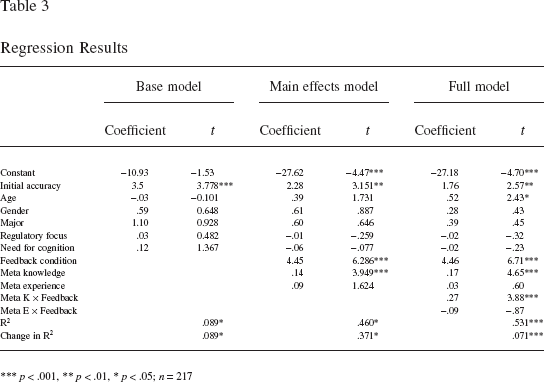
Table 3 presents the hierarchical regression results. Results are reported for a base model (Step 1), a main effects model (Step 2), and a full model (Step 3). The base model includes the control variables of a measure of decision accuracy at the completion of the initial decision task (Part 1), age, gender, academic major, regulatory focus, and need for cognition. The main effects model includes the set of control variables and the independent variables of feedback condition, metacognitive knowledge, and metacognitive experience. The full model includes the set of control variables, the independent variables of feedback condition, metacognitive knowledge, metacognitive experience, the interaction between metacognitive knowledge and feedback type, and the interaction between metacognitive experience and feedback type. This approach facilitates an investigation of the amount of variance in EDPC accounted for by the inclusion of additional explanatory variables in Steps 2, and 3, “over and above” the group of variables included in the previous regression model. The results for each model are reported in two columns: the first column details the regression coefficients (standardized), and the second column the t–ratio and level of significance (indicated by the number of asterisks following the t–ratio).
Regression Results
p < .001,
p < .01,
p < .05; n = 217
The base model does explain a significant amount of the variance in EDPC (R2 = .089, p > .05). The main effects model (Step 2) explains a significant amount of variance (R2 = .46, p < .001) in EDPC. Further, the main effects model represents a significant improvement in explained variance of EDPC over and above the base model (ΔR2 = .371, p < .001). Both feedback type and metacognitive knowledge account for this increased explanatory power. Specifically, feedback type is significant and related to EDPC (coefficient = 4.453, p < .001) such that EDPC improves as one moves from the outcome feedback condition to the cognitive feedback condition. This finding provides support for Hypothesis 3. Metacognitive knowledge is also significant and positively related to EDPC (coefficient = .142, p < .001) such that, all else equal, as metacognitive knowledge increases, EDPC improves, providing support for Hypothesis 1. Metacognitive experience was not significant (coefficient = .090, p > .10), and thus, does not provide support for Hypothesis 2.
The full model (Step 3) explains a significant amount of variance (R2 = .531, p < .001) in EDPC. Further, the full model represents a significant improvement in explained variance over and above the main effects model (ΔR2 = .071, p < .001). The interaction between metacognitive knowledge and feedback type is significant (coefficient = .274, p < .001) and positively related to EDPC. To better understand the nature of this interaction between metacognitive knowledge and feedback type, the nature of the relationship is plotted in Figure 1 consistent with the techniques recommended by Cohen and Cohen (1983). The dependent variable—EDPC—is plotted on the Y–axis. Feedback condition is plotted on the X–axis such that moving from left to right along the X–axis represents moving from the outcome to the cognitive feedback condition. Employing regression coefficients to calculate values of EDPC, the plots represent values of EDPC at both one standard deviation above and below the mean for metacognitive knowledge in each of the feedback conditions (outcome—cognitive).
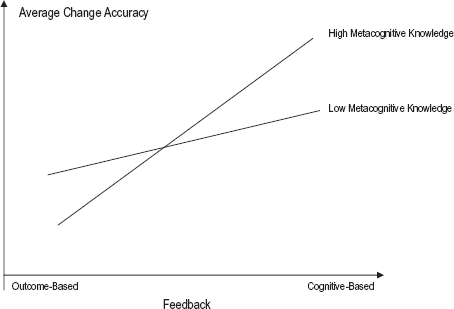
Feedback Condition by Metacognition Knowledge on Effective Decision Policy Change
Figure 1 indicates that moving from outcome to cognitive feedback (left to right) improves EDPC. Further, the demonstrated improvement in EDPC is more positive for those individuals high on metacognitive knowledge than those low on metacognitive knowledge (depicted by the significant and positive change in slope between low and high metacognitive knowledge). The nature of this interaction suggests that the positive relationship between cognitive (over outcome) feedback and EDPC is more positive for those individuals with higher metacognitive knowledge than those with less metacognitive knowledge, providing support for Hypothesis 4. The interaction between metacognitive experience and feedback type is not significant (coefficient = −.092, p > .10) and thus does not provide support for Hypothesis 5.
Discussion and Conclusion
Scholars posit that the ability to learn by adapting decision policies in the face of uncertain and dynamic decision contexts is central to entrepreneurial success (Haynie et al., 2009; Krause, Frese, Friedrich, & Unger, 2005). This is particularly the case for those that are unable to rely on past experience (Wiklund & Shepherd, 2003). As such, a theme incorporated throughout the entrepreneurship literature is cognitive adaptability: the ability to effectively and appropriately evolve or adapt decision policies (i.e., to learn) given feedback (inputs) from the environmental context in which cognitive processing is embedded. Explicit in this definition, however, is the notion that effective adaptation depends on appropriately interpreting the cause–effect relationship represented by feedback from the environment. To that end, scholars have studied characteristics of the individual and the team—such as hubris (Hayward et al., 2006), optimism (Lowe & Ziedonis, 2006) and the use of bias and heuristics (Tripsas & Gavetti, 2000)—as moderating how feedback from the environment is interpreted and incorporated into an iterative decision–making process. However, with regard to effective adaptation in response to feedback, less studied in an entrepreneurial or managerial context is the role of metacognition in the decision–making process.
Two concomitant issues are central given the findings of this study. First, do individuals inexperienced in the entrepreneurial process that actively facilitate the accumulation of relational feedback as inputs to future decision processes—such as seeking input from customers, suppliers, venture capitalists—perform better or differently given dynamic tasks such as opportunity recognition when compared with those who do not engage in those “feedback–seeking” behaviors? Further, within that sample of individuals inexperienced in the entrepreneurial process who engage in feedback–seeking behaviors, do those who have highly accessible and developed stocks of metacognitive resources outperform others given the dynamic tasks listed above? Such questions also lend themselves to integrating the work of Ericsson (2005, 2007; Ericsson, Nandagopal, & Roring, 2005), focused on the role of expertise and performance. Ericsson has suggested that cognitive and psychological adaptations due to extended deliberate practice relate to expert performance. Implicit in this proposition is the importance of the ability to relate feedback to subsequent adaptation. Our findings indicate that individuals inexperienced in the entrepreneurial process who engage metacognitive resources use feedback more effectively than others, suggesting that metacognitive ability represents an important mechanism related to the development of expert performance. In what follows, we expand on these findings with regard to both theory and practice in entrepreneurship.
The Role of Metacognition in Entrepreneurial Decision Making
We posit that the study's most interesting finding is the significant and positive contingent relationship between feedback and metacognitive knowledge in explaining cognitive adaptability in the performance of an entrepreneurial task for those individuals inexperienced in the entrepreneurial process. Previous research has established that cognitive feedback is effective in promoting subsequent learning and normative improvements in decision making (Balzer et al., 1994). This article serves to confirm these findings by demonstrating that cognitive feedback does promote significant, normative improvements in decision accuracy (over outcome–based feedback) given a dynamic decision task. This study's contribution to the above literature, however, is based on demonstrating that the relative benefits of cognitive feedback are not conferred equally; not all individuals who receive cognitive feedback realize equivalent improvements in decision accuracy. Specifically, the findings indicate that individuals with high metacognitive knowledge use feedback more effectively than individuals who have less metacognitive knowledge, and this performance difference is greater for cognitive feedback than for outcome feedback.
Beginning with McGrath and MacMillan's (2000) conceptualization of the “Entrepreneurial Mindset,” scholars have embraced the notion that dynamic decision processes are central to success in a managerial and entrepreneurial context (Ireland et al., 2003). In developing the foundations of the entrepreneurial mindset, Ireland and his colleagues described the cognitive tasks necessary for successful management as: making sense of opportunities in the context of changing goals, constantly questioning one's “dominant logic” in the context of a changing environment, and revisiting “deceptively simple questions about what we think to be true about markets and the firm (Ireland et al.). We propose that our conceptualization and empirical operationalization of cognitive adaptability captures some of the cognitive origins of the entrepreneurial mindset and, further, that cognitive adaptability can be enhanced through the development of metacognitive abilities. Our findings suggest that the behaviors characteristic of an entrepreneurial mindset described by Ireland and his colleagues above—generally the ability to adapt thinking process to a changing context and task demands—are a result of metacognitive resources. We offer this study, and thus one of its contributions, as an investigation of the cognitive origins of an entrepreneurial mindset. Future research should focus on the role of cognitive adaptability throughout the many steps and stages associated with the entrepreneurial process such as team formation, customer relations, market identification, and opportunity evaluation.
The findings of this study suggest that metacognition may represent an important resource for entrepreneurs—above and beyond prior knowledge—given that often they are required to perform dynamic and novel tasks (Hill & Levenhagen, 1995). When environmental cues change, decision makers adapt their cognitive responses and develop strategies for responding to the environment (Earley et al., 1989). Given the dynamism and uncertainty of many entrepreneurial tasks, metacognition can be a source of a better understanding as to why some entrepreneurs cognitively adapt to their dynamic context while others do not or are slow in doing so. It is our hope that the findings reported here will motivate future research directed toward the impact of metacognitive resources in performance given dynamic, entrepreneurial tasks such as opportunity recognition, discovery, and new venture creation.
The Role of Prior Knowledge and Learning in Entrepreneurship
Is it simply the case that the entrepreneurial success of an individual without prior entrepreneurial knowledge or experience can be written–off to the old saying that “sometimes even a blind squirrel finds a nut?” Or can it be argued that in some contexts, or for some individuals, a lack of prior knowledge might be overcome (at least in part) by the use of cognitive mechanisms to facilitate expeditious and effective learning and adaptation? This proposition is unaddressed in entrepreneurship because, as we have highlighted, few researchers have purposefully considered what might differentiate those entrepreneurs with no prior experience that are successful at an entrepreneurial task, from those that are not? This is a critical question for entrepreneurship scholars, given the importance of new entry and venture creation for economic growth (Wiklund & Shepherd, 2003). In this study, we have identified one possible explanation for normative differences between individuals without prior entrepreneurial experience—metacognitive abilities. One of the foundational tenets of metacognitive theory is the idea that employing metacognitive resources promotes the ability to relate knowledge learned in one context to problem–solving in another context. In a sense, metacognitive resources facilitate an analogical reasoning process that, for those inexperienced in the entrepreneurial process, may serve as a partial substitute for prior entrepreneurial knowledge. In sum, we suggest that our findings represent a first step toward opening the door to consider the cognitive origins of entrepreneurial sense–making for those individuals without prior entrepreneurial experience.
Future Research
Future research can build on the demonstrated relationship between metacognition and feedback in explaining cognitive adaptability at a dynamic task in the context of prior knowledge. Consider questions such as: Are more metacognitively aware individuals better able to “draw” on their knowledge and experience to adapt to dynamic environments? The current study was designed to minimize the potentially confounding impact of experience and prior knowledge. The findings of this study take a step further to address the question of “how” information may promote adaptability by beginning to investigate the process through which information—in this study, feedback—is incorporated into the decision policies of those engaged in an entrepreneurial, dynamic task. Future research can investigate the likely contingent relationship between metacognition and knowledge. Also, while we are very careful not to infer meaning to our non–significant finding with regard to the relationship between adaptable cognitions and metacognitive experience, the finding may highlight another compelling avenue for future research.
In the psychology and education literatures, metacognitive experience has been demonstrated to be important in translating past events in a way that makes them relevant and informative of a current task or situation (Flavell, 1987; Ford et al., 1998). The fact that metacognitive experience—at least in this study—appears not to have played a role in promoting adaptation on an entrepreneurial task raises interesting and important questions about the nature of entrepreneurial tasks (attributes, characteristics, etc.), and the utility of prior, disparate past events in facilitating sense–making in an entrepreneurial environment. Future research might extend the current study to one of inexperienced entrepreneurs, and also experienced entrepreneurs, to assess if the importance of metacognitive resources in promoting adaptability is enhanced or mitigated in the face of increasing entrepreneurial knowledge. Further, entrepreneurial tasks are often dynamic and novel. It could be that these characteristics of entrepreneurial tasks serve to “blunt” the potential benefits of metacognitive experience, and future research could investigate this proposition. In a related way, metacognitive experiences are affective and therefore more readily interpreted with age and experience (Flavell). While metacognitive abilities are robust and developed by early adulthood, research suggests that the accuracy of some types of metacognitive judgments might improve with age (Koriat & Shitzer–Reichert, 2002). Future research could focus on the role of metacognitive experience in promoting cognitive adaptability, as a function of both age and experience.
Potential Limitations
This research shares some limitations with most judgment–based research. Most of these involve challenges to the external validity of conjoint analysis; criticisms that artificial experiments do not have the immediacy, emotional importance, nor consider all of the information used to make entrepreneurial decisions in “real life” and the possibility that respondents could attach importance to attributes merely because they were presented in the experiment. However, there is evidence that even in the most artificial situations, conjoint analyses significantly reflect the decision policies actually used by individuals (e.g., Brown, 1972; Hammond & Adelman, 1976), and that it is unlikely that respondents attach importance to attributes merely because they were presented in the experiment (cf. Brehmer & Brehmer, 1988). Further, the nature of the experimental design employed here means that concerns over respondents only using attributes because they are presented in the experiment are irrelevant because we explicitly direct the respondents in not only which criteria to use, but how to use them (the weights to be applied to each attribute). Thus, our focus was not to suggest how the attributes are used by the sample, but to test how feedback changed decision policies.
Closely related to the above criticism is the fact that the attributes presented in this experiment lack the richness of real–life cues. Even though this is an almost “unavoidable” limitation of conjoint experiments because conjoint designs do not faithfully represent the decision as it appears in reality, Stewart (1993) and others assert that the method has strong validity. Research indicates the hypothetical representations, like the ones used in this study, are useful for capturing real policies (Chaput de Saintonge & Hathaway, 1981; Riquelme & Rickards, 1992). Further, an argument can be made that whether or not the decision scenarios “faithfully represented reality” was not relevant because the sample—as inexperienced entrepreneurs—had no basis in reality from which to judge the opportunity scenarios as representative of real life. Finally, we have argued that a student sample is appropriate given the aims of this study; that is, to consider how feedback type and metacognitive resources might relate to adaptability for individuals with no prior knowledge of the entrepreneurial task. However, because there is evidence that the accuracy of some metacognitive judgments improves with age and experience, the limited variance in age given our sample may constitute a limitation of this study.
Conclusion
In this study, we investigated the ability to revisit one's decision policies to adapt to a dynamic, entrepreneurial task. Complementing individual difference research on knowledge and performance at entrepreneurial tasks, we found that individuals inexperienced in the entrepreneurial process differed in metacognitive resources, and that these differences helped explain why some more effectively adapted their decision policy to reflect information about changes in the task. Although our finding that cognitive feedback was unsurprising because it was consistent with a well–established stream in the learning literature, we found that the benefits of cognitive feedback varied across naïve entrepreneurs and that the benefits were greater for those with more metacognitive knowledge. Given the breadth, complexity, and sheer volume of information available to entrepreneurial decision makers, and the rapid, substantial, and discontinuous change represented in contemporary business environments, we hope this research stimulates further investigations into explaining individual differences in “making the most” of feedback in response to dynamic entrepreneurial tasks, especially those with little to no experience.
Footnotes
1.
The decision policies of this sample of entrepreneurs were modeled using HLM, and the resulting decision weights were then incorporated into the current study to represent the feedback model employed in Part 2 of the experiment. Additional descriptive characteristics of this sample of expert entrepreneurs are provided later in the article.
2.
It is important to acknowledge that we recognize that experience is important in explaining performance in managerial tasks such as pattern recognition (Baron, 2006; Baron & Ensley, 2006) and in explaining the nature of opportunities recognized from a technology signal (Shane, 2000). Although it is difficult to completely rule out the potential impact of task–specific experience, we designed our study to focus on the individual difference of metacognition (metacognitive knowledge and experience), the type of feedback received, and their interaction. We chose a sample and a design to minimize the potential impact of task–specific experience. First, we deliberately chose a sample of individuals inexperienced in making managerial decisions, as well as a sample that was relatively homogenous in age and education. Second, our design captured each individual's effective change in decision policy, and individuals were randomly assigned to feedback condition. Randomization likely negates the impact of task–specific experience differences on the relationship between feedback and EDPC. By controlling the timing and the nature of the changes in decision context, the experimental design allowed us to minimize the potential impact of individuals’ prior experience with the opportunity assessment task (consistent with LePine, Colquitt, & Erez, 2000, p. 572).