







Abstract
While the term “business model” has gained widespread use in the practice community, the academic literature on this topic is fragmented and confounded by inconsistent definitions and construct boundaries. In this study, we review prior research and reframe the business model with an entrepreneurial lens. We report on a discourse analysis of 151 surveys of practicing managers to better understand their conceptualization of a business model. We find that the underlying dimensions of the business model are resource structure, transactive structure, and value structure, and discuss the nature and implications of dimensional dominance for firm characteristics and behavior. These findings provide new directions for theory development and empirical studies in entrepreneurship by linking the business model to entrepreneurial cognition, opportunity co–creation, and organizational outcomes.
What are business models and how do practitioners use them? These broad questions combine organizational design and strategy perspectives (Chandler, 1962; Zott & Amit, 2007) with a view toward implications for entrepreneurship studies. The formation, growth potential, and success of new organizational forms is often credited to the development of novel business models, especially in turbulent industries (Franke, Gruber, Harhoff, & Henkel, 2008; Venkatraman & Henderson, 1998). Researchers have suggested that business models are critical constructs for understanding value creation (e.g., Amit & Zott, 2001; Chesbrough & Rosenbloom, 2002; Mahadevan, 2000), while others note the lack of construct clarity and commingling with business strategy (Porter, 2001). This article presents a systematic review and presents findings from an inductive study of practitioner perspectives to reconstruct the business model and identify its underlying structures using an entrepreneurship lens. We integrate the scholarly dialogue on business models to emphasize the link between business models and opportunity enactment.
Definitions for business models vary widely, incorporating organizational narrative (Magretta, 2002), processes that convert innovation into value (Chesbrough & Rosenbloom, 2002), recipes for firm activities that incorporate organizational design and strategy (Slywotzky & Wise, 2003), “flows” of information and resources (Timmers, 1998), and designed structures such as the firm's set of boundary–spanning transactions (Amit & Zott, 2001). Most studies, however, fail to clearly distinguish the business model from received organizational constructs such as strategy, in part because the construct emerged as a term of convenience in the popular press and practice community (Osterwalder & Pigneur, 2005). The lack of a convergent, well–defined theoretical construct has led to inconsistent empirical findings in its effect on firm performance and organizational change. Disparate definitions suggest that business models for growing firms could be inherently uncertain (Andries & Debackere, 2007; Heirman & Clarysse, 2004) or, alternately, path dependent and predictable (Willemstein, van der Valk, & Meeus, 2007).
The study of business models is pertinent to entrepreneurship research as often studies tend to examine new ventures or innovation–driven industries. Business models may represent a form of entrepreneurial opportunity creation (Downing, 2005; Franke et al., 2008; Markides, 2008) explicitly initiated by market imperfections (Cohen & Winn, 2007). But the lack of a consistent framework has resulted in fragmented research questions and findings, especially within an entrepreneurial context. Studies ask whether a business model should be focused and formalized (Tracey & Jarvis, 2007), adapted to environmental circumstances (Hurt & Hurt, 2005), or specific to the entrepreneurial mode (Morris, Schindehutte, & Allen, 2005). Developing a convergent construct could significantly reduce confusion and help reconcile conflicting empirical results. Theory development should progress toward a necessarily artificial construct that best approximates “the hypothesized course of [observed] events” (Weber, 1949, p. 44) in the service of encouraging rigorous theory building, well–characterized descriptive research, and high–impact normative predictions. Our goal then is to provide a bridge from the literature to observation of the phenomenon in managerial practice.
Literature Review
Reviewing the literature on business models has become a significant task, if only for the quantity of documents published. An EBSCO© database search for “business model” on December 1, 2008, generated 929 title hits, 10,715 abstract/keyword hits, and 89,923 all–text hits. At the same time, use of the business model construct is relatively recent—of the 929 title hits, only 107 were published before 2000, and only 7 of those before 1990. The literature spans numerous fields and often focuses on information and communications technology (ICT), though many crossover articles present e–business models in an organizational theory context (e.g., Bienstock, Gillenson, & Sanders, 2002; Eden & Ackermann, 2000). Models of business date back to computational work by Simon and others (see Ijiri, 1964, for an early “business model” of growth).
To maximize the relevance, we excluded purely computing and modeling research as well as nonmanagement fields such as political economy. A search was conducted for “business model” using the “all–text” feature via EBSCO© Business Source Premiere (EBSCO Industries, Ipswich, Massachusetts) in the management and business studies, generating a total of 288 citations. A second search was conducted for “business model” using the “topic” feature via the ISI Web of Science® (Thomson Reuters, New York) search engine, generating 194 citations. Combining the search results yielded a total of 474 unique citations in the base review set; only eight citations occurred in both search outputs, confirming the fragmented nature of the field. A broader search yielded a variety of books, websites, and unpublished manuscripts. In total, 420 publications were searched for “business model.” Publications were eliminated under the following conditions: no use of the phrase (n = 102), irrelevant mention based on grammatical coincidence (n = 9), single use without explanation or relevance to organizations (n = 106), multiple mention without significant concept elaboration or development (n = 78), and multiple mention unrelated to organizational theory (n = 17). The remaining research studies (n = 108) were reviewed for theory and empirical contributions.
The immediate finding was the nonaccretive quality of the literature on business models: research has failed to converge on definitions, much less frameworks for normative or predictive findings. With few exceptions (see Zott & Amit, 2007, 2008) research on business models has not built upon prior research within a coherent framework. In fact, publications that review the literature on business models regularly comment on the lack of a construct definition (Eden & Ackermann, 2000). Research “groupings” have focused on specific industrial segments such as biotechnology (Bigliardi, Nosella, & Verbano, 2005; Nosella, Petroni, & Verbano, 2005), the dot–com industry (Fay, 2004; Lechner & Hummel, 2002), and spin–out variants (e.g., Garnsey, Lorenzoni, & Ferriani, 2008; Heirman & Clarysse, 2004). The literature spans research fields without explicit links between research topics, methodologies, or previous findings.
Despite this confusion, business model theory building and empirical research appears to germinate from established organizational topics such as strategic choice, resource accumulation, and innovation. From this starting point, six broad themes emerged within the vocabulary of organizational theory. The business model is commonly described and reflects on (1) organizational design, (2) the resource–based view (RBV) of the firm, (3) narrative and sensemaking, (4) the nature of innovation, (5) the nature of opportunity, and (6) transactive structures. Table 1 identifies the key characteristics of these thematic groups and representative construct definitions. We review each of these themes below.
Thematic Summary of Business Model Literature
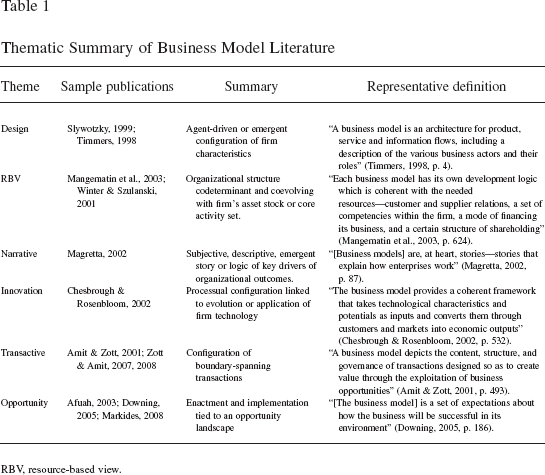
RBV, resource–based view.
Business Model as Organizational Design
The role of managerial agency in determining organizational structures resonates with the configuration of firm products, activities, and markets (Hunt, 1970). Managers and entrepreneurs rationally assess existing and potential business models to establish new organizations and ensure firm survival (Perlow, Okhuysen, & Repenning, 2002). Slywotzky's (1999) practitioner–focused work interlinks business models and strategy and suggests that business model innovation is the cornerstone of long–term performance. Alternate analyses suggest that firm performance is linked to business model fit with strategy (Zott & Amit, 2008) or business model consistency across international subsidiaries or partners (Roberts & Senturia, 1996). The business model as design requires that managers implement a single business model to avoid operational inefficiencies (Markides & Charitou, 2004)., On the other hand, the coevolution of strategy and business models may occur as a cumulative, emergent process directed by purposive, coordinated learning (Ghoshal & Bartlett, 1994). Even if business model change is initiated and executed top down, emergent business models may deviate from agent–driven design (Cule & Robey, 2004). In addition, questions of business model path dependence remain unresolved. Studies have found path–dependent transitions between business models in manufacturing (Lovins, Lovins, & Hawken, 1999) and biotechnology (Willemstein et al., 2007), but other research suggests that business model evolution is inherently uncertain (Heirman & Clarysse, 2004). General mechanisms for the evolution of successful or dominant business models remain unexplored. A theory of business models in which organizational outcomes are primarily influenced by managerial knowledge, expertise, choice, and execution has practical appeal but does not clearly explain business model innovation, the contingency effects of resource acquisition and deployment, or opportunity creation. Parallel research in multiple contexts has emphasized the business model as a component of organizational design without converging on its components.
Business Model and the RBV
The RBV commonly links business models to resource acquisition and allocation (Garnsey et al., 2008). Hamel (1999) suggests that firms must acquire resources concomitantly to the implementation of new business models. Mangematin et al. (2003) present a business model typology within the French biotech sector based on the financial, human, and social capital resources that drive organizational forms. The inclusion of knowledge and dynamic capabilities into the RBV paved the way for more linkages between the business model and RBV. Venkatraman and Henderson (1998) suggest that leveraging traditional and knowledge assets enables virtual organizing as a new business model. “New economy” firms have been credited with leveraging intangible assets to generate extraordinary value (Boulton & Libert, 2000). Eden and Ackermann (2000) define the business model as the dynamic capability that links the firm's distinctive competencies to organizational aspirations and outcomes. An alternate perspective links the business model to social networks and knowledge sharing (Chung, Yam, & Chan, 2004).
Few studies frame the business model as an evolving bundle of activities, a “complex set of interdependent routines that is discovered, adjusted, and fine–tuned by ‘doing’ ” (Winter & Szulanski, 2001, p. 731). Some variants connect the transactive element of market need to the key business activities (McEvily, Das, & McCabe, 2000). In this evolutionary framework, business model elements are discovered experientially and evolve without managerial agency. The RBV has permeated much of the research on business models, influencing theory building and empirical analysis. No consensus has emerged, however, on how business models interact with appropriability regimes, and much of the research on business models framed within RBV does not clarify how business models differ from product–market positioning strategy.
Business Model as Organizational Narrative
The business model construct lends itself to an institutional framework that incorporates organizational narrative. Citing Priceline and Wal–Mart as examples, Magretta (2002, p. 87) defines the business model as the gestalt embodiment of firm execution, integrating all elements of operations and structure into the narrative as “stories that explain how enterprises work.” The storytelling framework has proven a powerful tool for understanding and interpreting organizational behavior (Gabriel, 2000), but the necessarily subjective nature of story formulation presents challenges for objectively assessing organizational behaviors and outcomes. If the economic landscape is objectively specified, business model narrative may be limited to the business logic of the firm operating in a constrained environment, usually abstracted to the firm's revenue mechanism (Lewin, Long, & Carroll, 1999).
A related perspective focuses on sensemaking and enactment (Daft & Weick, 1984) where institutional pressures on the business model shape firm growth processes. Firms may control the legitimization process if the model is innovative and the firm drives narrative sensemaking at organizational and community levels (Zimmerman & Zeitz, 2002). Narrative sensemaking would be relevant in emerging markets where investors are unable to evaluate unproven business models without clarification (Sanders & Boivie, 2004). Business models may be an important component in the coevolution of stories that determine legitimacy as a necessary component of firm survival (Lounsbury & Glynn, 2001). If business models play a key role in legitimization, we would expect to see isomorphism based on the adoption of common business models (Kostova, Roth, & Dacin, 2008).
The narrative sensemaking of business models could occur within the firm as well. Business models would evolve via internally driven structuration, influenced by the narrative dynamics that drive the development of the firm's social order, rules, organizational structure, hierarchy, and meaning making (Downing, 2005). The narrative perspective allows for fuzziness in business model development and deployment. Firms may trial multiple business models at the same time (Brown & Gioia, 2002). At the same time, the business model as narrative mechanism limits the scope of research to story formation and cataloging of narrative commonalities; we currently have no processes that mediate narrative models and firm behavior or outcomes.
Business Model as Innovation Form
Many studies assess the relationship between technology innovation and business models or the change in business models. This perspective frames business models within an innovation context, defining it as “a coherent framework that takes technological characteristics and potentials as inputs and converts them through customers and markets into economic outputs. The business model is conceived as a focusing device that mediates between technology development and economic value creation” (Chesbrough & Rosenbloom, 2002, p. 532). A business model would be a component of innovation commercialization separate from product and process innovation. Here, business model development and change are punctuated phenomena that follow disruptions or enactment of new opportunities. An adaptive framework for innovation suggests that business models adjust in parallel to the firm's life–cycle evolution (Andries & Debackere, 2007). Business model change at the firm level would then be especially prevalent among immature firms in capital–intensive and high–velocity sectors. The business model may be an important link between innovation and organizational structure. It remains unclear, however, whether business model change results in reconfiguration of the firm's organizational structure (Francis & Bessant, 2005) or whether organizational design and knowledge management determine business model structure. More research is needed to clarify the links between business models and organizational innovation as well as the mechanisms and processes of business model innovation and change.
Business Model as Opportunity Facilitator
In a relatively undeveloped framework, the business model is a facilitative intermediary in the opportunity–creation process. The business model has been described as the link between innovation and value creation (Chesbrough & Rosenbloom, 2002) as well as the cognitive link between entrepreneurial appraisal of the opportunity and its exploitation (Fiet & Patel, 2008). Others focus on the transactive element and view the business model as the mechanism for opportunity exploitation (Amit & Zott, 2001). If the opportunity is uncertain, the optimal business model cannot be rationally determined (Heirman & Clarysse, 2004). The business model is sometimes equated to the underlying “business idea” or the firm's value creation mechanism (Afuah, 2003; Markides, 2008), but separating the entrepreneurial opportunity from the established firm's profit–managing process has not been addressed. Research on venture capitalists’ use of business model frameworks links business model development with perceived commercial potential (Franke et al., 2008; George & Nathusius, 2007), but the mechanisms by which the underlying opportunity and the business model are interconnected have not been explored. The results of the inductive study described in this article present promising directions for reconceptualizing the business model along these lines.
Business Model as Transactive Structure
The most rigorous and engaging construct definitions in the literature center on transactive structures such as the streams of logistics and revenue (Mahadevan, 2000). Amit and Zott's (2001) deductive construct seeks to explain extraordinary value creation mechanisms in e–businesses. The business model is proposed as a unifying mechanism describing the “content, structure, and governance of transactions” (Amit & Zott, p. 511). Firm performance is a function of specific business model characteristics (Zott & Amit, 2007) and the fit between business models and strategy (Zott & Amit, 2008). This framework has been most commonly applied to e–business sectors, usually in the development of cluster solutions and typologies that deconstruct exchange characteristics (e.g., Bienstock et al., 2002).
The transactive–based definition is inherently attractive: it rests on observed firm behavior, combines elements of entrepreneurship with strategy, and presents a spectrum of opportunities for empirical assessment and theory building. Fiet and Patel (2008) argue that some business models are “forgiving” by shifting transaction risk to outside resources without commensurate remuneration. Research has extended Amit and Zott's transactive model to assess strategic growth investment outcomes after the dot–com crash (Eisenmann, 2006) and value creation associated with Internet firm acquisitions (Uhlenbruck, Hitt, & Semadeni, 2006). The transactive theme has been a productive framework in the business model literature, but yet lacks theory building and empirical research outside of the e–business sector.
A Discourse Analysis of Business Models in Practice
A critical challenge to business model research is its lack of coherence. Efforts to review the literature and develop consensus tend to yield all–encompassing definitions that subsume established organizational constructs such as value creation and strategy (e.g., Morris et al., 2005; Osterwalder & Pigneur, 2005). While perfect coherence or agreement may not be strictly necessary, future research may be hampered by nonconvergent definitions. Given the lack of a consistent framework and the nonaccretive characteristic of empirical studies, we undertook an alternate approach to compare practitioner perspectives and construct definitions in the literature.
Pilot Interviews
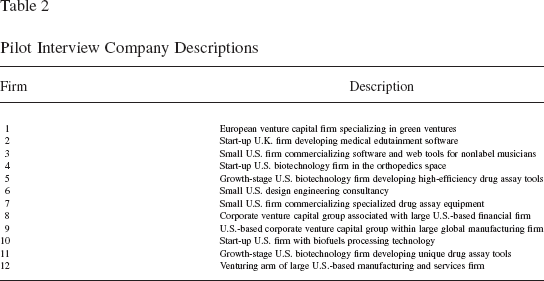
Our inductive investigation into business models began with pilot interviews of managers at venturing groups and early–stage technology firms identified in Table 2, because early use of the construct developed in the context of rapid adoption of Internet technology fueled by venture funding (Osterwalder & Pigneur, 2005). Interviewees responded to a semistructured interview template utilizing open–ended questions that narrowed to firm–specific characteristics of business models. Participants were prompted to describe business model elements and the mechanisms of business model change. Three observations from these pilot interviews emerged. First, every interviewee recognized the construct. Second, many interviewees expressed uncertainty about defining the general construct or identifying components of the business model—no consistent frameworks or definitions were evident. Finally, the definitions and examples offered by interviewees centered on three key characteristics: survival, organizational structure, and opportunity exploitation. Based on the fragmented literature and lack of precision in practice, we initiated a broader study to assess practitioner perceptions of business models.
Pilot Interview Company Descriptions
Survey Administration
The study utilized a survey instrument with open–ended questions prompting text responses as well as quantitative assessments of numerous firm characteristics in a standardized format. The survey asked two open–ended questions: “What is a business model?” and “What is your company's business model?” The questions were purposefully kept simple and placed at the start of the survey in order to obtain a tabula rasa response. Survey responses were affected by the available writing space and the written direction to “explain in 1 or 2 sentences.”
The survey was administered to 182 senior managers of Indian firms who attended executive education programs between Winter 2008 and Spring 2009. Firms ranged in size from 2 employees to more than 20,000 employees and in age from start–ups to more than 100 years old. The median annual growth rate was 23%, consistent with the rapid growth of the Indian economy in 2008. The sample covered a range of industry sectors with strong representation in ICT, manufacturing, high–technology sectors, and services firms. A secondary test sample was obtained by administering the survey to 13 managers of U.K. firms who attended an unrelated executive education program in Fall 2009.
Discourse Analysis
Discourse analysis, also referred to as “content analysis” or “textual analysis,” is an analytical tool attributed to Foucault (1982) that distills information from text using quantitative techniques (Fairclough, 2003). From an epistemological perspective, analysis seeks to understand the production of reality via use and evolution of language “as constitutive of the social world—not a route to it … the world cannot be known separately from discourse” (Phillips & Hardy, 2002, p. 6). Although the tools were primarily developed in fields such as political science and sociology (e.g., Weber, 1990), discourse analysis has been used in organizational research to assess mechanisms of organizational change (O'Connor, 1995), develop a meta–analysis of organizational science in the broader context of humanities studies (Zald, 1996), and even redefine the field of strategic management (Nag, Hambrick, & Chen, 2007).
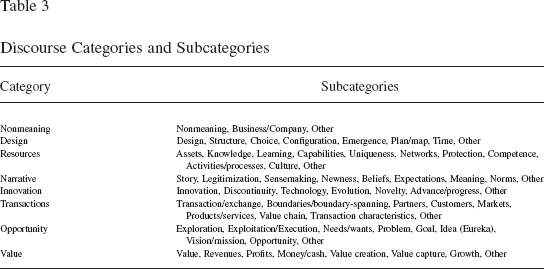
Discourse analysis requires three technical decisions (Stemler, 2001): first, the discourse content must be identified; second, the unit of analysis is chosen; and finally, the text is analyzed via an emergent or an a priori set of categories. In our study, the discourse content was the set of responses to the written survey question: “What is a business model?” Data were analyzed at both the word and response unit to enable comparison and increase objectivity. The lack of comparable analyses required the development of either an emergent or novel a priori categorization scheme. Established word categorization sets were unsuitable because of the specialized nature of this analysis. Although an emergent categorization would have been appropriate given the lack of previously established categorization sets, the thematic categorization developed in the literature review provided a useful basis for assessing survey content with the benefit of direct comparison between practitioner perceptions and received theory building. In order to maximize the validity of the categorization and to enable juxtaposition between practice and theory, we developed a set of subcategories based on the output of the literature review. The category and subcategory set is shown in Table 3.
Discourse Categories and Subcategories
The Base Data
The base data are the 182 surveys from managers of Indian firms. The target content includes hand–written responses to open–ended survey questions. A sample response to the question (Q1) “What is a business model?” is shown:
[76] The way by which organization's resources are deployed to create value to customers in the form of product and services leading to growth and higher profits for the organization.
Of the 182 surveys completed, 18 were eliminated from the sample because of incomplete responses or difficulties in handwriting transcription. Thirteen additional responses were excluded from the discourse analysis because the response appeared to be firm specific, such as, “[23] Design and manufacture of stainless steel process equipment for any process.”
The remaining 151 surveys represented 130 unique organizations. The data were cleaned as follows: obvious typographical errors were corrected, acronyms and shortenings were expanded to full words, and symbols and numerals were replaced with the appropriate words. Punctuation and other nonword symbols were discarded. A cursory review revealed that the words “business” and “model” would be oversampled in the analysis because numerous responses included the phrase “business model”; 44 instances of the phrase “business model” were eliminated from the sample. The resulting data set thus included 151 responses, 2,417 total words, and 650 unique words. Roughly 60% (n = 389) of the words occurred only once in the sample, 95% (n = 615) of the words occurred 10 times or less.
An initial discourse analysis reviewed and coded each response using a binary scheme to reflect the presence or absence of category–/subcategory–relevant content. Response–unit level discourse analysis presents the conceptual “sense” of the aggregate data more formally than high–level summaries. Each response could be coded to multiple categories, but only one primary subcategory within a category was assigned to ensure that category counts were not duplicated. For example, response [76] shown above describes a deployment “way” the company's resources and product/service mix as well as firm–level outcomes of value and profit. This response is therefore coded to the categories of Design, Resource, Transactions, and Value. It is specifically coded to the subcategories of “plan/map,”“resources–other,” products/services,” and “value–other.” respectively. Although two types of “value” were clearly identified in the response, only one subcategory is selected. This measures the prevalence of categories across responses rather than frequency within responses. A total of 315 response–level category/subcategory codings were recorded. Response–level category totals and percentages are shown in Table 4 against word–level coding output discussed below.
Absolute and Normalized Frequency of Business Model Concepts by Level of Analysis
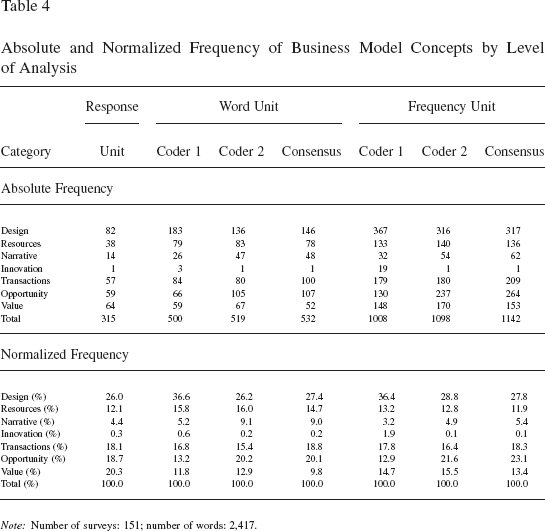
Note: Number of surveys: 151; number of words: 2,417.
Discourse analysis benefits from multilevel assessments and interpretation (Fairclough, 2003). Sentence– and response–level coding suffers from filtering and subjectivity associated with the complex process of extracting “meaning” from multiword sets. Because the survey responses ranged from less than 10 words to more than 40 words, contextualizing and coding responses required simplification and interpretation across substantively varying scales. A word frequency assessment is a standard tool of discourse analysis (Fairclough; Stemler, 2001). The potential benefits of word frequency analysis are numerous: systematic categorization at a defined content level, increased objectivity of coding, and larger data sets for quantitative assessment. The primary disadvantages are associated with coding effort and rigor and the presence of nonmeaning or uncodable words.
Two reviewers alternated independent coding with discussion to code the content in stages (Stemler, 2001). One coder was one of the authors with a high degree of familiarity with the context, terminology, and literature. The other coder was a finance graduate student who had no direct experience or familiarity with the context, terminology, or literature. After each independent coding stage, the reviewers compared coding and discussed differences. Minor subcategorization changes were made during the coding process. Ultimately, 118 unique words representing 1,275 occurrences (roughly 53%) were placed in the “nonmeaning” category, while 532 “meaning” words representing 1,142 occurrences were categorized thematically.
Table 4 compares the counts of the response–level analysis to the counts of the unique word–level and frequency of occurrence analyses, both in absolute numbers and normalized. The frequency of occurrence analysis takes into account how often specific words occurred in the sample. The higher counts for unique words and frequency in the consensus column are due to the recoding of nonmeaning words into the thematic categories during the consensus review process. Words associated with organizational design were most common both in number of words and total frequency. Words associated with opportunity and transactions were common. Less common were words associated with resources and value. Words associated with narrative were rare and words associated with innovation were almost nonexistent. These trends were consistent over the response and word levels of analysis.
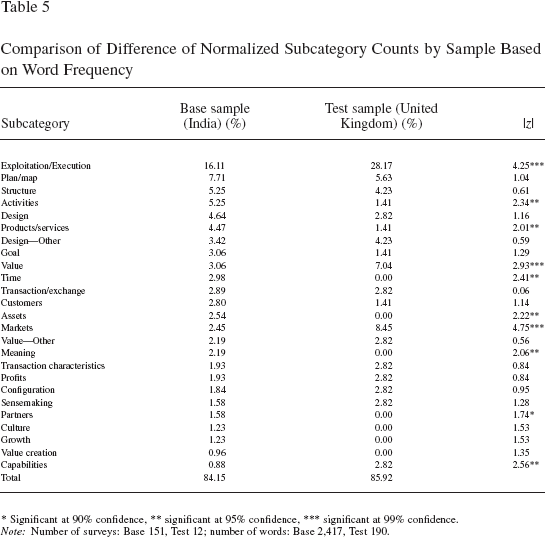
The 25 common subcategories, representing approximately 80% of usage across all analyses, are shown in Table 5. The subcategorization results reveal a more nuanced understanding of practitioner perceptions about business models. First, although ideation and purpose–/mission–related words occurred regularly, the most frequently occurring element within the “opportunity category” was exploitation/execution. Business models are tightly characterized by actualizing functions and activities. On the other hand, the most common elements within organizational design deal with structure and configuration. Business models are not isomorphic with strategic planning or content: business models are representations of organizational configuration or coordination. While value creation is a critical element of business models, no single subcategory dominates; business models may have idiosyncratic characteristics of value development, whether via revenue generation, profit making, or other less common preferred outcomes.
Comparison of Difference of Normalized Subcategory Counts by Sample Based on Word Frequency
Significant at 90% confidence,
significant at 95% confidence,
significant at 99% confidence.
Note: Number of surveys: Base 151, Test 12; number of words: Base 2,417, Test 190.
Comparing the response–level coding with the word–unit coding reveals useful lessons about the practice of business models. Figure 1 presents a radar diagram of the 20 subcategories with the highest coding counts, grouped into thematic units. Similarities between the response–level coding and the word–unit–level coding are evident, though some distinctions should be identified. The more abstract analysis at the response level, which would be the processing level utilized for most qualitative and case study research, shows a higher prevalence of the traditional aspects of strategic choice: planning, goals, and products and service. At the word–unit level, however, we see stronger representation of exploitation, transactions, activities, and assets, as well as miscellaneous elements of design and the nature of time.
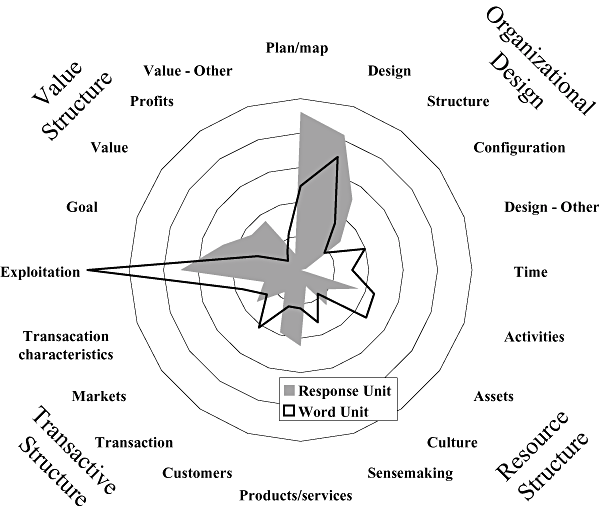
Business Model Subcategory Themes by Level of Analysis (Top 20 Subcategories Shown)
Whereas the higher–level perspective suggests a business model language of design and value, the underlying word usage in practice demonstrates the importance of resource and transactive elements at the organizational level. The predominance of design and execution, in combination with traditional product/market positioning evident in the study output have been the focus of most of the research on business models to date; the discourse analysis reveals that in practice the underlying components of business models incorporate both resource and transactive structures.
Testing Differences in Indian and U.K. Data
In order to test the generalizability of the Indian data set, the survey was administered to a small group of entrepreneurs at a business development seminar. Because the seminar targeted organizations with a design focus, and was offered free on a first–come, first–served basis, the demographics of the participants differed significantly from the base data set. The 13 U.K. firms are primarily early–stage entities engaged in design or design service fields. Of these, 11 are headquartered in London and 10 are less than 2 years old generating less than U.S. $150,000 in revenues per year, clearly qualifying as very early stage firms. Average self–reported growth rate was 30% and average self–reported net margin was 23%. The two samples presented similar growth and profit characteristics. The data for the U.K. sample were treated as described for the India sample. A total of 190 words, including 91 unique words, were assessed in a word frequency analysis in which 66 of the words were matched exactly against words in the base lexicon and were categorized directly. The remaining 25 new, unique words were categorized by contextual usage.
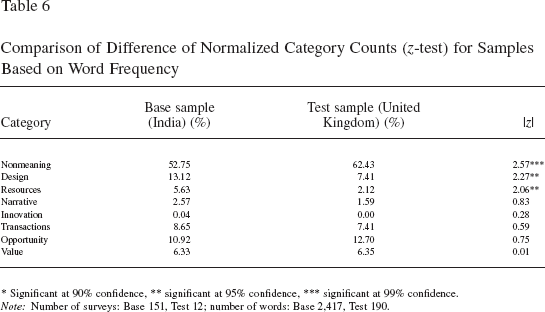
Table 5 also compares the top 25 subcategories based on word frequency for the base data set (India) and the test data set (United Kingdom). Table 6 compares the normalized category counts by word frequency for the base data set and the test data set. The normalized counts differ statistically for 10 of the 25 top subcategories, but there is also a surprising amount of similarity. Exploitation/execution is the dominant subcategory for both samples, and many of the top count subcategories match across samples. More than 80% of the total subcategorization counts occur in these 25 subcategories. The category data show some differences between samples, but the z–test for codings for four of the six “meaning” categories cannot be shown to be different at the 90% confidence interval. In addition, the differences are matters of degree. Rank ordering the categories results in only one mismatch: “design” is second in the base sample and third in the test sample, while “opportunity” is second in the test sample and third in the base sample. It should be noted that while the word frequency data is relatively normally distributed, the categorical data is not, so these tests provide only a first–order approximation for the comparison between the test sample data and the base data. Nevertheless, the similarities between the test sample and the base sample suggest that the broad concepts embodied in the business model in practice demonstrate general consistency despite significant differences in firm characteristics.
Comparison of Difference of Normalized Category Counts (z–test) for Samples Based on Word Frequency
* Significant at 90% confidence,
significant at 95% confidence,
significant at 99% confidence.
Note: Number of surveys: Base 151, Test 12; number of words: Base 2,417, Test 190.
Data Limitations
The data set and analytical processes present certain data limitations. Survey participants were self–selected into executive education programs and may demonstrate a common perspective on learning, knowledge, and resource investments. Because survey responses were limited to a few sentences, we do not know whether respondents would have preferred to write more, though many wrote less—the shortest responses were less than 10 words. The fact that discourse analysis showed strong similarities between the India and U.K. data samples suggests that ethnicity was not a distinguishing factor in practice perceptions about business models, but alternate hypotheses, such as the influence of primarily English–based practice publications, cannot be entirely ruled out. In addition, India and the United Kingdom share many cultural similarities that might not be carried over into other countries.
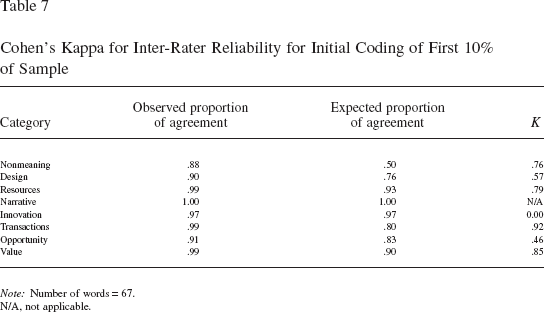
Although the analytical process utilized two coders and followed standard practices for discourse analysis, the process remains subjective. Cohen's Kappa was calculated following independent coding of the first 10% of the sample to test for inter–rater reliability (Table 7). The low frequency of “innovation” and “narrative” words, both in this subsample and the entire sample reduce the validity of the test for those categories, but inter–rater reliability was moderate or substantial for five of the other six categories (based on Landis & Koch, 1977).
Cohen's Kappa for Inter–Rater Reliability for Initial Coding of First 10% of Sample
Note: Number of words = 67.
N/A, not applicable.
Additional biases may have been introduced via the intercoder discussion process. One of the coders was more familiar with the literature and terminology of business models, and may have been a source of influence on the other coder. Comparing coding results shows that the consensus coding was closer to the second coder's preliminary codings in 5 of the 7 categories. Inter–rater reliability for postdiscussion coding is shown in Table 8. Cohen's Kappa values show reliability to be substantial, with the exception of the “innovation” category, caused again by the extremely low occurrence of Innovation words in the sample (1 out of 2,417).
Cohen's Kappa for Inter–Rater Reliability for Postdiscussion Coding of Entire Sample
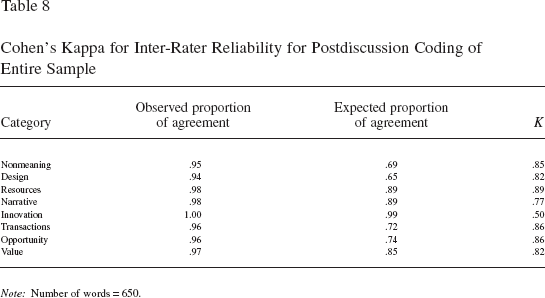
Note: Number of words = 650.
Discussion and Reconceptualization
Managerial discourse demonstrates that the business model is a relevant construct despite the concern expressed by managers that they'd “never tried to define it before” or “could not explain it clearly.” More than 90% of the survey participants attempted to answer the question “What is a business model?” and also provided a response to the question “What is your firm's business model?” Practitioners believe that the business model represented a relevant concept, linked closely to firm performance and survival, and especially relevant to the underlying opportunity that the firm exploits. Practitioner discourse reveals that a business model is an organization–level phenomenon, an architecture or design that incorporates subsystems and processes to accomplish a specific purpose. It is not equivalent to that purpose, nor is it the reason that the organization exists. It is not a process. The business model is not fully explained by a firm's revenue model, though aspects overlap. Practitioners apply both resource–based and transactive elements to the business model. Finally, the business model does not subsume nor is it subsumed by corporate strategy.
Reassessing the Literature
The lack of coherence or convergence in the literature lends additional importance to construct assessment and the identification of future research directions. Our analysis of the language of business models in practice presents specific clues for understanding business models in the broader context of organizational theory. First, the language of innovation is almost entirely absent from practitioner perceptions about business models. This is not to say that business models cannot be innovative, nor that innovation plays no role in business model formation or change, but that innovation is not, per se, a fundamental element of a business model. Similarly, although the literatures on narrative present compelling arguments for the importance of sensemaking and legitimization in the context of business model formation and change, the language of narrative and legitimization does not form a critical component of the business model construct in practice. The narrative may present a potentially useful abridgement of the complexity of organizational history in appreciating or contextualizing a firm's rationalized strengths, but understanding business models as a form of subjective and often retroactively adjudicated narration does not match practitioner language. For now, legitimization appears to be relatively distinct from the underlying business model components.
Alternately, the discourse analysis supports research streams linking business models to resources and transactive structures. The deductively derived transactive construct (Amit & Zott, 2001) matches the language and utilization of practitioners, describing a structure encompassing the nature and content of boundary–spanning transactions with organizational partners. The positioning of the firm's interactions and the configuration of the firm's transactional content features prominently in practitioner discourse; the nature of transactional characteristics similar to the transactional types described by Amit and Zott also recur in practitioner language. At the same time, practitioners describe elements of the firm's resource structure, especially core activities and capabilities, as commonalities in the overall business model. This resonates with extant research on activities and capabilities, and closely matches research on business models conducted in the life science fields, which emphasize scale economies and knowledge coordination structures.
The discourse analysis, both at the conceptual level but especially at the deeper layer of word frequency, emphasizes the relevance of opportunity in the business model construct. In particular, practitioner language focuses on three aspects of opportunity enactment: execution, goals, and ideas. A business model narrows entrepreneurial ideation to a definable opportunity, establishes the relevant goal set that drives entrepreneurial action and organizational investiture, and bounds the implementation of organizational activities that enact the opportunity. The business model develops in parallel with the entrepreneur's knowledge and resource base as the organizational structures are developed that will ultimately create value by exploiting the underlying opportunity. In this framing, the business model is both an enabling and limiting structure for the firm's accumulation and deployment of resources (e.g., Amit & Zott, 2001; Garnsey et al., 2008; Mahadevan, 2000; Morris et al., 2005; Tracey & Jarvis, 2007). The assumptions driving the development of a business model and its implementation activities ultimately provide specificity to the opportunity itself.
Business Model as Opportunity–Centric Design
Few of the business model definitions in the literature are based on rigorous inductive or deductive logic. This discourse analysis presents an integrative framework for understanding business models in the practitioner context and reconciles some of the disparities between the rigorous work on transactive structures, organizational theory in relatively mature sectors, and the assessment of business models in entrepreneurial contexts. Emphasizing the entrepreneurial aspect of business model development and change productively focuses attention on the opportunity–centric nature of business models. Business models are not the activities, but the structures that bound and connect the firm's core activity set in service to a specific set of goals (Winter & Szulanski, 2001). For small and medium–sized firms, the resource structure and transactive structure interact to create and capture value directly associated with the firm's primary opportunity. Focusing on the for–profit sector, specifically for small and medium enterprises (SMEs) that function as a single business unit, we can define that a business model is the design of organizational structures to enact a commercial opportunity.
This definition presents four distinct advantages over other definitions in the literature. First, it more accurately reflects use in practice. Second, it distinguishes the business model from the definition of strategic management (Nag et al., 2007). Third, it aligns the business model with opportunity discovery, ideation, and enactment, linking the currently fragmented streams of research. Finally, the reconceptualization establishes clear directions for future research on business models, particularly within the entrepreneurial framework.
Business Model Dimensions
The discourse analysis and the opportunity–centric framing of the business model yield three dimensions to the organizational structures noted in our definition: resource structure, transactive structure, and value structure. Resource structure refers to the static architecture of the firm's organization, production technology, and core resources leveraged to serve customers. Transactive structure is the organizational configuration that determines key transactions with partners and stakeholders. Finally, value structure is the system of rules, expectations, and mechanisms that determine the firm's value creation and capture activities. The characteristics of business model dimensions are discussed below.
Many business model analyses focus on the firm's product or production technology, which fits a contingency argument, i.e., firms with similar products and production technologies to present business models with similar characteristics. A significant majority of our survey participants mentioned product, production technology, or resource type in either the definition of a generic business model or a firm's specific business model. For example:
[130] The process of employing capital and resources, people, process and technology, to produce goods and services which will satisfy the needs of communities of customers thereby creating economic value for all the stakeholders involved.
The business model “resource structure,” however, should be distinguished from the value–differentiating resource characteristics of the firm. The resource structure of a business model is the organizational configuration of resources, capabilities, and activities independent of any subjectively or objectively derived value for those resources. We believe this is an improvement on routine, activity, or flow–based business model frameworks. First, a business model as an interdependent bundle of routines (Winter & Szulanski, 2001) presents a low–level map of the firm's activities, which does not fit with the higher–level perspective of the business model in practice. Second, although core value–creating activities may be closely tied to organizational structures at extremely small firms, the growth of administrative structures even in medium–sized firms serves to coordinate those activities, distancing the business model characteristics from specific activity characteristics. Activity–level analysis risks obscuring similarities between firm business models behind idiosyncrasies associated with nonrelevant distinctions, such as local organizational regulations and cultural exigencies. Finally, we note that the general framework for routines and activity–based analysis is grounded in large, mature organizations (Nelson & Winter, 1982), whereas the opportunity–centric nature of the business model construct is most clearly understood in SMEs.
The underlying elements of resource structure are therefore the general form of organizational structure, the nature of the firm's primary production systems, the structures that support the development and accumulation of critical value–bearing resources, as well as the implicit aspects of organizational structure, like culture, that coordinate activities. Each of these elements may be dissected into a variety of underlying organizational components, but some of the most interesting characteristics of resource structure function in a holistic manner in service to the underlying opportunity.
The decision to open an organics–focused co–op rather than a traditional convenience store is primarily a business model, rather than a resource–based decision. A low–density architecture that engenders casual hierarchy, cooperative culture, and limited investment in infrastructure is a key component of the resource structure that coevolves with the organization's resource and activity bundles. All of these may then feed into a strategic positioning of the business within the community market for groceries, perhaps as a high–price niche provider to a health–focused market segment. The resource structure provides the architecture in which the firm's potentially strategic resources are embedded without necessarily determining or deriving from a strategic plan or decision. It seems obvious that resource structure and resource strategy would coevolve, so research on business model and strategy coevolution holds much potential. Similarly, the resource structure of early–stage biotech and pharmaceutical companies may not be obviously linked with the firm's dynamic positioning within the industry and are more reflective of founder/entity opportunity enactment. In this case, resource structure and strategy intersect at the development of unique intellectual property that will determine whether a viable opportunity is successfully enacted, but some resource structures are more likely than others to enable the development process, regardless of the underlying value of the resources at stake or the specific strategic activities of the firm, such as network and partnership development.
The discourse analysis reinforces the importance of transactive structure. This is well–aligned with rigorous studies on business models (Amit & Zott, 2001), but suggests the inclusion of the interactions between the firm and its key stakeholders—namely employees and shareholders. The transactive element of business models presents a macro–level architecture that can be directly linked to the firm's value creation outputs. This is particularly relevant for differentiating the variety of business models of firms utilizing novel ICTs. The literature provides a set of characteristics for transactive structures based on transaction cost economics (Williamson, 1979) and on business model–specific research (Zott & Amit, 2007); the challenge lies in characterizing the structures, rather than the content of the transactions. Two of the firms from our pilot interviews develop and sell drug assay tools to organizations that perform high–throughput screening of drug targets. The underlying technologies are dramatically different, and the diseases for which the technologies are targeted are completely distinct, but the characteristics of the underlying transactions, and the organizational structures that configure those transactions, demonstrate significant similarities.
Differences in cost structures and sourcing linked to product specificity differentiate the resource structures for these firms, but many components of the transactive structures for these companies may be nearly isomorphic. Much of the transactive structure research has focused on transactive structure–dominant businesses, such as e–businesses, generating yielding useful descriptive components of transactive structure such as efficiency and lock–in (Zott & Amit, 2007). But significant research remains to unpack the nature of intrafirm–level transactive structures in the broader context of organizational behavior outside the e–business sector. The transactive structure holds great promise toward explaining business model development and performance, but more research on processes and outcomes is needed to fully understand the rich repertoire of transactive structure characteristics.
A common element across practitioner perspectives and the literature on business models is value, but business model value incorporates structuration of value creation and capture in the context of opportunity enactment. Value structure is the organizational system that defines, supports, and controls the processes of value creation and capture. Value structure serves as the facilitator between the nature of the underlying opportunity and the enactment of that opportunity via resource and transactive elements. It is the differentiating point of entrepreneurial cocreation that establishes the boundaries and enabling mechanisms for entrepreneurial action, mediating between the fundamental opportunity and the entrepreneur's perceptions of the opportunity landscape. As the firm acts to exploit the opportunity, the elements of value creation and capture likely adjust with the development of resources and boundary–spanning transactions. The value structure, however, may remain relatively constant, providing the high–level guidelines that link the entrepreneur's perception of available value to strategic decisions to maximize value creation and capture.
Business Models, Strategy, and Entrepreneurship
Establishing construct boundaries is a necessary precursor to directing future research. The data link the business model and strategy at both the response– and word–unit levels of discourse. At the same time, managers perceive important distinctions between the constructs. Explicit references to strategy occurred in only 10% of the responses and less than 5% of the word units. Disentangling the business model from strategy requires explicit construct boundaries, enabled by comparing the inductively developed business model definition against a socially constructed definition for strategic management: “the major intended and emergent initiatives taken by general managers on behalf of owners, involving utilization of resources, to enhance the performance of firms in their external environments” (Nag et al., 2007, p. 944). Careful consideration reveals straightforward distinctions between the two constructs.
First, strategy is a dynamic set of initiatives, activities, and processes; the business model is a static configuration of organizational elements and activity characteristics. A strategy may be reflexive, initiating change within the organization that impacts the emergent strategy; a business model is inherently nonreflexive. Implementing a business model may generate organizational change, but the business model itself is not a description of or recipe for change. Business models are opportunity–centric, while strategy is competitor or environment centric.
A business model is the organization's configurational enactment of a specific opportunity; strategy is the process of optimizing the effectiveness of that configuration against the external environment, including the potential to change the configuration, alter the underlying opportunity, or seek out new opportunities. The cognitive processes associated with opportunity identification and enactment focus may or may not incorporate firm–level strategic thinking, but the firm formation decision is based on the enactment of an opportunity through an explicit or implicit business model. Firm formation establishes a resource structure, no matter how rudimentary; enactment of any opportunity establishes a transactive structure linking the firm and at least one external entity; firm viability requires a value structure that creates and captures some minimal value to replenish or augment the firm's resource base. The business model is therefore a core building block of the entrepreneurial enactment process.
Implications for Theory
The opportunity–centric reconceptualization of the business model presents a useful framework to assess impact on firm behavior and outcomes. A significant element of business model configuration lies in the relative dominance of business model structural elements, whether purposeful or emergent, with implications for organizational effectiveness, strategic fit, and structuration within the environmental context. Dimensional dominance occurs when one business model dimension obtains relatively more resources or importance within the firm's configuration of activities and efforts. Dimensional parity occurs when a firm develops opportunity exploitation with equal focus on two or all three dimensions.
Resource–Structure Dominance
Technology, product, and process innovation and optimization codetermine industry evolution (Utterback & Abernathy, 1975) and firm behavior (Wernerfelt, 1984). Resource structure–dominated firms are likely to see firm evolution as a function of product development, where improved technology and products drive market reach and product adoption. Firm viability depends on accessing and leveraging resources with inherent, marketable value. In this framework, firm performance is a direct outcome of effective resource procurement, transformation, and delivery. Venture capital firms commonly refer to early–stage firms operating under strict resource dimensional dominance as “technologies in search of a market.”
It is not surprising that many firms focus on resource structure in their business model. Although the resource theme was not the most commonly mentioned element in responding to the general question (Q1) “What is a business model?”, responses to the question (Q2) “What is your firm's business model?” consistently incorporated aspects of organizational structure, production technology, and key resources. Two examples include:
[21, Q2]: A consulting model where a team of consultants execute projects and bring in improvements required/designed by the customer. [96, Q2]: We design and manufacture products, systems and services for electricity utilising revenue management. Understand the customer needs, develop a product which is flexible, sell concept to customer, improvise and capture the niche market. As the product gets older competition steps in, increase value addition in terms of features and compete in market. Keep innovating ahead of competitors. Most of the sale is through tenders.
Resource structure–dominant firms accommodate change by altering resource allocations, acquiring and deploying novel resources, and reassessing business model viability based on fitting the firm's available and potential resources against the perceived opportunity. Such organizations may be actively assessing strategic options associated with other business model elements, such as markets, boundary–spanning transactions, and even the nature of value, but the dominance of the resource structure, either in the minds of managers or diffused in various organizational routines or systems, drives behavior toward resource–based adaptations. Resource structure–dominant business models are likely most efficient in less rugged opportunity landscapes where variations based on small modifications of definable resources can be effectively assessed without requiring distant search processes. These business models may be vulnerable in shifting landscapes where distant search is costly and resource scale economies are highly localized.
The biotech company developing novel drug development assays in our pilot study is heavily resource–structure dominant. The firm was organized more than 15 years ago to prepare a long–term commercialization of leading edge and unique intellectual property developed at a major research university. Founders, investors, and managers believed that the revolutionary technology would ultimately generate extraordinary value despite the lack of well–defined market applications. The firm has consistently grown its patent portfolio, hired experienced management willing to make long–term commitments, trained scientists in–house, and focused on identifying, discovering, and controlling techniques and skills internally. Changes in the patent landscape, the downstream industry and markets, and even the financing environment have led to modifications of organizational structure and technology development efforts without any significant changes in the firm's boundary–spanning transactions, including its financing plans, or intended value creation/capture mechanisms.
Transactive–Structure Dominance
Transactive elements of business models focus on the nature of boundary–spanning transactions (e.g., Amit & Zott, 2001; Mahadevan, 2000). Rather than the transaction as the unit of analysis, we draw attention to the organizational structure that governs boundary–spanning transactions and intra–organizational transactions. Transactive structure is the configuration and set of characteristics of the organizational structure that determines and defines key transactions with partners and stakeholders. The discourse analysis revealed the importance of transactive structure to practitioners in business model configuration. The following response to “What is your firm's business model?” underscores this emphasis:
[19, Q2]: Catering to a niche market, we sell our products directly to customers [on order] through interior decorators and fashion houses. [85, Q2]: We are basically an advanced ceramic manufacturing company which also provides service through installation technology and total refractory management (TRM) for our customer to provide more value in what we and our customer are engaged with.
Transactive structure–dominant business models focus attention on the structures and systems that determine and execute boundary–spanning and intrafirm transactions. These models benefit from resilience to changes in resource costs and function effectively when scale economies in transactions demonstrate significant learning and tacit knowledge effects. A disruptive innovation (Christensen, Verlinden, & Westerman, 2002), competence destroying or not, will only significantly impact transactive structure–focused firms if complementary asset availability significantly changes resource procurement dynamics, or if changes in value structure alter the nature of customer business models as well.
The weakness in transactive–structure dominance lies in the potential for discontinuous changes in the nature of boundary–spanning transactions, which appear to be more rare and unpredictable than technology disruptions. For example, retail music stores survived a variety of changes in media formats and studio distributors but were effectively wiped out by iTunes and Digital Rights Management, which completely altered the music purchasing experience. The web services and software firm focused on the music industry in our pilot study transitioned from resource–structure dominance to transactive–structure dominance during the same period of turbulence in the music industry. The firm was founded to provide services to musicians primarily through the accumulation of a catalog of independent music that would generate bargaining power with music distribution channels. Industry and economic turbulence handicapped this resource structure–dominant model, and the company completely changed to a transactive–structure dominant business model focused on the nature of transactions with musicians and music producers—in effect the firm helped create a viable supply chain for independent and hobby musicians. Although the firm has begun to develop the catalog, the effort is secondary to the firm's focus on the workings of the supply chain.
Value–Structure Dominance
Value structure is the least understood dimension, despite the fact that performance is a cornerstone of strategic management (Nag et al., 2007). Because value is an inherent output of surviving firms, strategic performance research focuses on the relative effectiveness of value creation and capture in the context of competitor performance, rather than an absolute measure of value creation and capture. The system of rules, expectations, and mechanisms that determine the firm's value creation and capture activities must be considered holistically, rather than as independent mechanisms such as mission, governance, and incentive. This is particularly true for variations on value capture. The survival bias of most organizational research excludes consideration of nonobvious structures; recent activities in not–for–profit and double–/triple–bottom line organizations suggests that the rarity of certain value structures was due in part to variants of institutional pressures and preferences rather than nonviability.
Firms exemplifying value–structure dominance are rare, as commercial organizations likely take value structure for granted as a system that utilizes boundary–spanning transactions to generate profits that are recycled into organic growth or distributed to owners. True value–structure dominance would require that the firm's focus is primarily on the underlying mechanisms of value creation and capture. A monetization value–structure dominance would yield an investment model indifferent to sunk costs and nonvalue driving expertise, devoid of personal or organizational priorities or preferences. A few of the survey responses show a focus on aspects of value structure interlinked with resources and transactions:
[76, Q2]: Create high value product and service relevant to customer perception with changing difficult times and enhance all stakeholder values continuously.
An organization's value structure may center on one or more aspects of opportunity enactment, rather than on the monetization process. None of the organizations in our pilot interviews could be considered value–structure dominant. The continuing success of Craigslist.com, an Internet classifieds business, may be an example of nontraditional value–structure dominance, based on the apparent contradiction between the traditional transactive structure requirements of venture and corporate investors and the founder's long–term values embedded in the organization, such as accessibility over commercial success (Richtel, 2004). Value–structure dominance may be instigated by technology affinity when scientific entrepreneurs value market adoption over financial returns (George & Bock, 2008).
Directions for Future Research
This study opens pathways for future research on business models and entrepreneurship. We identify four broad areas for future research on entrepreneurship below.
Discourse Analysis of Entrepreneurial Activity
Discourse analysis has been used extensively in other areas of social science research (Weber, 1990) but has not been systematically applied to the entrepreneurial process. Entrepreneurial enactment takes place in a variety of environments that present challenges to observation and measurement. Early–stage entrepreneurial activity often comprises a limited number of participants and observers, limiting data collection mechanisms and objectivity. Discourse analysis may help identify broad patterns in entrepreneurial psychology and decision–making processes and isolate particular characteristics and actions unique to entrepreneurial circumstances. Discourse analysis may be flexibly applied to a variety of text–based inputs, including interviews, corporate documents, or even meeting notes and recordings. Of particular benefit would be longitudinal analyses of business model structures at firms to determine how structures change as firms transition from opportunity enactment to opportunity management. Productive research could compare business model discourse between types of entrepreneurial founders, such as technical vs. nontechnical, serial vs. new, or visionary vs. reluctant entrepreneurs. Alternatively, one can assess entrepreneur and firm outcomes by comparing business model characteristics identified by the entrepreneur vs. characteristics presented by the organization, either through observation or text from business plans and press releases.
Interactions of Business Model Dimensions
Resource, transactive, and value structures do not operate in isolation; organizations are complex systems of infrastructure, resources, and human interactions (Bower & Doz, 1979). The static framing of the business model construct does not require that the underlying structures, or the summative business model itself, be unchanging phenomena. In addition, the underlying elements of the dimensions are influenced by each other, whether directly through individual agency or via organizational routines. The underlying dimensions of the business model in practice could be studied for interaction effects. The business model is not a process, but it is shaped by individual–, group–, organization–, and environmental–level processes and events.
Research on dimensional interaction could assess whether static “fit” between characteristics of dimensions determines the probability and form of dimensional dominance. Additional research could develop scales for dimensional dominance or parity across two or all three dimensions. Understanding the nature of dimensional interaction represents a potentially informative area of study, and processual studies of business model change could describe how dimensional dynamics interact with underlying changes in the opportunity landscape. This could be an important stepping stone to a rich explanation of entrepreneurial cognition within an organizational context. The literature on business models has focused on business models as configurations of product and market combination that evolve in response to exogenous shocks; improved understanding of the interaction of business model dimensions could present a picture of subtle linkages between entrepreneurial cognition and organizational change.
Business Models in Opportunity Creation
Research on the relationship between the business model and opportunity creation may help identify layers of entrepreneurial activities between opportunity identification and organizational formation. A first step could be a cognitive model linking opportunity landscape assessment to business model design. Business model structures are a milestone, enabling comparison of important characteristics across organizations: development speed, resource acquisition, resource acquisition, and path dependence. A better understanding of business model structures could help answer a variety of questions about entrepreneurial activity. Are unique business model characteristics correlated with improved survival or performance? What are the key factors in the legitimization process associated with the implementation of innovative business models? Are some sectors (or customer types) more accessible to novel business models?
An interesting opportunity for research could bridge business models with the development of routines. Business model structures establish the context and boundaries for activities and processes associated with resource and capability development and boundary–spanning transaction formation. Empirical studies could identify business model characteristics that impel or hinder routinization or routine evolution.
Business Models and Entrepreneurial Outcomes
The business model is commonly linked to firm survival and long–term performance, but research on this relationship needs to expand beyond product and transaction characteristics. It is likely that novel data sets will be necessary to assess aspects of business model structures as the characteristics of these structures may require more sophisticated measurement. This research offers the potential to bridge studies of entrepreneurial cognition and affect with research on organizational growth by developing models for the impact of business model structures on economies of scale and scope and legitimization effects. Such research could result in normative models for multiple outcome types, including resource acquisition, development of boundary–spanning transactions and networks, survival and performance, and possibly even industry–level outcomes such as novel product standards and adoption characteristics.
Conclusions
Despite more than 15 years of interest and enthusiasm for developing, understanding, and applying business model frameworks, rigorous research on business models remains in a nascent stage. The fragmentation of definitions and constructs has precluded integrated and accretive research on business models, especially beyond the e–business sector. Based on an inductive study of practitioner perceptions, our reconceptualization presents an opportunity–centric perspective of the business model based on underlying dimensions of resource, transactive, and value structures. The interaction of business model dimensions potentially explains a variety of patterns in business model practice as well as the disparity in research to date. The findings of this study have potentially significant implications for entrepreneurship research. Entrepreneurs, either in venture creation or venture change stages, may assess opportunities based on the perceived importance of business model dimensions; the same opportunity may look different through a specific dominance lens. An integrated approach to research on business models presents an opportunity to unlock entrepreneurial processes, evaluate firm configuration effects, and explain and predict entrepreneurial outcomes.