







Abstract
Social exchange theory provides the basis for developing a model where collaborative communication from the franchisor relates positively to commitment, and commitment relates negatively to franchisees’ propensity to leave the relationship. We analyze data from a unique dataset of 200 franchisees and find partial support for this model; franchisor communication positively relates to one dimension of franchisee commitment, and one dimension of commitment negatively relates to propensity to leave. The study expands franchising theory by examining the franchising relationship from a social exchange perspective and by empirically demonstrating the important role commitment plays in the franchising context.
Franchise systems represent a unique entrepreneurial business structure because they include several different organizations that are legally independent from one another, economically interdependent on each other, and operationally indistinguishable from each other (Parsa, 1996). These dynamics have led researchers to develop several different research streams and theoretical approaches for examining franchising. While the phenomenon has garnered attention across disciplines, the most significant streams of research have examined franchising through the lens of: (1) agency theory, which focuses on franchisees as self–motivated local managers who require little monitoring (e.g., Carney & Gedajlovic, 1991; Shane, 1998); and (2) resource scarcity theory, which focuses on franchising as a way to gain access to financial and human capital (e.g., Kaufmann & Dant, 2001).
Despite multidisciplinary research in franchising, little research has examined the dynamics that impact the nature of the franchisor–franchisee relationship. Evidence suggests that researchers need to focus more on how relationship dynamics affect franchisee consequences, such as why franchisees exit (Frazer & Winzar, 2005). For that reason, researchers have begun to emphasize social interactions (e.g., trust and relational norms in the relationship) in franchising as a way to attenuate agency problems (Cochet, Dormann, & Ehrmann, 2008). Recent research has also begun to focus on relationship–building behaviors that reduce conflict and develop strong partnerships (Chiou, Hsieh, & Yang, 2004). One of the largely missing elements in this developing stream of literature, however, is a well–specified theoretical foundation to explain relationship dynamics and outcomes (Combs, Michael, & Castrogiovanni, 2004).
Researchers have also overwhelmingly focused on the franchisors’ perspective regardless of theoretical underpinning, providing little understanding about the behavior and motivations of franchisees. Thus, scholars have called for a greater need for theory and research specific to franchisees (Combs, Ketchen, Shook, & Short, 2010; Combs et al., 2004). Because of the need to understand the relational variables that lead franchisees to want to remain in the franchise relationship, there is a need to focus on franchisee perceptions. This may allow greater insight into how franchisors’ strategic decisions impact the commitment and motivation of franchisees and their intent to remain.
The overarching purpose of this study is to develop a theory to gain more insight into the franchisor–franchisee relationship from the perspective of the franchisee. Specifically, we develop social exchange theory (SET) in the franchise context. SET has been widely used to explain why individuals and firms enter, maintain, and exit relationships (Macneil, 1980). Over time, positive elements of the relationship can influence a partner's willingness to stay, and likewise, a lack of alternatives can increase motivation to maintain the relationship (Thibaut & Kelley, 1959). For this reason, relationship commitment represents a central tenet of SET. While commitment has been widely studied in other disciplines, entrepreneurship researchers have given limited attention to the multiple dimensions of commitment potentially at play in the franchisor–franchisee relationship.
We add to the franchising literature by demonstrating how the affective, normative, and continuance dimensions of commitment create different motivations that can prevent or encourage franchisees to exit the franchising relationship. Further, the use of SET to explain franchisor–franchisee relationships offers a different theoretical perspective that will hopefully generate greater research attention on how franchisors and franchisees perceive their exchange relationship and how this impacts key outcomes.
Literature Review and Theory Development
SET describes a series of ongoing, negotiated exchanges that take place between parties and often induce obligations between the parties (Emerson, 1976). The core assumption is that individuals and firms enter, maintain, and exit relationships based on the expected rewards that accompany them (Blau, 1968; Thibaut & Kelley, 1959). SET represents a theory well–suited to explain not only why franchisees enter into relationships with franchisors, but also what makes them stay. With SET, the series of negotiated exchanges that take place between parties (i.e., between a franchisor and franchisees) help shape decisions about whether to invest more effort in the current relationship or seek alternatives.
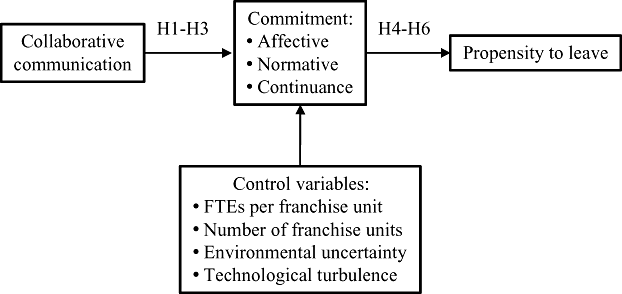
Communication patterns between exchange partners help shape the perception of obligation between parties. Collaborative communication—i.e., communication that is frequent, rational, reciprocal, and either formal or informal—represents one of the main mechanisms that franchisors use to communicate with their franchisees, as illustrated in the theoretical model in Figure 1. If the outcome of exchanges between franchisors and their franchisees remains positive over time, both parties have increased trust and increased commitment to the relationship (Lambe, Wittman, & Speckman, 2001). Consistent with SET, our model includes three dimensions of commitment (affective, normative, and continuance).
Theoretical Model
Whether the outcomes of the exchange relationship (such as commitment) remain positive or negative, an individual (such as a franchisee) will compare his or her outcomes with outcomes of other exchange alternatives (Lambe et al., 2001). Judging relationship rewards (outcomes) represents a key component that illustrates how individuals and firms operationalize social exchanges. Individuals use two outcomes as the basis for judging relationship attractiveness: the comparison level and the comparison level for alternatives (Thibaut & Kelley, 1959). The comparison level represents the standard level of outcome (rewards or costs) associated with a specific relationship and serves as a benchmark for determining attractiveness and the accompanying level of satisfaction with a relationship (Anderson & Narus, 1984). The comparison level for alternatives looks at the average relationship outcomes available from the most attractive alternative exchange relationship(s) (Thibaut & Kelley) and uses this as a minimum standard of performance (rewards) required to stay in the current exchange relationship (Lambe et al.).
Franchisors therefore must establish franchisees’ commitment and reduce their propensity to leave in pursuit of alternatives. Franchisee propensity to leave has great significance to franchisors, in part because franchisors have invested time and money in selecting and training each franchisee, so propensity to leave is the core construct in this study. Thus, SET accounts for the relationships and constructs illustrated in Figure 1. Each of these constructs receives greater discussion in the following sections.
Franchisee Commitment
Commitment represents a critical dependent variable in business–to–business and interpersonal exchange relationship research. This study defines commitment as “a stabilizing or obliging force that gives direction to behavior” by restricting freedom or binding the person to a course of action (Meyer & Herscovitch, 2001, p. 301). Individuals and firms differ in their reasons for committing to an exchange relationship. Three dimensions of commitment—affective, normative, and continuance—were developed in recognition of this notion. Originally focused on the individual, these three dimensions have been extended to the firm level of analysis (e.g., Gundlach, Achrol, & Mentzer, 1995). Scholars suggest each dimension develops in a different fashion, resulting in different motivations and behaviors (Meyer & Allen, 1991).
Each dimension of commitment represents a different reason why a franchisee might be drawn to the franchisor. Affective commitment represents an emotional attachment to the relationship (Meyer & Allen, 1984, 1991). Franchisees with strong affective commitment have established some sort of emotional connection to the franchise organization and like being in the relationship. Normative commitment, the second dimension, reflects a mindset of obligation to remain in the exchange relationship (Meyer & Allen). Franchisees with high levels of normative commitment feel a strong sense of obligation to the relationship (Meyer, Allen, & Smith, 1993). Continuance commitment (or calculative commitment in the marketing channels literature) represents the third dimension and reflects recognition of switching costs associated with leaving (Meyer & Herscovitch, 2001). Franchisees with high levels of continuance commitment view relationship switching costs as too high to leave their franchisor. Social exchange theory suggests that franchisors who want to grow as well as maintain their current base of franchisees need to examine each dimension of commitment to understand what holds their franchisees to the relationship.
Propensity to Leave
Propensity to leave constitutes the perceived likelihood that a partner will terminate the relationship in the near future (Bluedorn, 1982). Propensity to leave represents a key dependent variable in this study because the relationship between propensity to leave and actual turnover is consistently strong and positive (e.g., Griffeth & Hom, 1988; Hom & Hulin, 1981). Additionally, propensity to leave represents a key attitudinal outcome that can provide insight about the quality of the relationship between the franchisee and the franchisor.
Collaborative Communication
Communication may be the most important element in successful inter–firm exchange relationships (Bleeke & Ernst, 1993). Communication from customers or business partners, even in the form of a complaint, provides organizations with intelligence, prior warning, and a greater awareness of the company or competitive environment (Rice, 2008). Communication remains a critical feedback mechanism in regards to performance and the direction of future relationships (Anderson & Narus, 1990), and it fosters confidence in the continuity of the relationship (Anderson & Weitz, 1989). Scholars suggest that communication represents a key element in developing and maintaining good channel relationships in “quasi–integrated” channels such as franchising (Anderson & Narus; Mohr & Nevin, 1990).
“Communication” represents an overly broad phenomenon so this research focuses on collaborative communication. We extend collaborative communication from research in the buyer–supplier context (Joshi, 2009) to franchising, and define it as the extent to which franchisors communicate to influence franchisees on a frequent, formal, rational, and reciprocal basis.
Communication frequency, defined as the amount of contact between franchisees and franchisors, represents an important element in social exchange because “the most carefully designed relationship will crumble without good, frequent communication” (Bleeke & Ernst, 1993, p. 16). Frequent communication signifies close, committed ties (Huber & Daft, 1987), reduces operating costs (Cannon & Homburg, 2001), decreases organizational conflict, and increases cohesion among teams (Peters & Fletcher, 2004).
Reciprocal feedback refers to communications where franchisees and franchisors “talk with” as opposed to talk past one another, emphasizing the importance of “two–way” conversations (Joshi, 2009). Exchange partners give more time to partners with whom they have good feedback (Anderson, Lodish, & Weitz, 1987). Feedback reduces uncertainty and ambiguity (Daft & Lengel, 1986) and positively influences financial performance (Huselid, 1995).
Communication formality refers to the extent to which contacts between franchisors and franchisees are routinized, planned, or structured as opposed to unplanned, fleeting, or ad hoc (Mohr, Fisher, & Nevin, 1996). The formality of communication often provides an assessment of the underlying routine and structure of communication (Carr & Pearson, 1999). Informal communication materializes over a history of social exchange and remains unique to each relationship. Often intended to change beliefs and attitudes, the nature of informal communication leads to an environment where partners can support and nurture each other. In contrast, formal communication is more “direct” and seeks to change behaviors by implying or requesting specific actions (Peters & Fletcher, 2004). It also positively influences exchange relationships from both the buyer's and seller's perspectives (Carr & Pearson; Prahinski & Benton, 2004).
The final component, communication rationality, is defined as a situation where the franchisor presents reasons accompanied with supportive information for the franchisee to comply with a request (Payan & McFarland, 2005). Similar to Gundlach and Cadotte's (1994) “information persuasion” influence strategy, rationality represents a noncoercive influence strategy that ensures a complete argument structure (consisting of the three structural elements of a claim, data and warrant). Research demonstrates it is significantly more effective than other strategies and has the greatest positive impact on compliance (Payan & McFarland). Thus, communication rationality likely positively affects social exchange relationships.
Collaborative Communication–Commitment Relationships
Communication has often been deemed a crucial ingredient in social relationships, and represents a basis for obtaining commitment (Mohr & Spekman, 1994). Supportive communication increases organizational commitment (Leiter & Maslach, 1988) as indicated by a meta–analysis of commitment research showing communication as the antecedent with the highest capacity for predicting commitment (Mathieu & Zajac, 1990). Once a firm has entered into a relationship, communication between exchange partners can influence outcomes such as commitment. This remains in congruence with one of the foundational principles of SET that says exchange interactions result in economic and social outcomes. SET suggests that positive outcomes sustained over time increase firms’ trust in their trading partner(s) and their commitment to the exchange relationship (Lambe et al., 2001). If communication outcomes remain positive, they will likely lead to increased levels of commitment. Communication reduces role conflict and ambiguity (Nygaard & Dahlstrom, 2002), promotes mutual problem solving, and creates synergy between partners (Cummings, 1984), all of which provide evidence of “committed” behaviors (Mohr & Spekman). As illustrated in Figure 1, we contend that collaborative communication should also increase all three dimensions of commitment.
Affective commitment has been the most widely studied dimension of commitment. Emotion, through feelings of affective commitment, plays a significant role in social exchanges (Lawler & Thye, 1999). Since communication also serves as the basis for social relationships (Schramm, 1973), social exchange between the franchisor and franchisee necessitates a positive relationship between communication and building positive feelings among franchisees. Recent research provides an empirical basis that supports the relationship between collaborative communication and affective commitment. Specifically, in a buyer–supplier relationship, collaborative communication creates a sense of community and positively impacts affective commitment (Joshi, 2009; Prahinski & Benton, 2004; Sahadev, 2008). Therefore:
SET asserts that firms maintain relationships based on expected rewards (Thibaut & Kelley, 1959). If franchisees and franchisors realize that success for both partners is closely linked, then the expected rewards of both sides would be reciprocal. The more successful the franchisee becomes, the more royalties a franchisor will receive. Likewise, the more successful the franchisor becomes at branding and building a national/international reputation, the easier it becomes for franchisees to sell their products or services. SET (e.g., Emerson, 1976) clearly states that exchanges between partners lead to obligations. Since the franchisee would not have a business if not for the franchisor's ongoing operation, franchisees could feel a sense of obligation to the franchisor (i.e., normative commitment). It would be to the franchisor's benefit to “exploit” that sense of obligation (i.e., want the franchisee to feel obligated). The use of collaborative communication by the franchisor will engender this sense of obligation by consistently demonstrating that the franchisee and franchisor “are in this together” and that a reciprocal relationship exists between the performance and success of each.
Another line of literature that informs this research comes from the organizational socialization process. Meyer and Allen (1997) linked the socialization process (and internalizing a new set of norms) to the development of normative commitment. Communication partially explains how these norms develop and remain intact. New sets of norms or firm processes cannot be passed on to new members of the organization without communication. Thus, communication in the socialization process for franchisees should lead to normative commitment. Therefore:
Continuance commitment leads the franchisee to feel like it would be too difficult or that there are not enough alternatives. This idea of being “locked in” to the franchisor (Meyer & Herscovitch, 2001) may be similar to Bendapudi and Berry's (1997) “constraint based relationship” where the franchisee believes large economic, psychological, or social exit costs exist in the relationship with the franchisor (Bansal, Irving, & Taylor, 2004).
According to social exchange theory, the comparison level for alternatives relates to the most attractive alternative exchange relationship(s) (Thibaut & Kelley, 1959), and franchisees use this as the minimum standard of relationship performance (rewards) required to remain in the relationship (Lambe et al., 2001). In other words, a franchisee may be prone to consider other business possibilities and then compare those possible outcomes to the current situation. If the franchisee concludes that other alternatives are unattractive because the cost or difficulty associated with leaving and investing in another opportunity is too high, then continuance commitment increases. A franchisor may use collaborative communication as a means to increase continuance commitment by making franchisees feel that the current situation is superior to alternatives, or by thwarting franchisees’ evaluation of other alternatives. In sum, more collaborative communication can increase franchisees’ perceived switching costs and lead franchisees to believe that the effort or disruption to leave would be too great. Therefore:
Franchisee Commitment and Propensity to Leave
Figure 1 illustrates franchisees’ propensity to leave the franchise system as the dependent variable. Propensity to leave refers to the perceived likelihood that a franchisee will exit the relationship in the near future (Bluedorn, 1982). Propensity to leave matters greatly for exchange relationships because it allows parties to take action to repair or improve the relationship before it results in exit.
Consistent with SET, franchisees compare the costs of remaining in an existing relationship to the costs of termination, leading to possible conflicts (Spinelli, Rosenberg, & Birley, 2006). If other exchange opportunities appear more rewarding, then the intention to leave may grow stronger. A franchisee's comparison level for alternatives could account for low levels of commitment and a high propensity to leave. If rewards appear greater in a different relationship, commitment may decrease and propensity to leave may increase. Some social exchange relationships persist even with knowledge of better alternatives because of high financial, social, or emotional costs that would be incurred by leaving (Thibaut & Kelley, 1959).
Previous franchising research has linked commitment and relationship intentions but the sample was limited to a small set of industries and focused solely on affective commitment (i.e., Morrison, 1997). We extend this research to include three dimensions of commitment, as each dimension represents a different reason for the franchisee to be more or less likely to leave the relationship. Franchisees with strong affective commitment stay in the relationship because they want to, those with a high level of continuance commitment stay because they need to, and those with a high normative commitment stay because they feel obligated (Meyer et al., 1993).
Researchers in other marketing and management contexts have examined commitment dimensions. Ko, Price, and Mueller (1997) found that affective commitment leads to lower levels of employee search behavior for alternative employment opportunities. Affective commitment has also been linked to a decrease in absenteeism among nonsupervisory employees (Lyons, Duxbury, & Higgins, 2006), and a greater sense of belonging and identification that enhances the desire to stay with the organization (Meyer & Allen, 1991). Channels research shows that affective commitment reinforces partners’ desire and intention to remain in the exchange relationship (Hansen & Hetn, 2004; Ruyter, Moorman, & Lemmink, 2001).
A supportive exchange atmosphere leads to increased communication, greater agreement and value congruence, and consequently, a sense of identification that likely contributes to a franchisee's motivation to continue the relationship for affective reasons (Kumar, Hibbard, & Stern, 1994). Increased levels of affective commitment (e.g., the franchisee enjoys the relationship with the franchisor) would lead to franchisees staying in the relationship because they want to (Meyer et al., 1993), thereby decreasing their propensity to leave. Therefore:
Normative commitment appears in far fewer studies than affective and continuance commitment. As a result, the relationship between normative commitment and outcome variables such as propensity to leave remains less certain. Nevertheless, a few studies have included normative commitment, and these suggest that normative commitment leads to a lower propensity to leave (e.g., Bansal et al., 2004; Gruen, Summers, & Acito, 2000).
Levels of normative commitment generally remain stable (Allen & Meyer, 1990). This stability may be important in explaining why normative commitment impacts the propensity to leave. SET suggests that positive outcomes sustained over time increase exchange partners’ trust and commitment to the relationship. These positive exchanges also lead to the development of relational exchange norms that govern the relationship (Lambe et al., 2001). Meyer and Allen (1991) suggest that the feeling of obligation that characterizes normative commitment will be manifested through joining and remaining faithful to an organization. Therefore:
In some situations, exchange partners remain in a less rewarding relationship because of high social, emotional, or switching costs associated with moving to the alternative (Thibaut & Kelley, 1959). Continuance commitment suggests that the reason an exchange partner remains committed to an exchange relates to high switching costs from leaving the relationship. Franchisors use switching costs to dissuade franchisees from leaving by imposing initial franchise fees (Norton, 1988). Because franchisees must make an upfront investment for the rights to the franchise, they have an economic incentive to stay in the relationship. Outside of the possible financial loss, franchisees may also be committed because of the time and effort involved in finding another opportunity or because they perceive that no superior alternatives exist. Thus:
Methods
Sample and Data Collection
To test the model, a cross–sectional field study using a single respondent survey method was employed. The survey was designed and pretested on a sample of 38 franchisees drawn from a sample frame of 78 total franchisors with established operations in a state in the central United States; the state used for the pretest was not used for the full study sample. We utilized Bond's Franchising Guide, a well–known and often utilized data source in franchising research (e.g., Dant & Kaufmann, 2003; Shane, 1998) as the source of the sampling frame for the full study. The national frame was culled to 366 franchisors based on several factors. To facilitate data collection, only franchisors operating in a Midwest and a contiguous Eastern state were selected. The frame was also limited by excluding very small (less than 15 units), young (in operation for 5 years or less), and costly–to–enter franchise systems (maximum franchisee investment of $300,000). These were undertaken to protect against the liability of newness (Stinchcombe, 1965) and liability of smallness (Aldrich & Auster, 1986). We chose to cap the investment at a lower amount because high investments create an automatic financial “lock” into the relationship, making it more difficult to assess commitment and propensity to leave. Additionally, interviews with subject matter experts comprising a panel of franchisors, franchise brokers, and bankers who routinely lend start–up capital to franchisees concurred that obtaining financing for franchise investments above $300,000 is difficult for most (e.g., the average downsized mid–level manager or other nascent entrepreneur) prospective franchisees unless they already possess considerable personal wealth. In addition, fast food and lodging establishments were excluded since much research has been conducted in these contexts, and these are generally the franchises with the large upfront investment. Non–fast food and nonlodging units are understudied and calls in research have cited the need for alternative franchise sampling contexts (Dant, 2008).
Potential respondents (franchisees) were randomly selected and contacted by the first author to ask for their consent and participation. The first author called each franchisee in the summer of 2009 and verified that they were indeed the owner. If that franchisee agreed to participate in the study, then they gave their personal e–mail address and were immediately sent a link to the online survey. This data collection method ensured that unqualified employees or managers of the franchisee did not complete the survey questionnaire.
From the sample frame, we reached 268 franchisees, each from a different franchise system. Out of this group, 243 agreed to participate, and 204 completed an online survey. Four surveys were dropped from the study because of significant missing data. The response rate is thus 84% (204/243).
Respondents do not appear to differ from late or nonrespondents. Late respondents or those requiring a reminder telephone call (n = 75) were compared with the remainder of the sample (n = 125) using independent sample t–tests. No differences were observed at the 10% level for the number of franchise units owned, previous franchise ownership experience, education level, marital status, gender, technological turbulence, environmental uncertainty, full–time equivalent (FTEs) employees, and the number of franchise units owned.
We also compared the mean of the sample to that of the frame on select variables and found no differences: franchisor age (
Measures
Development of the measurement scales for each construct in the model proceeded through a series of steps. A review of the relevant literature was first conducted to identify available measures. Since the sampling frame came from a broad range of franchises, we adapted existing measures based on interviews with franchisees, franchisors, and franchising experts. The following discussion provides an overview of the measures for each of the constructs, and the complete set of individual items used for each variable are provided in Appendix A for collaborative communication and Appendix B for all other constructs.
Collaborative Communication
Consistent with previous research, collaborative communication was measured across multiple dimensions: communication frequency, reciprocal feedback, formality, and rationality (Joshi, 2009). Measures for communication frequency were adapted from Cannon and Homburg (2001) and utilized three domains: face–to–face communication, telephone communication, and written communication, with each domain containing three items. These dimensions were assessed by 7–point scales, anchored from 1 (never) to 7 (once per day or more). Cronbach's alpha for communication frequency was .81. Each of the other three collaborative communication variables was a 7–point Likert scale anchored from 1 (strongly disagree) to 7 (strongly agree). Reciprocal feedback was measured with a six–item scale adapted from Fisher, Maltz, and Jaworski (1997). Examples of items in this scale include “the franchisor responds promptly to communications from us” and “the franchisor has great dialogues with us.” Cronbach's alpha for reciprocal feedback was .94. Communication formality measures came from the Mohr et al. (1996) 6–item scale. Examples of items in this scale include “the franchisor has explicitly verbalized and discussed the terms of our relationship” and “the franchisor has conveyed their expectations from the relationship to our firm in detail.” Cronbach's alpha for communication formality was .90. Rationality was measured with three items adapted from Payan and McFarland (2005) and includes items such as “the franchisor shares the results of their past experiences with us in making a case for a particular course of action that they would like us to implement.” Cronbach's alpha for rationality was .93. Means of each of the four collaborative communication variables were utilized, reflective of a second–order approach.
Commitment
The six–item version of affective commitment from Meyer et al. (1993) was utilized. An example of an item in this scale is, “I would be very happy to spend the rest of my career with this franchise.” Cronbach's alpha for affective commitment was .89. Normative commitment includes six items from Meyer et al. Examples of items in this scale include, “This franchise deserves my loyalty,” and “I owe a great deal to my franchise.” Cronbach's alpha for normative commitment was .89. Continuance commitment consisted of five items adapted from Meyer et al. Examples of items in this scale include, “Right now, staying with my franchise is a matter of necessity as much as desire,” and “It would be very hard for me to leave my franchise right now, even if I wanted to.” Cronbach's alpha for continuance commitment was .81.
Propensity to Leave
Propensity to leave is a self–reported measure but research indicates that it relates strongly and positively to actual turnover (Griffeth & Hom, 1988). To operationalize propensity to leave, we included three items adapted from the Morgan and Hunt (1994) study. We added one item that extended the time frame of propensity to leave. This broadened time period likely better represents the time period in which franchisees consider leaving the franchise relationship. Cronbach's alpha for propensity to leave was .94.
Control Variables
Environmental uncertainty and technological turbulence are frequently modeled as control variables (e.g., Celly & Frazier, 1996). They relate to an inability to accurately predict future states, and thus are often associated with a need for more decentralized communication methods. Environmental uncertainty was three items adapted from Celly and Frazier addressing the predictability of business patterns in the industry and the level of sales forecast accuracy. Cronbach's alpha for environmental uncertainty was .82. Technological turbulence was four items adapted from Jaworski and Kohli (1993) addressing items such as the number of new product breakthroughs and the rate of technological change in the industry. Cronbach's alpha for technological turbulence was .92. We also controlled for outlet size. Larger, more successful franchisees may possess more in–house skills and thus require less in the way of communications. Size per franchise unit was measured on an open–ended scale by the number of FTEs per unit franchised.
Construct Validity
We validated the construct measures using CFA, which is most suitable for confirming whether construct measures load on their respective a priori constructs. The overall CFA model is significant (χ2= 1,037.012; df = 461, p< .001). Other fit statistics are mixed: RMSEA = .0792; CFI = .948; SRMR = .0906. According to Hair, Black, Babin, Anderson, and Tatham (2006, p. 753), RMSEA should be less than .08, CFI should be greater than .92, and SRMR should be less than .09 when the n < 250 and m ≥ 30 (in this research, n = 200 and m = 33 or the number of observed items). Given a satisfactory RMSEA and CFI and marginal SRMR, we tentatively accept the overall measurement model. Convergent validity was assessed by examining the scale reliabilities, percentage of variance extracted, and standardized loadings (Gerbing & Anderson, 1992). Appendix B shows the minimum loading was .484 and all remaining loadings exceeded .500. The lowest percentage of variance extracted equals .50 and the lowest scale composite reliability equals .81. The model appears to demonstrate that the items converge on the modeled latent variables. Divergent validity was assessed by fixing noncausal correlations to unity one–at–a–time and then conducting Δχ2(Δ df = 1) tests against the baseline CFA. For example, the test fixing the correlation between collaborative communication and affective commitment to unity resulted in Δχ2of 88.492 (p< .01). All other tests were similarly significant.
Common method variance (CMV) was procedurally addressed in the design of the survey and it was also addressed statistically. To control for CMV, Podsakoff, Mackenzie, Lee, and Podsakoff (2003) recommends several procedures that we incorporated into the survey design. Because we were asking franchisees for their feelings about their franchisors, we promised complete confidentiality and anonymity to reduce the social desirability effect. We also gave respondents the primary researcher's contact information to address any questions or comments that they might have. To reduce the halo effect, we used different scale formats for some measures. For instance, we alternated the Likert scale from agreement questions to semantic differential scales and included reverse–coded items. Finally, we developed the survey instrument over several iterations, incorporating input from academic and industry subject matter experts and conducting a pretest to control for item ambiguity.
Second, from a statistical perspective, we conducted Harman's single–factor test. The first factor explained less than 50% of variance; however, this simply means that multiple factors exist. The Harmon test does nothing to actually control for CMV. As a result, we control for CMV while testing our hypotheses using structural equation modeling (SEM) by controlling for the effects of an unmeasured latent factor (Podsakoff et al., 2003, p. 891).
Results
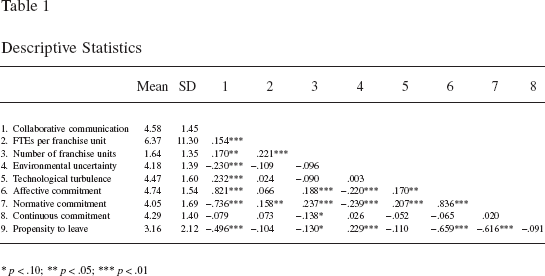
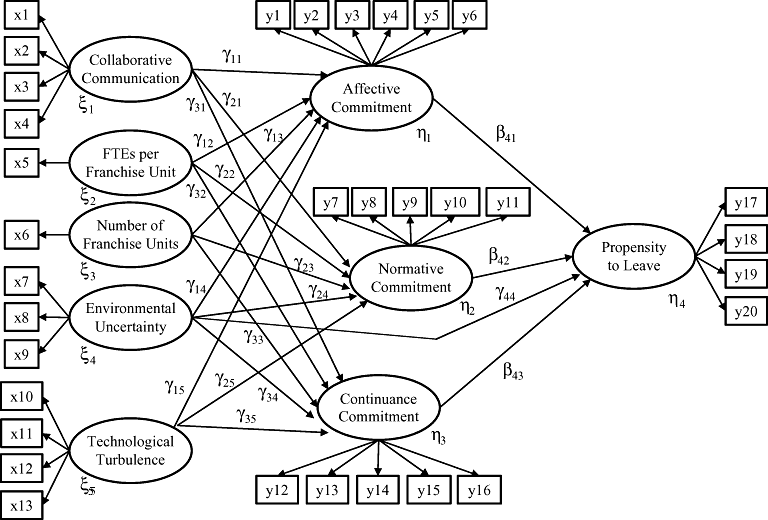
Table 1 shows means, standard deviations, and correlations. Table 2 contains the results of two models: an SEM applied to the model shown in Figure 2 and a CFA showing reproduced partial correlations between pairs of constructs. Each of these models is discussed before the substantive results are presented.
Descriptive Statistics
p< .10;
p< .05;
p< .01
Summary of the Results of Hypotheses Testing

p< .05;
p< .01.
Notes:Structural Equation Model: χ2= 1,045.986; df = 467; p< .001; RMSEA = .0789; CFI = .948; SRMR = .091.
CFA controlling for common method variance: χ2= 795.068; df = 434; p< .001; RMSEA = .056; CFI = .971; SRMR = .047.
Empirical Model
SEM is appropriate and advantageous over multiple regression. Unlike regression, SEM simultaneously estimates measurement error in conjunction with random error in equations. The method is capable of simultaneous estimation of mediation models, such as that in Figure 2, as opposed to estimating separate models in regression. The method provides estimates of total effects and overall fit statistics and fit values. As Table 1 highlights, the overall model χ2was significant (1,045.985; df = 467; p< .001). The RMSEA (.0789) was less than .80 and the CFI (.948) was greater than .92, indicating a good fit. The RMSR (.0906) was slightly greater than .09. As with the CFA, we tentatively accept the overall model fit. The model, respectively, explains 67%, 56%, and 4% of the variation in affective, normative, and continuance commitment. The model explains 33% of the variance in propensity to leave.
The second model in Table 2 accounted for CMV by controlling for the effect of an unmeasured latent factor. All items in the CFA were modeled as a result of their unique theoretical origin as well as a common factor across all constructs. This method does not require the identification of the CMV source. Rather, it assumes that all latent variables are under the influence of a single source, and that method and trait factors do not interact (Podsakoff et al., 2003, p. 891). For this model: χ2= 795.068; df = 434; p< .001; RMSEA = .056; CFI = .971; SRMR = .047.
Our results show that hypothesis 1 is supported. The relevant path in the SEM (γ11 = .819; t= 10.935; p< .01) and the relevant partial correlation in the CFA (standardized estimate = .226; t= 2.293, p< .05) are significant. Hypothesis 2 is not supported, as the partial correlation in the CFA is not significant (standardized estimate = −.076; t= −.679). Hypothesis 3 is not supported as the partial correlation in the CFA is not significant (standardized estimate = −.005; t= −.059). Hypotheses 4 and 5 are also not supported as neither partial correlation in the CFA is significant (hypothesis 4 standardized estimate = −.020; t= −.227 and hypothesis 5 estimate = −.104; t= −1.013). Finally, hypothesis 6 is supported. The partial correlation in the CFA is significant (standardized estimate = −.187; t= −2.318; p< .05).
Finally, of the 13 paths in the SEM that originate from the control variables, three are significant: the number of franchisee units predicts normative and continuance (inversely) commitment and environmental uncertainty predicts propensity to leave. One additional partial correlation is significant in the CFA: FTEs per franchisee unit inversely predicts affective commitment.
Discussion
Two key conclusions arise from this study. First, our results indicate that collaborative communication is related to franchisees’ affective commitment to the franchising relationship. Second, continuance commitment appears as the only dimension of commitment keeping franchisees from leaving the relationship, which is contrary to previous commitment research. We elaborate on each of these conclusions below and offer opportunities for further research.
Collaborative Communication and Affective Commitment
Our findings provide some support for social exchange theory, suggesting that when franchisors communicate with their franchisees on a frequent, formal, rational, and reciprocal basis, franchisees more likely become emotionally attached (affectively committed) to the franchisor. This support for hypothesis 1 replicates recent research in the channels research context (Joshi, 2009), and supports the contention that higher levels of collaborative communication engender greater affective commitment. Further, this finding also coincides with existing theory from the relationship marketing literature, which suggests that communication and commitment are keys to producing valued outcomes in inter–firm relationships (Geyskens, Jan–benedict, Steenkamp, & Kumar, 1996). SET also indicates that relationships based on affect play a major role in exchange relationships (Lawler & Thye, 1999). Thus, our findings reinforce the idea that franchisee commitment often arises from ongoing communication with the franchisor.
We extend previous commitment research to the franchising context by examining collaborative communication's relationship with the three dimensions of commitment described by SET; yet our results do not support a relationship with either normative or calculative commitment. The core premise of SET is that the exchanges that occur between actors shape decisions about whether to maintain or terminate a relationship (Thibaut & Kelley, 1959). However, rather than minimizing SET as an appropriate foundation for examining franchising relationships, perhaps there are other important outcomes of collaborative communication that should be examined. For instance, previous research supports a positive relationship between collaborative communication and knowledge (Joshi, 2009). Thus, examining factors that enhance knowledge capabilities when fostered by collaborative communication, such as idea generation, standardization, new product/service innovation, or integrative process development, could be valuable. Further, because collaborative communication involves two–way conversations with informal feedback, future research should also examine relationship–specific factors such as shared values, solidarity, or relational norms.
Continuance Commitment and Propensity to Leave
Our results indicate that continuance commitment negatively relates to a franchisee's propensity to leave. As the perceived switching costs associated with leaving the franchise relationship increase, franchisees appear less inclined to leave. This finding concurs with franchising research on bonding. Franchisors make a deliberate effort to control opportunistic behavior among their franchisees. To help, franchisors deliberately inflate the termination costs (Norton, 1988), creating the economic incentive to maintain the relationship (Shane, 1996).
Not finding a relationship between franchisees’ affective and normative commitment and their propensity to leave was surprising. Finding that only continuance commitment relates to propensity to leave initially appeared inconsistent with SET and the commitment literature in other contexts. The franchisees in our study remained in the franchising relationship primarily because of feeling trapped and this overshadowed any emotional attachment (affective commitment) or feelings of obligation (normative commitment). Using qualitative data provided from an open–ended question on the survey allowed us to speculate on these null results. Further research will be required to offer more empirical support.
Franchisees frequently noted the impact of the current economic downturn in the United States on their business and commented on the high cost of trying to leave. For instance, one franchisee complained that his franchisor, “has done absolutely zero to help franchisees in the last two years of this economic downturn,” while another franchisee commented that potential franchisees should not consider her industry because it has been “extremely down the last two years … and the economy makes it very difficult for the average franchisee to compete.” One franchisee appeared to come close to apologizing for her survey responses by reporting, “Some of the responses concerning budgeting and goal setting might be more positive in better economic times, but given our current economic state I answered the questions accordingly.” Franchisees commonly noted the economy has had a very negative impact on their business, with one adding that the situation appears particularly bleak “for franchisees that do not have the financial or competence level to run a business in the current business climate.” The current economic downturn appears to have a significant impact on franchisees in this study.
To summarize, we believe our results may reflect how relationships among franchisees and franchisors have been altered by the economic struggles they faced at the time the survey was administered (early 2009). SET suggests that the franchisees would compare their current situation with other available business alternatives (Lambe et al., 2001). Given the bleak economic conditions for businesses in general, franchisees likely concluded that leaving the current franchise for another business opportunity would be difficult and costly, which would increase continuance commitment to the franchisor. Therefore, in a tough economy, affect and any sense of obligation to the franchisor might hold less meaning. The results should not be viewed as evidence that SET does not account for franchising relationships, but instead that data collected in organizations in the past few years potentially reflect a historical anomaly rather than relationships that typically exist. Franchising researchers should re–examine these relationships once the economy improves to see whether franchisees experience different dimensions of commitment under normal economic conditions.
While our findings may represent a temporary shift in dynamics and relationships being shaped by all three dimensions of commitment, future research would also benefit from the examination of other outcome variables. It is interesting to note that there is a disconnect in that collaborative communication does not predict continuance commitment, although continuance commitment still decreases a franchisee's propensity to leave. Affectively committed franchisees might not be able to make the leap from “I like you” to “therefore I will stay”; however, consistent with the relationship marketing literature, an emotional connection could still influence relational outcomes that increase trust, satisfaction, and cooperation, and decrease opportunism and conflict.
Implications for Practice
This study offers implications for both franchisors and franchisees. As a franchisor, the goal of collaborative communication to franchisees is to build commitment and, in turn, get franchisees to remain. However, our results suggest that franchisors should be cautious about putting too many resources into the communication effort if it does not ultimately influence a franchisee to maintain the relationship. On the other hand, previous research shows that continuance commitment is generally a “negative” reason to remain in a relationship (Geyskens et al., 1996), so franchisees might “jump ship” when there are better opportunities. Further, there could be other advantages to maintaining good communications that were not studied here.
Potential franchisees should recognize that franchisors vary in their communication with franchisees and in their ability to address critical issues. Before deciding to purchase a franchise, potential franchisees should understand the communication structure of the franchisor and the commitment levels of existing franchisees.
Limitations
Our study has some limitations that should be noted. One important but unanticipated outcome of this study is the demonstration of the impact of CMV in this research. While we did take measures to mitigate its effects in the survey development stage of the research, Podsakoff et al. (2003) contend that researchers can still have difficulty finding a procedural remedy and may need to use a statistical remedy as well. When we used a statistical remedy offered by Podsakoff et al., our results were altered. Franchising researchers have paid little attention to the CMV issue, largely because much of the research has incorporated archival data. However, as surveys become a more common approach, the field will need to pay more attention to CMV going forward. We call attention to the issue here in the hope that our study will encourage franchising scholars to take a more rigorous approach to CMV.
A second limitation involves the use of one rather than multiple franchisees within a single franchise for the study. This would have been especially helpful for the communication construct in order to validate responses. Our interest involved providing an initial test of the hypothesized relationships in our model. Researchers should extend our work by testing the relationships with multiple franchisees.
Conclusion
The future of franchising research is ripe with opportunity to examine the franchisor–franchisee relationship by grounding it in theoretical frameworks offered in both marketing and organizational behavior. Because of the importance of franchising in the domestic economy, and certainly given the recent hardships suffered by so many small businesses, examining the franchising business model, and specifically relationship and performance drivers, will become more critical. We have taken a small step to advance the field in this direction. Going forward, we urge researchers to tease out the relationship nuances, paying particular attention to relational variables that will create more insight about the potential benefits gained from stronger relationships and/or the pitfalls to avoid in the franchising context.