







Abstract
The nonprofit sector serves an increasingly important entrepreneurial role in the economy. Scholars have taken an interest in entrepreneurship in nonprofits and have drawn upon entrepreneurial orientation (EO) as a methodological tool to advance knowledge in this domain. However, the nonprofit context differs from the for–profit context for which the EO scale was developed, particularly with regard to motivations, processes, and outcomes. We propose a new approach for capturing the manifestation of EO in the nonprofit context. A typology is presented to highlight the multiple facets of EO in the nonprofit context. We conclude with implications for scholars and practitioners.
Introduction
Entrepreneurial orientation (EO) is a construct used to capture the degree to which the firm's posture may be characterized as entrepreneurial versus conservative. With the construct, entrepreneurial firms are viewed as emphasizing the development of new and different products, services, and processes (i.e., innovativeness), implementing these innovations before competitors (i.e., proactiveness), and taking bold and aggressive steps to exploit opportunities (i.e., risk taking) (Lumpkin & Dess, 1996). Since it was pioneered by Miller in the early 1980s (Miller, 1983; Miller & Friesen, 1982), scholars have extensively tested a system of relationships among EO, various antecedents and outcomes, and moderators of these relationships. In a meta–analysis examining data from 53 samples, Rauch, Wiklund, Lumpkin, and Frese (2009) provide systematic and robust evidence of a positive, moderately large relationship between EO and firm performance.
As a construct and measurement tool, EO's development largely coincides with the growth of the entrepreneurship domain as a scholarly field, which gained significant momentum at the end of the 1970s and has carried through to today (Ireland & Webb, 2007; Kuratko, 2005). From its nascent period in which research largely examined entrepreneurship in for–profit firms, research examining entrepreneurship and its related topics has proliferated across many different contexts, including international contexts (McDougall & Oviatt, 2000), institutional settings (Maguire, Hardy, & Lawrence, 2004), political arenas (Schneider & Teske, 1992), and nonprofit firms (Morris & Joyce, 1998), among others. This research has led scholars to advance numerous variants such as international entrepreneurship, policy entrepreneurship, institutional entrepreneurship, academic entrepreneurship, and social entrepreneurship, suggesting subtle yet important differences in the entrepreneurship form across these different contexts.
Since being introduced, scholars have utilized EO as a tool to support research in many of these contexts. However, they have rarely (and minimally) adapted the EO scale to reflect differences in the entrepreneurship form across contexts. Without adapting the EO scale, researchers fail to capture the specific forms of entrepreneurship within each context, providing only a partial assessment of their study's phenomena. Nonprofit organizations represent a particular context characterized by significant differences from the traditional entrepreneurship form of for–profit organizations, and at the same time, a focus of recent EO research (e.g., Morris, Berthon, Pitt, Murgolo–Poore, & Ramshaw, 2001; Morris, Coombes, Schindehutte, & Allen, 2007; Morris & Joyce, 1998; Pearce, Fritz, & Davis, 2010). Nonprofit organizations are self–governed entities formed with the purpose of filling a societal need, and given their nonprofit status, they do not distribute revenues as profits (Boris & Steuerle, 2006). In 2009, nearly 1.6 million nonprofits, consisting of public charities, foundations, and other types of nonprofit organizations, operated in the United States (National Center for Charitable Statistics, 2010). According to the National Center for Charitable Statistics (Blackwood, Wing, & Pollak, 2008), the nonprofit sector grew over 27% in terms of number of establishments and 54% in terms of revenues and expenses from 1995 to 2005. The sector includes organizations serving important functions with respect to religion, education, health, human services, arts and culture, and political advocacy (Salamon, 1992). The growth of the sector, demands from government and the public for greater efficiency, and changes in their business/institutional environments (Mort, Weerawardena, & Carnegie, 2003) have led the sector to become increasingly entrepreneurial not only in terms of the founding of new organizations but also in the sense of innovation and the incorporation of novel business models (Pearce et al.).
Of particular interest in this study is understanding differences in the manifestation of EO between the for–profit and nonprofit contexts and the factors underlying these differences. To do so, we first define EO and examine the logic of EO's current conceptualization. Next, we discern the differences between the nonprofit and for–profit contexts, and establish key differences in entrepreneurship between the two contexts. In doing so, we provide the basis for a new approach to EO for the nonprofit sector. Our research suggests that the social–purpose motivation of nonprofits creates significant differences in terms of their processes and outcomes. Moreover, while the EO dimensions of innovativeness, risk taking, and proactiveness remain relevant in nonprofits, the form in which each of these dimensions is manifested changes. Synthesizing previous research, we highlight the meaning underlying innovativeness, risk taking, and proactiveness in the nonprofit context and then draw upon a typology of nonprofits (Dees, 1998) to discuss general differences that may be expected in the manifestation of EO in different types of nonprofits. The paper concludes with a discussion and the implications of our model for scholars and practitioners.
The Logic of EO
In the for–profit context, the organization exists to enhance owners’ wealth. This is accomplished by outcompeting other firms in serving customers within a marketplace. In an evolving market, competition is guided by the principles of supply and demand and a largely efficient price system. More specifically, prices are assumed to contain all relevant information to accurately direct resources. In such a system, the firm has a direct incentive to act entrepreneurially. Entrepreneurship results in products, services, and processes that address customer needs in new, more efficient, and effective ways, thereby creating new information that disrupts the price system, allowing the entrepreneur to appropriate significant profits, and providing the firm with a stronger competitive position (Eckhardt & Shane, 2003). Alternatively, the absence of a positive market response to these innovations provides immediate feedback, forcing the firm to adapt, change direction, and further innovate. Evidence also suggests that the more hostile the competitive environment, the more critical entrepreneurship becomes for firm sustainability (Covin, Green, & Slevin, 2006; Covin & Slevin, 1989; Dess, Lumpkin, & Covin, 1997; Wiklund & Shepherd, 2005). In effect, entrepreneurship provides a dynamic that not only drives the firm but is instrumental in its long–term survival.
EO was developed as a construct to capture the essence of entrepreneurship—that is, creating new resources or combining existing resources in new ways to develop and commercialize new products, move into new markets, and/or service new customers (Ireland, Hitt, Camp, & Sexton, 2001), each of which involves the “risk of buying at certain prices and selling at uncertain prices” (Stevenson & Jarillo, 1990, p. 18). Early entrepreneurship research, and hence our understanding of EO, is well established in a for–profit corporate context (e.g., Miller, 1983; Rauch et al., 2009; Wiklund & Shepherd, 2003). 1 Research on EO has focused on three primary underlying dimensions: innovativeness, risk taking, and proactiveness.
In terms of the firm's posture, innovativeness is an organizational characteristic reflected in a tendency to experiment, generate novel ideas, and participate in activities to create new products, processes, and services, as well as the openness of an organization's culture to new ideas and combinations (Hurley & Hult, 1998; Lumpkin & Dess, 1996). Risk taking concerns the willingness to commit significant resources to uncertain projects where outcomes are unknown and there is a potential for meaningful loss (Lumpkin & Dess, 1996; Miller & Friesen, 1978; Wiklund & Shepherd, 2003). Proactiveness is the tendency of an organization to anticipate future wants and needs and to pursue change ahead of the competition (Lumpkin & Dess, 1996). Consistent with the role of entrepreneurship in disrupting the price system, current measures center on the innovation needed and risks associated when proactively developing new products and services before competitors (Covin & Slevin, 1989; Lumpkin & Dess, 2001). While each dimension alone captures a facet of entrepreneurship, being truly entrepreneurial means that a firm's top managers strongly emphasize all three dimensions in defining their firm's posture (Covin & Slevin; Miller, 1983).
In the research to date, the underlying, implicit assumption is that EO is a behavioral orientation or posture that applies to any type of firm or organization. Without questioning this assumption, the EO construct has been readily applied to individuals, nonprofit organizations, public sector entities, communities, regions, and nations. However, the construct's applicability to organizations operating without a profit motive has not been well established and raises questions about how EO should be conceptualized.
Why Nonprofits Behave Entrepreneurially
An economy is the structure of public institutions, private firms, nonprofit organizations, and entrepreneurial activities that facilitates the dispersion of scarce resources in providing for the needs of society (Baumol & Blinder, 2008). Nonprofit organizations surface as a separate organizational form to serve the needs of society that are unmet by government and private companies. Organizations classified as nonprofits share two commonalities: they are formed with the intent of fulfilling a social purpose, and they do not distribute revenues as profits (Boris & Steuerle, 2006). Beyond this, significant diversity can exist among nonprofits, such as in their governance structures, relative dependence on various revenue sources, the role of volunteers, public visibility, and involvement in commercial activities (Salamon, 1992).
Absent the potential to appropriate profits, nonprofits pursue entrepreneurship for three primary reasons: (1) the need for enhanced revenue generation or greater internal efficiencies to financially sustain operations; (2) a sense that the demands in terms of the social need outstrip the ability of the organization to meet this demand, such as the ability to feed and house the homeless in a big city; and (3) changes in the environment that create social value creation opportunities that did not previously exist (Badelt, 1997; Dees, 1998; Pearce et al., 2010; Zahra, Gedajlovic, Neubaum, & Shulman, 2009). The overall number of nonprofit organizations has greatly increased over the past few decades. Growth of the sector has far outpaced available funds through grants from formal institutions (Salamon, 1999). Further, given the heightened diversity of social interests as well as economic fluctuations, funding sources from those who identify with the nonprofits’ social mission are increasingly inconsistent (Mort et al., 2003).
The desire to do more in meeting pressing social needs than is possible with existing organizational resources is another reason motivating entrepreneurial behavior. While the for–profit attempts to create demand, or manage demand with the price mechanism, the nonprofit can find demand to be overwhelming. If anything, relative to for–profits, there is a need for more creativity in managing multiple stakeholders with conflicting demands; heightened imagination in finding ways to garner, combine, and deploy scarce resources; and enhanced innovation in addressing vexing social problems. Some scholars would go further, suggesting that nonprofits must be more than service providers or cause advocates, instead defining themselves as fundamental agents of change, generating bold solutions that produce dramatic social returns (Brooks, 2008; Leadbeater, 1997).
Finally, entrepreneurship surfaces in the nonprofit sector because of changes in the external environment (James, 1998). Environmental changes introduce opportunities to serve broader social needs and create new forms of value. Advances in medical technology enabled the March of Dimes to define new social needs it could address. Similarly, Powell and Owen–Smith (1998) highlight federal policy changes in the 1980s and 1990s that allowed universities to retain property rights and commercialize their research advances.
The Need to Rethink EO in the Nonprofit Context
Entrepreneurship is reflected in the significant growth in the number of nonprofits together with the expanded scope and scale of many of these organizations (e.g., Habitat for Humanity, the Gates Foundation). Moreover, within these organizations, the focus of entrepreneurial behavior can vary (i.e., social mission, commercial operations, or some combination of both) (e.g., Dees, 1998; Mort et al., 2003; Moss, Short, Payne, & Lumpkin, 2011). Synthesizing previous research, our analysis suggests that how entrepreneurship is manifested in nonprofits is significantly influenced by the nonprofit's unique social mission–driven motivation, which in turn shapes key processes and outcomes. In this section, we focus on nonprofits’ unique motivations, processes, and outcomes in laying a foundation for understanding entrepreneurship and the application of EO in this context.
Motivations
In the nonprofit context, opportunities are not tied to creation of wealth for owners, but rather to the need to serve a social purpose while remaining financially sustainable, adding a layer of complexity to the organization (Austin, Stevenson, & Wei–Skillern, 2006; Moss et al., 2011). This purpose is central to everything the nonprofit does. Lack of a profit motive thereby removes the principal (although not necessarily the only) driver found in the for–profit organization for supporting innovation, risk taking, and proactiveness. Where private firms are focused on shareholder value driven by profits, nonprofits are driven by progress in achieving the social purpose, a need to provide value to multiple stakeholders, and the necessity to generate sufficient revenues to maintain or enhance operations (Austin et al.; Dees, Emerson, & Economy, 2001). Drawing upon a content analysis comparing social and for–profit ventures, Moss et al. find that while nonprofits can emphasize certain commercial forms of entrepreneurship, the predominant emphasis is on serving the social mission. Individual employees and volunteers identify strongly with the social mission, motivating their behaviors. Moreover, when a nonprofit performs better financially, nondistribution constraints prevent founders, those in management, and board members from personally sharing in the excess of revenues over expenses. While the potential may exist to increase salaries of employees when financial performance is strong, the general tendency is for compensation to significantly lag that received for equivalent private sector jobs (Benz, 2005).
Further, motivations can differ significantly among the various stakeholders of the nonprofit. The typical nonprofit faces a complex set of influences from, and linkages among, the demands of their stakeholders. There is a need to balance the interests of donors, users of their services, those who serve on their boards, the local community, regulatory authorities, managers, members, volunteers, and others (Independent Sector, 2001). These interests can be disparate and conflicting, particularly when it comes to entrepreneurial behaviors. For instance, the creation of a novel source of revenue generation that will help ensure financial viability but that is unrelated to the social purpose can be consistent with the motives of managers but at odds with the core mission–focused motivations of donors. In other words, while those involved in the nonprofit share a common social mission motivation, differences among stakeholders may surface in terms of (1) how the nonprofit should achieve its social mission, (2) how and to what extent the nonprofit's footprint should be scaled in providing broader social benefits, and (3) how the nonprofit should remain financially viable while serving and growing its market.
Processes
The unique social mission–based motivations of nonprofits lead to fundamental differences in their key processes compared with those in for–profits. Of particular importance is the set of key activities through which nonprofits generate cash flow. Where the for–profit emphasizes new product and service development processes as vehicles for generating new profits, enhancing competitive position, and producing returns on funds invested by stockholders, the nonprofit centers on processes related to the social mission and ways to enhance delivery of the core service or function (e.g., drug counseling, disaster relief, protection of animal rights). The motivation to provide social benefits often conflicts with for–profit models that would enable financial viability and growth. 2 To the extent that nonprofits incorporate for–profit business models, certain elements of society in need may be excluded from receiving social benefits.
The social mission motivation therefore finds nonprofits drawing upon different sources of financial capital to remain viable and scale their operations. They are forced to dedicate significant resources to fund–raising processes. While these processes tend to center on generating donations and grants, some nonprofits are also able to create revenue–generating operations (e.g., concerts, gift shops) (see Dees, 1998). Further, nonprofit organizations have created income sources by licensing their brand to for–profit firms to enhance the reputation of the latter's products (Dees). In more extreme cases, nonprofit organizations have (1) formed strategic alliances with for–profit firms in undeveloped markets where nonprofits have been embedded for long periods and the trust they have earned can be complemented by the financial resources of the for–profit firms in serving the local market's social needs (Webb, Kistruck, Ireland, & Ketchen, 2010); and (2) adopted microfranchise models to provide a variety of social benefits (i.e., business training, employment, needed products and services, etc.) while generating at least some level of income (Fairbourne, Gibson, & Dyer, 2007).
The variety of funding sources creates both opportunities and stakeholder issues for nonprofits. On the one hand, some donors or grant agencies may expect the nonprofit to eventually reach some level of fiscal sustainability. On the other hand, a different set of donors may prefer that their funds be dedicated to core activities associated with providing the social benefit. Stakeholders may also have differences regarding growth of the nonprofit (i.e., a donor may prefer funds to be invested in helping local children versus children in a different region or country), strategic/operational decisions (i.e., whether or not the nonprofit should remain focused on conservation of endangered species or expand to protecting all aspects of the environment), or the types of social benefits that are provided (i.e., providing a more efficient but less effective water filter versus a more costly yet effective water purification system). Balancing stakeholder issues, especially in the nonprofit context, in which stakeholders are a primary source of funds, labor, and other resources, creates a unique set of processes in nonprofits.
A related area of distinction concerns service delivery processes. The for–profit has incentive to engage in actions that either lessen supply or heighten demand for products and services so as to justify higher prices and margins. Further, segmentation and targeting enable the firm to charge price differentials reflecting differences in demand elasticities among customer groups. The nonprofit most typically provides services in a market where demand outstrips supply, and the service recipient or audience is often unable or unwilling to pay a price that covers costs or reflects demand conditions. As such, service delivery innovations are more concerned with the management of supply than with the management of demand.
Finally, unique competitive processes distinguish the nonprofit. The existence of two or more homeless shelters or environmental protection organizations operating in the same “market” may find them competing for funds and volunteers. However, the dynamics of competition do not typically find them attempting to capture market share from one another or put the other out of business (Austin et al., 2006). Rather, it is not unusual to find a collaborative spirit tied to a shared social purpose. Again, there are exceptions, such as when two nonprofit schools compete against one another for top students or when different religion–based entities seek to attract larger congregations. At the same time, nonprofits can find themselves competing against for–profits not only for resources but also for customers (Townsend & Hart, 2008). The extent to which for–profit firms are effective in serving market needs can possibly undermine the nonprofit's ability to generate funds from any commercial operations while also leading to stakeholder questions regarding the efficacy of how funds are being used.
Outcomes
The performance metrics employed by nonprofits can include both social (e.g., individuals counseled, pints of blood collected, souls saved) and financial (e.g., revenues from operations, financial contributions, grants, volunteer hours) indicators (Short, Moss, & Lumpkin, 2009). Overall progress in accomplishing the social purpose can be difficult to quantify (e.g., a cleaner environment, cultural enrichment of a community, reduction in spousal abuse). In addition, improved social performance does not necessarily lead to better financial performance, nor is the converse always true. Resources devoted to enhancing financial performance may come at the expense of serving the social purpose. Of course, nonprofits have a particular quandary in that their primary motivation is serving the social mission, yet being able to effectively serve the social mission means that management has to figure out a way to generate adequate funds to support the mission.
Given these unique motivations, processes, and outcomes, the nature of entrepreneurship as a process becomes more complex and multifaceted in the nonprofit context. Linkages between acting entrepreneurially, serving the core recipients of the nonprofit's services or message, satisfying the expectations of donors and other stakeholders, achieving the organizational mission, and measures of both financial and nonfinancial performance have either not been established, or if they exist, can be relatively complicated.
The complexities surrounding the nonprofit context are also suggested in the extant empirical work. A number of studies have drawn upon EO to examine entrepreneurship–related research questions in the nonprofit context. The key studies are summarized in Table 1. The limited attempts to measure EO have employed two general approaches. The first of these finds researchers employing the popular Covin and Slevin (1989) adaptation of the original EO scale developed by Miller (1983) and Miller and Friesen (1982) (e.g., Bhuian, Menguc, & Bell, 2005). The second approach attempts to make minor adjustments to the Covin and Slevin scale so that it better fits a given nonprofit context, such as nursing homes or churches (e.g., Davis, Marino, Aaron, & Tolbert, 2011). Neither of these approaches is ideal, as reflected in the outcomes of scale–testing efforts. Most empirical studies have seen items fall out of the established or adapted scales based on results of factor analyses or calculation of reliability coefficients (e.g., Coombes, Morris, & Allen, 2009; Davis et al.; Morris & Joyce, 1998; Morris et al., 2007; Rossheim, Kim, & Ruchelman, 1995). Where adequate scales are generated from the analyses, attempts to relate EO and/or its individual dimensions to performance have produced mixed results (Coombes et al.; Morris et al.; Pearce et al., 2010). As a case in point, Coombes et al. recently demonstrated significant relationships between EO and social performance, and between social and financial performance, but not between EO and financial performance. The mixed results raise questions regarding whether EO has a different relationship with performance in the nonprofit context or whether EO is manifested differently in the nonprofit context. Our analysis suggests that scales currently used do not capture the more complex, multifaceted nature of EO in the nonprofit context.
Empirical Articles Examining Entrepreneurial Orientation in the Nonprofit Context
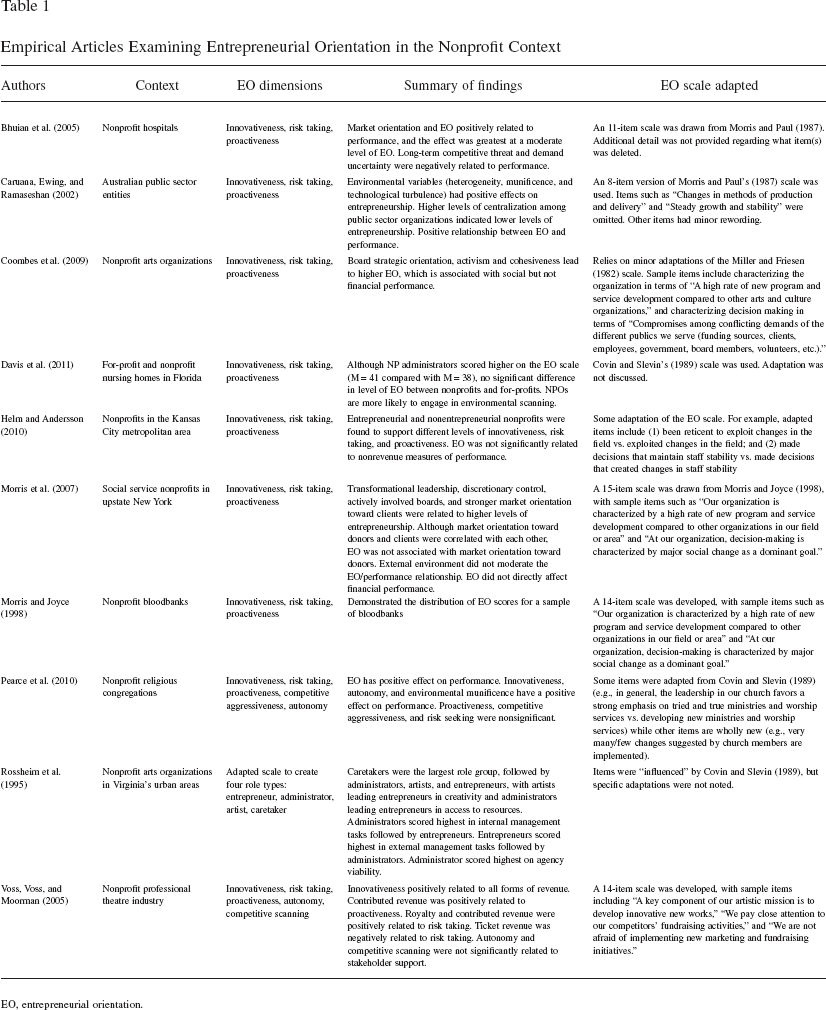
EO, entrepreneurial orientation.
Toward a New Understanding of Nonprofit EO
The limited understanding of the unique form and challenges of entrepreneurship in the nonprofit sector indicate an important role for scholars in advancing a more systematic knowledge base (Weerawardena & Mort, 2006). Developing an understanding of EO that captures the essence of the entrepreneurship form in the nonprofit context could be a valuable tool for developing this knowledge base. However, the ability to capture the true nature of EO within this context requires that we revisit three issues: (1) the meaning of EO in the nonprofit context, in particular, in terms of its definition and dimensionality; (2) the meaning of each of EO's dimensions; and (3) the meaning of the relationships among each of EO's dimensions.
The Meaning of EO
Entrepreneurship in the nonprofit context can be defined as “entrepreneurial activity with an embedded social purpose” (Austin et al., 2006, p. 1). This definition suggests that, in essence, entrepreneurship in the nonprofit context is the same as entrepreneurship in the for–profit context, albeit focused on a social purpose or mission. Conceptually, EO is a construct capturing the degree to which a firm's posture is entrepreneurial versus conservative and concerns how the firm's top managers support key entrepreneurial activities. EO's dimensions are conceptualized in terms of how the firm supports internal activities, not in terms of to what end these activities are directed. Based on this logic, one would not expect a separate dimension to focus on “social purpose,” which is goal as opposed to activity oriented. Therefore, EO's dimensionality within the nonprofit context may be expected to mirror its dimensionality in the for–profit context. Yet the different motives, processes, and outcomes surrounding entrepreneurial behavior in nonprofits suggest modification of the dimensions themselves.
Dimensionality
In the for–profit context, the EO dimensions capture facets of recognizing and exploiting opportunities through innovations having the potential for meaningful loss. However, the meaning of innovativeness, proactiveness, and risk taking are more complex and multifaceted in the nonprofit context. As we will discuss, nonprofit decision makers have to consider multiple forms of innovation, distinct points of reference for considering newness, and different types of potential loss. As such, an alternative conceptualization, with subdimensions emerging for all three dimensions, more accurately captures the meaning of entrepreneurship and EO in the nonprofit context. Our reconceptualization is summarized in Figure 1.
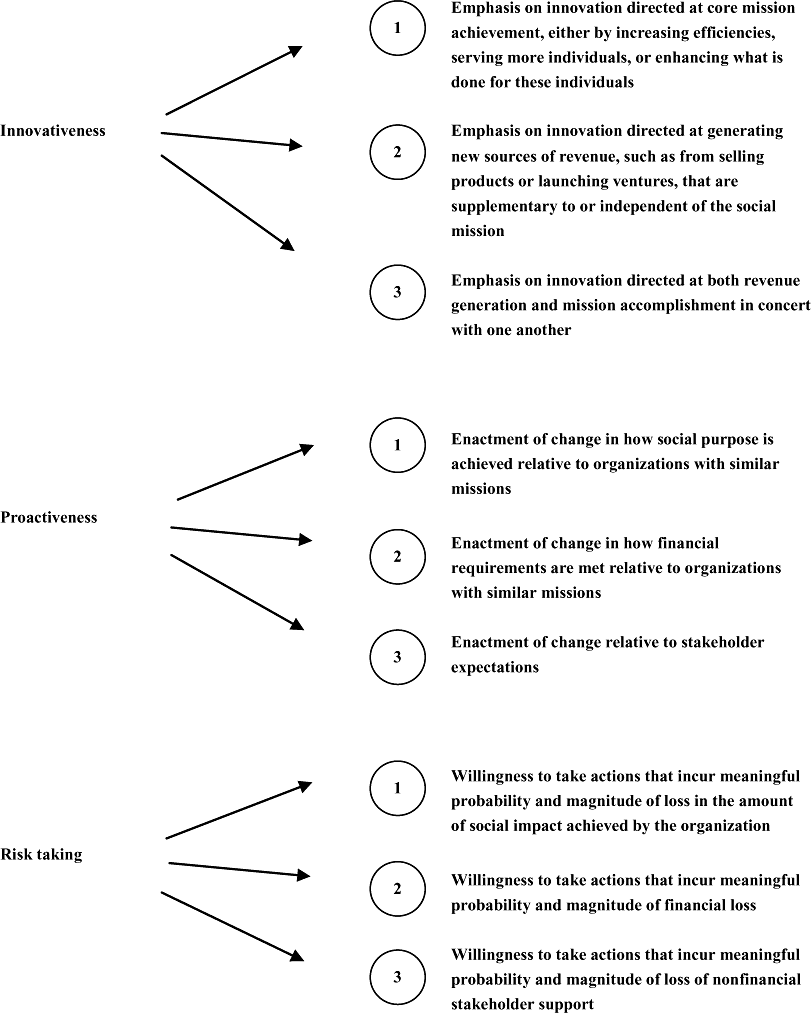
Entrepreneurial Orientation in Nonprofit Organizations
Innovativeness
The nonprofit's social mission–oriented motivation can lead nonprofits to pursue innovations to provide more effective benefits and scale these benefits to a larger market. Like any organization, however, the ability for nonprofits to pursue this motivation is based upon available resources. As such, nonprofit innovation can include facets of innovation related to enhancement of net revenues, fulfillment of the social mission, or both.
The exigencies of nonprofit survival in the contemporary environment find many of these organizations operating under conditions of uncertainty and engaging in practices that deviate from traditional operating procedure (Lasprogata & Cotten, 2003). Various observers have provided examples of innovations directed at financial performance, including the implementation of fees for services (Chetkovich & Frumkin, 2003), creation of new revenue–generating programs and related commercialization activities (Eikenberry & Kluver, 2004; Foster & Bradach, 2005; Lasprogata & Cotten), expansion of revenue–generating services and networks (Alexander, 2000), and diversification of funding sources to include unique types of sponsorships, advertising revenues, rental of assets, resource sharing, and blended funding streams (Frumkin & Kim, 2001; Prince & Austin, 2001). In a related vein, nonprofits have pursued consortia and mergers (Jenkins, 2001) and novel partnerships (Lasprogata & Cotten; Schwartz, 2001) to maintain or generate additional resources. They have implemented creative approaches to achieving greater staff efficiencies (McMurtry, Netting, & Kettner, 1991) and making operational improvements to reduce costs (Durst & Newell, 2001). Finally, some nonprofit organizations have adopted the “bake sale” approach, selling a range of products that do not necessarily have a relationship to the social mission except to raise awareness of their brand and create another source of income (Dees, 1998), corresponding to entrepreneurship in the for–profit context.
In contrast, when motivated by the need to better serve the social purpose, where the outcome measure is social returns, innovation will take the form of changes to the core mission, methods, or operations of the nonprofit itself. Basic workflows, technologies, and job design become subject to modification as management uncovers ways to serve or reach more people, or serve existing audiences better (Burt & Taylor, 2000; Cohn, 1999; Frumkin, 2002). Balser and Carmin (2009) describe Friends of the Earth as a highly innovative nonprofit, not necessarily focused on any specific social need. Rather, Friends of the Earth's mission constantly evolves to incorporate new, emerging issues within the environmental domain that are too controversial for other advocacy groups to address. Nonprofits are also innovative in how they approach achieving their mission, shifting from charity–based approaches to enabling approaches in which they provide education, training, and resources to help those in need become self–sufficient. This shift has resulted from a realization that charity–based approaches to serving social needs build a dependency on and expectation of the nonprofits that is unsustainable over the long term (Yunus, Moingeon, & Lehmann–Ortega, 2010).
In rare cases, the mission of the nonprofit will face “radical” change. For example, with its successful development of a polio vaccine, the March of Dimes's mission shifted its focus from conquering polio to saving babies from birth defects. More often, shifts in the nonprofit's efforts emerge as different needs surface within the organization's broader mission. In the 1970s, the World Wildlife Fund extended its efforts beyond species–related conservation efforts to the preservation of habitats and establishing national parks and reserves. At the beginning of this century, the American Cancer Society's (ACS) primary focus was raising public awareness through the publication of various media. In the mid–1930s, Marjorie Illig helped form the ACS's Women's Field Army, which went to the streets to raise money and educate, a shift that ultimately resulted in today's voluntary health organizations.
As illustrated in Figure 1, we label mission–related innovation as
Proactiveness
The essence of proactiveness is the degree to which an organization supports the anticipatory development and implementation of innovations in advance of others, thereby enabling growth and enhanced performance. At issue in a nonprofit context is the reference point as well as the type of change in describing something as less or more proactive. In other words, a conceptualization of proactiveness considers being proactive with respect to both whom and in terms of what type of innovation. In profit–seeking firms, the reference point is competitors. In nonprofits, two reference points are especially pertinent to understanding proactiveness: (1) firms or organizations serving the same niche and (2) stakeholders. Because nonprofits may be proactive in terms of social innovations but reactive in terms of commercial innovations, or vice versa, an effective conceptualization of proactiveness for nonprofits also includes a distinction for innovation type.
The subdimension labeled
The increasing competition for funds has led nonprofits to consider innovative sources of funding in addition to the traditional donor and grant funding sources (
An important but separate reference point is stakeholders of the nonprofit (
Risk Taking
While managers in profit–seeking firms are generally able to associate risk levels with prospective returns, the risk equation in nonprofits is more difficult to quantify. Because nonprofit outcomes include both social and financial aspects (Short et al., 2009), risk involves the potential for financial loss (i.e., as firms similarly deal with in the for–profit context) as well as potential for loss in achieving social impact. Nonprofits face a particular quandary in terms of how to provide social benefits as broadly as possible without undermining the organization's financial viability.
Incentive schemes for innovation are different in nonprofits. Given scarce resources and challenges in raising additional financial resources, the downside from innovations that fail can be greater than (and the upside from those that succeed can be considerably less than) that found in a for–profit environment (Roessner, 1977). Reinforcing the scarcity of resources challenge, the option of raising equity (or even debt capital) based on some promising innovation is generally not available. These characteristics, combined with the prominent role of stakeholders, heightened transparency of operations, and lack of personal financial benefit from engaging in risk–assumptive behaviors, suggest those who manage nonprofits are strongly influenced by a need to minimize the downside financial risks, especially when it puts the social mission in jeopardy. This will tend to be the case regardless of the upside. Alternatively, where conditions fundamentally threaten the survival of the organization, the incentive for risk taking becomes greater (Bryson, Gibbons, & Shaye, 2001; Foster & Bradach, 2005).
The ultimate risk in a nonprofit concerns an inability, or reduced ability, to achieve the social purpose (
While the ultimate risk is loss of social impact, nonprofits survive based on both their financial well–being and their ability to maintain internal and external stakeholder support. As such, actions are also risky to the extent that they threaten the net revenue position of the organization (
Relationships among Nonprofit–EO Subdimensions
Each subdimension of innovativeness, proactiveness, and risk taking is intended to capture a distinct conceptual space and to be mutually exclusive from other subdimensions. In other words, each subdimension may exist without relationship to other subdimensions. However, just as the evidence supports relationships among EO's three core dimensions (e.g., Covin et al., 2006), we expect that relationships among subdimensions can exist as well. Given the general resource scarcity of many nonprofits, support for innovation in terms of the social purpose (Innovativeness1) may draw upon financial and human resources that could support commercially focused innovativeness (Innovativeness2) or vice versa. In contrast, successful social innovativeness may attract additional donor funds and governmental grants that can then support commercial operations as the nonprofit seeks to create some level of financial independence. Commercial innovativeness can also lay the financial foundation for exploring new social venture ideas and scaling up existing socially focused operations. Innovativeness3, as organizational support for the unique form of innovation that captures both social and commercial aspects (i.e., the halfway house that launches a commercial laundry to not only generate revenues but also serve as a training and skills development facility for newly released prisoners), may be emphasized by nonprofits that seek to balance competing stakeholder interests concerning social and commercial innovation. As such, Innovativeness3 may be viewed as a substitute for either Innovativeness1 or 2.
In terms of risk taking, the willingness to support actions with the potential loss of financial resources (Risk2) could surface as a nonprofit seeks to implement social innovations. Given the ineffectiveness of charity–based approaches in providing a lasting solution to societal needs, one approach gaining wider acceptance among nonprofits is to provide education, training, and resources to individuals as a means to helping these individuals learn how to provide for themselves (Yunus et al., 2010). Kistruck and Beamish (2010) provide an interesting description of a nonprofit trying to implement cattle farming in base–of–the–pyramid markets (i.e., markets in which individuals earn on average one to two dollars per day). Local individuals are provided training and cattle to farm and are to resell the cattle at the end of the season back to the nonprofit. Driven by its social mission, the nonprofit is willing to accept substantial financial risks as the cattle they originally purchased can be poorly handled, leaving the nonprofit unable to recoup its investment. However, these risk–taking tendencies could also affect how certain stakeholders view the nonprofit's decision making (Risk3). Some stakeholders may come to view these organizational tendencies to be overly aggressive and lead them to withdraw support. Conversely, a separate set of stakeholders sharing the nonprofit's discontent with a lasting, unsatisfied societal need may actually stimulate this willingness to take what are deemed to be necessary financial risks.
Similar relationships may exist among the proactiveness subdimensions. A nonprofit's tendency to support social innovation ahead of other nonprofits with similar missions (Proactiveness1) may or may not signify a nonprofit that is commercially proactive (Proactiveness2) and vice versa. For example, through its Global Entrepreneurship Monitor studies, annual conferences, and numerous other activities, Babson College represents a socially and commercially proactive organization supporting the dissemination of entrepreneurship–related knowledge. Depending on stakeholders’ experiences with other nonprofits and in the for–profit sector, the stakeholders are likely to vary in their perception of nonprofit innovation as proactive (Proactiveness3).
Examining EO in a Nonprofit Typology
As reflected in the examples provided throughout the paper, the nonprofit sector is characterized by significant diversity, heightening the need for an understanding of EO that is multifaceted and more comprehensive. Despite the diversity, evidence suggests that entrepreneurial and conservative nonprofits can exist within various sector niches. In this section, we discuss examples from various niches to highlight varying degrees of social and commercial entrepreneurship, as illustrated in Figure 2, and draw implications for our nonprofit–EO conceptualization. We distinguish among nonprofits based on four quadrants: (1) socially and commercially conservative nonprofits, (2) socially conservative but commercially entrepreneurial nonprofits, (3) socially entrepreneurial but commercially conservative nonprofits, and (4) socially and commercially entrepreneurial nonprofits.

A Typology of Nonprofits Based on Levels of Social and Commercial Entrepreneurship
Although there may be exceptions, socially and commercially conservative nonprofits may be expected to be smaller nonprofits. As an example of nonprofits in this quadrant, consider first the Tuckahoe Volunteer Rescue Squad (TVRS) in Richmond, Virginia. As a nonprofit, completely volunteer ambulatory service, the TVRS has operated in the suburbs of Richmond since 1953, providing emergency service to the local community in conjunction with local fire and police services. The TVRS has stayed true to this social mission and rarely has taken social or commercial risks or acted proactively in how it implemented its mission and addressed stakeholders. Rather, the TVRS has effectively served the local community despite an increasing call load, given generous community donations, and volunteers serving in various capacities, such as ambulance drivers and trained emergency medical technicians. Similarly, the Impact Animal Foundation (IAF) in College Station, Texas is a nonprofit whose social mission is to provide cats and dogs with well–needed, healthy homes. Without a permanent facility, the IAF draws upon a network of volunteer foster parents, community donors, and partnerships with local pet stores as venues to let the public meet the animals.
Other nonprofits may be socially conservative yet also be quite commercially entrepreneurial. Numerous nonprofit credit counseling service agencies, which often have a social mission to provide education and advice to help consumers deal with their debt, also significantly promote commercial–oriented, debt–management packages with relatively high upfront fees. These agencies have become increasingly proactive in addressing debt needs, but balance the risks of having less social impact while becoming more financially viable. Native American tribes carry a nonprofit status yet operate numerous revenue–generating operations such as casinos, tobacco–related businesses, and selling mineral rights. While the commercial side of some of these tribes is entrepreneurial, the social mission to provide for the tribe and to develop infrastructure (i.e., education) for tribe members may be more socially conservative.
Two examples of socially entrepreneurial yet commercially conservative nonprofits (quadrant 3) are the Harlem Children's Zone and the Gates Foundation. While actively engaged in fairly traditional fund–raising approaches, the Harlem Children's Zone focuses its entrepreneurial efforts on a pipeline of highly innovative programs that holistically work with children from birth through completion of college while also continuing to expand the organization's geographic footprint. Similarly, the Gates Foundation, with a solid financial base funded by Bill and Melinda Gates and Warren Buffett, demonstrates high levels of social entrepreneurship in its unique approaches to providing grants and forming strategic partnerships that serve to advance the mission of improving people's health and giving them a chance to lift themselves out of hunger and poverty.
As our fourth quadrant in Figure 2, socially and commercially entrepreneurial nonprofits emphasize entrepreneurship not only in regards to their social mission or how their mission is achieved but to commercial operations as well. MicroNutrient Initiative and March of Dimes can be characterized as examples of nonprofits in this category. MicroNutrient Initiative is a global nonprofit aimed at reducing vitamin and mineral deficiencies in vulnerable populations. As a socially entrepreneurial nonprofit, MicroNutrient Initiative has developed various innovations (i.e., lozenges, food mixes, and sachets for delivering vitamins and minerals through various channels), supported independent research (e.g., research leading to iron and iodine double–fortified salt), developed situation assessments and designed programs/policies, and helped monitor and evaluate initiatives. From a commercial standpoint, MicroNutrient Initiative leverages financial partnerships with governments and United Nations agencies, for–profit firms, and other nonprofits to efficiently and effectively deliver solutions globally. The March of Dimes has been entrepreneurial in achieving its mission of reducing birth defects, premature births, and infant mortality. For example, the March of Dimes supports researchers through significant, and what could be regarded as risky and proactive, grants in ground–breaking research, leading to 13 March of Dimes–supported researchers receiving the Nobel Prize. Through numerous other social and commercial initiatives such as the sale of booklets and DVDs, national symposiums, corporate sponsorships, and online continuing education modules, March of Dimes disseminates knowledge and continuing education to health–care professionals and patients.
This typology helps clarify the potential shortcomings when relying on conventional approaches to EO in the nonprofit context. Failure to capture the nature of entrepreneurship at the organizational level seems greatest as entrepreneurship occurs in both social and commercial forms. Hence, the likelihood of inaccurately assessing EO is greatest with organizations in quadrant 4 and lowest in quadrant 1. With an organization that is high on social and commercial entrepreneurship, an EO that does not explicitly capture both domains invites respondents to understate the full extent to which entrepreneurship is being manifested. In fact, if a scholar relies upon the meaning of EO in the for–profit context, a nonprofit organization that is very entrepreneurial in ensuring its financial sustainability or in retaining stakeholder support will likely be assigned a high EO score regardless of how conservative the organization is in achieving its social mission. The risk–taking dimension offers an especially vexing example of the potential for misrepresentation. As it is conventionally construed in terms of economic losses, those social or commercial innovations that put aspects of social mission achievement or stakeholder support at risk are likely to be underemphasized. As such, our nonprofit EO, with subdimensions within innovativeness, risk taking, and proactiveness, offers a richer ability to differentiate levels of entrepreneurship between organizations in the respective quadrants. Finally, interpretations of EO are enhanced to the extent that benchmarks are established for a given type of nonprofit. Our framework offers value in establishing proper benchmarks. For instance, some nonprofits may be constrained legally or operationally from engaging in more social, commercial, or both forms of entrepreneurship. Thus, they may be limited to quadrants 1, 2, or 3 in Figure 2. The ability to differentiate levels of entrepreneurship across quadrants becomes vital in such benchmarking. As we shall elaborate upon in the concluding section, the typology can also be helpful in guiding ongoing research on EO.
Discussion and Implications
Since the momentum of entrepreneurship research began increasing in the late 1970s, the field has produced a significant and diverse body of research. More recently, scholars have begun to distinguish among various forms of entrepreneurship, such as social entrepreneurship, international entrepreneurship, policy entrepreneurship, and institutional entrepreneurship, in which contextual differences produce subtle yet important differences in the form of entrepreneurship. While work on EO began over a quarter century ago and has led to significant advancements in our knowledge of how entrepreneurial behaviors are tied to outcomes, EO research has not yet adapted to differences in the entrepreneurship form across contexts. As such, studies using EO may not fully capture the essence of the specific form of entrepreneurship within these various contexts outside of the pure for–profit context.
Given this gap between how entrepreneurship research in general and EO research specifically has advanced, the differences in how EO is manifested within the context of nonprofit organizations represent an especially important issue. We focus on the nonprofit context for two reasons. First, the nonprofit sector is playing a more significant role in providing for society's needs than at any time in history. Second, the specific form of social entrepreneurship in nonprofit organizations, due to motivation, process, and outcome–based differences, provides a basis that varies significantly from the form of entrepreneurship in the for–profit context that has underpinned the vast majority of EO research.
Social entrepreneurship as a process incorporates the same behavioral tendencies as entrepreneurship in the for–profit context. As such, an EO in nonprofits involves innovativeness, proactiveness, and risk taking. However, the primary motivation of nonprofits to serve a social purpose coupled with the need to remain financially viable leads to a set of processes and outcomes that are more complex and multifaceted than those in for–profit firms. Our understanding of nonprofit EO incorporates (1) social, mission–centric innovation, commercial innovation, and the unique case in which innovation includes both social and commercial aspects; (2) social, financial, and stakeholder–relevant risk; and (3) proactiveness relative to similar organizations in terms of social and commercial innovation as well as relative to stakeholder expectations. To illustrate the multifaceted nature of EO in the nonprofit context and the need for a more comprehensive understanding, we utilize a typology of nonprofits based upon varying levels of social and commercial entrepreneurship.
This research provides implications for both scholars and practitioners. For scholars, a primary implication is the need to move to the development of a measurement scale with strong psychometric properties for nonprofit EO. Numerous examples for operationalizing a theoretically derived construct are available in psychology (e.g., Button, Mathieu, & Zajac, 1996; VandeWalle, 1997). Following these models for scale development, a first step in operationalizing EO for nonprofits will require scholars to develop an extensive list of items that tap each subdimension of innovativeness, proactiveness, and risk taking. Taking this item list, scholars can then meet with nonprofit practitioners and researchers specialized in this domain to refine the list, toss out any items that are not relevant, and perhaps consider adding items that may have been overlooked. Given the significant diversity in the nonprofit sector, a diversity of practitioners and researchers is recommended during this step as the prevalence of forms of innovativeness, proactiveness, and risk taking is likely to differ across niches and organizational types. Upon narrowing to a relevant item list, scholars should then perform a series of confirmatory analyses by sampling two diverse sets of nonprofits and determining appropriate items for each subdimension/factor of nonprofit EO.
A number of additional considerations may facilitate effective operationalization of the nonprofit EO. One consideration may be the timeline in which respondents consider their nonprofit's innovativeness, proactiveness, and risk taking. In the for–profit conceptualization of EO, managers are asked to consider the last 5 years in which new lines of products or services have been marketed (Covin & Slevin, 1989). A meaningful question for scholars to ask is whether 5 years in the nonprofit context is equivalent to 5 years in the for–profit context, which could hold implications for framing items. A separate consideration involves the actual scaling of innovativeness, proactiveness, and risk taking in the nonprofit context. While respondents force their responses (based on their perception of their organization's tendencies) into a Likert scale, a question surfaces if scholars attempt to compare EOs of nonprofits and for–profit firms in terms of each dimension. Scholars may need to standardize scores when comparing across nonprofit and for–profit sectors.
The development of an EO scale raises questions regarding how to effectively collect data on EO in nonprofits. In existing research, EO is viewed as a firm–level construct but has primarily been measured at the top management level under the assumption that the firm's top decision makers shape the firm's posture (e.g., Covin & Slevin, 1989). In nonprofits, however, the structure of decision making is different than in for–profit firms and, in many cases, the top management component of the nonprofit is not always congruent with the decision–making component that is the nonprofit board. As such, one important consideration for scholars is whether the nonprofit's managers or the board serves as a more effective sampling group.
For practitioners, nonprofit EO offers a more complex and complete picture of entrepreneurship within the nonprofit organization. It provides guidance to managers in terms of where to focus when addressing entrepreneurship within this context. Nonprofit EO considers not only the development of new products and services but also means through which the organization can pursue social mission–related and commercial opportunities. Moreover, nonprofit EO considers calculated risk taking in terms of both financial loss and disaffected stakeholders, and it allows for proactiveness relative to both some standard as well as stakeholder expectations. Our model suggests, however, that nonprofit decision makers need to balance these different opportunities to meet the nonprofit's various social, financial, and stakeholder objectives. We expect that nonprofit decision makers measuring highly on nonprofit EO can more effectively achieve this balance. Decision makers who favor an emphasis on mission place their firm's survival at risk by (1) overlooking commercial, revenue–generating opportunities; and (2) potentially leading the social mission away from the core values with which the nonprofit's stakeholders identify. Similarly, decision makers favoring revenue–generation opportunities may risk mission displacement (i.e., a shift away from core values in terms of how the social mission should be implemented).
In conclusion, we have examined the manifestation of EO in the nonprofit context. Nonprofit organizations represent a vital economic mechanism through which many of society's unmet needs are satisfied. As in the for–profit sector, entrepreneurship has become an important means through which nonprofit organizations enhance their efficiency and effectiveness in fulfilling these opportunities. Elaborating upon the differences in how EO manifests in the nonprofit context offers a foundation from which scholars can build to examine entrepreneurship in the non–profit context, how environmental forces may influence the effectiveness of a nonprofit EO across the sector's various niches, and how nonprofits can balance social and commercial–oriented operations in effectively fulfilling the social mission and scaling the nonprofit. We hope this work stimulates additional research to examine EO and the entrepreneurship process in the nonprofit context.
Footnotes
1.
Early definitions of entrepreneurship strongly emphasized its for–profit nature. For example, Cole (1949) defined entrepreneurship as “a purposeful activity to initiate, maintain, and aggrandize a profit–oriented business.”
2.
As noted previously, the inability for public institutions and for–profit firms/entrepreneurs to efficiently provide such social benefits highlights individuals within society who are unable to purchase relevant products/services.