







Abstract
We collected longitudinal data from 160 high–tech small–business owners to analyze if the planned behavior constructs are related to their decision to innovate, as evidenced by their behavior (rather than their intentions to do so). Subjective norms and perceived behavioral control are directly related with innovation exploitation. Attitude towards the opportunity is significant only when respondents perceive both positive subjective norms and being in high control. This multiplicative effect suggests that the planned behavior constructs can be thought of as necessary conditions beneath which business owners are much less likely to exploit identified opportunities. Implications are discussed.
Introduction
Innovation is nowadays broadly recognized as important for the survival and growth of firms. Accordingly, the past 20 years have witnessed increased attention for the entrepreneurial efforts of businesses. A substantial part of the field of entrepreneurship research focuses on individuals discovering opportunities, deciding to exploit them, and implementing them through a process of resource acquisition and organization (Shane, 2003). Entrepreneurship is generally regarded as a multistage process that can be defined as “an activity that involves the discovery, evaluation and exploitation of opportunities to introduce new goods and services, ways of organizing markets, processes, and raw materials through organizing efforts that had previously not existed” (Venkataraman, 1997, in Shane, p. 7).
An important condition for entrepreneurship is that it “requires a decision by a person to act upon an opportunity because opportunities themselves lack agency” (Shane, 2003, p. 7). Opportunities are exploited only when human beings decide to act. Accordingly, for most businesses to be innovative, and particularly the smaller ones, which are central in the current article, innovation primarily depends on the behavior of the business owner to identify and act upon opportunities.
This study focuses explicitly on small–business owners’ decision to exploit opportunities they have already identified, i.e., to engage in the part of the entrepreneurial process in which resources are recombined to create new means–end frameworks (Shane, 2003). A drawback in previous work is that the stage in the entrepreneurial process at which individuals decide to exploit received scant attention. Shane, for example, in his broad review of the entrepreneurship literature, concluded that:
…we could use more research that examines the actual decision to exploit opportunities rather than the static state of being an entrepreneur. (…) Research on the actual decision to exploit opportunities among people at risk of such exploitation would overcome many of the limitations inherent in much of our existing research on this topic, as well as provide more precise explanations for how individual differences influence the entrepreneurial process. (p. 264)
We draw on a well–known social psychological model, i.e., the theory of planned behavior (Ajzen, 1991), to identify psychological constructs that have been scantly applied to incumbent small–business owners. More specifically, we propose that the decision to exploit correlates with business owners’ attitude towards the opportunity (whether they find it attractive), subjective norms (whether they experience positive pressure from close social ties), and perceived behavioral control (whether they are confident of acquiring the resources needed for exploitation and effectively combining these). In addition to past work, we also explore potential interactions between these constructs, developing the idea that they may be necessary conditions for exploitation, no matter how favorable the other constructs.
This research deviates from earlier work in various respects. First, past planned behavior studies in the field of entrepreneurship focused on new firm formation and self–employment (e.g., Fitzsimmons & Douglas, 2011; Kolvereid, 1996; Kolvereid & Isaksen, 2006; Krueger, Reilly, & Carsrud, 2000; Linan & Chen, 2009; Tkashev & Kolvereid, 1999). It has been ignored that incumbent business owners also face entrepreneurial opportunities. In this article we are concerned with business owners’ decision to engage in identified opportunities for innovation. We define innovation exploitation as recombining resources to actually create and introduce new products or processes. It must be noticed that past studies have already linked planned behavior theory with innovation, but then the focus was on adoption, for example new technologies in organizations (Morris, Venkatesh, & Ackerman, 2005; Yi, Jackson, Park, & Probst, 2006) or high–tech products (Kulviwat, Bruner, & Al–Shuridah, 2009). Here, we are concerned with innovation opportunities that still need to be developed, putting decision makers at substantial risks and forcing them to recombine and reorganize their resources.
Second, we recognize that the planned behavior constructs have already been applied to explain individuals’ intentions. Influenced by Bird's (1988) initial propositions, many have studied intentions to exploit entrepreneurial ideas (e.g., Fitzsimmons & Douglas, 2011; Kolvereid, 1996; Krueger et al., 2000; Linan & Chen, 2009). Yet, intentions do not automatically induce entrepreneurial behaviors (Brännback, Carsrud, Kickul, Krueger, & Elfving, 2007; Wiklund & Shepherd, 2003). In this article we directly focus on individuals’ decision to exploit as evidenced by their actual behavior. Previous studies largely neglected this matter. Currently, we are aware of only two planned behavior studies that captured actual behaviors or outcome variables, but these were concerned with business growth (Wiklund & Shepherd) and self–employment (Kolvereid & Isaksen, 2006). In this context, most previous work relied on cross–sectional data, while it was frequently recommended that we ultimately need longitudinal data to capture actual behaviors (e.g., Kolvereid; Krueger et al.; Linan & Chen). Here, we draw on longitudinal data of 160 small–business owners, including their a priori attitudes, perceived subjective norms, and control beliefs, and their eventual decision to engage in innovation. As such, the article provides no integral application of Ajzen's (1991) theory, but rather uses it to identify potential antecedents of individuals’ actual behavior.
Another deviation is that most planned behavior studies in the entrepreneurship literature used samples of students (e.g., Kolvereid, 1996; Krueger et al., 2000). Such samples can be criticized for not necessarily representing the decisions of incumbent entrepreneurs (Robinson, Huefner, & Hunt, 1991). The examination of broader samples is more recent (Kolvereid & Isaksen, 2006; Wiklund & Shepherd, 2003) but students are still prevailing today (e.g., Fitzsimmons & Douglas, 2011; Linan & Chen, 2009). Finally, we do not limit ourselves to the additive effects of the planned behavior constructs, but also explore their potential (multiplicative) interactions. This would reflect that if a decision maker completely dislikes an opportunity, deems very unfavorable subjective norms, or perceives no control, no amounts of the other antecedents can compensate. Previous studies have recommended that such interactions merit investigation (Boyd & Vozikis, 1994; Fitzsimmons & Douglas; Krueger, 2003).
Theory and Hypotheses
The theory of planned behavior was designed to explain human behavior in specific contexts, and more specifically, to explore the influence of individuals’ attitudes to the behavior in question (Ajzen, 1991). The theory proposes that to predict whether a person will engage in specific behavior, we need to know whether the person is in favor of doing it (attitude), how much the person feels social pressure to do it (subjective norms), and whether the person feels in control of the behavior in question (perceived behavioral control). These antecedents increase the likelihood that the person will intend to act and accordingly increase the chance of doing so.
Ajzen's theory has been applied in many contexts to connect people's attitudes and decisions to engage in specific types of behavior. Most samples involved consumers to analyze their choice of leisure (Ajzen & Driver, 1992), health care (Albarracin, Johnson, Fishbein, & Muellerleile, 2001), durable products (Notani, 1997), and financial investments (East, 1993), to mention only a few. Applications in the context of businesses are more scarce, but still many examples can be found, mainly in the area of technology and innovation adoption (e.g., Kulviwat et al., 2009; Morris et al., 2005; Yi et al., 2006). The theory has also been used to develop propositions on emerging entrepreneurship (Boyd & Vozikis, 1994; Krueger & Carsrud, 1993), and these were later empirically tested (e.g., Kolvereid, 1996; Krueger et al., 2000; Tkashev & Kolvereid, 1999). In addition, it has been identified that planned behavior theory strongly overlaps with alternative models of new firm formation, including Shapero's (1982) model of the entrepreneurial event (see Krueger & Brazeal, 1994; Krueger et al.). We therefore propose that attitude, subjective norms, and perceived control are among the main predictors of the decision to exploit opportunities for innovation.
In the remainder of this section we elaborate on these constructs and develop hypotheses. In doing so, entrepreneurship and organizational behavior studies are referred to. Entrepreneurship studies have shown why we may anticipate a connection between the planned behavior constructs and the decision to form new organizations or to become self–employed. Next, organizational behavior studies are used to justify similar connections for the exploitation of innovation opportunities. Individual innovation literature applies similar psychological antecedents that are useful to explain our presuppositions.
Attitude
Attitude toward a behavior is “the degree to which a person has a favorable or unfavorable evaluation or appraisal of the behavior in question” (Ajzen, 1991, p. 188). It is the general feeling for or against the action based on its expected outcomes, and reflects both evaluative considerations (the perceived costs and benefits of a given behavior) and affective ones (beliefs about positive or negative feelings derived from the behavior itself).
Entrepreneurship literature regards attitudes as an important determinant of individuals’ exploitation behavior. As discussed in the Introduction section, multiple studies demonstrated a positive connection with self–employment intentions (e.g., Krueger et al., 2000). In this vein, Shane (2003) discusses that the information necessary to determine whether opportunity exploitation will pay off cannot be obtained with certainty at the time it is identified, because that information does not come into existence until the entrepreneur pursues the opportunity (p. 7). In order to exploit, entrepreneurs must believe that they will gain more than they are giving up. In addition, entrepreneurship studies identified affective considerations as influential. People with a greater desire for independence have been demonstrated to be more likely to start a business (Reynolds & White, 1997; Vesalainen & Pikhala, 1999). Thus, individuals can be triggered by the very act of opportunity exploitation and not necessarily its expected outcomes.
In the organizational behavior literature, early research among strategic decision makers has shown that perceived opportunities are strongly associated with the expectation of gain (Jackson & Dutton, 1988). Moreover, individual innovation studies suggest that attitude influences decision making. Farr and Ford (1990) proposed that the likelihood of individuals being innovative depends on the perceived pay–off achieved through innovation. Even if a person senses an opportunity for innovation, implementation is unlikely if it is felt that the pay–off from such behavior is low. Moreover, evidence for affective considerations can be found in Amabile's (1996) argument of intrinsic motivation. Defining this construct as “any motivation that arises from the individual's positive reaction to a task itself; this reaction can be experienced as interest, involvement, curiosity, satisfaction, or positive challenge” (p. 115), she found that intrinsic motivation influences creative performance. It has also been shown that intrinsically motivated individuals are more likely to engage in non–compulsory behaviors like donating blood for medical applications (Frey & Jegen, 2001). Thus, intrinsic motivation may well be influential beyond creative behaviors and stimulate individuals to exploit. Given these considerations, we hypothesize:
Subjective Norm
Subjective norm is defined as “perceived social pressure to perform or not to perform the behavior” (Ajzen, 1991, p. 188). Such norms are concerned with the likelihood that important referents (dis)approve of performing a behavior. Subjective norms represent the internalized influences of close ties, i.e., persons and groups with which the entrepreneur has intimate contacts, including friends, family, and close business partners.
Early entrepreneurship studies found that Ajzen's subjective norms correlate with students’ self–employment intentions (Kolvereid, 1996; Tkashev & Kolvereid, 1999). Yet, subjective norms are not consistently found to be significant (e.g., Krueger et al., 2000). This may be due to measurement issues, or the presence of indirect or interaction effects (Linan & Chen, 2009). When regarded as a determinant of actual behavior however, we have good reasons to anticipate a positive correlation. In the entrepreneurship literature there is a related line of research on the influence of family members. Shane (2003) discusses that the children of entrepreneurs should be more likely to exploit opportunities, because observation of their parents’ behavior provides the necessary inspiration and better motivation to engage in similar activities. This presupposition has been repeatedly supported in empirical work (e.g., De Wit & van Winden, 1989; Dunn & Holtz–Eaking, 1996). There is also evidence for the influence of other close ties, including friends and neighbors (Honig & Davidsson, 2000) and spouses (Caputo & Dolinsky, 1998).
The individual innovation literature provides more arguments to suppose a positive relationship with the decision to innovate. Rather than friends and family, this literature investigates the influence of work groups—which exert powerful pressures on individuals to adjust their behavior. In this vein, Axtell et al. (2000) surveyed the employees of a U.K. manufacturing plant, and found that work group climate was important for their innovative behaviors. It made a difference if employees found their colleagues to be positive as soon as identified opportunities for innovations had to be further developed. Likewise, in a recent study of Korean workers, Choi (2007) found a positive correlation between innovation climate and employees’ change–oriented behavior, a construct that basically reflects employee behavior to act upon opportunities beyond their formal work roles. We hypothesize:
Perceived Behavioral Control
Perceived behavioral control is the “perceived ease or difficulty of performing the behavior of interest” (Ajzen, 1991, p. 188). This concern is based on the presence of requisite resources and abilities. The more resources and abilities individuals believe they possess, and the fewer obstacles or impediments they anticipate, the greater should be their perceived control over the behavior. Perceived control was added to the theory of planned behavior to explain the decision to engage in behaviors that are beyond individuals’ volitional control (Ajzen, p. 184).
In the entrepreneurship literature, perceived behavioral control is usually perceived as compatible with Bandura's (1982) concept of self–efficacy, which “is concerned with judgments of how well one can execute courses of action required to deal with prospective situations” (p. 122). More recently, researchers extended the concept into a task–specific one labeled entrepreneurial self–efficacy (Chen, Greene, & Crick, 1998; DeNoble, Jung, & Ehrlich, 1999). Chen et al. define it as “the strength of an individual's belief that he or she is capable of successfully performing the roles and tasks of an entrepreneur” (p. 301). They found that in innovation activities, business founders had higher entrepreneurial self–efficacy than non–business founders. Yet, although most entrepreneurship researchers regard perceived control and self–efficacy as similar (e.g., Boyd & Vozikis, 1994; Kolvereid & Isaksen, 2006; Krueger et al., 2000), recent views emphasize that the concepts are not identical (Ajzen, 2002; Linan & Chen, 2009), or propose that they may even interact in their influence on individual risk–taking (e.g., Monsen & Urbig, 2009). Perceived behavioral control is argued to include not only feelings of ability, but also perceptions about controllability of the behavior (Ajzen, 1991).
Nevertheless, with only few exceptions empirical studies have shown that either perceived behavioral control or self–efficacy are correlated with individuals’ self–employment intentions. For example, Zhao, Seibert, and Hills (2005) surveyed master of business administration students, and found that self–efficacy was an important determinant of entrepreneurial intentions, which fully mediated the influence of a range of other potential determinants, including perceptions of formal learning from entrepreneurship education, past entrepreneurial experience, and risk–taking propensity. Other examples reporting positive correlations include Krueger et al. (2000), Linan and Chen (2009), and Fitzsimmons and Douglas (2011). Past work also demonstrated that people with higher general self–efficacy are more likely to engage in opportunity exploitation (e.g., Casson, 1995; Choi & Shepherd, 2004). Moreover, an experimental study by Krueger and Dickson (1994) showed that perceived self–efficacy significantly influences participants’ opportunity and threat perceptions in such a way that they take more risks.
In the organizational behavior literature, the early study by Jackson and Dutton (1988) showed that decision makers strongly associate opportunities with feelings of control. Likewise, drawing on Lazarus's (1966) cognitive stress–coping theory, Gebert (1987) proposed that after identifying a performance gap employees engage in an appraisal of situation control. This appraisal focuses on the analysis of coping strategies, that is, if they perceive to personally possess the resources needed (e.g., autonomy, time, budget, staff, knowledge) to cope with the situation. If insufficient control is perceived, individuals will assess the likelihood of procuring resources elsewhere, making innovation exploitation more likely—and indeed this is what empirical evidence has confirmed (Krause, 2004). We hypothesize:
Interaction
We here also investigate the potential multiplicative nature of the proposed antecedents. Past planned behavior studies have repeatedly tested the assumption that individuals’ motivations and perceived abilities interact in their effect on behavioral achievement, but not in the context of entrepreneurship (Krueger, 2003). We argue that it makes sense to explore this matter. Consider the situation in which business managers have a positive attitude towards an identified opportunity for innovation. As exploitation requires resource acquisition and combination, and usually substantial individual effort with uncertain outcomes (Shane, 2003), the connection between attitude and exploitation may be stronger if the other conditions are met, i.e., if business managers experience positive pressure from their close ties, and high perceived control. We note that innovation exploitation is a clear example of behavior beyond individuals’ volitional control—the very reason that Ajzen (1991) included perceived behavioral control in this theory—and that just a positive attitude may not be enough. Of the few who proposed an integrative approach, an early qualitative study by Mintzberg, Raisinghani, and Theoret (1976) combined various arguments to explain how individuals decide about opportunities for innovation. They state that the “moment of action” is determined by a multiplication of stimuli, including the interest of the decision maker and the perceived payoff, the influence of the idea source and “significant others,” and the associated uncertainty and perceived probability of the successful termination of the decision (p. 253).
Modeling multiplicative effects reflects the idea proposed by Krueger (2003) that if small–business managers either do not like an opportunity, experience negative pressure from close ties, or perceive lack of control, no amounts of the other antecedents may compensate. According to Krueger, one interesting implication from such models is that we may have to think of the proposed antecedents in terms of “threshold phenomena, something that is rarely examined…in entrepreneurship research” (p. 118). Thus, we explore if the planned behavior constructs interact, i.e., if exploitation is more likely if the planned behavior constructs are simultaneously present. Despite the fact that such multiplicative modeling is intuitively convincing, we recognize that a strong theory is still lacking. We therefore tentatively hypothesize:
Data
While most previous planned behavior studies used cross–sectional surveys, we obtained longitudinal data from a sample of small–business owners. We first screened for business owners who were considering opportunities for innovation, then followed up by surveying their attitudes, subjective norms, control beliefs, and decision to exploit.
Sampling and Procedures
Between 2005 and 2008, the Dutch research organization EIM Business and Policy Research conducted an annual survey among a panel of high–tech small firms. All respondents were owners/general managers with full responsibility for strategic decision making. High–tech small firms were defined as firms with no more than 250 employees, actively engaging in research and development (R&D), and having developed new technology–based products in the past 3 years (EIM, 2006). Such firms usually operate in manufacturing and knowledge intensive services industries, including chemicals, rubbers and plastics, machinery and equipment, technical wholesale trade, IT and software development, commercial engineering, and R&D services. Being financed by the Dutch Ministry of Economic Affairs, the panel was created to obtain better statistics on high–tech small firms—a primary target of innovation and entrepreneurship policies. The first wave of the panel was conducted at the end of 2005 by means of telephone and internet surveys. For our current research we were allowed to add questions to the second and third waves in December 2006 and 2007, respectively.
We collected data via three distinct surveys. First, early December 2006 a telephone survey was carried out among the full panel of 779 members. We added screening questions to identify respondents who were considering innovation opportunities at the time. Innovation was introduced as any purposeful renewal aimed to produce some kind of benefit and based on an identified opportunity (cf. King & Anderson, 2002, pp. 2–3). It was mentioned that innovation is not limited to new products, but may also include processes. We then asked if respondents had identified any opportunities and if these included examples that they were still considering. If these criteria were satisfied, respondents were asked for a full description (open–ended question). A manufacturer specializing in machines for the food industry for example reported an opportunity to create a new product: “We consider to develop a new type of machine for the production of artificial bacon to decorate liver–sausages.” Another example was an IT services firm reporting a process innovation opportunity: “We may invest in developing a radical new internet platform for small businesses to more efficiently distribute and update our products.” In case respondents mentioned multiple opportunities, we asked them to describe the one they had identified most recently. In all, 532 panel members responded to the survey, a response rate of 68.3%. Within this group, 332 panel members satisfied the screening (42.6%). In comparison with the full panel, both response distributions were not selective. Drawing on χ2– and t–tests we found that respondents were not different from non–respondents in terms of industry types, size classes, education level, and age. p–Values of significance of difference tests were above the 5% level no matter what distribution and variable was tested.
In the second step we organized a pen–and–paper survey that was sent out to the respondents that had passed the screening. In the introduction letter we indicated that we were interested in the specific opportunity that respondents had described on the phone. Its description was printed on top of the questionnaire. The survey then offered multiple–item scales to measure the planned behavior constructs (see hereafter). In addition, the survey checked relevant background variables including industry types, firm size, education, and career experience. Respondents were also asked to classify the type of opportunity, i.e., if they primarily regarded it as a product or process innovation. This survey was sent out in January 2007. After three weeks, a reminder letter was sent to all non–respondents to increase the response rates. Eventually, we received the questionnaires from 185 persons, a response rate of 55.7%. Again, responses were representative in terms of industry types, size classes, education level, and age.
In the third step, we added a question to the next wave of the high–tech panel that was conducted by telephone interviewing in December 2007. Now we focused only on the 185 panel members that had responded to the pen–and–paper survey. The interviewers first reminded the respondent of their reported opportunity by reading its description out loud. Then they asked what the respondent had decided. To be regarded as a positive decision, the interviewers were instructed to ask for behavioral evidence, i.e., respondents should currently engage in innovation development activities, or have already finishing implementing the innovation. Any decision without such behavioral follow–up would just indicate a goal intention that does not necessarily induce behavioral achievement (e.g., Brännback et al., 2007; Gollwitzer, 1999). We obtained responses from 160 panel members. Again, these responses were representative for those that had qualified for our research. Drawing on χ2– and t–tests no significant differences were found between respondents and nonrespondents on industry type (p = .71), size class (p = .73), education level (p = .08), and age of the respondents (p = .50).
Variables and Descriptive Statistics
Table 1 describes the variables that we used to test our hypotheses, and presents descriptive statistics. Our dependent variable was dichotomous, indicating whether high–tech business owners had decided to exploit the opportunity one year after they had first reported it. In 44% of the cases, this appeared to be true.
Variables and Descriptive Statistics (N = 160)

Rated on 7–point semantic differential scales, coded 1 (bad, etc.) to 7 (good, etc.).
Rated on 5–point scales (fully disagree/disagree/neither agree nor disagree/agree/fully agree), coded 1 to 5.
M, mean; SD, standard deviation.
Our planned behavior measures were in line with the (broadly accepted) guidelines for planned behavior studies as described by Francis et al. (2004). Thus, items were compatible with the behavior that was to be predicted, i.e., to exploit the specific opportunity that respondents had identified. The full description of the opportunity was printed on the questionnaire, and items made explicit reference to it.
We remark that in entrepreneurship research, there is not yet a standard to measure the planned behavior constructs (Linan & Chen, 2009; McGee, Peterson, Mueller, & Sequeira, 2009). Researchers have used a variety of measures to evaluate attitudes, subjective norms, and control beliefs towards self–employment or new firm formation (e.g., Kolvereid, 1996; Krueger et al., 2000). As our focus was on opportunities for specific innovations, we modified the wording of incumbent measures or developed new ones.
Incumbent attitude measures usually ask for individuals’ employment status motives like autonomy and self–realization (e.g., Kolvereid, 1996; Kolvereid & Isaksen, 2006). For innovation opportunities such items have no counterpart, so we measured attitude by means of a semantic differential scale that involved the use of five bipolar adjectives. The list of items included evaluative (e.g., not rewarding–rewarding) and affective ones (e.g., boring–exciting). The good–bad scale was also included to capture overall evaluation (as recommended by Francis et al., 2004). Most of these adjectives are also used in more recently published measures of attitude towards entrepreneurship (e.g., Linan & Chen, 2009; McGee et al., 2009).
Subjective norms were measured with four items to rate the extent to which respondents perceived their close ties to favor exploiting the opportunity. In line with existing measures of subjective norms towards self–employment intentions, we distinguished between friends, relatives, close ties, and “people who are important to me” (Kolvereid, 1996; Kolvereid & Isaksen, 2006; Krueger et al., 2000).
Perceived behavioral control was measured with four items on the extent to which respondents perceived themselves as capable of exploiting the opportunity. We did not merely adopt an entrepreneurial self–efficacy measure, because these have been criticized for including only perceived confidence and ability while ignoring controllability of behavior (Ajzen, 2002). Thus, the items reflected confidence, perceived ability, and controllability. In past studies on self–employment intentions, Kolvereid (1996) used a similar measure.
Table 1 shows that all measures were internally consistent (α > .70, mean correlation r > .40, item–rest correlations [IRCs] > .30). We also checked if our planned behavior measures reflected truly different constructs. A confirmatory factor model was specified in which each item loaded only on its presupposed factor and the latent factors were allowed to correlate. Maximum likelihood estimates indicated good fit, as common fit measures were acceptable (GFI = .97, RMSEA = .08; TLI = .96, NFI = .95; χ2/df = 2.65). All items loaded significantly on their presupposed factor with λ > .55, indicating convergent validity. In addition, correlations between the three dimensions were modest (r < .30) and lower than the square root of the average variance extracted (all > .70) indicating divergent validity (Fornell & Larcker, 1981).
Table 1 also shows the variables that we used as control variables. By adding these to our regression equations, we (partially) controlled for third variables that may both influence the proposed antecedents and the decision to exploit. Thus, we included a dummy indicating if respondents considered developing a product innovation (versus process innovation). Process innovation opportunities may be more difficult to exploit as they usually affect internal processes more substantially. Firm size was added as well, as larger organizations are materially advantaged but behaviorally constrained when it comes to innovation (Rothwell, 1983). We were also aware that the planned behavior constructs are normally used to explain individuals’ intentions, not behavior. As past studies identified that the relationship between intentions and behavior is influenced by both personal and environmental factors (e.g., Boyd & Vozikis, 1994), we added a number of control variables related to the transition from intention to behavior. In an earlier, related study of small–business managers’ growth intentions and their actual conduct, Wiklund and Shepherd (2003) found that environmental dynamism, education, and experience magnified the effect of intentions on actual behavior. We therefore included proxies for these variables as control variables (environmental dynamism indicated by a dummy for services firms, as Dutch services industries tend to be much more dynamic than manufacturers—see EIM, 2008).
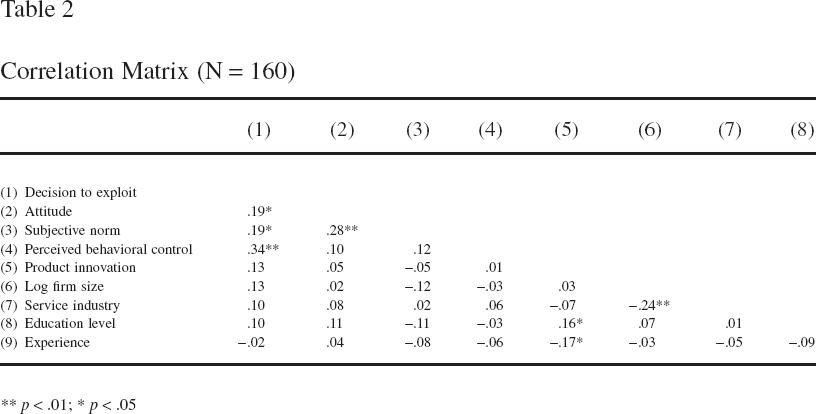
Log transformation was applied to our measure of firm size because it was not normally distributed (absolute values of skewness and kurtosis > 2). After this transformation all variables satisfied the basic assumptions of the regression models presented hereafter. Correlations between the variables are shown in Table 2.
Correlation Matrix (N = 160)
p < .01;
p < .05
The largest single correlation is between the decision to exploit and perceived behavioral control. The reported correlations indicated no concerns for multicollinearity (Hair, Anderson, Tatham, & Black, 1998, p. 189).
Results
We conducted binary logistic regression analyses, a form of regression used when the dependent is a dichotomy and the independents are of any type. Thus, we estimated the relationship between the planned behavior constructs and the odds that high–tech small–business owners engage in innovation exploitation. We first mean centered our measures and computed interaction terms by multiplying the centered values for the various two– and three–way combinations of the planned behavior constructs (cf. Jaccard, 2001). Next, various specifications of the model were applied by entering the independent variables and interaction terms at successive steps.
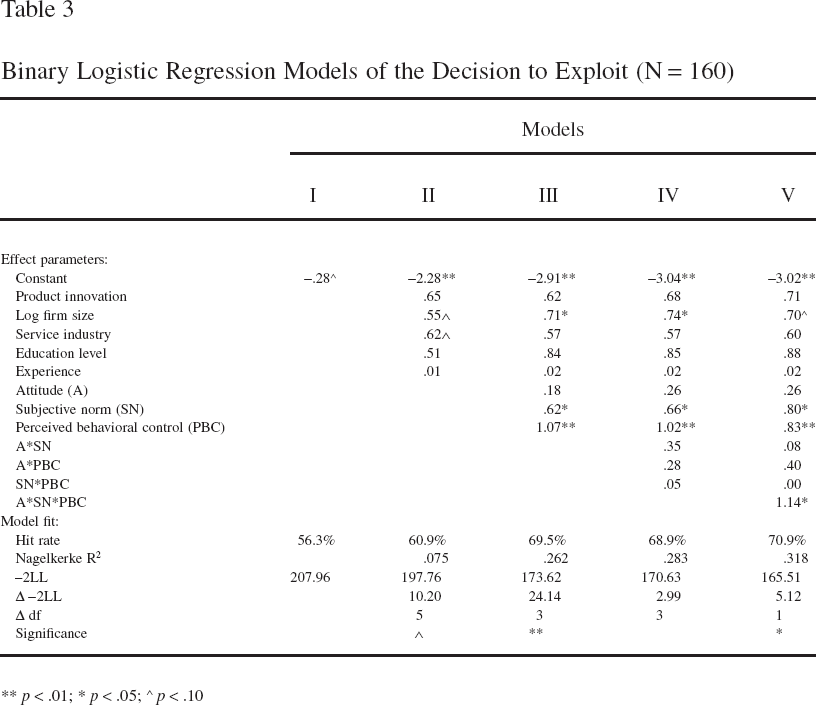
Table 3 presents the results. Goodness–of–fit is assessed by comparing the transformed loglikelihood value −2LL with the previous model, and evaluated against the χ2 distribution. Other fit measures include the hit rate (representing the share of correctly classified cases) and Nagelkerke's R2 (indicating the strength of association in the overall model).
Binary Logistic Regression Models of the Decision to Exploit (N = 160)
p < .01;
p < .05;
p < .10
The first model was an empty model (intercept only) to obtain baseline values for −2LL and the hit rate. The second model added the control variables, which marginally improved model fit (Δ–2LL = 10.20, p < .10). With the exception of experience the effect parameters had their anticipated signs, but only log transformed size and the services dummy were significant.
In the third model we entered the planned behavior constructs to test hypotheses 1–3. Goodness–of–fit improved significantly (Δ–2LL = 24.14 with Δdf = 3, p < .01). From the Wald tests we concluded that attitude was not related to the decision to innovate. Its effect parameter was non–significant (b = .18, p > .10), so hypothesis 1 is not confirmed. In the Discussion section we elaborate on this finding. For subjective norm, we found that the effect parameter (b = .62) was significant at the 5% level. This implies that a one unit increase in perceived subjective norm increases the odds of innovation creation by exp(.62) = 1.86. Hypothesis 2 is supported. For perceived control, we found a strong and positive connection with the decision to innovate (b = 1.07, p < .01). Such perceptions increased the odds of exploitation by exp(1.07) = 2.92. Hypothesis 3 is supported.
To test hypothesis 4 we estimated models IV and V. Model IV reports all two–way interactions, showing that none of these were significant. (We also estimated alternative specifications in which the two–way interactions were entered one at a time, but no significant findings emerged.) Next, model V tested for an interaction between the three focal independent variables. Following Jaccard's (2001) recommendation of hierarchically well–formulated models, it is compared with model IV. We found that model fit improved significantly (Δ–2LL = 5.12, p < .05). Thus, as far as the three–way interaction is concerned, we found support for our exploratory hypothesis 4.
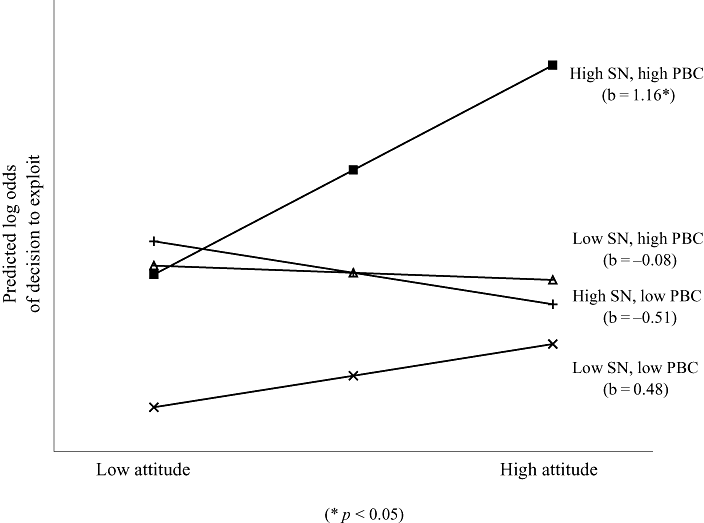
To further analyze this significant effect parameter (b = 1.14, p < .05), we rearranged the regression equation in simple regressions of the decision to exploit, first with the entrepreneur's attitude as the focal independent variable, and at conditional values of both subjective norm (SN) and perceived control (PBC). Following Jaccard (2001), we evaluated these simple regressions at high and low scores for both moderating variables (one standard deviation above and below the mean). Figure 1 shows the simple equations between attitude and the predicated log odds of the decision to exploit.
Simple Binary Logistic Regression Models of the Decision to Exploit (N = 160)
We found that at high scores of subjective norm and perceived behavioral control, the relationship between attitude and the decision to exploit was positive and significant (b = 1.16, p < .05). For the other simple regressions this parameters was not significant, suggesting that attitude and the decision to exploit are connected only if business owners perceive their close ties to be positive and that they are in control.
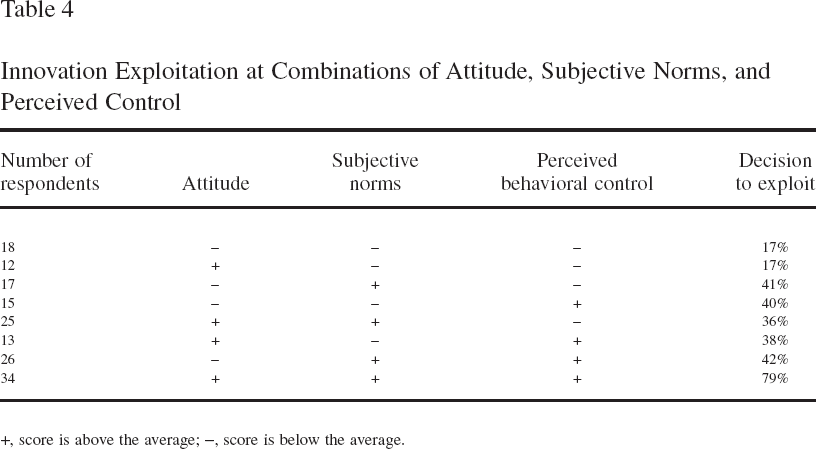
We also conducted the simple regression analyses from the perspectives of subjective norms and perceived behavioral control. For subjective norms, we found that the connection with innovation exploitation was stronger at simultaneous high levels of attitude and perceived control. A similar result was obtained for perceived control—the correlation with exploitation was stronger when respondents had both favorable attitudes and perceived positive subjective norms (results available on request). To further illustrate the relationships we computed the descriptive statistics in Table 4. It presents the share of respondents engaging in innovation at various combinations of the antecedent variables. When respondents scored above the mean on all three constructs, 79% indicated to exploit the innovation opportunity. When they scored below the mean on all constructs, only 17% did.
Innovation Exploitation at Combinations of Attitude, Subjective Norms, and Perceived Control
+, score is above the average; −, score is below the average.
Finally, we conducted a sensitivity analysis to check if our findings were a result of over–fitting the data with too many independent variables. For each independent variable one popularly needs ten outcomes in the sample (Peduzzi, Concato, Kemper, Holford, & Feinstein, 1996), a rule of thumb that is violated in our data. This may result in large estimated coefficients and/or standard errors. Although it has recently been argued that the rule of ten events per independent variable is probably too conservative (Vittinghof & McCulloch, 2007), we did investigate whether we would find similar results with more parsimonious models. Since our control variables of product innovation, education, and experience were not significant, we ran a range of models in which these variables were omitted. Results were similar, i.e., significant effect parameters for subjective norms, perceived control, and the three–way interaction term, while the other parameters were insignificant.
Discussion
The literature recognizes the decision to exploit opportunities as essential in the entrepreneurial process, but past work has investigated this decision rather indirectly. We here used longitudinal data of incumbent, high–tech small–business owners to directly investigate their decision to engage in opportunity exploitation, as recommended by Shane (2003). More specifically, we focused on their decision to innovate, using the planned behavior constructs as independent variables, and we also explored their potential interaction effects.
Where previous studies showed that the planned behavior constructs can be used to predict entrepreneurial intentions, we here found that they are also relevant for the decision to innovate, as evidenced by respondents’ behavior. Surprisingly however, we found no evidence for our hypothesis that attitude is related to such exploitation. This contradicts past work in which attitude is a strong and significant predictor of entrepreneurial intentions. It may be due to the fact that intentions do not automatically induce behaviors—a criticism that has been pronounced earlier by Wiklund and Shepherd (2003) and Brännback et al. (2007). Drawing on Bagozzi and Warshaw (1990), the latter authors suggest that intentions can evolve over time, and they found initial evidence that the degree of intentions indeed moderates the attitude–behavior relationship. Likewise, in their work on consumer decision making Bagozzi and colleagues extend the theory of planned behavior by demonstrating that intentions to engage in goal–directed behaviors are also preceded by individual desires and anticipated emotions (Perugini & Bagozzi, 2001)—and more recently, a related line of research is emerging in entrepreneurial decision making (e.g., Michl, Welpe, Spörrle, & Picot, 2009). Clearly, not controlling for intentions and their cognitive process determinants may be the reason why a direct correlation between attitude and innovation exploitation was lacking. In this vein, we also point to Gollwitzer's (1999) notion of implementation intentions. Such intentions may facilitate goal achievement by specifying when, where, and how specified goals can be achieved. Implementation intentions have been shown to help people get started and to protect their ongoing goal pursuits from any distractions—lack of implementation intentions may also compromise a connection between strong attitudes and innovation exploitation.
We remark that lack of correlation for attitude may also be due to the type of decision that is under investigation. Innovation exploitation is probably more severe than other decisions that were (so far) studied with planned behavior theory. Compared to innovation adoption, health issues or choice of leisure activities, innovation is marked by heavy uncertainty—especially for materially constrained small–business owners. Thus, innovation may be further from business owners’ volitional control, and a positive attitude by itself may simply not be enough. In this vein, we again refer to Brännback et al. (2007) who proposed that the decision to exploit is no static process, but contingent on how goals and paths differ over time. Individuals may initially have poorly formed attitudes and intentions, which are more likely to change, and thus less suitable to predict future decision making and behaviors.
Yet another reason may be that our screening of respondents resulted in selection bias. We notice that the mean scores on our attitude measure were relatively high—5.84 on a scale coded 1 to 7 (see Table 1). This suggests that respondents mainly reported opportunities they found attractive. If small–business owners are unable to identify opportunities that they do not like—unattractive opportunities may immediately disappear from their radar—this would imply that our data suffered from reduced variance on this construct. Future research on these issues is called for (see Suggestions section).
The hypothesis that subjective norm is positively related with opportunity exploitation was supported. To date, entrepreneurship studies were biased towards individuals’ intentions to start a business when their parents, friends, or spouses were supportive of doing so. In the case of incumbent business managers however, the influence of close ties on decision making is relatively uncharted. Many studies were concerned with social networks, but these regard network ties as sources of finance, information, and legitimacy after the decision to exploit has been taken (e.g., Bruderl & Preisendorfer, 1998; Elfring & Hulsink, 2003). We also note that previous studies on entrepreneurial intentions provided mixed results on the role of subjective norms (Linan & Chen, 2009). For future theory building, this may reflect a differential impact of subjective norms when different types of opportunities (new firm formation versus innovation) are investigated.
As for the third proposed antecedent, our finding was that perceived behavioral control is strongly associated with the decision to innovate. This finding is in line with what previous work suggests, with the exception of Kolvereid and Isaksen (2006). In a longitudinal survey of Norwegian start–ups they found that perceived control measures did not influence new firm formation and subsequent entry into self–employment. As their most likely explanation, they stressed that perceived control was measured with rather general entrepreneurial self–efficacy indicators (p. 882). Indeed, their measures clearly differed from how we measured perceived control, stressing the importance of recent work by Linan and Chen (2009) and McGee et al. (2009) who argue that the huge variety of measures limits comparisons of empirical contributions, and that more consistency in measurement is merited.
Finally, in our exploration of multiplicative effects no support was found for any two–way interactions, but we did find strong support for a three–way interaction. When all proposed antecedents were present simultaneously, innovation exploitation was much more likely. If we rearranged the significant result into simple regressions with attitude as the focal independent variable, the interpretation was that attitude is significantly related to opportunity exploitation only under conditions of favorable subjective norms and perceived control. This suggests that in addition to their additive effects, a simultaneous presence of positive subjective norms and perceived control enables attitude to “work,” i.e., in line with Krueger (2003), without supportive close ties and control beliefs, a positive attitude is not sufficient to engage in innovation. This finding, as well as those in other recent contributions (Fitzsimmons & Douglas, 2011), mainly demonstrates that future modeling likely benefits from investigating more complicated relationships—also to find if our findings generalize to other types of decisions and research contexts.
Implications
To anyone with a professional interest in innovation in small businesses our results confirm that the decision to exploit is not just a matter of “like” or “ability.” Finding a strong, multiplicative effect between the planned behavior constructs, we conclude that it is important that positive attitudes, subjective norms, and perceived control are simultaneously present for innovation to take off. This finding is relevant not only for small–business managers, but also for a broad range of professionals who normally contribute to small firm innovation, including consultants, suppliers, accountants, and engineers. Our findings also imply that close ties are influential and cannot be ignored in any attempt to influence decision–making of small–business owners.
Moreover, our findings have implications for policy makers interested in stimulating innovation in small firms. Today, both entrepreneurship and innovation are among the main pillars of economic policies in basically all developed countries. In the European Union for example, ever since the Lisbon conference in 2000 national governments embraced this focus (European Commission, 2008a). Accordingly, individuals who decide to actually develop and implement opportunities are wanted. However, most current policies deal with relieving hampering factors like access to finance and knowledge, i.e., by providing subsidies and fiscal incentives, or by stimulating public–private partnerships (European Commission, 2008b). Implicitly, policy makers seem to intervene mostly on behavioral control issues. Our results suggest that this approach has limitations, i.e., attitudes of small–business owners and social pressure from close ties matter too and merit attention. A serious reflection on what policy interventions are needed to simultaneously develop business owners’ attitude, perceived subjective norms, and control beliefs are called for. Rather than subsidies, we would expect much more from interventions such as competitions in which business owners pitch their opportunities to apply for finance (in such a way that the review process also assesses their attitudes and potential influence of network ties).
Suggestions
We agree with Linan and Chen (2009) and McGee et al. (2009) that the current variety of planned behavior measures limits the comparability of research output. Due to our focus on innovation and accordingly modified measures, this also applies here. Future research should validate our findings for other opportunity types and draw on other (incumbent) measures in order to broadly generalize. Larger samples are merited, too. Despite our substantial data collection efforts, the sample size was relatively limited (N = 160), so some significant relationships (including interactions) may have been missing due to limited power. Likewise, future research would benefit from data collected at multiple time points, for example to explore if and when business owners delay opportunity exploitation (but still end up exploiting it), or to estimate more sophisticated models of how the planned behavior constructs change over time.
We also stress that our results can be extended further, for example by elaborating on individuals’ attitudes towards identified opportunities. New surveys should do a better job of capturing less attractive opportunities. One way do that is to draw a homogenous sample from a narrow industry type, then ask business owners to assess a specific innovation opportunity that they all likely face (e.g., tracking and tracing equipment in transport firms). This would also simplify our methodology, as the screening survey to find those considering specific opportunities is eliminated. Another important direction is to measure respondents’ intentions, and to elaborate on the role of implementation intentions (Gollwitzer, 1999) and other potential determinants like cognitive processes—a strand of entrepreneurial decision–making research that is currently emerging (e.g., Brännback et al., 2007; Michl et al., 2009). Such work would enable better analyses of how planned behavior constructs and intentions evolve over time, and to explore if the interactions between the planned behavior constructs are dissimilar when intentions or behaviors are concerned.
Our findings on subjective norms suggest that more can be done on how close ties influence individuals’ decision to exploit. While previous studies provided mixed results (Linan & Chen, 2009), our findings suggest that this relationship may be contingent on the type of opportunity under investigation (self–employment versus innovation). Alternatively, the antecedents of intentions versus behaviors can be dissimilar, and both explanations provide opportunities for research.
Another opportunity is to investigate more thoroughly the interactions between the planned behavior constructs, also by analyzing potential nonlinearities in their relationship with the decision to exploit. This would further develop the idea of “threshold phenomena” that was introduced by Krueger (2003)—planned behavior construct may in fact be only influential for particular parts of their domain. Finally, it would be interesting to explore why business owners in our sample refrained from innovation, by researching any barriers that they envisioned, or, following Shapero (1982), any precipitating events triggering their decision. Such events are likely to precede individuals’ control beliefs towards identified opportunities.
In all, we found that the constructs of a well–known social psychological model can be applied to explore when small–business owners are likely to exploit identified innovation opportunities. We suggest that research on entrepreneurial intentions would benefit from a relatively new direction by focusing more on actual decisions made by individuals, as evidenced by their behaviors, and to also investigate the multiplicative effects of these proposed antecedents. Our empirical results suggest that continued work in this direction is merited and may enhance our understanding of opportunity exploitation in business.