







Abstract
This study examines how characteristics of university departments impact students’ self–employment intentions. We argue that four organizational–level factors (entrepreneurship education, entrepreneurship support programs, industry ties, and research orientation) increase such intentions. Using a data set of 1530 business students and 132 professors at 25 university departments, this study shows that entrepreneurship education and industry ties are related to self–employment intentions only for the males in our sample. A negative effect of the department's research orientation was found. Our study suggests that the organizational context plays an important but gender–specific role in shaping future entrepreneurs. Implications of our findings are discussed.
Introduction
Universities are increasingly seen as critical institutions providing society with important learning and inspirational resources that can foster entrepreneurship (Souitaris, Zerbinati, & Al–Laham, 2007). It is therefore not surprising to see that there are federally funded initiatives such as the Small Business Innovation Research (SBIR) Program in the United States and laws such as the Bayh–Dole Act of 1980 encouraging universities to invest in infrastructure supportive of entrepreneurship. As a result, the number of technology licensing offices and entrepreneurship courses has grown drastically (Vesper & Gartner, 1997). Such activities imply that the organizational context can, in part, shape future entrepreneurs through awareness raising, education, and support.
However, in explaining entrepreneurial behavior, scholars have primarily focused on individual–level factors (e.g., Shane, 2003, for a review), such as dispositions (Collins, Hanges, & Locke, 2004) and family background (Scherer, Adams, Carley, & Wiebe, 1989). This approach has resulted in a high number of potential antecedents to entrepreneurship, leading some researchers to doubt that a coherent and parsimonious set of individual–level factors can ever be found (Gartner, 1989; Zhao, Seibert, & Hills, 2005). Moreover, other studies have examined the impact of organizational–level factors, such as university quality (Di Gregorio & Shane, 2003), organizational norms (Louis, Blumenthal, Gluck, & Stoto, 1989), and entrepreneurship education (Souitaris et al., 2007) on entrepreneurial behavior and interest. Both streams of research have evolved in relative isolation, whereas scholars of organizational behavior have suggested that “…ultimately, behavior is determined by both dispositions and situations” (House, Shane, & Herold, 1996, p. 204). To date, however, research bridging the gap between both levels to explain student and graduate entrepreneurship is still scarce.
Given the gaps mentioned earlier, we use a unique data set of 1,530 students and 132 professors at 25 university departments and apply a cross–level approach to examine the relationship of university department–level factors (entrepreneurship education, entrepreneurship support programs, industry ties, and research orientation) with students’ self–employment intentions, adjusted for critical individual–level factors (dispositions, role model performance, social network support, work experience, and opportunity perception). In line with prior research (Kolvereid, 1996a; Souitaris et al., 2007), we define self–employment intentions as the subjective likelihood that a person becomes self–employed within a certain period of time. 1 Building on insights from human capital, network–based, and organizational norms research, we argue that the university setting can directly affect the likelihood that students identify and exploit opportunities, and thus their self–employment intentions.
Other authors have instead studied entrepreneurial intentions, defined as intentions to start a new business (Krueger, 1993). Such intentions are often associated with launching more growth–oriented start–ups (e.g., Zhao et al., 2005), while self–employment intentions seem to also include other forms of entrepreneurship, such as freelancing. Sometimes both terms are used synonymously (e.g., Souitaris et al., 2007). Indeed, respondents in our pretests reported problems differentiating them. We refer to self–employment intentions because the nature of a business is often difficult to determine prior to start–up and intentions can exist without having a business idea as a base to distinguish both types (Bhave, 1994).
Our cross–level study extends the literature on multiple fronts. Because our approach spans levels of analysis and thus acknowledges the important but neglected influence of the organizational context on individual behavior, it can help to resolve some of the controversies in prior research (Gartner, 1989). In testing our cross–level hypotheses, we use hierarchical linear modeling (HLM) and thus avoid estimation errors associated with traditional regressions approaches (Raudenbush & Bryk, 2002). Moreover, we develop and test a multilevel model of self–employment intentions drawing on arguments from human capital, network–based, and organizational norms research. To policy makers and university managers, our findings may help to understand how effective current initiatives to stimulate academic entrepreneurship are. In particular, this knowledge can contribute to further improving such programs, also by considering their gender–specific outcomes.
Theoretical Development
In explaining why some and not others discover, evaluate, and exploit entrepreneurial opportunities, previous research has provided two categories of explanations. First, individual–level arguments hold that individuals who are, for instance, more achievement oriented (Collins et al., 2004), more risk tolerant (Stewart & Roth, 2001), more independence seeking (Douglas & Shepherd, 2002), more self–efficacious (Chen, Greene, & Crick, 1998), more creative (Lee & Wong, 2004), more susceptible to decision–making biases (Simon, Houghton, & Aquino, 1999), male (Matthews & Moser, 1996), and wealthier (Georgellis, Sessions, & Tsitsianis, 2005) are more likely to exploit a given opportunity. Similarly, individuals who possess idiosyncratic prior knowledge (Shane, 2000), who are more creative, and more optimistic are more likely to discover opportunities themselves (Ardichvili, Cardozo, & Ray, 2003).
Second, organizational–level arguments hold that entrepreneurial behavior is linked to characteristics of the university, such as university policies, characteristics of the technology licensing office, university culture, and intellectual eminence (Shane, 2004). Scientists with universities that share revenues with inventors’ departments, encourage patenting of inventions (Landry, Amara, & Rherrad, 2006), have strong entrepreneurial norms (Louis et al., 1989), and are higher in research quality (Di Gregorio & Shane, 2003) are more likely to commercialize their inventions. Similarly, entrepreneurship researchers have shown a positive effect of university entrepreneurship education on students’ self–employment intentions (Peterman & Kennedy, 2003; Souitaris et al., 2007; Zhao et al., 2005).
Both research streams have evolved relatively isolated from each other. Consequently, to date, scholars have not examined how factors at both levels interact in shaping academic entrepreneurship. However, as the recent special issue of the Academy of Management Journal notes (Hitt, Beamish, Jackson, & Mathieu, 2007, p. 1385), focusing on single levels “yields an incomplete understanding of behaviors occurring at either level.” In contrast, a cross–level lens allows the researcher to understand the context in which some behaviors occur and “illuminates the multiple consequences of behaviors traversing levels of social organization” (Hitt et al., p. 1385). A cross–level approach can help to solve the controversy about inconsistent findings of prior individual–level studies (Gartner, 1989). It acknowledges that behavior may be, ultimately, determined by both dispositions and context (House et al., 1996).
In adopting our cross–level approach, we do acknowledge significant scholarship that is dedicated to understanding the role of universities in fostering technology commercialization (Di Gregorio & Shane, 2003; Shane, 2004) and students’ self–employment intentions (Peterman & Kennedy, 2003; Souitaris et al., 2007; Zhao et al., 2005). Studies on student entrepreneurship have examined up to two universities using pretest–post–test designs. However, the scope of our sample allows us to complement this valuable, fine–grained research and to make an important contribution by combining the individual and organizational level discussed earlier to accurately assess the impact of crucial university aspects on self–employment intentions.
Our article develops and tests a multilevel model of self–employment intentions. We basically argue that the university creates a contextual environment that affects students above and beyond individual influences of self–employment intentions. This contextual effects approach is similar to Hoegl, Parboteeah, and Munson (2003) who showed that team members of the same team were more similarly affected by key team level properties relative to team members from other teams. Such contextual effects occur irrespective of key individual controls as team members are more likely to interact with each other and be similarly impacted by such team–level properties. Through this interaction, irrespective of a person's individual preferences, the person is more likely to be exposed and socialized in ways that make them more similarly influenced by the team. We therefore extend this logic and argue that universities that display characteristics conducive to entrepreneurship are thus more likely to influence students to have stronger self–employment intentions. Such characteristics create norms showing valuation for entrepreneurship and are likely to influence students.
As recommended by Hitt et al. (2007), we start by articulating the theoretical base of the model. The focal unit is the individual (student). At the individual level, we reviewed prior studies on drivers of entrepreneurial behavior and selected six, short–run stable influences. 2 Being well–established in the extant literature, they serve as critical control variables as they tease out potential individual influences. At the organizational level, prior research and interviews with students, entrepreneurship professors, and managers of entrepreneurship programs indicated that four department characteristics may create a context that is conducive to student or graduate entrepreneurship: entrepreneurship education; entrepreneurship support programs; industry ties; and research orientation. They can affect students’ self–employment intentions by transferring important know–how, providing access to critical contacts, and/or reflecting entrepreneurial norms. We therefore build our model on logic from human capital, network–based, and organizational norms research. In the subsections below, we will argue why the four factors should affect students’ intention to pursue an entrepreneurial career.
We reviewed empirical research published in peer–reviewed journals from 1980 to 2005. From 43 determinants reported in 99 studies, more than 20 can be assessed as short–run stable. Thereof, we selected six determinants—need for achievement, risk taking propensity, need for independence, parental role models, work experience, and opportunity perception—because they: (1) are grounded in well–established theory; (2) have shown a significant positive, negative, or non–linear effect on entrepreneurial behavior in more than two–thirds of all cases; (3) are relevant for students and graduates for up to five years after graduation; and (4) are conceptually distinct from other constructs and variables. In acknowledging the theoretical importance of network influences (Hoang & Antoncic, 2003), we introduced another construct labeled “Social Network Support.”
Entrepreneurship Education
We first consider entrepreneurship education and argue that such education is positively related to self–employment intentions. Entrepreneurship education refers to the scope of curricular lectures or courses that primarily aim at sensitizing and qualifying students for an entrepreneurial career. Whether entrepreneurship can be taught at universities is an area of ongoing debate (e.g., Aronsson, 2004; Gendron, 2004). However, many scholars agree that at least some elements associated with the subject can be developed or enhanced via education and training (Henry, Hill, & Claire, 2005). Such efforts can transfer entrepreneurship–specific human capital that can foster the recognition and development of business opportunities (Becker, 1964; Ucbasaran, Westhead, & Wright, 2008). Students learn about techniques to generate elemental business ideas and, in some cases, about markets, ways to serve markets, and/or underemployed resources. Such prior knowledge can affect both the number and innovativeness of opportunities that they associate with the same technology (Shane, 2000; Shepherd & DeTienne, 2005). Moreover, entrepreneurship courses provide methods, including market analysis and business planning, to confirm that a business idea is new and valuable. The expected profitability of an opportunity plays a major role in the decision to exploit it (Bhave, 1994).
Entrepreneurship education also transfers entrepreneurship–specific human capital that increases the potential payoff from exploiting a given opportunity. It aims at providing a basis in areas such as business planning, strategies of market entry, acquisition of resources, and organizing and managing a new venture. Entrepreneurship students learn how to bring business ideas better or faster to market than others. Consequently, they should realize higher value from the same opportunity as others. Such knowledge should give students the confidence to consider starting their own business (Dyer, 1994) and promote entrepreneurial self–efficacy (Souitaris et al., 2007). Prior studies have demonstrated a positive link between entrepreneurship–specific human capital and venture performance (Bosma, van Praag, Thurik, & de Wit, 2004; Gimeno, Folta, Cooper, & Woo, 1997). Similarly, nascent entrepreneurs who have taken business classes feel more competent to successfully perform entrepreneurial tasks (Peterman & Kennedy, 2003; Zhao et al., 2005) and advance the start–up process faster than others (Davidsson & Honig, 2003)—findings indicating increases in entrepreneurship–specific human capital.
From an organizational norms perspective, entrepreneurship education signals that self–employment is socially desirable. To all students (not only course participants), the number of courses indicates the degree to which entrepreneurial behavior is approved by a department. Consequently, such courses reflect organizational norms that promote entrepreneurship. They should raise students’ awareness for self–employment as a legitimate career alternative and encourage some students to pursue entrepreneurial careers. Studies have indeed shown a positive link between perceived social desirability and self–employment intentions (Kolvereid, 1996b; Peterman & Kennedy, 2003). Similarly, scientists in departments with entrepreneurial norms commercialize their inventions through firm formation more often than others (Louis et al., 1989). Thus:
Entrepreneurship Support Programs
A second critical aspect of university education we consider is the presence of entrepreneurship support programs. While universities may provide some form of entrepreneurship education, the extent to which other programs are provided to support entrepreneurship differs. As such, entrepreneurship support programs measure the breadth of systematic and complementary institutional activities that aim at sensitizing, qualifying, and supporting students for an entrepreneurial career. Examples of the presence of entrepreneurship support programs include activities such as promotion of offers (e.g., presentations in lectures), business plan competitions, extra–curricular counseling (e.g., on venture financing), and material support (e.g., start–up capital).
We argue that students at universities with more active entrepreneurship support programs are more likely to pursue entrepreneurial careers. Network–based research suggests that many entrepreneurs use social ties to compensate for lacking resources or to leverage their existing resources (Greve & Salaff, 2003; Hoang & Antoncic, 2003). However, students often lack the initial personal network and have to rely on institutional network partners. Irrespective of the students’ network position, entrepreneurship support programs provide access to critical start–up resources below market prices or resources that are unavailable elsewhere. Thus, they help to overcome resource constraints that hinder or slow down the founding process. In the stage of opportunity development, such programs can give access to experts to evaluate elemental business ideas. Moreover, business plan competitions encourage students to further develop opportunities and offer contacts to mentors. This can demonstrate the value of an opportunity and therefore motivate students to exploit it through firm creation (Bhave, 1994). 3
The overall utility of such competitions is, to date, relatively untested and continues to be an area of ongoing debate (Gumpert, 2002; Honig, 2004). Although business planning was found to be positively related to small firm performance, the relationship was smaller for new firms than for existing ones (Brinckmann, Grichnik, & Kapsa, 2010). This also raises the question of how effective such activities are in motivating and enabling nascent entrepreneurship, which may constitute an interesting field for future research. We thank the editor for pointing us to this debate.
In the stage of opportunity exploitation, students can receive extra–curricular training in special fields such as venture financing or taxes. They can also get counseling in different areas and, in some cases, obtain financial support such as seed–funding or scholarships as well as non–financial support such as free office space. Moreover, such programs may provide students with the necessary contacts, for instance to venture capitalists or to entrepreneurially minded peers, to facilitate opportunity exploitation. Importantly, because this resource flow does not depend on the strength of ties, social contracting (Starr & Macmillan, 1990), or reputation (Shane & Cable, 2002), it enables many students to overcome barriers to self–employment.
Entrepreneurship support programs also signal that self–employment is socially desirable. In many countries, universities receive extra public funding to establish programs. Consequently, their existence reflects a public interest in entrepreneurship, whereas entrepreneurship education, as discussed earlier, reflects a university's interest in entrepreneurship. Programs may animate some students to pursue entrepreneurial careers or at least sensitize them for self–employment as one career option. Similarly, empirical research by Souitaris et al. (2007) suggests that inspiration rather than resource utilization is the key benefit of programs. Thus:
Industry Ties
A third critical aspect is the activity of industry partners and the degree to which universities maintain such ties. Many types of university–industry partnerships, such as research collaborations or corporate sponsorship, are less visible to students. In contrast, educational activities, including presentations and lectures, by industry representatives, are more salient to students. They constitute a forum from which the influence of industry activity flows to students. We therefore argue that students at universities with more active industry partners are more likely to tend to entrepreneurial careers. 4 The more intensive the ties a university has with industry, the more likely students have access to incubation resources (Bramwell & Wolfe, 2008; Souitaris et al., 2007) that may encourage students to consider self–employment.
It is important to note that an alternative argument could be made—students at universities with intensive industry ties are more likely to tend to wage–employment because the industry often sustains intensive university relations to secure an access to qualified personnel. Consequently, this could lower the enterprising tendency of students. Because there is still little research on the link between industry ties and employment preferences, we start by examining its effect on entrepreneurial intentions.
Network–based research proposes that the number and nature of social ties influences the chances of opportunity recognition (Arenius & De Clercq, 2005). Individuals with large networks and many weak ties were found to recognize more business opportunities than others (Singh, Hills, Hybels, & Lumpkin, 1999). Many entrepreneurs rely on informal industry contacts or participate in professional forums to learn about recent trends and developments (Ozgen & Baron, 2007). For students, departments with intensive industry ties may thus prepare a better environment for entrepreneurship. In presentations and lectures, knowledgeable industry representatives provide information that can sensitize students to current market needs and assist them in identifying and developing opportunities. Professors from departments with close industry relations are also more likely than their colleagues to have a “feeling” for industry problems, or even start–up experience (Krabel & Mueller, 2009), that they can share in lectures. Moreover, industry partners may introduce students to market–oriented thinking and make them more alert to opportunities.
In addition, direct ties to industry representatives facilitate acquiring critical resources to exploit a given opportunity. Students can use these contacts to learn about industry standards or to get referrals to potential investors, customers, or suppliers. Lectures and presentations by industry partners are a chance for potential entrepreneurs to establish direct social ties. In some cases, industry partners may act as customers, suppliers, or even investors. Under conditions of information asymmetry and uncertainty, investors are more willing to fund ventures to which they had prior social ties (Shane & Cable, 2002). Thus:
Research Orientation
The impact of university research on entrepreneurship remains a key area of study (Rasmussen & Borch, 2010). Many successful new ventures originate from leading research universities, such as Google and Yahoo! from Stanford and Facebook from Harvard. A university's research is an important resource for prospective entrepreneurs. We therefore examine the department's research orientation as a fourth critical aspect that should be positively related to students’ self–employment intentions.
A number of studies suggested that more extensive research is typically associated with higher degrees of entrepreneurship. For instance, Azoulay, Ding, and Stuart (2007) argue that a flurry of publications typical at more research oriented universities is often associated with the discovery of a new and productive research domain. In turn, such productivity has been shown to be strongly related to academic patenting. Thus, stronger research output fosters the discovery of new ideas that may be eventually commercialized. Furthermore, Rasmussen and Borch (2010) argue that a university provides a rich source of technological opportunities that can lead to the development of new technology ventures. Such processes also indicate that the research process results in new developments that may eventually be commercialized. Additionally, Kirchhoff, Newbert, Hasan, and Armington (2007) also demonstrate that university research and development expenditures tend to be typically associated with higher levels of new business formations in the regions they operate.
The abovementioned evidence suggests that more research–driven institutions are more likely to provide students with superior knowledge and necessary skills to commercialize complex ideas. Such education transfers general human capital, thereby training them to effectively collect and assess information required to identify and develop opportunities (Arenius & De Clercq, 2005; Ucbasaran et al., 2008). In some areas such as consulting or market research, cutting–edge knowledge taught at universities constitutes the basis for self–employment. Thus, higher quality education at research–oriented departments may result in higher payoff from exploiting such an opportunity.
However, the extant research also suggests potential network effects. Specifically, from a network perspective, research–oriented departments facilitate direct access to crucial contacts. Because top institutions typically attract and recruit higher quality students and faculty, they provide a favorable forum to locate competent co–founders or to discuss business ideas with knowledgeable fellow–students or professors. Moreover, the institutional reputation can serve as a quality signal for prospective entrepreneurs. This can increase the willingness of customers and investors to interact with a start–up that has no previous track record (Di Gregorio & Shane, 2003). Although research–oriented departments may also increase some students’ interest in research careers, they, however, offer advantageous conditions for prospective entrepreneurs. Thus:
Methods
Research Context
Public universities in Germany in the year 2005 provide the setting of our study. Entrepreneurship support and education is a relatively recent phenomenon at German universities. Starting in 1997 (1963 in the United States; Katz, 2003), many, but not all institutions, established endowed positions for entrepreneurship. In 2002, 48 of 72 public universities had created entrepreneurship chairs (Klandt, 2004). Entrepreneurship courses are typically electives that students can access after successfully passing the first four semesters (“Grundstudium”). Since 1998, the federally funded EXIST program, alongside smaller local initiatives, aims at stimulating more entrepreneurship at selected universities. The various activities range from raising awareness for entrepreneurship as career alternative to material support of start–up projects.
Germany provides a favorable setting for our study for three reasons. Recent trends have led to or amplified the heterogeneity in university entrepreneurship resources across institutions—a necessary condition for our research. Second, the number of universities and the class sizes in Germany are large enough to conduct sophisticated quantitative analyses. Third, the gender gap between rates of self–employment, unemployment, and graduation is similar to other developed countries, although total values vary substantially across countries (OECD, 2010).
Sample and Procedures
To ensure sufficient variability and a high regional representativeness of our organizational–level data, we drew a stratified random sample of 30 universities from the general population of 72 public universities in Germany. The strata are defined on basis of: (1) the intensity of institutional entrepreneurship support (low, mid, high—according to ranking data provided by Schmude & Uebelacker, 2003); and (2) affiliation to federal states. Within universities, we considered three types of departments—computer science, electrical engineering, and business—because start–ups in these fields have a relatively high potential for growth and employment and because self–employment is not part of the typical career path, as is often the case in pharmaceutical science. Of these, we focused on the latter because only the business sample comprised both genders and allowed us to conduct gender–specific analyses.
We also note that our study examines university departments (or schools/colleges), rather than entire universities for three reasons. First, departments and not universities define curricula and therefore control students’ access to entrepreneurship education. Second, students are more likely to interact within the sphere of their departments than across. Third, university–focused research neglects that universities differ in the number and type of departments with possibly different subcultures.
Individual–level data came from a survey of students at 25 university departments. Trained interviewers conducted the study at the beginning or the end of one lecture per department. We focused on lectures that were according to student representatives very popular or compulsory, but excluded entrepreneurship courses. This sampling strategy increases the representativeness of each subsample, without oversampling entrepreneurship students. Moreover, we selected a short time frame for our data collection (3 weeks), in order to minimize the risk that time–variant influences, such as a change in the general economic situation, bias our data. From 7,925 questionnaires, 6,037 (thereof 2,283 from business students) were returned. To ensure that students had access to entrepreneurship offers and did not belong to any group with unique founding behavior (e.g., Cooper & Dunkelberg, 1986), we retained respondents that had finished their second year of studies, had worked less than four years full time, were not likely to succeed a family business, and were German citizens. 5 Furthermore, entrepreneurial–minded students might be attracted to universities with a good reputation for entrepreneurship support. As detailed in Appendix B, we therefore excluded respondents who had primarily selected their university for their entrepreneurship offers.
Our study does not include students without German citizenship. The decision was motivated by arguments that disadvantages on the labor market lead immigrants to choose self–employment (e.g., Mesch & Czamanski, 1997). Indeed, the non–German citizens in our sample are higher in entrepreneurial intentions (F = 59.68, p < .001) and expect to take longer for finding a job (F = 6.01, p < .01). Consequently, our findings are mostly generalizable to German citizens. Future research is necessary to show how university characteristics affect entrepreneurial interests of immigrants and exchange students.
Our final sample consisted of 827 male and 703 female students at 25 and—due to missing values on the individual level—21 departments, respectively. The ratio of male to female in our sample is 1.17, compared with 1.23 in the population of business students in 2005 (Federal Statistical Office, 2007). The gender distribution therefore appears representative of the business student population. The mean age was 23.31 years (standard deviation [SD] = 1.72) for women and 23.85 years (SD = 1.80) for men, with an average number of 6.88 semesters (SD = 2.15) and 6.96 semesters (SD = 2.30), respectively. Because students had on average about one year to their next career decision, we assume a high validity of self–reported self–employment intentions as a predictor of actual behavior (Ajzen, 1991).
Data on entrepreneurship support programs and industry ties came from a survey of full professors at the 25 university departments. We emailed 308 business professors an invitation to participate in our study online or via fax, if they were an active part of the faculty within the three–semester–period from Fall 2004/2005 to Fall 2005/2006. This is the time frame for our organizational–level data because on average the student in our sample is in his or her 7th semester and could therefore access entrepreneurship–related offers for three semesters. After two email reminders and one follow–up call the final sample consisted of 132 professors.
Measures
Dependent Variable
Self–employment intention refers to the subjective likelihood that a person becomes self–employed within five years of the successful completion of his or her studies. Scholars have typically studied self–employment intentions of potential founders (e.g., Souitaris et al., 2007), venturing decisions of actual founders (e.g., Eisenhauer, 1995), or differences between founders and others (e.g., Stewart & Roth, 2001). We focus on self–employment intentions because they are measurable without unpredictable time lag, potential survival bias, an ex–post rationalization by the respondents, or the risk of identifying consequences instead of determinants of self–employment. Thus, intentions are likely to directly reflect organizational–level influences. 6 Although evidence in the entrepreneurship context is still lacking, a meta–analytic review by Armitage and Conner (2001) shows that intentions account for up to 31% of the variance in general, self–reported behavior and 20% of the variance in observed behavior. Like all other items (unless stated otherwise), it was measured on a 7–point Likert scale (1 = “I completely disagree”; 7 = “I completely agree”). We derived our three item measure based on Kolvereid (1996a). The measure is reliable at an alpha of .81. An overview of our items is located in Appendix A.
This requires that university characteristics can affect intentions. Souitaris et al. (2007) and Peterman and Kennedy (2003) have demonstrated that entrepreneurship education can influence occupational preferences. Drawing on these insights, our study illuminates how organizational characteristics account for the between–department variance in intentions.
Independent Variables
We measure entrepreneurship education as the total number of credit points for curricular courses that concentrate on entrepreneurship–specific content. Two researchers reviewed the curricula and coded courses ranging from lectures to project seminars. This procedure was repeated after two days. A comparison of the results, first with the own records and then with those of the other researcher, showed no discrepancies. To ensure the completeness of the curricula, we called randomly selected faculty–members per scientific field.
Having no directly applicable published measures, we developed scales for the other major constructs of our study through a procedure proposed by Rossiter (2002). Compared to other heuristics, it actively involves expert raters in the development process who specifically help to clarify if a formative or reflective measurement model is more appropriate for a given construct. Therefore, it aids to prevent misspecifications that have plagued, for instance, marketing studies in the past (Jarvis, Mackenzie, & Podsakoff, 2003).
To assess the validity of our formative measures (an area of ongoing debate), we tested: (1) content validity by asking expert judges (Rossiter, 2002); (2) nomological or criterion validity by analyzing the correlation between the measure and, if available, a theoretically linked measure (MacKenzie, Podsakoff, & Jarvis, 2005); and (3) discriminant validity by analyzing the intercorrelations of the measures (MacKenzie et al.). Because formative indicators are not necessarily intercorrelated, reliability in terms of internal consistency and convergent validity are irrelevant in this case (Jarvis et al., 2003). Both content and discriminant validity were confirmed. Results for criterion validity are reported in the following.
We operationalize entrepreneurship support programs as the extent of activities through which extra–departmental units attempt to promote entrepreneurial behavior at university departments. Drawing on interviews with professors combined with prior work by Souitaris et al. (2007) and descriptions of entrepreneurship support programs, the measure included five entrepreneurship–specific formative indicators: (1) promotion of program offers and entrepreneurship as career option, (2) extracurricular training, (3) business plan competitions, (4) counseling, and (5) material support. Professors rated the frequency of these activities at their chairs (7–point Likert scale, 1 = “seldom,” 7 = “often”). We surveyed professors rather than program representatives because they have no obvious incentive to overestimate program activities. The average score of the items for all professors at one department is our final measure of entrepreneurship support programs. An alternative, university–level measure of program activities (Schmude & Uebelacker, 2005) was positively correlated to our aggregated, department–level measure of entrepreneurship support programs (r = .422, p < .05), which indicates criterion validity.
We measure industry ties as the level of activities of industry partners at university departments. Interviews with professors and students suggest two forms of support that are salient to students and constitute the indicators of this construct: (1) presentations held by industry partners, and (2) lectures held by industry partners. Professors assessed the extent of such activities at their chairs (7–point Likert scale, 1 = “seldom,” 7 = “often”). The measure is reliable at an alpha of .75.
Finally, we captured research orientation with a department–level proxy for the average research budget per researcher granted by third parties, including both public and private institutions (CHE, 2008). In Germany, research positions at business departments have similar resource endowments. More active researchers therefore have to acquire extra funding. We measure research inputs rather than research outputs (e.g., publications) as they are measureable without time lag and German business schools vary in their appreciation of publications in top journals. A positive correlation of this measure with a related measure for the research reputation of a department, as evaluated by professors (r = .346, p < .01; CHE), confirms criterion validity.
Control Variables
We control for a selection of individual–level influences. Need for achievement can be broadly defined as expectations of doing something better or faster than anybody else or better than the person's own earlier accomplishments (Hansemark, 2003). Achievement motivated people are more likely to self–select into entrepreneurial careers because this occupation includes activities that are typically associated with the achievement motive, such as striving for concrete feedback regarding individual performance (Collins et al., 2004). We employ a formative measure of vocational achievement motivation developed and validated by Cassidy and Lynn (1989). Need for independence refers to a need to do and say as one likes despite conventional expectations. Autonomy is one of the most frequently stated reasons for choosing an entrepreneurial career (Kolvereid, 1996a). We derived a job–related, formative measure of this construct. Its four indicators include the freedom to decide on working hours, work contents, work processes, and to operate without supervision. Risk–taking propensity refers to the tendency of a decision maker either to take or to avoid risks (Sitkin & Pablo, 1992). An entrepreneur takes more risks than others because he or she is confronted with less structured and more uncertain problems and bears the ultimate responsibility for his or her decisions (Stewart & Roth, 2001). Although recent meta–analyses have provided mixed findings (Miner & Raju, 2004; Rauch & Frese, 2007; Stewart & Roth), our own selection criteria suggested to include the construct. We measure this construct by a modified version of the established Risk Style Scale (Schneider & Lopes, 1986).
People with (successful) entrepreneurial role models are more likely to become self–employed than others because they are socialized into an entrepreneurial career (Scherer et al., 1989) or inherit specific entrepreneurial knowledge (Tervo, 2006). We measure the performance of entrepreneurial role models (conceptually based on Scherer et al.) as formative constructs with indicators for the perceived performance of: (1) parents, (2) other relatives, (3) friends, and (4) acquaintances. Social network support refers to the extent of support that a person expects for becoming self–employed after graduation. People with effective network support are more likely to opt for self–employment because they can acquire resources below market prices or elsewhere unavailable resources (Evans & Jovanovic, 1989). Based on the extant literature and interviews with students, we measure this formative construct on two dimensions (7–point Likert scale, 1 = “no support,” 7 = “great support”), sources of support (family, partner, friends, and acquaintances), and types of support (material support, procurement of contacts, information and good advice, emotional support). Moreover, people can acquire skills and knowledge through work experience that increases the potential pay–off from self–employment and, thus, self–employment intentions. We measure it as the number of months as a wage–employee, including professional training and full time. Moreover, many people tend to self–employment after perceiving a business idea with market potential, referred to as opportunity perception (Bhave, 1994). We measure it with a dummy variable (0 = “no opportunity perceived;” 1 = “opportunity perceived”).
On the organizational level, we additionally control for the average student quality. It is likely to decrease self–employment intentions because companies tend to recruit from high–quality universities, thus increasing opportunity costs for self–employment. We use a measure provided by the “Studentenspiegel” survey (Friedmann et al., 2004) that bases on several dimensions, such as high school marks and internships.
Analysis
We employed HLM (Raudenbush & Bryk, 2002) with restricted maximum likelihood estimates because it overcomes the statistical shortcomings of traditional methods for analyzing hierarchical data (Hofmann, 1997). Since our hypotheses evaluated main effects of variables at both levels on the individual–level outcome (students’ self–employment intentions), we used intercepts–as–outcomes models to test our hypotheses. Additional tests showed that slopes–as–outcome models were not appropriate options because the individual–level slopes do not vary significantly across university departments. This type of model addresses the issue of whether, in our case, department–level variables moderate the relationship between individual–level predictors and the dependent variable.
Our cross–level approach complements prior quasi–experimental research. These studies compared students’ self–employment intentions before and after taking entrepreneurship courses and interpreted inter–temporal changes as treatment effects (e.g., Souitaris et al., 2007). In contrast, our cross–level study links between–department variance in intentions to department–level influences. Significant relationships are attributed to the organizational context. This cross–level design complements prior work by controlling for individual–level influences and by drawing on a large, multi–institutional sample, thereby helping to establish the external validity of prior findings.
Moreover, we estimated separate models for female and male students as prior research has revealed that men are more likely than women to start and operate their own business (e.g., Brush, 1992; Hsu, Roberts, & Eesley, 2007). Gender–specific analyses permit us to control whether differences in individual–level or organizational–level variables account for these findings.
We first examined whether there was sufficient between–department variance in the outcome to warrant further analysis. Tests similar to analyses of variance by departments confirmed this for male students, but not for female students. However, to formally test our hypotheses, we conducted complete analyses for both genders. To avoid multicollinearity and to make the intercept more interpretable, all individual–level predictors were centered around their group mean. Consequently, the intercept represents the self–employment intention of a student with a group average score on all individual–level predictors (Hofmann, 1997). The pattern of the results was the same as for uncentered data. Following recommendations by Raudenbush and Bryk (2002) and Snijders and Bosker (1999), we confirmed that the six assumptions of hierarchical linear models with two levels were met.
Results
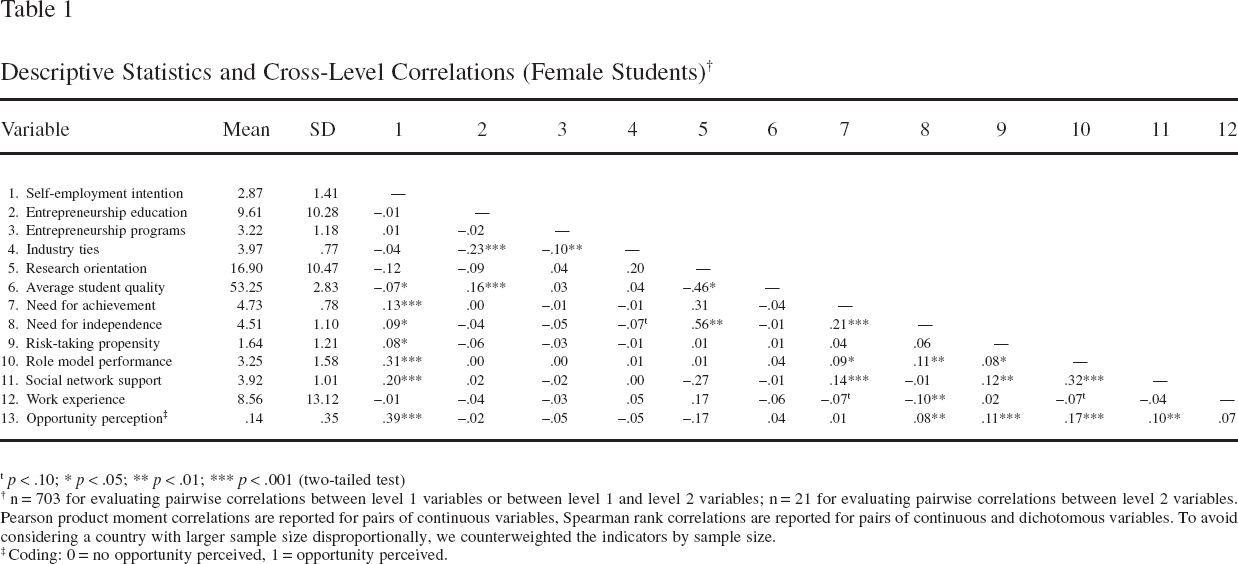
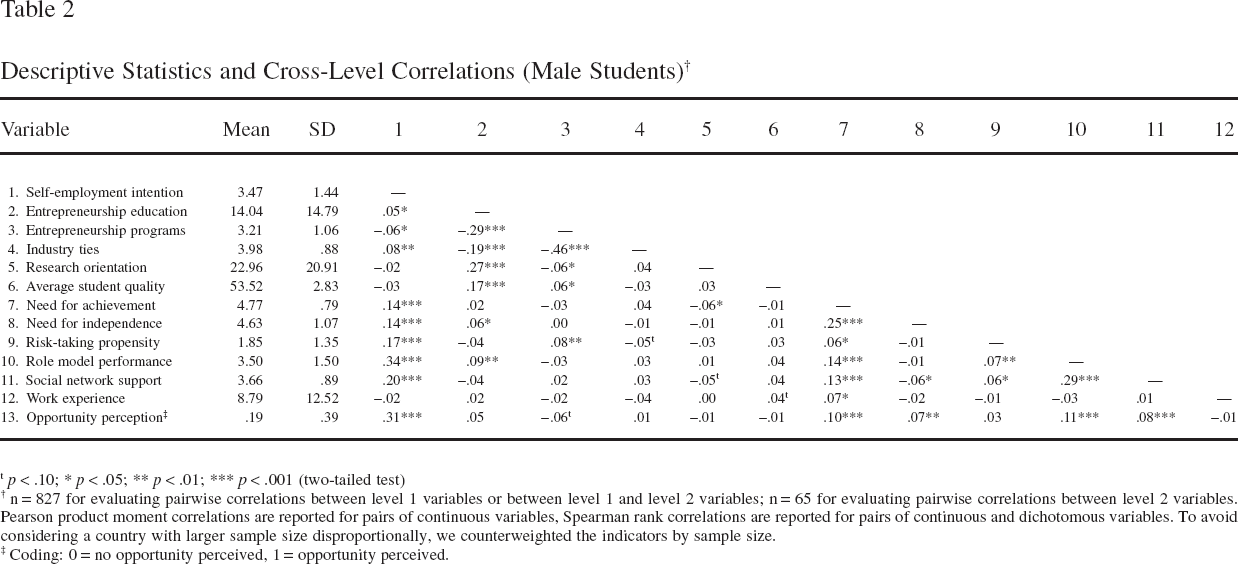
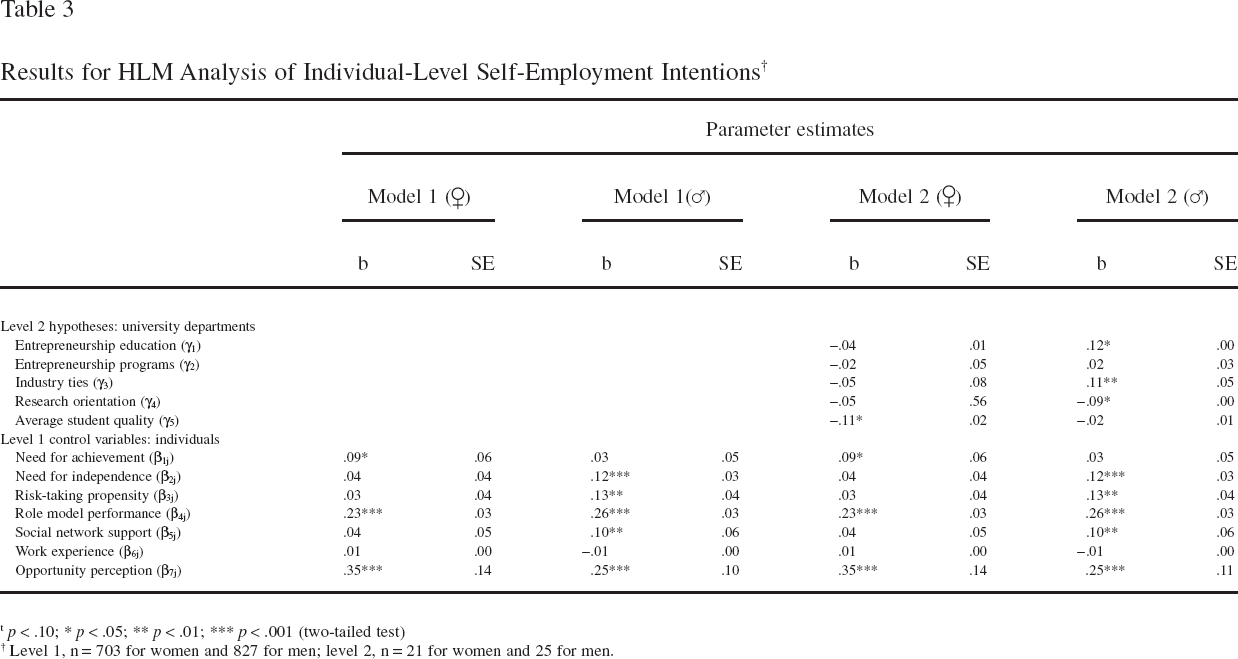
The descriptive statistics and correlation matrix for the variables in the study are reported in Table 1 for female students and in Table 2 for male students. Table 3 reports HLM results for both genders, including standardized coefficients of organizational– and individual–level variables predicting students’ self–employment intentions. Model 1 shows the effects of individual–level variables. Model 2 combines variables at both levels. Drawing on techniques suggested by Raudenbush and Bryk (2002, p. 149), we estimated the variance explained at both levels of analysis. The organizational–level variables accounted for 29 and 30% in the between–department variance (Model 2), while the individual–level variables explained 23 and 22% of the variance (Model 1) of self–employment intentions for females and males, respectively.
Descriptive Statistics and Cross–Level Correlations (Female Students) †
p < .10;
p < .05;
p < .01;
p < .001 (two–tailed test)
n = 703 for evaluating pairwise correlations between level 1 variables or between level 1 and level 2 variables; n = 21 for evaluating pairwise correlations between level 2 variables. Pearson product moment correlations are reported for pairs of continuous variables, Spearman rank correlations are reported for pairs of continuous and dichotomous variables. To avoid considering a country with larger sample size disproportionally, we counterweighted the indicators by sample size.
Coding: 0 = no opportunity perceived, 1 = opportunity perceived.
Descriptive Statistics and Cross–Level Correlations (Male Students) †
p < .10;
p < .05;
p < .01;
p < .001 (two–tailed test)
n = 827 for evaluating pairwise correlations between level 1 variables or between level 1 and level 2 variables; n = 65 for evaluating pairwise correlations between level 2 variables. Pearson product moment correlations are reported for pairs of continuous variables, Spearman rank correlations are reported for pairs of continuous and dichotomous variables. To avoid considering a country with larger sample size disproportionally, we counterweighted the indicators by sample size.
Coding: 0 = no opportunity perceived, 1 = opportunity perceived.
Results for HLM Analysis of Individual–Level Self–Employment Intentions †
p < .10;
p < .05;
p < .01;
p < .001 (two–tailed test)
Level 1, n = 703 for women and 827 for men; level 2, n = 21 for women and 25 for men.
Organizational–level results, adjusted for individual–level influences, indicated the presence or absence of support for our hypotheses regarding the positive impact of organizational–level factors on self–employment intentions. Hypothesis 1 posited a positive relationship between entrepreneurship education and students’ self–employment intentions. This hypothesis was only supported for male students (γ1 = .12, p < .05). Contrary to hypothesis 2, we could find no significant link between entrepreneurship support programs and self–employment intentions. We replicated this finding using (1) a dummy coded 1 for participation in the EXIST–program, Germany's largest, nationwide program and (2) disaggregated university–level data by Schmude and Uebelacker (2005). Hypothesis 3, proposing a positive impact of industry ties, was confirmed only for male (γ3 = .11, p < .01), but not for female students. Disconfirming hypothesis 4, we found a negative relationship between research orientation and self–employment intentions for males (γ4 = −.09, p < .05). As a robustness check, we re–estimated the models using research reputation instead. The pattern of the results did not change. Among the controls, average student quality was negatively related to the self–employment intentions of females only (γ5 = −.11, p < .05).
With regard to our individual–level variables, the results are mixed. Regardless of gender, we found a positive relationship for self–employment intentions with role model performance (β4j = .23, p < .001 for women; β4j = .26, p < .001 for men) and opportunity perception (β7j = .35, p < .001; β7j = .25, p < .001). For males, need for independence (β2j = .12, p < .001), risk–taking propensity (β3j = .13, p < .01), and social network support (β5j = .10, p < .01) were positively related to self–employment intentions. For females, a significant effect of need for achievement was found (β1j = .09, p < .05).
Discussion and Implications
Our article was based on the premise that certain organizational–level factors foster students’ self–employment intentions, when controlling for individual–level influences. We drew from the human capital, network based, and organizational norms literatures to propose four key factors, entrepreneurship education, entrepreneurship support programs, industry ties, and research orientation. To our knowledge, this is the first large–scale study on the effectiveness of these factors in encouraging more entrepreneurship among students and graduates. Results from our HLM models provide some gender–specific support for our thesis.
Significant findings for entrepreneurship education lend empirical support to a conventional conjecture. Thereby, we supplement prior, case–based evidence (e.g., Peterman & Kennedy, 2003) by surveying a representative, multi–university, and cross–level sample and, thus, by emphasizing the generalizibility of findings, rather than richness in details. Our findings provide empirical evidence in the ongoing debate about the teachability of entrepreneurship (Aronsson, 2004; Gendron, 2004; Henry et al., 2005). Moreover, results for industry ties suggest that intensive connections between the industry and university departments also inspire prospective entrepreneurs. Prior studies have shown that industry ties enable persons to realize existing self–employment intentions, for instance by providing seed capital. Our study indicates that industry ties also encourage persons to develop such intentions.
Interestingly, we find significant effects of both factors only for male students, but not for female students. The current discussion on gender differences in entrepreneurship research (Brush, 2006) offers different explanations for why women may be unaffected by these offers. First, prior studies suggest that one key motivation for women to become self–employed is the desire to balance work and family, whereas men are often motivated by a desire for autonomy or other intrinsic reasons (e.g., Brush, 1992). Consequently, self–employment (and any form of support) may play a greater role for female students in life stages that lie beyond our time frame of five years after graduation. Second, other influences countervail the effect of organizational–level factors. For instance, discrimination against women entrepreneurs (Bates, 2002) or an entrepreneurship community that is dominated by men may give female students few incentives to identify with that group and, ultimately, to pursue entrepreneurial careers. Third, current entrepreneurship promotion strategies are possibly not adjusted to the specific needs of women entrepreneurs as their design might draw upon on the perceived and the male–oriented notion of entrepreneurship (Wilson, Kickul, & Marlino, 2007).
Moreover, we find no significant relationship between entrepreneurship support programs and self–employment intentions. This suggests that such offers have no direct, motivational effect on students. It also disconfirms findings by Souitaris et al. (2007) who found a positive effect, with inspiration, rather than learning or resource utilization being the program's most salient benefits. One possible explanation is that the programs in the two studies differ in their quality. Such differences might occur because different funding bases of the programs (mainly private sponsorship in Souitaris et al. vs. public funding in our sample) might (1) provide different performance incentives for the program staff or (2) lead them to focus on students with different entrepreneurial talent. A second explanation is that influences within or above the organizational level neutralize the effect of entrepreneurship support programs. For instance, a negative image of entrepreneurs or strong uncertainty avoidance within a society might keep students from considering entrepreneurial careers at the outset. Similarly, professors might insufficiently support such programs as they are skeptical to the idea of academic entrepreneurship.
Interestingly, the finding for research orientation suggests that organizational characteristics are negatively related to students’ self–employment intentions. Such results are surprising given that prior research has shown that research productivity is often related to academic patenting (Azoulay et al., 2007) and new business formations (Kirchhoff et al., 2007). However, most of the previous studies considered research in the scientific areas where ideas are much more amenable to commercialization. Perhaps, research in business departments is less applied and less conducive to commercialization by prospective students. Furthermore, strong research may also encourage students to consider academic research careers instead. However, both careers are not mutually exclusive. After receiving a doctorate, some individuals might stay on the academic career track but pursue entrepreneurial activities on a part–time basis, such as for instance, through consulting. Others might leave academia in lieu of an entrepreneurial career, particularly when the doctorate increases the potential payoff from self–employment. Both scenarios suggest the possibility that post–graduate education could serve as a stepping stone into (part–time) self–employment. Thus, although students’ self–employment intentions were found to be, on average, lower in research–oriented departments, they could increase in the long run. Because testing this possibility lies beyond the scope of our study, it provides an interesting avenue for future research.
Taken together, our findings make important contributions to the entrepreneurship literature. First and foremost, we address an otherwise neglected research question: How is university entrepreneurship education related to self–employment intentions? Our findings are critical in informing policy makers as they decide on the allocation of scarce resources dedicated to understanding entrepreneurship. Second, drawing on multiple literatures, we also specify which organizational offers are critical. Third, we also develop measures for the various types of organizational–level factors we propose. Finally, our findings also provide support for the importance of the many individual–level variables we consider.
Limitations
Despite the important findings, our study is not without limitations. First, data limitations preclude controlling for the actual participation in one or multiple entrepreneurship classes. This limitation should not seriously handicap our investigation because the study demonstrates that offers of entrepreneurship courses explain a significant share of the between–department variance in students’ self–employment intentions. Moreover, course participants are likely to share some of their insights with fellow students, thereby contributing to the diffusion of entrepreneurial know–how and motivation within the department. Thus, the effect of such courses may not be restricted to participants alone. However, to test the robustness of our results we separately inserted self–constructed dummies for course participation. These dummies simulate several effect strengths of course participation on self–employment intentions (ranging from r = .25, p < .001 to r = .85, p < .001). Although the pattern of our results did not change, regardless of the dummy used, future research could corroborate our findings by demonstrating how entrepreneurship education stimulates the diffusion of entrepreneurial knowledge within an organization.
Second, our focus on organizational–level determinants led us to neglect regional influences. For instance, academic unemployment or human capital density within a region might explain additional between–department variance in self–employment intentions. Third, the predictive validity of intentions has been established only in a general context (Armitage & Conner, 2001), not in an entrepreneurial context. Consequently, we cannot predict (1) how many students will actually realize their self–reported intentions and (2) how many students will enter self–employment opportunity–driven, without intending it to date (Bhave, 1994). Fourth, we cannot rule out that a common–source bias distorts the results for our individual–level influences. However, the cross–level results should be unaffected by such bias. Fifth, the 25 departments in our sample are below the number of 30 groups recommended by Hofmann (1997). Finally, the study examines business students in Germany. Our findings are therefore mostly generalizable to this context.
Practical Implications and Future Research
Our study examined contextual influences on students’ self–employment intentions and provides some useful implications for the management of programs that encourage more academic entrepreneurship. First, an understanding of whether entrepreneurship education successfully raises the founding propensity of students and graduates is important for such programs that need to optimally employ their scarce resources. However, entrepreneurship education also prepares students for entrepreneurship–related occupations, for instance as venture capitalists, but its effectiveness in doing so is relatively untested. Second, our finding that female students are unaffected by organizational–level factors might encourage program representatives to check whether their offers are adequately adjusted to the special needs of women entrepreneurs, for instance by providing female role models. Third, knowledge of which university settings are most responsive to entrepreneurship support is important for policy makers, who have to make decisions about budgets. Our results suggest that entrepreneurs are more likely to come from universities with intensive industry ties than from other institutions.
Our nonfindings for entrepreneurship support programs warrant further investigation. Other longitudinal studies might examine whether such programs lead to a faster or better realization of existing intentions rather than fostering them at the outset. Also of interest are the effects of entrepreneurship offers on the entrepreneurial behavior of professors and doctoral candidates, including both licensing and firm formation. In addition, future research might explore the impact of organizational characteristics on how students perceive the feasibility and desirability of entrepreneurship—important antecedents of intentions (Krueger, Reilly, & Carsrud, 2000). Further, scholars using a multilevel lens might illuminate different or additional organizational–level factors. Specifically, the development and impact of an “entrepreneurial culture” at universities is an important direction for future research. This includes the question of whether such institutions can attract entrepreneurial–minded personalities and, thus, outweigh the limited mobility of many students. Future studies might also examine whether university contextual factors moderate the relationships between individual–level factors and entrepreneurial behaviors. For instance, is the relationship between need for achievement and entrepreneurial behaviors accentuated by entrepreneurship education? While our analysis provides insight into the effectiveness of some entrepreneurship resources, we hope that future studies will deepen our understanding of how universities can contribute to entrepreneurship.