







Abstract
How do entrepreneurs obtain the creative ideas they need to develop innovative new products? We interviewed 32 technology entrepreneurs to generate a grounded theory as to how technology entrepreneurs use social behaviors, techniques, and cognitive processes to generate, validate, and refine ideas for new products, processes, or services. The results reveal a complex, cyclical, and recursive multilevel social process emphasizing active and social experimentation. Greatest ideational productivity occurs when “trusted partners” exchange and refine ideas through a form of shared cognition. The findings will be useful to researchers and practitioners interested in entrepreneurship, social creativity, and management team dynamics.
Introduction
The origins of innovative entrepreneurial firms can always be traced to creative new ideas (Amabile, Conti, Coon, Lazenby, & Herron, 1996). This notion of creativity as a driving force behind entrepreneurship dates back to the term “creative destruction,” which is used to describe economic growth through innovation (Schumpeter, 1942). Creative ideas seem commonplace, but successful entrepreneurial ideas are scarce and valuable commodities (Stevens & Burley, 1997). Furthermore, the cognitive skills and methodologies used by successful serial entrepreneurs to spawn such ideas are not well understood (Baum, Frese, & Baron, 2007).
The literature is replete with theories of creativity beginning with its description as a four–stage process: preparation, incubation, insight, and verification (Wallas, 1926). Amabile (1983) later focused on the components of managerial creativity (i.e., domain skills, creativity skills, and motivation). Researchers have more recently been interested in the influence of social networks on creative ideation, suggesting that weak ties offer the greatest novel influence by bringing new domain knowledge and perspectives to bear on problem solving (Perry–Smith, 2006).
However, there has been surprisingly little written about how entrepreneurs use creativity to develop new ideas for important products and processes (Baum et al., 2007). Amabile (1997) theorized that entrepreneurial success is linked to a combination of intrinsic motivation and certain supportive forms of “synergistic extrinsic” motivation. There is anecdotal evidence that highly educated technology–oriented entrepreneurs may lack the cognitive flexibility to navigate easily the various stages of creativity and learning and might therefore be prone to overanalyze rather than to act (Kolb & Kolb, 2005; Pinard & Allio, 2005). Most studies have been purely theoretical: Few, if any, entrepreneurial creativity studies have been based on field data probing the actual cognitive and behavioral patterns of successful technology entrepreneurs.
We interviewed 32 technology entrepreneurs regarding their recent ideational experiences to explore the behaviors, techniques, and thought processes used by entrepreneurs to develop, refine, validate, and filter (for usefulness) their creative ideas regarding products, services, and processes. Informed by the literature, we anticipated new insights into techniques used by entrepreneurs to generate ideas. Instead, they revealed a complex array of social interactions and experimental inquiries, contradicting the prevailing image of a lone entrepreneur struck by a novel idea or positively influenced by predominantly weak social ties.
Our data shatter the traditional oversimplistic view of ideation as the first in a linear series of progressive activities to form a new business. We observed entrepreneurs consciously engaging in an ongoing complex, cyclical, and recursive social process of problem solving and learning, which is integral to and inseparable from the larger cycle of innovation and new business formation. These findings illuminate methodologies and skills that nascent entrepreneurs can master, challenging the conventional wisdom that only certain individuals are “born” to be entrepreneurs.
Literature Review
Components of Entrepreneurial Creativity
As seen in Figure 1, the theory of organizational creativity put forward by Amabile (1983) focuses on three main components: domain knowledge, creativity skills, and task motivation.

Components of Creativity (Amabile, 1983)
Entrepreneurs have a base of domain knowledge essential to performing creative transformational processes that lead to creative new ideas (Shane, 2000; Weisberg, 1999). However, base knowledge is a “double–edged sword” and can stifle creativity through strong biases toward existing ideas and properties of familiar exemplars (Frensch & Sternberg, 1989; Runco & Chand, 1995; Smith, Ward, & Schumacher, 1993; Ward, 2004). This phenomenon is referred to as the “inverted U” theory of knowledge and creativity, whereby creativity is positively correlated with knowledge until the onset of biased expert knowledge begins to limit and ultimately reduce creativity (Frensch & Sternberg). Knowledge is key to creative entrepreneurial actions such as opportunity recognition and knowledge asymmetry accounts at least in part for why entrepreneurs in the same environment do not all recognize the same opportunities (Shane).
Creativity skills include cognitive style, heuristics, and ideation techniques (Amabile, 1983). Cognitive style is defined as individual preferences toward certain modes of thinking, perceiving, remembering information, and problem solving (Amabile; Tennant, 1988). Amabile has explored the role of numerous cognitive styles including the ability to see new meanings in concepts or objects (“breaking the perceptual set”) or adopting a new problem–solving strategy (“breaking the cognitive set”). Other cognitive styles conducive to creativity include keeping creative production options open as long as possible (Getzels & Csikszentmihalyi, 1976) while suspending judgment (Stein, 1975). Heuristics are learned mental shortcuts used by entrepreneurs to simplify decision making and idea generation under difficult conditions, typically in the absence of sufficient time or data to employ customary managerial analysis techniques (Busenitz & Barney, 1997; Tversky, 1974).
The third component of creativity skills and techniques utilized to generate creative ideas and transformational processes, involves the stretching and expansion of ideas, most commonly by combinations of dissimilar objects, analogical associations, and methods of problem–framing/finding (Mumford, Reiter–Palmon, & Redmond, 1994; Ward, Patterson, & Sifonis, 2004). Creative combinations are achieved by merging the features or attributes of a source concept into a target concept (Mednick, 1962). Gentner's (1983) theory of analogy focuses on identifying structural similarities between target and source objects so that analogous attributes from a source concept can be mapped into a target to produce a new concept.
Creative combinations and analogical thinking can both be subject to the “path of least resistance” tendency to retrieve known, familiar, and relevant exemplars, sometimes leading to less–original ideation (Finke, Ward, & Smith, 1992). Manipulating problems (i.e., framing or viewing the basic nature of a problem through a different lens) can lead to novel ideas and solutions (Runco & Chand, 1995). Another generational technique is “problem–finding/definition” (Mumford et al., 1994), in which solutions with different novel properties tend to emerge depending on the manner in which a problem is identified and framed.
Amabile (1983, p. 365; 1996) describes intrinsic motivation as “a motivational state generated by the individual's reaction to intrinsic properties of the task and not generated by extrinsic properties.” She has also defined a third type of motivation, “synergistic motivation,” as being stimulated by extrinsic factors that positively influence creative performance. These usually occur during stages that depend less on novelty and depend more on the timely execution of certain tedious operations such as validation and communication of ideas (Amabile, 1996). She describes intrinsic motivation as a common state and/or trait of highly creative entrepreneurs, especially when combined with synergistic extrinsic motivation (Amabile, 1993, 1997).
Perseverance, a key by–product of intrinsic motivation, is a crucial trait for achieving high–level creative insights that require protracted effort through multiple recursive cycles. Perseverance in pursuit of novelty requires attention, a scarce cognitive resource that must be channeled to areas of greatest interest and carefully protected against intrusions from the outside world (Csikszentmihalyi, 1996). Neuroscientists have demonstrated that humans have only limited working memory in the prefrontal cortex region and that accurate retrieval from long–term memory is difficult, if not impossible, in the presence of the usual distractions in a typical managerial work environment (Kane & Engle, 2002).
Cycle of Learning and Creativity
Learning, the means for adding to base knowledge, can also lead directly to new ideas. Experiential learning (Kolb, 1984), the most appropriate theory for entrepreneurial learning, focuses on the process of learning from experience versus learning outcomes (Corbett, 2005). Kolb defines learning as the process whereby knowledge is created from the combination of grasping and transforming experience. The learning experience is grasped through either abstract comprehension or concrete apprehension and then processed through reflective observation (RO) or active experimentation (AE).
According to Kolb, learners tend to prefer certain learning styles and by doing so exhibit various cognitive strengths and weaknesses. Learners with a diverging style, he argues, tend to be great at brainstorming and are often interested in the arts. Divergent thinking is strongly associated with creative thought, and learners with this style are able to naturally generate ideas. Assimilative learners, Kolb contends, tend to be interested in theory and abstract problem solving; learners with a converging style are analytically oriented and tend to be specialists in technical fields. Accommodative learners also tend to prefer relatively social and action–oriented careers such as marketing and sales. A smaller percentage of learners exhibit a balanced style and are able to adapt their learning style on a situational basis (Kolb & Kolb, 2005; Sharma & Kolb, 2009).
Creativity has been described as a time–domain process that utilizes the same fundamental stages and cognitive processes as learning. By merging the classical stages of creativity (Csikszentmihalyi, 1996; Wallas, 1926) with Kolb's (1984) experiential learning model, we created a useful and richly descriptive conceptual framework we call the “cycle of learning and creativity” (Figure 2). Creativity and experiential learning are both recursive and cyclical phenomenon, sharing a common cognitive flow as individuals move through four primary stages: (1) studying and incorporating oneself into a subject area; (2) stepping away to reflect and incubate ideas; (3) experiencing an “insight” or epiphany as novel abstract concepts emerge; and (4) verifying abstract concepts as an active experiment (Csikszentmihalyi; Wallas). This process can repeat multiple times in a recursive spiraling fashion, with each successive repetition converging toward a better solution or idea.
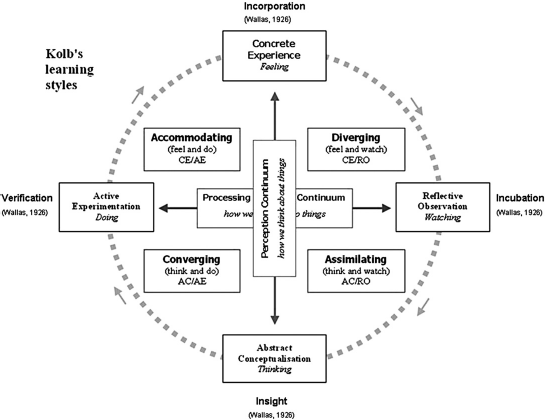
Cycle of Learning and Creativity (Superimposition of Wallas's Stages of Creativity over Kolb's Learning Styles). AC, abstract conceptualization; AE, active experimentation; CE, concrete experience; RO, reflective observation
Csikszentmihalyi (1996) warns that his model of creativity is not to be taken too literally but, rather, used as a useful conceptual tool. Field studies have shown that certain steps may be either skipped or be practically indiscernible or may occur out of sequence; however, the model is a useful tool for understanding the time domain of creativity and the cognitive resources needed at different points in time (Corbett, 2005; Csikszentmihalyi).
Social Environment
Although there have been relatively few empirical studies of the social network impact on entrepreneurial creativity, researchers (Perry–Smith, 2006) have recently applied Granovetter's (1973) network theory to creativity, demonstrating that weak social ties benefit creativity by providing valuable information that is unique and less repetitive. Conversely, strong ties tend to have only a neutral impact by distributing similar information over localized redundant paths. Another study demonstrated that mentors, industry networks, and professional forums all make a positive impact on entrepreneurial opportunity recognition (Ozgen & Baron, 2007). The researchers found that this was especially true when the entrepreneur possessed both strong self–efficacy and relevant schemas (i.e., mental frameworks) for interpreting and acting upon information gained through social contacts.
Methods
Methodology
The aim of this study was to learn about successful entrepreneurial ideation, a research endeavor we deemed best served by qualitative methods (Ward, 2007). Qualitative research is a particularly strong method for exploring meanings, contexts, processes, and unanticipated phenomena, and for inducing credible causal explanations that extend existing managerial practice (Maxwell, 2005). Ward specifically advocates open–ended discussions in the form of semi–structured interviews to elicit detailed narratives about actual entrepreneurial experiences of creating novel new products and processes. Accordingly, we adopted a grounded theory approach to collect and analyze systematically qualitative field data (Strauss & Corbin, 1990).
Our method was shaped by two basic principles of grounded theory: constant comparison and theoretical sampling (Strauss & Corbin, 1990). Constant comparison refers to the simultaneous collection and analysis of data using rigorous coding techniques to identify emergent themes that influence subsequent data collection. Ongoing analysis directs the forward selection of respondents and the study progresses until theoretical saturation, the point at which no new ideas emerge (Strauss & Corbin).
Sample
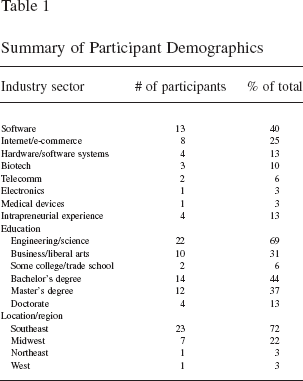
Our sample consisted of 32 entrepreneurs, all founders and/or senior executives in one or more technology start–up businesses. All respondents were based in the United States, most (23) in the Southeast and others in the Midwest (7), Northeast (1), and West (1). The study achieved industry diversity by including participants from software, Internet/e–commerce, hardware/software systems, biotechnology, telecommunications, electronics, and medical devices. A concerted effort was made to achieve gender diversity; however, the study reflects the male–dominated nature of the industry (there were 30 male participants but only 2 females).
Participants were contacted initially by email to solicit their participation. The first interviews were conducted with close professional contacts; afterwards, a “snowball” technique was used to generate referrals and subsequent participants.
Most of the participants (78%) were highly successful (i.e., having founded at least one company with revenues exceeding $10 million annually) and/or serial entrepreneurs (having founded multiple new businesses, at least one of which had achieved >$2 million in annual revenues). However, a contrasting group of participants (22%) were either first–time entrepreneurs in the early stages of new business formation or entrepreneurs whose experience was limited to smaller–scale ventures. Four participants (12%) also had significant corporate intrapreneurial experience at some point in their professional careers. Participants ranged in age from 27 through 60 years with an average age of 47. All participants had attended some college or trade school, and 50% had earned graduate or professional degrees (Table 1).
Summary of Participant Demographics
Data Collection
Data were collected during a 2–month period from mid–April to mid–June 2010 and consisted of face–to–face interviews with 28 participants and four telephone interviews. The approximately 1–hour–long recorded interviews were transcribed by a professional service, and these transcriptions were then carefully reviewed by the researcher to confirm data accuracy.
The interview protocol (see Appendix) was designed to elicit lengthy narratives detailing participants’ actions, thoughts, feelings, and social interactions at the inception of ideas for new products or processes. Narratives included ensuing actions taken to further socialize, develop, and filter ideas from a raw state into useful, novel new products and processes. Special effort was made to trigger vivid recollection of ideational experiences that had occurred within only days or weeks prior to the interview.
Each interview consisted of the same four core questions; however, probes were varied and tailored in response to the particular interview situation. Probes were informed by literature reviews and pilot interviews, and these were primarily used to source more finely detailed information by encouraging the participants to relive and relate their ideational experiences through different lenses (i.e., their thoughts, feelings, actions, and interactions with others). Respondents were not only asked about successful ideas but also asked about ideas which failed or were consciously filtered and not pursued. Interview notes and post–interview memos were also produced for each interview.
Data Analysis
The audio recording for each interview was reviewed multiple times, and each transcript was read repeatedly. Interviews were first coded using “open–coding” techniques recommended by Strauss and Corbin (1990). This involved rigorous line–by–line examination of every transcript to identify “codable moments” or segments of text with potential research significance (Strauss & Corbin). Open coding, which began immediately after the first interview and continued throughout data collection, resulted in the identification of 1,683 fragments of text that were sorted on the basis of similarity into 21 initial categories.
During a second analytical phase called “axial coding” (Strauss & Corbin, 1990), the original categories were examined and refined in alignment with common themes that emerged from the data. This involved systematic reassessment of coding categories based upon unfolding discovery and reinterpretation of data patterns. Thematic analysis during axial coding resulted in a reduction from the 21 original categories to 7 key data categories that became the focus of our study. Examination of key emergent themes prompted a return to the literature for comparison of data and existing literature. A third and final phase of “selective coding” reduced the data to a final set of four predominant data categories supporting our key findings.
Findings
Technology entrepreneurs utilize a variety of behaviors, techniques, and thought processes to develop, refine, and validate creative ideas, as well as to filter them based on their usefulness. However, our data present strong evidence of the three key ideational processes common to all technology entrepreneurs. First, they all utilize complex and sophisticated social networks as sources of ideas and to test, refine, and validate trial ideas. Second, technology entrepreneurs exhibit extraordinary domain specificity by filtering ideas outside specific markets and technologies. Finally, they actively experiment and iterate ideas rather than engage in protracted conceptual analysis.
Finding 1
Technology entrepreneurs rely heavily on the strength of their strongest ties. Maximum ideational productivity occurs when a small select “inner group” including a “trusted partner” is engaged in search of a solution.
1.1.
Successful technology entrepreneurs form a strong and select inner group that drives ideational productivity, and which encompasses a diverse blend of experience, personalities, and cognitive styles while sharing certain core traits.
All 32 interview participants described an “inner group” typically consisting of the entrepreneur and two or three select colleagues who interact frequently and intensely with the entrepreneur, both as a sounding board and as a source of ideas. Entrepreneurs socialize ideas with both weak and strong ties; however, this inner group represented the entrepreneurs’ most consistently productive social capital. Fifteen of the 26 serial entrepreneurs teamed with inner group members for multiple ventures, and in at least five cases, the team repeated ventures within the same market and technology.
All respondents who provided detailed insight into the composition of the inner group described common traits such as a shared vision, a common language, and shared domain experiences and knowledge. Many participants described their ability to have vigorous but constructive arguments among inner group members to refine their ideas:
We all bring different backgrounds to the business which are mostly pretty complementary. We all know each other well enough that we can sit and argue and shout and scream over the boardroom table and still drink beer afterwards.
Participants stated that group “chemistry” allowed them to brainstorm freely and more productively within their exclusive group. However, they noted that this chemistry was usually lost when outsiders were included:
All these guys fit. They get it. They fit. Our personalities fit. They're creative guys. When we get together, we kick ideas off of each other. It's a brainstorming session every time we get together. When we're meeting with a larger group, and with those meetings, we're mostly in listening mode. We're kind of picking their brains, and so it doesn't flow as well because we're kind of seeing where they go. I'd say the ones between (just) the three of us tend to flow better.
Inner group members shared many traits but were otherwise highly diverse. They assumed different roles within the company and pooled various functional knowledge, personalities, and cognitive traits (including preferences for different media and techniques to develop ideas):
I'm analytics. One of the partners is technology. One of the partners is strategy. Generally, we'll describe what . . . the challenge is . . . and then we'll just start working our way around the table. People start to throw out their interpretation of what the problem is. You know, “I think it's like this,” or, “I think it's like that.” I would draw pictures. There are a couple of other guys that are very visual that will start drawing pictures. Other people aren't; they just start laying out examples. Some people will use metaphors.
The most common source of diversity came from the fact that some inner group members had a strong technical background, whereas others had a more general business or marketing orientation:
Since they have an engineering background and I have a business background, they look at things backwards. Of course, they say I look at things backwards. But the reality is we do attack business problems differently, which I think has really helped all of us. I think it's really enhanced our ability to come up with different ideas.
1.2.
Successful entrepreneurs commonly described a single “trusted partner” from the inner group as their most crucial ideational resource.
Seventeen out of the 32 interview respondents described a key relationship with one member of the inner group that was particularly productive and crucial to their success. “It's kind of like . . . how musicians work and jam together, and he and I just have a very good way of knowing how to lead the other one.” The respondents told stories of intense interactions with trusted partners that yielded critical and timely ideas, often under extreme time pressure. Eleven of these 17 serial entrepreneurs worked with the same trusted partner in multiple start–up ventures. There were no reports of “divorce” among these serial entrepreneurs (i.e., instances in which trusted partners were abandoned and replaced in subsequent ventures).
Participants described a symbiotic relationship with trusted partners based upon respect, trust, comfort, excitement, encouragement, passion, and open, easy communication. Trusted partners had heated frank discussions but ultimately agreed on a solution and remained friends:
We're very open with each other. There's no fear of criticism between the three of us, and I think that that helps a lot. I could ask a question that's a very silly question to a biologist or a biochemist, but there's no fear of being scientifically ridiculed for having asked a question that someone thinks is silly. And so I think a lot of our conversations are like that, just because they're open and easy communication, it makes it easy to come up with these other ideas.
Trusted partners were conscious that their unique form of constructive conflict might be misinterpreted by others in the firm as open hostility:
And so I've got a good relationship with a partner that we really can have drag–out meetings and conversations about things, but it helps both of us really think about it. In a lot of the group meetings, we'll be very strong and very opinionated. You've got to be careful sometimes on how you do communicate when you're in a much larger group meeting because of that because you may have constituents in the room that don't see us working the way we work all the time, and they may be taken aback, or they may hush up because of that.
Finding 2
Technology entrepreneurs generate many ideas in a variety of domains; however, they almost exclusively pursue ideas within their core domain.
Technology entrepreneurs are highly ideational in a variety of markets and disciplines. Nevertheless, they selectively elaborate creative ideas within a specific core domain defined as their primary area of technology and/or market specialization.
Our interview protocol did not probe for noncore domain ideas; however, 15 interview participants described serious consideration of ideas outside their core domain. For example, one seasoned entrepreneur (with no background in human resources) was pursuing his second start–up in the marketing analytics industry, but he had nearly started a business based on his idea for a human resources Internet solution:
One of the things I thought about and I got pretty serious about it, was in the HR space. . . . And I was real serious about it, so I spent a lot of time talking with different people, I don't know why I abandoned that, but it was right about the time that we started this, and I just realized that I needed to go all in.
Another entrepreneur spent substantial time developing a business simulation product, only to abandon it for his second software start–up in the same vertical market:
I had this concept of building this game . . . which I still think today would be extremely successful because it's not taught anywhere, but I don't have the resources. I'm not from that industry, so I tried to tap into the gaming industry. To me it was more of a timing thing. It just became, you know, these other things started taking off, and so this kind of took more of a backseat.
Nine participants told stories of extensively socializing and prototyping trial elaborations of noncore domain ideas, and five participants launched side businesses based on noncore domain ideas. However, with only one exception, all participants rejected opportunities to pursue noncore domain ideas as their main full–time business, instead strictly pursuing ideas within their core domain. The one exception was a finance–oriented information technology professional who partnered with a family member (a medical domain expert) to launch a consumer medical products company. Seven interviewees described multiple repeat ventures within specialized core domains, and one participant created very similar ventures a total of three times.
Participants described a self–awareness of the role of domain knowledge in their selectivity of which ideas they would pursue; some even expressed regret about decisions to pursue certain ideas in unfamiliar domains. The following quote is from a successful entrepreneur who was convinced by a venture capitalist (who had the idea for the business) to go outside his comfort zone, becoming the CEO of a social–networking start–up company:
It was a [failed] idea conceived by a business person not . . . born out of an industry frustration. It's very rare that some smart guy who knows nothing about a certain industry comes up with a solution for an industry. We didn't get it at all, right? And in fact, there still is no business model for Twitter, right? Who cares if I can sign up to see if Ashton Kutcher wants to tell me that he's having a cheeseburger, or he's stuck in line at Starbucks or any of the stupid things that people put out over tweets, right? I didn't get it, right? Didn't get it at all.
Finding 3: Active Experimentation
Technology entrepreneurs move quickly from research and conceptual analysis into an active experiment to concretely validate and develop important ideas.
All respondents told stories of how they moved quickly from conceptualizing and evaluating ideas to experimenting socially and actively as an iterative means of either validating and perfecting ideas or quickly abandoning them.
We basically test something out in small area with very few funds. If it works, great, we'll put more money into it to kind of make it successful, but as an entrepreneur, you wake up every single day, you make decisions, and you move on. And a lot of times your decisions are right, a lot of times they're wrong, but you learn from them, and you just continue to plow forward.
These experiments generally took the form of complex sophisticated social interactions, pilot projects, or trial launches of a new product or service—sometimes before the product or service was fully developed. Respondents often described experimentation as a learning and risk management process:
Once we had the capital, we said you can't really go after it until you experiment, until you try, until you listen, until you talk to customers, until you actually just get your hands dirty, and before you could actually step it up and put it out as a kind of a business line that you could count on. So we said, “Hmm, that might be worth piloting, [but] we're still learning [and] we're going to just kind of sit down and do a full brain dump, probably in July, and say, ‘What's everything we learned? How do we take it up to the next level?’ ”
Respondents cited their inability to analyze effectively the complex array of possible features and customer requirements, preferring to learn quickly by testing a concrete trial solution with a goal of either succeeding or failing quickly:
I kind of have a fail fast mentality that I try to instill in people around here, so when I have an idea, like that I want to very quickly get to the point where if it's going to fail, I want it to happen very quickly, before I sink a lot of money and time into it.
Several respondents described experimentation as an entrepreneurial competitive advantage against established larger players: A failed small–scale entrepreneurial experiment does little or no damage to the reputation or future prospects of a start–up venture. The following quote is from an entrepreneur who spent the early part of his career as a product manager in major Fortune 500 consumer goods company:
Focus groups are expensive, and . . . the results, I thought, were spotty at best. You can't do that in a small company, and you can't afford big focus groups and everything. And focus groups, for me, have always been wrong. So I've come up with the theory that if you can make prototypes to be inexpensive enough, the best thing to do is actually do your best thinking of what you know, get some feedback for ideas, but make the product, then throw it out there, and see how it goes in the marketplace. We're not a major consumer goods company, where a failure is visible. When major consumer goods company launches a new product, they don't launch until Wal–Mart's on board, Target's on board. They make shelf space for it. If it's a failure, it's a big deal. For us, we're selling it online. We're just showing it to people. The best test is actually to make the product and get it out there. It's the only accurate test, after you've given it your best guess. A lot of times, you're creating a product that when you describe it to somebody, they can't visualize how they would use it well enough to give you good feedback, but when you hand it to them and give it to them for a week, then they'll come back, and they'll give you very good feedback. If you can tool–up a product for $20,000 and make $10,000 worth of product, $30,000 is less than you would spend on doing all this market research, and you have a product that, who knows, maybe you can start selling.
Discussion
An emerging perspective in the entrepreneurship literature frames the entrepreneur not as a sole actor, but as a team leader or partner in a complex multilevel social environment (West, 2007). Our data greatly expand our understanding of this social phenomenon.
The entrepreneurs we interviewed gave us insight into the complex, highly social recursive process of ideation that we now perceive as tantamount to a holistic model of innovation and new business formation. Our process stands in strong contrast to established theories of opportunity recognition and serial/linear entrepreneurial business development. Entrepreneurs recognize problems and work as partners or in teams to solve these problems through complex but well–defined social interactions as part of a cycle of learning and experimentation. Furthermore, our data indicate that the benefits of trust, shared language, and shared vision among strong social ties far outweigh the theoretical benefits of weak ties on entrepreneurial creativity.
Entrepreneurial Ideation Process (EIP)
Entrepreneurial teams follow a deliberate, methodical process to develop ideas and to solve problems within a domain. We mapped that process in the narratives of 32 technology entrepreneurs (Figure 3) to illustrate ideation progression through five (typically recursive) phases. These phases, constituting what we call the “EIP,” involve a variety of firm and extra–firm actors engaged in both social/conceptual and active experiment.
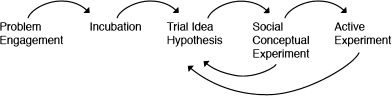
Entrepreneurial Ideational Process
The EIP describes how an entrepreneurial team incubates ideas in response to problems—often for days, weeks, or months—before generating a “trial idea and hypothesis.” This hypothesis encapsulates the entrepreneurial team's perspective and its understanding of both the problem and its environment, and typically encompasses the presumed roles and perceptions of potential funding sources, key partners, customers, and market influences. It reflects their unique “perspective strategy” described by Mintzberg (1987, p. 17) as the “collective mind: individuals united by common thinking and behavior.” Perspective strategy is different from “position strategy,” which articulates a competitive position within a market, product, or technology space. Perspective strategy is a visionary, adaptable, and entrepreneurial form of sense making to interpret events against the backdrop of what is known and assumed about the environment (Mintzberg, Ahlstrand, & Lampel, 2005). Our EIP hypothesis is essentially a perspective strategy statement that acts as a lens for interpreting experimentation results.
While entrepreneurial experimentation is typically described in literature as a concrete trial for purposes of risk management (Sull, 2004), our data suggest that social and conceptual experimentation always precedes physical experimentation. Social experimentation requires both an idea and a set of assumptions and perspectives (the EIP hypothesis) tested for validity and refinement—or ultimately discarded as useless. Social conceptual experimentation builds social capital in the form of a useful pool of participants for future experiments and some participants are even ultimately recruited as team members. Our data support previous observations that experimentation is too expensive for large corporations who cannot afford highly visible failures (Sull).
This makes experimentation a defining and uniquely entrepreneurial methodology. We interviewed intrapreneurs who later became entrepreneurs and provided insightful contrast between corporate and entrepreneurial social experimentation methodologies. Corporate intrapreneurs tend to maintain an inward focus, carefully socializing ideas within the firm to secure funding and political support from key stakeholders, whereas entrepreneurs primarily socialize ideas outside the firm:
I still believe in keeping it stealthy, but I can't remember the last time I signed a NDA with somebody. . . . We've socialized [our startup] . . . far more than I would have socialized it inside a corporation . . . [and] without fear of pissing off a current customer. Since I have none, I go straight to potential buyers of the service . . . in the corporate setting, you know, you're always dancing the fine line of how do you talk to your customer . . . without either leaking something or biasing their opinion about something. My experience is that inside a corporation when the stakes are high, individual group heads compete more so than collaborate.
Social Strata of Ideation
We view entrepreneurial social networks (for purposes of ideation) as concentric rings of decreasingly intense social capital (Figure 4). At the core, this social system consists of the entrepreneur and an inner group who share common language, experience, vision, and cognition—but individually possess diverse problem–solving styles and functional knowledge. The inner group is crucial to ideational productivity, and most of the processing of feedback from experiments (both social/conceptual and active/concrete) occurs at this level.
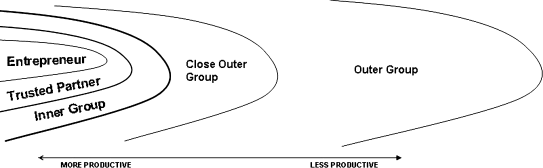
Social Levels of Ideation
Roughly half of our respondents described a unique one–on–one relationship with a member of the inner group, a trusted partner. Similar dyadic relationships have been described by researchers in other domains (Farrell, 2003), but to our knowledge, this “soul mate” phenomenon has not appeared in the entrepreneurship literature. Dyadic and inner group ideational dynamics are similar, but trusted partners share ideas openly with no fear of judgment and no concern about the agenda or motives of their partners. As expressed in the quote below, trusted partners described intensely focused sessions of shared cognition in which partners interactively exchanged and translated symbols between media (i.e., from verbal or written words to graphical images and back to words, at different levels of granularity).
[He] will say . . . a story or something, and that just triggers something. He actually used the word but I didn't know what that was. I mean, I interpreted in my mind . . . I knew that he wasn't thinking this. As soon as he said that . . . I saw the three boxes in my mind. We do a lot of that where he'll say something. I don't know what he means, but maybe I'll put a twist on it, my interpretation. I'll say something. He'll come back and say, “Hey, I like that.” It seems to be more prevalent when it's just the two of us.
The core idea gains novelty and usefulness through each interactive exchange while the shared understanding of their idea grows. Distributed ideational cognition requires an extraordinary connection between trusted partners that was reported as unattainable in any other setting. The inner group was highly productive, but trusted partners described inhibitions and concerns regarding how their thoughts might be judged in a group setting and would reflect badly on them personally:
I know for me personally, I won't throw things out quite so on a whim. Maybe I wait until I think it's a much better idea. So I might throw out a little sillier idea if it's just (my partner) and I. I actually feel that I've been more creative when it's . . . just the energy from the two of us, and not from the whole group.
Our interview protocol was not designed to probe specifically for details about the formation of the inner group; however, there is evidence of an informal “auditioning” process that allows entrepreneurs to attain the familiarity and trust necessary for inclusion into this highly selective social space:
It's very important that they fit. So everyone who has come in, we started out by bouncing ideas off of them and getting feedback in terms of either they get it or they don't. If they don't get it, then okay, it's not a good fit.
A “close outer group,” operating just beyond the “inner group,” consists of extra–firm actors (i.e., key partners, customers, support groups such as entrepreneurs’ organizations, and a collection of individuals constituting what one entrepreneur called his “personal board of directors”). Contact with members of the close outer group is much less intimate and familiar than with the inner group but is frequent enough to maintain close relationships. Most social experimentation occurs within this close outer group, and its members often represent key actors in the ideational hypothesis.
The final layer revealed by our data is the “outer group” consisting of the weakest ties to the firm. Encounters with the outer group are either by chance or intentional with highly strategic intent:
So I always start with the CEO. I normally find the contact details through press releases. Got his name. Normally there are three variances on email addresses that you can work on to get in contact with them. Sent him an email. I normally get a reply same day from CEOs. I was bounced around to three or four people, but he kept in contact. He said have you found the person you want? I find it pretty easy to get a hold of anyone in any company if you've got something valid to talk about.
By definition, the entrepreneurs do not know members of the outer group very well (perhaps not at all), so unless the meeting is by chance, the entrepreneur has to state a clear specific purpose for the contact. Socializing an idea within the outer group has the greatest opportunity for novel and highly divergent influence; however, our data indicate that the outer group was by far the weakest source of ideational productivity.
EIP versus Classical Theory of Entrepreneurship
Entrepreneurial business development is commonly portrayed as an orderly, linear process (see Figure 5) beginning with the discovery and recognition of an opportunity, followed by resource acquisition, strategy development, organization, and execution (Shane, 2003). Researchers describe entrepreneurial opportunity recognition as a creative decision–making process to assemble new “ends–means” frameworks (Shane, p. 42).

The Entrepreneurial Process (Shane, 2003)
Our findings, which depart sharply from this classical model, suggest that our EIP spans all stages the entrepreneurial process—resource acquisition, strategy (perspective), and performance (experimentation)—and offers a vastly more realistic portrayal of the actual practice of entrepreneurship.
Domain Knowledge, Ideation, and Metacognition
The entrepreneurs in our study demonstrated creative ideation in many domains, including domains outside their recognized area of domain expertise; however, they consciously and exclusively selected ideas within a “home domain” for elaboration. When asked about domain selectivity, entrepreneurs cited insufficient understanding of the new domain risk factors, challenges developing new “close outer group” network ties, and issues attaining funding in a domain in which they lack a track record.
These entrepreneurs clearly demonstrated a meta–cognitive approach to ideation and risk management: They had sufficient knowledge to generate credible highly novel trial ideas outside their home domain but also knew that they lacked other key assets for successful elaboration. This new understanding of the extraordinary domain specificity of entrepreneurial ideation sheds new light on the complex role of domain knowledge within the practice of entrepreneurship.
The EIP and Learning
Mapping the stages of our EIP into experiential learning theory (ELT; Kolb, 1984) yields a useful and enlightening theoretical framework, which extends experiential learning theory beyond individual creativity and learning into a broader multilevel social construct for innovation.
Table 2 summarizes the development of an idea, tracing its experiential learning path as it spirals outward from individual problem engagement to different levels of social experimentation and finally to the uniquely entrepreneurial active experiment: announcing a partially finished product to gauge customer interest.
Case Study: Stages of Entrepreneurial Ideation/Experiential Learning Theory Map
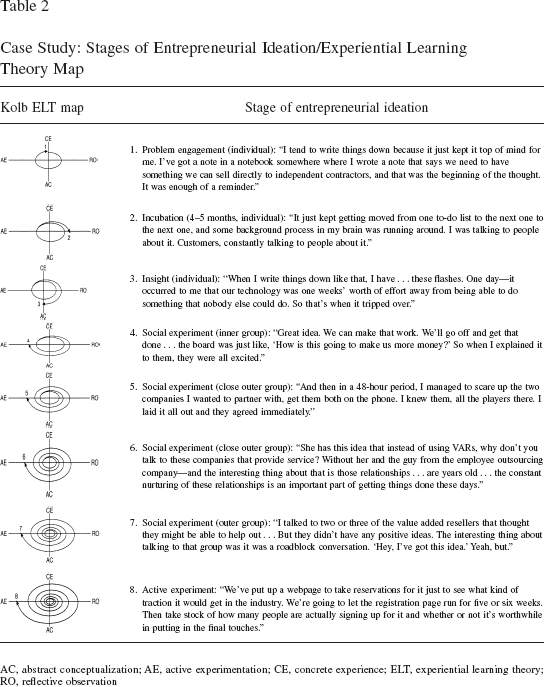
AC, abstract conceptualization; AE, active experimentation; CE, concrete experience; ELT, experiential learning theory; RO, reflective observation
Participant entrepreneurs displayed evidence of a cognitive style emphasizing action and experimentation or a flexible style characterized by fluency throughout the entire ideation cycle. The literature suggests that highly educated domain experts usually favor analytical and conceptual processes (Kolb & Kolb, 2005; Pinard & Allio, 2005) and may be subject to “cognitive entrenchment” or problem–solving fixations due to “high–level stability in one's domain schemas” (Dane, 2010, p. 579). The entrepreneurs in our study exhibited an extraordinary ability to avoid such entrenchment by taking action and moving their business forward.
Limitations
Our study is based upon a small nonrandom sample of 32 entrepreneurs with limited geographic and industry diversity. All of the participants in the study have achieved some measure of entrepreneurial success; however, most have dealt with the usual struggles of entrepreneurship, and some of their behavior and methodologies may not represent best practices. All of our participants were in the technology industry, and we caution against generalizing our results to nontechnology industries.
The principle researcher in this study is a technology entrepreneur, and it is possible that the researcher's personal experiences, thoughts, and opinions could have influenced the interpretation of interview data. Data and findings were subject to careful review and oversight from a panel of advisers to offset personal biases and maintain objectivity.
Implications for Practice and Further Research
Practitioners may benefit from our interpretation of a strongly social and experimental nature of ideation. The importance to our study participants of a trusted partner and a strong inner group cannot be overstated, and it serves as an encouraging model for aspiring entrepreneurs who find the traditional view of the “lone entrepreneur” dispiriting. The outward–looking social nature of entrepreneurs can be adopted and developed by nascent entrepreneurs as can the entrepreneurial predilection for experimentation.
Our findings suggest many opportunities for future research. Ethnographic and longitudinal studies could provide additional detail as to how trusted partner dyads and inner groups form, function, and evolve over time. Such research would provide firsthand access to the entire team, exposing a greater breadth of social perspectives.
Our data demonstrate how entrepreneurs perform iterative experimentation using a cognitive style represented by Kolb's (1984) “accommodating” quadrant, which emphasizes “AE and CE.” However, we used the Kolb experiential learning theory strictly as a descriptive framework and did not administer Kolb learning styles indicator tests to participants. Quantitative studies could be conducted looking for correlations between learning style or cognitive style test instrument results and entrepreneurial performance.
“Absorptive capacity,” which limits the processing of “phenomena one can make sense of” (Nooteboom, 2000, p. 73), has been used to explain learning and problem–solving issues between partnering firms engaged in joint R&D and technology transfer. Absorptive capacity could be explored as a team–level theory to explain why, in spite of the theoretical advantages of incorporating diverse “weak–tie” resources and perspectives, the inner group seems to audition and self–select members with similar perspectives who “get it.”
As Nooteboom (2000, p. 74) points out, “sense making, understanding and agreement are more or less limited. People can collaborate without agreeing, it is more difficult to collaborate without understanding, and it is impossible to collaborate if they do not make sense to each other.” This inner group “auditioning” process could be explored as a possible self–defense mechanism that protects limited team cognitive resources from being overwhelmed by divergent influences or destructive internal debate.