







Abstract
This paper examines how culture and gender shape entrepreneurial perceptions and intentions within Hofstede's cultural dimensions framework and gender role theory. We test whether gender differences exist in the way university students in three nations perceive barriers to entrepreneurship and whether gender has a moderating effect on the relationship between perceived barriers and entrepreneurial intentions across nations. Findings indicate significant gender differences in barrier perceptions. However, this gap is not consistent across cultures. Also, a moderating effect of gender on the relationship between barriers and entrepreneurial intentions is identified. Implications for research and practice are discussed.
Introduction
It is generally accepted than men have stronger entrepreneurial intentions than women (de Bruin, Brush, & Welter, 2007; Díaz–García & Jiménez–Moreno, 2010; Gupta, Turban, Wasti, & Sidkar, 2009). Empirical evidence also indicates that, in spite of growth in female entrepreneurship, there are still almost twice as many male entrepreneurs (Bosma & Levie, 2009). Research also suggests that cultural context can shape entrepreneurial attitudes and intentions. For example, Wilson, Marlino, and Kickul (2004) have identified significant differences between American boys and girls of different ethnic groups in their interest in entrepreneurship. Also, Mitchell et al. (2002) identified significant cross–cultural differences in willingness and ability cognitions among entrepreneurs from several G7 and Pacific Rim nations. Indeed, Thornton, Ribeiro–Soriano, and Urbano (2011) state that implicit norms, social mores, “and cultural factors . . . influence the individual career choice to be an entrepreneur and create a new business” (p. 106). However, few studies have examined differences across genders from a cross–cultural perspective (Verheul, Van stel, & Thurik, 2006). A better understanding of how cultures shape entrepreneurial intentions can serve to explain the gender gap in entrepreneurship and possibly identify strategies to reduce it. Indeed, several researchers call for an examination of gender and entrepreneurial intentions across different nations and cultures (de Bruin et al.; Krueger, 2007; Liñan & Chen, 2009; Wilson, Kickul, Marlino, Barbosa, & Griffiths, 2009).
In this paper, we examine how culture and gender shape individual perceptions of barriers to entrepreneurship and intentions to become an entrepreneur, within the framework of Hofstede's (1998) cultural dimensions and of gender role theory (Heilman, 1983). We test whether male and female university students differ in the importance they give to three types of barriers to entrepreneurship (lack of support, fear of failure, and lack of competency), which were previously identified as significantly more important for female entrepreneurs by Heilman and Chen (2003), Langowitz and Minniti (2007), and Thébaud (2010). We also test the degree to which perceived barriers shape students’ intentions to pursue an entrepreneurial career within and across cultures. By doing so, our study serves to address a gap in current knowledge regarding the way in which cultural differences and socio–cultural factors shape entrepreneurial attitudes and intentions across genders. Indeed, Liñan and Chen (2009) suggest that “cross–cultural studies are needed for the effect of different cultures and values on the entrepreneurial intention to be better understood” (pp. 593–594).
Our sample consists of 761 university students from three nations: China, the United States, and Belgium. We focused on these three nations because they have been identified in cross–cultural studies (Gupta, Hanges, & Dorfman, 2002; Hofstede, 1980) as being part of three distinct cultural clusters: the Confucian–Asian cluster, the Anglo cluster, and the European cluster. These clusters differ in terms of their rankings on Hofstede's four dimensions of individualism (IDV), uncertainty avoidance (UA), power distance (PD), and masculinity (MAS). The three nations differ mostly on the IDV, UA, and PD dimensions, which have been associated with entrepreneurship within nations. Indeed, entrepreneurial activity has been positively linked to individualistic cultures (Gupta et al., 2010; Hofstede), ranking low on UA (Shane, 1993) and high on PD (Busenitz & Lau, 1996; Mitchell, Smith, Seawright, & Morse, 2000).
Our reliance on a student sample is suitable for examining entrepreneurial intentions as Krueger, Reilly, and Carsrud (2000) state: “Students fac[e] an immediate career choice [and] . . . starting a business may be a realistic option” (p. 425) for them. Similarly, Hmieleski and Corbett (2006) “advocate the importance of studying the intentions of students, who, through university . . . programs and the increased infusion of entrepreneurship across educational curriculums, experience increasingly lower barriers to starting their own businesses” (p. 59).
Theory and Hypotheses
Culture and Entrepreneurship
National culture consists of the underlying value systems that are specific to a group or society and motivate individuals to behave in certain ways (Hofstede, 1998), such as starting a business. Hofstede's seminal cross–cultural comparison differentiates among cultures on four dimensions: IDV, UA, PD, and MAS. Busenitz and Lau (1996) suggest that individualistic, masculine cultures ranking high on PD and low on UA would create favorable environments for entrepreneurship and potentially lead to a higher proportion of self–employment. In the following, we discuss each dimension, define it, and explain how it relates to entrepreneurship.
PD refers to the degree to which individuals accept and expect that power in organizations and institutions will be unequally distributed (pluralist vs. elitist). High PD cultures exhibit an unequal distribution of power, strong hierarchies, control mechanisms, and an emphasis on deferring to and obeying those in positions of power (Hofstede, 1980). Busenitz and Lau (1996) argue that high PD promotes entrepreneurial activity. Similarly, Mitchell et al. (2000) found that PD exerts an influence on arrangement, ability, and willingness cognitions which in turn affect the decision to start up.
IDV, as opposed to collectivism, refers to the degree to which individuals consider themselves autonomous, different from others, and independent from social groups. In individualistic societies, people value freedom, autonomy, and individual interests. In collectivist societies, on the other hand, individuals consider themselves to be more interdependent, less differentiated from others, committed to pursuing group rather than individual goals, and integrated into strong, cohesive in–groups. The focus on materialistic achievement and wealth common in individualistic cultures makes these more supportive of entrepreneurial activity (Gupta et al., 2010). Indeed, Hofstede (1980) argues that collectivist cultures, which emphasize group conformity, are generally less likely to exhibit high rates of entrepreneurship.
UA refers to a society's tolerance for uncertainty and ambiguity. In cultures ranking high on UA, members are likely to feel uncomfortable in unstructured (i.e., novel, unknown, surprising) situations. In such cultures, individuals try to minimize uncertainty through strict laws and rules, formal structures, as well as safety and security measures. Given the inherent uncertainty associated with an entrepreneurial career, it may be socially discouraged in high UA cultures. Indeed, Shane (1993) found a negative relationship between UA and innovation and Kreiser, Marino, Dickson, and Weaver (2010) found a negative relationship between UA and risk taking.
Finally, a culture ranking high on MAS is one in which traditional male values like earnings, recognition, advancement, and challenge play an important role (Hofstede & Hofstede, 2005). A “masculine” society expects men “to be assertive, tough, and focused on material success; women are supposed to be more modest, tender, and concerned with the quality of life” (Hofstede, 1998, p. 6). In high MAS cultures, gender roles are more differentiated showing “a gap between men's–values and women's–values” (Hofstede & McCrae, 2004, p. 64). In general, qualities considered essential for business tend to be viewed as masculine (Heilman, 2001). This includes entrepreneurship, which is perceived to require traits such as independence, aggressiveness, autonomy, and courage, frequently associated with men (Gupta et al., 2009).
The three nations in our study vary in their rankings on Hofstede's (1998) four dimensions (see Table 1). Based on these rankings and on the previously mentioned studies linking culture and entrepreneurship, we would expect China 1 (lowest UA, highest PD and MAS) to offer the most supportive environment for entrepreneurial activity followed by the United States (highest IDV, low UA, and high MAS). We would expect Belgium (high IDV, high PD, moderate/high MAS) to offer the least supportive environment for entrepreneurship among the three nations.
Country Rankings on Hofstede's Dimensions
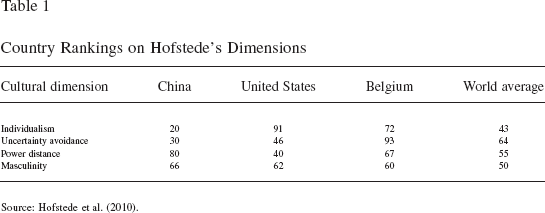
Source: Hofstede et al. (2010).
Because culture shapes individual behavior, we would expect Chinese students to be most likely to intend to pursue an entrepreneurial career followed by American and lastly Belgian students. However, ignoring gender differences in the way culture shapes entrepreneurial intentions may be too simplistic. Indeed, in their cross–cultural comparison of students’ entrepreneurial perceptions and intentions, Liñan, Roomi, and Santos (2010) found that female students’ entrepreneurial intentions and perceptions were more affected by the cultural context in which they live than those of men. Namely, when men's attitudes were compared across cultures (UK and Spain), no significant differences were found, but women differed significantly, even when other variables such as income were controlled for, indicating the role of culture in shaping attitudes and intentions for aspiring female entrepreneurs.
We expect gender differences in entrepreneurial perceptions and intentions to be influenced most significantly by PD and MAS. We therefore focus on these two dimensions in our discussion and exclude the other two because, as Hofstede, Hofstede, and Minkov (2010) indicate, no gender differences between men and women from the same country were identified on these dimensions. First, “women and men in the same countries . . . showed exactly the same stress levels and rule orientation” (p. 199), which is how Hofstede et al. assessed the UA dimension. Second, “there are no systematic differences in individualism between women and men” (Hofstede, 2001, p. 218). We discuss the impact of PD and MAS on women's entrepreneurial perceptions and intentions in the following sections.
Gender and Barriers to Entrepreneurship
Cultural values can also act to shape societal gender roles and stereotypes in terms of the occupations considered appropriate for men or women. Gender role stereotypes lead to gender typing of jobs as predominantly feminine or masculine (Heilman, 1983). Heilman (1983) stresses that individuals aspire to hold jobs that are socially accepted for their sex, while avoiding those considered appropriate for the opposite sex. Gender stereotypes are not only descriptive—denoting differences in how men and women actually are—but prescriptive as well—denoting norms regarding behaviors that are suitable for each, namely, how men and women “should” behave (Heilman, 2001). While Heilman's (1983) work examined gender stereotyping in the United States, others (Schein, Mueller, Lituchy, & Liu, 1996) suggest that gender typecasting is a global phenomenon. In their comparison of management students’ attitudes in Japan, China, the United States, UK, and Germany, Schein et al. found that men were consistently considered to be more likely than women to possess the traits necessary for success in managerial positions.
Entrepreneurship has traditionally been a male–dominated field (Ahl, 2006), with men owning more businesses than women (Marlow, 2002). Commonly shared cultural beliefs about gender roles can therefore shape the opportunities and incentives that individuals experience in pursuing certain occupations. The fact that an entrepreneurial career is gendered can also shape the interaction between female entrepreneurs and various service providers and, as a result, limit women's ability to access the necessary resources or receive necessary support to become successful entrepreneurs. This may cause women to perceive the environment to be challenging and unsuitable for entrepreneurial activity (Zhao, Seibert, & Hills, 2005) with insurmountable barriers. Indeed, in their 17–nation study, Langowitz and Minniti (2007) found that “women tend to perceive themselves and their business environment in a less favorable light compared to men” (p. 356). In this study, we examine the perceptions of three types of barriers: lack of support, fear of failure, and lack of competency. We focus on these three barriers because past studies have identified these to be significant barriers to female entrepreneurship. Heilman and Chen (2003) propose that lack of support is a more significant barrier to entrepreneurship for women, Langowitz and Minniti indicate that fear of failure is negatively related to women's entrepreneurial intentions, and finally, Thébaud (2010) identified lack of competency as a more significant barrier for women compared with men. A discussion of each barrier is presented next.
Lack of Support Barrier.
Barriers to entrepreneurship can include difficulties in obtaining institutional support for aspiring entrepreneurs, receiving family support, securing financing from lenders, building a relationship with suppliers, and/or a solid customer base. Lüthje and Franke (2003) indicate that the perceived availability of support such as access to “qualified consultants and service support for new companies” (p. 147) has a positive impact on entrepreneurial intentions. We would expect that the perceived absence of such support could therefore act as a barrier. Women, more so than men, may perceive such assistance to be lacking. Heilman, Martell, and Simon (1988) explain why this occurs. They propose that resource providers entrepreneurs depend on (i.e., consultants, lenders, suppliers, customers) frequently make decisions under uncertainty without access to complete information. They may therefore be especially vulnerable to the influence of gender stereotypes, which could result in added challenges for female entrepreneurs. For example, women “starting businesses typically dominated by white males may potentially face difficulties in obtaining a client base” (Heilman & Chen, 2003, p. 359). Heilman and Chen also report that women entrepreneurs have less bank credit compared with men, which may cause added challenges in obtaining financial backing for business start–up and/or growth. Kolvereid, Shane, and Westhead (1993) conclude that, not surprisingly, women report the environment for starting a business to be hostile and difficult, which may result in women perceiving the environment to be less supportive of female entrepreneurs and anticipating significant barriers in finding support.
Fear of Failure Barrier.
The gendered nature of the entrepreneurial career (Heilman, 1983) may raise additional barriers for women in terms of fear of failure. Women may experience a heightened fear of failure when starting a business because doing so would constitute the pursuit of a career which is socially discouraged for women. Furthermore, some research evidence indicates that women are more risk averse than men and that this has a negative influence on their propensity to step into self–employment. In his study of German individuals, Wagner (2007) found gender–specific differences in risk aversion to be an important reason not to become self–employed with only 44% percent of all men, but 56% of all women in his sample considering fear of failure as a reason to avoid entrepreneurship. Similarly, in their cross–cultural study, Langowitz and Minniti (2007) found fear of failure to be “negatively related to women's entrepreneurial propensity” (p. 354) but not to men's. Higher risk aversion among women across a variety of situations (e.g., asset management) has also been identified by Eckel and Grossman (2003). In the context of entrepreneurship, Carter (2002) found female founders to be more risk averse and less likely to expect debt financing (investing a higher level of their assets relative to wealth) to capitalize their business; this includes both total debt and institutional debt (Carter). The idea that women have lower risk tolerance has also been used to explain low growth rates in female–owned firms (Johnson & Powell, 1994).
Lack of Competency Barrier.
Societal gender roles, stereotypes, and occupational gender typing can also shape the perceptions individuals have of themselves. Thébaud (2010) proposes that “men and women draw on gender status beliefs in order to assess their own abilities” (p. 5). In her study of GEM data, Thébaud finds that “in the U.S., despite having approximately equal amounts of human, social, and financial capital, women are about half as likely as men to think they have the ability to be an entrepreneur” (p. 8). Krueger (2007) adds that when certain occupations are typed as masculine, women's intentions to pursue these occupations will be weaker, because they perceive themselves as less able and/or skilled. In fact, Thébaud's findings show that in most of the 24 countries in the GEM sample (which includes Belgium and the United States), male entrepreneurs are more likely to believe that they have the necessary knowledge, skills, and experience to be an entrepreneur. In this study, we focus on individuals’ perceived importance of the lack of entrepreneurial competencies as a barrier to entrepreneurship. The importance of perceived skills was also examined cross–culturally by Uslay, Teach, and Schwartz (2002) who assessed the importance of perceived lack of experience as a barrier to entrepreneurship in Spain, the United States, and Turkey. They found significant cross–cultural differences in the importance students attributed to this barrier. Namely, Turkish and Spanish students “perceived lack of experience as a more significant obstacle for entrepreneurship than the U.S. respondents” (p. 111).
Culture, Gender, and Barriers to Entrepreneurship
While Busenitz and Lau (1996) propose that high MAS, high PD cultures create an environment favorable for entrepreneurial activity overall, we expect men and women to experience this differently. In his study comparing 25 nations, Glick (2006) identified a positive relationship between PD and gender inequality. He argues that “nations that score highly on . . . power distance exhibit less actual gender equality” (p. 294). Glick further argues that in these nations, gender inequality not only exists but is also reinforced and legitimized. Parboteeah, Hoegl, and Cullen (2008) also found a positive relationship between PD and traditional gender roles stating that in high PD “societies, women are likely to be at the lower ends of the societal hierarchy and people are more willing to accept such inequalities” (p. 809). In addition, the Chinese Confucian value system is at the base of hierarchical social relationships which determine subordinate status of wives to their husbands (Graham & Lam, 2003). We would therefore expect Chinese women to consider barriers to entrepreneurship to be more significant due to higher gender inequality in their high PD culture. We would also expect women in China to perceive fear of failure as a more significant barrier compared with women in the United States or Belgium given the value this culture places on saving face and preserving a good reputation, which is the cultural value of “Mianzi” (Graham & Lam, p. 90). In addition, this cultural orientation has been linked to longer hesitation rates when it comes to innovation and adherence to tradition. Indeed, Allen, Elam, Langowitz, and Dean's (2008) findings suggest that culture plays a role in gender differences in fear of failure. They found that, while a higher proportion of women avoid starting a business because of their fear of failure, this difference was significantly higher for Chinese women compared with Belgian and American women.
In addition, because in high MAS cultures “men are supposed to be more concerned with achievements outside the home . . . be assertive, competitive and tough. . . . [and] women are supposed to be more concerned with taking care of the home, of the children, and of people in general,” (Hofstede & Hofstede, 2005, p. 117), we would expect women from these cultures to consider barriers to entrepreneurship to be more significant because of the higher degree of occupational gender typing in these cultures. The higher the degree of gender stereotyping, the more likely women are to encounter challenges in dealing with different stakeholders (e.g., consultant, lenders, service providers), and perceive barriers to be more significant compared with men. Furthermore, Heilman (1983) suggests that when a profession is gendered, individuals may underestimate their skills and avoid pursuing that profession. We would therefore expect women to perceive lack of competency to be a more important barrier compared with men. Given that China ranks higher on both PD and MAS compared with the United States and Belgium, we propose that:
Perceived barriers to entrepreneurship may shape individual attitudes toward business ownership as well as the perceived ability to succeed as a business owner. In the following section we discuss the way in which perceived barriers may shape behavioral intentions to pursue an entrepreneurial career.
Entrepreneurial Intentions
Ajzen's (1991) theory of planned behavior proposes that three antecedents (personal attraction, subjective norm, and perceived behavioral control) shape individual behavioral intentions. This theory has often been applied in studies examining entrepreneurial intentions (Díaz–García & Jiménez–Moreno, 2010; Liñan, 2008; Liñan & Chen, 2009; Liñan et al., 2010; Moriano, Gorgievski, Laguna, Stephan, & Zarafshani, 2011). Most relevant to our examination is the role of behavioral control, which refers to the perceived ease or difficulty of performing the behavior as well as anticipated impediments and obstacles (Ajzen). Indeed, some studies have examined the role perceived barriers play in shaping the previously mentioned antecedents. For example, Liñan assessed the impact of perceived skill on the motivational factors determining entrepreneurial intention and found skill perceptions to “have a very significant effect over the three motivational constructs considered (personal attraction, subjective norm, and perceived behavioral control)” (p. 267). In his study, Liñan assessed students’ perceptions of their own abilities and skills including opportunity recognition, creativity, problem–solving skills, leadership and communication skills, development of new products and services, and networking skills. In our study, we examine the relationship between the perceived importance of three types of barriers (lack of support, fear of failure, and lack of competency) and behavioral intentions between genders and across cultures.
The direct relationship between barriers and entrepreneurial intentions has already been established. Wagner's (2007) findings indicate a direct relationship between fear of failure and intentions to pursue entrepreneurship. Lüthje and Franke (2003) studied the attitudes and entrepreneurial intentions of engineering students in several nations (United States, Canada, Asia, and Europe) and found a direct relationship between perceived availability of support to entrepreneurs, perceived barriers to entrepreneurship, and students’ intentions to pursue an entrepreneurial career. They conclude that when individuals perceive “an antagonistic environment for business founders . . . they are less likely to become entrepreneurs. An optimistic evaluation of help and [support] available to potential business founders is associated with a higher propensity to pursue a career as an entrepreneur” (p. 143). Similarly, in their study of Spanish, American, and Chinese students, Pruett, Shinnar, Toney, Llopis, and Fox (2009) found a direct relationship between perceived importance of barriers and behavioral intentions. They argue that individuals who perceive lack of “knowledge, business risks, and financing [barriers] are significantly less likely to have strong entrepreneurial intentions” (p. 585). Brenner, Pringle, and Greenhaus (1991) also argue that the perceptions of insurmountable barriers to entrepreneurship can make a person avoid entrepreneurship and opt for paid employment instead. Finally, Liñan (2008) examined the role of perceived competency in behavioral intentions and found perceived skills to play a significant and positive role in shaping behavioral intentions.
The desire to pursue an entrepreneurial career, however, is not consistent across genders or across cultures (Giacomin, Janssen, Pruett, Shinnar, & Toney, 2011). While a number of studies (Baughn, Cao, Le, Lim, & Neupert, 2006; Gupta et al., 2009; Kristiansen & Indarti, 2004; Kourilsky & Walstad, 1998; Langowitz & Minniti, 2007; Wilson, Kickul, & Marlino, 2007; Wilson et al., 2004, 2009; Zhao et al., 2005) found differences in entrepreneurial intentions across genders, with men showing stronger intentions to pursue an entrepreneurial career compared with women, few gender comparisons were done cross–culturally. A few exceptions include Liñan et al.'s (2010) cross–cultural study comparing entrepreneurship students from the UK and Spain. They found female students to have lower entrepreneurial attraction and intentions than male students. Similarly, Langowitz and Minniti found gender differences in propensity to start a business across countries and cultures. Also, in their comparison of Vietnamese, Philippine, and Chinese students, Baughn et al. identified significant differences in entrepreneurial intentions across the three nations. These differences, however, were not homogeneous when gender was examined.
Gender differences were also identified in the importance of barriers to entrepreneurship. For example, Wagner (2007) states that “fear of failure has a smaller negative influence on the propensity to step into self–employment for men than for women” (p. 16). Langowitz and Minniti (2007) also find that among necessity–driven entrepreneurs, fear of failure was significant for women but not for men. Allen et al. (2008) propose that lack of competence is more likely to be an important barrier for women than for men. They find that significantly fewer women believe themselves to have sufficient skills for running a business and that women are less self–assured in their perceptions of their own abilities than men. The authors suggest that this gap can possibly “be explained in part by the differences in choices for women across these country groups, in which labor markets, institutional structures, and cultural norms provide a varying array of incentives to women's entrepreneurial activity” (p. 11). Indeed, Thornton et al. (2011) argue that “both formal and informal institutions can legitimize business activity as a socially valued or attractive activity—and promote or constrain the entrepreneurial spirit” (p. 111) which further points to the importance of cultural norms in shaping individual perceptions and intentions.
Drnovsek and Erikson (2005) propose that behavioral intentions are shaped through perceived desirability or appropriateness of the action as well as perceived ability for implementing the action. Bird (1988) adds that entrepreneurial intentions are shaped by personal factors such as perceived abilities and social factors such as culture. We would therefore expect that gender and culturally shaped gender roles (i.e., social factors) would moderate the relationship between the perceived importance of barriers and the intentions to pursue an entrepreneurial career. If entrepreneurship is not considered to be a desirable or appropriate career for women in a certain culture, even women who feel that barriers are relatively unimportant may choose not to pursue it. In order to examine the relationship between the perceived importance of barriers, gender, and culture, we propose that:
Our conceptual model representing the hypothesized relationships between the variables is presented in Figure 1.
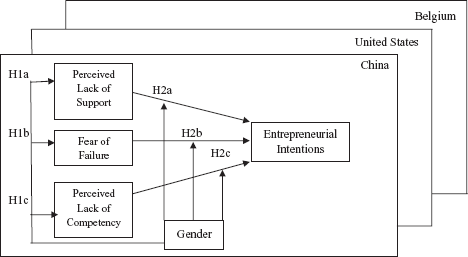
Our Model
Methodology
Sample
Our sample consists of university students from China, the United States, and Belgium. We focused on these three nations because they have been identified in cross–cultural studies as being part of three distinct cultural clusters: China is part of the Confucian–Asian cluster (Gupta et al., 2002), the United States belongs to the Anglo cluster, and Belgium is within the European cluster (Gupta et al.; Hofstede, 1980). Past studies examining individual entrepreneurial dispositions focused on Eastern European (Mueller & Goić, 2002; Mueller & Thomas, 2001), North American, Latin American (Mueller & Thomas), and Asian (Swierczek & Quang, 2004) countries separately. In this study, we were able to examine data from those three nations and perform a comparison across the previously mentioned three cultural clusters, rather than focusing on a single one. In addition, studying students allows us to assess not only the attitudes of aspiring entrepreneurs, but also the attitudes of those students who may not want to become entrepreneurs. Furthermore, as stated previously, student samples are suitable for examining entrepreneurial intentions because students face an immediate career choice (Krueger et al., 2000) and because they anticipate lower barriers to business ownership due to the increased infusion of entrepreneurship across educational curriculums (Hmieleski & Corbett, 2006).
Data Collection and Respondents
Our sample includes 761 students (147 Chinese, 285 American, and 329 Belgian) from a single university in each nation (China, United States, and Belgium), majoring in various fields of study including: art, communication, political sciences, law, sociology, foreign languages, history, management, engineering, and computer information systems. Student samples are very common in entrepreneurship research (Liñan & Chen, 2009) especially given evidence that university graduates between 25 and 34 years of age show the highest propensity toward starting up a firm (Reynolds, Bygrave, & Autio, 2004). Our survey instrument is based on a study carried out by Genescá and Veciana (1984) and replicated several times in Spain (Veciana, Aponte, & Urbano, 2005). We used the original questionnaire developed by Veciana et al. with additional demographic questions. The Spanish questionnaire was translated into English 2 (for the American and Chinese students) and into French (for the Belgian students). The questionnaires were back–translated into the language of origin to assure no loss of meaning. Questionnaires were adminstered during class sessions, yielding a response rate of 100%. Using Likert scales and demographic variables, we measured students’ entrepreneurial intentions as well as their perceived barriers to business start–up.
Variables
We assessed the perceptions of three types of barriers on a five–point Likert scale. Students were asked to rate the importance of each barrier to starting a business with “1” being “very unimportant” to “5” being “very important.” Therefore, respondents scoring low do not perceive that barrier to be important. The barriers included: (1) perceived lack of support to aspiring entrepreneurs, (2) fear of failure, and (3) perceived lack of competency.
Perceived lack of support was assessed by four items including lack of: (1) assistance in assessing business viability, (2) organizations to assist entrepreneurs, (3) formal help to start a business, and (4) legal assistance or counseling. Fear of failure was assessed by one item: fear of failure. Measuring fear of failure with a single item has been the approach adopted in numerous recent publications addressing this barrier to entrepreneurship (Arenius & Minniti, 2005; Langowitz & Minniti, 2007; Minniti & Nardone, 2007; Wagner, 2007), and is also the measure used in the GEM questionnaire (Allen et al., 2008). In these studies, respondents were asked whether fear of failure would prevent them from starting a business. Perceived lack of competency was measured by four items including: lack of (1) high entrepreneurial competence, (2) knowledge, (3) experience in management and accounting, and (4) knowledge of the business world and the market. These correspond with what Man, Lau, and Chan (2002) label “conceptual competencies,” which they consider relevant to firm performance and success. Finally, entrepreneurial intentions were measured by one item, an approach used in several recent publications (Díaz–García & Jiménez–Moreno, 2010; Fitzsimmons & Douglas, 2005; Graevenitza, Harhoffa, & Weberb, 2010; Veciana et al., 2005). Students were asked to answer the following question: “Have you ever thought of starting a business?” Responses were measured on a four–point Likert scale from “0” being “No, never,” to “3” being “Yes, I have a definite plan to start my own business.” For the purposes of our analysis, responses were coded as “0” (No, never/Yes, vaguely) or “1” (Yes, seriously/Yes, I have a definite plan to start my own business). Gender was coded as “1” for males and “0” for females.
Data Analysis
As proposed, we examine whether differences exist among Chinese, American, and Belgian students in the mediating impact of gender on the perceived entrepreneurial barriers. We also test whether gender moderates the impact of perceived barriers on entrepreneurial intentions. In order to do so, we used the partial least squares (PLS) approach to structural equation modeling. PLS is a latent variable modeling technique that has gained popularity in entrepreneurship and management research (Echambadi, Campbell, & Agarwal, 2006; Kautonen, Tornikoski, & Kibler, 2011; Liñan & Chen, 2009; Mitchell, Mitchell, & Smith, 2008). The structural equation modeling procedure seeks to explain the structure or pattern among a set of latent constructs, which are measured by one or more indicators (do Paço, Ferreira, Raposo, Rodrigues, & Dinis, 2011). PLS comprises a measurement model and a structural model. The first determines the relations between observed items and the latent variables. The second determines the relations between the latent variables (Barclay, Thompson, & Higgins, 1995). Therefore, the PLS model is interpreted in two stages: First, reliability and validity of the measurement and the model is assessed and, second, the structural model is assessed by evaluating the explanatory power and the significance of the path coefficients (Chin, 1998). As Fornell and Bookstein (1982) emphasized, the PLS approach is more appropriate than maximum likelihood approaches when the goal of the research is prediction rather than model fit. PLS is also particularly appropriate for exploratory research because it makes minimal demands with respect to measurement scales, sample size, and residual redistributions (Chin; Wold, 1985). Since the aim of our study is to predict both the direct effect of gender on perceived entrepreneurial barriers, as well as the moderating effect of gender on the relationship between the perceived barriers and entrepreneurial intention, the PLS approach is well suited. In this study, we used the Smart PLS software (v2.0) developed by Ringle, Wende, and Will (2005).
Reliability and Validity Assessment of the Latent Variables in Each Country
In order to test the reliability and validity of the latent variables 3 (lack of support and lack of competency barriers), we performed a principal component analysis (PCA) and used the statistic from the PLS measurement model in each country. The PCA results show that two factors with an eigenvalue greater than one emerged in each country. We identify these two factors as the Perceived Lack of Support and the Perceived Lack of Competency barriers. Both KMO and Bartlett's tests suggest that our data are suitable for factor analysis. The cumulative variance explained by these two factors is 53.62% for the Chinese, 59.71% for the American, and 56.01% for the Belgian samples. Table 2 presents the rotated factor matrix; all items correspond to the expected factor in each country.
Exploratory Factor Analysis (Varimax), * Reliability, and Average Variance Extracted (AVE) Statistics by Country
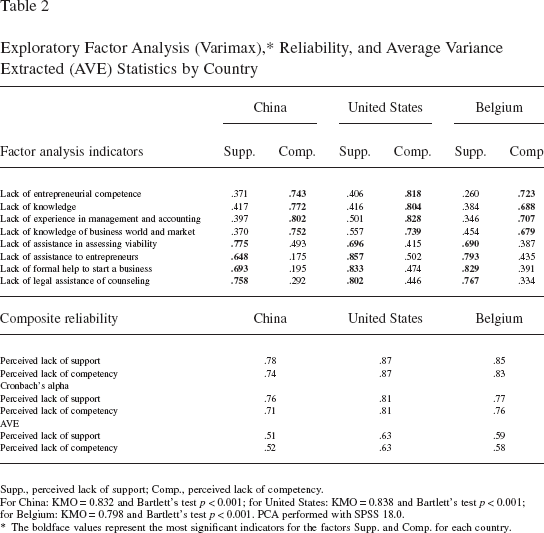
Supp., perceived lack of support; Comp., perceived lack of competency.
For China: KMO = 0.832 and Bartlett's test p < 0.001; for United States: KMO = 0.838 and Bartlett's test p < 0.001;
for Belgium: KMO = 0.798 and Bartlett's test p < 0.001. PCA performed with SPSS 18.0.
The boldface values represent the most significant indicators for the factors Supp. and Comp. for each country.
The reliability of each variable was assessed using Fornell and Larcker's (1981) composite reliability and Cronbach's alpha. As Table 2 shows, the composite reliability and the Cronbach's alpha value for the two variables are above 0.7 in each country, which demonstrates an acceptable reliability (Nunnally, 1978). The convergent validity is evaluated by analyzing the value of the average variance extracted (AVE) statistics. Table 2 shows that the AVE for the two variables is larger than 0.5 in each country, which demonstrates an adequate convergent validity (Chin, 1998). Finally, in order to evaluate the discriminant validity, we compare (see Table 3) the square root of the AVE statistics with the correlations among the latent variables in each country (Chin; Hair, Anderson, Tatham, & Black, 1998). In order to obtain acceptable discriminant validity, the square root of the AVE needs to be higher than the corresponding bivariate correlation. Overall, the results presented in Tables 2 and 3 indicate that the reliability and validity of each construct are satisfactory in each of the countries.
Correlation Matrix and Discriminant Validity by Country
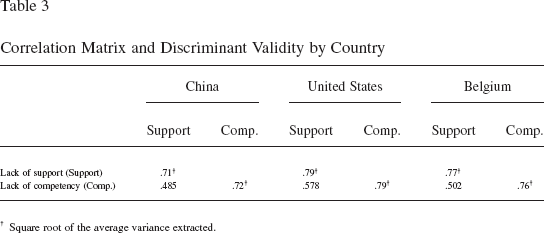
Square root of the average variance extracted.
Common Method Variance
As Chang, van Witteloostuijn, and Eden (2010) emphasized, the common method variance (CMV) is a serious concern when data are collected from a survey instrument. Moreover, the CMV's threat is more important when the variables (dependent and independent) used in the model refer to perceptual measures of the same individual (Podsakoff, MacKenzie, Lee, & Podsakoff, 2003). Chang et al. warn that CMV “can cause systematic measurement errors that either inflate or deflate the observed relationships betweens constructs, generating both Type I and Type II errors.” In order to address this concern, we applied the common method factor (CMF) procedure (Liang, Saraf, Hu, & Xue, 2007). The CMF procedure consists of adding a first–order factor to the theoretical model with all of the measures as indicators. In PLS, this approach is implemented as follows: Each indicator is converted into a single–indicator construct making all major constructs of interest second–order constructs. A latent CMV factor is added by creating a second–order construct and linking all the first–order constructs. In order to identify whether or not CMV is an issue, the theoretical model must be tested with and without the CMF procedure. This two–step procedure allows us to examine the significance of the structural parameters (Podsakoff et al.). Our results 4 show that (1) the factor loading in both models (with and without CMF) is significant and of similar magnitude and (2) the direction and the p value level of the path coefficients remain the same in the two models. We can therefore conclude that CMV is not a serious threat in this research.
In order to test our conceptual model, we proceed in a two–step process. First (Model 1), we determined the direct effect of gender on the perceived entrepreneurial barriers in each country. Second (Model 2), we examined the potential moderating effect of gender in each country. In order to test if gender differences (Model 1) and the gender moderating effect (Model 2) will be largest in China compared with the United States and Belgium, we used the exploratory group comparisons in both models (Chin, 2000) between China and the United States and between China and Belgium. The group comparisons are based on a t–test statistic to assess the statistical significance of the difference in coefficients between the two groups (Eberl, 2010).
Results
Descriptive Statistics
Survey respondents were 55.5% male, 75.2% were business majors, and 24.8% majored in other fields of study. Also, 21.7% were first year students, 13.8% were second year students, 25.6% were third year students, 19.4% were fourth year students, and the remaining 19.6% were in their fifth year of study. Table 4 presents the sample characteristics for each country.
Sample Characteristics by Country
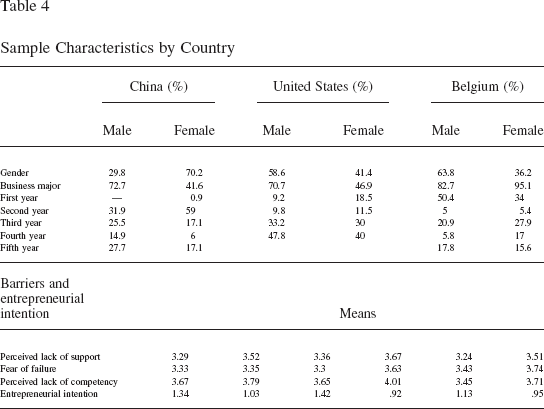
Female students are overrepresented in the Chinese subsample, whereas male students are overrepresented in the U.S. and Belgian subsamples. The majority of male students were fourth year students in the United States, first year students in Belgium, and second year students in China. Concerning the female students, the majority were fourth year students in the United States, second year students in China, and first year students in Belgium.
When we examine the importance of the three entrepreneurial barriers and the entrepreneurial intentions, some gender differences appear (See Table 4). The importance of the three barriers is lower for male than for female students in the three countries. Concerning the entrepreneurial intention, in all three countries, male students seem more prone to create a business compared to female students.
Gender's Effect on Barrier Perceptions (Model 1)
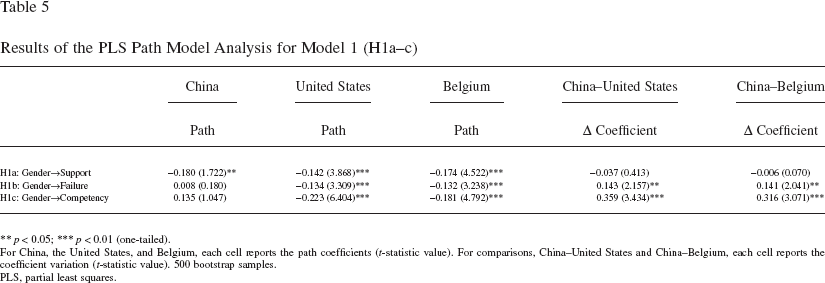
In Model 1, we test hypotheses H1a through H1c examining the mediating effect of gender (being male) on the perceived importance of each barrier. Table 5 reports the structural model coefficients and the t–test values for Model 1, with the two last columns presenting the country comparisons of gender's impact.
Results of the PLS Path Model Analysis for Model 1 (H1a–c)
p < 0.05;
p < 0.01 (one–tailed).
For China, the United States, and Belgium, each cell reports the path coefficients (t–statistic value). For comparisons, China–United States and China–Belgium, each cell reports the coefficient variation (t–statistic value). 500 bootstrap samples.
PLS, partial least squares.
First, as we hypothesized, the importance of the lack of support barrier is perceived as significantly less important by males than by females in all three countries (β = −0.180 in China, β = −0.142 in the United States, and β = −0.174 in Belgium). The same relationship exists for the perceived importance of the fear of failure and lack of competency barriers in the United States and Belgium (β = −0.134 and β = −0.223 for the United States and β = −0.132 and β = −0.181 for Belgium). For these two barriers, the paths are not significant in China, meaning that there is no statistically significant difference in how Chinese males and females perceive these two barriers.
Second, as we expected, our results demonstrate that significant differences exist in the gender gap among the three countries in the perceived importance of two of these barriers (p < 0.05 for the fear of failure barrier and p < 0.01 for the lack of competency barrier). However, contrary to what we expected, it seems that the gender gap in the perceived importance of the fear of failure and lack of competency barriers is significantly larger in the United States and in Belgium than in China. These results offer only partial support for H1a, H1b, and H1c. Namely, with regard to H1a, while males do indeed perceive the lack of support barrier to be less important than females, and while this gender gap is consistent across the three nations, we cannot conclude that it is highest in China compared with the United States and Belgium as we hypothesized. With regard to H1b and H1c, while a significant gender difference in the perceived importance of the fear of failure and lack of competency barriers was identified in the United States and Belgium (men perceiving these barriers as less important than women), there was no statistically significant difference in how men and women in China perceived these barriers. Furthermore, while we hypothesized that the gender gap will be largest in China, this was not the case, with the gender gap in the United States and Belgium being larger compared with China.
Moderating Effect of Gender (Model 2)
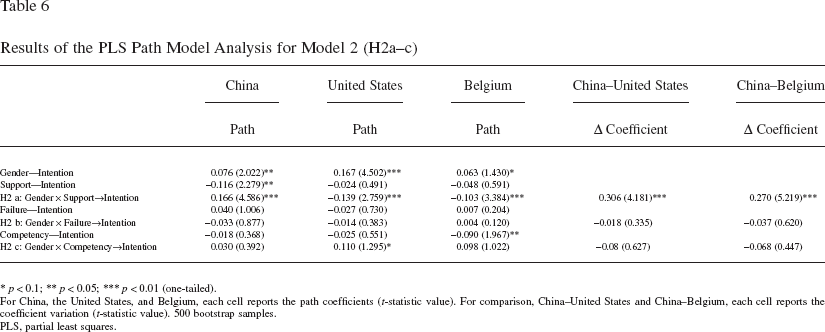
Hypotheses H2a through H2c test the moderating effect of gender on the relationship between the barriers and entrepreneurial intentions. Table 6 reports the structural model coefficients and the t–test values of the model tested, with the last two columns presenting the country comparisons. Before presenting the results of the moderating effect, we include the direct effects of gender and of the perceived barriers on entrepreneurial intentions. Concerning the direct effect of gender (being male) and the direct effect of the perceived barriers on entrepreneurial intention, two main results appear. First, in the three countries, our findings show significant and positive (but small in China and Belgium, β = 0.063 and β = 0.076, respectively) effects of gender on entrepreneurial intentions. Second, and surprisingly, while the direct relationship between the perceived importance of the barriers and entrepreneurial intentions was negative (with the exception of fear of failure in China and Belgium), it was not statistically significant with two exceptions: (1) In China, the lack of support barrier had a significantly negative (β = −0.116, p < 0.05) effect on entrepreneurial intentions; and (2) In Belgium, the lack of competency barrier had a significantly negative (β = −0.090, p < 0.05) effect on entrepreneurial intentions.
Results of the PLS Path Model Analysis for Model 2 (H2a–c)
p < 0.1;
p < 0.05;
p < 0.01 (one–tailed).
For China, the United States, and Belgium, each cell reports the path coefficients (t–statistic value). For comparison, China–United States and China–Belgium, each cell reports the coefficient variation (t–statistic value). 500 bootstrap samples.
PLS, partial least squares.
However, as hypothesized, once the moderating effect of gender on the relationship between the perceived barriers and entrepreneurial intention is taken into account, some significant results appear. Our findings show that gender plays a significant moderating role on the relationship between the perceived lack of support barrier and the entrepreneurial intention in the three countries (β = 0.166 in China, β = −0.139 in the United States, and β = −0.103 in Belgium). The moderating effect of gender is negative for the United States and for Belgium, but positive for China. This means that for men in the United States and Belgium, the lack of support barrier has a stronger negative relationship with entrepreneurial intentions than for women. In China, the opposite is true, in that for men, the lack of support barrier has a weaker negative relationship with entrepreneurial intentions than for women. When the gender gap in the three nations was compared, as expected, the comparison analyses results show that the moderating effect is largest in China, compared with the United States and Belgium (significant at p < 0.01 level), offering support for H2a.
Contrary to what we expected, gender has no moderating effect on the relationship between the perceived fear of failure barrier and the entrepreneurial intention for the three countries. Moreover, as our comparison analyses show, no significant differences between China and the United States or China and Belgium appear, failing to support H2b.
Finally, gender has a significant and positive (β = 0.110) moderating effect on the relationship between the lack of competency barrier and entrepreneurial intentions for the U.S. subsample only, but not for the other two countries. This means that for men in the United States, perceived lack of competency has a weaker negative relationship with entrepreneurial intentions than for women in the same nation. However, our comparison analyses show no significant differences between China and the United States or between China and Belgium, failing to support H2c. Figure 2 summarizes our results and integrates those into our conceptual model.
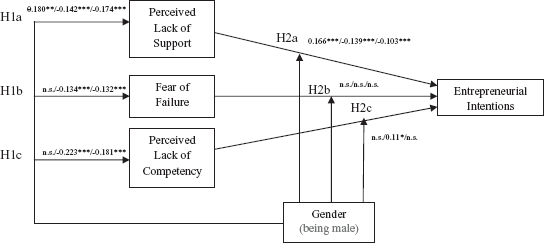
Summary of Main Results. Path Coefficients for China/United States/Belgium
Discussion
In this paper, we sought to examine how culture and gender shape individual perceptions of barriers to entrepreneurship and intentions to become an entrepreneur. In the following paragraphs, we present our findings for the three nations, as well as the comparisons among them. First, our findings indicate that women in China, the United States, and Belgium perceive the lack of support barrier as significantly more important than men. Surprisingly, we found no difference in the gender gap across the three nations, which suggests that perceptions of the support available (or lacking) are not shaped by culture but rather by gender and/or possibly by the specific institutional environment in each nation. This result was unexpected given the fact that, generally, in emerging economies, fewer support mechanisms are put in place to assist aspiring entrepreneurs. Emerging economies are typically characterized by a lack or a weakness of institutions supporting a market–based economy, both formal (Peng & Heath, 1996) and informal (Manolova, Eunni, & Gyoshev, 2008). One possible explanation could be that the Chinese government's economic reforms initiated in the late 1970s, which sought to facilitate the development of free enterprise (Anderson, Li, Harrison, & Robson, 2003; Benzing, Chu, & Callanan, 2005; Han & Baumgarte, 2000), have opened up opportunities for young people to pursue entrepreneurship regardless of gender and resulted in shaping their perceptions of available support mechanisms. Indeed, in their recent examination of individual perceptions of China's institutional environment (in terms of government regulations 5 ), Gupta et al. (2010) found it to be more favorable to entrepreneurship than in other emerging economies including India, South Korea, and Brazil, but also more favorable than in the United States. As China moves to a more market–oriented economy, state–owned businesses are declining in importance, and small firms play an increasingly important role (Anderson et al.). In their examination of Chinese business students’ attitudes, Gupta et al. suggest that the “institutional reforms to promote private enterprise in China have set the country on an appropriate path help[ing] to create a suitable milieu for entrepreneurship” (p. 21). This possibly indicates that, when it comes to government support for entrepreneurial activity, China can no longer be categorized as an emerging economy.
Second, we found that women perceived the fear of failure and lack of competency barriers to be more important than men, but this difference was significant only in the United States and Belgium (whereas the difference between men and women's perceptions was not statistically significant in China). Possibly, men and women in China do not rank the fear of failure barrier differently in terms of importance because of the weight Chinese culture places on saving face and preserving a good reputation (the Chinese cultural value of “Mianzi”) (Graham & Lam, 2003), something that is equally important for men and women. Indeed, China's one–child–per–family policy may have created gender–neutral parental expectations. As Tsui (2007) proposes: “Unlike previous generations where daughters were valued less than sons, one child families, at least in large urban areas, have high parental . . . expectations for both boys and girls” (p. 7). This gender–neutral parental pressure to succeed may minimize gender differences in fear of failure. Concerning the lack of competency, the Chinese government's efforts to equalize girls’ educational opportunities (Tang, Zheng, & Wu, 2002), as well as government–sponsored competitions such as the China girls math Olympiad (Math Sciences Research Institute, 2010), may have contributed to shaping the attitudes of female aspiring entrepreneurs who do not perceive their competencies to be different from those of their male colleagues. In addition, Chinese culture stresses the belief that hard work rather than ability determines success (Tsui), which may further align the expectations across genders as to the importance of the lack of competency barrier. In the United States and Belgium, on the other hand, gender roles and societal expectations regarding occupations considered socially appropriate for women (Heilman, 1983) seem to still shape female perceptions of their own competencies.
Our study also indicates that both culture and gender moderate the relationship between the perceived importance of some of the barriers and entrepreneurial intentions. First, our findings show that gender has a significant moderating effect on the relationship between the perceived lack of support barrier and the entrepreneurial intention in the three countries. For men in the United States and Belgium, the lack of support barrier has a stronger negative relationship with entrepreneurial intentions than for women; whereas for Chinese men, the lack of support barrier has a weaker negative relationship with entrepreneurial intentions than for women. This means that, while both men and women who perceive the lack of support barrier to be important are less likely to pursue an entrepreneurial career, in the United States and Belgium this barrier has a weaker effect on women's entrepreneurial intentions than on men's; whereas in China, this barrier has a stronger effect on women's entrepreneurial intentions than on men's, exposing some cross–cultural differences.
One explanation for our findings in Belgium and the United States could be that women in these nations never expected a support infrastructure to be accessible to them in the first place and, as a result, are less likely to be deterred by its absence. Indeed, Heilman (1983) proposes that women expect to encounter more barriers to entrepreneurship. Zhao et al. (2005) add that women perceive the environment to be more challenging.
Our results also indicate that gender has no moderating effect on the relationship between the perceived fear of failure barrier and the entrepreneurial intention for the three countries. This is consistent with the research stream stressing that traits, or at least traits alone, are not determining factors in the explanation of entrepreneurship (Gartner, 1988). This is encouraging given that fear of failure is a rather personal characteristic which could be challenging for policy makers to change. Thus, focusing resources and efforts on shaping perceptual factors, such as the perceived lack of support discussed previously, may be more instrumental in promoting women's entrepreneurship. This point will be further developed in our implications section next.
Finally, we find that for women in the United States, perceived lack of competency has a stronger negative relationship with entrepreneurial intentions than for men in the same nation. However, we identified no such differences in the two other nations. Possibly, young Chinese women perceive self–employment as a way to reduce their traditional dependence on male family members and gain control over their own income. In China, where patriarchy traditionally played a strong role in the family (Lee, 1984), self–employment may be a strategy that facilitates women's empowerment. Chinese women may therefore be as motivated as Chinese men, regardless of perceived barriers, to pursue entrepreneurship, which may offer a way out of this dependence. As for the nonstatistically significant difference between the genders in Belgium, this is consistent with the most recent GEM report (Kelly, Bosma, & Amorós, 2010), citing the highest female participation in entrepreneurship in Belgium compared with other Western European nations. Furthermore, the educational systems in Belgium and China may also serve to explain the nonsignificant gender differences in perceived importance of the lack of competency barrier. Because higher education is not as costly as in the United States, Chinese and Belgian students typically do not work while pursuing a degree, resulting in less work experience, possibly shaping both men's and women's perceptions of competency and entrepreneurial intentions.
Limitations
This study suffers from a few limitations. First, we collected our own data from three universities (in China, the United States, and Belgium) by using an existing survey instrument, which was not specifically designed for our research questions. We were therefore unable to examine additional perceptions of barriers such as whether female respondents believed they would encounter challenges in hiring and managing employees, building a customer base, or working with suppliers.
Second, males are overrepresented among the business students in our Chinese and American samples, which may have biased our results given the higher propensity to pursue entrepreneurship among business students compared with other disciplines. In the Chinese sample, of all the male students, 72.7% are business majors, but only 41.6% are business majors among the female students. Similarly, in the U.S. sample, 70.7% of the male students are business majors, but only 46.9% of the female students are business majors. The students are also unequally distributed in terms of progress toward graduation. The majority of male students were fourth year students in the United States, first year students in Belgium, and second year students in China. Female students were mostly fourth year students in the United States, second year students in China, and first year students in Belgium. Considering that students who are in the terminal years of their degree may more actively consider and pursue entrepreneurship, this unequal distribution may have somewhat biased our results.
Third, because we studied university students, our findings are not generalizable to the population at large. While college–educated women may desire to pursue an entrepreneurial career, this may not be the case for all women. Indeed, in many countries, especially “less developed cultures with masculine, traditional cultures, university students represent the educated elite” (Mueller, 2004, p. 214).
Furthermore, since our data were collected from a single university in each nation, regional variations in large and diverse nations such as the United States and China further limit generalizability. Also, we do not include data on government policies and/or programs aimed at promoting entrepreneurship in general and female entrepreneurship in particular. Such policies and/or programs may differ significantly across the three nations (or even regions) in our study and influence individual perceptions and intentions.
Implications for Research and Practice and Future Research Avenues
Our findings show that culture and gender do matter when it comes to perceptions of barriers to entrepreneurship and their relationship with entrepreneurial intentions. The role of gender and culture is, however, not consistent. First, gender seems to matter in how individuals perceive lack of support; namely, we found this barrier to be significantly more important for women than for men in the three nations. This means that gender and institutional support, rather than national culture, or at least Hofstede's (1980) dimensions thereof, account for the observed perception patterns. Governments wishing to promote entrepreneurship in general and female entrepreneurship in particular, should create support mechanisms such as chambers of commerce and/or agencies which provide advice, training, as well as access to lenders, consultants, mentors, and networks. Indeed, Audretsch, Aldridge, and Sanders (2011) found that access to social networks and the ability to develop one's social capital facilitate entrepreneurship. In addition, because our study dealt with subjective perceptions, agencies need to work on information dissemination as much as program creation because, if individuals perceive that support is lacking, it will act as a barrier, whether support exists or not. To isolate the effect of institutional support, future studies could examine the type and “amount” of support available across countries and the awareness that aspiring entrepreneurs have of that support.
Second, culture and gender seem to play a role in shaping the perceptions of the other two barriers: Women in the United States and Belgium perceived fear of failure and lack of competency to be more important barriers than men in the same countries. This gender difference, however, did not exist in China, suggesting that Chinese culture somehow acts to shape individual perceptions of these two barriers in a way that eliminates gender differences. This is possibly due to the emphasis Chinese culture places on the belief that hard work, rather than ability, determines success (Tsui, 2007). Also, the fear of failure and lack of competency may be viewed as things that are under the individual's control and thus possibly could be overcome, which further align the expectations across genders as to the importance of those two barriers.
Organizations and/or agencies aiming to develop female entrepreneurship in the United States and Belgium could focus on increasing perceived competency among women, but not so easily on reducing fear of failure. As mentioned previously, fear of failure is a personal disposition which may be difficult to impact directly through education or institutional support. Thus, shaping confidence and self–efficacy could possibly be more effective in increasing female entrepreneurship. Indeed, research has already identified the impact of perceived self–efficacy on entrepreneurial intentions (Baughn et al., 2006; de Bruin et al., 2007). Implications for entrepreneurship education include the need to focus on increasing awareness of the available institutional support mechanisms among entrepreneurship students, as well as on increasing perceived competency in entrepreneurial skills among female students in particular, which will serve to reduce the perceived importance of the lack of competency barrier.
Culture also plays an important role in how gender moderates the relationship between perceived barriers and entrepreneurial intentions. First, for women in Belgium and the United States, there is a weaker negative relationship between perceived lack of support and entrepreneurial intentions than for men. Future studies would need to examine the reasons for these differences, which may be best explored through alternative research methodologies. Qualitative approaches, for example, could allow for an in–depth examination of the complex interaction between socio–cultural and contextual variables shaping entrepreneurial attitudes and intentions. Indeed, Thornton et al. (2011) suggest that “the problem of integrating analyses of the social and cultural factors that affect entrepreneurship is challenging” (p. 110).
In China, the negative relationship between the perceived lack of support barrier and entrepreneurial intentions was stronger for women than for men. Furthermore, in this nation, but not in the others, the overall relationship between perceived lack of support and entrepreneurial intentions was negative and significant, stressing the importance of addressing this barrier in general, not just for women. In the goal of promoting female entrepreneurship, special attention should be given to the degree to which Chinese women are aware of available assistance and the degree to which they expect to be able to find the support they need. If Gupta et al.'s (2010) propositions are indeed correct, and the Chinese institutional environment is favorable to entrepreneurship, then Chinese institutions need to further investigate why women's perceptions of the lack of support barrier are more likely to stop them from starting a business compared with men. Possibly the support available is not what aspiring female entrepreneurs need, or alternatively, they might simply be unaware of the support mechanisms already in place.
Our results also suggest that gender and culture shape the relationship between the perceived lack of competency barrier and entrepreneurial intentions given that it was more strongly negative for women, albeit only in the United States. The absence of a moderating effect of gender on the relationship between perceived lack of competency and entrepreneurial intentions in China and Belgium could lie in students’ overly optimistic self–assessments, regardless of country of origin. Indeed, Shinnar, Pruett, and Toney (2009) compared student and faculty evaluations of barriers with entrepreneurship and concluded that students overestimated their entrepreneurial skills and abilities compared with faculty evaluations possibly due to “optimism and lack of work experience” (p. 157). The extent to which students’ self–evaluations are truly reflective of their actual skills and the impact this has on the importance they give to different barriers remain to be examined in more detail as well. Future research could investigate whether students in fact overestimate their skills and whether men and women across different cultures are equally likely to do so, as well as the implications this has for entrepreneurial intentions.
As discussed in our limitations, our data include business and nonbusiness majors, as well as students at various stages of their education. Future research could examine the relationships between perceived barriers and entrepreneurial intentions for students who are business majors versus students who major in other fields of study to examine whether the former perceive barriers to be less important (given their academic training in the business discipline) compared with the latter, and also whether business majors and/or students in the terminal years of their degrees have stronger entrepreneurial intentions than students who are nonbusiness majors or in the early stages of the academic path. This is especially important given the recent trend to extend entrepreneurship education beyond the walls of business schools into other disciplines such as art, sciences, engineering, medicine, nursing, psychology, etc. (Janssen, Eeckhout, Gailly, & Bacq, 2009; Shinnar et al., 2009). One final avenue for future research involves the measurement of cultural values. We used Hofstede's (1980) group level cultural values as assumptions in formulating our hypothesis and explaining our research findings without directly measuring cultural value orientations of study participants. Some researchers (McCoy, Galleta, & King, 2005) recommend that studies addressing individual–level models “should be used with individual–level culture measures so that future studies can provide more useful guidance in how culture influences behaviour” (p. 220). Future research could possibly assess cultural value orientations at the individual level, which would measure participants’ actual cultural value orientations, and in turn assess their impact on perceptions, attitudes, and intentions. Researchers who study gender and culture's effect on entrepreneurial perceptions and intentions should examine the interaction between the two variables, even though their impact is not always uniform for all types of barriers, as our results have shown.
Footnotes
1.
In this paper we compare the United States and Belgium against China and will therefore list China first in our discussion and presentation of results.
2.
For the Chinese students, who were taking English language classes and thus proficient in English, verbal clarifications were given when necessary during survey administration.
3.
As the two latent variables Fear of failure and Entrepreneurial intention are measured by one indicator each, we do not test the reliability and the validity of these two latent variables.
4.
The complete results of the CMF procedure are available from the authors.
5.
Government policies can improve the regulatory environment for entrepreneurship by offering incentive programs and preferential treatment for new and small ventures in procurement using public taxes (Dickson & Weaver, 2008).