







Abstract
This study provides a critical examination of how different theoretical perspectives in entrepreneurship research translate into individual behavior, and whether such behavior is evident in the creation and development of new ventures. Using an alternative templates research methodology, the behaviors underlying the theories of effectuation, causation, and bricolage are evaluated to see whether such behaviors are observable in case study data describing the early development of six new ventures. The analysis highlights behavioral similarities and differences between the various theoretical perspectives in entrepreneurship research, providing insight into how these perspectives contrast and complement one another, and how they could be integrated in future research.
Introduction
As interest in entrepreneurship as a domain of research has intensified, so a number of new theoretical perspectives have emerged to explain the actions and logic that underlie entrepreneurial behavior. These approaches, which contrast with the more traditional model of entrepreneurial behavior, have broadly been referred to as the “emerging theoretical perspectives” for entrepreneurship research (Eisenhardt, Kotha, Meyer, & Rajagopalan, 2010). The traditional model of entrepreneurship draws largely on economic thinking to describe how an individual or firm takes entrepreneurial action by searching for areas where the demand for a product/service exceeds supply (Casson, 1982; Khilstrom & Laffont, 1979) to discover an entrepreneurial opportunity, and evaluate whether it is worth exploiting (Shane & Venkataraman, 2000; Venkataraman, 1997). After deciding to exploit an opportunity, an entrepreneur takes action by seeking resources to establish an entity that will develop and deliver a product or service to exploit the identified opportunity, and in so doing, create returns from the venture. Alternative theoretical perspectives for describing entrepreneurial action—such as effectuation (Sarasvathy, 2001) and entrepreneurial bricolage (Baker & Nelson, 2005)—suggest that under certain conditions, entrepreneurs take a different route to identifying and exploiting opportunities. According to the emerging theoretical perspectives of entrepreneurship, entrepreneurs (1) focus primarily on the resources they have on hand and ignore market needs in uncovering an opportunity (Baker & Nelson; Sarasvathy); (2) ignore long–run returns and focus primarily on what they are willing to lose in making decisions about whether to pursue an opportunity (Sarasvathy); (3) refuse to enact the resource limitations dictated by the environment (Baker & Nelson); and (4) eschew long–range goals and plans (Sarasvathy). Prominent emerging theoretical perspectives in entrepreneurship research appear to have much in common with each other, yet they have largely developed and evolved independently of one another. 1 The first aim of this research is to compare and contrast the prominent emerging theoretical approaches for entrepreneurship research. To effectively compare and contrast these approaches, one needs to assess them with a common unit of analysis. Because entrepreneurship is about action (McMullen & Shepherd, 2006), and because action in entrepreneurship is often observed as an individual behavior (Bird & Schjoedt, 2009), entrepreneurial behavior is a useful unit for this analysis. Entrepreneurial behaviors are the “concrete enactment of individual or team tasks required to start and grow a new organization” (Bird & Schjoedt, p. 328) that manifest as “discrete units of individual activity that can be observed by an audience” (Bird & Schjoedt, p. 335). The second aim of this research is to link the critical elements of the emerging theoretical approaches for entrepreneurship research to the individual behavior of entrepreneurs, and then to see if such behaviors are observable in people starting new ventures.
To achieve these aims, I translate the major elements in emerging entrepreneurship theories into behaviors and then adopt an alternative templates research strategy (Langley, 1999) to examine the individual behaviors pertaining to the emergence and growth of six new consumer Internet ventures founded between 2000 and 2003. The alternate templates research approach, which was popularized by Allison (1971) in his study of decision making at the time of the Cuban Missile Crisis, provides for “several alternative interpretations of the same events based on different but internally coherent sets of a priori theoretical premises” (Langley, p. 698). This allows one to “assess the extent to which each theoretical template contributes to a satisfactory explanation” (Langley, p. 698), and in so doing, provides insight into how various theoretical perspectives are related to one another.
This paper proceeds as follows: In the first section, the theory and literature relating to each of the theoretical approaches addressed is briefly reviewed. The processes encapsulated within each theory are translated into entrepreneurial behaviors—“discrete units of individual activity that can be observed by an audience” (Bird & Schjoedt, 2009, p. 335). Thereafter, the data and methods used in this research are described, and the findings that emerged from the analysis of six new ventures are reported. The final section outlines the conclusions and implications of this research.
Theory Review
Selection of Theoretical Perspectives
Over the past decade, a number of different theoretical perspectives have emerged to describe the logic and behavior underlying the entrepreneurial process, e.g., effectuation (Sarasvathy, 2001), entrepreneurial bricolage (Baker & Nelson, 2005), the creation perspective (Alvarez & Barney, 2007), and user entrepreneurship (Shah & Tripsas, 2007). These new theoretical perspectives have largely sought to describe the differences between the traditional approach to entrepreneurship (called the “causal approach” by Sarasvathy (2001), the “discovery approach” by Alvarez and Barney, and the “classic approach” by Shah and Tripsas) and an alternative approach. While it would be valuable to compare and contrast all these theoretical perspectives with the traditional perspective, in the interest of parsimony, the focus of this research is on the traditional approach and two prominent emerging theories. Using the criteria of generality and impact, I focus on effectuation and bricolage as the two emerging theoretical perspectives to be compared with a traditional approach to entrepreneurship research. Both these theoretical perspectives offer general explanations of entrepreneurship, 2 and the foundational papers for effectuation (Sarasvathy, 2001) and entrepreneurial bricolage (Baker & Nelson) are more widely cited than the papers pertaining to the other alternative theoretical perspectives. 3
Sarasvathy (2001) describes the traditional approach to entrepreneurship as a “causal approach”; therefore, I adopt the concept of causation in this research to capture and outline the traditional theoretical perspective. The three theoretical perspectives that are examined in this research are causation, effectuation, and entrepreneurial bricolage.
Framework for Reviewing the Theoretical Perspectives
Whetten (1989) proposes that the journalistic questions of who, what, where, when, why, and how are useful for describing the building blocks of theory. In this section, these journalistic questions are applied as an organizing framework to dissect the elements of each of the relevant entrepreneurship theories. Within this framework, the what element addresses the following question: What factors (variables, constructs, concepts) should be considered as part of the explanation of the social or individual phenomena of interest? The how element concerns how this set of factors is related. The why element then addresses the “underlying psychological, economic, or social dynamics that justify the selection of factors and the proposed causal relationships” (Whetten, p. 491). Thus, what and how provide description, while why provides explanation. Finally, the who, where, and when elements act as conditions that place limitations on the propositions generated from a theoretical model: “These temporal and contextual factors set the boundaries of generalizability, and as such constitute the range of the theory” (Whetten, p. 492). Table 1 provides an overview of the causal, effectual, and bricolage approaches to entrepreneurship using Whetten's questions—what, how, why and who, where, when—as an organizing framework. Each of these approaches is further expanded on in the next section using the same framework to guide the discussion.
Entrepreneurship Theories
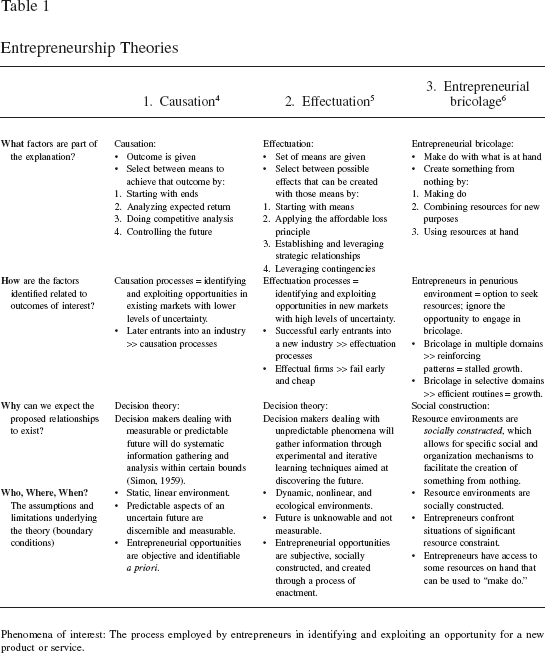
Phenomena of interest: The process employed by entrepreneurs in identifying and exploiting an opportunity for a new product or service.
Causation
Causation is the term used by Sarasvathy (2001, 2008) to describe a traditional perspective on entrepreneurship. Under a causation model, an individual entrepreneur decides on a predetermined goal and then selects between means to achieve that goal (Sarasvathy, 2001). Entrepreneurship is reflected as “a linear process in which entrepreneur volition leads to gestational and planning activities” (Baker, Miner, & Eesley, 2003, p. 256), and involves “. . . the process of discovery, evaluation and exploitation of opportunities” (Shane & Venkataraman, 2000, p. 218). Central to this approach are concepts of intentionality (Katz & Gartner, 1988), opportunity identification and evaluation (Shane & Venkataraman), planning (Delmar & Shane, 2003), resource acquisition (Katz & Gartner), and the deliberate exploitation of opportunities (Shane & Venkataraman).
What Factors Form Part of the Explanation?
The factors that form part of the explanation of the entrepreneurial process include the identification and evaluation of objective opportunities (Shane & Venkataraman, 2000), the establishment of goals to exploit identified opportunities (Sarasvathy, 2001), and the analysis of alternative means to fulfill goals while accounting for environmental conditions that constrain the possible means (Sarasvathy). Criteria for choosing between means usually involve maximizing the expected returns in terms of predetermined goals (Sarasvathy).
How Are the Factors Identified Related to Outcomes of Interest?
In the causal view of entrepreneurship, markets are rarely created. Markets, and entrepreneurial opportunities within those markets, are assumed to preexist (Casson, 1982; Shane & Venkataraman, 2000). The goal of the entrepreneur is to grab as much of the existing market universe as possible (Kotler, 1991). Therefore, in identifying “how” causation factors are related to new venture outcomes, it is argued that identifying opportunities, focusing on goals, analyzing returns, competitive analysis, and controlling the future will be more strongly related to outcomes for later entrants into an established industry (Sarasvathy, 2001).
Why Do the Proposed Relationships Exist?
The explanation for “why” causation logic is adopted in the entrepreneurial context stems from decision theory (e.g., Ellsberg, 1961; Simon, 1959), which posits that decision makers’ underlying beliefs about future phenomena can be deduced by examining the types of heuristics and logical approaches they use in making a decision relating to that phenomena, and “if decision makers believe they are dealing with a measurable or relatively predictable future, they will tend to do some systematic information gathering and analysis within certain bounds” (Sarasvathy, 2001, p. 252). Furthermore, entrepreneurs set goals and establish plans to concretize their intentions (Katz & Gartner, 1988) and attract resources (Katz & Gartner). “By helping firm founders to make decisions, to balance resource supply and demand, and to turn abstract goals into concrete operational steps, business planning reduces the likelihood of venture disbanding and accelerates product development and venture organizing activity” (Delmar & Shane, 2003, p. 1165).
Boundary Conditions.
For the causal process to be applicable, the market for a product or service needs to exist prior to exploitation, and historic information must be available to evaluate opportunities and assess means to exploit those opportunities (Sarasvathy, 2001). The existence of a market, and the existence of information about the market, is therefore a boundary condition for this approach.
Process.
The process underlying the causal approach to entrepreneurship is reflected in Figure 1. The process flow diagram shows how the recognition and evaluation of opportunities allow for opportunity identification that leads to the establishment of goals and a plan to exploit the identified opportunity. Thereafter, the entrepreneur raises resources to develop and market a solution and, in turn, engages in the processes of creating something to address the opportunity identified, which hopefully results in entry into the marketplace, allowing for feedback that leads to further refinements of the product or service.
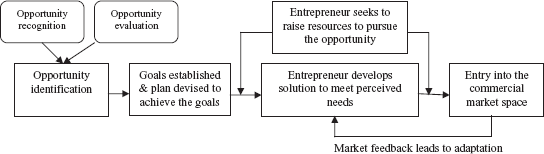
Causation Approach to Entrepreneurship (Adapted From Classic Approach to Entrepreneurship in Shah & Tripsas, 2007)
Because entrepreneurial environments are often highly dynamic, unpredictable, and ambiguous, there is not always enough information for entrepreneurs to readily recognize and evaluate opportunities prior to exploitation. To address this, Sarasvathy (2001, 2008) proposed the theory of effectuation as an explanation for entrepreneurial activities under such conditions. Effectuation is juxtaposed with causation “as a dichotomy to enable clearer theoretical exposition” (Sarasvathy, 2001, p. 245).
Effectuation
Effectuation is described by Sarasvathy (2008) as “a logic of entrepreneurial expertise, a dynamic and interactive process of creating new artifacts in the world.” A conceptual model of effectuation in market and venture creation was initially sketched by Sarasvathy (2001), and expanded upon by Sarasvathy and Dew (2005), and by Sarasvathy (2008). The theory suggests that under conditions of uncertainty, entrepreneurs adopt a decision logic that is different to that explicated by a traditional, more rational model of entrepreneurship (called “causation” in Sarasvathy's writings).
Effectuation dictates that in highly uncertain and dynamic environments, target customers can only be defined ex post through whoever buys a product or service. Goals change, are shaped and constructed over time, and are sometimes formed by chance. Instead of focusing on goals, the entrepreneur exerts control over the available set of means—the things over which the entrepreneur has control (Sarasvathy, 2001). At the individual level, this includes personal knowledge, skills, and social networks. At the firm level, means include physical, human, and organizational resources (Barney, 1991).
What Factors Form Part of the Explanation?
The key factors that are part of the explanation for the role of effectual logic in entrepreneurship include (1) starting with means as opposed to establishing end goals; (2) applying affordable loss instead of expected return when evaluating options; (3) leveraging relationships instead of competitive analysis when assessing relationship with other individuals and organizations; and (4) exploiting and not avoiding contingencies (Sarasvathy, 2008).
Starting with means describes how entrepreneurs make important decisions by focusing on the resources under their control—asking “Who am I?”; “What do I know?”; and “Whom do I know to uncover opportunities?” (see Figure 2)—rather than focusing on a predefined end goal. They engage in activities and allow goals to emerge and change as they exploit the means under their control, thereby engaging in an ongoing process of exploration (March, 1991) to uncover options for what they can do. Chandler, DeTienne, McKelvie, and Mumford (2011) operationalized this as follows: Affordable loss entails making decisions based on what one is willing to lose, and committing a specific amount of resources to an endeavor with the understanding and acceptance that such resources may be lost. The alternative is to make resource allocation decisions based on probabilities and expected returns (Latene, 1959). Leveraging strategic relationships suggests that entrepreneurs can focus their attention on building partnerships rather than doing systematic competitive analysis. Competitive analysis has traditionally been a key input into strategy formulation (Porter, 1979), yet entrepreneurs can focus more on whom they can work with rather than compete with. Exploiting contingencies entails embracing unexpected events and turning them into profitable opportunities, thereby getting unanticipated outcomes as opposed to achieving a predefined goal.
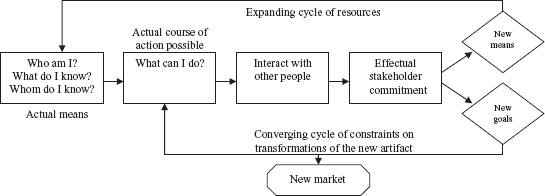
Effectual Approach to Entrepreneurship (Sarasvathy & Dew, 2005)
How Are the Factors Identified Related to Outcomes of Interest?
It is argued that effectual processes are related to uncovering and exploiting opportunities in new markets with high levels of uncertainty (Sarasvathy, 2001). Because of this, Sarasvathy suggests that successful early entrants into a new industry are more likely to have used effectuation processes than causation processes. Because effectuation does not involve elaborate planning and prediction, the costs associated with such activities are reduced (Bhide, 2000; Mintzberg, 1994). Sarasvathy (2001) argues that if new firms created through processes of effectuation fail, they will fail early and/or at lower levels of investment than those created through processes of causation.
Why Do the Proposed Relationships Exist?
Effectuation builds on the decision theory literature that suggests that if decision makers believe they are dealing with relatively unpredictable phenomena, they will try to gather information about future trends through experimental and iterative learning (e.g., Ries, 2011). The elements of effectuation are enactments of experimental and iterative learning techniques that enable entrepreneurs to discover information about the future as time passes (Sarasvathy, 2001).
Boundary Conditions.
Effectuation is relevant in dynamic, nonlinear, and ecological environments (Sarasvathy, 2001) where the future is unknowable and, therefore, not measurable. The theory of effectuation assumes that entrepreneurial opportunities are subjective, socially constructed, and created by an entrepreneur through a process of enactment in which “[m]anagers construct, rearrange, single out, and demolish many ‘objective’ features of their surroundings, and literally create their own constraints” (Weick, 1979, p. 243).
Process.
The process flow of an effectual approach to entrepreneurship is captured in Figure 2. The entrepreneurial process is initiated with an examination of the means available to an entrepreneur. The questions “Who am I?”, “What do I know?”, and “Whom do I know?” allow for an examination of the means available to an entrepreneur, which allows him or her to consider what he or she can do (Sarasvathy & Dew, 2005). Through interacting with others and engaging with stakeholders, the entrepreneur discovers new means and establishes new goals that allow for revaluation of means and possible courses of action (Sarasvathy & Dew).
Bricolage
Another entrepreneurship theory that has come to the fore in the recent past is the theory of entrepreneurial bricolage (Baker & Nelson, 2005). The term “bricolage” can be defined as “making do by applying combinations of resources at hand to new problems and opportunities” (Baker & Nelson, p. 33). The concept was originally introduced by the anthropologist Levi–Strauss (1966) to distinguish between the actions of an engineer and the actions of a “bricoleur” or handyman. While the engineer focuses on gathering tools and materials for an intended design, the bricoleur chooses instead to make do with whatever material is at hand. For example, to design a table, the engineer might draw out a plan and requisition supplies—wooden boards, wood screws, sandpaper, and varnish—to achieve an intended design. In contrast, the bricoleur would choose to look around the workshop and create a table from a discarded wooden block. He or she might improvise table legs from metal poles and use leftover paint to achieve the desired object. While the end state in each case is similar—a table—the mechanism used to achieve that state is quite different for the engineer and the bricoleur (Levi–Strauss).
Since its original conception, bricolage has been applied in a range of different domains and to a variety of phenomena, including explanations of the formative processes in teaching (Hatton, 1989), lawmaking (Hull, 1991), and institution building (Lanzara, 1998). In the entrepreneurship literature, bricolage has been used to conceptually explain market creation (Baker & Nelson, 2005) and nascent firm growth (Baker et al., 2003). In the innovation literature, bricolage describes how robust designs can be created in uncertain environments (Ciborra, 1996; Garud & Karnoe, 2003).
What Factors Form Part of the Explanation?
Bricolage may be considered as the development of an action–orientated or “hands–on” approach (Senyard, Baker, & Davidsson, 2009). Through a refusal to enact limitations on known existing resources and their uses (Phillips & Tracey, 2007), bricoleurs use resources in ways for which they were not originally designed (Baker & Nelson, 2005). This resource repackaging, transposing, and recombining can be considered forms of “creative reinvention” (Rice & Rogers, 1980). In an entrepreneurial context, bricolage is creating something from nothing by making do with what is at hand to solve problems and uncover opportunities (Baker & Nelson).
How Are the Factors Identified Related to Outcomes of Interest?
Baker and Nelson (2005) inductively derived the foundations of a theory of entrepreneurial bricolage. They proposed that when entrepreneurs are confronted with penurious environments—environments that present new challenges without providing new resources—they have three options: (1) to seek resources from domains external to the firm; (2) to avoid new challenges by remaining inert, downsizing, or disbanding; or (3) to enact bricolage by making do by applying combinations of the resources at hand to new problems and opportunities. Those who adopt the third approach have the choice to enact bricolage in five domains: (1) physical inputs—imbuing forgotten, discarded, worn, or presumed single–application materials with new use–value; (2) labor inputs—involving customers, suppliers, and hangers–on in providing work on projects; (3) skills inputs— permitting and encouraging the use of amateur and self–taught skills that would otherwise go unapplied; (4) customers/markets—providing products or services that would otherwise be unavailable; and (5) institutional and regulatory environment—refusing to enact limitations with regard to many “standards” and regulations, and by actively trying things in a variety of areas in which entrepreneurs either do not know the rules or do not see them as constraining. Baker and Nelson proposed that entrepreneurs vary in their enactment of bricolage, and this variation affects firm outcomes over time:
Bricolage across multiple domains generates mutually reinforcing patterns and, in some cases, a firm identity and community of practice that cements firms into the practice of parallel bricolage and stalled growth . . . In contrast, firms that engaged in selective bricolage created something from nothing in fewer domains. Evidently because they escaped the self–reinforcing dynamics of the parallel bricolage identity and organizational form, these firms often preserved the ability to leverage the unique services created through bricolage to generate growth. (Baker & Nelson, p. 354)
The theory of entrepreneurial bricolage suggests that the patterns that an entrepreneur adopts with respect to enacting or testing and counteracting limitations will shape the relationship between bricolage activities and firm growth. Bricolage activities can enable entrepreneurs to overcome resource constraints, but they can also lock the firm into a self–reinforcing cycle of activities that limit growth.
Why Do the Proposed Relationships Exist?
The theory of entrepreneurial bricolage rests on the concept of the social construction of resources. Penrose (1959) outlines how the resource environment is idiosyncratic to the uses firms make of it. This leads to differences in how entrepreneurs interpret their environment and in the ability of their firms to survive and prosper given ostensibly similar resource constraints. Resource environments are therefore socially constructed, which allows for specific social and organization mechanisms to facilitate the creation of something from nothing (Baker & Nelson, 2005).
Boundary Conditions.
In order for the theory of entrepreneurial bricolage to be relevant, entrepreneurs need to confront an environment that is resource constrained while still having access to some resources that can be used to “make do.” The theory is therefore most relevant to entrepreneurs operating in penurious environments.
Process.
The process of entrepreneurial bricolage, as described by Baker and Nelson (2005), is reflected in Figure 3. This process captures the options available to entrepreneurs in penurious environments: avoid challenge, seek resources, or make do with what is on hand. By making do with what is on hand, an entrepreneur can leverage physical, institutional, or human resources in novel ways. Extensive bricolage in multiple domains can result in a bricolage “trap” and restricted growth, while bricolage in selective domains allows for breaking through resource constraints while also establishing a base for firm growth.
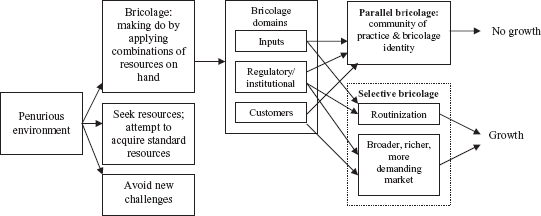
Bricolage Approach to Entrepreneurship (Baker & Nelson, 2005)
Entrepreneurial Behavior
The study of entrepreneurial behavior is an examination of human behavior involved in finding and exploiting entrepreneurial opportunities through creating and developing new organizations (Bird & Schjoedt, 2009). The goal of this line of research is to “explain, predict, and control (shape and change) behavior at the individual and team level” (Bird, Schjoedt, & Baum, 2010). Entrepreneurial behaviors are the “concrete enactment of individual or team tasks required to start and grow a new organization” (Bird & Schjoedt, p. 328) and manifest as “discrete units of individual activity that can be observed by an audience” (Bird & Schjoedt, p. 335). Although a number of studies have examined entrepreneurial behaviors as both independent and dependent variables (see Bird & Schjoedt for a review), there is very limited published research that considers the behavioral implications of some of the emerging theories of entrepreneurship such as effectuation and entrepreneurial bricolage. From a review of the literature, two studies emerged that extend the emerging theories of entrepreneurship into the behavioral domain. Chandler et al. (2011) developed and validated self–report scales to assess the application of effectuation and causation processes within new ventures. Some of the items in the scales they developed are directly related to entrepreneurial behaviors. Senyard et al. (2009) refer to the concept of “bricolage behaviors” in the theorizing for their study on the relationship between entrepreneurial bricolage and performance. They developed an eight–item scale for measuring “bricolage behaviors” in entrepreneurial ventures. These two studies (Chandler et al.; Senyard et al.) provide a useful foundation for operationalizing the behaviors that underlie effectuation, causation, and bricolage. The researchers conducting these studies (Chandler et al.; Senyard et al.) engaged in a series of activities to generate and validate the items in the instruments they created. Because of the effort they put into understanding the theory and translating it into measurable items, it is valuable to use these operationalizations as central to the description of entrepreneurial behavior associated with each theoretical perspective. To this end, the items used in their measurement instruments were adapted as a foundation to describe the entrepreneurial behaviors underlying each of the entrepreneurship theories. Table 2 provides a description of the entrepreneurial behaviors associated with each of the theoretical perspectives, plus additional specific examples for each behavior. 7
Behaviors Underlying Entrepreneurship Theories
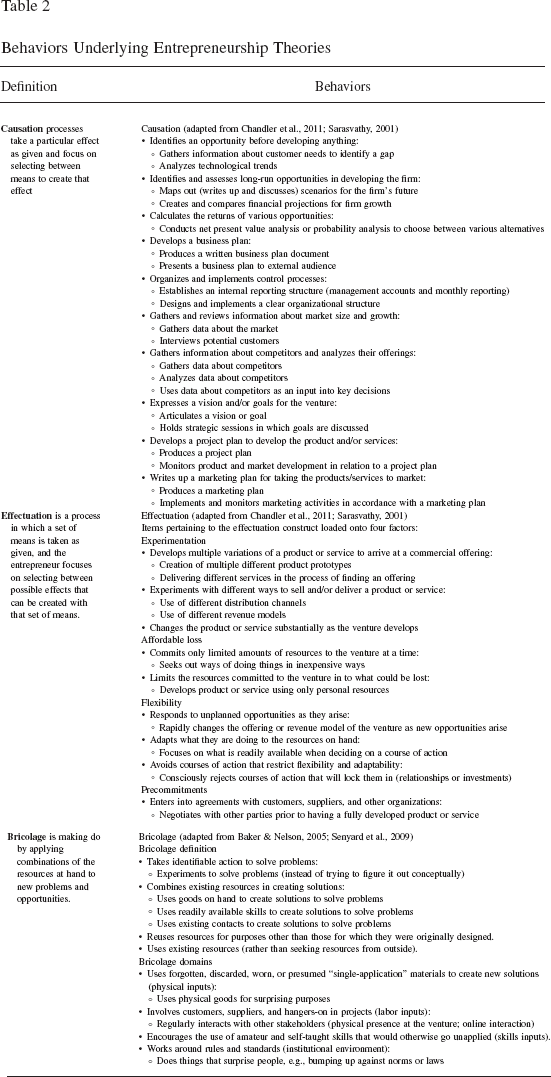
The specific behaviors underlying each of the theoretical perspectives reviewed here are used as a basis to evaluate the actions taken in the emergence of six new firms in the computer Internet space. The methodology, data, and analysis tools are described in detail in the next section.
Methods
This research relied on an alternate template research design (Langley, 1999). The alternate template approach is useful for comparing and contrasting if and how different theoretical perspectives explain a complex process. It provides alternative explanations of the same situation using different theoretical perspectives and assumptions—thereby highlighting elements of each perspective that fit with the data. The “confrontation among different interpretations can reveal the contributions and gaps” of each perspective (Langley, p. 699). The strategy was popularized by Allison (1971) in his classic study of the decisions made during the Cuban Missile Crisis of 1962. It has since been used to examine alternate approaches to organizational change (Markus, 1983) and competitive strategy (Collis, 1991). To my knowledge, the alternate templates research approach has never been used to contrast different theories in entrepreneurship research.
Because this strategy draws on theory from outside the data, it is deductive (Langley, 1999). There are two ways of applying this approach. The first is to develop competing hypotheses based on different theoretical perspectives, and to formally test the hypotheses to reveal which theory is more useful for explaining the data (e.g., Markus, 1983). The second way to apply this approach is to use different theoretical perspectives to interpret what is known about a situation. In such cases, “the different interpretations are less like true ‘tests’ of theory and more like alternate complementary readings that focus on different variables and levels of analysis and reveal different types of dynamics” (Langley, p. 699). In using the alternate templates strategy in this research, the latter approach is applied. The details pertaining to each step in this research process are expanded on below.
Theoretical Perspectives and Entrepreneurial Behaviors
Early in the project, the entrepreneurship literature was carefully reviewed, and the theoretical perspectives to be used to interpret and analyze the case data were selected. Causation, effectuation, and bricolage were chosen because of their prevalence in the literature and broad focus in addressing general entrepreneurship issues. The foundational articles relating to each of these theoretical perspectives were carefully reviewed, along with other articles that have examined behaviors pertaining to the various perspectives (e.g., Chandler et al., 2011, for causation and effectuation; Senyard et al., 2009, for bricolage). The individual actions that underlie each of the theories were identified. These actions (i.e., individual behaviors) are summarized in Table 2.
Context and Cases
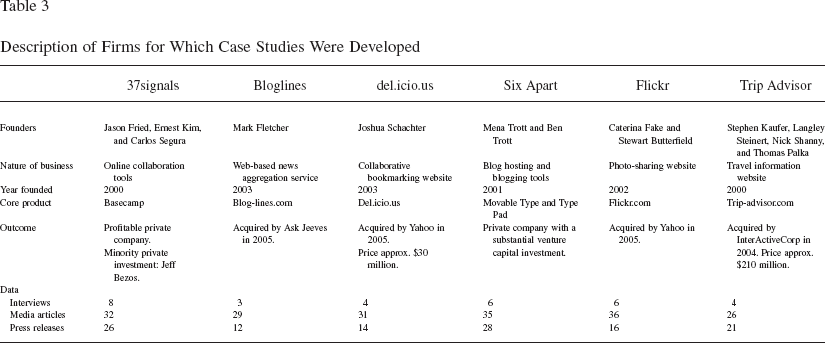
The alternate templates research approach requires that different theoretical approaches be applied to explain an actual set of events (Langley, 1999); therefore, actual entrepreneurial events need to be identified and selected for analysis. I decided to focus on consumer Internet ventures launched between 2000 and 2003 as a context for this study. At the turn of the millennium, emerging Web technologies created many new opportunities for enterprising entrepreneurs, and a number of individuals who built consumer Internet firms during this time provided intricate details about their venture creation experiences that made the development of detailed qualitative case studies possible. I identified six consumer Internet ventures founded by independent entrepreneurs (i.e., not as part of a larger organization) between 2000 and 2003. This group of entrepreneurs formed a “cohort” of entrepreneurs interviewed for the book Founders at Work (Abrahamson, 2007). The interviews provided detailed information about the entrepreneurial behavior underlying the venture founding process. The richness and detail in data were the primary reason for selecting the cases, and this ultimately outweighed the benefit of using a random sample (Santos & Eisenhardt, 2009; Siggelkow, 2007). Descriptions of the six new ventures that provided a context for this study are found in Table 3.
Description of Firms for Which Case Studies Were Developed
Developing Case Studies
A research assistant and I utilized multiple data sources to develop case histories for each of the firms being examined. Our focus in developing the case histories was to capture the decisions and actions of entrepreneurs as they created and developed their new ventures. The primary data source for each case history was a transcript from an interview with the firm founder. The interviews were conducted according to a semistructured interview protocol designed to capture the intricacies of the firm founding process. Each transcript was between 6,000 and 10,000 words long, and the interviews were conducted for a book titled Founders at Work (Abrahamson, 2007). We supplemented the data in the interview transcripts with secondary data from media articles, interviews, press releases, information from company websites, and e–mail interactions with the company founders. We utilized 40–50 secondary data sources per venture to develop each case history. With data from multiple sources, we were able to triangulate all the information that went into the final case history for each venture, thereby increasing the validity of the cases that were analyzed. The details about the venture in each case, and the data that were collected for each case, are reported in Table 3. For each venture, a research assistant and the author independently developed a full detailed case history using all the data at our disposal. We created 17 questions to guide the development of each case history so as to ensure that we addressed all the critical issues, and to enable us to compare the details from each case history after they had been independently developed. The 17 questions that were used in developing each case history are reported in the Appendix. Each case history was between 14,000 and 18,000 words long, and captured intricate details of the venture development process from inception to exit, or through to 2006, whichever came first. After independently developing each case, we compared the cases and carefully identified inconsistencies. Where there were inconsistencies, we referenced back to the source data and/or corresponded with the entrepreneur via e–mail to resolve what actually happened.
Matching the Data to the Theoretical Criteria
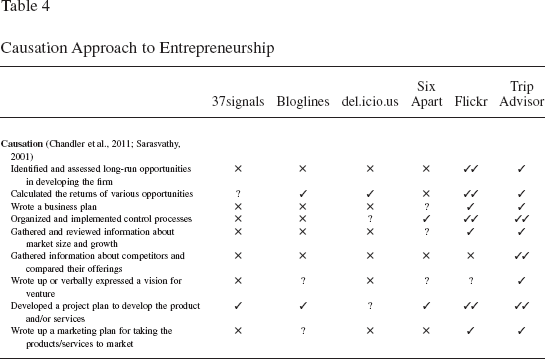
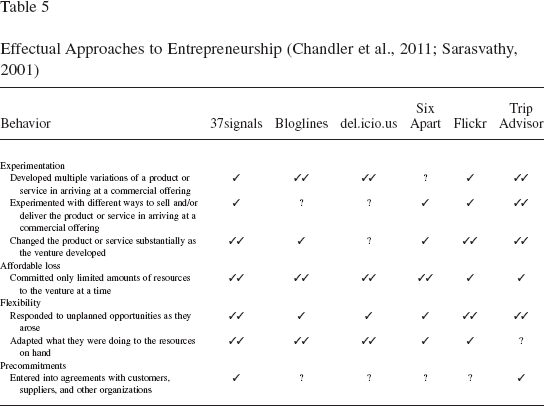
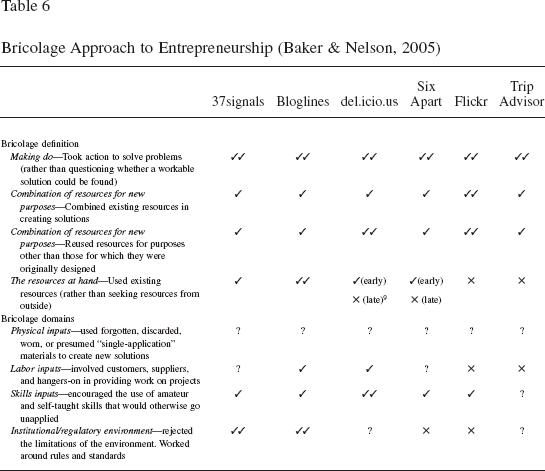
We then sought to match the data in each case study to the behavior associated with each theory. A fit between the qualitative data in the case study and the behaviors associated with each theory provided some evidence that a particular theory is relevant for explaining the emergence of a particular venture. The strength of the fit between the data and the respective behaviors was also assessed. The fit between the data in the case and the behaviors associated with the theory was assessed as strong if (1) it was clearly evident that the behavior of the entrepreneur (as captured in the case study) matched with the behavior associated with the theory (as reported in Table 2), and (2) if the data in the case study were clear, came from multiple sources, and were not likely to be contested by anyone else reading the same information. A strong fit between the data in the case and the behaviors associated with the theory is marked with “✓✓” in Tables 4–6. In other cases, the evidence was not as strong, meaning that it required some interpretation or was not supported by multiple data sources, and in such cases, it was marked with “✓” in Tables 4–6. In some cases, there was clear evidence that the actions of the entrepreneur did not align with the behavior associated with the theory, and this outcome was marked with “✗” in Tables 4–6. When it was not possible to infer from the data whether the actions of the entrepreneur aligned with the theory, this outcome is marked with “?” in Tables 4–6.
Causation Approach to Entrepreneurship
Effectual Approaches to Entrepreneurship (Chandler et al., 2011; Sarasvathy, 2001)
Bricolage Approach to Entrepreneurship (Baker & Nelson, 2005)
Drawing Conclusions
The analysis of the case study data using the various theoretical perspectives provides a platform for comparing and contrasting the behaviors underlying the different theories and for identifying consistent themes across the various theoretical perspectives in the entrepreneurship literature. In order to draw some conclusions from the analysis, I carefully observed patterns in the data as reflected in the summary tables.
Results
The analysis of the data using different theoretical perspectives revealed interesting insights about each of the different theories. In this section, the extent to which each of the behavioral aspects of each theory appeared to fit with the case study data is discussed. Then, using this analysis, some conclusions about the similarities and differences of each of the theoretical perspectives and the relevance of each perspective for capturing the actions and behaviors of entrepreneurs are drawn.
Causation
Across the six ventures analyzed, only two entrepreneurial teams (the founders of Trip Advisor and Flickr) demonstrated behaviors that fit with causation processes. Trip Advisor was founded by Stephen Kaufer, Langley Steinert, Nick Shanny, and Thomas Palka in 2000. The idea for a company providing rich, realistic travel information via the Web had come to Kaufer in 1998 when he was planning a vacation and struggled to find the information he needed. Having recognized the opportunity and having assessed it to be potentially viable (Shane & Venkataraman, 2000; Venkataraman, 1997), he assembled a founding team and formed a firm to raise resources to exploit the opportunity (Katz & Gartner, 1988). In developing the idea, the founders assessed their options with respect to which markets they would serve, where they would source the necessary information they needed, and how they would create and capture value, all the time working toward the vision of providing the “richest database of travel information” (Kaufer in interview with Abrahamson, 2007). The summary of alignment between theory and data in Table 4 illustrates the extent to which the Trip Advisor founding team reflected behaviors associated with causation. Although Trip Advisor demonstrated strong behavioral alignment with causation, there was also evidence that the founders of Trip Advisor enacted behaviors associated with effectuation (which is contrasted with causation logic in describing effectuation and causation; see Sarasvathy, 2001): They experimented with different products and business models; they restricted spending to what they could afford; they were flexible to new opportunities and alternative ways of doing things; and they worked closely with customers to reduce uncertainty (see Table 5). This suggests that the behaviors associated with causal and effectual models can be enacted simultaneously in the same venture.
Evidence against the adoption of a causal—planned, goal oriented, return maximizing—approach to venture development in four of the six ventures is fairly strong. There was little to no evidence that the behaviors associated with causation were enacted in the emergence and development of 37signals, Bloglines, del.icio.us, and Six Apart. In all four of these firms, the entrepreneurs did not appear to initially analyze long–term opportunities, develop specific strategies, research target markets, or do a meaningful competitor analysis. Also, in all four cases, they developed the first iteration of their focal product before recognizing it as a realistic commercial opportunity. Table 4 summarizes the analysis of the actions taken by entrepreneurs in all six ventures in relation to the behavioral criteria associated with causation.
Effectuation
Research done to validate the effectuation construct (Chandler et al., 2011) suggests that effectuation has four distinct dimensions: (1) experimentation—trying different approaches in the marketplace before settling on a business concept; (2) affordable loss—predetermining how much one is willing to lose and experimenting within the bounds of that constraint; (3) flexibility—adapting to changing circumstances, unexpected events, and new knowledge; and (4) precommitments—establishing early relationships with customers, suppliers, and other strategic partners to reduce uncertainty and spread responsibility to other stakeholders. I adapted the measures developed by Chandler et al. (2011) to establish criteria for assessing whether the behaviors within case study data fit with the theory of effectuation. The summary results of this assessment can be found in Table 5.
The results suggest that the dimensions of affordable loss, flexibility, and experimentation are useful for explaining the actions of the entrepreneurs in the case studies examined here. Behaviors associated with affordable loss were consistently applied across all six firms, and some of the entrepreneurs made specific reference to how this type of logic fostered creativity within the emerging organization:
The money was scarce, but I'm a big believer that constraints inspire creativity. The less money you have, the fewer people and resources you have, the more creative you have to become. I think that had a lot to do with why we were able to iterate and innovate so fast. (Caterina Fake, cofounder of Flickr, as quoted in Abrahamson, 2007) I was the only programmer and I was dedicating 10 hours a week to this, while we were developing it. 37signals was paying me to do this out of its consultancy revenue, since we didn't have funds to fund it. And we realized through this process that those constraints—which sound negative—were actually the greatest gift to the development of Basecamp. That whole constrained development model really focused our view on what we needed, and it forced us to make tough decisions about making less software all the time. (David Heinemeier Hansson, partner at 37signals, as quoted in Abrahamson, 2007)
Flexibility was also a very useful mechanism in describing the behaviors of the entrepreneurs in all six case studies. Some of the examples of flexibility included creating a commercial product out of a tool developed for internal project management at 37signals, doing consulting work to implement the free software developed at Six Apart, and working in 15–minute increments to develop the del.icio.us product while still a full–time employee at an investment bank. Linked with flexibility, the dimension of experimentation was also useful for explaining the actions of the entrepreneurs. Many of the actions for flexibility were also coded as for experimentation, highlighting overlaps between these two dimensions. The experimental nature of the approach at Flickr is reflected in the following quote:
What we did was just start building stuff . . . so Flickr started off as a feature (of an online game). It wasn't really a product. It was a kind of instant messaging thing that you could drag and drop photos onto people's desktops and show them what you were looking at (while playing the online game). We built it really fast; we had a lot of the technology already from the game, but we built the first instance of Flickr in eight weeks. (Caterina Fake, cofounder of Flickr, as quoted in Abrahamson, 2007)
Because of the nature of these firms as Web–based enterprises, the concepts of experimentation, flexibility, and affordable loss seem highly pertinent. One of the primary elements of Web–based firms is computer code. Because of the ease with which computer code can be created and changed, Web entrepreneurs have the option to experiment and change things easily without incurring significant cost, giving rise to a logic of experimentation, flexibility, and affordable loss in building the ventures.
The only dimension of effectuation that was not useful for explaining what was observed in the case studies was precommitments. We could not tell from the data whether the ventures entered into agreements with suppliers and customers to reduce uncertainty, and thus the effectual concept of precommitments (Chandler et al., 2011) did not fit with the data.
Bricolage
In assessing whether bricolage is a useful theory for explaining the action and behaviors of the entrepreneurs in this sample, we examined criteria related to the definition of bricolage (three elements) and to the five domains of bricolage (Baker & Nelson, 2005). Two of the three elements of the bricolage definition—making do and combining resources for new purposes—were useful for describing the behaviors outlined in the data. All of the entrepreneurs could be described as demonstrating “a bias toward action and active engagement with problems and opportunities” (Baker & Nelson, p. 334), and all of them appeared to “combine and reuse resources for different applications than those for which they were originally intended or used” (Baker & Nelson, p. 334). The bias toward action was reflected in the entrepreneur's inclination to develop and test tools, even prior to recognizing a commercial opportunity. The recombination of resources came via using computer code that was created for other purposes in the development of a product or tool that was later released to the market. Paul Fletcher of Bloglines used computer code that he had created for an antispam product in the development of his Web–based news aggregation service. Mena and Ben Trott of Six Apart used the structure and architecture of the enterprise blogging platform they had created, called Movable Type, to create the first version of their consumer blogging platform called Type Pad. The Flickr founders used much of the functionality from the online game they had been creating, called Game Never–Ending, in the development of the Flickr photo sharing platform that later became their primary product.
With respect to the third element of the bricolage definition—demonstrating a bias toward relying on the preexisting elements at hand rather than seeking to acquire resources from outside the firm—it appears that some of the entrepreneurs relied almost entirely on resources under their control (e.g., 37signals and Bloglines), whereas in other ventures, the entrepreneurs started out by relying on their own resources but soon brought in resources from external resource providers (e.g., del.icio.us and Six Apart). In the case of Flickr and Trip Advisor, the entrepreneurs brought in external funding in the process of creating the company, thereby using the resource–seeking approach rather than having a bias toward relying on preexisting resources (Baker & Nelson, 2005).
The bricolage domain in the theory that is most evident in the data is the skills domain, where founders relied on a range of self–taught coding skills in the development of the Web–based products. Many of them described themselves as “hackers” 8 and used skills they had acquired from a broad range of sources to develop Web–based products. In the interview transcripts (Abrahamson, 2007), the founders of four of the six firms (Bloglines, del.icio.us, Six Apart, and Flickr) referred to the development and creation of computer code as a “hobby” or as something that they “do for enjoyment in their spare time.” This further suggests that the founders of these companies were applying bricolage with respect to skills in accordance with Baker and Nelson's (2005) conceptualization.
The data in the case studies suggested that although all of the entrepreneurs applied some elements of bricolage (see Table 6), none of them used bricolage across multiple domains. They avoided generating “mutually reinforcing patterns and . . . a firm identity and community of practice that cements firms into the practice of parallel bricolage and stalled growth” (Baker & Nelson, 2005, p. 354). This fits with the logic proposed by Baker and Nelson in which selective entrepreneurial bricolage (as observed in these six cases) is proposed to facilitate growth. All six of these firms grew significantly in their early stages of development.
Discussion
The results from this analysis provide a number of interesting insights for entrepreneurship theory and practice. From a theoretical perspective, the application of different entrepreneurship theories to the same case study data provides insight into the similarities and differences between the theories at the level of entrepreneurial behavior. Although this is a specialized setting and the findings from this analysis cannot be generalized to all entrepreneurial ventures, in this context, the behaviors associated with effectuation and bricolage appeared to be more representative of what entrepreneurs do in building their businesses. Across all six ventures, the behaviors associated with effectuation and bricolage were prevalent (see Tables 5 and 6). Where entrepreneurs did employ behaviors associated with causation, they employed those behaviors alongside behaviors associated with effectuation and bricolage (e.g., in the cases of TripAdvisor and Flickr). There were no cases where only the behaviors associated with causation were responsible for the development of the venture. This partially aligns with Sarasvathy's (2001) contention that “[b]oth causation and effectuation are integral parts of human reasoning that can occur simultaneously, overlapping and intertwining over different contexts of decisions and actions” (p. 245). Based on this finding, it may be valuable for future researchers to analyze whether effectual and causal behaviors are complementary in the entrepreneurial process, i.e., do entrepreneurs who employ effectual and causal behaviors concurrently have advantages over entrepreneurs who favor one or the other, and under what circumstances is causation, effectuation, or a concurrent approach of effectuation and causation advantageous?
Common Dimensions and Propositions
The comparison of effectuation and entrepreneurial bricolage (at both a conceptual level and within the data) suggested that there are dimensions that are shared across both perspectives. Although the theories of effectuation and bricolage were created to explain different phenomena in the entrepreneurship domain, the behaviors associated with both theories appear to be similar in many respects. Both theories offer propositions that contrast with the ideas in the more traditional economic model of entrepreneurship (e.g., causation model), and both theories appear to tap into some of the same foundational dimensions. The dimensions that appear to be consistent across the two theoretical perspectives include the following: (1) existing resources as a source of entrepreneurial opportunity; (2) action as a mechanism for overcoming resource constraints; (3) community engagement as a catalyst for venture emergence and growth; and (4) resource constraints as a source of creativity. These dimensions are summarized in Table 7 and discussed below.
Consistent Dimensions Embedded in the Emerging Entrepreneurship Theories

Existing Resources Are a Source of Entrepreneurial Opportunity.
The theories of bricolage and effectuation both suggest that resources under the control of the entrepreneur are a key source of entrepreneurial opportunity. Sarasvathy and Dew (2005, p. 543) suggest that under effectual logic, entrepreneurs create opportunities by asking “Who am I? What do I know? Whom do I know?” and using the answers to these questions to then respond to the question “What can I do?” In the bricolage approach to entrepreneurship (Baker & Nelson, 2005), entrepreneurs create opportunities and markets by “making do with what is at hand.” The idea that resources on hand are a key source of advantage for firms aligns strongly with the resource–based view of the firm, which suggests that the “value, rareness, imitability and substitutability” (p. 99) of firm resources are key indicators of potential competitive advantage within a firm (Barney, 1991). Although new firms typically do not have a rich resource base from which to build a competitive advantage, the entrepreneurs within those firms can identify opportunities to create competitive advantage by focusing on the resources that they (as individuals) bring to a venture (i.e., skills, knowledge, and relationships) (Sarasvathy & Dew). They can combine resources (physical inputs, human inputs, institutional inputs) in novel ways so as to create value (Baker & Nelson).
In five of the six cases examined, the entrepreneurs created an entrepreneurial opportunity out of something they had already developed, either in their individual capacity or for the nascent firm in which they were operating. Having already developed a piece of software to solve a personal or business need or as a mini–experiment, they discovered that what they had created could have commercial potential. In all five of these cases, the entrepreneurs were in control of their core product before they realized the potential attached to that core product.
These findings suggest that across the emerging entrepreneurship theories, there is an important relationship between resources under the control of the entrepreneur and entrepreneurial opportunity recognition. Prior research has highlighted how entrepreneurs identify different entrepreneurial opportunities because of variation in their knowledge and prior experience (Grégoire, Barr, & Shepherd, 2010; Shane, 2000). Building on the notion that prior knowledge and experience are central to opportunity recognition and linking it with the emerging entrepreneurship theories, it appears that there is a relationship between focusing on resources on hand and the entrepreneurial opportunities identified by an entrepreneur. Specifically, the opportunities that emerge when an entrepreneur focuses on resources on hand are more actionable than those that are discovered through market or industry analysis. Action is central to entrepreneurship (McMullen & Shepherd, 2006); entrepreneurs need to identify opportunities on which they can act if they are to create anything of value: “[U]ltimately, someone somewhere must undergo a decision process in which action is chosen if any market ‘process’ is to occur” (McMullen & Shepherd). It is therefore useful to distinguish between entrepreneurial opportunities that are actionable, those where the entrepreneur can immediately take action to seize the opportunity, versus those that are difficult to act on where the entrepreneur needs to depend on a multitude of other factors to seize the opportunity. One of the significant barriers to entrepreneurial action is resources. An entrepreneur may identify an opportunity for a new product or service, but if he or she does not have access to the resources that are required to seize that opportunity, then the process of acquiring resources may be perceived as significantly challenging (Brush, Greene, & Hart, 2001), causing him or her to not act on the opportunity. Entrepreneurs who focus on the resources under their control when identifying an entrepreneurial opportunity will readily have some of the resources on hand to act on the opportunity, and, therefore, they will more readily take action to create value from the identified opportunity. This relationship between opportunity identification and entrepreneurial action is captured in the following proposition:
Taking Action is a Mechanism for Overcoming Resource Constraints.
The second common dimension emerging from the analysis is that taking action can serve as a means for overcoming resource constraints. The traditional logic of entrepreneurship is to recognize an opportunity and then to go out and access resources to exploit that opportunity (Hsu, 2008). One of the most consistent findings in the data was that all the entrepreneurs “demonstrated a bias toward action and active engagement with problems or opportunities rather than lingering over questions of whether a workable outcome can be created from what is at hand” (Baker & Nelson, 2005), and this action orientation provided the momentum they needed to overcome the initial resource constraints associated with starting a business. Within the data, entrepreneurs took action to overcome constraints by (1) devoting small chunks of time or resources to a solution while working on other jobs; (2) actively experimenting with low–cost solutions to see which solution worked best; (3) leveraging resources on hand (e.g., databases, computer code, hardware) in devising possible solutions; and (4) sharing crude solutions with a wide audience to get feedback on what they had developed. These actions fit with the logic in Sarasvathy's (2001) paper on effectuation in which she states that “sufficiency is provided by active implementations of imagined solutions . . . effectuation processes are far more frequent and very much more useful in understanding and dealing with spheres of human action” (p. 250). The action orientation of the entrepreneurs in the case studies served as a means to overcome resource constraints and to find a workable solution. By acting on their ideas, the entrepreneurs examined were able to discover creative ways to solve problems so as to operate in resource–constrained entrepreneurial environments. This leads to the following proposition:
Community Engagement as a Catalyst for Venture Emergence and Growth.
The third important dimension, serving as a key input into the entrepreneurial process across the emerging entrepreneurship theories and from within the data, is “community engagement.” In five of the six cases, the entrepreneurs developed a large, strong community following, prior to launching their product. In three of the five cases, the entrepreneurs hosted blogs with a significant number of regular readers. In the other two cases, the entrepreneurs had developed a community of people supporting their efforts through prior products or services they had developed (e.g., Joshua Schachter of del.icio.us had a community of people already using other tools that he had developed for organizing information on the Internet, and the founders of Flickr had access to the community of people playing the online game they were creating). The community of people reading each entrepreneur's blog or using their existing products served two key purposes in the entrepreneurship process. First, in the process of developing and testing a new product, the entrepreneur shared and exchanged information about the product with their blog readers or existing users. The feedback and input from these “early customers” served as a source of innovation and collective creativity (Hargadon & Bechky, 2006), which allowed for the development of a more appealing product over time. Second, when launching the product, the same community served as early users and “evangelists” selling the product to others through word of mouth. This observation fits with the effectual logic concept of “initial customers as partners and vice versa” (Sarasvathy, 2008), and it aligns partially with the bricolage concept of “involving customers, suppliers, and hangers–on in providing work on projects” (Baker & Nelson, 2005, p. 349).
Overall, it would seem that when entrepreneurs have access to a broad base of people who are interested in what they are doing as they develop a new product or service, then they have an advantage over those entrepreneurs operating in isolation. Sharing a new product with an interested community provides the early feedback that enables an entrepreneur to move forward in the product development cycle, and ultimately create a more appealing product. Furthermore, as the community members act as evangelists for the new product, the sales for the product will increase at a higher rate compared with a venture where no such community exists, leading to a higher level of growth in ventures embedded in a community. This observation leads to the following proposition:
Resource Constraints as a Source of Creativity and Innovation.
The fourth common dimension to emerge from this study is the idea that resource constraints serve as sources of creativity and innovation. Bricolage and effectuation explicitly incorporate resource constraints as key elements of the respective theories. A “penurious environment” is the starting point for the process model of entrepreneurial bricolage, and out of this environment an entrepreneur can choose to “make do by applying combinations of the resources at hand to new problems and opportunities” (Baker & Nelson, 2005, p. 353). In effectuation theory, the affordable loss principle stipulates that an entrepreneur “begins with a determination of how much one is willing to lose” so that one can leverage “limited means in creative ways to generate new ends as well as new means” (Sarasvathy, 2008, p. 81). The idea that resource constraints inspire creativity and innovation was supported in the case data. Five of the six entrepreneurs were explicit in describing how they believed that resource constraints were valuable and necessary inputs to foster creative and novel solutions in the firms they ended up creating (as reported earlier in the paper). Research in the areas of cognitive psychology supports the notion that constraints foster creativity. Building on established concepts of encoding/retrieval and analogical thinking, Finke, Ward, and Smith (1992) argue that individuals are more creative when limited by constraints than when faced with a “blank slate.” They suggest that individuals draw on existing knowledge frameworks to establish “preinventive structures” that interact with the constraints of the task at hand to foster creative solutions. If there are no constraints to channel people's cognition when interacting with preinventive structures, then solutions tend to be less creative. These insights have been tested in the consumer marketing literature. Moreau and Dahl (2005) used experimental studies to show that where input and time constraints are active, the outcomes produced in product development tasks are deemed more creative than when constraints are inactive. The authors explain the increased innovativeness of such constraints–driven solutions by arguing that when the demands of the innovative task are in conjunction with a perception of resource constraints, team members tend to look for alternatives beyond “the path of least resistance” (Moreau & Dahl), which was shown to lead to higher ratings on innovativeness of the outcomes produced (e.g., Goldenberg, Mazursky, & Solomon, 1999; Moreau & Dahl; Ward, 1994). Therefore, based on the theoretical arguments in the emerging entrepreneurship theories, and linking those with the findings from the data and with the insights from the creative cognition literature, I offer the following proposition:
Contribution
This study makes three contributions to the entrepreneurship literature. First, it compares and contrasts traditional and emerging entrepreneurship theories, providing scholars with an overview of the similarities and differences between the three theories at both a theoretical and a practical level. After reviewing the key elements of the emerging theories, and after using each theory to explain case study data, four important similarities are identified. Both of the emerging theories reflect the following four dimensions: (1) existing resources serve as a source of entrepreneurial opportunity; (2) taking action is a mechanism for overcoming resource constraints; (3) community is a catalyst for venture emergence and growth; and (4) resource constraints are a source of creative innovation. These four dimensions create a connection across the theories of effectuation and bricolage, and can be used by future researchers to further examine how new firms emerge and how new markets are created.
Second, this study considers how the critical elements of the respective entrepreneurship theories translate into entrepreneurial behavior—“discrete units of individual activity that can be observed by an audience” (Bird & Schjoedt, 2009, p. 335). Understanding elements of a theory at a behavioral level provides for a clearer understanding of a theory and allows a wider audience to interpret the essence of the theory. For example, when effectuation is described as a process in which an individual “take[s] a set of means as given and focus[es] on selecting between possible effects that can be created with that set of means” (Sarasvathy, 2001, p. 245), then it is really difficult for a wide audience to understand and interpret what is meant by effectuation. However, when effectuation is described as a series of behaviors that include creating multiple product prototypes in the process of developing a new product, experimenting with different distribution and revenue models, seeking out ways to do things with limited resources, using only personal resources to launch a product, focusing on resources on hand to decide on a course of action, and negotiating agreements with customers and suppliers prior to launching a product or service, then the essence of effectuation becomes more real and understandable. Although one may lose a level of abstraction that is useful for theorizing by focusing on behaviors, it is important to focus on behaviors to make theories more accessible to practitioners. This research makes some of the important entrepreneurship theories more understandable at a behavioral level.
Third, this study is the first (to my knowledge) to apply the alternate templates research approach (Langley, 1999) to entrepreneurship theories. Although the alternate templates research approach has been applied in the domains of decision making (Allison, 1971), organizational change (Markus, 1983), and strategy (Collis, 1991), it has never been applied to entrepreneurship and new venture creation. Because entrepreneurship is still an emerging academic field, many new theories are being proposed to explain the dynamics of new venture creation. The alternate templates research approach provides a useful framework for effectively assessing emerging theories to understand the relationship between the theories and how each of them contributes to our understanding of new venture creation.
Research Implications
This research builds bridges between some of the most prominent new theories in entrepreneurship research. The findings highlight fundamental similarities between effectuation and bricolage, which provides a basis for future scholars to evolve and develop an even more integrative perspective of the behaviors that underlie the entrepreneurial process in uncertain, resource–constrained environments. Although the theories of effectuation and bricolage have sometimes been placed in the same category (e.g., Eisenhardt et al., 2010), they have not been systematically compared. The systematic comparison conducted here allowed for new concepts, constructs, and relationships to emerge that are worthy of further refinement and investigation, and center around (1) actionable opportunities, (2) individual or team action orientation, (3) entrepreneurial communities, and (4) resource constraints.
The concept of an actionable opportunity—an opportunity that an individual can immediately act upon, as distinguished from a hypothetical opportunity—is attractive as theory but has many impediments to implementation—is likely to be a useful construct in entrepreneurship research. Entrepreneurship is about action (McMullen & Shepherd, 2006); therefore, defining and distinguishing actionable opportunities, and understanding the antecedents and outcome of such opportunities, could be a major advancement in entrepreneurship research.
Action orientation can be conceptualized as an individual– and/or team–level construct that captures an entrepreneur's or venture team's inclination to act. Research in social psychology (Kuhl, 1981) and marketing (Bagozzi, Baumgartner, & Yi, 1992) has found that an individual difference variable governing self–regulatory processes, called action orientation, is a key construct in moderating the relationship between intention and action in individuals. Action orientation “reflects a person's readiness to make a decision and to implement that decision” (Bagozzi et al., p. 506). Because of the emphasis on individual action emerging from this research, it would be useful to adopt and adapt the construct of action orientation as a connecting construct between theories and as a predictor variable of important entrepreneurial outcomes (e.g., organizational emergence, first sale).
The concept of an entrepreneurial community is likely an extension of the rich research stream on entrepreneurial networks (see Hoang & Antoncic, 2003, for a review), yet this research highlights how, with the development of new communication technologies, e.g., the Web, blogs, and social networks, entrepreneurs have more means to build and engage a network, and the extent to which they do initiates other key venture development activities such as product testing and marketing.
Prior research has suggested that resource constraints foster creativity (Goldenberg et al., 1999; Moreau & Dahl, 2005; Ward, 1994). The research reported in this paper would suggest that there might be a relationship between resource constraints within a new venture and important venture outcomes such as innovation, survival, and growth. It would be useful to conduct more systematic research that elaborates on and tests this relationship.
Practical Implications
The research conducted here has important potential implications for entrepreneurs and for teaching entrepreneurship. While the findings from this research are not necessarily definitive and are not generalizable to all settings, they do hint at entrepreneurial behaviors and actions that are likely to make a difference in the entrepreneurial process.
First, opportunity recognition that focuses on the resources under the control of the people seeking to launch a venture is likely to help entrepreneurs identify opportunities that are actionable. Many entrepreneurship textbooks encourage wannabe entrepreneurs to look for a gap in the market. If that is the starting point for identifying entrepreneurial opportunities, then there is a much higher likelihood that entrepreneurs will spend time evaluating opportunities that they will never be able to act on. Therefore, encouraging opportunity recognition that orientates on the resources under the team's control and then pushes them to find a market gap utilizing these resources will likely lead to entrepreneurial action.
Second, this research reinforces the importance of action in the entrepreneurial process. This theme is widely touted in popular entrepreneurship books, e.g., The Lean Startup (Ries, 2011) and Action Trumps Everything (Kiefer, Schlesinger, & Brown, 2010). This research largely supports that advice in these books by highlighting that entrepreneurs who engage in experimentation and who interact early and often with customers will be able to overcome many of the hurdles associated with starting a venture.
Third, this research suggests that entrepreneurs may benefit from being active community builders. By building a community of interested parties around their ventures, they benefit from feedback and word–of–mouth advertising. Therefore, this should be seen as a key part of the venture creation process, especially for consumer–orientated enterprises. Furthermore, community engagement could be highlighted and taught in entrepreneurship education programs.
Finally, entrepreneurs and resource providers (e.g., venture capitalists) should be conscious of the potential risks and implications of excessive amounts of capital in a new venture. Too many resources within an entrepreneurial enterprise may prompt a team to become comfortable and quell creativity. Entrepreneurial ventures may be better off if they are forced to operate within tight resource constraints.
Limitations and Opportunities for Future Research
As with all research, there are some limitations in this research that need to be acknowledged. These limitations open the door for future researchers to make a contribution to this field. The first limitation pertains to the sample of cases that are used in the analysis. It is seldom that the alternate templates research approach is applied to a representative sample of cases (Langley, 1999), as the purpose of the research is not to generalize the findings to a broader population but to compare and contrast different theoretical perspectives. In this research, the cases were selected because of access to rich details about the actions and behaviors of the entrepreneurs behind each venture. The findings about the prevalence of behaviors associated with causation, effectuation, and bricolage are not generalizable to other entrepreneurial endeavors without strong caution. There is an opportunity for future researchers to examine the extent to which behaviors associated with these different theories are prevalent among a representative sample of entrepreneurial endeavors and whether various combinations of such behaviors are associated with entrepreneurial success. This could conceivably be accomplished using representative data collected as part of a longitudinal study of entrepreneurial dynamics, e.g., the Comprehensive Australian Study of Entrepreneurial Emergence or the Kaufmann Firm Survey.
The second limitation pertains to the depth of the discussion in relation to the behaviors and processes underlying each of the theoretical perspectives. Two factors contribute to this limitation. First, because this is a journal article, there are limitations on how much one can write about the enactment of the actual behaviors and processes that underlie those findings. Some of the prior applications of the alternate templates research strategy were captured in full–length books (e.g., Allison, 1971), providing the researcher with more latitude to write about behaviors and processes in great detail. Second, I chose to analyze six case studies so as to be able to examine patterns of behavior across the different cases. Many applications of the alternate templates research design focus on a single case study (e.g., Lee, 1989), which provides the researcher with an opportunity to provide more detail in reporting on the analysis, but it does not allow for observing patterns between cases. I therefore traded off the opportunity to report on more detail in order to (1) be able to report on the research in a journal article and (2) be able to observe patterns between cases. It would be useful for future researchers to provide a deeper, richer analysis of entrepreneurial ventures using the alternate templates methodology, either by focusing on a single case study and/or by publishing the findings in a book.
Conclusion
For many years, the domain of entrepreneurship relied largely on theoretical ideas imported from other domains. Over the past decade, scholars have begun developing theories specific to the domain of entrepreneurship. Effectuation and entrepreneurial bricolage are two such theories. As we seek to establish theories of entrepreneurship, it is important to understand how they relate to one another and to the traditional models of entrepreneurship. Furthermore, it is useful to assess how the processes related to such theories are manifest in the behavior of entrepreneurs (Bird & Schjoedt, 2009). This paper adopts the alternate templates approach (Allison, 1971; Langley, 1999) to provide such a comparison. The advantage of the alternate templates approach is that it provides a platform for comparing theories in context and for relating theory to action. Instead of reviewing theoretical ideas in the abstract, one is able to assess the extent to which such ideas help explain behaviors captured in empirical data.
The analysis highlights how certain behaviors are consistent across the emerging theories in entrepreneurship research and, therefore, points to the common behavioral dimensions of effectuation and entrepreneurial bricolage. The analysis also suggests that the causal model of entrepreneurship—which is the model that is most often touted in business school classes (Sarasvathy, 2001)—may not effectively capture and reflect the actual behavior of entrepreneurs launching new ventures in a dynamic environment. Where causal approaches to entrepreneurship are adopted, they are utilized in conjunction with behaviors associated with effectuation and bricolage. Therefore, at a minimum, the traditional model of entrepreneurship needs to be combined with the emerging models to explain how entrepreneurs behave in the process of launching new ventures. The emerging theories of entrepreneurship (effectuation and bricolage) appear to be similar in many respects and provide a basis for identifying and developing new propositions focusing on the relationships between resources, entrepreneurial opportunities, action, solutions, communities, resource constraints, and creativity that may further enrich entrepreneurship research.
Footnotes
1.
The foundational articles for each perspective (Baker & Nelson, 2005; Sarasvathy, 2001) do not cite each other. A review of more recent literature under each of these theoretical perspectives suggests there is limited cross–citation between research on effectuation and entrepreneurial bricolage.
2.
I am grateful to the reviewers for pointing out that effectuation and bricolage are both “more general explanations of entrepreneurship.”
3.
At the time of conducting this research, Sarasvathy (2001) had been cited 778 times according to Google Scholar; Baker and Nelson (2005) had been cited 385 times; Shah and Tripsas (2007) had been cited 72 times; and Alvarez and Barney (2007) had been cited 236 times.
4.
Sarasvathy (2001, 2008).
5.
Sarasvathy (2001, 2008).
6.
Baker and Nelson (2005).
7.
These examples are illustrative but not exhaustive. There are likely other behaviors that would also be attributed to each of the theoretical dimensions.
8.
A hacker is a clever programmer. A “good hack” is a clever solution to a programming problem, and “hacking” is the act of doing it. Eric Raymond, compiler of The New Hacker's Dictionary, lists five possible characteristics that qualify one as a hacker: (1) a person who enjoys learning details of a programming language or system; (2) a person who enjoys actually doing the programming rather than just theorizing about it; (3) a person capable of appreciating someone else's hacking; (4) a person who picks up programming quickly; and (5) a person who is an expert at a particular programming language or system ( ).
).
9.
The entrepreneurs started out by relying on their own resources but soon brought in resources from external investors.