







Abstract
We examine how entrepreneurs’ behaviors related to credentials and impression management (IM) impact perceptions of new venture (NV) legitimacy. Results from this experiment, as hypothesized, show that entrepreneurs’ credentials and IM behaviors are positively related to legitimacy perceptions. Contrary to expectations, however, findings do not support either interaction hypothesis when credentials are high or low. We discuss how these findings illustrate the importance of entrepreneurs’ behaviors during the NV creation process and outline multiple directions for future research.
Introduction
To launch and grow new ventures (NVs), entrepreneurs rely on stakeholders to provide critical resources in the earliest stages of firm development. Unfortunately, given nascent ventures’ lack of operating history, these stakeholders face high uncertainty about nascent ventures’ viability, and, thus, may be reluctant to invest time, money, advice, and other critical resources in them (Singh, Tucker, & House, 1986; Zott & Huy, 2007). Consequently, unless entrepreneurs can successfully overcome this “liability of newness,” their NVs face a high probability of failure (Shane & Cable, 2002; Stinchcombe, 1965).
Not surprisingly, the topic of how entrepreneurs secure necessary resources, given the high uncertainty surrounding NVs, represents a fundamental focus in entrepreneurship research (Venkataraman, 1997). Scholars have noted that stakeholders have highly subjective perceptions about NVs because of high uncertainty about ventures’ long–term viability (Aldrich & Fiol, 1994). Accordingly, studies have been performed to investigate myriad cues that stakeholders may employ, including entrepreneurs’ business network connections (Larson, 1992), industry experience (Shepherd, Douglas, & Shanley, 2000), as well as NVs’ affiliations with other organizations (Stuart, Hoang, & Hybels, 1999), to reduce uncertainty, and, in turn, decide whether or not to commit time and resources. Overall, findings indicate that stakeholders explicitly or implicitly rely on multiple cues to decide whether NVs exhibit appropriate characteristics to be considered legitimate based on prevailing social norms (Suchman, 1995; Zimmerman & Zeitz, 2002).
Although research into what cues stakeholders use to make decisions is well developed (e.g., Shepherd & Zacharakis, 2003; Tyebjee & Bruno, 1984), we know much less about specific behaviors that entrepreneurs can employ to positively influence stakeholders’ perceptions and subsequent resource–related decisions. Extant research has often investigated “checklists” (e.g., writing business plans and obtaining tax identification numbers) that most entrepreneurs follow rather than theoretically grounded hypotheses that may help differentiate appropriate and inappropriate entrepreneurial behaviors (Zott & Huy, 2007). One promising research avenue, however, investigates the practical value that an entrepreneur's social skills and behaviors, including persuasion, social adaptability, and impression management (IM) behaviors, can have in successfully launching a NV (Baron & Markman, 2003; Bowey & Easton, 2007; Hayton & Kelley, 2006).
IM, defined as behaviors employed to create, protect, maintain, or alter an image of oneself held by a target audience, may prove particularly useful for investigating entrepreneur–stakeholder interactions because of its well–developed theoretical base, strong empirical support, and ability to bridge individual behaviors and organizational outcomes (Bolino, Kacmar, Turnley, & Gilstrap, 2008). Entrepreneurship studies have begun investigating the relationship between IM behaviors and NV outcomes, but, to date, this research has remained primarily conceptual (De Clercq & Voronov, 2009) or, in the case of empirical studies, has relied on entrepreneurs self–reporting their IM abilities rather than gauging stakeholders’ perceptions of these behaviors (Baron & Markman, 2003).
Accordingly, we build on this nascent research by empirically investigating the relationship between an entrepreneur's IM behaviors and stakeholders’ perceptions of NV legitimacy during the start–up stage of the entrepreneurship process. The present study offers three primary contributions to the literature. First, we hypothesize and test a model in which entrepreneurs’ behaviors influence perceptions of a NV's legitimacy. Our theory–based model draws on work regarding entrepreneurs’ IM behaviors and credentials. Second, our experimental design affords stronger evidence of possible causality between entrepreneurs’ behaviors and stakeholders’ perceptions than can be inferred from other more common (e.g., survey–based) research methods typically used in entrepreneurship research. Third, these findings have practical implications, suggesting that the use of actionable behaviors by entrepreneurs may influence stakeholders’ perceptions.
We proceed as follows. First, we review the literature related to NV legitimacy and entrepreneurs’ credentials. Here, we focus on “cognitive legitimacy” as this construct gauges the extent to which stakeholders believe NVs will be, among other things, “competent,”“effective,” and/or “needed” (Zimmerman & Zeitz, 2002, p. 416). We also review how entrepreneurs’ credentials impact potential stakeholder perceptions during initial encounters as well as serve to establish the base for subsequent communications. Next, we develop and test three hypotheses, drawing on the IM literature, employing an experimental design and a sample of 89 financial professionals routinely tasked with evaluating the viability and legitimacy of organizations. We conclude by discussing the limitations, implications, and future directions for this research.
Theoretical Background
NV Legitimacy
NVs face significantly different challenges relative to their more established counterparts, especially when considering how each vies for requisite resources (Stinchcombe, 1965). For NVs, these challenges are rooted in the inability to secure resource investments, due to lack of legitimacy. Most research examining how entrepreneurs enlist stakeholder support has focused on the process of enhancing NV legitimacy through actions such as conforming to prevailing industry practices, allying with established firms, providing critical information about an entrepreneur's qualifications to outside stakeholders, and enlisting high–profile board members (Aldrich & Fiol, 1994; Shepherd & Zacharakis, 2003; Zimmerman & Zeitz, 2002). Yet the opportunity exists to further examine antecedents to NV legitimacy, particularly in terms of important behaviors that an entrepreneur can employ.
Scholars define legitimacy as favorable judgments of acceptance, appropriateness, and worthiness made about individuals and their efforts (Zimmerman & Zeitz, 2002). Attaining legitimacy in a NV setting is thought to facilitate firm viability by providing firms access to resources they otherwise would not be able to obtain (Aldrich & Fiol, 1994; Meyer & Rowan, 1977; Zucker, 1987). Although legitimacy, arguably, has no specific, tangible value and cannot be accounted for directly as a firm asset, attaining legitimacy based on stakeholder perceptions allows NVs to reduce, and potentially overcome, malevolent stigmas tied to newness that precipitate an overwhelming proportion of NV failures (Delmar & Shane, 2004; Stinchcombe, 1965; Tornikoski & Newbert, 2007).
A recent review of the literature identified 18 types of legitimacy (for a review, see Bitektine, 2011), and, of these, cognitive legitimacy is widely perceived as the most important that NVs must obtain (Choi & Shepherd, 2005; Suchman, 1995). Studies have defined cognitive legitimacy as assessments of comprehensibility or taken–for–grantedness made by key stakeholders concerning an organization (Shepherd & Zacharakis, 2003; Suchman). NVs become comprehensible to the extent that stakeholders perceive them as familiar, based on social and cultural norms, personal experiences, and memories. It follows that NVs can attain cognitive legitimacy when their characteristics align with stakeholders’ cognitive models of viable organizations (Zimmerman & Zeitz, 2002). NVs can also attain cognitive legitimacy when key stakeholders perceive them as necessary elements in a larger system of organizations. Suchman (p. 583) describes cognitive legitimacy as “the most subtle and powerful” of all legitimacy dimensions because attaining it means that a NV has achieved “taken–for–grantedness,” and stakeholders now view it as a viable organization, necessary for technological, societal, or financial advancement.
Entrepreneurs’ Credentials
Conformance to professional norms and expectations often serves as the basis for many decisions made about an entrepreneur by a stakeholder (Zimmerman & Zeitz, 2002). Credentials related to an entrepreneur's educational accomplishments, social status, industry experience, and family background serve as cues that entrepreneurs are in line with widely recognized norms and expectations developed by stakeholders. The fulfillment of expectations likely influences decisions about the entrepreneur's potential future performance.
Organizational research suggests that individuals who skillfully demonstrate credentials related to their social prominence and exceptional educational achievements are more likely to attain high–level positions in organizations (Collins, 1979; Useem & Karabel, 1986). Credentials are “capital” (Bourdieu, 1986), and expectations regarding credentials are rooted both in society (e.g., social connections) and culture (e.g., achievements in education). When social and cultural capital are realized (i.e., credentials meet expectations), individuals may be able to convert this capital into “economic capital” (Bourdieu), through, for example, appointments to boards of directors (Westphal & Stern, 2006, 2007) or employment in upper corporate managerial positions (Useem & Karabel).
Entrepreneurship research on credentials has examined the role that an entrepreneur's (or founding team's) credentials play in how stakeholders perceive an organization, and, in turn, whether they choose to invest time, effort, or money. When entrepreneurs have relevant industry and start–up experience, stakeholder perceptions of a NV's cognitive legitimacy may increase (Zimmerman & Zeitz, 2002). Research has demonstrated that top management team credentials are crucial in investors’ decisions about whether or not to invest in a firm's initial public offering (Chemmanur & Paeglis, 2005) or venture capitalists’ decisions to invest in NVs (Baum & Silverman, 2004; Tyebjee & Bruno, 1984). Conversely, a NV's “novelty in management,” based on its team's lack of industry and start–up experience, could decrease the venture's cognitively legitimacy (Shepherd & Zacharakis, 2003) and, in turn, increase its chances of failing because of a liability of newness (Shepherd et al., 2000; Thornhill & Amit, 2003). Thus, when stakeholders recognize an entrepreneur's credentials as favorable, they will more likely view future endeavors of the entrepreneur as favorable and, in turn, worthy of investment. Therefore, we posit the following:
IM Behaviors
IM is defined as behavior enacted to create, protect, maintain, or alter an image of oneself held by a target audience so as to highlight one's abilities and to manage the perceptions of others (Barsness, Diekmann, & Seidel, 2005; Bolino et al., 2008; Jones & Pittman, 1982). IM is a process through which an individual (the actor) attempts to impact the perceptions that people (the targets) form of her or him in various organizational contexts (Goffman, 1959). Accordingly, IM behaviors represent a particularly useful lens through which the interactions of entrepreneurs (actors), who strive to manage the perceptions of potential and present stakeholders (the targets), can be examined because it focuses on how individual–level behaviors (e.g., employing IM tactics) affect firm–level outcomes (e.g., perceptions and commitment; Bolino et al.).
IM theory describes the way an actor can purposely influence a target. The underlying assumption is that the target is cognizant and aware of the actor's existence, his or her character and prevailing roles, behaviors, and issues. A significant amount of uncertainty about the actor, however, may still exist, and this cognitive gap allows the actor to use specific behaviors to influence the target's perceptions. Although these impressions that fill the voids of certainty are, at times, false in nature, they are not frequently detected as fabrications by the target (Leary & Kowalski, 1990). This form of management by fabrication and manipulation often applies to the first impression made by the target. The use and effectiveness of IM, however, can extend throughout the duration of the relationship between the actor and the target (Ashforth & Johnson, 2001; Higgins, 1996).
Dimensions of IM.
Recent work reviewing IM defined and investigated 31 distinct IM behaviors and tactics (Bolino et al., 2008). Many of these, however, are not likely to be behaviors that entrepreneurs will enact. For instance, behaviors such as intimidation or defamation of others would not likely be used during the early stages of entrepreneur–stakeholder interactions. Likewise, many behaviors are not applicable to the NV context (e.g., supervisory–focused IM).
Of the IM tactics identified (Bolino et al., 2008), the ones that can likely be used by entrepreneurs in their early interactions with stakeholders are ingratiation, self–promotion, and exemplification. These three behaviors, when enacted either separately or collectively, can shine a positive light on the entrepreneur. During initial meetings with key stakeholders, these behaviors may benefit entrepreneurs in a similar manner as when they are enacted by subordinates in an organizational setting to improve performance appraisals and career success (Dulebohn & Ferris, 1999; Judge & Bretz, 1994; Wayne & Kacmar, 1991). We examine each of the three types, in turn.
Ingratiation is defined as the use of flattery by the actor to increase the target's level of feeling and emotions (i.e., affect) for the actor. The two forms of ingratiation that have received the most attention in the IM literature are doing favors, a tactic where the acceptor of the favor subsequently feels obliged to reciprocate in some manner, and flattery, a tactic in which goals of the actor are attained by excessive (and possibly even insincere or nonchalant) praise (Gordon, 1996). Both types are considered viable tactics that actors often use for manipulating the sentiments of targets and for inducing interpersonal attraction (Gordon; Martin, 1987; Pandey, 1986).
Self–promotion is defined as highlighting one's abilities or accomplishments to be viewed as competent. Evidence supporting the contention that self–promotion tactics can positively influence a target's perceptions has been widely reported in the human resources literature, specifically in works discussing the dynamics of the interview process (Howard & Ferris, 1996; Kristof–Brown, Barrick, & Franke, 2002; Stevens & Kristof, 1995). Ellis, West, Ryan, and DeShon (2002) extended the discussion of self–promotion by examining the interaction effects of the tactics used when combined with ingratiation. The interaction between the two dimensions was found to correlate significantly with variance related to interviewer evaluations, suggesting that these tactics complement each other.
Exemplification is defined as behavior that portrays the actor as an industrious, focused, and desirable agent of an organization. This tactic is employed to make the actor appear at the very least diligent, with the most desired effect being the appearance of the actor going beyond the call of duty (Jones & Pittman, 1982).
IM Behaviors in the Entrepreneur–Stakeholder Context.
Translating these findings into entrepreneurship research, we assume that an entrepreneur (i.e., the actor) has the ability to affect the perceptions formed by a stakeholder (i.e., the target) that are related to events, objects, and contexts pertaining to a NV. Thus, by demonstrating competence and the potential for success, not through operationally derived business outcomes, but rather through behaviors, recalled experiences, and interpersonal skills, the entrepreneur may be able to minimize uncertainty in the stakeholder's mind and, in turn, enhance a NV's cognitive legitimacy.
The premise that entrepreneurs’ interactions with stakeholders can influence attitudes and cognitions is well supported in the literature. For example, research shows that an entrepreneur's level of preparedness (Chen, Yao, & Kotha, 2009) as well as social competence (Baron & Markman, 2003) can positively influence investors’ perceptions and subsequent financial outcomes. The underlying contention is that if stakeholders’ perceptions can be managed through entrepreneurial behaviors, positive outcomes may result. Therefore, increased use of IM behaviors should likewise increase the probability that key stakeholders will perceive NVs as legitimate. Accordingly, we present our second hypothesis.
The Moderating Role of IM
We propose the effect that demonstrations of credentials have on the probability stakeholders will perceive NVs as cognitively legitimate will be moderated by the use of IM behaviors. From a theoretical perspective, however, this can be a complicated relationship. On the one hand, if credentials have been previously demonstrated, research suggests that the entrepreneur could actually diminish NV legitimacy by engaging in IM behaviors. Specifically, several researchers (Jones & Pittman, 1982; McGuire, 1985) have found that, in an interview setting where the credentials have already been demonstrated, IM statements made to increase desirability actually reduce it, resulting in a self–promoters paradox. Findings suggest that if stakeholders already perceive an actor's credentials as impressive, they may become wary of further self–promotional attempts, viewing them as unnecessary (Ashforth & Gibbs, 1990). In this way, entrepreneurs actually could be perceived as manipulative if they attempt to build on existing credibility. Moreover, because manipulative behavior is generally associated with “illegitimate” organizations, employing IM behaviors in situations where credentials have already been properly demonstrated may actually reduce a NV's level of cognitive legitimacy. This addresses one key tenet of cognitive legitimacy—taken–for–grantedness (Suchman, 1995). In the mind of the stakeholder, red flags could be raised due to unnecessary manipulative behavior that serves to negatively impact cognitive legitimacy perceptions.
On the other hand, in the absence of credentials and objective information regarding the NV, research suggests that IM behaviors may be effective. Specifically, after an initial introduction and brief review of background information related to the entrepreneur and NV, an entrepreneur may be able to do very little other than attain legitimacy through behavior. Stakeholders often understand, however, that the entrepreneur must work, through salesmanship, to portray the NV as viable, reliable, and legitimate (Rutherford, Buller, & Stebbins, 2009). Therefore, they may be more likely to positively perceive IM behaviors as “good story–telling” (e.g., Lounsbury & Glynn, 2001) and tolerate it in the absence of business–related documentation–signaling credibility (Aldrich, 1999; Holt & Macpherson, 2010).
In sum, in the absence of credentials, IM behaviors are likely seen as appropriate story–telling devices that are “part of the game.” In the presence of credentials, however, these behaviors are more likely seen as “protesting too much” and serve to diminish a NV's taken–for–grantedness.
To account for these two possible moderating effects, we posit the following:
Methodology
Participants
We recruited 350 investment and financial professionals, with the support of the National Association of Insurance and Financial Advisors (NAIFA), to complete an online experiment. Of the original 350 recruited, a total of 90 participants engaged in the experiment over the course of a 2–month period with no incentive offered (26% response rate). All participants were members of NAIFA or practicing financial planners and investment managers in one of two cities, one in the Midwest and the other on the East Coast. We attribute the high response rate, even given the lack of incentive, to NAIFA's endorsement of this research.
We drew our sample from financial and insurance specialists because each had familiarity and knowledge pertaining to risk assessment, uncertainty, and investment decision making. 1 Respondents were asked to voluntarily use 15 minutes of their time to “help an entrepreneur evaluate a potential venture.” Two thirds (66.7%) of the participants were male, and over 90% (90.9%) were Caucasian. Over 90% (90.9%) had earned a bachelor's degree, and over a quarter had also earned a graduate degree (27.7%). Based on the design, the cell frequencies ranged from 13 to 18 subjects per cell. 2
Procedures
We used a 3 × 2 factorial between–subjects design, where we manipulated the two independent variables, IM behaviors (i.e., none, moderate, or high) and credentials (i.e., low or high). The dependent variable assessed in this study is cognitive legitimacy. Participants experienced the following procedures.
After participants provided consent online, they were asked to read a short vignette and an accompanying résumé related to an entrepreneur. After reading these materials online, they responded to questions focused on manipulation checks specific to the résumé and vignette. After completing these items, participants watched a short video of the entrepreneur describing his ideas and his nascent venture. 3 Participants then responded to additional questions that related to another set of manipulation checks pertaining to the entrepreneur and the NV. The exercise concluded with survey items related to perceptions of cognitive legitimacy and demographic information.
Independent Variables
Manipulating Credentials and IM.
Before conducting this experiment, we carefully operationalized and tested the manipulations of credential demonstrations and IM behaviors. Two vignettes per metropolitan area (see Appendix A) were constructed outlining the past educational, corporate, entrepreneurial, and volunteer work experiences of the “entrepreneur.” We configured one vignette to induce high levels of credentials in the participants pertaining to the entrepreneur, and the other, low levels. Fictitious résumés accompanied the vignettes (see Appendix A). Examples of specific items constructed to demonstrate strong or high levels of credentials included entries on the vignette and résumés detailing previous not–for–profit start–up experience, affiliation with a university within the metropolitan area, and 10 years worth of volunteer work in the nonprofit sector.
After we constructed the two manipulations of high credentials and low credentials using written documents, we scripted dialogue that was used by an actor in a visual presentation to induce the three IM conditions (i.e., high, moderate, and no IM behaviors; see Appendix B). For high and moderate IM conditions, the actor's script contained statements related to self–promotion, exemplification, and ingratiation. Examples of statements meant to operationalize IM behaviors include “The goal of my work is, of course, to revolutionize the space industry, and I think I am just the person to spark the change” (self–promotion); “. . . my plans are to take some time out of my absurdly busy schedule . . .” (exemplification); and “As investment and insurance professionals you have an understanding of the process of opportunity recognition and evaluation, as you are all leaders in the business community” (ingratiation). Fifteen statements, meant to create favorable impressions of the entrepreneur and his potential venture, were included in the “high IM” script. Six similar statements were included in the “moderate IM” script. Zero IM statements were included in the “no IM” script.
Once the scripts were reviewed and revised by a subject matter expert whose primary research interests are IM behaviors, they were used to create two sets (i.e., one set for each city where the data were collected) of three videos used in the experiment sessions. Except for the statements in the actor's scripts, all elements in each video were kept consistent, including the person posing as the entrepreneur, the video setting, the actor's rate of speech and level of enthusiasm, and the lighting within the taping room. The actor chosen for the role of entrepreneur is a 42–year–old Caucasian male. The setting was an office, where the actor wore the same grey suit, white shirt, and tie for all tapings. The taping of all videos was completed during afternoon hours over the course of 2 days. Only incandescent room lighting was used in all six tapings to match the brightness of each recording.
Stimuli Validation.
We employed a pilot study to assess the quality of video tapings, effectiveness of the manipulations in both the vignettes and the videos, and time needed to complete each of the three types of experiments. Six doctoral students from a large state university in the Southeast, studying and researching in the field of management, participated in the pilot study. The pilot session began when the participants were divided into two groups and asked to review either the “low–credentials” vignette or the “high–credentials” vignette for approximately 5 minutes. The participants were then asked to respond to a survey meant to gauge the level of comprehensibility of the credentials stimuli. The five survey items included “David's family plays a big part in his interest,”“David's bachelor degree is from this University,” and “David has a ‘hotmail’ account.” Participants responded on a 1 (strongly disagree) to 5 (strongly agree) Likert–type scale. Participants’ responses were consistent with the manipulation. Immediately after the collection of the completed surveys, we conducted a qualitative session where participants’ thoughts on improving the vignettes and résumés were recorded and later codified.
During the latter half of the pilot study, the same format of inquiry was employed for the video recordings that were to be used in the laboratory experiment as part of the actor's enactment of different levels of IM behaviors. The participants were first divided into three groups, shown the scripted and videotaped materials, asked to complete an IM behavior–related survey, and finally asked for their thoughts related to the stimuli. The IM behavior–related survey included five items including “In the video you just watched, David's compliments directed to the viewer were numerous”; “In the video you just watched, David Noble stated that the Astrobiology, Astronomy, and Spaceflight Institute is interested in his idea”; and “In the video you just watched, David Noble stated he is pretty well–equipped to start up this non–profit new venture.” Distinct differences in the video recordings, measured both by the questionnaire items serving as manipulation checks as well as by the comments offered, were identified by the pilot study participants. Based on the pilot study's results, we made subtle changes to the credentials stimuli before starting the large–scale empirical project.
Control Variables
To rule out the possibility that the current findings were due to a spurious relationship, we included the demographic control variables, age and gender (Becker, 2005).
Dependent Variable
Cognitive Legitimacy.
We assessed perceived cognitive legitimacy using a 3–item measure developed by Pollack, Rutherford, and Nagy (2012). This scale was developed based on extant legitimacy research (e.g., Zimmerman & Zeitz, 2002; Zott & Huy, 2007). The 3–item scale was derived directly from Zimmerman and Zeitz's (pp. 419–20) discussion of how stakeholders perceive NV “identity” and characteristics such as “successful in the business domain in which it purports to operate.” Items within our survey include “I envision the business receiving high–profile endorsements in the future,”“I envision this business receiving favorable press coverage in the future,” and “I envision this business having a top management team that will benefit the organization.” Participants responded using a 1 (strongly disagree) to 5 (strongly agree) Likert–type scale. The scale exhibited adequate reliability (α = .83).
Results
Manipulation Checks
The credentials manipulation was assessed using a 5–item Likert–type scale (α = .73) anchored by the endpoints of 1 (strongly disagree) and 5 (strongly agree). The items created for the manipulation checks were meant to be very straightforward and easily comprehensible. We employed the same items as in the pilot study. We also used the same 5–item, 5–point scale developed for the pilot study to measure the effectiveness of the IM manipulations (α = .86). Mean scores for the two credential manipulation items were 2.08 for participants (n = 44) in the “low–credentials” condition and 3.78 for participants (n = 45) in the “high–credentials” condition. We found a significant difference between these two conditions (t[1,44] = 10.05; p < .001). Mean scores for the five IM manipulation items were 2.32 for participants (n = 26) in the “no IM” condition, 3.24 for participants (n = 27) in the “moderate IM” condition, and 4.28 for participants (n = 36) in the “high IM” condition. The differences among these three means were significant (F[2,87] = 64.39; p < .001). The Scheffe follow–up test of mean differences among the three levels of IM treatments resulted in significant mean difference statistics among all three levels (high versus no IM = 1.96; p < .001; high versus moderate IM = 1.04, p < .001; moderate versus no IM = 0.92, p < .001). Given the results of the manipulation checks, we concluded that the credentials and the IM manipulations were effective.
Hypothesis Testing
We tested hypotheses 1 and 2 using univariate analysis of variance. Covariate variables for gender and age were not statistically significant in either analysis. Hypothesis 1 predicted that credential demonstration would be positively related to a NV's cognitive legitimacy. As predicted, the 45 participants in the high–credentials condition (M = 3.21) reported higher perceptions of cognitive legitimacy relative to the 44 participants in the low–credentials condition (M = 2.83). These results provide support for hypothesis 1 (F[5,84] = 3.01; p < .03).
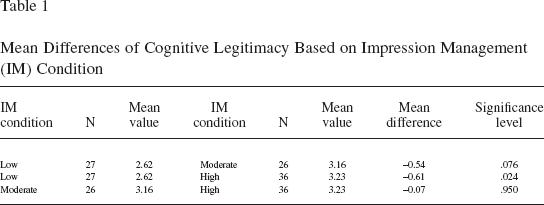
Hypothesis 2 predicted that IM behavior would also be positively related to a NV's cognitive legitimacy. As predicted, the 36 participants in the high IM condition (M = 3.23) reported higher perceptions of cognitive legitimacy relative to the 27 participants in the moderate IM condition (M = 3.16) and the 26 participants in the no IM condition (M = 2.62). These results provide support for hypothesis 2 (F[5,84] = 4.52, p < .02). Post hoc testing using Scheffe's method showed a distinct difference in cognitive legitimacy levels between the “no IM” and “high IM” conditions (.61; p < .03), but not between “no IM” and “moderate IM,” nor between “moderate IM” and “high IM” (see Table 1).
Mean Differences of Cognitive Legitimacy Based on Impression Management (IM) Condition
Hypothesis 3a predicted that IM behaviors would moderate the positive relationship between credentials and cognitive legitimacy attainment, such that when credential levels are high, IM behaviors will lessen the positive relationship between credentials and cognitive legitimacy. Hypothesis 3b predicted that IM behaviors would moderate the positive relationship between credentials and cognitive legitimacy attainment, such that when credential levels are low, IM behaviors will increase the positive relationship between demonstrations of credentials and cognitive legitimacy. The individual mean ratings of cognitive legitimacy as a function of credentials and IM behaviors are shown in Figure 1. This figure depicts differences among mean levels of cognitive legitimacy consistent with hypothesis 3b with cognitive legitimacy scores increasing in the low–credential scenario based on higher IM behaviors. The two–way interaction, however, between credentials and IM behaviors for the outcome of cognitive legitimacy was not significant (F[5,84] = .98; p = .38). Thus, neither hypothesis 3a nor hypothesis 3b was supported.
Mean Ratings of Cognitive Legitimacy as a Function of Demonstrations of Credentials and Impression Management (IM) Behaviors
Discussion
Overview
Consistent with predictions, we find evidence suggesting that stakeholders’ perceptions of NV cognitive legitimacy may be influenced by both an entrepreneur's credentials and IM behaviors. In support of hypothesis 1, the results of the present research illustrate that entrepreneurs’ credentials can influence stakeholders’ perceptions of cognitive legitimacy using documents highlighting a compelling work history, education, objectives, and affiliations. In the high–credentials condition, participants reported significantly greater levels of perceived cognitive legitimacy for NVs relative to participants in the low–credentials condition. These results, thus, build on a large body of extant research examining the effect that an entrepreneur's background (e.g., industry experience) has on the potential appeal of a NV to a stakeholder (Shepherd et al., 2000; Tyebjee & Bruno, 1984).
In support of hypothesis 2, results illustrate that entrepreneurs’ IM behaviors can influence stakeholders’ perceptions of NV cognitive legitimacy, as long as a relatively large number of IM behaviors are enacted in a short period of time. These findings bolster prior work reporting a positive relationship between IM behaviors and positive organizational outcomes (Barsness et al., 2005; Grandey, Fisk, Mattila, Jansen, & Sideman, 2005; Siegel & Brockner, 2005). In the context of the entrepreneur–stakeholder relationship, IM may serve as a lever through which entrepreneurs may influence the resource–seeking process (Baron & Markman, 2003). We extend this work by identifying specific behaviors that can assist entrepreneurs in achieving legitimacy through communication–focused actions; namely self–promotion, exemplification, and ingratiation behaviors appear to be useful in this context.
The lack of support for either hypothesis 3a or hypothesis 3b is somewhat surprising, given that both are based on empirical evidence related to the “self–promoters paradox” and “good story telling,” respectively (e.g., Hazer & Jacobson, 2003; Lounsbury & Glynn, 2001). As noted, results for low credentials were in the expected direction to support hypothesis 3b; however, differences between levels of IM behaviors were not significant. We suggest three possible explanations for these results.
First, from a theoretical perspective, cognitive legitimacy, like other legitimacy forms, may have a “threshold effect” (Rutherford & Buller, 2007). Reexamining Figure 1 shows that IM behaviors “top out” quickly (e.g., between “low” and “medium” levels) in terms of their impact on stakeholders’ perceived cognitive legitimacy. Thus, once this threshold is reached, additional IM behaviors may have a limited ability to enhance credentials, resulting in a nonsignificant interaction effect in our empirical test.
Second, from a research design perspective, the nonsignificant interaction may result from the experimental method employed in the current study. Specifically, the self–promoters paradox (hypothesis 3a) has been found primarily in job interview situations, which provide a highly interactive setting between a person employing IM behaviors and his/her target. Thus, employing a video–taped presentation, although necessary to achieve the geographic diversity desired in the current study, may have reduced the interaction between an entrepreneur's IM behaviors and credentials relative to what might have occurred in a face–to–face setting. Investigating this possibility represents an opportunity for future research.
Third, the nonsignificant interaction may result from respondents’ lack of familiarity with the possible venture's industry. Specifically, given that many respondents had limited experience with space programs, they may have relied more heavily on credentials and IM of entrepreneur, rather than including their own knowledge of the industry in their decision making, as would be expected in many entrepreneur–stakeholder interactions (De Clercq & Dimov, 2008). This tendency, in turn, may have led to independent variable main effects dominating any potential interaction between credentials and IM behaviors (e.g., the strength of the main effect of utilization in Choi, Hise, Bagozzi, & Fadil, 2010).
Overall, however, this work represents one of the first efforts in entrepreneurship research to use the experimental method to investigate IM behaviors, in a sample of individuals, who, on a daily basis, make investment decisions while considering risks, uncertainty, costs, and benefits. Although findings did not support our interaction hypotheses and the existence of a “self–promoters paradox” within the stakeholder–entrepreneur context, we feel that the model we test relating credentials, IM behaviors, and cognitive legitimacy is markedly generalizable and relevant for nascent and practicing entrepreneurs. Furthermore, our identification of specific behaviors entrepreneurs can employ to influence stakeholders’ perceptions may be particularly useful. This work, thus, highlights and bolsters the usefulness of combining IM behaviors with credentials to influence outcomes for individuals across organizational contexts (e.g., Hazer & Jacobson, 2003; Westphal & Stern, 2006, 2007). Finally, our use of an experimental design, which until recently has been somewhat limited in entrepreneurship research, provides an example of a creative way that important entrepreneurial questions can be studied using this methodology. Although not all research questions can be studied via experiments, those that can be studied offer a high probability of producing replicable results, given the increased ability to control for confounding factors through random assignment and other experimental procedures (Davidsson, 2008).
Implications and Future Directions
In sum, we answer the question: “Can entrepreneurs, through targeted behaviors, affect the likelihood that a prospective stakeholder will grant their NV legitimacy?” Based on the present findings, we argue, yes. Legitimacy is generally understood as stakeholder driven. That is, it cannot be gained by an entrepreneur independently, but it must be granted by customers, financiers, employees, and other stakeholders. Scholars (e.g., Suchman, 1995; Zimmerman & Zeitz, 2002) have proposed, however, that through tactical management of personal behavior and organizational characteristics, entrepreneurs may increase their chances of attaining NV legitimacy. This is a substantial proposition because legitimacy is likely the key antecedent to NV survival and performance (Delmar & Shane, 2004; Rutherford et al., 2009; Tornikoski & Newbert, 2007).
In the present research, we submit this line of thinking to empirical verification. Specifically, in the context of the entrepreneur–stakeholder relationship, we hypothesized that well–designed and calculated attempts to capitalize on credential demonstrations and employ IM behaviors during social interactions may increase the likelihood the stakeholder will perceive the entrepreneur's NV as legitimate. The contention that legitimacy attainment is vital to the success of an organization has been made in many seminal organizational theory works (Dowling & Pfeffer, 1975; Hannan & Freeman, 1984; Meyer & Rowan, 1977) and has long been central to entrepreneurship research (Delmar & Shane, 2004; Shepherd & Zacharakis, 2003; Stinchcombe, 1965; Zimmerman & Zeitz, 2002).
Overall, the present research provides empirical support for the notion that entrepreneurs can affect stakeholders’ perceptions of NV legitimacy. We, thus, answer the many calls for further investigation and understanding of the various dimensions of the relationship between entrepreneurs and stakeholders by moving beyond the extant agency theory and transaction costs viewpoints (Sapienza & Korsgaard, 1996; Steier & Greenwood, 1995). Although our participants were not potential investors in a particular NV, per se, we suggest that these results inform the entrepreneur–investor dyadic relationship because respondents were a subset of sophisticated financial professionals experienced at evaluating the viability of ventures.
Moving forward, future research has the opportunity to advance our work. First, recent research has shown that more experienced entrepreneurs are better at the symbolic side of relationship management (Clarke, 2011). This suggests that an entrepreneur's ability to manage stakeholder perceptions may increase as a function of start–up experience. Accordingly, measuring (and manipulating) entrepreneurs’ experience by having entrepreneurs with different levels of start–up experience attempt to employ IM behaviors with an actual sample of prospective investors may be a useful avenue to pursue. Along these lines, examining how IM behaviors, credentials, and experience relate to building trust within an actual sample of prospective investors would be the next step in testing an overall model where trust represents the mediating mechanism. 4
Second, entrepreneurs starting ventures in new industries face the twofold challenge of establishing both industry and NV legitimacy (Aldrich & Fiol, 1994). This raises the question of how a sample of prospective investors may respond to behaviors enacted by entrepreneurs whose NVs are positioned in relatively new versus established industries. Future work here could explore how demonstrations of credentials and IM behaviors affect various other types of legitimacy (e.g., industry, regulative, or normative legitimacy) in new industries as well as established industries.
Limitations
The primary limitations of the present work relate to demographic generalizability across cultures and nations. First, the data were collected in only two geographical areas of the United States, both of which were smaller metropolitan cities (populations between 200,000 and 300,000) in the middle and eastern sections of the United States. Future work is advised to replicate these findings in additional domestic, as well as international, locations. Second, the data were collected at a time (2009–2010) when the United States economy was experiencing a downturn. Thus, sentiments related to the economy may have indirectly led to more conservative responses related to legitimacy. Accordingly, temporally separate replications of the present work are needed. Third, the sample was largely comprised Caucasian males who, as a whole, may have had significantly different career experiences and paths to their positions in the insurance and investment industries than other demographic groups. Overall, replication of this work utilizing more diverse samples (e.g., in terms of gender, age, and ethnicity) is advised.
One final limitation is that the data were collected from participants with varied backgrounds in the financial and insurance industries. These individuals manage portfolios (allocating funds across asset classes) and provide insurance recommendations (financial planning and suitability analyses). These professionals may offer different perceptions relative to other venture investors who could engage (either actively or passively) in the governance of the NV they fund. In addition, the script used in the experiment stated that “feedback” was being sought for this entrepreneur. This is again psychologically distinct from the role of an equity partner or debt financier. 5 As such, we recommend replication of the present work using data samples collected from angel investors, lending specialists (e.g., bankers), and/or venture capitalists. 6
Conclusion
Prior theoretical and empirical works in the area of NV legitimacy have suggested a number of different approaches for attaining this critical status. The institutional approach bridges elements of institutional theory (DiMaggio & Powell, 1983) with the entrepreneurship context. The approach assumes that because an entrepreneur and NV are most often unknown and operating in an unfamiliar fashion, demonstrating recognizable individual– and firm–level activities will increase the probability that legitimacy will be attained (Hannan & Freeman, 1984; Meyer & Rowan, 1977). In addition, the social relationship approach to legitimacy attainment offers insight into NV survival. This theoretical perspective contends that the attainment of legitimacy and subsequent survival of the venture hinges on the establishment and management of social relationships between the entrepreneur and the exogenous stakeholders of the firm (Stinchcombe, 1965; Stuart et al., 1999).
The present work provides evidence to support the contention that, based on the two aforementioned approaches to legitimacy attainment, entrepreneurs can increase the probability that their NVs will attain cognitive legitimacy by demonstrating recognizable credentials and by employing behaviors that help create benevolent perceptions of themselves in the minds of stakeholders. When examined independently, both an entrepreneur's demonstration of credentials and increased use of IM behaviors were found to be positively related to the likelihood of stakeholders perceiving a NV as cognitively legitimate. Overall, these findings lead us to conclude that credentials and IM behaviors both play very important roles when studying the behaviors that may facilitate the granting of resources in the early stages of the entrepreneurship process.
Footnotes
1.
The present sample, thus, conforms to the U.S. Securities and Exchange Commission's definition of “sophisticated investors” under Section 4(2) of the Securities Act of 1933. This exemption defines these investors as individuals having “enough knowledge and experience in finance and business matters to evaluate the risks and merits of the investment or be able to bear the investment's economic risk” (see  ). Entrepreneurs are permitted to sell equity to these investors without having to go through the complicated and expensive securities registration process required for listing on an organized stock exchange. Thus, along with potential customers, suppliers, and other investor types (e.g., “accredited investors”), these sophistical investors represent an important potential stakeholder group that can supply NVs the critical early–stage resources we focus on in this study.
2.
Before data analysis began, we noted that one respondent did not meet an Internal Review Board requirement for participation in the experiment, and, thus, that person's responses were removed from the dataset.
3.
A paid professional actor served as the entrepreneur in this experiment. His fictitious personal information and carefully scripted business pitches were delivered to subjects via our survey website. With the exception of the information related to the independent variables, all documents, questions, and general information presented to the entire subject pool remained uniform and consistent.
4.
We thank an anonymous reviewer for this insight.
5.
We thank an anonymous reviewer for this point of clarification.
6.
We thank an anonymous reviewer for clarification here.