







Abstract
Binding various features of an event together and maintaining these connections in memory is an essential component of episodic memories. Previous theories make contradictory predictions about the effects of emotional arousal on memory binding. In this article, I review evidence for both arousal-impaired and arousal-enhanced memory binding and explain these contradictory findings using an object-based framework. According to this framework, emotionally arousing objects attract attention that enhances binding of their constituent features. In contrast, the emotional arousal associated with one object either impairs or has no effect on the associations between that object and other distinct objects or background contextual information. After initial encoding, the attention-grabbing nature of emotionally arousing objects can lead to interference in working memory, making it more difficult to maintain other bound representations. These contrasting effects of arousal on memory binding should help predict which aspects of emotional memories are likely to be accurate and which aspects are likely to be misremembered.
To remember an event accurately, one must bind its various elements together and maintain these bound representations in memory. To accurately report a shooting on a crowded street, an eyewitness must remember where the gun was and who was holding it, as well as where the various involved parties were and what each one looked like. Having accurate memory for the various elements of an event does not guarantee accurate memory for how they were associated, as conditions that promote accurate memory for items are not always the same as conditions that promote accurate memory for associations between items and their contexts (Ceraso, Kourtzi, & Ray, 1998; Johnson, Nolde, & DeLeonardis, 1996; Mather, Johnson, & De Leonardis, 1999). These behavioral findings of dissociations between memory for items and memory for associations are supported by animal studies, neuroimaging studies, and research with patients with brain injuries, suggesting that memory binding involves different processes than does remembering single items or features (for reviews, see Johnson & Raye, 2000; Kesner, Lee, & Gilbert, 2004; Marshuetz, 2005; Miyashita, 2004). In particular, the hippocampus and the prefrontal cortex play important roles in the ability to remember associations among various elements of an event (Achim & Lepage, 2005; Bunge, Burrows, & Wagner, 2004; Davachi & Wagner, 2002; Henke, Weber, Kneifel, Wieser, & Buck, 1999; Johnson, Hayes, D'Esposito, & Raye, 2000; Kirwan & Stark, 2004; Mitchell, Johnson, Raye, & D'Esposito, 2000; Mitchell, Johnson, Raye, & Greene, 2004; Olson, Page, Moore, Chatterjee, & Verfaellie, 2006; Prince, Daselaar, & Cabeza, 2005; Ranganath, Cohen, Dam, & D'Esposito, 2004; Ryan & Cohen, 2004; Sperling et al., 2003).
In this article, I focus on how emotional arousal influences memory binding. Memory for intensely emotional events is often vivid and detailed. Many studies have confirmed that emotional arousal increases the likelihood that items will be remembered and that this arousal-induced enhancement relies on the amygdala (for reviews, see Hamann, 2001; Phelps, 2006; Phelps & LeDoux, 2005). But this enhanced item memory does not necessarily mean that emotional arousal enhances memory binding. In this article, I review studies indicating that emotional arousal enhances memory binding in some situations but impairs it in others, and I present an object-based framework of emotional attention and memory to resolve this seemingly contradictory pattern of results.
EXISTING THEORIES ABOUT AROUSAL AND MEMORY BINDING
Most research on emotional memory in humans has focused on item memory rather than on memory for context or associations. However, two theories that make opposing predictions about emotional arousal and memory binding have emerged.
Opposing Predictions
Arousal-Enhances-Binding Hypothesis
MacKay and colleagues posit that arousing stimuli trigger emotional reactions that prioritize the process of binding those stimuli to their context (Hadley & MacKay, 2006; MacKay & Ahmetzanov, 2005; MacKay, Hadley, & Schwartz, 2005; MacKay et al., 2004). Research by MacKay's group has focused on the differences in memory for taboo words and for neutral words. According to their priority-binding theory, when a word is seen during a list-learning task, a binding node is primed to form connections between the episodic context and the word's meaning. When an arousing word appears in a rapidly presented sequence of words (e.g., 200 ms per word), activation of other currently primed binding nodes is delayed until binding for the higher-priority emotional item is complete (Hadley & MacKay, 2006). This theory is potentially consistent with studies showing that, after viewing a sequence of words one at a time, people tend to have better memory for the color or location of emotional or arousing words than for the color or location of neutral words from the sequence (MacKay & Ahmetzanov, 2005; MacKay et al., 2004); however, the priority-binding hypothesis does not make direct predictions about the slower word-presentation rates used in some of the studies showing the same effect (D'Argembeau & Van der Linden, 2004; Doerksen & Shimamura, 2001; Kensinger & Corkin, 2003; but see Davidson, 2004).
Arousal-Impairs-Binding Hypothesis
Jacobs, Nadel, and colleagues argue that because high levels of stress disrupt hippocampal and prefrontal function (for reviews, see Lupien & Lepage, 2001; Radley & Morrison, 2005; Sapolsky, 2004), memory binding should be impaired for arousing events (Jacobs & Nadel, 1998; Metcalfe & Jacobs, 1998; Nadel & Jacobs, 1998; Payne, Nadel, Britton, & Jacobs, 2004). They also argue that because stress simultaneously facilitates amygdalar function, memory for item information from the arousing event should be enhanced, potentially leading to vividly remembered fragments of emotional events. This arousal-impairs-binding hypothesis may serve as a model of memory in posttraumatic stress disorder (see also Diamond, Park, Puls, & Rose, 2001). Reports of traumatic events remembered in an overly general fashion without contextual details (e.g., McNally, Lasko, Macklin, & Pitman, 1995) suggest that highly emotionally charged elements may be vividly remembered but not associated with one another in a coherent fashion.
Other Relevant Theoretical Perspectives
Attentional Narrowing and Memory for Gist Versus Peripheral Details
According to Easterbrook's (1959) cue-utilization hypothesis, emotional arousal leads to a narrowing of attention that benefits central information at the cost of peripheral information. Studies of eyewitness memory provide evidence consistent with this theory (Burke, Heuer, & Reisberg, 1992; Christianson & Loftus, 1991; Christianson, Loftus, Hoffman, & Loftus, 1991; Steblay, 1992; for a review, see Christianson, 1992). For instance, participants who watched a slide show of an event with a critical central element that was either neutral (a woman walking with a bicycle) or arousing (a woman lying wounded near her bicycle) remembered the central detail (the color of the woman's coat) better in the arousing condition than they did in the neutral condition but remembered a peripheral object (the color of a car) less well in the emotional condition than in the neutral condition (Christianson & Loftus, 1991). As in the Christianson and Loftus study, most of the studies finding evidence for attentional narrowing manipulated how arousing a central cue, such as the woman and her bicycle, was (for a review, see Reisberg & Heuer, 2004). Thus, when it is the central cue that elicits the arousal, the attentional narrowing may result from shifts in attention away from peripheral information (e.g., Mitchell, Livosky, & Mather, 1998).
In contrast, few studies have focused on testing the most straightforward interpretation of Easterbrook's (1959) hypothesis—that when viewers are experiencing high arousal not directly associated with any stimuli, their attention will narrow. However, there is some initial evidence that the viewer's own arousal level can narrow his or her attentional focus. People typically expand the boundaries of pictures when remembering them (Intraub & Richardson, 1989). But highly anxious participants are less likely to expand the boundary of aversive pictures in memory, whereas anxiety level does not influence boundary extensions for neutral or pleasant pictures (Mathews & Mackintosh, 2004). Thus, anxious people, who presumably are more likely to experience arousal when seeing an aversive picture, appear to focus more on the central aspects of aversive pictures than do less anxious people, consistent with Easterbrook's theory (but see Moulds & Bryant, 2006).
Research with patients with amygdala damage indicates that arousal-induced enhancements in memory for the central details, or gist, of an event depend on the amygdala (Adolphs, Cahill, Schul, & Babinsky, 1997; Adolphs, Denburg, & Tranel, 2001; Cahill, Babinsky, Markowitsch, & McGaugh, 1995). Of particular interest, memory for the central detail of neutral pictures seen the day before was enhanced in normal controls but impaired in patients with amygdala damage if the pictures alternated with arousing pictures rather than with neutral pictures (Adolphs, Tranel, & Buchanan, 2005). Thus, activation of the amygdala by emotionally arousing stimuli enhances memory for central information, even when that information is not in itself arousing.
Although the attentional-narrowing and gist-versus-peripheral-detail hypotheses make predictions about memory for contextual detail, they do not make any predictions about memory binding per se. Failing to remember that there was a bookcase behind a nude person in a photograph (e.g., Schmidt, 2002) might result from failing to bind that contextual detail to the arousing element in the scene or from failing to remember the bookcase itself. Thus, studies that examine the effects of arousal on memory for peripheral information provide useful but incomplete information about how arousal influences binding.
Perceptual–Affective Trade-offs
Researchers have also proposed other ways emotion might shift attention allocation. For instance, one argument is that internal arousal levels may swamp attention and lead people to pay less attention to peripheral information (Mandler, 1975, pp. 124–125). In particular, there can be a trade-off between memory for affective components of an event and memory for perceptual components of an event that depends on which components receive more attention (Hashtroudi, Johnson, Vnek, & Ferguson, 1994; Suengas & Johnson, 1988).
More generally, trade-offs in memory can occur based on whether people pay more attention to the items or to the associations among the items (Hockley & Cristi, 1996; Murdock, 1982). Emotional processing can direct attention toward either items or associations. For example, participants who saw a videotape of two women making statements and then rated their own feelings about each statement (self-focus condition) were more likely to correctly recognize the statements a few minutes later than were participants who rated how each speaker seemed to feel about the statements (other-focus condition; Johnson et al., 1996; Mather et al., 1999). But in the same studies, emotional self-focus led to less accurate source attributions for the statements than did emotional other-focus, presumably because less source-specifying information was bound to the statements.
OVERVIEW
In this article, I attempt to resolve the different accounts provided by the arousal-enhances-binding and the arousal-impairs-binding hypotheses, first reviewing factors likely to play a role in initial encoding and short-term retention and then reviewing factors likely to play a role in long-term memory consolidation of emotionally arousing events. I discuss evidence that arousal sometimes enhances and sometimes impairs memory binding and argue that to predict whether arousal will lead to enhancement or impairment, it is necessary to consider how the various elements of an event are organized into objects or object-like groupings—a factor not considered in the theories I have previously described.
AROUSAL AND MEMORY BINDING IN INITIAL ENCODING AND SHORT-TERM RETENTION
Arousal Should Enhance Within-Object Perceptual Binding
Binding features of objects to create coherent representations starts with initial perception. If a person is quickly shown a scene, how well can he or she correctly bind the various features to their appropriate sources? For example, how likely is someone to correctly perceive blotches of red and green in the scene as a red apple and a green leaf rather than as a green apple and a red leaf (Treisman & Schmidt, 1982)?
Focused Attention Is Required for Perceptual Binding
Treisman's feature-integration theory proposes that features such as color and shape are registered automatically and in parallel in the visual field, but that to bind features within an object (such as a red apple) together, the viewer must focus attention on that object (Treisman, 1999). Furthermore, because of capacity limits, attention can only be focused on one spatial region at a time. Thus, when searching for two features that co-occur within the same visual object, people typically need to look at each object on the screen one at a time. In contrast, when the task is to find any target that contains one of the two features, increasing the number of objects in the display does not slow down people's search much, indicating that they do not have to look at each object to detect individual features (Treisman & Gelade, 1980).
According to feature-integration theory, it is the shared spatial location that enables features belonging to the same object to be linked and to be entered into an object file (Kahneman, Treisman, & Gibbs, 1992). However, other researchers have shown that attention is also object based (for a review, see Scholl, 2001). For instance, a functional magnetic resonance imaging (fMRI) study using superimposed houses and faces as stimuli revealed that attending to the motion of the face led to enhanced activation in a region of the brain specialized in processing faces but not in a region of the brain specialized in processing places and houses (O'Craven, Downing, & Kanwisher, 1999). Attending to the motion of the house led to the opposite pattern. Thus, attention can be allocated to a specific object even if it shares a spatial location with another object. Studies with auditory stimuli also suggest that attention is needed for the perceptual binding required to form an auditory object (Alain & Arnott, 2000; Carlyon, Cusack, Foxton, & Robertson, 2001; Cusack & Carlyon, 2003).
Emotionally Arousing Stimuli Attract Focused Attention
One role of emotion is to direct attention and action (Oatley & Jenkins, 1996). In fact, emotional stimuli often seem to grab attention (Eastwood, Smilek, & Merikle, 2001; Fox et al., 2000; Fox, Russo, Bowles, & Dutton, 2001). People notice threatening stimuli, such as angry faces or snakes, more quickly than they notice other types of stimuli (Mather & Knight, 2006; Öhman, Flykt, & Esteves, 2001; Öhman & Mineka, 2001), and people with specific phobias, such as a fear of spiders or snakes, show an especially large detection advantage for the animal they fear (Öhman et al., 2001). Eye-tracking studies reveal that people initially saccade toward emotional pictures (especially arousing negative ones) more often than they do toward neutral pictures and spend more time looking at the emotional pictures (Calvo & Lang, 2005; Knight et al., 2007; LaBar, Mesulam, Gitelman, & Weintraub, 2000; Nummenmaa, Hyona, & Calvo, 2006; Rosler et al., 2005).
In addition to noticing emotional stimuli faster, people also pay more attention to them. Brain-imaging studies reveal that people show more activation in visual-processing regions for emotionally intense pictures than they do for emotionally neutral pictures (e.g., M.A. Bradley et al., 2003; Mather et al., 2006). These differences occur even when emotional and neutral pictures have been equated for complexity and luminance (as reviewed in Phan, Wager, Taylor, & Liberzon, 2002), suggesting that it is the emotional nature of the pictures that leads to greater visual processing.
One brain region responsible for emotion's attentional advantages is the amygdala, which has extensive connections with many cortical and subcortical areas, including two-way connection pathways with the visual cortex, allowing it to influence sensory processing across all levels of the visual hierarchy (Amaral, Behniea, & Kelly, 2003). An fMRI study of patients with brain injuries (Vuilleumier, Richardson, Armony, Driver, & Dolan, 2004) provided convincing evidence that the amygdala enhances visual processing for emotional stimuli. Control participants and patients with hippocampal damage had increased activation in face- and visual-processing brain regions (fusiform and occipital cortices) when seeing emotional stimuli, whereas the patients with amygdalar damage did not.
Arousal Is the Most Important Factor Driving Emotional Attention Effects
Various theoretical accounts can explain these findings of preferential attention to emotional stimuli, including the hypothesis that there is a general negativity bias in attention (Baumeister, Bratslavsky, Fickenauer, & Vohs, 2001; Pratto & John, 1991; Rozin & Royzman, 2001) and the hypothesis that the detection of stimuli that threaten survival is more adaptive than detection of other stimuli (Öhman & Mineka, 2001). However, the most important factor seems to be how arousing the stimuli are (in other words, whether they are likely to lead to heightened physiological activity), rather than their valence. For example, a study comparing negativity bias, evolutionary threat, and arousal as factors in attentional interference found that it was the highly arousing stimuli that created the most interference (Schimmack, 2005).
Prediction for Binding Based on Emotional Arousal's Effects on Attention
Given arousal-enhanced attention effects and the role of attention in perceptual binding, a straightforward prediction is that, because arousing stimuli are more likely than neutral stimuli to attract focused attention, perceptual binding will be enhanced for any features that could be considered to be in the same object as the arousing item. It may seem logical to conclude from this that enhancements or impairments in perceptual binding for emotionally arousing stimuli will have consequences for later memory. Yet, as I will review, perceptual binding is fragile and often is not remembered even a few seconds later. Thus, perceptual-binding effects may not translate into memorial-binding effects.
Emotionally Arousing Items Have Enhanced Access to Working Memory
Processes involved in the short-term maintenance, manipulation, and rehearsal of information are referred to as working memory (Baddeley, 2003). Engaging in these self-generated reflective processes helps create new memory traces (Blumenfeld & Ranganath, 2006; Davachi, Maril, & Wagner, 2001). In contrast, perception alone does not lead to explicit memory. Even when looking at a stable scene, observers maintain little information across eye movements (Irwin, 1996), and they often fail to notice major changes in a visual scene when there is a brief flicker or when an object is interposed between the original and changed version (change blindness; Rensink, Oregan, & Clark, 1997; Simons & Levin, 1998). However, even in the context of high levels of change blindness in visual short-term memory, people still show signs of perceptual grouping into objects or spatial configurations (Jiang, Chun, & Olson, 2004; Jiang, Olson, & Chun, 2000; Vidal, Gauchou, Tallon-Baudry, & O'Regan, 2005; Woodman, Vecera, & Luck, 2003).
Compared with memory for individual features or items, short-term memory for visual-feature conjunctions is poor (Isenberg, Nissen, & Marchak, 1990; Mitchell, Johnson, Raye, & D'Esposito, 2000; Mitchell, Johnson, Raye, Mather, & D'Esposito, 2000; Simons, 1996; Stefurak & Boynton, 1986). Even when the number of pieces of information tested is equated (e.g., a location–object conjunction vs. two objects or two locations), participants are worse at remembering the feature conjunction than the items just a few seconds after seeing the stimuli (Mitchell, Johnson, Raye, Mather, & D'Esposito, 2000). Furthermore, it is easy to disrupt feature-conjunction representations in working memory by presenting interfering information. For instance, presenting more visual information to review on the screen during a working-memory recognition test impairs memory for color–object or location–object conjunctions but not memory of the individual features (Wheeler & Treisman, 2002), and presenting a set of items to be retained during a brief working-memory trial sequentially, rather than simultaneously, impairs conjunction memory more than feature memory (Allen, Baddeley, & Hitch, 2006).
Together, these findings reveal that, although initial visual representations integrate features that appear to be from the same group or object, little of what is perceived from complex scenes survives in working memory for even a few seconds and that associations among features are particularly vulnerable to interference. In the previous section, I suggested that, because emotionally arousing objects attract attention, people should show enhanced perceptual binding of those objects' features. But is this enhanced perceptual binding likely to have any impact on later memory? As reviewed in the next section, research on the attentional blink suggests that the answer is yes.
Evidence From Attentional-Blink Research
When people detect a target item in a rapid stream of visual stimuli, they miss subsequent targets in the next 400- to 600-ms interval, a phenomenon known as the attentional blink (Broadbent & Broadbent, 1987; Raymond, Shapiro, & Arnell, 1992). Despite participants' lack of conscious awareness of words immediately following targets, their brain activity reveals that they perceive and semantically process the nonreported words (Luck, Vogel, & Shapiro, 1996). But, despite this initial perception, it appears that noting the presence of the first target consumes resources necessary to represent subsequent targets, causing the attentional blink (Chun & Potter, 1995; Dell'Acqua & Jolicoeur, 2000; Jolicoeur, 1999; Jolicoeur & Dell'Acqua, 1998; Subramaniam, Biederman, & Madigan, 2000).
As might be expected given emotional events' special attentional status, emotionally arousing stimuli are more resistant to the attentional blink than are neutral stimuli (A.K. Anderson, 2005; A.K. Anderson & Phelps, 2001; Keil & Ihssen, 2004). Emotionally arousing words are more likely to be reported when they appear during an attentional-blink period than neutral words are, and the effect is due to the words' arousal level rather than to their valence or distinctiveness (A.K. Anderson, 2005; Keil & Ihssen, 2004). Thus, emotionally arousing stimuli are more likely than other stimuli to make it beyond the fleeting perceptual-representation stage, when competing with other stimuli for processing resources.
What do these studies using the attentional-blink paradigm have to tell us about the influence of emotional arousal on binding? It depends on how much one assumes that binding is needed to represent an item in working memory and report it a few seconds later. Attentional-blink paradigms typically require participants to detect a conjunction of various features. For example, the distractors may be in blue whereas the target is in red, requiring participants to detect the red word and then note what the word is (A.K. Anderson, 2005). However, the attentional blink occurs even when the information to be detected during the blink period consists of only one item, such as the letter X in a stream of letters all the same color (Raymond et al., 1992). Thus, the attentional blink appears to be a disruption in representing both unbound information (e.g., an item such as the letter X) and conjunctions (e.g., a word and its color) in working memory.
In summary, findings that emotionally arousing stimuli are less subject to the attentional blink than are neutral stimuli suggest that the former are more likely to make the transition from perception to working memory, both when they are composed of just one feature and when they are composed of multiple features.
Evidence From Other Rapid Serial Visual Presentation Paradigms
Another study provides further evidence that feature conjunctions associated with emotional items are more likely to be encoded than are conjunctions with neutral items (Arend, Botella, & Barrada, 2003). In this study, participants saw many short lists of words, with each word appearing for 150 ms, immediately followed by the next word. The words were all neutral words in lowercase, except for one word that appeared in uppercase and was sometimes neutral and sometimes emotional. The task after each list ended was to indicate the color of the uppercase word. Participants were more accurate at identifying the color of emotional uppercase words than of neutral ones.
Another study examined misbinding among words (MacKay et al., 2005). In this study, a filler word, two critical words with the same final letters, and then a word fragment were presented in sequence, each for 100 ms (e.g., symbol, veal, anal, swer). Part of the second critical word (e.g., anal) and the fragment (e.g., swer) could always form a new illusory word (e.g., answer). After seeing the sequence, participants were asked to recall the words and the fragment. If the second critical word was taboo (e.g., anal), participants were less likely to recall the illusory word than if the second word was neutral. This reduction in the illusory conjunctions suggests that the beginning and end of arousing words tended to cohere with each other when consolidated into working memory, whereas the components of neutral words were more likely to remain free-floating features available to bind with the following word fragments.
In summary, findings from various paradigms indicate that arousing items have privileged access to working memory and that within-object features associated with arousing items, such as colors or syllables, also show the same benefit. These findings suggest that the enhanced within-object perceptual binding expected for arousing items should carry through to working memory and short-term memory as well.
Direct Evidence for Arousal-Enhanced, Within-Object Memory Binding
The hypothesis that arousal-enhanced, within-object perceptual binding leads to memory-binding enhancements is supported by recent findings. For instance, several studies show that people are better at remembering the color or location of emotional words than of neutral words (D'Argembeau & Van der Linden, 2004; Doerksen & Shimamura, 2001; Kensinger & Corkin, 2003). In the first study along these lines, participants saw a series of emotional and neutral words appear one at a time either in yellow or blue type and tried to remember the color of the words (Doerksen & Shimamura, 2001). After a brief filler task, participants recalled more of the emotional words than the neutral words. Participants also were more accurate at identifying the color of previously seen emotional words than of neutral words. Better memory for the color context of emotional words was also found in a second study in which the words were presented in black type with a colored border around the word. In contrast, in a third study, participants did not remember the color of categorically related words any better than they remembered the color of unrelated neutral words, suggesting that the enhanced memory for the color of emotional words is not simply the result of the emotional words all being from the categories of “positive” or “negative” (Doerksen & Shimamura, 2001). Other studies also demonstrate enhanced memory for the color of emotional words using different encoding tasks (D'Argembeau & Van der Linden, 2004; Kensinger & Corkin, 2003; MacKay et al., 2004), as well as enhanced memory for the location of emotional words (D'Argembeau & Van der Linden, 2004).
Arousal-enhanced binding effects are also seen with pictures. In one study, arousing and neutral pictures were shown in various locations during an incidental encoding task (Mather & Nesmith, in press). Each participant was shown some arousing pictures yoked with visually similar but less arousing pictures seen by another participant (e.g., a photo of an electric chair for executions was yoked with a photo of an ordinary chair, with the same background in both photos). Despite the visual similarity, participants were better able to remember the locations of the arousing pictures than those of the neutral pictures, and this effect occurred for both positive and negative arousing pictures. In another study, participants were more likely to remember the specific details of emotionally arousing objects (e.g., a picture of a spider) than of neutral objects (e.g., a picture of a barometer; Kensinger, Garoff-Eaton, & Schacter, 2006).
Is Within-Object Arousal-Enhanced Binding Due To Interference?
According to MacKay's theory, binding the source of an emotional word to its context is given top priority by the emotional system (e.g., Hadley & MacKay, 2006). All other binding that might occur at the same instant is postponed until the emotional binding is complete. Thus, according to the priority-binding hypothesis, emotion-enhanced binding is the result of interference for neutral items that occurs during presentation of mixed lists of emotional and neutral items, at least when the items are presented rapidly enough (Hadley & MacKay, 2006). The emotional items consume the resources available for binding before the neutral items can be bound with their contextual details. By the time resources are available for binding a neutral item, its lexical node is no longer activated.
Certainly, there is evidence that emotionally arousing stimuli interfere with encoding temporally or spatially adjacent stimuli. Studies examining immediate memory for sequences of words, pictures, or film actions show both an enhancement for an arousing item in the sequence and an impairment for items that occurred in close temporal or spatial proximity to the arousing item (Bornstein, Liebel, & Scarberry, 1998; Detterman & Ellis, 1972; Ellis, Detterman, Runcie, McCarver, & Craig, 1971; Erdelyi & Blumenthal, 1973; Hadley & MacKay, 2006; Hurlemann et al., 2005; Johnson et al., 2005; MacKay et al., 2004; Miu, Heilman, Opre, & Miclea, 2005; Runcie & O'Bannon, 1977; Schmidt, 2002; Strange, Hurlemann, & Dolan, 2003). Although some of the studies cited here used quite rapid presentation, impairment for temporally adjacent items is also seen with up to a 3- or 4-s interval—either unfilled or filled with other neutral items—surrounding the arousing item (Detterman & Ellis, 1972; Hurlemann et al., 2005; Runcie & O'Bannon, 1977) and sometimes even with items appearing up to 6 s after an arousing item (Schmidt, 2002). 1 However, all these findings of impairment were for item memory and so do not address the question of whether arousing items interfere with memory binding for nearby items.
In a series of experiments examining incidental memory for picture locations, Mather and Nesmith (in press) found no evidence that interference can account for arousal-enhanced memory binding. The effect of arousal on memory for the location of pictures was not influenced by how much time there was between presentations of neutral and arousing items or by whether arousing and neutral items were presented in separate blocks or intermixed. Thus, the ability to bind a neutral picture to its location was not disrupted by having an arousing picture appear before or after it. Furthermore, when two pictures appeared at the same time on the screen, whether one picture was arousing did not affect location memory for the other picture. Thus, the enhanced location memory for arousing pictures seen in this study did not come at the expense of binding competing neutral pictures to their locations.
These findings of arousal-enhanced binding cannot be accounted for by a priority-binding mechanism, in which differences in memory binding for arousing and neutral items are due to impaired binding of bystander items presented near arousing items, rather than to enhancement in binding for arousing items. In addition, because no enhancement in location memory was seen for neutral pictures shown on the screen at the same time as arousing pictures, these findings also argue against a second possible account for arousal-enhanced binding: that the effect is due to a global enhancement in memory binding at the moment that arousal is being experienced. Instead, the arousal-enhanced binding seen in the Mather and Nesmith (in press) study was specific to the arousing object and did not carry over to other nearby objects.
Arousal and Between-Object Memory Binding
Within-object memory binding is important, but it is not the only type of binding that is required to accurately remember an event. It is also important to be able to make links between different objects or items. In general, memory for the associations among various features tends to be best for features that are perceived as part of the same object (Asch, Ceraso, & Heimer, 1960; Ceraso, 1990; Delvenne & Bruyer, 2004; P. Walker & Cuthbert, 1998; Wilton, 1989).
In the previous sections, I argued that emotionally arousing objects elicit focused attention that enhances within-object feature binding. How might arousal influence between-object memory binding? One possibility based on the literature reviewed so far is that between-object binding should be no more or less effective for arousing objects than for nonarousing objects. Because the benefits of attention for binding accrue just to the object being attended to (Mather & Nesmith, in press), there may not be any additional benefit for binding that object to other objects or to contextual information.
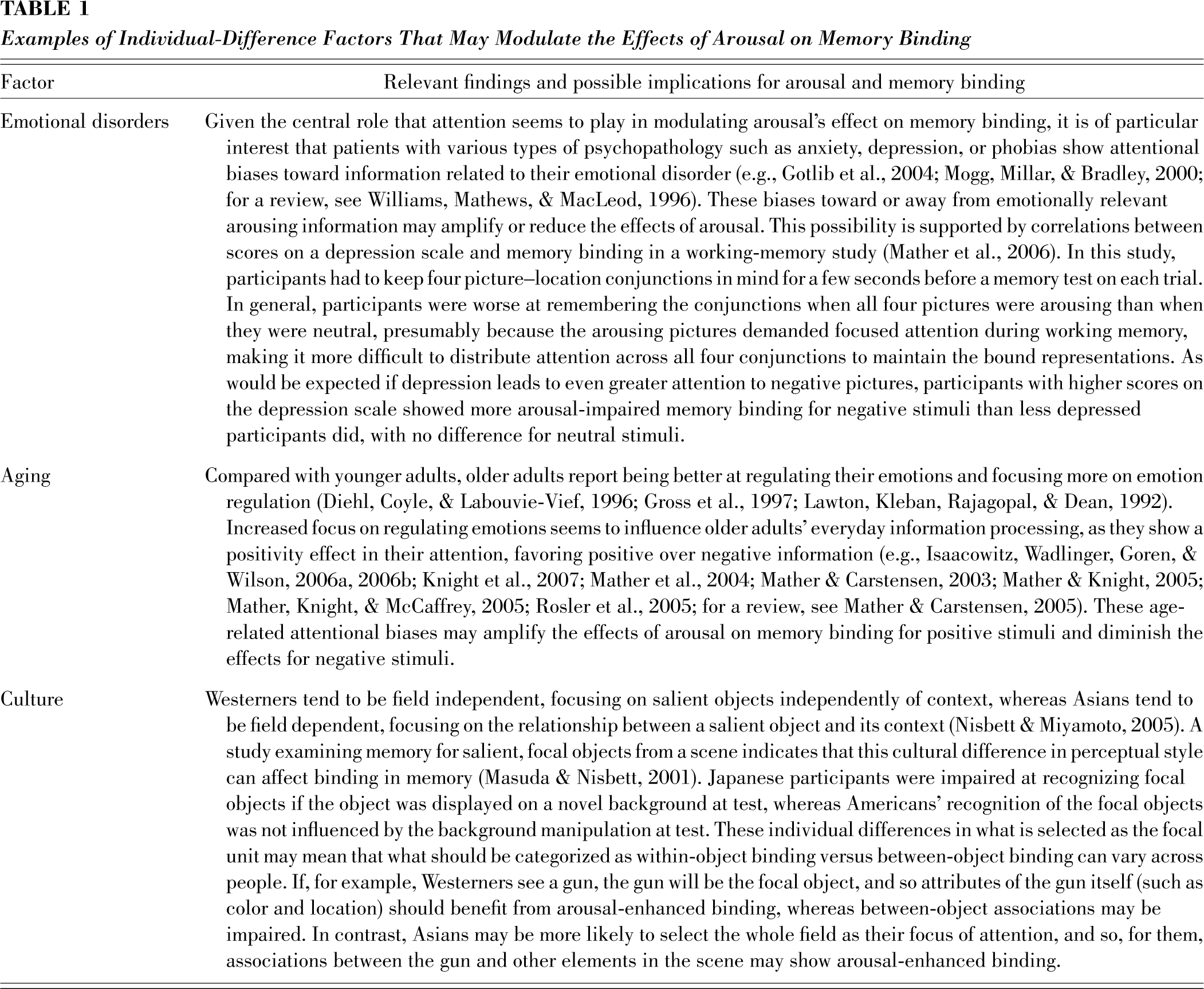
It is also possible that between-object binding will be impaired if one of the objects is emotionally arousing. Making associations among multiple objects requires focusing on the big picture—the gestalt indicating how everything fits together (for a related discussion, see the section on cultural differences in perceptual style in Table 1). Although some basic information about the layout of a visual field is perceived automatically, attention seems to be necessary to encode these relationships (Mack, Tang, Tuma, Kahn, & Rock, 1992; Moore & Egeth, 1997). In addition, what is defined as an object in object-based attention depends on the perceiver's goals (for a review, see Serences & Yantis, 2006). When there are many moving elements and a subset of them needs to be tracked simultaneously, observers group the target elements and direct attention toward them as though they were a coherent object (Yantis, 1992). Thus, when one element of a scene is emotionally arousing, attention is likely to focus on it and help bind its subcomponents into a coherent object rather than focusing on the broader scope of the scene. This relative neglect of the scene-level interrelationships might decrease between-object binding.
Examples of Individual-Difference Factors That May Modulate the Effects of Arousal on Memory Binding
In fact, several studies in which participants were asked to generate their own associations to words revealed arousal-based impairments in between-object binding. In this paradigm, generation trials with the largest skin-conductance change or subjective arousal ratings typically yielded the least accurate memory for the associates (Contini & Whissell, 1992; Jones, Ogorman, & Byrne, 1987; T. Kohler & Thons, 2005; T. Kohler, Tiede, & Thons, 2002; Rossmann, 1984). A study in which participants watched short film clips without a soundtrack as they listened to lists of words also revealed arousal-based impairments (L. Anderson & Shimamura, 2005): Participants' later word–film association memory was worse for words heard during the most highly arousing films, depicting an amputation or self-mutilation, than for words heard during nonarousing neutral or positive films. However, the second most arousing film clips, depicting either a car chase or downhill ski racing, yielded better word–film association memory than the control films. Given that the films varied in their content as well as in their arousal levels, one possible explanation of these nonlinear effects of arousal is that the effects of the films on word–film associations were influenced by the ease of making associations with the film topic as well as by how arousing they were. 2 There also were differences across film conditions in word recall; thus, the corresponding word–film association memory effects may have been the result of differential memory for the words rather than for the word–film associations themselves.
A study examining whether the arousal associated with one picture might enhance memory for the association between that picture and a bystander picture shown at the same time (Mather, 2007) found that after an incidental encoding task, participants remembered the locations of the arousing pictures better than the locations of nonarousing pictures, replicating previous findings of arousal-enhanced location memory. However, there was no arousal effect on memory for which pictures were shown together, indicating that the arousal associated with one picture did not lead to enhanced associations with other items.
Effects of Arousal on Binding Items to an Encoding Task
A recent fMRI study revealed no effects of emotional arousal on binding pictures or words to the encoding task done for that item (Kensinger & Schacter, 2006). Participants viewed emotionally arousing and neutral words and pictures and, for each item, were prompted to categorize the item either as animate or inanimate or as common or uncommon. Afterwards, participants received a surprise recognition test and were asked to identify which categorization they had made for each item as well as whether the item had been studied or not. Participants were equally accurate at identifying their categorization for arousing and neutral items—revealing no source-monitoring advantage for the arousing items. In contrast, they had an item-memory advantage for the arousing items: More arousing than neutral items were correctly identified as studied but were attributed to the wrong encoding task. Amygdala activity during encoding predicted later item memory but not source accuracy. Instead, source accuracy was predicted by activity in the hippocampus, superior temporal gyrus, and a few other regions. In this study, source information was not part of the arousing objects and so, from the perspective of the object-based framework outlined here, it makes sense that enhanced attention to arousing objects did not enhance item-source binding.
Kensinger and Schacter's (2006) findings of no arousal advantage for source monitoring contrast with those of another study in which participants saw the name of a neutral or emotional object (e.g., frog, casket) and were asked to indicate whether the objects were bigger or smaller than a shoebox (Kensinger & Schacter, 2005a). After their response, participants saw either a photo of the object or a blank square. A day or two later, participants completed a surprise source identification test in which they heard previously studied and new words and were asked to indicate whether they had seen the picture associated with it or not. Participants were more likely to correctly attribute emotional items than neutral ones to the word-and-picture-seen condition, and this increase in accuracy was associated with activity in the amygdala and orbitofrontal cortex while viewing the emotional items. Although this type of source attribution could be influenced by information external to the object itself, such as remembering thoughts that the initially imagined frog looked quite different from the pictured frog (Johnson, Hashtroudi, & Lindsay, 1993), it seems likely that the enhanced source accuracy for the emotional items was due to enhanced memory for visual details from the photo of the object—in other words, within-object information (see also Kensinger & Schacter, 2005b).
Thus, in summary, in contrast with the arousal-based benefits for binding seen for within-object binding of features such as perceptual detail, color, or location to an item, arousal either has no effect or impairs binding of arousing items to information that is not part of that same object.
Arousal and Interference in Binding During Working Memory
Both the arousal effect for within-object memory binding and the lack of one for between-object memory binding seem to be direct consequences of how emotionally arousing objects attract focused attention while they are visible. However, arousal is likely to influence attention beyond the moment of perception (e.g., Most, Chun, Widders, & Zald, 2005). Even if perceptual interference does not play much of a role in the effects of arousal on initial memory binding, after an item is perceived its representation may compete for attention in working memory with other recently perceived items. This competition may impair the maintenance of binding for other objects. In general, multiple bound representations in working memory are fragile and easily disrupted, even when tested just a few seconds after the stimuli were perceived (e.g., Mitchell, Johnson, Raye, Mather, & D'Esposito, 2000; Wheeler & Treisman, 2002).
In paradigms with very brief retention intervals (2 s or less), a secondary task or visual attentional shifts to an unrelated stimulus can disrupt memory for conjunctions and individual features of visual stimuli (Allen et al., 2006; Yeh, Yang, & Chiu, 2005). Indeed, when people are tested on two features of an object, if they forget one feature of an object, they are more likely to also forget the other feature than would be predicted from single-feature tests, suggesting that attentional shifts disrupt memory for the whole object, not just the within-object links (Gajewski & Brockmole, 2006).
However, when required to maintain multiple conjunctions for a little longer (5 s or more), people often make conjunction errors in later memory in which they mix up the features of different items that were simultaneously maintained in working memory (Hannigan & Reinitz, 2000; Reinitz & Hannigan, 2004). For example, if they rehearse toothpaste and heartache together, people are later more likely to falsely recognize toothache than if they rehearse the original two words on separate trials (Reinitz & Hannigan, 2004).
Given that maintaining multiple bound representations in working memory is likely to lead people to mix up which features go with which items, how might the arousal induced by the various items affect the ability to maintain the bound representations? Because of the fragility of recently perceived conjunctions, it seems essential to refresh each conjunction frequently when maintaining multiple bound representations. A broad focus of attention that encompasses multiple representations in working memory seems ideal for this purpose. In contrast, emotionally arousing items tend to demand attention, making it more difficult to refresh other items (Johnson et al., 2005). Presentation of emotional distractor pictures during the delay interval of a working-memory task leads to relative deactivation of brain regions associated with working memory and also impairs working-memory performance relative to a nonemotional distractor control condition (Dolcos & McCarthy, 2006). Thus, if the contents of working memory consist of multiple bound representations of emotionally arousing objects, it seems likely that each time an arousing object receives focused attention, the links between other objects and their features are at risk of being lost.
A study testing this hypothesis that emotional arousal interferes with maintaining multiple bound representations had participants complete a working-memory task in which they had to remember the locations of four different pictures over a brief delay (Mather et al., 2006; see also Mitchell, Mather, Johnson, Raye, & Greene, 2006). On each trial, the four pictures were all high arousal, medium arousal, or low arousal. As the arousal level of the four pictures increased, participants' ability to identify correct picture–location conjunctions decreased, but their ability to later recall the pictures increased. Thus, in this working-memory task, arousal impaired binding but enhanced item memory.
Two fMRI experiments using the same paradigm revealed that, compared with low-arousal trials, both high- and medium-arousal trials yielded more activity in regions associated with visual processing (fusiform gyrus, middle temporal gyrus/middle occipital gyrus, lingual gyrus) and less activity in the superior precentral gyrus and the precentral-superior temporal intersect. The greater levels of visual processing during the high-arousal trials suggest that high-arousal trials evoked more attention, yet in a way that was too focused on one picture at a time to be beneficial for maintaining multiple conjunctions. The disruptive influence of this arousal on binding is consistent with the decreased levels of activation associated with arousal at the intersect of the inferior precentral gyrus and superior temporal gyrus—an area associated with memory binding (Henke et al., 1999; Mitchell, Johnson, Raye, & D'Esposito, 2000).
Role of Endogenous Arousal in Short-Term Retention of Associations
Thus far, I have focused on the effects of arousal induced by specific external stimuli. From this perspective, the effects of arousal are examined on a within-subject basis, with memory for arousing items compared with memory for nonarousing items learned during the same episode. However, as I reviewed at the beginning of the article, some theoretical approaches make predictions about the impact of endogenous states of arousal on memory, such as Easterbrook's cue-utilization theory and Nadel and Jacobs' arousal-impairs-binding theory. These theories focus on how a person's overall level of arousal during an episode influences memory for various aspects of the episode. However, the role of endogenous levels of arousal on encoding and short-term retention processes is difficult to evaluate because only a few studies have manipulated human participants' arousal levels and then examined how the levels influence memory binding.
Furthermore, participants' endogenous arousal levels are usually measured via sampling levels of stress hormones that rise and fall relatively slowly. For instance, after a stressful experience, peaks in cortisol levels typically occur 20 to 30 min later, and increased cortisol levels are still seen up to an hour later (Dickerson & Kemeny, 2004). Thus, any study that tests memory immediately after an arousing encoding session is affected by increased levels of stress hormones that can impair retrieval (for a review, see Roozendaal, 2002), with potentially greater retrieval impairments for emotional items than for neutral items (Kuhlmann, Piel, & Wolf, 2005; Kuhlmann & Wolf, 2005). These retrieval impairments may make it difficult to discern any encoding effects that would be evident if the person were no longer experiencing elevated arousal.
EMOTIONAL AROUSAL AND LONG-TERM CONSOLIDATION OF BOUND REPRESENTATIONS
The previous sections of this article focus on research investigating initial perception, working memory, and relatively short-term retention (such as a memory test for a list of words seen 5 min ago). However, being able to remember what happened in the past hour is no guarantee of being able to remember the same events a week later, let alone several years later. Most events we experience are quickly forgotten. Yet memories that have survived for a few years can be quite stable, often lasting for the rest of one's life (Bahrick, 2000). The process through which some memories become long-lasting representations is known as long-term consolidation (Frankland & Bontempi, 2005; Takashima et al., 2006). In general, the molecular and synaptic processes underlying long-term memory lasting days, weeks, or longer require structural changes not necessary for short-term memory lasting minutes to hours (Bailey & Kandel, 2004). The hippocampus plays an essential role in both the consolidation and retrieval of episodic memories, as revealed by the retrograde amnesia seen in patients with hippocampal lesions (Nadel, Samsonovich, Ryan, & Moscovitch, 2000).
Many studies demonstrate that emotional arousal triggers stress hormones that modulate memory-consolidation processes (McGaugh, 2000). Thus, the research reviewed thus far on emotional perception and memory tested shortly after encoding can tell only part of the story about how arousal affects memory binding. To understand when memory for associations among various elements of an event will be long lasting and when the associations will be forgotten quickly, factors operating during consolidation must be considered. Unfortunately, although some studies have examined emotional memories over long delays (especially memory for shocking public events, known as flashbulb memories), there is, as yet, little research with humans that examines how the passage of time influences associative or contextual memory rather than item memory. In this section, I describe and evaluate the relevant evidence for two hypotheses about the effects of arousal on long-term memory consolidation for bound representations and then discuss the potential role of object-based factors.
Hypothesis 1: Long-Term Consolidation of Memory Binding Is Enhanced for Arousing Items
In 1963, Kleinsmith and Kaplan reported on how arousal affects paired-associate learning. Their study revealed a striking crossover interaction in memory for associates of low- and high-arousal items. Participants were shown eight words, each presented one at a time for 4 s along with a single-digit number from 2 to 9. There was a brief color-naming task between each word, and participants' skin-conductance response was measured after each word. Skin conductance shows a quick response to novel or emotional stimuli that may be mediated by the amygdala (Bagshaw & Benzies, 1968; Davis & Whalen, 2001). Participants were then given an immediate memory test or a memory test after a delay (20 min, 45 min, 1 day, or 1 week, depending on the condition). During the memory test, they were shown each word and asked to name its associated number.
Words were divided into high- and low-arousal groups uniquely for each participant based on how much skin resistance dropped while they saw the word, with the four largest-percent deflections coded as high arousal and the four smallest coded as low arousal. Not surprisingly, low-arousal word–number pairs showed a pronounced forgetting curve, with nearly 50% of the associated digits recalled on the immediate test, dropping to about 0% a week later. The surprising finding was that memory for the high-arousal associates showed the opposite pattern, with only about 10% recall on the immediate test but about 40% recall a week later. The same crossover interaction occurred in a follow-up study using the same method with six nonsense syllables as stimuli instead of words (Kleinsmith & Kaplan, 1964).
This crossover interaction in paired-associate memory typically does not replicate when items are categorized by group norms rather than by each participant's skin-conductance responses (e.g., Kaplan & Kaplan, 1970; Maltzman, Kantor, & Langdon, 1966; Schönpflug, 1966, as cited by Levonian, 1972; but see E.L. Walker & Tarte, 1963). Furthermore, in another paradigm in which participants are asked to report the first word that comes to mind when hearing each word on a list, association trials with the largest skin-conductance change or subjective arousal ratings typically yield the least accurate memory for the associations, both on immediate and long-term tests (Contini & Whissell, 1992; Jones et al., 1987; T. Kohler & Thons, 2005; T. Kohler et al., 2002; Rossmann, 1984; but see B.P. Bradley & Baddeley, 1990; Parkin, Lewinsohn, & Folkard, 1982).
What might account for the lack of generalizability of the Kleinsmith and Kaplan arousal-by-delay interaction? A major confounding factor in their paradigm is that skin-conductance responses tend to be largest for the first items in a list and smallest for the last items (Cahill & Alkire, 2003; Levonian, 1972; Schürer-Necker, 1990). Recency effects predict that participants will show an advantage in recall for the last items from the list on immediate memory tests but not on long-term memory tests (Glanzer & Cunitz, 1966; Postman & Phillips, 1965). Together, the skin-conductance responses and recency effects should lead the low-arousal (more often last) items on the list to be remembered better on an immediate test and worse on a long-term test than are the high-arousal (more often first) items on the list. Indeed, Schürer-Necker's (1990) repeat of Kleinsmith and Kaplan's (1963) experiment including some buffer items at the beginning and end of the list revealed no effect of arousal on memory. Thus, no conclusions about arousal and long-term consolidation of associations should be drawn from Kleinsmith and Kaplan's work, and further research is needed to test the claim that consolidation of associative memory is enhanced for arousing items compared with neutral items.
Hypothesis 2: Emotional Arousal at the Time of Encoding Impairs Consolidation of Binding
Heightened emotional arousal such as that induced by a stressor (either negative or positive) has both immediate and longer lasting effects (for reviews, see de Kloet, Joels, & Holsboer, 2005; Sapolsky, 2004). Within seconds, stress activates the sympathetic nervous system, triggering secretion of catecholamines such as epinephrine (adrenaline) and norepinephrine. On a slower time scale measured in minutes rather than seconds, stress also activates the hypothalamic-pituitary-adrenal (HPA) axis. This axis begins in the brain with the release of hormones at the hypothalamus, stimulating pituitary release of adrenocorticotropic hormone into the bloodstream. When this hormone reaches the adrenal gland, it triggers the release of glucocorticoids (e.g., cortisol in humans and corticosterone in rodents) that serve a negative feedback regulatory function to help terminate HPA responses to stress.
Memory for items and memory for associations might be affected in opposite ways by elevated glucocorticoid levels after encoding, because of negative effects of stress on brain regions involved in memory binding coupled with positive effects of stress on amygdala modulation of memory consolidation. As outlined at the beginning of this article, Nadel, Jacobs, and colleagues make this argument for opposite effects of elevated glucocorticoid levels; they argue that traumatic events will disrupt memory for associated context and details because stress impairs hippocampal and prefrontal-cortex binding functions (Metcalfe & Jacobs, 1998; Nadel & Jacobs, 1998; Payne et al., 2004). They also argue that the thematic content of the memory remains intact or is enhanced because stress facilitates amygdala-based enhancement of emotional memories. 3
This dissociation between the effects of stress on the hippocampus/prefrontal cortex and the effects of stress on the amygdala is supported by animal studies, at least for chronic stress (for reviews, see Kim & Diamond, 2002; Radley & Morrison, 2005; Sandi, 2004). For example, in rats, chronic immobilization stress led to dendritic atrophy in the hippocampus but to dendritic aborization in the amygdala (Vyas, Mitra, Rao, & Chattarji, 2002). In addition, people with high levels of cortisol, such as Cushing's disease patients (Starkman, Gebarski, Berent, & Schteingart, 1992), depressed people (Sheline, 1996, 2003), and some older adults (Lupien et al., 1998), tend to have smaller hippocampi. People treated with long-term corticosteroid prescriptions to control disorders such as arthritis show reduced hippocampal volume and declarative memory deficits compared with controls (E.S. Brown et al., 2004). The medial prefrontal cortex suffers similar impairing effects from chronic stress (Radley et al., 2005; Radley et al., 2004; Wellman, 2001).
Animal studies demonstrate that acute stress can also affect hippocampal function. A stressful experience, such as a sequence of shocks to a rat's tail, can impair long-term potentiation in the hippocampus for a day or two (Garcia, Musleh, Tocco, Thompson, & Baudry, 1997; Shors, Gallegos, & Breindl, 1997). Is this poststress impairment in hippocampal long-term potentiation the direct result of stress hormones interacting with the hippocampus? Apparently not, because disabling a rat's amygdala before a stressful experience eliminates the subsequent impairments in hippocampal long-term potentiation and spatial-memory performance on a task performed several hours later (Kim, Koo, Lee, & Han, 2005; Kim, Lee, Han, & Packard, 2001). These findings indicate that amygdala–hippocampus interactions during stressful events impair hippocampal memory functioning in the subsequent hours. In addition, more generally, evidence from animal studies indicates that the basolateral complex of the amygdala mediates the memory-modulating effects of both epinephrine and corticosterone (McGaugh, 2004).
Thus, the hypothesis that acute stress during an emotional event impairs consolidation of binding but enhances consolidation of central details is consistent with the literature, but there are gaps that need to be filled in (for further discussion, see Kihlstrom, 2006). Of particular importance, the animal literature focuses mostly on chronic stress, and it is not clear whether the hippocampal/prefrontal cortex versus amygdala distinction would play out in the predicted way for memory for a particular trauma. For instance, self-report of memory fragmentation does not differ for traumatic and nontraumatic memories among veterans diagnosed with posttraumatic stress disorder (Rubin, Feldman, & Beckham, 2004).
However, some evidence consistent with the hypothesis is provided by two recent studies. In a study of memories of the September 11, 2001, terrorist attacks, college students were asked to describe the central details (who they were with, where they were, what they were doing, and when) of their first awareness of the events of 9/11, as well as some peripheral details (what they ate for breakfast and lunch, what they wore, and what the weather was like) both in the days immediately after 9/11 and 2 months later (Schmidt, 2004). Participants with extremely intense emotional reactions to 9/11 showed less memory consistency in peripheral details over the 2-month interval than did those with moderate emotional reactions. In contrast, there was no difference between the two groups in the consistency of the central details in their accounts. A similar pattern was seen in a study in which participants received either cortisol or a placebo before seeing a slide show accompanied by a story (Rimmele, Domes, Mathiak, & Hautzinger, 2003). A week later, the cortisol group showed enhanced recognition memory for the story, especially for the emotional phase of the story, but this group showed impaired recall of details from the emotional phase of the story compared with the placebo group. Thus, arousal seems to impair later memory for peripheral details of emotional events. However, both of these studies tested only memory for peripheral details, not the links among various elements of the event. Future research should directly examine the effects of stress on binding and memory consolidation.
Object-Based Hypothesis: The Effects of Arousal on Consolidation Depend on the Type of Association
As discussed earlier, an important factor to consider for the effects of arousal on memory binding during initial encoding is whether the elements to be bound are part of the same object as the arousing item or whether the binding has to occur between different objects. One possibility that should be considered is that the effects of postencoding stress on memory consolidation are different for these two types of bound representations. The amygdala may enhance long-term consolidation of emotionally arousing objects, such that whatever is considered to be an integral component of the emotionally arousing object will also show enhanced long-term consolidation. In contrast, connections between the integral component and other objects or contextual details may not get the same degree of consolidation. We already know that memory-consolidation enhancements seen when stress hormones rise after an event can be specific to the emotionally arousing elements of the event, not everything that happened (Buchanan & Lovallo, 2001; Cahill & Alkire, 2003; Cahill, Gorski, & Le, 2003). Apparently, some immediate marker of what is emotionally arousing interacts with the slower acting hormones. Thus, it is possible that the memory-consolidation benefits that accrue to an item marked as arousing also accrue to any information that is considered to be part of the same object (such as color and location) but not to links with other objects or to contextual details.
Summary for Arousal and Long-Term Consolidation of Binding
As reviewed earlier, there are at least a couple of plausible hypotheses about how arousal affects long-term memory consolidation of bound representations. However, these hypotheses suffer from a lack of relevant (and confound-free) research with human participants. Kleinsmith and Kaplan's findings that memory consolidation was enhanced for associations with arousing items are confounded with order effects. In fact, studies that did not have the order confound typically found the opposite effect: Associations with other items are more likely to be forgotten for arousing items than for neutral items. More promising is the hypothesis, based on animal research indicating opposing effects of long-term stress on the amygdala versus hippocampus and prefrontal brain regions, that arousal could lead to enhanced consolidation of item memory but impaired consolidation of memory binding. However, work is needed to extend these findings to instances of acute (rather than chronic) arousal and to human episodic memory. In doing this work, researchers should pay attention to the distinction between within-object and between-object binding, as benefits for consolidation may accrue depending on whether an associated feature is considered to be part of the same object as the arousing item.
CONCLUSIONS
Making and retaining associations among various elements of experience is essential for episodic memory. As I outlined at the outset of the article, two previous theories make opposing predictions about the effects of arousal on memory binding. These two theories focus on different aspects of arousal. MacKay and colleagues' priority-binding theory posits that arousing stimuli get priority over nonarousing stimuli in their access to binding resources when the stimuli are first perceived; their theory thus focuses on the effects of arousing versus nonarousing items. Nadel, Jacobs, and colleagues' arousal-impairs-binding theory posits that because acute stress impairs the function of brain regions responsible for binding (the hippocampus and prefrontal cortex) but enhances amygdala function, binding of the elements of a stress-inducing event should be impaired even as memory for the unbound elements is enhanced by the amygdala; this theory thus focuses on the overall level of emotional arousal experienced during an event.
This review reveals limitations and gaps in both theories. The priority-binding theory cannot account for instances when memory binding is worse for arousing items than for neutral items (L. Anderson & Shimamura, 2005; Contini & Whissell, 1992; Jones et al., 1987; T. Kohler & Thons, 2005; T. Kohler et al., 2002; Mather et al., 2006; Rossmann, 1984) or for the finding that arousal-enhanced memory binding in slower-paced lists does not seem to be the result of competition among arousing and neutral items for binding resources (Mather & Nesmith, in press). On the other hand, findings of arousal-enhanced binding (D'Argembeau & Van der Linden, 2004; Doerksen & Shimamura, 2001; Kensinger & Corkin, 2003; MacKay et al., 2004; MacKay & Ahmetzanov, 2005; Mather & Nesmith, in press) indicate that Nadel, Jacobs, and colleagues' arousal-impairs-binding theory does not hold up for item-based effects; the momentary arousal elicited by a particular item is not sufficient (or not specific enough) to impair hippocampal/frontal processes responsible for binding.
To help resolve these contradictions, I outlined an object-based framework that predicts when arousal enhances and when it impairs binding in initial encoding and short-term retention. The arousal associated with an object elicits focused attention that enhances within-object binding, making it easier to later remember which features (such as color and location) were associated with that object. But that focused attention does not benefit binding of the arousing object with other objects or with contextual features and sometimes even impairs it. The attention-grabbing nature of emotionally arousing objects can also influence the maintenance of bound representations during working memory, because focusing too intently on one arousing object makes it difficult to maintain other bound representations.
A number of questions remain. For instance, what determines which features are perceptually grouped together to form an object representation? This question is challenging to address theoretically (for reviews, see Feldman, 1999; Scholl, 2001), but one useful characterization is that object representations allow the separation of information associated with the object from the rest of the information available to perception, supporting figure-ground segregration (Griffiths & Warren, 2004; Grossberg & Raizada, 2000; Kubovy & Van Valkenburg, 2001). In general, a variety of factors, such as continuation, similarity, and closure, influence what features are perceived as forming a coherent object (Behrmann & Kimchi, 2003; Kramer & Jacobson, 1991; Marino & Scholl, 2005; Moore, Yantis, & Vaughan, 1998). One reason the process of object perception is difficult to define is because it is flexible and influenced by factors such as previous experience and attentional task demands (Esterman, Prinzmetal, & Robertson, 2004; Prinzmetal & Keysar, 1989; Zemel, Behrmann, Mozer, & Bavelier, 2002). Because object-ness is in the eye of the beholder, it may vary depending on individual differences in grouping perceptual information. These individual differences may moderate the effects of emotional arousal on memory binding (see Table 1 for speculation about the effects of these and other individual differences).
In addition, little information is available about the effects of the observer's overall level of arousal on memory binding. It is possible that Nadel and Jacobs' arousal-impairs-binding theory applies to situations in which the overall level of arousal during or after an event is elevated, but not enough evidence exists yet to indicate whether this is the case. Likewise, not much is known about how long-term consolidation may affect bound representations of arousing items versus nonarousing items. However, because of the importance of the distinction between within- and between-object binding in initial encoding and short-term retention, it seems likely that whether information is in the same object or not will play an important role in the effects of arousal on long-term consolidation as well.
Also of interest is how arousal's effects on memory binding might be related to previous findings of enhanced memory for the gist or central elements of arousing events (for a review, see Reisberg & Heuer, 2004). It is possible that arousal effects on memory binding contribute to findings such as the weapon-focus effect, in which memory for a central arousing stimulus is enhanced and memory for peripheral details is impaired. The critical factor that needs to be investigated is whether there are enhancements and impairments in memory associations in addition to item-memory effects.
An important topic for future research related to all of these issues is the neural circuitry involved in arousal-enhanced memory binding. Many studies indicate that the hippocampus plays a critical role in relational memory (for reviews, see Cohen & Eichenbaum, 1993; Eichenbaum & Cohen, 2001). However, there is growing evidence that within-object and between-object binding are supported by different structures within the medial-temporal-lobe memory system. The hippocampus seems to be particularly important for encoding and remembering associations between different items, whereas the perirhinal cortex supports item or object memory (M.W. Brown & Aggleton, 2001; Davachi, Mitchell, & Wagner, 2003; S. Kohler, Danckert, Gati, & Menon, 2005; Moses, Cole, Driscoll, & Ryan, 2005; Wan, Aggleton, & Brown, 1999; Winters, Forwood, Cowell, Saksida, & Bussey, 2004). Of particular interest are studies showing that the perirhinal cortex supports the integration of features within a particular item or object, allowing objects comprised of similar features to be distinguished (Buckley & Gaffan, 2006; Bussey, Saksida, & Murray, 2006; Eacott, Machin, & Gaffan, 2001; Murray & Richmond, 2001; Norman & Eacott, 2004). Also of interest are studies showing that the hippocampus may not be required for within-object discriminations (Barense et al., 2005; Lee et al., 2006; Saksida, Bussey, Buckmaster, & Murray, 2006). Consistent with these links between within-object binding and the perirhinal cortex, some researchers have argued that the perirhinal cortex is the culmination of the ventral visual stream or “what” pathway (Buckley & Gaffan, 2006; Bussey & Saksida, 2005). Representations in the ventral visual stream are organized hierarchically from simple features to complex conjunctions, and the perirhinal cortex is well positioned to integrate complex conjunctions and allow for encoding of object representations that involve multiple sensory modalities. Projections between the amygdala and the perirhinal cortex are extensive (McDonald, 1998; Pitkanen, Pikkarainen, Nurminen, & Ylinen, 2000; Stefanacci, Suzuki, & Amaral, 1996; Suzuki, 1996; von Bohlen und Halbach & Albrecht, 2002), and so the amygdala may modulate within-object binding in the perirhinal cortex. Research into the role of the amygdala in arousal-enhanced memory binding may also help address the question of whether the effects are unique to emotional stimuli or whether such effects would occur for any stimuli that attract attention.
In general, this object-based framework of how emotional arousal influences memory binding should help predict when emotional memories will be accurate and when they will be distorted. In addition, the finding that arousal does not always have the same effect on memory for items and on memory for associations may help explain why, for emotional events, people's subjective sense of memory vividness often has little relation to their memory accuracy. For instance, high confidence in memories of shocking public events such as the terrorist attacks on 9/11 is often a poor predictor of the accuracy of memory for such events (Christianson & Engelberg, 1999; Neisser & Harsch, 1992; Schmolck, Buffalo, & Squire, 2000). Furthermore, the relationship between confidence and accuracy is less strong for memory of arousing events than for memory of neutral events (Clifford & Hollin, 1981; Talarico & Rubin, 2003), and an increased feeling of remembering emotional stimuli compared with neutral stimuli does not indicate greater accuracy for recall of the emotional stimuli (Sharot, Delgado, & Phelps, 2004). Vivid memories of emotional elements of an event may make people feel confident in their memories, even when they have impaired memory for the associations among these elements and other contextual details.
Footnotes
Acknowledgements
This work was supported by a grant from the National Institute on Aging (AG025340). I thank Bruce Bridgeman, Marcia Johnson, Karen Mitchell, and Deanna Novak, who provided comments on previous versions of this article, and Lila Davachi, for discussion about the perirhinal cortex.
1It should be noted that all these studies finding impairment for items temporally adjacent to arousing items tested memory within a few minutes of stimuli presentation. A study with a week delay before the memory test showed the opposite effect, with recognition memory enhancement for neutral items presented a few seconds before arousing pictures (A.K. Anderson, Wais, & Gabrieli, 2006), suggesting that the effects of arousal on memory for nearby items differ for initial encoding and subsequent consolidation.
2Alternatively, this may be an example of a Yerkes-Dodson inverted U-shaped function, in which moderate levels of arousal lead to the best performance.
3
 define stress as a pleasant or unpleasant strain or pressure involving high levels of physiological arousal that activates the HPA axis. As such, it has a very similar meaning as the term emotional arousal used in the rest of this article, although stress typically connotes a relatively high level of emotional arousal. However, for consistency with the literature discussed in this section, the word stress is used here.