







Abstract
The ability of personality traits to predict important life outcomes has traditionally been questioned because of the putative small effects of personality. In this article, we compare the predictive validity of personality traits with that of socioeconomic status (SES) and cognitive ability to test the relative contribution of personality traits to predictions of three critical outcomes: mortality, divorce, and occupational attainment. Only evidence from prospective longitudinal studies was considered. In addition, an attempt was made to limit the review to studies that controlled for important background factors. Results showed that the magnitude of the effects of personality traits on mortality, divorce, and occupational attainment was indistinguishable from the effects of SES and cognitive ability on these outcomes. These results demonstrate the influence of personality traits on important life outcomes, highlight the need to more routinely incorporate measures of personality into quality of life surveys, and encourage further research about the developmental origins of personality traits and the processes by which these traits influence diverse life outcomes.
Starting in the 1980s, personality psychology began a profound renaissance and has now become an extraordinarily diverse and intellectually stimulating field (Pervin & John, 1999). However, just because a field of inquiry is vibrant does not mean it is practical or useful—one would need to show that personality traits predict important life outcomes, such as health and longevity, marital success, and educational and occupational attainment. In fact, two recent reviews have shown that different personality traits are associated with outcomes in each of these domains (Caspi, Roberts, & Shiner, 2005; Ozer & Benet-Martinez, 2006). But simply showing that personality traits are related to health, love, and attainment is not a stringent test of the utility of personality traits. These associations could be the result of “third” variables, such as socioeconomic status (SES), that account for the patterns but have not been controlled for in the studies reviewed. In addition, many of the studies reviewed were cross-sectional and therefore lacked the methodological rigor to show the predictive validity of personality traits. A more stringent test of the importance of personality traits can be found in prospective longitudinal studies that show the incremental validity of personality traits over and above other factors.
The analyses reported in this article test whether personality traits are important, practical predictors of significant life outcomes. We focus on three domains: longevity/mortality, divorce, and occupational attainment in work. Within each domain, we evaluate empirical evidence using the gold standard of prospective longitudinal studies—that is, those studies that can provide data about whether personality traits predict life outcomes above and beyond well-known factors such as SES and cognitive abilities. To guide the interpretation drawn from the results of these prospective longitudinal studies, we provide benchmark relations of SES and cognitive ability with outcomes from these three domains. The review proceeds in three sections. First, we address some misperceptions about personality traits that are, in part, responsible for the idea that personality does not predict important life outcomes. Second, we present a review of the evidence for the predictive validity of personality traits. Third, we conclude with a discussion of the implications of our findings and recommendations for future work in this area.
THE “PERSONALITY COEFFICIENT”: AN UNFORTUNATE LEGACY OF THE PERSON–SITUATION DEBATE
Before we embark on our review, it is necessary to lay to rest a myth perpetrated by the 1960s manifestation of the person–situation debate; this myth is often at the root of the perspective that personality traits do not predict outcomes well, if at all. Specifically, in his highly influential book, Walter Mischel (1968) argued that personality traits had limited utility in predicting behavior because their correlational upper limit appeared to be about .30. Subsequently, this .30 value became derided as the “personality coefficient.” Two conclusions were inferred from this argument. First, personality traits have little predictive validity. Second, if personality traits do not predict much, then other factors, such as the situation, must be responsible for the vast amounts of variance that are left unaccounted for. The idea that personality traits are the validity weaklings of the predictive panoply has been reiterated in unmitigated form to this day (e.g., Bandura, 1999; Lewis, 2001; Paul, 2004; Ross & Nisbett, 1991). In fact, this position is so widely accepted that personality psychologists often apologize for correlations in the range of .20 to .30 (e.g., Bornstein, 1999).
Should personality psychologists be apologetic for their modest validity coefficients? Apparently not, according to Meyer and his colleagues (Meyer et al., 2001), who did psychological science a service by tabling the effect sizes for a wide variety of psychological investigations and placing them side-by-side with comparable effect sizes from medicine and everyday life. These investigators made several important points. First, the modal effect size on a correlational scale for psychology as a whole is between .10 and .40, including that seen in experimental investigations (see also Hemphill, 2003). It appears that the .30 barrier applies to most phenomena in psychology and not just to those in the realm of personality psychology. Second, the very largest effects for any variables in psychology are in the .50 to .60 range, and these are quite rare (e.g., the effect of increasing age on declining speed of information processing in adults). Third, effect sizes for assessment measures and therapeutic interventions in psychology are similar to those found in medicine. It is sobering to see that the effect sizes for many medical interventions—like consuming aspirin to treat heart disease or using chemotherapy to treat breast cancer—translate into correlations of .02 or .03. Taken together, the data presented by Meyer and colleagues make clear that our standards for effect sizes need to be established in light of what is typical for psychology and for other fields concerned with human functioning.
In the decades since Mischel's (1968) critique, researchers have also directly addressed the claim that situations have a stronger influence on behavior than they do on personality traits. Social psychological research on the effects of situations typically involves experimental manipulation of the situation, and the results are analyzed to establish whether the situational manipulation has yielded a statistically significant difference in the outcome. When the effects of situations are converted into the same metric as that used in personality research (typically the correlation coefficient, which conveys both the direction and the size of an effect), the effects of personality traits are generally as strong as the effects of situations (Funder & Ozer, 1983; Sarason, Smith, & Diener, 1975). Overall, it is the moderate position that is correct: Both the person and the situation are necessary for explaining human behavior, given that both have comparable relations with important outcomes.
As research on the relative magnitude of effects has documented, personality psychologists should not apologize for correlations between .10 and .30, given that the effect sizes found in personality psychology are no different than those found in other fields of inquiry. In addition, the importance of a predictor lies not only in the magnitude of its association with the outcome, but also in the nature of the outcome being predicted. A large association between two self-report measures of extraversion and positive affect may be theoretically interesting but may not offer much solace to the researcher searching for proof that extraversion is an important predictor for outcomes that society values. In contrast, a modest correlation between a personality trait and mortality or some other medical outcome, such as Alzheimer's disease, would be quite important. Moreover, when attempting to predict these critical life outcomes, even relatively small effects can be important because of their pragmatic effects and because of their cumulative effects across a person's life (Abelson, 1985; Funder, 2004; Rosenthal, 1990). In terms of practicality, the −.03 association between taking aspirin and reducing heart attacks provides an excellent example. In one study, this surprisingly small association resulted in 85 fewer heart attacks among the patients of 10,845 physicians (Rosenthal, 2000). Because of its practical significance, this type of association should not be ignored because of the small effect size. In terms of cumulative effects, a seemingly small effect that moves a person away from pursuing his or her education early in life can have monumental consequences for that person's health and well-being later in life (Hardarson et al., 2001). In other words, psychological processes with a statistically small or moderate effect can have important effects on individuals' lives depending on the outcomes with which they are associated and depending on whether those effects get cumulated across a person's life.
PERSONALITY EFFECTS ON MORTALITY, DIVORCE, AND OCCUPATIONAL ATTAINMENT
Selection of Predictors, Outcomes, and Studies for This Review
To provide the most stringent test of the predictive validity of personality traits, we chose to focus on three objective outcomes: mortality, divorce, and occupational attainment. Although we could have chosen many different outcomes to examine, we selected these three because they are socially valued; they are measured in similar ways across studies; and they have been assessed as outcomes in studies of SES, cognitive ability, and personality traits. Mortality needs little justification as an outcome, as most individuals value a long life. Divorce and marital stability are important outcomes for several reasons. Divorce is a significant source of depression and distress for many individuals and can have negative consequences for children, whereas a happy marriage is one of the most important predictors of life satisfaction (Myers, 2000). Divorce is also linked to disproportionate drops in economic status, especially for women (Kuh & Maclean, 1990), and it can undermine men's health (e.g., Lund, Holstein, & Osler, 2004). An intact marriage can also preserve cognitive function into old age for both men and women, particularly for those married to a high-ability spouse (Schaie, 1994).
Educational and occupational attainment are also highly prized (Roisman, Masten, Coatsworth, & Tellegen, 2004). Research on subjective well-being has shown that occupational attainment and its important correlate, income, are not as critical for happiness as many assume them to be (Myers, 2000). Nonetheless, educational and occupational attainment are associated with greater access to many resources that can improve the quality of life (e.g., medical care, education) and with greater “social capital” (i.e., greater access to various resources through connections with others; Bradley & Corwyn, 2002; Conger & Donnellan, 2007). The greater income resulting from high educational and occupational attainment may also enable individuals to maintain strong life satisfaction when faced with difficult life circumstances (Johnson & Krueger, 2006).
To better interpret the significance of the relations between personality traits and these outcomes, we have provided comparative information concerning the effect of SES and cognitive ability on each of these outcomes. We chose to use SES as a comparison because it is widely accepted to be one of the most important contributors to a more successful life, including better health and higher occupational attainment (e.g., Adler et al., 1994; Gallo & Mathews, 2003; Galobardes, Lynch, & Smith, 2004; Sapolsky, 2005). In addition, we chose cognitive ability as a comparison variable because, like SES, it is a widely accepted predictor of longevity and occupational success (Deary, Batty, & Gottfredson, 2005; Schmidt & Hunter, 1998). In this article, we compare the effect sizes of personality traits with these two predictors in order to understand the relative contribution of personality to a long, stable, and successful life. We also required that the studies in this review make some attempt to control for background variables. For example, in the case of mortality, we looked for prospective longitudinal studies that controlled for previous medical conditions, gender, age, and other relevant variables.
We are not assuming that personality traits are direct causes of the outcomes under study. Rather, we were exclusively interested in whether personality traits predict mortality, divorce, and occupational attainment and in their modal effect sizes. If found to be robust, these patterns of statistical association then invite the question of why and how personality traits might cause these outcomes, and we have provided several examples in each section of potential mechanisms and causal steps involved in the process.
The Measurement of Effect Sizes in Prospective Longitudinal Studies
Before turning to the specific findings for personality, SES, and cognitive ability, we must first address the measurement of effect sizes in the studies reviewed here. Most of the studies that we reviewed used some form of regression analysis for either continuous or categorical outcomes. In studies with continuous outcomes, findings were typically reported as standardized regression weights (beta coefficients). In studies of categorical outcomes, the most common effect size indicators are odds ratios, relative risk ratios, or hazard ratios. Because many psychologists may be less familiar with these ratio statistics, a brief discussion of them is in order. In the context of individual differences, ratio statistics quantify the likelihood of an event (e.g., divorce, mortality) for a higher scoring group versus the likelihood of the same event for a lower scoring group (e.g., persons high in negative affect versus those low in negative affect). An odds ratio is the ratio of the odds of the event for one group over the odds of the same event for the second group. The risk ratio compares the probabilities of the event occurring for the two groups. The hazard ratio assesses the probability of an event occurring for a group over a specific window of time. For these statistics, a value of 1.0 equals no difference in odds or probabilities. Values above 1.0 indicate increased likelihood (odds or probabilities) for the experimental (or numerator) group, with the reverse being true for values below 1.0 (down to a lower limit of zero). Because of this asymmetry, the log of these statistics is often taken.
The primary advantage of ratio statistics in general, and the risk ratio in particular, is their ease of interpretation in applied settings. It is easier to understand that death is three times as likely to occur for one group than for another than it is to make sense out of a point-biserial correlation. However, there are also some disadvantages that should be understood. First, ratio statistics can make effects that are actually very small in absolute magnitude appear to be large when in fact they are very rare events. For example, although it is technically correct that one is three times as likely (risk ratio = 3.0) to win the lottery when buying three tickets instead of one ticket, the improved chances of winning are trivial in an absolute sense.
Second, there is no accepted practice for how to divide continuous predictor variables when computing odds, risk, and hazard ratios. Some predictors are naturally dichotomous (e.g., gender), but many are continuous (e.g., cognitive ability, SES). Researchers often divide continuous variables into some arbitrary set of categories in order to use the odds, rate, or hazard metrics. For example, instead of reporting an association between SES and mortality using a point-biserial correlation, a researcher may use proportional hazards models using some arbitrary categorization of SES, such as quartile estimates (e.g., lowest versus highest quartiles). This permits the researcher to draw conclusions such as “individuals from the highest category of SES are four times as likely to live longer than are groups lowest in SES.” Although more intuitively appealing, the odds statements derived from categorizing continuous variables makes it difficult to deduce the true effect size of a relation, especially across studies. Researchers with very large samples may have the luxury of carving a continuous variable into very fine-grained categories (e.g., 10 categories of SES), which may lead to seemingly huge hazard ratios. In contrast, researchers with smaller samples may only dichotomize or trichotomize the same variables, thus resulting in smaller hazard ratios and what appear to be smaller effects for identical predictors. Finally, many researchers may not categorize their continuous variables at all, which can result in hazard ratios very close to 1.0 that are nonetheless still statistically significant. These procedures for analyzing odds, rate, and hazard ratios produce a haphazard array of results from which it is almost impossible to discern a meaningful average effect size. 1
One of the primary tasks of this review is to transform the results from different studies into a common metric so that a fair comparison could be made across the predictors and outcomes. For this purpose, we chose the Pearson product-moment correlation coefficient. We used a variety of techniques to arrive at an accurate estimate of the effect size from each study. When transforming relative risk ratios into the correlation metric, we used several methods to arrive at the most appropriate estimate of the effect size. For example, the correlation coefficient can be estimated from reported significance levels (p values) and from test statistics such as the t test or chi-square, as well as from other effect size indicators such as d scores (Rosenthal, 1991). Also, the correlation coefficient can be estimated directly from relative risk ratios and hazard ratios using the generic inverse variance approach (The Cochrane Collaboration, 2005). In this procedure, the relative risk ratio and confidence intervals (CIs) are first transformed into z scores, and the z scores are then transformed into the correlation metric.
For most studies, the effect size correlation was estimated from information on relative risk ratios and p values. For the latter, we used the r equivalent effect size indicator (Rosenthal & Rubin, 2003), which is computed from the sample size and p value associated with specific effects. All of these techniques transform the effect size information to a common correlational metric, making the results of the studies comparable across different analytical methods. After compiling effect sizes, meta-analytic techniques were used to estimate population effect sizes in both the risk ratio and correlation metric (Hedges & Olkin, 1985). Specifically, a random-effects model with no moderators was used to estimate population effect sizes for both the rate ratio and correlation metrics. 2 When appropriate, we first averaged multiple nonindependent effects from studies that reported more than one relevant effect size.
The Predictive Validity of Personality Traits for Mortality
Before considering the role of personality traits in health and longevity, we reviewed a selection of studies linking SES and cognitive ability to these same outcomes. This information provides a point of reference to understand the relative contribution of personality. Table 1 presents the findings from 33 studies examining the prospective relations of low SES and low cognitive ability with mortality. 3 SES was measured using measures or composites of typical SES variables including income, education, and occupational status. Total IQ scores were commonly used in analyses of cognitive ability. Most studies demonstrated that being born into a low-SES household or achieving low SES in adulthood resulted in a higher risk of mortality (e.g., Deary & Der, 2005; Hart et al., 2003; Osler et al., 2002; Steenland, Henley, & Thun, 2002). The relative risk ratios and hazard ratios ranged from a low of 0.57 to a high of 1.30 and averaged 1.24 (CIs = 1.19 and 1.29). When translated into the correlation metric, the effect sizes for low SES ranged from −.02 to .08 and averaged .02 (CIs = .017 and .026).
SES and IQ Effects on Mortality/Longevity
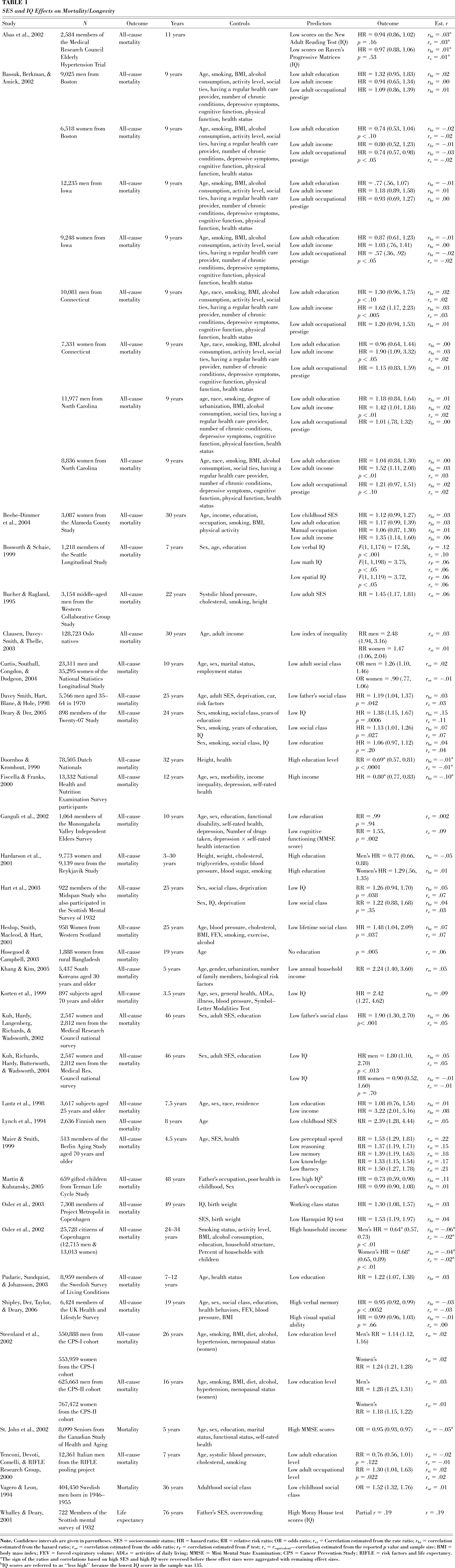
The sign of the ratios and correlations based on high SES and high IQ were reversed before these effect sizes were aggregated with remaining effect sizes.
IQ scores are referred to as “less high” because the lowest IQ score in the sample was 135.
Through the use of the relative risk metric, we determined that the effect of low IQ on mortality was similar to that of SES, ranging from a modest 0.74 to 2.42 and averaging 1.19 (CIs = 1.10 and 1.30). When translated into the correlation metric, however, the effect of low IQ on mortality was equivalent to a correlation of .06 (CIs = .03 and .09), which was three times larger than the effect of SES on mortality. The discrepancy between the relative risk and correlation metrics most likely resulted because some studies reported the relative risks in terms of continuous measures of IQ, which resulted in smaller relative risk ratios (e.g., St. John, Montgomery, Kristjansson, & McDowell, 2002). Merging relative risk ratios from these studies with those that carve the continuous variables into subgroups appears to underestimate the effect of IQ on mortality, at least in terms of the relative risk metric. The most telling comparison of IQ and SES comes from the five studies that include both variables in the prediction of mortality. Consistent with the aggregate results, IQ was a stronger predictor of mortality in each case (i.e., Deary & Der, 2005; Ganguli, Dodge, & Mulsant, 2002; Hart et al., 2003; Osler et al., 2002; Wilson, Bienia, Mendes de Leon, Evans, & Bennet, 2003).
Table 2 lists 34 studies that link personality traits to mortality/longevity. 4 In most of these studies, multiple factors such as SES, cognitive ability, gender, and disease severity were controlled for. We organized our review roughly around the Big Five taxonomy of personality traits (e.g., Conscientiousness, Extraversion, Neuroticism, Agreeableness, and Openness to Experience; Goldberg, 1993b). For example, research drawn from the Terman Longitudinal Study showed that children who were more conscientious tended to live longer (Friedman et al., 1993). This effect held even after controlling for gender and parental divorce, two known contributors to shorter lifespans. Moreover, a number of other factors, such as SES and childhood health difficulties, were unrelated to longevity in this study. The protective effect of Conscientiousness has now been replicated across several studies and more heterogeneous samples. Conscientiousness was found to be a rather strong protective factor in an elderly sample participating in a Medicare training program (Weiss & Costa, 2005), even when controlling for education level, cardiovascular disease, and smoking, among other factors. Similarly, Conscientiousness predicted decreased rates of mortality in a sample of individuals suffering from chronic renal insufficiency, even after controlling for age, diabetic status, and hemoglobin count (Christensen et al., 2002).
Personality Traits and Mortality
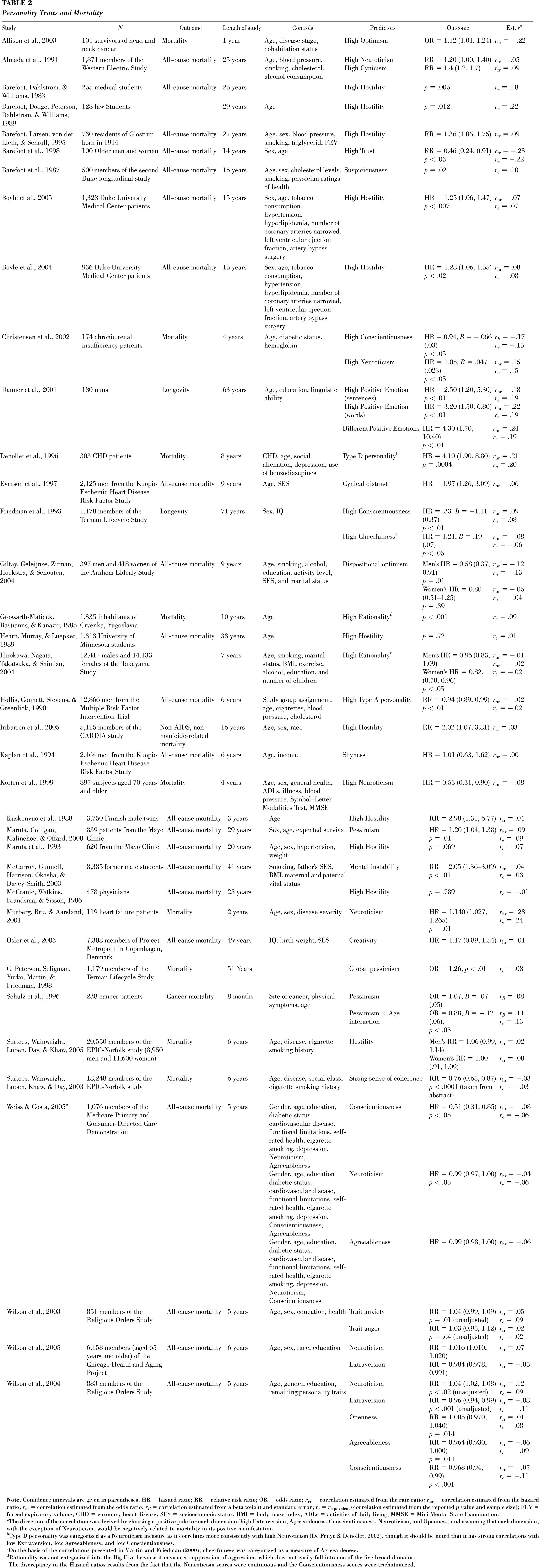
The direction of the correlation was derived by choosing a positive pole for each dimension (high Extraversion, Agreeableness, Conscientiousness, Neuroticism, and Openness) and assuming that each dimension, with the exception of Neuroticism, would be negatively related to mortality in its positive manifestation.
Type D personality was categorized as a Neuroticism measure as it correlates more consistently with high Neuroticism (De Fruyt & Denollet, 2002), though it should be noted that it has strong correlations with low Extraversion, low Agreeableness, and low Conscientiousness.
On the basis of the correlations presented in Martin and Friedman (2000), cheerfulness was categorized as a measure of Agreeableness.
Rationality was not categorized into the Big Five because it measures suppression of aggression, which does not easily fall into one of the five broad domains.
The discrepancy in the Hazard ratios results from the fact that the Neuroticism scores were continuous and the Conscientiousness scores were trichotomized.
Similarly, several studies have shown that dispositions reflecting Positive Emotionality or Extraversion were associated with longevity. For example, nuns who scored higher on an index of Positive Emotionality in young adulthood tended to live longer, even when controlling for age, education, and linguistic ability (an aspect of cognitive ability; Danner, Snowden, & Friesen, 2001). Similarly, Optimism was related to higher rates of survival following head and neck cancer (Allison, Guichard, Fung, & Gilain, 2003). In contrast, several studies reported that Neuroticism and Pessimism were associated with increases in one's risk for premature mortality (Abas, Hotopf, & Prince, 2002; Denollet et al., 1996; Schulz, Bookwala, Knapp, Scheier, & Williamson, 1996; Wilson, Mendes de Leon, Bienias, Evans, & Bennett, 2004). It should be noted, however, that two studies reported a protective effect of high Neuroticism (Korten et al., 1999; Weiss & Costa, 2005).
The domain of Agreeableness showed a less clear association to mortality, with some studies showing a protective effect of high Agreeableness (Wilson et al., 2004) and others showing that high Agreeableness contributed to mortality (Friedman et al., 1993). With respect to the domain of Openness to Experience, two studies showed that Openness or facets of Openness, such as creativity, had little or no relation to mortality (Osler et al., 2002; Wilson et al., 2004).
Because aggregating all personality traits into one overall effect size washes out important distinctions among different trait domains, we examined the effect of specific trait domains by aggregating studies within four categories: Conscientiousness, Positive Emotion/Extraversion, Neuroticism/Negative Emotion, and Hostility/Disagreeableness. 5 Our Conscientiousness domain included four studies that linked Conscientiousness to mortality. Because only two of these studies reported the information necessary to compute an average relative risk ratio, we only examined the correlation metric. When translated into a correlation metric, the average effect size for Conscientiousness was −.09 (CIs = −.12 and −.05), indicating a protective effect. Our Extraversion/Positive Emotion domain included six studies that examined the effect of extraversion, positive emotion, and optimism. The average relative risk ratio for the low Extraversion/Positive Emotion was 1.04 (CIs = 1.00 and 1.10) with a corresponding correlation effect size for high Extraversion/Positive Emotion being −.07 (−.11, −.03), with the latter showing a statistically significant protective effect of Extraversion/Positive Emotion. Our Negative Emotionality domain included twelve studies that examined the effect of neuroticism, pessimism, mental instability, and sense of coherence. The average relative risk ratio for the Negative Emotionality domain was 1.15 (CIs = 1.04 and 1.26), and the corresponding correlation effect size was .05 (CIs = .02 and .08). Thus, Neuroticism was associated with a diminished life span. Nineteen studies reported relations between Hostility/Disagreeableness and all-cause mortality, with notable heterogeneity in the effects across studies. The risk ratio population estimate showed an effect equivalent to, if not larger than, the remaining personality domains (risk ratio = 1.14; CIs = 1.06 and 1.23). With the correlation metric, this effect translated into a small but statistically significant effect of .04 (CIs = .02 and .06), indicating that hostility was positively associated with mortality. Thus, the specific personality traits of Conscientiousness, Positive Emotionality/Extraversion, Neuroticism, and Hostility/Disagreeableness were stronger predictors of mortality than was SES when effects were translated into a correlation metric. The effect of personality traits on mortality appears to be equivalent to IQ, although the additive effect of multiple trait domains on mortality may well exceed that of IQ.
Why would personality traits predict mortality? Personality traits may affect health and ultimately longevity through at least three distinct processes (Contrada, Cather, & O'Leary, 1999; Pressman & Cohen, 2005; Rozanski, Blumenthal, & Kaplan, 1999; T.W. Smith, 2006). First, personality differences may be related to pathogenesis or mechanisms that promote disease. This has been evaluated most directly in studies relating various facets of Hostility/Disagreeableness to greater reactivity in response to stressful experiences (T.W. Smith & Gallo, 2001) and in studies relating low Extraversion to neuroendocrine and immune functioning (Miller, Cohen, Rabin, Skoner, & Doyle, 1999) and greater susceptibility to colds (Cohen, Doyle, Turner, Alper, & Skoner, 2003a, 2003b). Second, personality traits may be related to physical-health outcomes because they are associated with health-promoting or health-damaging behaviors. For example, individuals high in Extraversion may foster social relationships, social support, and social integration, all of which are positively associated with health outcomes (Berkman, Glass, Brissette, & Seeman, 2000). In contrast, individuals low in Conscientiousness may engage in a variety of health-risk behaviors such as smoking, unhealthy eating habits, lack of exercise, unprotected sexual intercourse, and dangerous driving habits (Bogg & Roberts, 2004). Third, personality differences may be related to reactions to illness. This includes a wide class of behaviors, such as the ways individuals cope with illness (e.g., Scheier & Carver, 1993), reduce stress, and adhere to prescribed treatments (Kenford et al., 2002).
These processes linking personality traits to physical health are not mutually exclusive. Moreover, different personality traits may affect physical health via different processes. For example, facets of Disagreeableness may be most directly linked to disease processes, facets of low Conscientiousness may be implicated in health-damaging behaviors, and facets of Neuroticism may contribute to ill-health by shaping reactions to illness. In addition, it is likely that the impact of personality differences on health varies across the life course. For example, Neuroticism may have a protective effect on mortality in young adulthood, as individuals who are more neurotic tend to avoid accidents in adolescence and young adulthood (Lee, Wadsworth, & Hotopf, 2006). It is apparent from the extant research that personality traits influence outcomes at all stages of the health process, but much more work remains to be done to specify the processes that account for these effects.
The Predictive Validity of Personality Traits for Divorce
Next, we considered the role that SES, cognitive ability, and personality traits play in divorce. Because there were fewer studies examining these issues, we included prospective studies of SES, IQ, and personality that did not control for many background variables.
In terms of SES and IQ, we found 11 studies that showed a wide range of associations with divorce and marriage (see Table 3). 6 For example, the SES of the couple in one study was unsystematically related to divorce (Tzeng & Mare, 1995). In contrast, Kurdek (1993) reported relatively large, protective effects for education and income for both men and women. Because not all these studies reported relative risk ratios, we computed an aggregate using the correlation metric and found the relation between SES and divorce was −.05 (CIs = −.08 and −.02), which indicates a significant protective effect of SES on divorce across these studies. Contradictory patterns were found for the two studies that predicted divorce and marital patterns from measures of cognitive ability. Taylor et al. (2005) reported that IQ was positively related to the possibility of male participants ever marrying but was negatively related to the possibility of female participants ever marrying. Data drawn from the Mills Longitudinal study (Helson, 2006) showed conflicting patterns of associations between verbal and mathematical aptitude and divorce. Because there were only two studies, we did not examine the average effects of IQ on divorce.
SES and IQ Effects on Divorce
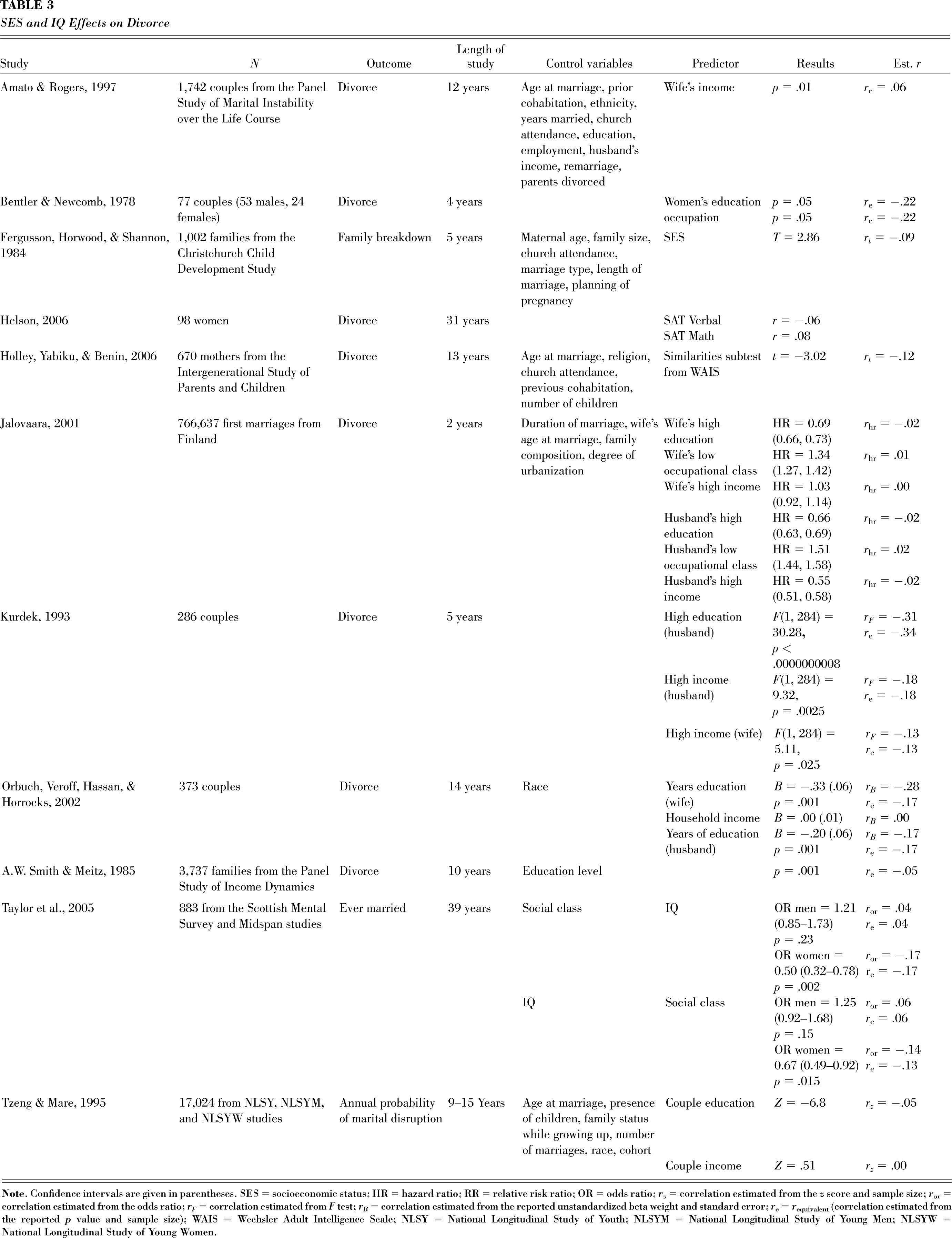
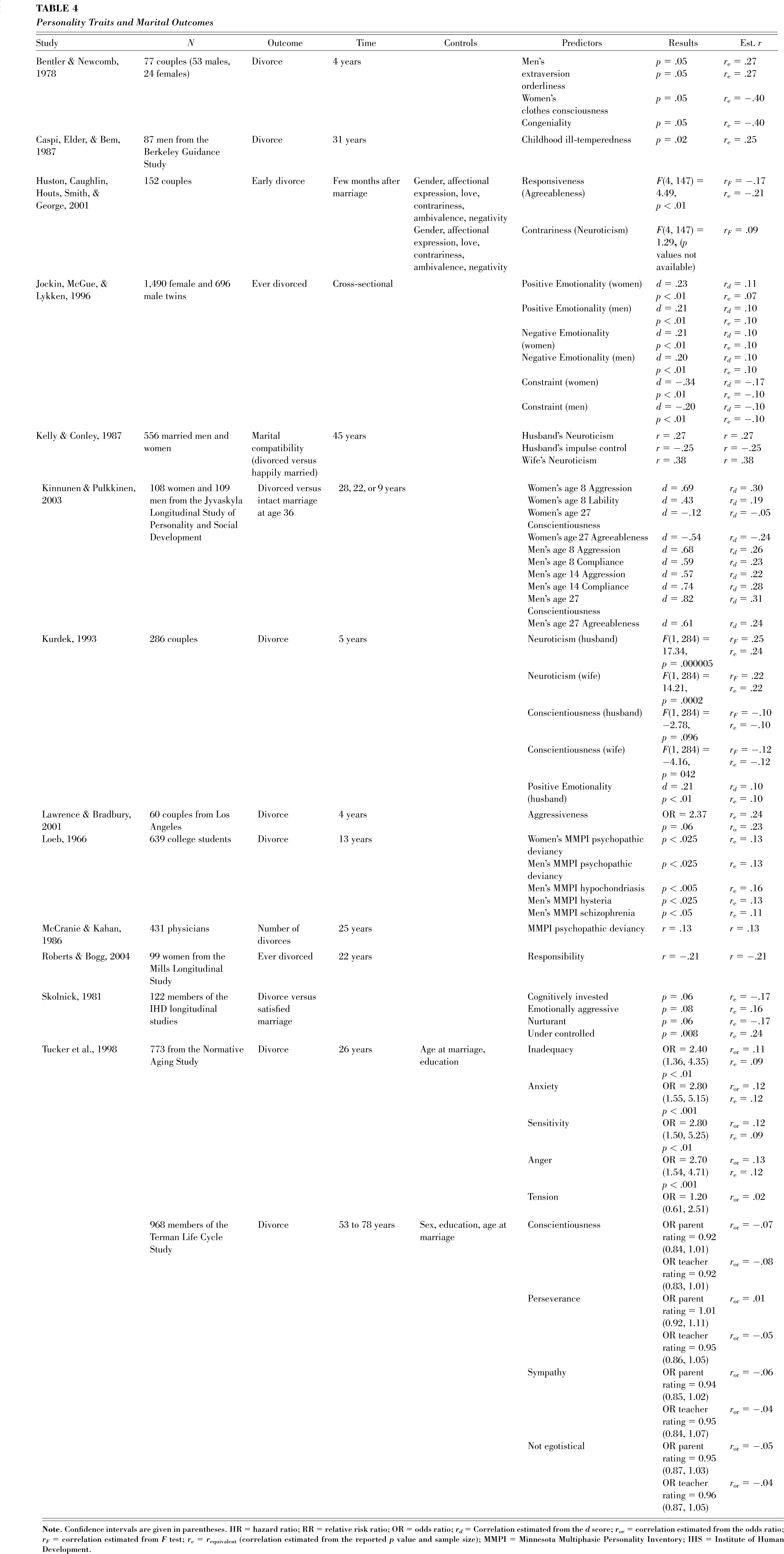
Table 4 shows the data from thirteen prospective studies testing whether personality traits predicted divorce. Traits associated with the domain of Neuroticism, such as being anxious and overly sensitive, increased the probability of experiencing divorce (Kelly & Conley, 1987; Tucker, Kressin, Spiro, & Ruscio, 1998). In contrast, those individuals who were more conscientious and agreeable tended to remain longer in their marriages and avoided divorce (Kelly & Conley, 1987; Kinnunen & Pulkkenin, 2003; Roberts & Bogg, 2004). Although these studies did not control for as many factors as the health studies, the time spans over which the studies were carried out were impressive (e.g., 45 years). We aggregated effects across these studies for the trait domains of Neuroticism, Agreeableness, and Conscientiousness with the correlation metric, as too few studies reported relative risk outcomes to warrant aggregating. When so aggregated, the effect of Neuroticism on divorce was .17 (CIs = .12 and .22), the effect of Agreeableness was −.18 (CIs = −.27 and −.09), and the effect of Conscientiousness on divorce was −.13 (CIs = −.17 and −.09). Thus, the predictive effects of these three personality traits on divorce were greater than those found for SES.
Personality Traits and Marital Outcomes
Why would personality traits lead to divorce or conversely marital stability? The most likely reason is because personality traits help shape the quality of long-term relationships. For example, Neuroticism is one of the strongest and most consistent personality predictors of relationship dissatisfaction, conflict, abuse, and ultimately dissolution (Karney & Bradbury, 1995). Sophisticated studies that include dyads (not just individuals) and multiple methods (not just self reports) increasingly demonstrate that the links between personality traits and relationship processes are more than simply an artifact of shared method variance in the assessment of these two domains (Donnellan, Conger, & Bryant, 2004; Robins, Caspi, & Moffitt, 2000; Watson, Hubbard, & Wiese, 2000). One study that followed a sample of young adults across their multiple relationships in early adulthood discovered that the influence of Negative Emotionality on relationship quality showed cross-relationship generalization; that is, it predicted the same kinds of experiences across relationships with different partners (Robins, Caspi, & Moffitt, 2002).
An important goal for future research will be to uncover the proximal relationship-specific processes that mediate personality effects on relationship outcomes (Reiss, Capobianco, & Tsai, 2002). Three processes merit attention. First, personality traits influence people's exposure to relationship events. For example, people high in Neuroticism may be more likely to be exposed to daily conflicts in their relationships (Bolger & Zuckerman, 1995; Suls & Martin, 2005). Second, personality traits shape people's reactions to the behavior of their partners. For example, disagreeable individuals may escalate negative affect during conflict (e.g., Gottman, Coan, Carrere, & Swanson, 1998). Similarly, agreeable people may be better able to regulate emotions during interpersonal conflicts (Jensen-Campbell & Graziano, 2001). Cognitive processes also factor in creating trait-correlated experiences (Snyder & Stukas, 1999). For example, highly neurotic individuals may overreact to minor criticism from their partner, believe they are no longer loved when their partner does not call, or assume infidelity on the basis of mere flirtation. Third, personality traits evoke behaviors from partners that contribute to relationship quality. For example, people high in Neuroticism and low in Agreeableness may be more likely to express behaviors identified as detrimental to relationships such as criticism, contempt, defensiveness, and stonewalling (Gottman, 1994).
The Predictive Validity of Personality Traits for Educational and Occupational Attainment
The role of personality traits in occupational attainment has been studied sporadically in longitudinal studies over the last few decades. In contrast, the roles of SES and IQ have been studied exhaustively by sociologists in their programmatic research on the antecedents to status attainment. In their seminal work, Blau and Duncan (1967) conceptualized a model of status attainment as a function of the SES of an individual's father. Researchers at the University of Wisconsin added what they considered social-psychological factors (Sewell, Haller, & Portes, 1969). In this Wisconsin model, attainment is a function of parental SES, cognitive abilities, academic performance, occupational and educational aspirations, and the role of significant others (Haller & Portes, 1973). Each factor in the model has been found to be positively related to occupational attainment (Hauser, Tsai, & Sewell, 1983). The key question here is to what extent SES and IQ predict educational and occupational attainment holding constant the remaining factors.
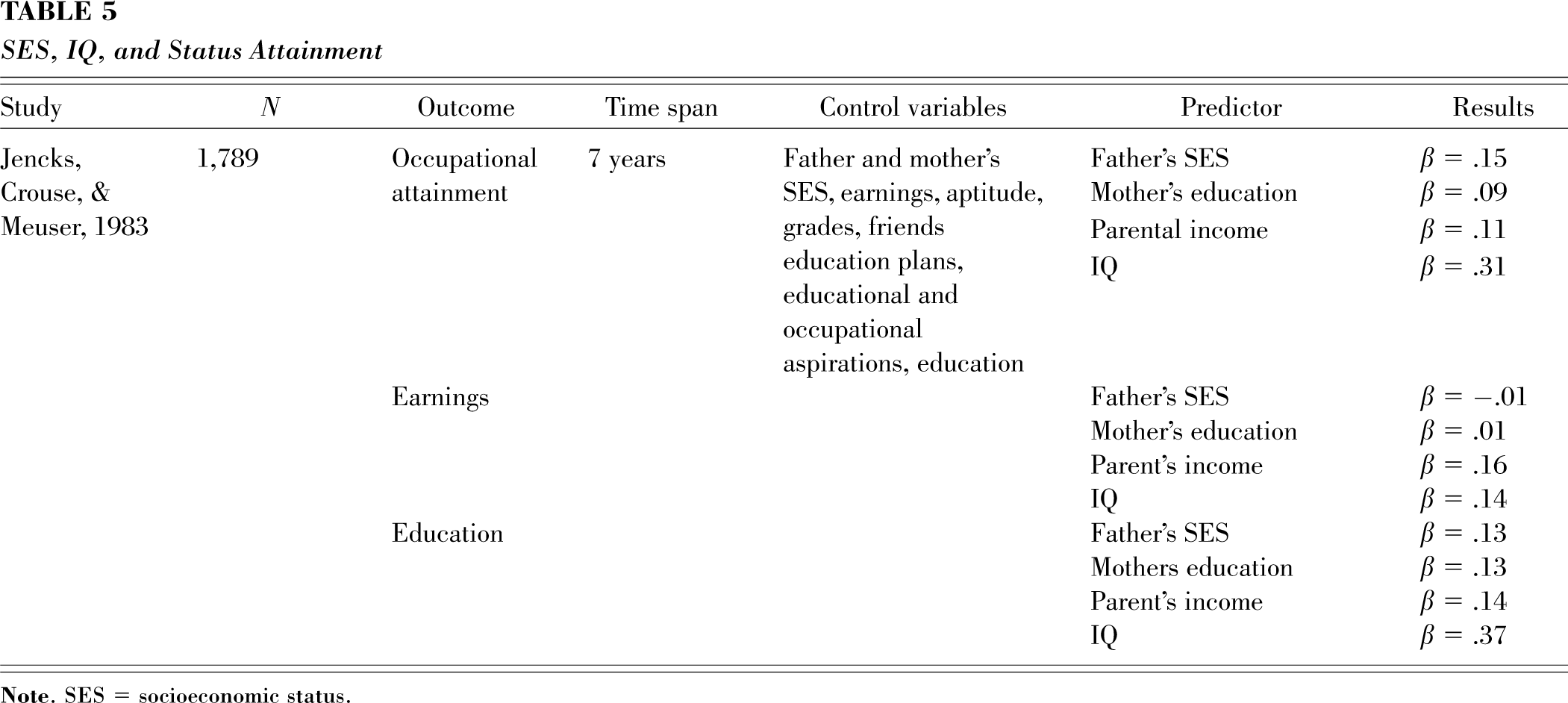
A great deal of research has validated the structure and content of the Wisconsin model (Sewell & Hauser, 1980; Sewell & Hauser, 1992), and rather than compiling these studies, which are highly similar in structure and findings, we provide representative findings from a study that includes three replications of the model (Jencks, Crouse, & Mueser, 1983). As can be seen in Table 5, childhood socioeconomic indicators, such as father's occupational status and mother's education, are related to outcomes, such as grades, educational attainment, and eventual occupational attainment, even after controlling for the remaining variables in the Wisconsin model. The average beta weight of SES and education was .09. 7 Parental income had a stronger effect, with an average beta weight of .14 across these three studies. Cognitive abilities were even more powerful predictors of occupational attainment, with an average beta weight of .27.
SES, IQ, and Status Attainment
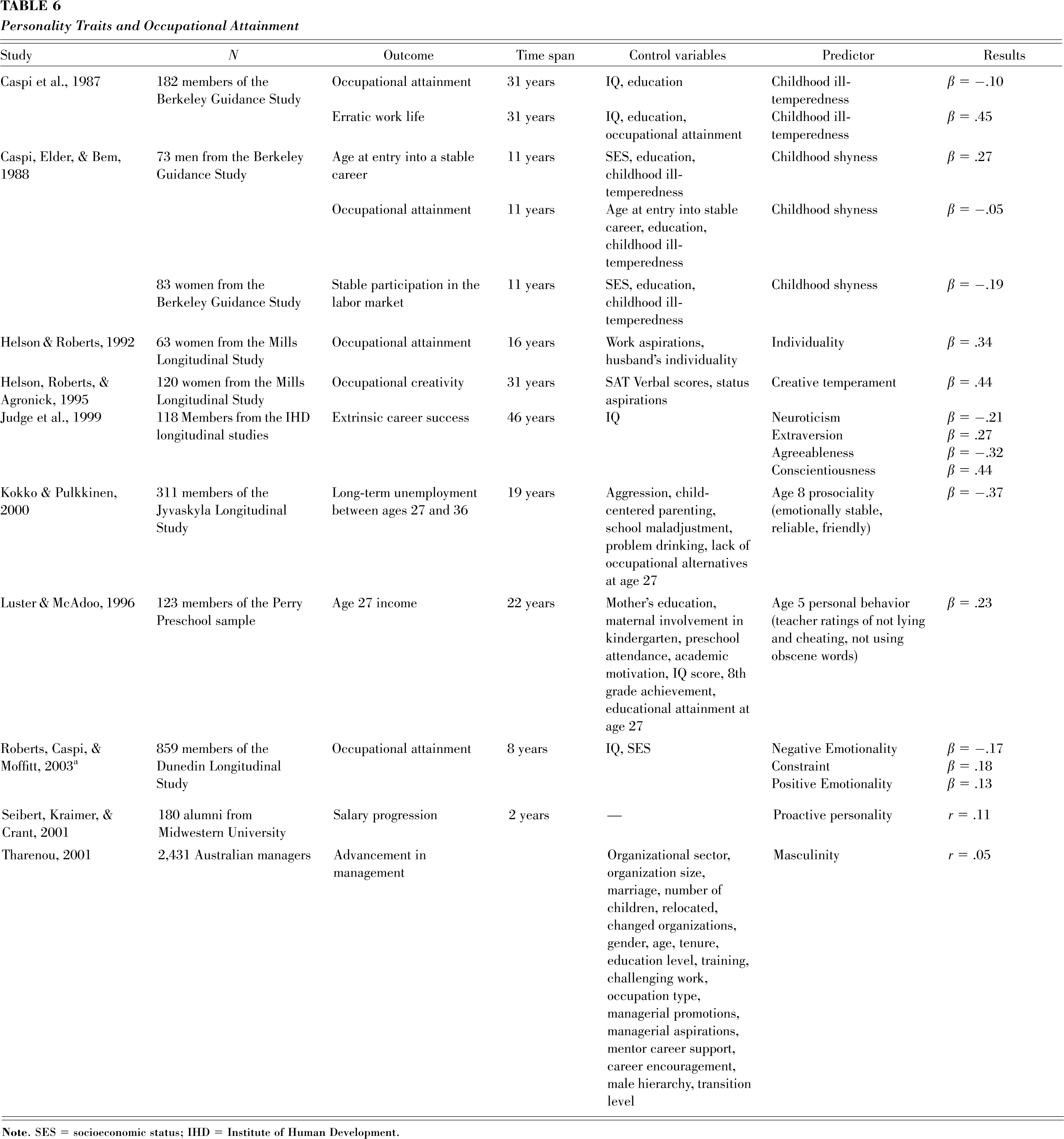
Do personality traits contribute to the prediction of occupational attainment even when intelligence and socioeconomic background are taken into account? As there are far fewer studies linking personality traits directly to indices of occupational attainment, such as prestige and income, we also included prospective studies examining the impact of personality traits on related outcomes such as long-term unemployment and occupational stability. The studies listed in Table 6 attest to the fact that personality traits predict all of these work-related outcomes. For example, adolescent ratings of Neuroticism, Extraversion, Agreeableness, and Conscientiousness predicted occupational status 46 years later, even after controlling for childhood IQ (Judge, Higgins, Thoresen, & Barrick, 1999). The weighted-average beta weight across the studies in Table 6 was .23 (CIs = .14 and .32), indicating that the modal effect size of personality traits was comparable with the effect of childhood SES and IQ on similar outcomes. 8
Personality Traits and Occupational Attainment
Why are personality traits related to achievement in educational and occupational domains? The personality processes involved may vary across different stages of development, and at least five candidate processes deserve research scrutiny (Roberts, 2006). First, the personality-to-achievement associations may reflect “attraction” effects or “active niche-picking,” whereby people choose educational and work experiences whose qualities are concordant with their own personalities. For example, people who are more conscientious may prefer conventional jobs, such as accounting and farming (Gottfredson, Jones, & Holland, 1993). People who are more extraverted may prefer jobs that are described as social or enterprising, such as teaching or business management (Ackerman & Heggestad, 1997). Moreover, extraverted individuals are more likely to assume leadership roles in multiple settings (Judge, Bono, Ilies, & Gerhardt, 2002). In fact, all of the Big Five personality traits have substantial relations with better performance when the personality predictor is appropriately aligned with work criteria (Hogan & Holland, 2003). This indicates that if people find jobs that fit with their dispositions they will experience greater levels of job performance, which should lead to greater success, tenure, and satisfaction across the life course (Judge et al., 1999).
Second, personality-to-achievement associations may reflect “recruitment effects,” whereby people are selected into achievement situations and are given preferential treatment on the basis of their personality characteristics. These recruitment effects begin to appear early in development. For example, children's personality traits begin to influence their emerging relationships with teachers at a young age (Birch & Ladd, 1998). In adulthood, job applicants who are more extraverted, conscientious, and less neurotic are liked better by interviewers and are more often recommended for the job (Cook, Vance, & Spector, 2000).
Third, personality traits may affect work outcomes because people take an active role in shaping their work environment (Roberts, 2006). For example, leaders have tremendous power to shape the nature of the organization by hiring, firing, and promoting individuals. Cross-sectional studies of groups have shown that leaders' conscientiousness and cognitive ability affect decision making and treatment of subordinates (LePine, Hollenbeck, Ilgen, & Hedlund, 1997). Individuals who are not leaders or supervisors may shape their work to better fit themselves through job crafting (Wrzesniewski & Dutton, 2001) or job sculpting (Bell & Staw, 1989). They can change their day-to-day work environments through changing the tasks they do, organizing their work differently, or changing the nature of the relationships they maintain with others (Wrzesniewski & Dutton, 2001). Presumably these changes in their work environments lead to an increase in the fit between personality and work. In turn, increased fit with one's environment is associated with elevated performance (Harms, Roberts, & Winter, 2006).
Fourth, some personality-to-achievement associations emerge as consequences of “attrition” or “deselection pressures,” whereby people leave achievement settings (e.g., schools or jobs) that do not fit with their personality or are released from these settings because of their trait-correlated behaviors (Cairns & Cairns, 1994). For example, longitudinal evidence from different countries shows that children who exhibit a combination of poor self-control and high irritability or antagonism are at heightened risk of unemployment (Caspi, Wright, Moffitt, & Silva, 1998; Kokko, Bergman, & Pulkkinen, 2003; Kokko & Pulkkinen, 2000).
Fifth, personality-to-achievement associations may emerge as a result of direct effects of personality on performance. Personality traits may promote certain kinds of task effectiveness; there is some evidence that this occurs in part via the processing of information. For example, higher positive emotions facilitate the efficient processing of complex information and are associated with creative problem solving (Ashby, Isen, & Turken, 1999). In addition to these effects on task effectiveness, personality may directly affect other aspects of work performance, such as interpersonal interactions (Hurtz & Donovan, 2000). Personality traits may also directly influence performance motivation; for example, Conscientiousness consistently predicts stronger goal setting and self-efficacy, whereas Neuroticism predicts these motivations negatively (Erez & Judge, 2001; Judge & Ilies, 2002).
GENERAL DISCUSSION
It is abundantly clear from this review that specific personality traits predict important life outcomes, such as mortality, divorce, and success in work. Depending on the sample, trait, and outcome, people with specific personality characteristics are more likely to experience important life outcomes even after controlling for other factors. Moreover, when compared with the effects reported for SES and cognitive abilities, the predictive validities of personality traits do not appear to be markedly different in magnitude. In fact, as can be seen in Figures 1–3, in many cases, the evidence supports the conclusion that personality traits predict these outcomes better than SES does. Despite these impressive findings, a few limitations and qualifications must be kept in mind when interpreting these data.
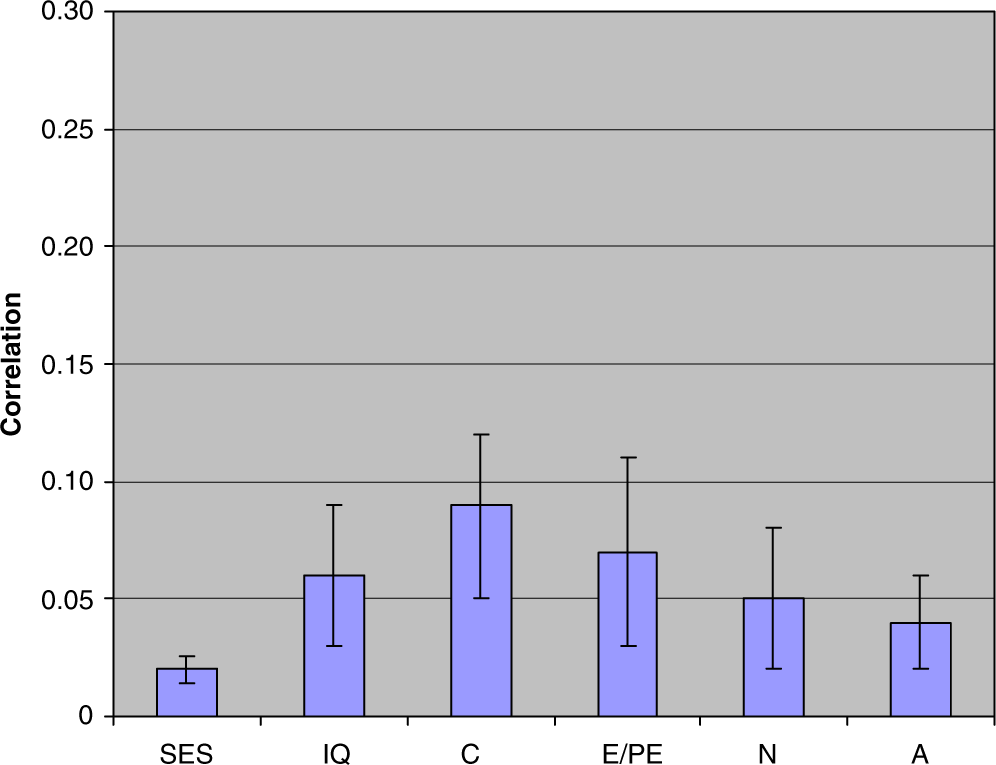
Average effects (in the correlation metric) of low socioeconomic status (SES), low IQ, low Conscientiousness (C), low Extraversion/Positive Emotion(E/PE), Neuroticism (N), and low Agreeableness (A) on mortality. Error bars represent standard error.
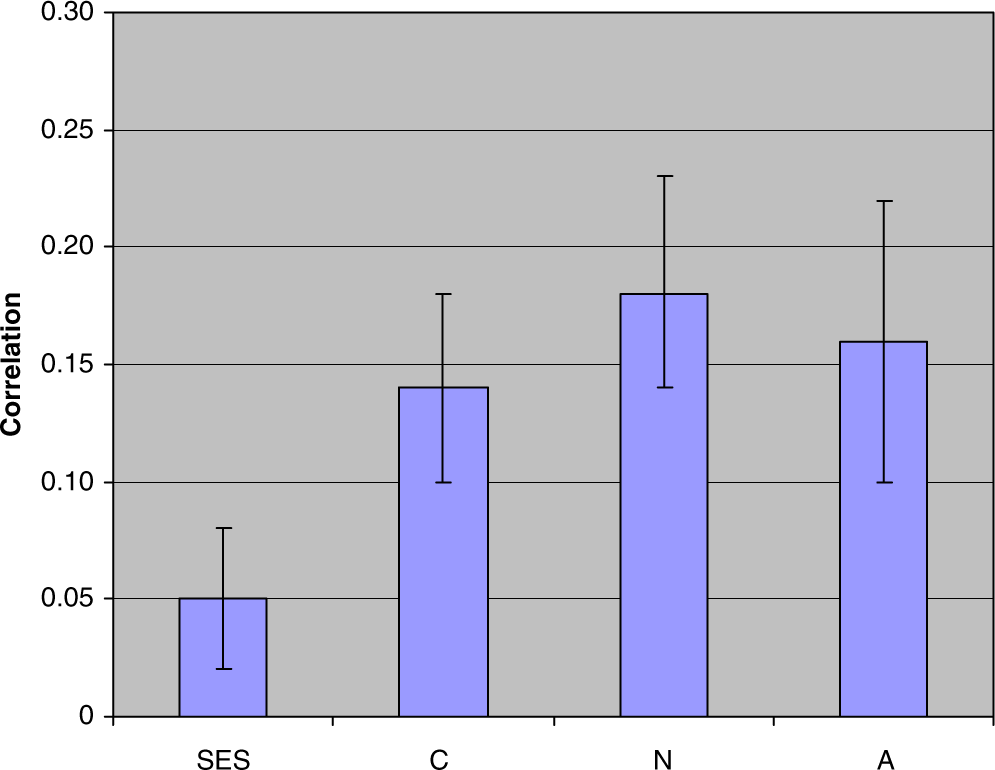
Average effects (in the correlation metric) of low socioeconomic status (SES), low Conscientiousness (C), Neuroticism (N), and low Agreeableness (A) on divorce. Error bars represent standard error.
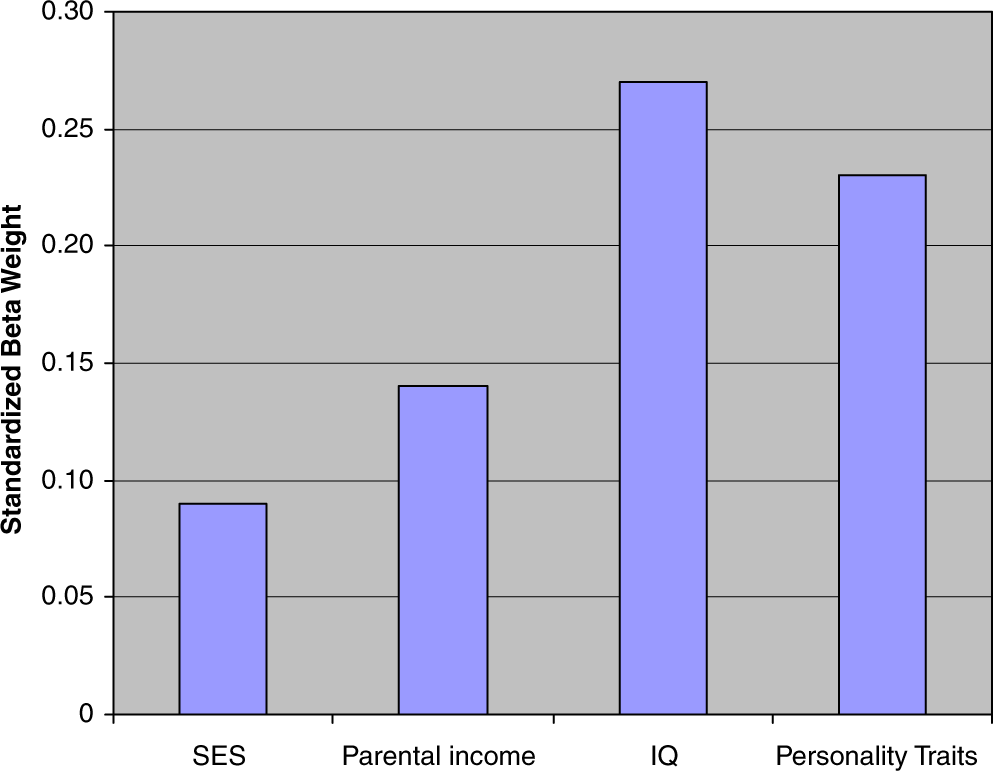
Average effects (in the standardized beta weight metric) of high socioeconomic status (SES), high parental income, high IQ, and high personality trait scores on occupational outcomes.
The requirement that we only examine the incremental validity of personality measures after controlling for SES and cognitive abilities, though clearly the most stringent test of the relevance of personality traits, is also arbitrarily tough. In fact, controlling for variables that are assumed to be nuisance factors can obscure important relations (Meehl, 1971). For example, SES, cognitive abilities, and personality traits may determine life outcomes through indirect rather than direct pathways. Consider cognitive abilities. These are only modest predictors of occupational attainment when “all other factors are controlled,” but they play a much more important, indirect role through their effect on educational attainment. Students with higher cognitive abilities tend to obtain better grades and go on to achieve more in the educational sphere across a range of disciplines (Kuncel, Crede, & Thomas, 2007; Kuncel, Hezlett, & Ones, 2001, 2004); in turn, educational attainment is the best predictor of occupational attainment. This observation about cumulative indirect effects applies equally well to SES and personality traits.
Furthermore, the effect sizes associated with SES, cognitive abilities, and personality traits were all uniformly small-to-medium in size. This finding is entirely consistent with those from other reviews showing that most psychological constructs have effect sizes in the range between .10 and .40 on a correlational scale (Meyer et al., 2001). Our hope is that reviews like this one can help adjust the norms researchers hold for what the modal effect size is in psychology and related fields. Studies are often disparaged for having small effects as if it is not the norm. Moreover, small effect sizes are often criticized without any understanding of their practical significance. Practical significance can only be determined if we ground our research by both predicting consequential outcomes, such as mortality, and by translating the results into a metric that is clearly understandable, such as years lost or number of deaths. Correlations and ratio statistics do not provide this type of information. On the other hand, some researchers have translated their results into metrics that most individuals can grasp. As we noted in the introduction, Rosenthal (1990) showed that taking aspirin prevented approximately 85 heart attacks in the patients of 10,845 physicians despite the meager −.03 correlation between this practice and the outcome of having a heart attack. Several other studies in our review provided similar benchmarks. Hardarson et al., (2001) showed that 148 fewer people died in their high education group (out of 869) than in their low education group, despite the effect size being equal to a correlation of −.05. Danner et al. (2001) showed that the association between positive emotion and longevity was associated with a gain of almost 7 years of additional life, despite having an average effect size of around .20. Of course, our ability to draw these types of conclusions necessitates grounding our research in more practical outcomes and their respective metrics.
There is one salient difference between many of the studies of SES and cognitive abilities and the studies focusing on personality traits. The typical sample in studies of the long-term effect of personality traits was a sample of convenience or was distinctly unrepresentative. In contrast, many of the studies of SES and cognitive ability included nationally representative and/or remarkably large samples (e.g., 500,000 participants). Therefore, the results for SES and cognitive abilities are generalizable, whereas it is more difficult to generalize findings from personality research. Perhaps the situation will improve if future demographers include personality measures in large surveys of the general population.
Recommendations
One of the challenges of incorporating personality measures in large studies is the cost–benefit trade off involved with including a thorough assessment of personality traits in a reasonably short period of time. Because most personality inventories include many items, researchers may be pressed either to eliminate them from their studies or to use highly abbreviated measures of personality traits. The latter practice has become even more common now that most personality researchers have concluded that personality traits can be represented within five to seven broad domains (Goldberg, 1993b; Saucier, 2003). The temptation is to include a brief five-factor instrument under the assumption that this will provide good coverage of the entire range of personality traits. However, the use of short, broad bandwidth measures can lead to substantial decreases in predictive validity (Goldberg, 1993a), because short measures of the Big Five lack the breadth and depth of longer personality inventories. In contrast, research has shown that the predictive validity of personality measures increases when one uses a well-elaborated measure with many lower order facets (Ashton, 1998; Mershon & Gorsuch, 1988; Paunonen, 1998; Paunonen & Ashton, 2001).
However, research participants do not have unlimited time, and researchers may need advice on the selection of optimal measures of personality traits. One solution is to pay attention to previous research and focus on those traits that have been found to be related to the specific outcomes under study instead of using an omnibus personality inventory. For example, given the clear and consistent finding that the personality trait of Conscientiousness is related to health behaviors and mortality (e.g., Bogg & Roberts, 2004; Friedman, 2000), it would seem prudent to measure this trait well if one wanted to control for this factor or include it in any study of health and mortality. Moreover, it appears that specific facets of this domain, such as self-control and conventionality, are more relevant to health than are other facets such as orderliness (Bogg & Roberts, 2004). If researchers are truly interested in assessing personality traits well, then they should invest the time necessary for the task. This entails moving away from expedient surveys to more in-depth assessments. Finally, if one truly wants to assess personality traits well, then researchers should use multiple methods for this purpose and should not rely solely on self-reports (Eid & Diener, 2006).
We also recommend that researchers not equate all individual differences with personality traits. Personality psychologists also study constructs such as motivation, interests, emotions, values, identities, life stories, and self-regulation (see Mayer, 2005, and Roberts & Wood, 2006, for reviews). Moreover, these different domains of personality are only modestly correlated (e.g., Ackerman & Heggested, 1997; Roberts & Robins, 2000). Thus, there are a wide range of additional constructs that may have independent effects on important life outcomes that are waiting to be studied.
Conclusions
In light of increasingly robust evidence that personality matters for a wide range of life outcomes, researchers need to turn their attention to several issues. First, we need to know more about the processes through which personality traits shape individuals' functioning over time. Simply documenting that links exist between personality traits and life outcomes does not clarify the mechanisms through which personality exerts its effects. In this article, we have suggested a number of potential processes that may be at work in the domains of health, relationships, and educational and occupational success. Undoubtedly, other personality processes will turn out to influence these outcomes as well.
Second, we need a greater understanding of the relationship between personality and the social environmental factors already known to affect health and development. Looking over the studies reviewed above, one can see that specific personality traits such as Conscientiousness predict occupational and marital outcomes that, in turn, predict longevity. Thus, it may be that Conscientiousness has both direct and indirect effects on mortality, as it contributes to following life paths that afford better health, and may also directly affect the ways in which people handle health-related issues, such as whether they exercise or eat a healthy diet (Bogg & Roberts, 2004). One idea that has not been entertained is the potential synergistic relation between personality traits and social environmental factors. It may be the case that the combination of certain personality traits and certain social conditions creates a potent cocktail of factors that either promotes or undermines specific outcomes. Finally, certain social contexts may wash out the effect of individual difference factors, and, in turn, people possessing certain personality characteristics may be resilient to seemingly toxic environmental influences. A systematic understanding of the relations between personality traits and social environmental factors associated with important life outcomes would be very helpful.
Third, the present results drive home the point that we need to know much more about the development of personality traits at all stages in the life course. How does a person arrive in adulthood as an optimistic or conscientious person? If personality traits affect the ways that individuals negotiate the tasks they face across the course of their lives, then the processes contributing to the development of those traits are worthy of study (Caspi & Shiner, 2006; Caspi & Shiner, in press; Rothbart & Bates, 2006). However, there has been a tendency in personality and developmental research to focus on personality traits as the causes of various outcomes without fully considering personality differences as an outcome worthy of study (Roberts, 2005). In contrast, research shows that personality traits continue to change in adulthood (e.g., Roberts, Walton, & Viechtbauer, 2006) and that these changes may be important for health and mortality. For example, changes in personality traits such as Neuroticism have been linked to poor health outcomes and even mortality (Mroczek & Spiro, 2007).
Fourth, our results raise fundamental questions about how personality should be addressed in prevention and intervention efforts. Skeptical readers may doubt the relevance of the present results for prevention and intervention in light of the common assumption that personality is highly stable and immutable. However, personality traits do change in adulthood (Roberts, Walton, & Viechtbauer, 2006) and can be changed through therapeutic intervention (De Fruyt, Van Leeuwen, Bagby, Rolland, & Rouillon, 2006). Therefore, one possibility would be to focus on socializing factors that may affect changes in personality traits, as the resulting changes would then be leveraged across multiple domains of life. Further, the findings for personality traits should be of considerable interest to professionals dedicated to promoting healthy, happy marriages and socioeconomic success. Some individuals will clearly be at a heightened risk of problems in these life domains, and it may be possible to target prevention and intervention efforts to the subsets of individuals at the greatest risk. Such research can likewise inform the processes that need to be targeted in prevention and intervention. As we gain greater understanding of how personality exerts its effects on adaptation, we will achieve new insights into the most relevant processes to change. Moreover, it is essential to recognize that it may be possible to improve individuals' lives by targeting those processes without directly changing the personality traits driving those processes (e.g., see Rapee, Kennedy, Ingram, Edwards, & Sweeney, 2005, for an interesting example of how this may occur). In all prevention and intervention work, it will be important to attend to the possibility that most personality traits can have positive or negative effects, depending on the outcomes in question, the presence of other psychological attributes, and the environmental context (Caspi & Shiner, 2006; Shiner, 2005).
Personality research has had a contentious history, and there are still vestiges of doubt about the importance of personality traits. We thus reviewed the comparative predictive validity of personality traits, SES, and IQ across three objective criteria: mortality, divorce, and occupational attainment. We found that personality traits are just as important as SES and IQ in predicting these important life outcomes. We believe these meta-analytic findings should quell lingering doubts. The closing of a chapter in the history of personality psychology is also an opportunity to open a new chapter. We thus invite new research to test and document how personality traits “work” to shape life outcomes. A useful lead may be taken from cognate research on social disparities in health (Adler & Snibbe, 2003). Just as researchers are seeking to understand how SES “gets under the skin” to influence health, personality researchers need to partner with other branches of psychology to understand how personality traits “get outside the skin” to influence important life outcomes.
Footnotes
Acknowledgements
Preparation of this paper was supported by National Institute of Aging Grants AG19414 and AG20048; National Institute of Mental Health Grants MH49414, MH45070, MH49227; United Kingdom Medical Research Council Grant G0100527; and by grants from the Colgate Research Council. We would like to thank Howard Friedman, David Funder, George Davie Smth, Ian Deary, Chris Fraley, Linda Gottfredson, Josh Jackson, and Ben Karney for their comments on earlier drafts of this article.
1This situation is in no way particular to epidemiological or medical studies using odds, rate, and hazard ratios as outcomes. The field of psychology reports results in a Babylonian array of test statistics and effect sizes also.
2The population effects for the rate ratio and correlation metric were not based on identical data because in some cases the authors did not report rate ratio information or did not report enough information to compute a rate ratio and a CI.
3Most of the studies of SES and mortality were compiled from an exhaustive review of the literature on the effect of childhood SES and mortality (Galobardes et al., 2004). We added several of the largest studies examining the effect of adult SES on mortality (e.g., Steenland et al., 2002), and to these we added the results from the studies on cognitive ability and personality that reported SES effects. We also did standard electronic literature searches using the terms socioeconomic status, cognitive ability, and all-cause mortality. We also examined the reference sections from the list of studies and searched for papers that cited these studies. Experts in the field of epidemiology were also contacted and asked to identify missing studies. The resulting SES data base is representative of the field, and as the effects are based on over 3 million data points, the effect sizes and CIs are very stable. The studies of cognitive ability and mortality represent all of the studies found that reported usable data.
4We identified studies through electronic searches that included the terms personality traits, extraversion, agreeableness, hostility, conscientiousness, emotional stability, neuroticism, openness to experience, and all-cause mortality. We also identified studies through reference sections of the list of studies and through studies that cited each study. A number of studies were not included in this review because we focused on studies that were prospective and controlled for background factors.
5We did not examine the domain of Openness to Experience because there were only two studies that tested the association with mortality.
6We identified studies using electronic searches including the terms divorce, socioeconomic status, and cognitive ability. We also identified studies through examining the reference sections of the studies and through studies that cited each study.
7We did not transform the standardized beta weights into the correlation metric because almost all authors failed to provide the necessary information for the transformation (CIs or standard errors). Therefore, we averaged the results in the beta weight metric instead. As the sampling distribution of beta weights is unknown, we used the formula for the standard error of the partial correlation (√N−k−2) to estimate CIs.
8In making comparisons between correlations and regression weights, it should be kept in mind that although the two are identical for orthogonal predictors, most regression weights tend to be smaller than the corresponding zero-order validity correlations because of predictor redundancy (R.A. Peterson & Brown, 2005).