







Abstract
We discuss four potential ways to reduce conflict between groups: consideration of future consequences, independent leadership, outgroup empathy, and coordination. We review relevant empirical findings for each method and discuss how each can be used to promote intergroup cooperation.
Intergroup conflict is one of the greatest problems facing the world today. War, genocide, and terrorism are ever-present realities of modern life. It has been estimated that over 210 million people were killed during the 20th century by governmental genocidal policies (Woolf & Hulsizer, 2004) and that 170 million of these casualties were civilian deaths. It is perhaps even more frightening that the number of people killed by terrorists each year is on the rise. Figure 1 presents a graph of the number of people throughout the world killed by terrorists from 1972 to 2006 (National Memorial Institute for the Prevention of Terrorism, 2007). As shown in the figure, fewer than 2,500 people were killed by terrorists between 1992 and 1996. In comparison, more than 8,000 people were killed between 1997 and 2001 and more than 30,000 people were killed between 2002 and 2006. Clearly, the plague of intergroup violence requires a cure.
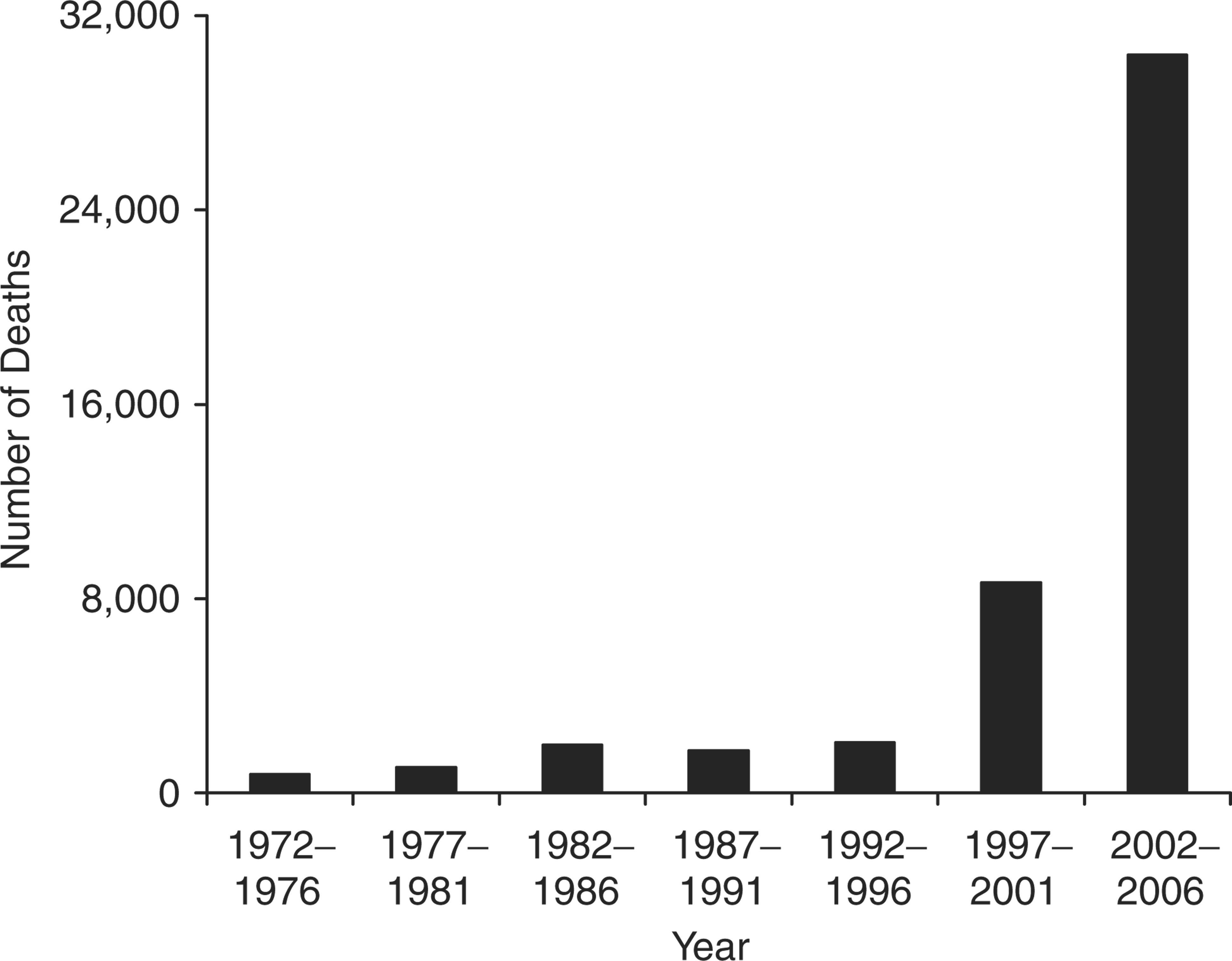
Deaths due to terrorism throughout the world from 1972 to 2006.
Although the task of reducing intergroup violence is daunting, social scientists are making progress (e.g., Gaertner & Dovidio, 2000; Kelman, 1997; Pettigrew, 1998). Research in our laboratory has revealed four possible approaches to reducing conflict between groups: consideration of future consequences, independent leadership, outgroup empathy, and coordination. In this article, we provide an overview of our findings and discuss how these techniques might be used to reduce conflict. All of the experimental results we report are statistically significant (p < .05).
In these experiments, intergroup conflict was operationalized as intergroup behavior in the prisoner's dilemma game (PDG; see Fig. 2). The PDG is a mixed-motive game in which participants have the option of acting cooperatively (by choosing X) or competitively (by choosing Y). Because interindividual interactions in the PDG are generally more cooperative than they are in intergroup interactions (a phenomenon known as the interindividual–intergroup discontinuity effect; Wildschut, Pinter, Vevea, Insko, & Schopler, 2003), in most of these studies, intergroup behavior was compared with interindividual behavior in the same game, with outcomes (money) equated on a per individual basis. Manipulations that promote intergroup cooperation relative to interindividual cooperation point to possible ways to reduce conflict that uniquely relate to group processes. 1
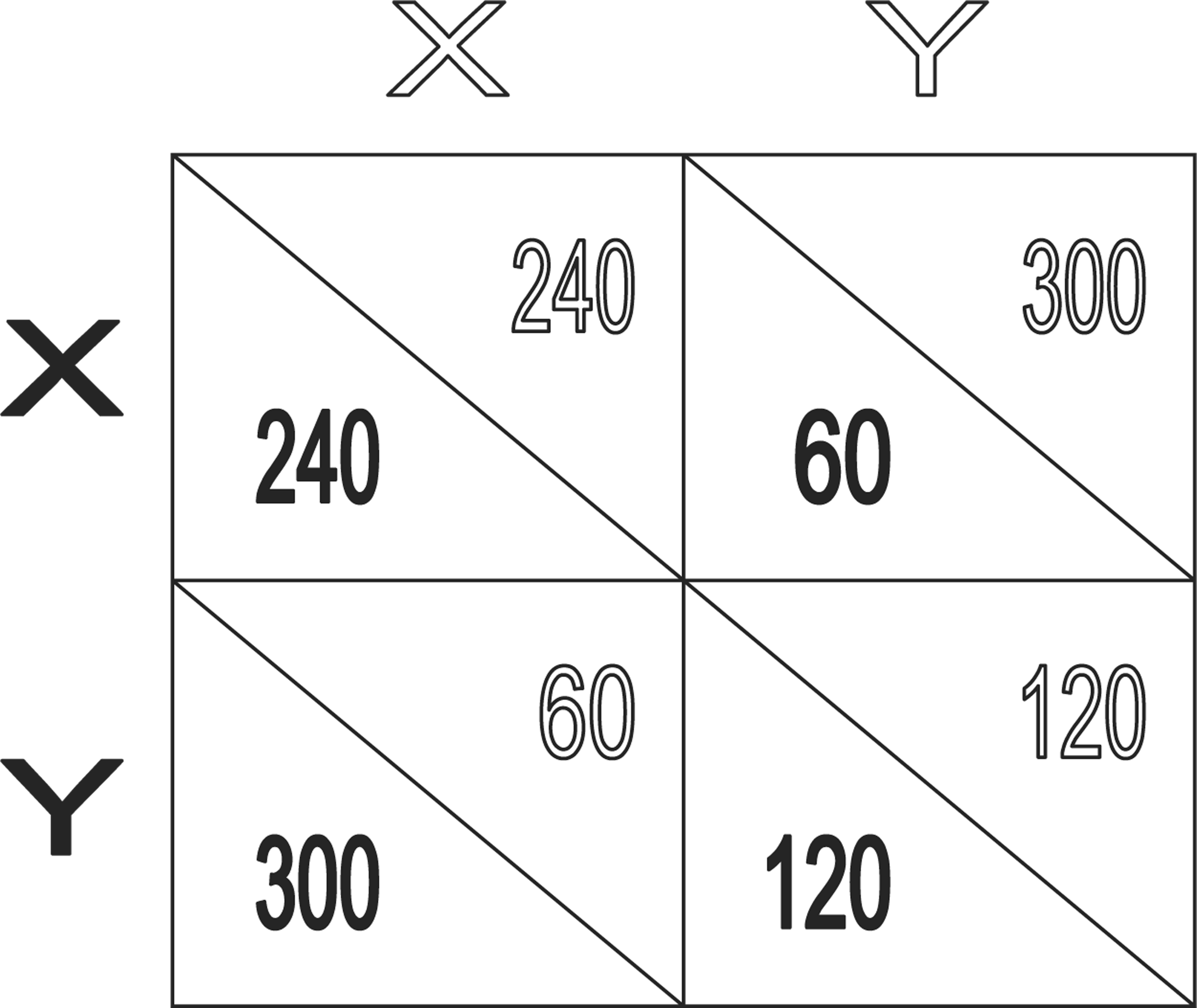
A prisoner's dilemma game (PDG) matrix. This matrix represents a social interaction involving two groups (a bolded group and an outlined group). Each group has two choices, X and Y. The values represent the amount of money (in U.S. cents) that each side receives as a function of the two groups' choices.
Obviously, experimental games cannot capture all of the complexities of specific intergroup conflicts; however, using the PDG to study conflict allows researchers to identify the unique contributions of different psychological processes. Despite the seeming simplicity of the PDG, Axelrod pointed out that it could be used to model trench warfare in World War I, and a survey by Halevy, Sagiv, Roccas, and Bornstein (2006) found that some Israeli Jews perceive the Israeli–Palestinian conflict as a prisoner's dilemma.
CONSIDERATION OF FUTURE CONSEQUENCES
Expectation of Future Interactions
Axelrod (1984) has written about the importance of future interactions in promoting cooperation in the PDG. Specifically, Axelrod argued that cooperation emerges in the PDG when players realize that they might meet again in the future or, in other words, when the future has “a sufficiently large shadow” (p. 174). Axelrod noted that cooperation emerged in the trench warfare of World War I because small units faced each other for long periods of time. For example, one soldier made the following observation:
It would be child's play to shell the road behind the enemy's trenches … but on the whole there is silence. After all, if you prevent your enemy from drawing his rations, his remedy is simple: he will prevent you from drawing yours
Axelrod's trench warfare example suggests that intergroup cooperation can be induced through the expectation of future interactions. In a relatively simple empirical demonstration of this idea, Insko et al. (2001) showed that anticipation of future trials in the PDG can lead to increases in intergroup cooperation. Participants were assigned randomly to one of two 3-person groups and were informed that they would interact with the other group in the PDG either one time or multiple times. All groups interacted only once. Insko et al. (2001) hypothesized that the expectation of multiple interactions, as opposed to a single interaction, would shift groups from a short-term to a long-term orientation and that this would increase cooperation. The results were consistent with those predictions and showed that groups expecting a single trial cooperated 44% of the time, whereas groups expecting multiple trials cooperated 72% of the time.
Turn Taking
In a separate investigation of the benefits of future consideration, Insko et al. (1998, Study 2) compared successive responding (i.e., turn taking) with simultaneous responding in the PDG. In the successive-responding condition, one group learned its opponent's choice before making its own choice on the first trial, and the other group learned this information before choosing on the second trial. In the simultaneous-responding condition, both groups made their choices at the same time. Insko et al. (1998) argued that turn taking would make it functional for groups to think beyond the immediate situation and instead focus on the long-term consequences of their behavior. For example, if on the first trial, the group choosing second decided to exploit their opponent's cooperation, the other group could do the same on the next trial. Ultimately, this pattern might result in mutual non-cooperation for the remainder of the interactions. Insko et al. (1998) predicted that participants in the turn-taking condition would recognize the potential costs of mutual non-cooperation and therefore would be more likely to cooperate than would participants in the simultaneous-responding condition.
The results were consistent with predictions: Groups in the turn-taking condition cooperated 76% of the time, whereas groups in the simultaneous responding condition cooperated 45% of the time. This pattern held both for groups that initially chose first and for groups that initially chose second. It is important to note that Insko et al. (1998) found that groups in the successive-responding condition were more likely to expect reciprocity than were groups in the simultaneous-responding condition. In fact, the second group invariably cooperated if the first group cooperated. Insko et al. (1998) argued that thinking about the potential for reciprocity in intergroup interactions shifts the focus of both groups from the immediate gains of competition to the long-term benefits of cooperation. It seems, then, that knowing that opponents who are exploited will have the opportunity for retaliation is a potential impetus for peace.
Tit for Tat
In a third experiment, Insko et al. (1998, Study 1) took an operationally different, but conceptually similar, approach to future consideration by examining the effects of tit-for-tat responding in the PDG. They posited that having participants face an opponent using a tit-for-tat strategy would make groups aware of the long-term costs of reciprocal competition and, accordingly, would result in increased cooperation. In the control condition, groups interacted in the PDG for 15 trials. In the tit-for-tat condition, one group was composed of confederates who cooperated on the first trial, but on subsequent trials they chose whatever the participants had chosen on the previous trial. Insko et al. (1998) found that groups that faced a tit-for-tat opponent cooperated 92% of the time, whereas groups in the control condition cooperated 72% of the time. In support of the link between tit-for-tat responding and the consideration of future consequences, mediational analyses suggested that the tit-for-tat manipulation caused participants to become more concerned with long-term outcomes and that this concern was related to cooperation.
Consideration of Future Consequences and Peace in the Middle East
Results from these studies suggest that groups entrenched in conflict may be made to cooperate if they are induced to think about the long-term consequences of their actions. The tit-for-tat results suggest that one way to promote such thinking is to let the other side know that peaceful, cooperative actions will be reciprocated, as will hostile, competitive actions. In August of 2005, Ariel Sharon, the former Prime Minister of Israel, tried such a strategy. During a unilateral Israeli pull-out of settlements in the Gaza Strip, Sharon informed the Palestinians of Israel's tit-for-tat intentions: “The world awaits the Palestinian response—a hand offered in peace or continued terrorist fire. To a hand offered in peace, we will respond with an olive branch. But if they choose to fire, we will respond with fire, more severe than ever” (Matza, Nissenbaum, & Merzer, 2005, p. A8). Sharon's statements coupled with the empirical findings of Insko et al. (1998) suggest that one way to promote peace may be through tit-for-tat strategies.
Unfortunately however, Israel's tit-for-tat intentions were not enough to establish peace: At the time this article was written, Israeli–Palestinian violence was on the rise, and the death toll in this region of the world was the highest it had been in years. Why might Israel's tit-for-tat attempt have failed? Unfortunately, tit for tat does not guarantee consideration of long-term consequences. Indeed, a major limitation of the tit-for-tat approach is that in the absence of cooperation, hostility will be reciprocated. Such “eye-for-an-eye” responding can, of course, leave everyone blind. Research by Van Lange and colleagues (Tazelaar, Van Lange, & Ouwerkerk, 2004; Van Lange, Ouwerkerk, & Tazelaar, 2002) suggests that, at least for individuals, forgiveness might prevent cycles of negative reciprocity. Specifically, they have found that apologies (Tazelaar et al., 2004) and generosity (Van Lange et al., 2002) can mitigate the negative effects of misunderstandings or “noise” (i.e., discrepancies between intended and actual outcomes). Another way to avoid cycles of negative reciprocity might be through trust.
Future Consideration and Trust
Although researchers have found it difficult to reach a consensus regarding the appropriate definition of trust (cf., Cook, Hardin, & Levi, 2005; Yamagishi & Yamagishi, 1994), most would agree that trust, or lack thereof, is an important factor in intergroup conflict. In our laboratory, we use the word trust to refer to the expectation that one's opponent will behave cooperatively (Insko, Kirchner, Pinter, Efaw, & Wildschut, 2005; Insko et al., 2001). Note that, because cooperation may be rooted in factors other than goodwill and benign intent, some theorists (e.g., Yamagishi & Yamagishi, 1994) would disagree that the expectation of cooperation is a true indicator of trust. Although we acknowledge that the intentionality behind cooperation may often be an important issue to consider, what is important for our purposes is whether groups expect cooperation from their opponent, regardless of the assumed basis for cooperation.
Insko et al. (2001) first explored the role of trust in intergroup conflict by testing whether the anticipation of future interactions would lead to increased trust as well as increased cooperation. Insko et al. (2001) predicted that, because the anticipation of future interactions makes the long-term benefits of cooperation salient, groups expecting multiple PDG trials would be more likely to expect cooperation from their opponent than would groups expecting only a single trial. The results were consistent with predictions; groups anticipating multiple trials reported that the likelihood that their opponent would cooperate was 70%, whereas groups anticipating a single trial reported a likelihood of 47%. The actual rates of cooperation were strikingly similar (72% and 44%, respectively).
Groups anticipating future interactions made relatively more cooperative and more trusting choices than did groups not anticipating future interactions; however, there was still significant competition in the multiple-trials condition. Some other factor must be present if conflict is to be eliminated more completely. Insko et al. (2001) speculated that the missing ingredient for peace was proneness to abstract thinking or, more specifically, proneness to conceptualize the “shadowy” future consequences of multiple trials.
Trust and Abstract Thinking
Thinking about the future consequences of one's actions requires more abstract thought than does thinking about immediate outcomes. It is important to look at abstract thinking and trust together because there are often short-term benefits but long-term costs of exploiting another group's trust. Therefore, if it is to be maximally effective at promoting cooperation, trust must be coupled with an ability to think abstractly about the future.
To test this idea, Insko et al. (2001) included assessments of trust and abstract thinking, along with the trial manipulation, in a model predicting intergroup competition. The results were consistent with predictions: Insko et al. (2001) found that competition was practically eliminated when multiple trials were anticipated and groups were composed of abstract thinkers who trusted their opponents. When multiple trials were anticipated, groups with high trust and high abstractness cooperated 93% of the time. Cooperation dropped to 74% when trust was high but abstract thinking was low, and it dropped to 10% when abstract thinking was high but trust was low. Clearly, the optimal combination for reductions in intergroup conflict is for groups to anticipate future interactions, to trust their opponent, and to think abstractly. Anticipating future interactions may promote cooperation on its own but trust and abstract thinking must also be present for conflict to be more completely eliminated.
A Possible Role for Ideology in Extending the Time Required for Recognition of Long-Term Consequences
Overall, the studies cited above suggest that intergroup conflict may be reduced if groups are induced to think about the long-term consequences of their actions. Although certain personality traits, such as abstract thinking, may predispose groups to behave cooperatively, dispositional traits are often less malleable than is situational structure. One might thus find it promising that situational factors, such as turn taking and tit-for-tat responding, can induce groups to develop a long-term perspective and forgo conflict for cooperation. However, as illustrated by the Thirty Years War in Germany, “The Troubles” in Northern Ireland, and the Israeli–Palestinian conflict, some instances of tit-for-tat like responding may go on for many years before combatants realize the futility of such behavior. Unfortunately, it may take quite a while before the more radical group members begin to consider the negative future consequences of their behavior. 2
Why does it sometimes require a considerable passage of time before groups realize the futility of continued conflict? We do not know, but the fact that the above examples all involve conflict between religious groups suggests the interesting possibility that group-related ideology may play a role. 3 Although we have yet to explore this issue, research by Jost on systems justification theory (e.g., Jost & Hunyady, 2005) and by Pratto and Sidanius on social dominance theory (e.g., Pratto, Sidanius, & Levin, 2006) suggest that ideology may have a strong influence on intergroup behavior.
INDEPENDENT LEADERSHIP
Can strong leaders make peace? Research by Pinter and colleagues (2007) suggests that they can. Leaders often act so as to benefit their ingroup, which unfortunately often puts them at odds with outgroups. In general, groups advocate and engage in more contentious behavior than do individuals, which undoubtedly poses problems for leaders who are trying to find middle ground. Perhaps the most difficult task for any leader is to satisfy his or her constituents while still brokering reasonable agreements with outgroups. In light of the relative peacefulness of interindividual interactions, Pinter et al. designed a study to investigate ways to make group leaders act more like individuals (i.e., cooperatively).
Specifically, Pinter et al. (2007) compared the behavior of group leaders with that of individuals in the PDG. Group leaders were appointed (i.e., randomly selected) by the experimenter. 4 In addition, Pinter et al. examined two factors that they suspected would affect leaders' behavior: leader accountability and guilt proneness. Accountable leaders were informed that ingroup members would be aware of the leader's influence on the groups' outcomes, and unaccountable leaders were informed that ingroup members would not be aware of the leader's influence. Guilt proneness was measured at the beginning of each experimental session.
Pinter et al. looked at guilt proneness because of the postulated role of guilt as a moral emotion (Tangney, 2003). Guilt proneness tends to cause individuals to act in line with moral norms. Moral norms in interindividual contexts generally require fairness and cooperativeness. Wildschut and Insko (2006) labeled this set of norms individual morality. In intergroup contexts, however, being moral generally means doing what is best for one's ingroup. Wildschut and Insko (2006) labeled this set of norms group morality. Whereas individual morality prescribes cooperation in the PDG, group morality prescribes competition because, in the PDG, maximizing ingroup outcomes necessarily entails minimizing outgroup outcomes (Cohen, Montoya, & Insko, 2006; Wildschut & Insko, 2006). The goal of the Pinter et al. study was to induce leaders to act in line with the codes of individual morality rather than those of group morality. They hypothesized that accountable leaders would face strong normative pressure to favor the ingroup and thus would be induced to follow the codes of group morality and act competitively. On the other hand, they hypothesized that, because they would face considerably less normative pressure to favor the ingroup, unaccountable leaders would be free to follow the codes of individual morality and act cooperatively. Because of the association between guilt proneness and morality, Pinter et al. expected differences due to accountability to emerge primarily for high-guilt leaders.
Consistent with predictions, accountable high-guilt leaders cooperated only 63% of the time, whereas unaccountable high-guilt leaders cooperated 98% of the time. These findings suggest that high-guilt leaders who are given some degree of independence or unaccountability in their decision making will be better able to foster peace than will leaders who are relatively less independent. Leaders with strong moral convictions may be able to bring about peace, but only if they are able to push the pressures of group morality aside and instead act within the dictates of individual morality.
On September 24, 1995, Israeli Prime Minister Yitzhak Rabin and Palestinian Authority Chairman Yasser Arafat signed the Oslo 2 Accord, which represented a major step forward in Israeli–Palestinian peace efforts (Smith, 2006). How were Rabin and Arafat able to come to such an agreement? One interpretation is that they acted independently from their more extreme bases and thus were able to behave more like individuals (i.e., cooperatively). Unfortunately, such independent leadership had heavy costs. Both leaders lost vital support from their own sides for attempting to negotiate a peace agreement, and for Rabin, this resulted in his murder. On November 4, 1995, Rabin was killed by an Orthodox Jew who believed Rabin's negotiations with Arafat were the mark of a traitor (Smith, 2006). Rabin's assassination underscores the difficulties associated with independent leadership—it may be able to bring about peace, but leaders who act independently may not stay leaders for long (see Haslam & Platow, 2001, for empirical support of this idea).
OUTGROUP EMPATHY
Research in our lab has revealed a third process for promoting cooperation between groups: outgroup empathy. By outgroup empathy, we mean feelings of concern directed at an outgroup. The assumption underlying this line of research is that empathizing with an outgroup can lead to cooperative intergroup behavior. There is a substantial body of research highlighting the effectiveness of empathy in reducing both interindividual aggression (Miller & Eisenberg, 1988) and prejudice (Stephan & Finlay, 1999). Furthermore, there is a growing body of research suggesting that empathy can be helpful in reducing antipathy toward outgroups (Malhotra & Liyanage, 2005; Schechtman & Basheer, 2005). For example, Shechtman and Basheer found that the more empathy Arab children felt toward Jewish children, the less likely they were to support aggression toward Jewish children. Malhotra and Liyanage found that Tamil and Sinhalese high-school students living in Sri Lanka who had participated in a 4-day peace workshop in 2001 were more likely in 2002 to report empathic feelings toward the outgroup and donate money to an outgroup charity than were those Tamil and Sinhalese students who had not participated in the peace workshop. Malhotra and Liyanage's findings are particularly striking, as the hostility between the Tamils (a Hindu group) and the Sinhalese (a Buddhist group) has plagued Sri Lanka with civil warfare for over 20 years.
Pettigrew (1998) suggested that the effectiveness of intergroup contact in improving intergroup relations may stem in part from outgroup empathy or outgroup perspective taking. Malhotra and Liyanage's (2005) findings support this idea, as do findings by Hewstone, Cairns, Voci, Hamberger, and Niens (2006). Hewstone et al. found that intergroup contact between Protestants and Catholics in Northern Ireland was positively related to outgroup perspective taking, attitudes, trust, and forgiveness.
We conducted an experiment testing whether outgroup empathy can promote intergroup cooperation (Cohen & Insko, 2008). In the experiment, participants were assigned randomly to one of two 3-person groups and interacted for one trial by making choices on a PDG-Alt matrix (a prisoner's dilemma plus a third withdrawal choice yielding intermediate outcomes regardless of the opponent's choice). Participants were randomly assigned to complete one of three writing exercises (outgroup empathy, ingroup empathy, or objective perspective) prior to making their choices in the PDG-Alt matrix. Those in the outgroup-empathy condition were asked to imagine how the members of the other group felt about the upcoming interaction in the prisoner's dilemma matrix (e.g., how they would likely feel when they learned each group's decision). Participants in the ingroup-empathy condition were asked to imagine how the members of their own group felt about the upcoming interaction. Participants in the objective-perspective condition were asked to think about the upcoming interaction while remaining objective and detached.
We predicted that participants in the outgroup-empathy condition would act more cooperatively and that participants in the ingroup-empathy condition would act less cooperatively than would those in the objective-perspective condition. Our results (see Figure 3) were consistent with these predictions, although further analyses revealed that the increase in cooperation among those in the outgroup-empathy condition occurred primarily for group members who were low in dispositional empathy, and the decrease in cooperation among those in the ingroup-empathy condition occurred primarily for high-guilt group members.
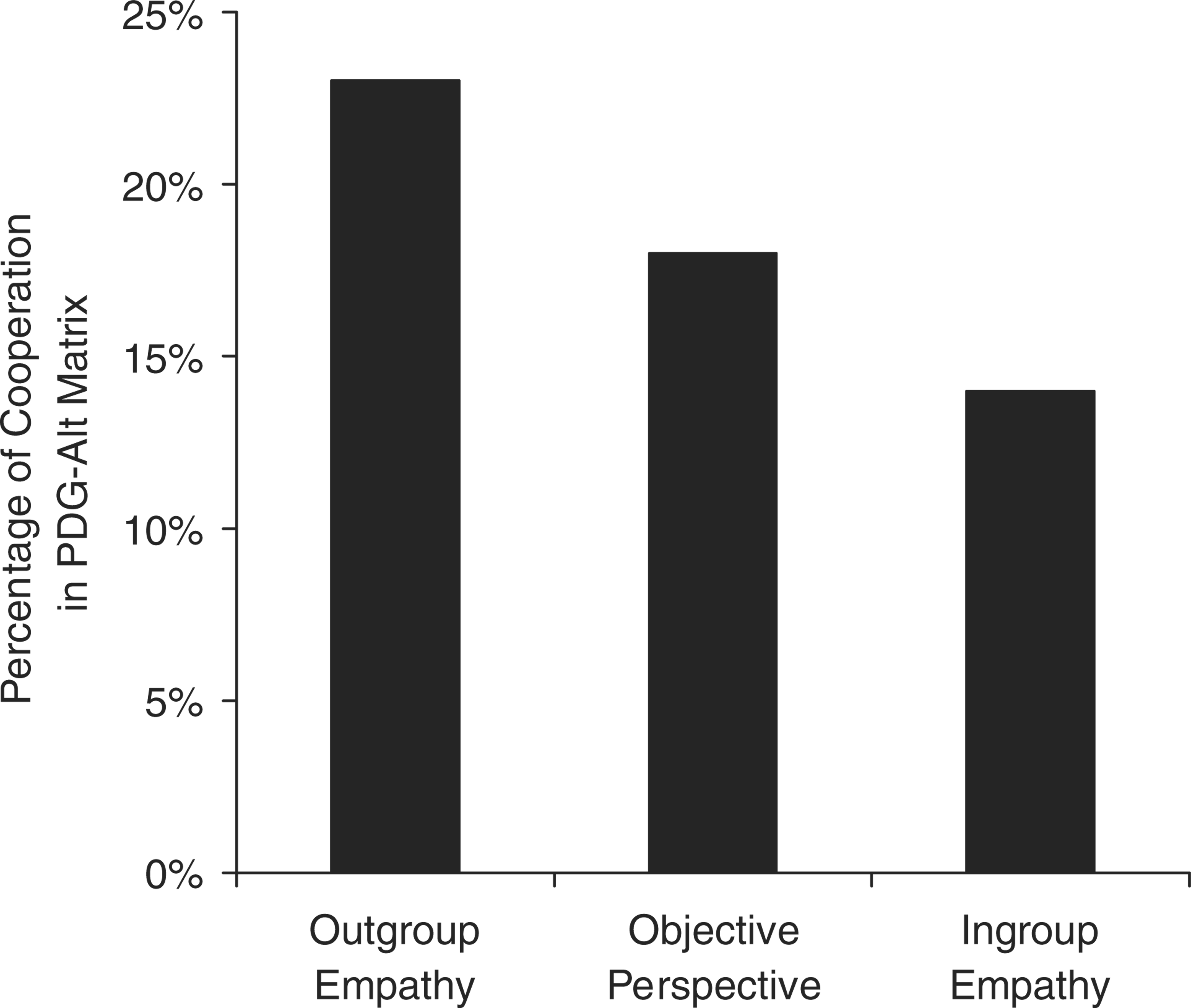
Results for empathy study (N = 356). PDG=prisoner's dilemma game.
An intriguing promise of outgroup empathy is that it may be helpful in overcoming group-related ideological differences that are frequently associated with prolonged conflict. Note that the conflicts between the Jews and Muslims in Palestine (Schechtman & Basheer, 2005), the Buddhists and Hindus in Sri Lanka (Malhotra & Liyanage, 2005), and the Protestants and Catholics in Northern Ireland (Hewstone et al., 2006) are all associated with religious-ideological differences. It is thus encouraging that research has supported the idea that intergroup contact and outgroup empathy can promote positive intergroup relations among groups with deep-rooted histories of conflict.
COORDINATION AND SUPERORDINATE GOALS
Sherif, Harvey, White, Hood, and Sherif (1961) conducted a classic demonstration of the effectiveness of superordinate goals in reducing intergroup conflict. They presented evidence that hostility between two groups of boys at a summer camp was reduced when the boys were faced with achieving shared or superordinate goals (e.g., pooling money so as to rent a favorite movie, locating a problem with the camp's water system).
Why do superordinate goals promote cooperation? One possibility is that superordinate goals create situations in which outcomes can be maximized through coordination. Coordination situations can be represented as matrices with interaction terms (e.g., Leader, Battle of the Sexes; Kelley & Thibaut, 1978) in which, unlike the PDG, each side can maximize their own outcomes though cooperation instead of competition. Wolf, Insko, Kirchner, and Wildschut (in press) found that groups were more cooperative in coordination situations than in exchange situations (e.g., PDG) and that the difference was mediated by the tendency for individuals to perceive both groups as one common group. Wolf et al.'s findings support Gaertner and Dovidio's (2000) Common Ingroup Identity Model, which proposes that intergroup bias may be reduced by the promotion of the perception of one common group. Gaertner and Dovidio's model suggests that intergroup cooperation might be increased by making group members understand that they are all equally members of the human race. This Jeffersonian idea can be traced back to John Locke (1690/1997) and has been developed at some length by the philosopher Peter Singer (1981) in his book The Expanding Circle.
CONCLUSION AND A QUESTION FOR FUTURE RESEARCH
In this article, we discussed four possible approaches to reducing conflict between groups: consideration of future consequences, independent leadership, outgroup empathy, and coordination. Although these findings should be regarded as preliminary and only suggestive, we believe that they provide a basis for optimism about a very difficult and obviously important problem.
There are many issues that could and should be addressed by future research, but one important question to consider is how various approaches to conflict reduction might be implemented. How might psychological processes that reduce intergroup conflict play out in protracted conflicts throughout the world? Psychologists are making progress in answering this question (e.g., Hewstone et al., 2006; Kelman, 1997), and we hope this trend continues.
Footnotes
1The PDG is a symmetric matrix in which the opponents have equal power to influence each other's outcomes. Although our pilot testing has not revealed reliable differences between matrices with equal power and those without, we acknowledge that there probably are circumstances in which such differences occur.
2Nash's concept of an equilibrium point (a situation or cell form that neither party can unilaterally leave without reducing outcomes) implies that mutual competition should continue indefinitely. The PDG was, in fact, developed by two mathematicians at RAND Corporation, Merrill Flood and Melvin Drescher, specifically for the purpose of testing the equilibrium-point prediction (Poundstone, 1992). Although research has generally failed to support Nash's game-theory prediction, we acknowledge that such behavior does clearly occur in some situations and that, as speculated above, it may be particularly likely in conflicts between differing ideologies.
3We do not mean to imply that the ideology associated with extended conflicts need be religious. Note the Marxist guerilla campaigns of Che Guevara and others.
4Although many leaders are appointed, such as executive officers in various business organizations, we acknowledge that democratically elected leaders might introduce additional complexities.