







Abstract
The news that the brain continues to develop through much of adolescence risks becoming an explanation for anything and everything about teenagers and suggests the need for closer analysis. Central to such analysis is clarifying what develops at a psychological level during these years. An examination of contemporary research data on adolescent cognitive development identifies increased executive control as a major dimension of cognitive development during the second decade of life. Such development is consistent with changes occurring in the brain during this period.
We now know that the human brain continues to develop during the second decade of life (Casey, Giedd, & Thomas, 2000; Giedd et al., 1999; Nelson, Thomas, & deHaan, in press; Sowell et al., 1999). Modern longitudinal neuroimaging research provides evidence of two kinds of change. One is in the so-called gray matter, which undergoes a wave of overproduction (paralleling one occurring in the early years) at puberty, followed by a reduction, or “pruning,” of those neuronal connections that do not continue to be used. A second change, in so-called white matter, is enhanced myelination, that is, increased insulation of established neuronal connections, improving their efficiency (Giedd et al., 1999). By middle to late adolescence, then, the evidence suggests, teens have fewer, more selective, but stronger, more effective neuronal connections than they did as children.
The news about adolescent brain development has attracted the interest and imagination of the mass media, and authors have not hesitated to draw wide-ranging implications. In The Primal Teen: What the New Discoveries About the Teenage Brain Tell Us About Our Kids, for example, Strauch (2003) pointed to incomplete brain development as an explanation for just about everything about teens that adults have found perplexing, from sleep patterns to risk taking and mood swings. In the cognitive realm, she quoted approvingly a middle-school teacher who said it is good to know that “if you have an adolescent in a seventh-grade science class and he or she is having difficulty with abstract concepts, it may … have to do with brain development and developmental readiness” (p. 214). This inference is noteworthy and warrants concern, among other reasons because it absolves less-than-optimal instruction as a possible contributor. Ought an immature adolescent brain carry this explanatory burden?
To reverse the question, are there identifiable psychological implications of an immature adolescent brain? If we are reluctant to see the teen brain become an explanation for anything and everything about teenagers, this is perhaps the better question to ask. In this article, I examine the cognitive realm as the one in which an affirmative answer would seem most likely. The question that must first be asked, however, is a basic one. What cognitive changes take place during this life period? We must be able to characterize the course of cognitive development during the second decade of life if we are to evaluate the role that brain development may play in it. It is therefore this question that I turn to next.
THE SECOND DECADE
If, as the simplest first step, we consult a few of the many textbooks on adolescent development, a consistent picture appears. These books cover the waterfront, addressing topics from body changes to developing romantic relationships, school adjustment, and youth culture, to name only some. Yet none of these texts (with one or two notable exceptions, e.g., Moshman, 2005) devotes more than a brief chapter, or section of a chapter, to the cognition of adolescents.
The cognition section of adolescence textbooks, moreover, is the one likely to have undergone the least change in the past several decades. The standard textbook portrayal of adolescent cognitive development, equally likely to be found in texts published in 1970 and 2005, centers on a description of the transition from the concrete operational to formal operational stage in Piaget's stage sequence (Inhelder & Piaget, 1958). In contrast to concrete operational thought, formal operational thought is described as more abstract, more systematic, and less egocentric, with associated implications for “the adolescent personality” (Elkind, 1994). The Piagetian view also continues to be widely disseminated in textbooks and other literature for teachers, which often include implications (like the one of the teacher quoted earlier) regarding cognitive limitations of students who have not attained formal operations (Metz, 1995).
In stark contrast, in the current scholarly literature, the idea of thought developing toward greater abstraction during the childhood or adolescent years has been largely dismissed as either incoherent or wrong (Keil, 1998, in press). Moreover, very few, if any, contemporary researchers endorse the notion of the abrupt emergence in adolescence of a discontinuous, new cognitive structure similar in its specifics to the one Inhelder and Piaget described as formal operations (for reviews of the relevant research literature, see Keating, 2004; Klaczynski, 2004; Kuhn, 2000; Kuhn & Franklin, in press; Moshman, 1998, 2005).
This disparity is indeed a cause for concern and a topic in its own right, especially in light of the extent to which textbooks serve as the entry point (and, for most people, also the exit) to a field. The disparity is not one that is seen in developmental textbooks' coverage of earlier life periods; sections on those periods undergo regular updating to reflect current research literature. Why the difference? A possible factor is the relatively small proportion of research effort that developmental psychologists have devoted in recent years to periods beyond early childhood. Instead, the focus of interest in developmental psychology increasingly has come to lie in the earliest years of life. The goal has been to identify competencies in their earliest forms, the assumption being that if the processes involved can be understood in these earliest forms, understanding of later, more complex forms will readily follow.
Indeed, this widespread attention to earliest origins of cognitive competencies has led to increasing popularity of the view that all the important action occurs during the child's first years, after which the stage is set, with striking competencies in place so that there is no reason for us to expect any major new changes (Gopnik, Meltzoff, & Kuhl, 1999; Gopnik & Schulz, 2004). Moreover, this position has led to strong educational recommendations, notably, those arising from the idea of the young child as a natural scientist, in command of a robust, already well-developed curiosity and exploratory orientation that are forced underground in middle childhood by the wrong educational methods (Gopnik, 2005). This natural intellect need only be preserved and protected, not developed, and it will thrive, according to this view.
Coupled with the new evidence of brain development in the second decade, the reemergence of this view makes it all the more important to clarify what we know about cognition and its development in the years beyond childhood. Might the “natural curiosity” of early childhood be susceptible to fine tuning during later childhood and adolescence? Do the second-decade brain developments neuroscientists have identified relate to any psychological changes? Is there perhaps even a second critical period paralleling the period of rapid brain and cognitive development in the early years of life? Or, alternatively, is all the action, psychologically speaking, confined to the early childhood years?
To anticipate the answers offered here, the most recent reviews (Keating, 2004; Kuhn & Franklin, in press), undertaken independently, converge in pointing to evidence not of abstract thinking (which it is far from straightforward to define), but rather of enhanced executive control as the major dimension of cognitive development during the second decade of life. Such development is consistent with changes occurring in the brain at adolescence. With other factors controlled, behavioral data show that late adolescents or young adults are better able to monitor and manage their own processes of learning and knowledge acquisition, compared with children just entering adolescence. Microgenetic methods (Kuhn, 1995; Siegler, in press), moreover, have made it possible to gain a more detailed picture of these processes and how they operate within and across individuals.
WHAT DEVELOPS?
Information Processing
The kinds of cognitive changes that we might most expect to be supported by brain development are enhancements in basic information processing. Improved effectiveness of information processing might be achieved in any of three ways: through improved speed, through improved capacity, or—a path that is often overlooked—through improved inhibition. Inhibition in turn comprises two components, resistance to interfering stimuli and inhibitory control of one's own responses.
There is now considerable evidence that processing speed continues to improve from early childhood through midadolescence (Kail, 1991, 1993; Luna, Garver, Urban, Lazar, & Sweeney, 2004). There is also evidence that both components of inhibition capability develop across the childhood years and into adolescence (Harnishfeger, 1995; Harnishfeger & Bjorklund, 1993; Luna et al., 2004). It should be emphasized, however, that this evidence comes from paradigms in which the individual is instructed to inhibit responses. We know less about situations in which individuals make their own decisions in inhibiting thought or behavior and how successful they are in doing so. The self-regulatory processes that come into play in such contexts may turn out to be particularly important in an adolescent's functioning.
In the case of execution rather than inhibition, evidence does show that performance continues to improve well into adolescence when the task requires self-regulation and management of processing (e.g., organized search of multiple locations to obtain tokens; Luciana, Conklin, Hooper, & Yarger, 2005). With respect to processing capacity, however, questions of definition and measurement, and the difficulty of obtaining “pure” measures of capacity, have left unresolved the question of whether there occurs an absolute increase in capacity with development, although it is established that processing effectiveness continues to improve in the second decade (Case, Kurland, & Goldberg, 1982; Case & Okamoto, 1996; Cowan, 1997; Demetriou, Christou, Spanoudis, & Platsidou, 2002; Pascual-Leone, 1970). Hence, in sum, in examining higher-order cognition, it is necessary to keep developing information-processing capabilities in mind without expecting that they will by themselves explain what is observed in the realm of higher-order cognition.
Learning
Another possibility is that adolescents have become more effective learners than children. Put in terms consistent with contemporary views of learning as change in understanding (Schoenfeld, 1999), the question is whether the ability to integrate new information with existing understandings improves from childhood to adolescence. Older children and adolescents have clearly had more time and opportunities to learn, compared with younger children, and as a result they clearly know more. Differences in knowledge, then, are certainly a large part of what makes children and adolescents different from one another. But does the learning process itself differ with age?
A lack of interest in learning, as opposed to performance, in the field of developmental psychology in the past several decades (Siegler, 2000) has left this question neglected. Following the appearance of Kendler and Kendler's (1962) evidence against the behaviorist tenet that the learning process is invariant across age and species, with the exception of one chapter by Carey in 1985, the question lay largely dormant—one of those seemingly straightforward questions that someone not closely acquainted with the field assumes has been answered but in fact has not.
Recently, Pease and I (Kuhn & Pease, in press) sought to revisit the question in a study based on a contemporary understanding of the learning process and designed in such a way that competing explanations (of superior learning by older individuals) could be ruled out. Sixth graders and young adults were presented the teddy bear shown in the top panel of Figure 1 and assisted in outfitting the bear with seven accessories (see the bottom illustration in Fig. 1). The interviewer explained that a charity was raising funds and giving the bears to donors as token gifts. In an effort to improve donations, it was explained, the charity wanted to try dressing the bears up a bit, but they could afford to add only a few accessories. Participants were asked to choose the two accessories they thought were most likely to increase donations and the two they thought were least likely to do so. This content domain was selected to make it unlikely that superior performance on the part of the older group could be attributed to richer or more extensive content knowledge.

Teddy bear, with and without accessories, used by Kuhn and Pease (in press).
Each participant was then presented results of five “test runs” involving the four accessories he or she had selected. These instances were presented one at a time, each remaining in view so that in the end all five were displayed together. The five instances involved different combinations of the accessories and established that two accessories (one the participant believed was effective and one he or she believed was ineffective) increased donations, and the other two did not. The most successful combination (highest donation and fewest accessories) was the fifth instance; the most effective accessory combination could simply be “read off” from this instance, and no complex inferential reasoning was required. Nonetheless, and strikingly, neither group was entirely successful in learning the information presented. Adults, however, were more successful than sixth graders: Seventy-five percent of adults chose the fifth combination as the most effective one, whereas 35% of the younger group did so.
Ruling out a number of alternative explanations, Pease and I proposed that the older participants made better use of a meta-level executive to monitor and manage learning (Kuhn & Pease, in press). This executive function allowed them to maintain and flexibly access dual representations, one of their own understanding (of the relations they expected or saw as most plausible) and the other of new information to be registered. In the absence of this function, there exists only a singular experience—of “the way things are”—that serves as a framework for understanding the world. This executive control, manifested in response inhibition and bracketing, has been implicated as well in tasks involving various forms of deductive as well as inductive inference (for review, see Klaczynski, 2004, or Kuhn & Franklin, in press), for example, when the reasoner is asked to draw conclusions from premises irrespective of his or her belief in the truth of the premises.
Should it be concluded, then, that the learning process undergoes developmental change? Carey (1985) answered this question with a categorical no, claiming there was no reason to believe that the learning process operates any differently in children than in adults. Findings such as the ones Pease and I obtained (Kuhn & Pease, in press) suggest that Carey's sweeping claim, although likely true with respect to some kinds of learning, was overstated. A great deal of the learning children and adults engage in, both in and out of school, is simple associative learning, and there is no evidence to indicate that the nature of associative learning processes undergoes developmental change. In contrast, learning that is conceptual—that involves change in understanding—requires cognitive engagement on the part of the learner, and hence an executive function that must allocate, monitor, and otherwise manage the mental resources involved. Such executive functions, and the learning that requires them, do show evidence of developing.
Self-Directed Inquiry
Another area of research has examined how older children, adolescents, and adults perform when they are asked to engage in their own self-directed investigation to answer a question or understand a domain of inquiry (Ford, 2005; Klahr, 2000; Kuhn & Dean, 2005; Kuhn, Garcia-Mila, Zohar, & Andersen, 1995; Kuhn & Phelps, 1982; Schauble, 1990, 1996). These studies from different laboratories have yielded very similar overall pictures (Klahr, 2000; Kuhn, 2002). Adults on average exhibit more skill than children or young adolescents at each stage of the inquiry process. Children are more likely than adolescents or adults to seek to investigate all factors at once; to focus on producing outcomes rather than analyzing effects; to fail to control variables and, hence, to choose uninformative data for examination; and to engage in what Klahr refers to as “local interpretation” of fragments of data, ignoring other data that may be contradictory. Klahr (2000) concluded that “adult superiority appears to come from a set of domain-general skills that … deal with the coordination of search in two spaces” (p. 119), one of hypotheses (or theories) and one of data.
In both young teens and young adults, my colleagues and I (Kuhn et al., 1995) found exercise (of current strategies, in the absence of additional feedback) was a sufficient condition for development of more advanced inquiry strategies in a rich problem environment that required their use. This strategic progress with continued engagement was maintained when new problem content was introduced midway through a several-month period of engagement.
Microgenetic analysis (Kuhn, 1995; Siegler, in press) is especially valuable in affording insight into the nature of the change process. Across a variety of domains, microgenetic work has shown that individuals have available a variety of strategies (of inquiry, analysis, and inference), from which they select variably across occasions (Siegler, in press). This variability implicates a meta-level, or executive, operator that governs strategy selection (Kuhn, 2001). Developmental change is marked not only by an increase in frequency of selection of more advanced, more effective strategies, but also by a decrease in frequency of selection of less advanced, less effective strategies (a point that is equally important and typically overlooked). Feedback from exercise of a strategy should feed back to the meta-level, enhancing its regulatory effectiveness and hence further enhancing performance in a continuous process (see Fig. 2).
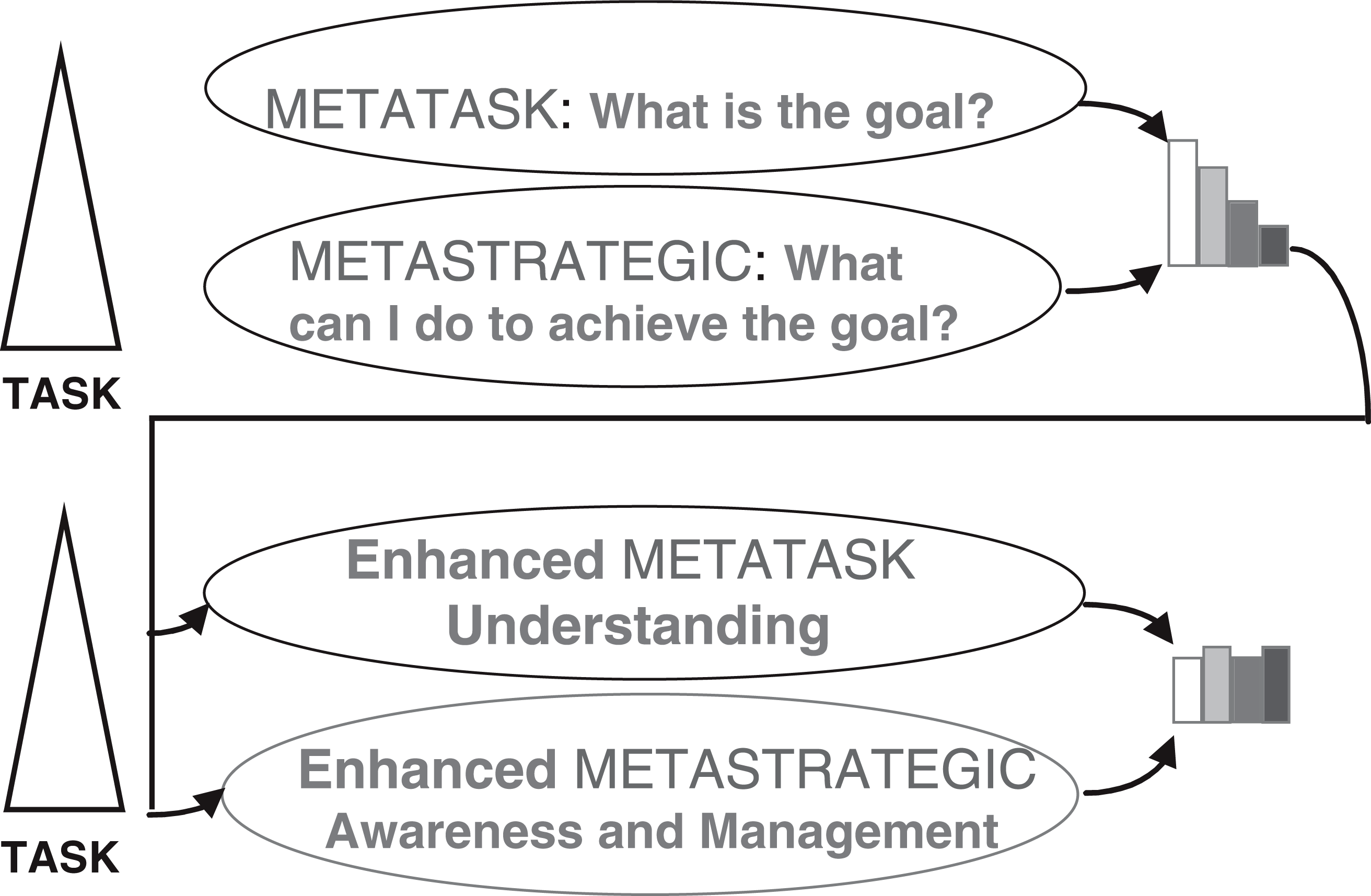
Diagram of shifting distribution of strategy usage (from Kuhn, 2001). The multiple strategies an individual has available to apply to the task are depicted by the bars at the right, with frequency of usage of a strategy represented by height of the bar. In the progress depicted from the upper to the lower half of the diagram, the less effective strategies to the left become less frequent, and the more effective strategies to the right more frequent (in this case, yielding a temporary, transitional result of all strategies being of roughly equal frequency). Implicated in this change are the metatask and metastrategic operators that appear in the middle (between task and strategies), representing the individual's understanding of the task goal, understanding of the strategies he or she has available to apply, and awareness of the need to coordinate the two in selecting a strategy. Feedback from the performance level should enhance meta-level understanding, further enhancing performance, in a continuous process.
Decision Making
There has been relatively little research on adolescents' decision making, much of it devoted to experimental interventions designed to foster improvement, with mixed results (Byrnes, 1997; Jacobs & Klaczynski, 2005). Studies assessing developmental change in decision making from childhood to adolescence and adulthood have been largely limited to the most well-known of the decision-making scenarios in the adult decision-making literature, scenarios in which the rate of fallacious judgments among adults is known to be high. For example, the sunk-cost fallacy (e.g., choosing to watch a disliked movie longer if you paid to obtain it vs. obtained it for free) was studied by Klaczynski and Cottrell (2004), who found the incidence of correct responding (not committing the fallacy) to be 16% among young adolescents (average age=12), 27% among older adolescents (average age=16), and 37% among adults. The typical picture obtained in such studies is one of modest improvement during the teen years, with performance moving toward an asymptote characteristic of the modest level of performance in the adult population (the average adult is as likely to make an incorrect judgment as a correct one in response to most of the scenarios).
Drawing on dual-process theories of cognition proposed by Sloman (1996) and other researchers, Klaczynski (2004, 2005) proposed a dual-process account of the development of decision-making skills. Cognitive development, Klaczynski proposed, is not in fact unidimensional, proceeding along a singular course as traditional theories espouse, but rather occurs along two trajectories and involves parallel development of two distinct systems. One is an experiential system and the other an analytic system. The most important contrasts between the two systems appear in Table 1. Much of the time the two systems operate in coordination, each applied to situations to which it is better suited. In contexts like the sunk-cost decision scenario just summarized, however, they conflict and yield opposing judgments.
Contrasting Attributes of Two Cognitive Systems in Dual-Process Theories of Cognitive Development
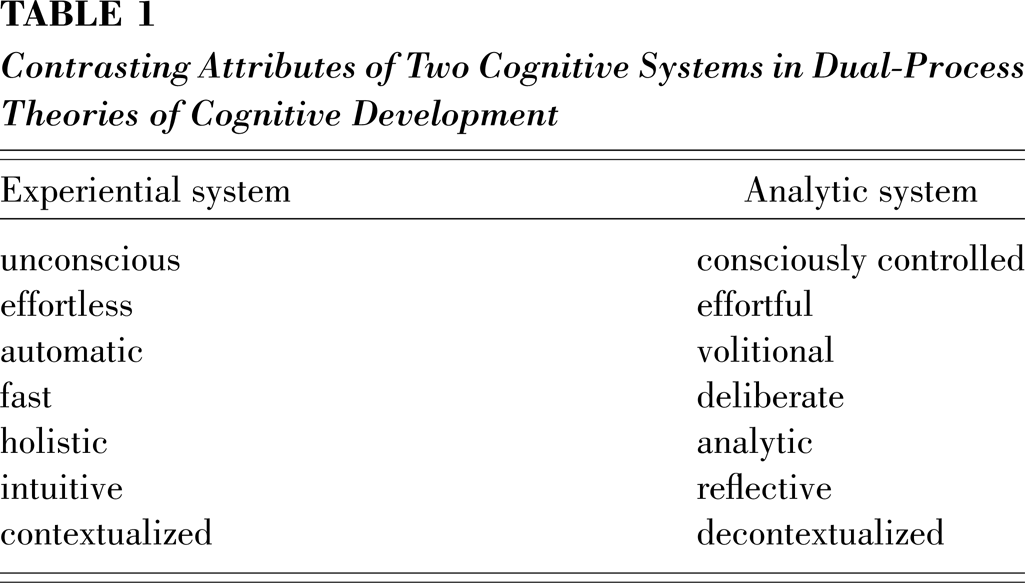
The experiential system, Klaczynski (2004, 2005) proposed, is always present and remains the predominant system. It is useful and adaptive; were it not for its rapidity and automaticity, information processing would be overburdened. Developmental change may occur, however, in the degree to which the experiential system predominates. The potential to respond experientially increases with age, Klaczynski suggested. Also becoming more prominent with age, he suggested, are increasingly powerful metacognitive operators. These metacognitive operators have the potential to invoke the analytic system. Once invoked, the analytic system has the dual tasks of inhibiting the experiential system and doing its own primary work, which entails extracting the decontextualized representations that will lead to correct judgments.
Improvements in performance on decision-making tasks during adolescence are consistent with such a model. A number of Klaczynski's (2005) secondary findings are also consistent with it. The model accounts, for example, for the finding that a “logical person” cue (“Think about this situation from the perspective of a perfectly logical person”) enhances performance on the grounds that such a cue induces uncertainty about whether to use one's normal experiential processing mode. However, there is no consistent evidence for developmental change occurring separately in two distinct systems. Despite two earlier reports of increased susceptibility to certain decision-making fallacies during adolescence (Davidson, 1995; Jacobs & Potenza, 1991), Klaczynski did not replicate these findings and found no evidence that reliance on experiential processing increases with age on any task.
A dual-process model nonetheless fits well with a variety of data on developing deductive and inductive inference skills (Kuhn & Franklin, in press), to the extent that they entail response inhibition, particularly the premature termination of processing that precludes consideration of alternatives, and the ability to bracket, or temporarily inhibit, one's beliefs, in order to accurately represent data and allow the inference system to operate. Both inhibition and bracketing involve competing systems, one effortless and intuitive and the other deliberate and reflective. And both point to the importance of a meta-level executive that mediates selection of the more reflective, less contextualized alternative.
Second-Order Cognition
Inhelder and Piaget (1958) introduced formal operations—the final stage in Piaget's sequence of developmental stages—as comprising operations on operations, or second-order operations. With the attainment of this stage at adolescence, it was claimed, thought becomes capable of taking itself as its own object. One can think about one's own thinking. Specifically, mental operations can be performed on the concrete operations of classification and relation that constitute the preceding stage in the sequence.
Piaget has been widely criticized as casting too wide a net in undertaking to explain all of cognitive development as manifestations of a singular, albeit evolving, stage structure. From another perspective, however, at least with respect to the formal operational structure, Piaget's conception was overly modest and cast too narrowly. He certainly appears to have had the right idea in highlighting thinking about thinking as an emergent quality of cognition in late childhood and early adolescence. What constrained this treatment was his assumption that second-order operations were of the same general form as first-order (concrete) operations, that is, entirely content-neutral, general, and therefore abstract and equally applicable without regard to context, content, or purpose. As one can categorize or order any elements using concrete operations, so can one manipulate propositional statements about any such categories by using a set of formal operations.
In the real world of adolescent thought, in contrast, gradually emerging reflective awareness of one's thought has a number of features that differentiate it from propositional logic, features that make it infinitely more flexible and widen its range of application. Here I mention only two of the most important. First, the content and meaning of what is being thought about are of primary importance to the thinker and play a major role in whether, and what kind of, thinking occurs. Second, thinking about thinking implies the potential for management of thinking, not simply reflection on it or rule-governed manipulation of it. This active, self-directed management, in turn, implies the potential for volition and, by implication, some degree of control. Adolescents increasingly take charge of their mental life, choosing what to think about, when and where to do so, and how to allocate their mental effort. For these reasons, I have referred here to developments in these kinds of meta-level or second-order cognitive skills as developments in executive control. At the most general level, then, what develops in the second decade of life is a set of skills entailed in effectively managing one's mind.
BRAIN DEVELOPMENT AND COGNITIVE DEVELOPMENT
I return now to the question with which I began. How might developments in the brain be connected to cognitive changes in the second decade of life?
Possibly the single most important understanding regarding neurological development in recent years has been the appreciation of the degree to which it is experience driven. Brain development cannot be viewed in the traditional unidirectional manner simply as a necessary or enabling condition for cognitive or behavioral change. Instead, the activities that are engaged in affect which neuronal connections will be strengthened and which will wither. These neurological changes in turn further support activity specialization, in a genuinely interactive process.
In contemplating the question of brain-mind connections in the second decade, some insight is gained by considering another life period in which both brain development and significant cognitive development have been identified—the early childhood years. The idea that early experience can be critical in altering long-term developmental paths continues to be held in high regard. Recent data, for example, show that young adults who had attended the Perry Preschool Project fared better on various life indicators than nonattending peers from the same disadvantaged community (Schweinart et al., 2004). Apparently, the authors proposed, the early intervention provided them intellectual tools, the effect of which may have been threefold: First, use of the tools strengthened and perfected them, furthering their range of application. Second, this activity enhanced neurological development, paving the way for further change, in the interactive manner noted in the previous paragraph. Third, the preceding changes yielded a degree of academic success, which in turn led to a commitment to education. Potential effects of early intervention thus extend not only to brain and cognitive development, but also to disposition and intellectual values (Kuhn & Park, in press).
In early adolescence, all of these forms of influence stand to operate in similar ways. There is a notable difference between the two periods, however. An extremely high degree of interindividual variability becomes the norm, rather than the exception, by early adolescence (Stanovich & West, 1997, 1998). After the first decade of life, development along universal pathways does not continue to the most advanced levels for everyone. Many adults cease to show any development beyond levels achieved by typical early adolescents. Variation in positions along developmental pathways becomes pronounced. In addition, within specific content domains, the range and depth of individually acquired expertise becomes much greater than in childhood. The results Pease and I obtained are typical of this variability (Kuhn & Pease, in press). Some 12-year-olds performed as well as the typical adult, and some adults performed no better than most 12-year-olds. The pattern in this respect is quite different from that observed in the case of the majority of childhood cognitive attainments, which are closely age linked.
How should we explain this heightened variability, and what are its implications? One level of explanation, of course, lies in the brain. Early adolescence, as I noted in the introduction, is a second developmental period during which a sequence of overproduction and pruning of neuronal connections occurs. Luna et al. (2004) suggested that increased efficiency of neuronal communication associated with increased myelination may support increased processing speed, and local refinements in brain circuitry reflecting changes in synaptic organization may benefit response inhibition. At the same time, this pruning of unused connections is guided by the activities in which the young teen engages. Both brain and behavior, then, together begin to become more specialized.
Correlational evidence supports the view that experience is at least as influential at this age as in the first years of life (Feinstein & Bynner, 2004). The power of experience is heightened by teens' increasing freedom and personal control—on the one hand, in managing and deploying their intellectual resources to accomplish a task and, on the other, more broadly, in choosing the activities in which they will invest themselves and in managing their lives. It thus may be especially important to consider what kinds of experience we wish the developing adolescent brain to have. How do young teens choose to invest the many discretionary hours they have to spend each week? The choices that earlier were made by parents are now made by teens themselves. Simply through concentrated engagement in the activities they choose, adolescents get even better at what they are already good at, thus increasing the range and diversity of individual pathways. By early adolescence, individuals are indeed producers of their own development (Lerner, 2002).
One consequence of these choices is an increasing sense of personal identity—“this is who I am” and, particularly, “this is what I'm good at” (and its even more potent complement, “this is what I'm no good at”). Thus, during this second critical period, it is disposition, as much as or more than competence, that needs to be the focus of individuals concerned with supporting adolescents' cognitive development. To a greater extent than children, teens attribute meaning and value (both positive and negative) to what they do and draw on this meaning to define a self. Positively valued activities lead to behavioral investment, which leads to greater expertise and hence greater valuing, in a circular process that has taken hold by early adolescence. The selfless curiosity and exploration characteristic of the early-childhood critical period have likely gone underground and are difficult to detect. An implication is that the valuing of intellectual engagement is a critical dimension to be supported by people who work with young adolescents (Kuhn, 2005; Kuhn & Park, in press). We can identify here another point of convergence among researchers who study adolescent cognitive development: The disposition construct needs at least as much attention as the competence construct (Keating, 2004; Kuhn, 2005; Moshman, 2005; Stanovich, 1999). The competencies an adolescent develops will count for little if the adolescent chooses not to use them.
Early adolescence is a critical time for the interplay in development of the brain, the mind, and the person. Developmental neurologists and neuropsychologists have provided some tantalizing new evidence regarding brain development in these crucial years. But this development does not dictate what happens on a psychological plane. Psychologists should now do all they can to provide the data that will help to make it clearer how brain, mind, and person develop together.