







Abstract
The focus of this article is on the examination of variables that moderate the influence of exposure to TV violence. The research on the relationship between TV violence and aggressive behavior of the audience has largely focused on addressing the social policy issue of whether witnessing TV violence fosters aggressive behavior in viewers, particularly children. There has been a dearth of research addressing the conditions that enhance the aggression stimulating effects of media violence, those that mitigate these effects, and those that may even result in reduced aggression after one witnesses media violence. To illustrate the importance of potential moderating factors, we present longitudinal correlational data relating the degree of viewing TV violence to various social behaviors and cognitive attributes of White and African-American male and female elementary-school-age children. Although TV violence viewing was associated with lower cognitive attributes and negative social behaviors in White males and females and African-American females, a very different pattern of relationships was found for African-American males.
There are few areas in the study of mass media effects that have been as extensively investigated as the effects of exposure to violence on television. Nevertheless, we would suggest that despite the plethora of research addressed to this issue, the study of possibly significant variables has been neglected. From a social policy standpoint, it may be sufficient to assume that the conditions under which increased aggression occurs are more common than those under which no effect or aggression reduction occur. Policy makers are interested in television fare that is extant, not what might be. However, with regard to scientific understanding of a phenomenon, it is important to determine the parameters governing the influence of exposure to TV violence. These parameters or moderating influences may relate to program variables such as the kind of violence depicted, its dramatic context, its outcome, or attributes of the protagonists; observer variables such as affective state, personality disposition, and social class; and to the social and historical context in which the program is viewed.
To illustrate the possible role of one of these variables, program context, we suggest the following “thought” experiment. Assume that in our experimental studies, we use one of the following programs as violent stimuli: Hamlet, Macbeth, Medea, or Treasure Island. It is possible but unlikely that witnessing these dramas would stimulate aggressive behaviors. An objection that these programs are very different from standard TV fare is germane to the public policy issue but is not pertinent to the question of whether exposure to these dramas would stimulate aggression. Given the level of violence in these portrayals, particularly the first three, it is useful to speculate as to why they are unlikely to foster aggression. We would suggest that the major factor differentiating these dramas from those that stimulate aggression is that the central themes of the former entail internal conflicts and concerns, such as issues of identity, guilt, desertion, and humiliation and, in the case of Treasure Island, ambivalent attachment and adventure, with the violence being quite secondary.
Might witnessing some of these dramas actually be cathartic and reduce aggression? We think that this might well be the case, but we feel that the show would not provide a substitute outlet for aggression but rather an Aristotelian sense of catharsis: a “purging” of the emotions. In any case, we would propose the general hypothesis that the more a dramatic presentation depicting violence focuses on internal conflicts and feelings of the central protagonists, the less likely it is that it will enhance aggression. Conversely, the more a dramatic presentation focuses on aggressive, violent behaviors, the more likely it is to stimulate aggression. We offer this hypothesis not to argue its validity, but rather as one illustration of our contention that research on the effects of witnessing dramatic presentations of violence has been unduly limited in its exploration of parameters governing these effects.
A very different type of potential moderating variable that has received little attention is that of race or ethnicity. There may well be cultural factors associated with race or ethnicity that influence television viewing behavior and the effects of TV on viewers. Thus, early studies indicate that African-American children watch much more television than do White children (Stroman, 1984; Tangney & Feshbach, 1988). Although there is a body of descriptive research on the television viewing behavior of African-American children, there is a dearth of studies bearing on the possible role of race or ethnicity as a moderator of the link between television and aggression. We have been able to locate only one study relating TV viewing to a facet of aggressive behavior in which race was one of the factors assessed (Thornton & Voigt, 1984). Even in this article, separate correlations for the different racial groups are not reported.
The findings of a study we carried out underline the importance of distinguishing between racial groups in determining the relationship between TV viewing and aggressive behavior. In a combined cross-sectional, longitudinal study, we administered measures assessing TV viewing, intelligence, and adjustment to 4th, 5th, and 6th grade children. Measures of the child's adjustment and behaviors were also completed by teachers and by mothers. To assess IQ, we administered the Otis-Scoring Mental Ability Test (Otis, 1965), and we assessed the children's self concept with the Piers-Harris scale (Piers & Harris, 1969). Academic performance was based on a global rating by the teacher. The teacher report measure of aggression was derived from a modified version of the School Behavior Check List, Form A2 (Miller, 1977), and the parent report measures of the children's delinquency and cruelty were derived from subscales of the Achenbach Behavior Checklist (Achenbach, 1978; Achenbach & Edelbrock, 1979).
To assess television viewing behavior, we provided the children with a list of all television programs, in a TV Guide format, broadcast by the area's eight major commercial stations and two cable stations during the 7 days previous to testing, excluding those programs aired after 11:30 pm and during school hours. The children were asked to check the programs they had actually watched during the previous week, not the programs they usually watch, for each half-hour interval. The TV viewing frequency score is the total number of hours watching TV during the previous week. We categorized programs as violent or nonviolent. A violent program was defined as one in which violence was central to the role or occupation of a main character (e.g., a police show), one in which violence was central to the plot or theme, or one that portrayed more violence than one would normally expect to encounter in daily life. Reliability of categorizing programs as violent was high, with agreement between two raters being over 90%. The violent TV score consisted of the sum of violent TV program hours observed during the previous week.
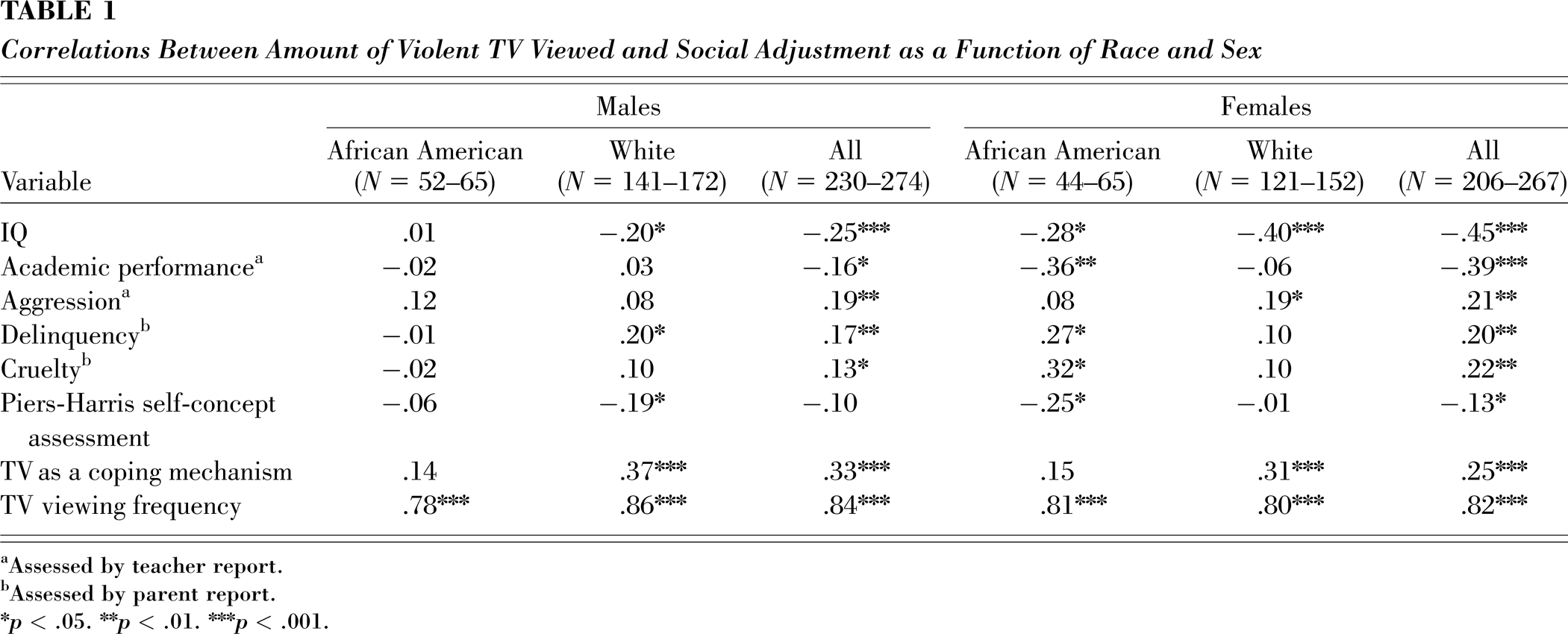
Cognitive and social correlates of the violent TV viewing measure are presented separately for race (African-Americans and White) and gender in Table 1. As Table 1 indicates, both gender and race influence the relationship between the amount of violent TV viewed and personality attributes. Overall, the amount of violent TV viewed tends to be linked to negative personality attributes for White males and for African-American and White females. It is of interest that no significant correlates were obtained for African-American males. The correlations shown for all males and all females can be misleading in that the correlations for the total group may not hold with respect to the relationships obtained when the data for each racial group are analyzed separately. Thus, the significant inverse relationships between violent TV viewing and the variables of IQ and parent report of delinquency found for all males hold only for White males. Also, although a significant negative correlation between amount of violent TV viewed and academic performance was obtained for the total group of males, neither of the correlations for each racial group considered separately approaches significance. In this instance, the negative correlation for the total group is a function of the differences between African-Americans and White males in TV viewing and academic performance. African-American males watch more violent TV and have lower academic performance ratings than do White males.
Correlations Between Amount of Violent TV Viewed and Social Adjustment as a Function of Race and Sex
aAssessed by teacher report.
bAssessed by parent report.
∗ p < .05.
∗∗ p < .01.
∗∗∗ p < .001.
The findings for African-American males raise the possibility that television viewing, including the viewing of violent TV, may have a different function for this group than for White males and African-American and White females in that there is little evidence of amount of violent TV viewing being associated with increased aggression, poorer self-concept, or lower IQ in African-American males.
The findings for African-American males were not anticipated, and consequently these data need to be replicated and any interpretation is, of necessity, post hoc. The data raise the possibility that processes competing with or overriding the aggression stimulating or aggression modeling effects of viewing violence on television may be more salient for African-American males. One such process may be positive feelings that are elicited by the TV dramas viewed, which could modulate hostile, aggressive impulses. Another possible process is the inhibition of aggression by viewing aggressive, antisocial behaviors that result in punishment. A less subtle, more prosaic possibility is that the more time these youngsters spend viewing TV, the less time they spend on the streets where they may get into difficulties. This latter possibility is central to the thesis proposed by two economists, Dahl and Vigna (Goodman, 2008). Although one may take issue with their analyses indicating a yearly decrease in assaults following the release and showing of violent films and providing no evidence of a spike in violent crimes emerging after the weekend showing of these films, their data underline the importance of considering the role of broader, social behavioral factors in our understanding of the effects of media violence.
The Dahl and Vigna data seem to take issue with the general proposition that TV violence tends to foster aggressive, antisocial behaviors. Our concern, as indicated earlier, is not with this important social policy question but rather with the need for a more general conceptualization of the effects of exposure to TV violence, one that takes into account personality differences, ethnic differences, the social context in which TV is viewed, variations in the dramatic context, and other potentially significant moderating factors.
Footnotes
Acknowledgements
We wish to thank the Markle Foundation for generous support of this study.