







Abstract
How do infants represent objects, actions, and relations in events? In this review, we discuss an approach to studying this question that begins with linguistic theory—specifically, semantic structures in language. On the basis of recent research exploring infant cognition and prominent linguistic analyses, we examine whether infants representations of motion events are articulated in terms of the components proposed by Talmy (1985; e.g., path, manner) and whether infants' event representations are defined in terms of broad semantic roles (agent, patient, source, goal) as proposed by Jackendoff (1990) and Dowty (1991). We show how recent findings in infant cognition are consistent with the idea that the infant's representation of events is a close reflection of the linguistic categories. We especially highlight research that is explicitly guided by linguistic categories likely to have correlates in nonlinguistic cognition to illustrate the usefulness of using language to pose questions about early conceptual representations.
One of the central questions in current developmental science is “what is the nature of the infant's representations of the world?” Although there is a strong consensus that infants do not see the world as the “blooming buzzing confusion” suggested by William James (1890/1981, p. 462), researchers are still unclear as to precisely how they think about objects, actions, and relations. In this article, we discuss a theoretical approach for investigating infant cognition that has been guiding a growing body of research in the field, including our own. This approach begins with linguistic theory: Its working hypothesis is that prelinguistic conceptual representations directly reflect the semantic structures used by language. Modern linguistic theory has long been concerned, at least in principle, with how language is grounded in the human mind (e.g., Chomsky, 1965), and many linguists have explicitly suggested that the structures of language, particularly the semantic structures, provide direct insight into the organization of human cognition (Goldberg, 2006; Jackendoff, 1983, 1990; Langacker, 1991; Pustejovsky, 1995; Talmy, 1985). Our research approach takes these linguists at their word and examines the claim in the domain of infant cognition. The advantages to this approach are largely methodological. By starting with linguistic theory, we begin with well-reasoned analyses of semantics that provide a ready-made tool with which to investigate the infant mind. We know that infants must eventually acquire these semantic structures as part of acquiring language, so there must be some kind of relationship between prelinguistic thought and those structures; the most straightforward possible relationship would be an isomorphism. Moreover, the linguistic analyses are clear enough that they make our working hypothesis falsifiable and therefore useful for scientific progress.
In this article, we review three prominent linguistic analyses, each examining a different dimension of the semantics of events: motion events, thematic and action tiers, and thematic roles. These analyses are highly complementary with each other and overlap somewhat in scope. In each section, we review the central findings from the linguistic theory and then consider recent research in infant cognition and ask to what extent infants' representations reflect these semantic structures. The infants vary in age across the studies considered, but we refer to them all as being prelinguistic. We do not mean to suggest that these infants have no knowledge of language, but only that they are not yet able to produce or fully comprehend the specific linguistic elements in question. In some cases, the infancy work was conducted explicitly within the program identified here: The research was directly guided by the linguistic concepts. In other cases, the infancy work was done outside this program, but our aim is to show how this work can be understood within the present framework. We conclude by discussing a few general considerations and implications of this research program.
MOTION EVENTS
In an influential paper, Talmy (1985) proposed that motion events include several key components: an object that undergoes the motion ( figure), the motion itself, the path over which the figure moves, and the object in relation to the figure (reference object). The complete path expression (path + reference object) can be divided into different types including source paths, in which the figure moves from a reference object that is its starting point or source; goal paths, in which the figure moves to a reference object that is its end point or goal; and via paths, in which the figure moves past the reference object (Jackendoff, 1983). The cause and the manner of the figure's movement are optionally encoded. The sentence the duck waddled from the tree past the mailbox and into the pool illustrates these semantic elements and how they map into syntax, as seen in Figure 1.

Talmy's (1985) analysis of motion event. This example illustrates the semantic elements comprising a motion event and how they are typically mapped into syntactic structure in English (e.g., motion + manner = verb phrase). Other languages show different lexicalization patterns (e.g., Spanish: motion+ path = verb phrase).
Are infants' event representations articulated in this way? Do they form categories based on the semantic elements Talmy lays out? Recent research suggests that they might (for a review, see Pruden, Hirsh-Pasek, & Golinkoff, 2008; Pulverman, Hirsh-Pasek, Golinkoff, Pruden, & Salkind, 2006). For example, in one study, infants were familiarized with events depicting an animated starfish performing various movements (e.g., twisting, bending) that shared a common path (e.g., over a dot). During test, infants were presented with an in-category event (novel manner, familiar path; e.g., toe-touch over a dot) and an out-of-category event (novel manner, novel path; e.g., toe-touch under a dot). Infants from 10–12 months of age looked longer at the in-category (familiar path) events, suggesting that they categorized the events based on path (Pruden, Hirsh-Pasek, Maguire, & Meyer, 2004). Other experiments using similar methods showed that 13–15-month-old infants categorize manner across varying paths (Pruden et al., 2004), and 9–11-month-old infants categorize manner across varying rates (Salkind, Golinkoff, & Brandone, 2005).
The findings reviewed above suggest that infants represent events in terms of manner and via paths. Other studies suggest that infants represent goal and source paths as well. Lakusta, Wagner, O'Hearn, & Landau (2007) familiarized 12-month-old infants to a motion event of a duck moving to one of two goal objects (see Fig. 2). After familiarization, the locations of the goal objects were switched. During test, infants viewed either the duck move to the same goal as in familiarization (but in a different location) or to a different goal as in familiarization (but in the same location). Infants looked longer at the test trials where the duck moved to a different goal, suggesting that infants encoded the goal during familiarization and were surprised when the duck changed its apparent goal at test. In further experiments, infants viewed similar motion events, except the objects were sources—the duck moved from one of two source objects. Infants looked longer when the duck moved from a different source, but only when the source objects were sufficiently salient (i.e., when the objects were big and colorful). Thus, infants represent goals and sources in motion events, although their representations of goals seem to be more robust than their representations of sources.
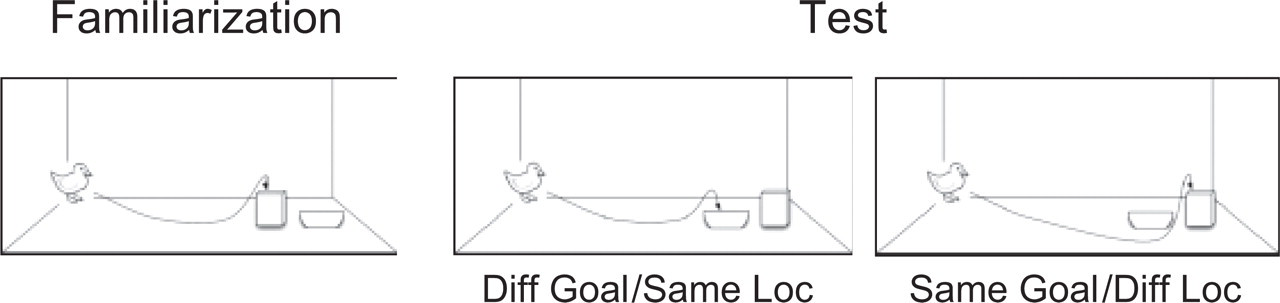
In familiarization, the duck moved to one of two goal objects. During intertrial, the researchers switched the objects (moving the first object to the second's location and vice versa). In three test trials, the duck moved to a different goal in the same location, and in three test trials, the duck moved to the same goal in a different location. (Reproduced from Lakusta, Wagner, et al., 2007, with permission from Taylor and Francis.)
Together these findings suggest that infants' event representations are articulated in terms of manner and various kinds of paths—possibly reflecting the key semantic elements of manner and via, goal, and source paths suggested by Talmy (1985). These data suggest that there is an isomorphism between prelinguistic thought and the semantic structures of language, and they contribute important information about how infants represent events in the world. Armed with this knowledge, research has further explored the extent to which the isomorphism between prelinguistic thought and language is complete.
In language, there is a robust asymmetry between goals and sources, with goals having a more prominent role than sources (e.g., Filip, 2003; Fillmore, 1997; Markovskaya, 2006; Nam, 2004). For example, Nam (2004) argues that, in semantic structure, locative goal paths (e.g., Brian ran to the house) constitute core events, whereas locative source paths (e.g., Brian ran from the house) modify the process of the event. This distinction between core and modifying events corresponds to the distinction between arguments and adjuncts, which have a variety of linguistic reflexes throughout language, including these particular cases.
Further evidence for the prominence of goals over sources in language comes from people's linguistic descriptions of events. When asked to describe events, children and adults tend to include the goal but omit the source (e.g., describing a scene in which a bird flies from a bucket into a pitcher as “the bird flew into the pitcher” rather than “the bird flew from the bucket into the pitcher”). This bias for goals in event descriptions is broad and robust—it extends to events in very different conceptual domains, such as motion by an animate and inanimate figure, attachment/detachment, change of possession, and change of state (Lakusta & Landau, 2005, 2007). Do infants also show a bias for goals over sources in their representations of events? And, if so, does this goal bias extend to events in different conceptual domains? If there is a complete isomorphism, then the relative importance of goals and sources for infants should reflect the prominence relationship between goals and sources observed in language. To test this hypothesis, Lakusta, Wagner, et al. (2007) familiarized 12-month-old infants to a toy duck moving from one of two source objects to one of two goal objects (see Fig. 3). During test, infants viewed either the duck move from a different source to the same goal or from the same source to a different goal. Infants looked longer at the test trials in which the duck moved from the same source to a different goal, suggesting that infants encoded the goal during familiarization and were more surprised at test when the figure changed its apparent goal rather than its source. Thus far, these results are consistent with a goal bias in language reflecting a goal bias in prelinguistic thought.
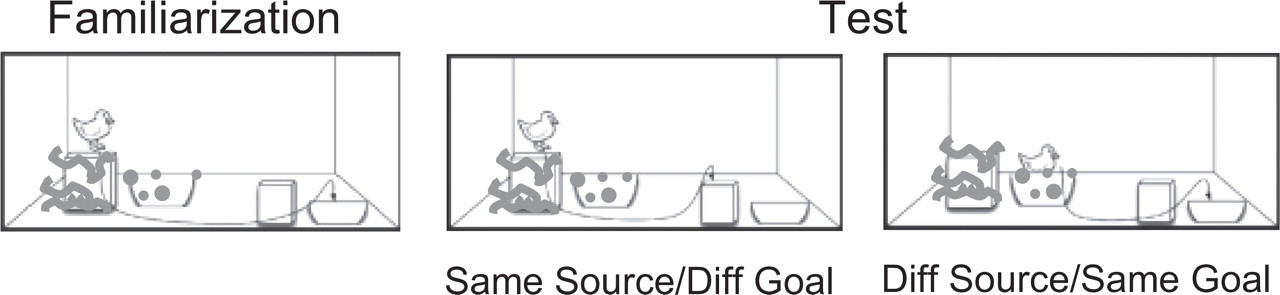
In familiarization, the duck moved from one of two salient sources to one of two goal objects. During intertrial, the researchers did not switch the objects. In three test trials, the duck moved from the same source to a different goal, and in three test trials, the duck moved from a different source to the same goal. (Reproduced from Lakusta, Wagner, et al., 2007, with permission from Taylor and Francis.)
However, recent findings suggest that there may also be some important differences between the linguistic and infant representations of events. Recall that the linguistic goal bias occurs broadly, extending to motion events with both animate (e.g., duck waddling from the tree into the pool) and inanimate figures (e.g., leaf blowing from the tree into the pool). A complete isomorphism between prelinguistic thought and language would predict that infants should show the same pattern. Recent findings suggest that this is not the case. Using a method similar to the one used by Lakusta, Wagner, et al. (2007), Lakusta and Carey (2007); Lakusta, Reardon, Oakes, & Carey, (2007) found that 12-month-old infants show a goal bias for events involving motion by an animate figure (a self-propelled balloon with a face) but not for events involving motion by an inanimate figure (a plain balloon). These results suggest that the intentionality in the event strongly modulates infants' encoding of sources and goals in a way that differs from the structure of language. Further research will be needed to determine how much language exerts its unique constraints over the prelinguistic representations.
THEMATIC AND ACTION TIERS
Earlier, we explored whether infants' event representations are articulated in terms of the motion event components laid out by Talmy (1985). In the next two sections of this article, we turn our attention to two linguistic analyses that focus primarily on semantic roles in linguistic structure (Dowty, 1991; Jackendoff, 1990). We ask whether and to what extent infants' event representations are also defined in terms of these roles.
It is now well accepted in many linguistic theories that abstract semantic roles are needed to fully characterize event structure in sentences. In the sentence The girl makes a sandwich, the arguments of the verb (the girl, the sandwich) have a very specific semantic relationship to the verb (they are, respectively, the maker and the makee), but they are also instantiations of the more general semantic roles of agent and patient. By appealing to these more abstract roles, linguists are able to identify commonalities across verbs and verb classes and general principles for linking syntactic positions to semantic functions (see Gruber, 1965, and Jackendoff, 1983, among others).
Jackendoff (1990) argues that semantic roles fall into two tiers: a thematic tier that deals with motion and location (i.e., the spatial structure of the event), and an action tier that deals with actor–patient relations (i.e., the intentional structure of the event). Consider the event of a girl kissing a boy. This event has two participants: a girl and a boy. On the thematic tier, the girl is the source or the spatial starting point of the action, whereas the boy is the goal or the end point of the action. By contrast, on the action tier, the girl is the actor or the initiator of the action, whereas the boy is the patient or the object affected by the action. There is no strict one-to-one relation between the roles on the two tiers. In the event just described, the girl is both the source and the actor. However, in an event of a girl hopping out of a car, the girl is the theme and the actor, whereas the car is the source and not the actor. In general, the relationships between semantic roles in thematic and action tiers vary along event domains. For example, in transfer events, sources tend to be actors, whereas in motion events, themes tend to be actors.
Recent research with infants suggests that they represent the intentional structure of events, one that may correspond to the action tier in semantic structure. For example, Baldwin, Baird, Saylor, and Clark (2001) reported that 10- to 11-month-old infants are able to appropriately parse goal-directed action events. In this study, infants were habituated to a goal-directed action (e.g., a woman notices a towel on the floor, reaches for it, grasps it, and then places it on the counter), and during the test, they either viewed the same action with a pause inserted at a “natural breakpoint” (e.g., at the end of the event, when the woman placed the towel on the counter) or the same action with a pause inserted at an “unnatural breakpoint” (e.g., in the middle of the event, before the woman placed the towel on the counter). Infants looked longer at the test events that had an “unnatural breakpoint,” suggesting that, during habituation, they parsed the event along the event's natural breakpoints and are thus sensitive to the structure of goal-directed actions.
Further evidence that infants represent the intentional structure of events comes from Woodward (1998). In this study, 5-, 6-, and 9-month-old infants were habituated to a human hand reaching for one of two objects (a ball or a teddy bear). At test, the locations of the objects were switched, and infants viewed the hand reach for either a different object (in the old location) or to a different location (with the old object). Infants looked longer when the hand reached for a different object, suggesting that they encoded the goal object as a relevant component of the event. Critically, infants in another condition saw the same sequence of events with a mechanical claw instead of a human hand. These infants did not look longer when the claw reached to a different object. These results suggest that infants as young as 5 months represent a human grasp, but not a mechanical grasp, as an intentional action: one that is directed toward a particular goal object. Additional studies by Woodward and colleagues (Guajardo & Woodward, 2004; Woodward, 1999; Woodward & Somerville, 2000) and Baillargeon and colleagues (Luo & Baillargeon, 2005) lend support to this interpretation that infants make different inferences about the relationship between event participants when they perceive an intentional dimension to the event.
The fact that intentionality makes a difference for infants suggests that they have representations consistent with the action tier in Jackendoff's linguistic analysis. Do infants also represent the spatial structure of the event, corresponding to Jackendoff's thematic tier? Research by Gergely, Csibra, and colleagues suggests that infants may often use a nonmentalistic interpretation of events more compatible with the thematic tier (see Gergely & Csibra, 2003, for a review). They argue that infants represent the external features of an event, such as the patterns of motion, the environmental constraints, and the ultimate destinations—all elements that can largely be defined spatially. They also invoke the principle of rationality, which states that endings should be achieved by the most efficient means possible and in which efficiency is again largely defined in spatiotemporal terms, such as the shortest path between points.
To illustrate, in one study (Gergely, Nadasdy, Csibra, & Biro, 1995), 12-month-old infants were habituated to an animated circle that jumped over a barrier and contacted another circle. During test, the barrier was removed, and infants viewed two events: in one, the moving circle performed the same jumping behavior despite the absence of a barrier to motivate it; in the other, the moving circle simply traced a direct path to the other circle. Infants dishabituated only to the events with the jumping path, suggesting that they were surprised at the inefficiency or irrationality of such a path in this case. Further studies have shown that infants can reason about goal states, action patterns, and situational constraints in accord with the rationality principle (Csibra, Biro, Koos, & Gergely, 2003; Wagner & Carey, 2005).
It is a question for future research of whether this work clearly demonstrates an analysis parallel to Jackendoff's thematic tier. In Gergely and Csibra's theorizing, the external, spatial analysis is taken to be primary, and the representations that support it are intended explicitly to be nonmentalistic. However, the principle of rational action needed to bind the components together certainly goes beyond the spatial analysis required of the thematic tier. Nevertheless, these data suggest that the spatial analysis is a critical element of infant cognition.
In sum, it appears that infants' representations reflect at least the basic components of the semantic structure of events as proposed by Jackendoff (1990)—they have both an intentional and a (mostly) spatial analysis of events. Further research will be needed to determine how extensive the isomorphism is between Jackendoff's tiers and infants' representations. For example, do infants understand that a single element can receive both a spatial and an intentional analysis? Moreover, do they make the systematic links used in language, such as expecting an intentional actor (on the action tier) to also be a spatial source (on the thematic tier)?
THEMATIC PROTO-ROLES
Beyond the two different analyses of semantic roles (spatial vs. intentional), there is also the question of how many and precisely which roles are used by language. There are many specific theoretical treatments of this question, but we appeal here to the approach laid out in Dowty (1991).
Dowty proposed that only two roles were needed to account for the relevant semantic properties and linkings between those roles and syntactic structures: proto-agent and proto-patient. Both proto roles consist of a set of prototypical features, none of which is necessary or sufficient. A proto-agent is volitional, sentient, and causal; it moves and it exists independently from the event. A proto-patient is something that undergoes a change of state, often in stages, is causally affected by the event, does not exist independently from the event, and is stationary relative to other participants. In the sentence The girl makes a sandwich, the girl has all the features of a proto-agent, and the sandwich has all the features of a proto-patient. The central principle of syntactic linking for Dowty is that, in basic active sentences, the best proto-agent will appear as the subject of the sentence and the best proto-patient will appear as the direct object, just as the example sentence illustrates.
Of course, not all arguments fulfill every prototypical feature (e.g., the agent and subject of The train hit the car is neither sentient nor volitional; the patient and object of The girl kicked the ball is not stationary and exists independently), but the prototypicality of the arguments strongly influences how it is linked into the syntax (see Dowty, 1991, for a complete discussion of the intricacies of this theoretical approach). We can now ask, do infants characterize events in terms of roles, and to the extent that they do, do they identify those roles with the same features proposed by Dowty?
In the infancy literature, the most extensive and relevant work has been done on infant understanding of causality, which is central to defining the proto-roles: Proto-agents cause things to happen, and proto-patients undergo change. Seminal work on infant causality (Leslie & Keeble, 1987) used Michotte-style launching events (cf. Michotte, 1963). Infants were shown either a causal event, such as one ball hitting another and thereby launching it, or they were shown a noncausal version of the event, in which the first ball hit another ball, but the second ball moved after a delay (so the first ball could not have launched the second by normal mechanical means). By 6 months of age, infants who had habituated to the causal launching event dishabituated if the roles of the balls were reversed. That is, infants appeared to have assigned the first ball the role of causer and the second ball the role of causee, and they recognized a difference if the balls switched roles. By contrast, infants who were habituated to the noncausal event did not dishabituate when the balls switched the order of the motions. That is, simply being the ball that moved first was not enough for infants at this age to assign enduring roles.
These results suggest that infants' concepts share at least two important properties with Dowty's proto-roles. First, they suggest that infants are capable of assigning roles to objects, at least within a single event, and second, they suggest that causality is a critical factor in role assignment just as it is important in defining proto-roles. More recent work on causality has suggested that infants may also link the features of sentience and volition to proto-agents. In a study by Saxe, Tenenbaum, and Carey (2005), 10- and 12-month-old infants were habituated to an event in which an object was tossed over different sized barriers. Saxe et al. argued that infants would perceive this event as causal and infer a causal agent of the event even though none was seen during the habituation phase. At test, infants were shown a human hand emerging after the event, either from the same side the object was tossed from or from the opposing side. Infants looked longer when they saw the hand emerge from the opposing side, as if they had in fact inferred a causal agent and expected it to be in a position to produce the cause. Moreover, infants showed no looking preference when what emerged after the event was an inanimate object (a toy train) rather than a human hand. This result suggests that infants both inferred a causal agent and expected that agent to be sentient in some way. Finally, when the tossed object had a face and had previously been shown to be able to move on its own, infants showed no preference for which side the hand appeared. This result suggests infants can assign the causal agent role to something that appears to move of its own volition. (See also Saxe & Carey, 2006, and Saxe, Tzelnic, & Carey, 2007, for additional findings and discussion.) 1
To the best of our knowledge, none of the infancy work on causality has explicitly invoked Dowty's proto-roles in their analysis of infants' understanding. However, the results from this literature are highly consistent with the idea that infants assign semantic roles to events and that the bases for their assignment are at least consistent with the features Dowty proposed. Of course, further research in this area is necessary to determine how infants assign roles to event participants (see Gordon, 2004) and to pin down whether infants' conceptions of event roles align completely with Dowty's proto-roles.
BEYOND EVENTS
We have focused our discussion on three dimensions within the semantics and cognition of events, but the general approach of using linguistic analyses to investigate infant representations can be applied more widely, as seen in other studies. For example, current investigations of infants' spatial concepts have made extensive use of linguistic analyses to guide their research questions (Bowerman & Choi, 2001; Casasola & Cohen, 2002; Hespos & Spelke, 2004; McDonough, Choi, & Mandler, 2003). Of central interest is how infant representations stack up against the variety of ways that different languages encode spatial relations: for example, Spanish en covers both English in and on, and Korean distinguishes between a tight-fitting on (one Lego block on another) and a loose-fitting on (a book on a table). The results thus far suggest infants are quite flexible in their ability to categorize spatial relations, although their ability to find specific relations develops over time (see discussion in the next section). Other work looking at infants' concepts of objects and nonsolid substances (Huntley-Fenner, Carey, & Solimando, 2002; Xu & Carey, 1996) has been highly influenced by a parallel distinction found in many languages between count nouns (which refer to individuateable objects such as tables and turtles) and mass nouns (which refer to nonindividuated stuff, such as water and rice). Recent investigations in this area suggest that infants reason quite differently about items in the world that are individuateable (solid objects) and those that are nonindividuated stuff (such as sand). In this domain, infants appear to be sensitive from early on to this primary division among elements in the physical, as well as linguistic, world.
ABSTRACTION IN LANGUAGE AND INFANT REPRESENTATIONS
The categories and semantic structures of language are very abstract: Notions such as path, manner, goal, and proto-agent are used broadly and cut across a wide variety of specific instances. The explanatory power of linguistic analyses depends in part on the way in which they account for particular examples from general principles. Actual research with infants, of course, requires the researcher to choose specific items to test, and there is some evidence that infants in many cases form quite narrow, concrete representations of those items. For example, Casasola and Cohen (2002) examined 10- and 18-month-old infants' representations of spatial relations such as containment (in), support (on), and tight fit (kkita). They found that both groups of infants showed evidence of an abstract category of containment; when habituated to in events, infants generalized to new in events during test. However, only the 18-month-olds showed evidence for a support and tight fit category, and this category was quite narrow—infants were able to discriminate different spatial relationships of on only if they were displayed using previously familiarized toys. They did not notice a new spatial relationship of on if it involved new toys. Researchers have found a similar trajectory from a limited, concrete understanding to more abstract, general representations for infants' ability to find roles in causal events (Cohen, Rundell, Spellman, & Cashon, 1999).
Recent work on infants' understanding of occlusion and containment events (Hespos & Baillargeon, 2001) has also shown a developmental pattern of concrete to abstract representations. Infants' ability to track object information initially depends on the specific event it is in: thus, 4-month-olds will keep track of an object's height in the context of an occlusion event (where height is critical) but not in the context of a containment event (where it is not). The fact that infants' object analysis is tied directly to specific events suggests that the same may hold for young infants' event representations; infants might initially be forming very specific event roles (such as hider and hidee) rather than a more general, abstract thematic analysis. Note, however, that Hespos and Baillargeon's data also suggest that infants' object understanding becomes far less restricted after 7 months of age.
To the extent that infants' representations are tied to specific concrete instances, they are very different from the abstract, general representations appealed to by the linguistic accounts. If such representations truly underlie infant cognition, it suggests that there may be only a very weak connection between them and the semantic structures of language, and certainly not a complete isomorphism. However, there is evidence that infants are not incapable of forming abstract categories, they are simply easily distracted by concrete details.
For example, Maguire et al. (2001) asked whether infants would form general categories of actions that could be linked to new verbs. Infants were habituated to several people doing an unusual action (such as one might see in an aerobics class) and at test were asked to discriminate between someone doing the same action and a different one. Infants aged 18 months failed at this task, as if they did not see the similarity in the action across the people. It is interesting to note, however, that infants succeeded if the actions of each different person were shown more abstractly as point light displays. Infants were capable of forming the general representation of the action itself; they were simply highly distracted by the specifics of the individual actors. Similar results have been found in the domain of infant causality. Infants as young as 6 months old are able to assign roles to the different participants in an event if the participants are abstract, such as the simple balls used in Leslie and Keeble (1987). When these items are replaced with real toys (such as a toy car and a toy train), infants are not able to assign the roles until several months later (Cohen & Oakes, 1993; Oakes & Cohen, 1990). The fact that it takes time for infants to learn how to integrate specific instances into abstract categories need not undermine the idea that those abstractions are present initially (see also Lakusta, 2008, for evidence suggesting that infants' representations of goals extend beyond a specific event by at least 14 months of age). 2
GENERAL IMPLICATIONS
As we have seen, our research question is only just beginning to be addressed empirically, and it is currently unclear whether prelinguistic thought more, or perhaps less, directly reflects the semantics of language. There appear to be clear cases in which infants' understanding corresponds quite closely with the categories used by language, as in the three cases described above. However, there are cases where the organization of early thought may truly differ from the organization in linguistic structure. Ultimately, the specific relationship between prelinguistic thought and the structure of language has important implications about the evolutionary development of language and the specific learning mechanisms used by children in acquiring language.
To the extent that prelinguistic thought is substantially different from linguistic structures, it will become critical to account for the origin of the linguistic structures. From an evolutionary perspective, differences would suggest that language did not arise directly out of preexisting cognitive structures but that it may have been the result of an evolutionary break (as has been suggested by Chomsky, 1988). Extensive differences also raises the possibility that the acquisition of language could have a radical impact on the development of thought, as the semantics that organize language would be fundamentally different from the concepts that organize prelinguistic thought.
On the other hand, if prelinguistic thought is highly similar to linguistic structures, then we would expect there to be a large degree of continuity in development. Evolutionarily, such similarity would suggest that the linguistic semantics were built off of existing cognitive structures, and we might expect to find equivalent structures in other species. Similarly, the process of learning linguistic semantics would consist of some variant of a mapping procedure. The basic function of the learning mechanism would be to link existing concepts into particular linguistic structures, with the greatest challenges coming from the points where language groups distinguishable concepts together and in explaining how children learn the different groupings of concepts that occur cross-linguistically.
CONCLUSIONS
We have outlined a research approach that begins with linguistic theory and uses it as a means for guiding investigations into infant cognition. For researchers who are primarily interested in the origins of cognition, the advantages of this program are primarily pragmatic. The linguistic analyses have the virtue of being independently important in adult cognition and also being specific about content. They therefore serve as a useful tool for generating specific, testable hypotheses about the nature of the infant mind. Moreover, for researchers who are also interested in the origins of the language faculty, this research program is critical for understanding the ontogenetic (and possibly also the phylogenetic) origins of language itself.
Footnotes
1We limit our discussion to evidence most directly related to the idea that infants represent objects as taking on roles in events—roles that may be homologous to the semantic roles proposed by Dowty (1991). However, the interested reader should also refer to the work by Waxman and Braun (2005), Wilcox (1999),  , and others, which sheds light on the information that infants may use for object categorization and individuation tasks.
2Some of the research described in this section (and elsewhere in this article) has been carried out explicitly to determine whether the acquisition of particular linguistic forms might influence the presence and/or organization of nonlinguistic concepts. Our approach to language and thought is fundamentally orthogonal to this so-called Whorfian question: The linguistic analyses of events taken up here are quite general, and to the best of our knowledge, have universal application. Specific languages might vary in precisely how these analyses are lexically and structurally manifested (Talmy, 1985, discusses this point in detail), but the underlying structure is proposed to be universal. It is this underlying, universal structure that guides our hypotheses about prelinguistic thought. To the extent that this underlying structure is not universal, then language is not a neutral window on the nature of prelinguistic thought.
Acknowledgements
The preparation of this paper was partially funded by NIH grant 5F32HD051197 to Laura Lakusta. We would like to thank Susan Carey, Lila Gleitman, and Barbara Landau for helpful discussions and general inspiration.