







Abstract
Minimally displaced extra-articular bicolumnar fractures of the distal humerus at the level of the base of the olecranon fossa (sometimes referred to as transcondylar fractures) are uncommon. Good results after both operatieve and non-operative treatment have been described, whereas other studies suggest that these fractures have a high risk to non-union. We describe three patients with non-union after a nondisplaced or minimally displaced low transcondylar (extra-articular) fracture of the distal humerus. Three relatively unique non-union cases are described with the aim of increasing awareness of the potential pitfalls associated with these fractures, suggesting that these fractures merit caution and additional study.
Introduction
Low extra-articular transcondylar fractures of the distal humerus are uncommon [1], and it is tempting to treat them non-operatively, particularly when they are nondisplaced or minimally displaced. Review of the very limited literature dealing with low transcondylar fractures suggests no consensus regarding optimal treatment. A few series report good results after operative and nonoperative management [2], [3] whereas others describe problems with union [1], [4]. In addition, transcondylar fractures appear to be over-represented in many series of non-union. For example, Ackerman et al. reported on the treatment of 20 non-unions of the distal humerus, 13 of which were extra-articular non-unions of the low distal humerus [5].
The present case report describes three patients with non-union after a nondisplaced or minimally displaced low transcondylar (extra-articular) fracture of the distal humerus with the aim of increasing awareness of the potential pitfalls associated with these fractures.
Case Reports
Patient 1
A 61-year-old woman presented with elbow pain after a fall on her outstretched left arm when trying to step over her cat. On examination, there was swelling and eccymosis of the elbow. She had a full range of motion. Radiographs showed an elbow effusion but no fracture (Fig. 1a). She was diagnosed with an occult radial head fracture and discharged with a sling and pain medications.
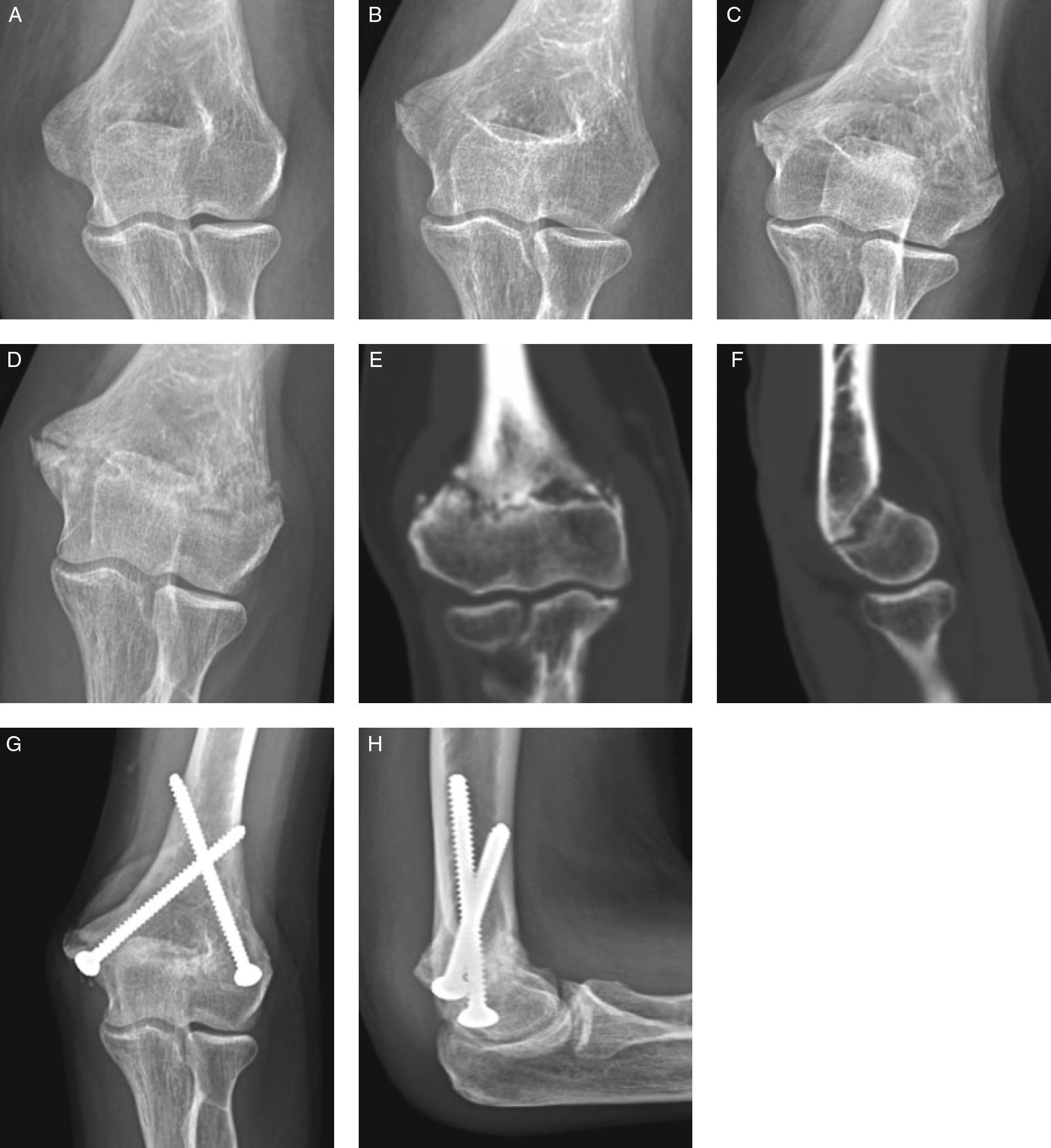
A 61-year-old woman presented with elbow pain after a fall on her outstretched left arm when trying to step over her cat. (A) An anteroposterior radiograph after injury was interpreted as indicating no fracture but, in retrospect, one can see a minimally displaced fracture at the medial epicondyle. (B) One week later, the fracture was more apparent on an anteroposterior radiograph. (C) One month later, an anteroposterior radiograph shows the low transcondylar extra-articular fracture more clearly. (D) Four months later, the fracture is still apparent on an anteroposterior radiograph. (E, F) Computed tomography scans show a stable, well aligned non-union. (G, H) One year after screw fixation, the fracture is healed.
When she was evaluated 1 week later in the office, she had a 20° flexion contracture and 130° of flexion. At this time, radiographs were interpreted as showing a nondisplaced medial epicondyle fracture (Fig. 1b). Nonweight bearing was advised with active motion exercises supervised by an occupational therapist.
One month after injury, radiographs revealed a complete transcondylar fracture of the distal humerus with near-anatomic alignment (Fig. 1c). Active exercises were continued. Four months after injury, the elbow was still painful and radiographs and computed tomography showed no interval healing with a more distinct fracture line (Fig. 1d-f). Open reduction and screw fixation without bone graft was performed. Six weeks after surgery, radiographs showed interval callus formation and bony bridging. One year after surgery, she has elbow flexion from 0° to 135°, full forearm rotation, and full function with no pain and a healed fracture on radiograph (Fig. 1g, h).
Patient 2
A 65-year-old woman with advanced rheumatoid arthritis on methotrexate and prednisone fell on her right elbow and had pain and swelling. Radiographs revealed a minimally displaced transcondylar humerus fracture. Operative treatment was advised by the surgeon and a percutaneous pinning was performed. The Kirschner wires were removed 1 month after surgery. Two months after surgery, the fracture line was apparent on radiographs although there appeared to be some healing. Four months after injury, the elbow was still painful and the fracture line persisted on radiographs. Seven months later, she had persistent pain and radiographic non-union and she was referred to the senior author (AAW) (Fig. 2a, b). Open reduction and internal fixation was performed using plates and screws without bone graft. She started active exercises within 1 week. Nineteen months after surgery, she had a healed fracture and a range of motion from 120° of flexion to a 40° flexion contracture, (which she felt was near her baseline as a result of rheumatoid arthritis) with minimal pain (Fig. 2c, d).
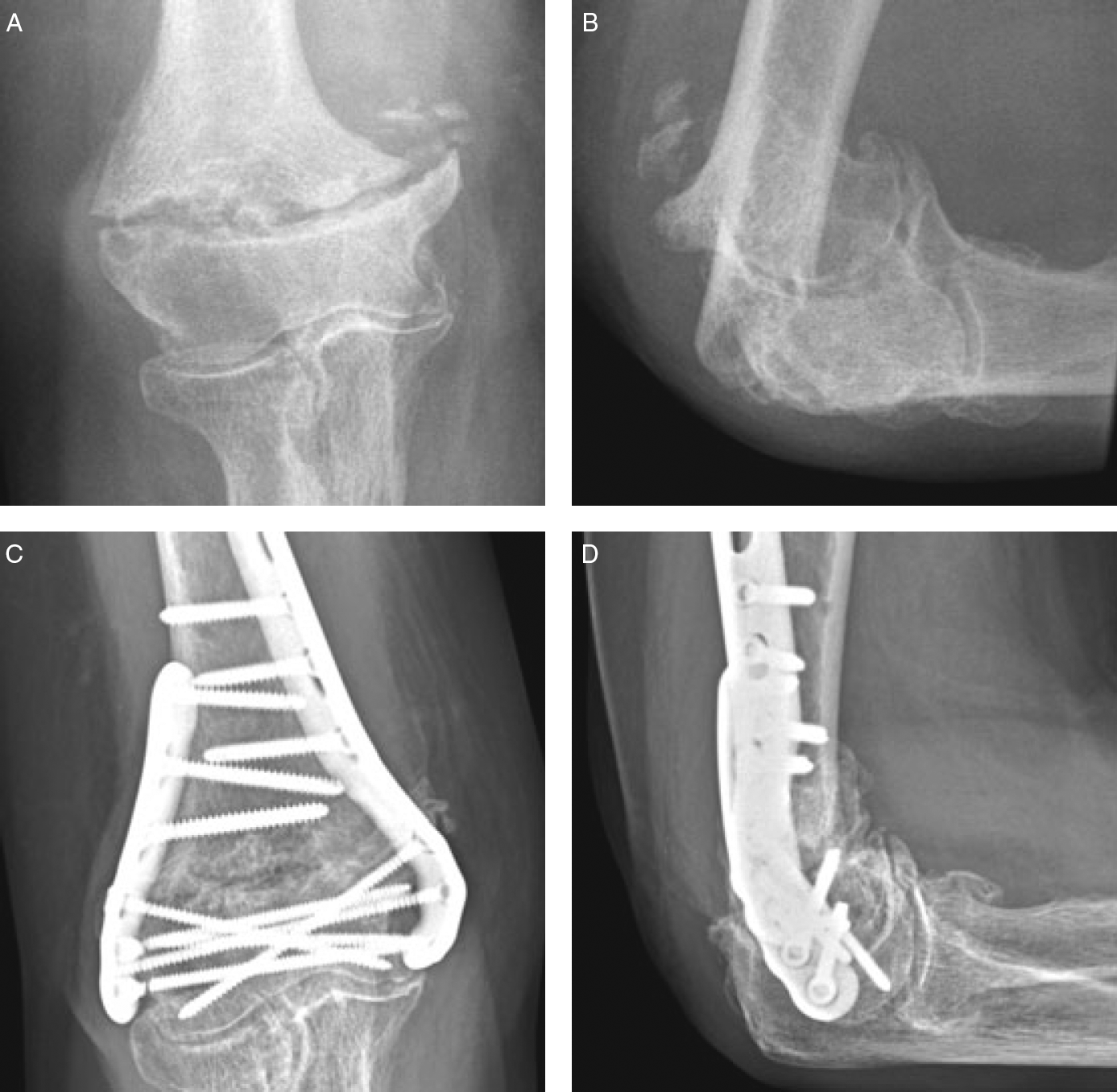
A 65-year-old woman with advanced rheumatoid arthritis on methotrexate and prednisone fell on her right elbow and had pain and swelling. Her minimally displaced transcondylar humerus fracture was treated elsewhere with percutaneous pinning. (A, B) Four months after injury, the elbow was still painful and anteroposterior and lateral radiographs showed a persistent fracture line. (C, D) Nineteen months after open reduction and internal fixation with plates and screws without bone graft, the fracture appears healed on anteroposterior and lateral radiographs.
Patient 3
A 55-year-old infirm man with diabetes mellitus, chronic renal failure, polysubstance abuse, hepatitis C and cirrhosis tripped and fell injuring his left elbow. On examination, the elbow was tender but had full motion. Radiographs revealed a nondisplaced transcondylar distal humerus fracture, which was treated with splint immobilization and pain medication. One week later, a cast was applied and radiographs revealed acceptable alignment. One month later, radiographs showed a displaced unstable extra-articular fracture of the distal humerus and he was transferred to the senior author (AAW). Open reduction and internal fixation with parallel plates was performed without bone grafts.
Active motion was initiated within 1 week. When last seen 1 month after surgery, his wound was healed, the radiographs showed stable alignment and fixation, and he had 100° of flexion and a 30° flexion contracture and an ulnar neuropathy. He did not return for scheduled visits thereafter. He was admitted to the hospital 1 year later with ununited left proximal femur and distal humerus fractures. The distal humerus non-union was unstable and the plates and screws were broken, loose and widely displaced. He had persistent ulnar neuropathy. He underwent operative treatment of the ununited femur fracture and had a complex postoperative course related to his multiple medical comorbidities. Surgery on the elbow was deemed too risky thereafter.
Discussion
Low transcondylar extra-articular fractures are uncommon, minimally displaced fractures in particular [1]. Non-operative treatment is the natural choice when the fracture is minimally displaced or nondisplaced, although these cases suggest that caution is warranted. Given that these three patients were transferred specifically for healing problems, it is of interest to consider how many patients with minimally displaced transcondylar fractures are successfully treated with cast immobilization. Not much has been written about these fractures, although Perry et al. had some success with non-operative treatment [2]. They reported a 100% union rate on three nondisplaced transcondylar fractures that were treated non-operatively. Furthermore, these fractures showed superior prognosis compared to displaced transcondylar fractures that were treated operatively in their series. Conversely, Robinson et al. described a high risk of non-union with low transcondylar fractures, particularly after non-operative treatment [1].
Considering that transcondylar fractures are uncommon, the literature dealing with non-unions of the low distal humerus reveals a relatively high prevalence of non-unions of transcondylar fractures. Ackerman et al. treated 20 non-unions of the low distal humerus, 13 of which were extra-articular, nine cases of which were initially treated operatively and four non-operatively [5]. Mitsunaga et al. reported on treatment of 32 non-unions of the distal humerus, two of which were transcondylar fractures. The initial treatment, however, was not mentioned [6]. Helfet et al. performed the largest study on 52 non-unions of the low distal humerus, in which six were classified as transcondylar (of which five were initially treated operatively and one non-operatively) [7].
Each of our cases is relatively unique. Patient 1 suggests that even occult fractures can prove problematic. Patients 2 and 3 raise the possibility that the fracture was displaced and unstable at the time of injury but relatively well aligned on radiographs. Although no conclusions can be made about optimal management on the basis of these patients, we can conclude that this type of injury merits caution in treatment and additional research.
Footnotes
Conflicts of Interest
David Ring is a consultant for Wright Medical, Acumed, Biomet and Skeletal Dynamics, and receives royalties from Wright Medical.
One or more of the authors (AAW) has received funding from the Marti-Keuning Eckhardt Foundation, the Netherlands and the Anna Foundation, the Netherlands