






Abstract
We model a situation where a firm wishes to balance workload requirements by creating a portfolio of recurrent insourcing and outsourcing contracts. We use harmonic analysis to decompose an input workload profile into a portfolio of insourcing and outsourcing contracts using rectangular‐wave basis functions to better achieve some desired constant workload level. However, this initial selection of contracts may result in impractical options. Therefore, we also develop mathematical programs using principles from goal programming and integer programming to refine the portfolio of contracts to more accurately reflect a realistic environment by placing constraints on the available contracts and explicitly considering operational costs. We consider several modeling extensions including the ability to hold limited amounts of inventory and the use of one‐shot contracts to supplement our portfolio of recurrent contracts.
Keywords
1. Introduction
Many companies face a continual challenge in adapting to changing workload requirements over time. Companies generally prefer the level loading characterized by a constant capacity utilization rate, but they often possess a large amount of fixed capacity assets that are not easily increased or decreased in the short‐term to adjust to changes in demand requirements. Therefore, companies have traditionally built up large amounts of inventory during periods of low demand in anticipation of high demand periods that will exceed their fixed capacity, or they have attempted to utilize a flexible work force through short‐term hiring and layoffs of workers. Other possible coping mechanisms for dealing with predictable variability include influencing customer demand through various pricing schemes or product mixes and more long‐term solutions such as building excess capacity to meet the maximum expected demand. However, these strategies are either very expensive, e.g., due to the high cost of hiring/laying off personnel, building excess capacity, etc., or cannot be applied in some industries, e.g., electric utility companies cannot easily build an inventory of product during low demand periods for use in high demand periods. In this context, some companies are turning to the use of subcontracting as a substitute for more traditional workload‐balancing strategies as a means to improve their response to changes in customer demand.
In many cases, companies are more willing to enter into recurrent subcontracts rather than the one‐shot subcontracting agreements typical of a spot market. Recurrent subcontracts represent a periodic commitment to provide (accept) service to (from) a company. As such, recurrent subcontracts provide the certainty for future services and cash flows, presenting attractive alternatives to one‐shot subcontracts, which represent agreements to provide (accept) service only once. Moreover, spot or non‐recurrent contracts merely push the load leveling problem back to the previous echelon of the supply chain. Ring and Van De Ven (1992) state that
Recurrent contracting enables the parties to build trust, by demonstrating norms of equity and reciprocity. … Thus, given the opportunity, parties may engage in recurrent low‐risk transactions within market governance structures for purposes of establishing higher levels of trust with their partners. Over time, recurrent contracting between parties also permits experimentation with safeguards calibrated to higher degrees of risk and greater reliance on trust.
Further discussions of recurrent‐type subcontracting agreements can be found in the transactions cost economics (TCE) literature (see Williamson, 1981, 1985 for a review of TCE). We consider the case where a company wishes to enter into recurrent subcontracting arrangements. Given this desire to establish recurrent subcontracts, we develop models to optimally design a portfolio of such subcontracts.
In particular, we consider a setting where one company, say Company A, provides a good or a service to the market, but there also exists a large number of similar firms that can provide perfectly substitutable goods or services that are willing to enter into recurrent subcontracting agreements. In this research, workload balancing over a time horizon is achieved in a novel way, by creating a portfolio of recurrent insourcing and outsourcing contracts to achieve a constant capacity utilization rate at some desired level. By insourcing we mean that Company A becomes a subcontractor for other firms. This strategy is graphically illustrated in Figure 1. In this research, we deviate from the traditional make‐or‐buy dichotomous sourcing decision, which assumes exclusive in‐house production or exclusive outsourcing, and allow a supplier to both make and buy during a regular operations cycle.
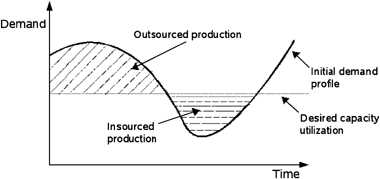
We begin our analysis by developing models for industries where Company A has no ability to hold inventory to protect against predictable variability. This could include traditional scenarios in the power generation industry where demand is seasonal, but there is no ability to store electrical power. Or, consider the case in the logistics industry where the sales and marketing departments are often motivated to book whatever contracts for transport that they can (due to sales incentives, etc.). At a later date, these commitments must be balanced with the available capacity (in the form of vehicles, drivers, trailers, etc.). Again, there is no ability to hold inventory in this example, but recurrent subcontracts may offer a means to balance workload with capacity. Later, we extend our analysis to consider one‐shot contracts and holding limited inventory amounts.
To summarize, our goal is to decompose a workload profile with negative and positive deviations from a desired capacity utilization level into a portfolio of recurrent insourcing and outsourcing contracts that achieves, as close as possible, some desired constant capacity utilization level. We employ harmonic analysis to decompose the initial workload profile into a sum of basis functions that represent the insourcing/outsourcing contracts. Harmonic analysis is a common mathematical tool that generalizes Fourier analysis and has many successful applications in areas such as pattern recognition, data compression, signal processing, data analysis, etc. However, to the best of our knowledge, this represents the first application of such transforms to workload balancing. While classic Fourier analysis uses trigonometric basis functions to approximate and decompose an input function, we rely mostly on rectangular waves represented by modified‐Walsh basis functions to obtain a portfolio of realistic insourcing/outsourcing contracts. Another important feature of this research is our combining the use of modified‐Walsh functions to represent recurrent contracts with mathematical programs that utilize formulation aspects common in goal programming and integer programming to further refine our results. These mathematical programs allow the decision maker to balance the portfolio of contracts by placing constraints on volume, frequency, and number of contracts.
The contribution of our work is twofold. First, we present a new approach based on harmonic analysis for developing portfolios of recurrent contracts to aid in workload balancing. Second, we combine this transform analysis with combinatorial optimization, formulating mathematical programming models that allow for increased flexibility of our model and further refinements of our results.
2. Review of Relevant Literature
Subcontracting has become an increasingly popular method that firms use to stay efficient and competitive in today's global markets. The most frequent form of subcontracting, outsourcing, has experienced rapid growth in recent years, particularly in the United States. Companies continue to outsource an ever expanding set of activities, ranging from product design and manufacturing to marketing, after‐sales services, and financial analysis (see, e.g., Engardio et al., 2003). Owing to its gaining popularity, there is an expanding body of literature in operations management that examines subcontracting – usually in the form of outsourcing. Below, we summarize subcontracting works published in the operations management literature that study analytic models and are most relevant to our research. We also briefly review works related to our research from the areas of capacity planning, Fourier transforms, and goal programming.
Kamien and Li (1990) propose a model in which subcontracting can be explicitly considered as a production planning strategy by employing a multiperiod, game‐theoretic approach where two firms with substitutable technologies seek to determine how much to subcontract from the other in the presence of stochastic demand. Van Mieghem (1999) studies the coordination of capacity investment, production, and subcontracting decisions by analyzing a single‐period, competitive stochastic investment game with recourse between a manufacturer and a subcontractor under stochastic demand. In this context, the author analyzes and presents outsourcing conditions for three contract types: price‐only contracts, incomplete contracts, and state‐dependent price‐only and incomplete contracts. Cachon and Harker (2002) use a game‐theoretic framework to analyze a model which incorporates horizontal competition or customer demand between two firms which face scale economies. In addition, each firm is allowed to outsource production to a supplier. Note that, while the above works have a similar objective to ours in that they employ subcontracting to achieve production smoothing, they are different from our work in the scenarios used (stochastic demand, competition between firms) and in their employed methodology for analysis.
Atamtürk and Hochbaum (2001) consider the trade‐offs between capacity acquisition, subcontracting, production, and inventory decisions to meet a varying demand forecast over a multiperiod horizon. Similar to our work, the authors use the demand forecast as the basis for choosing an appropriate subcontracting schedule. Atamtürk and Hochbaum propose solutions that simultaneously optimize over the subcontracting, production, and inventory decisions while we focus only on subcontracting. Logendran and Puvanunt (1997) and Logendran and Ramakrishna (1997) address the problem of multiperiod‐capacity allocation and subcontracting bottleneck parts in cellular and flexible manufacturing systems. Similar to our work, these papers assume that demand is deterministic. However, the authors use heuristics to solve their resulting mathematical programs, while we provide optimal solutions.
Subcontracting through outsourcing has also been addressed in the economics literature. For example, in a recent paper Grossman and Helpman (2005) propose a framework that firms can use to determine the location of outsourcing in a global economy. Unlike our model, the authors do not allow firms to produce in‐house as an alternative, or in parallel, to outsourcing. For more works on outsourcing in the economics literature, we direct the reader to Grossman and Helpman (2002) and references therein.
Our research is also peripherally related to previous work in the area of capacity planning. The focus in the capacity planning literature is on determining the sizes, types, and timing of capacity adjustments in order to satisfy forecasted customer demand. This contrasts with our research, where capacity is considered fixed and customer demand is met through subcontracting. Research in capacity planning has been well summarized in the excellent review paper by Van Mieghem (2003).
In the work presented here, we focus on the use of modified‐Walsh functions to represent recurrent contracts. Many other basis functions could be used to represent recurrent contracts. The most common functions used in traditional harmonic analysis are trigonometric functions (Fourier analysis). Fourier analysis is a mathematical technique used successfully in signal and image processing, word recognition, signature verification, filtering, data compression, communications, spectroscopy, and many other applications. For a review of theory and traditional applications of Fourier analysis, we direct the reader to Bracewell (1999).
Several recent references employ harmonic analysis in applications that are more common in operations management. Bloomfield (2000) provides an introduction to the use of Fourier transforms in statistical analysis. Dejonckheere et al. (2003) and Daganzo (2004) use Fourier transforms to examine the bullwhip effect in linear supply chains. In particular, Dejonckheere et al. (2003) measure the bullwhip effect using the ratio of the amplitudes of demand (i.e., the input function) to inventory orders (i.e., the output function) using a Discrete Fourier Transform (DFT). This decomposition method is somewhat similar to our method for obtaining the volumes in insourcing and outsourcing contracts using discrete versions of modified‐Walsh functions. However, their use of the DFT ascribes no significance to the basis functions involved in the decomposition, while in our work the basis functions are essential in determining the timing and duration of the recurrent subcontracts. Specifically, our models will concentrate on the use of rectangular waves represented by modified‐Walsh basis functions to ease interpretation of the representative contracts. Walsh basis functions and their applications are documented in Beauchamp (1984).
In order to better constrain the recurrent subcontracts to resemble scenarios that would be acceptable in practice, we also propose mixed integer programs based on goal programming to further refine the selected portfolio of recurrent contracts identified by harmonic analysis. Goal programming is often used to consider a variety of objectives simultaneously and is popular in applications related to engineering, operations management, agriculture, public policy, etc. Most relevant to our work, goal programming can be used to find the best fit of a curve to data in the L 1‐norm, also known as the Least Absolute Deviation (LAD) fit. For a general review of goal programming formulations and examples of current applications see Lee and Olson (1999) and references therein. Fourier transforms and mathematical programming are also combined by Chen et al. (1998) to fit functions from an “overcomplete” (i.e., linearly dependent) set of periodic basis functions so as to minimize the l 1‐norm of coefficients among all such fits.
3. Rectangular‐Wave Basis Functions
3.1. Problem Description
We analyze a setting where multiple companies provide a product or service to the market. Demand for this product at the company of interest, Company A, is deterministic, but with a high degree of predictable variation. Company A is interested in subcontracting as a means to balance its workload over a time horizon of length H. We first consider the case where Company A has no ability to hold inventory for later use to the market; later, we relax this restriction. This scenario is illustrated by Figure 2, which shows the projected capacity utilization of Company A over the time horizon (Figure 2 is based on actual data of aggregate customer demand for electricity in New South Wales, Australia). The figure contains 32 data points sampled at equal time intervals and the time horizon is normalized to 1. Figure 2 is an example of what will be referred to as the capacity commitment profile for the company of interest (Company A).
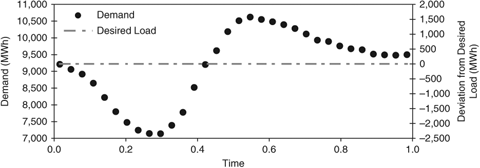
Most companies have a preferred capacity utilization based on the total capacity available, the desire to keep some capacity in reserve for emergency production, and the agent's ability to manage the process as capacity utilization increases. In Figure 2, the desired capacity utilization is set to 9250 MWh. Our problem can now be formulated in terms of finding a solution to eliminate the positive and negative deviations from the desired capacity utilization, as shown in Figure 2 using the right‐hand side y‐axis. To balance its workload, Company A wishes to establish recurrent outsourcing/insourcing contracts, where Company A commits to a certain subcontracting volume with other companies, over predefined periods of time. For instance, Company A may sign a contract with Company B to outsource 30 units of production every other week and a second contract with Company C to insource 60 units of production for one week each month.
3.2. Modified‐Walsh Basis Functions
Classical Fourier analysis uses trigonometric basis functions to decompose an input signal. While still a viable way to decompose the workload profile, trigonometric functions, however, are not entirely appropriate for our analysis as they raise interpretability problems. To better represent recurrent insourcing and outsourcing contracts, we prefer basis functions that remain constant for a certain amount of time, meaning that the subcontractor agrees to provide (accept) a constant amount of work for a given time, affording some measure of load leveling to the subcontractor. Walsh functions represent one such basis function that satisfies this requirement. Walsh basis functions have been used successfully in a wide range of applications, e.g., signal and image processing, character and pattern recognition, data compression, spectroscopy, statistical analysis, etc. (Beauchamp, 1984).
Walsh functions also capture important aspects of recurrent contract work. Specifically, each zero crossing indicates either the commencing or the halting of a work activity, (see Figure 3). Cohn (1971) defines the number of these zero crossings over the function's domain to be the sequency of a Walsh function. A high sequency indicates short production runs with possibly many setups, while a lower sequency indicates longer production runs with fewer setups. Walsh functions are also intrinsically linked with the harmonic analysis of time series. In particular, dyadic sampling of a continuous commitment profile over a certain time horizon [0, T] with scale N results in a discrete time series sampled at dyadic rational epochs t=kT/2 N for k=0, …, 2 N . For the dyadic group 2 ω , which embodies the algebraic properties of dyadic rational numbers for any choice of N, the dual group to 2 ω is comprised of Walsh functions, see Onneweer (1978).
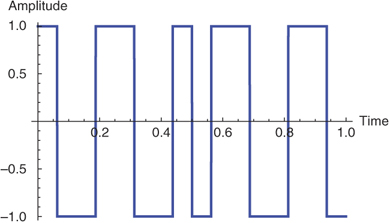
An examination of Figure 3 reveals that Walsh basis functions, however, still raise certain practical challenges, as each amount that is outsourced (insourced) is inextricably paired with an equivalent amount that must be insourced (outsourced). Therefore, seeking basis functions that allow a realistic portfolio of insourcing and outsourcing contracts, we propose modified‐Walsh rectangular‐wave functions that eliminate the coupling of insourcing and outsourcing. These new functions are obtained by translating upward and scaling the Walsh functions, such that they take only positive values and have unit amplitudes, as illustrated in Figure 4. Note that a downward translation and scaling of the Walsh functions would also result in a complete set of basis functions. Our results, however, show no significant differences between the two translation methods and, therefore, we prefer to use the upward‐translated functions throughout our analysis.
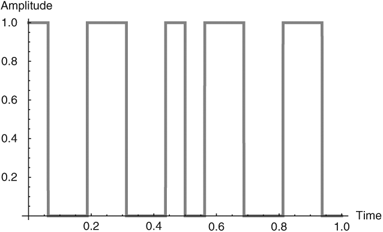
Thus, we propose decomposing the input workload profile into a set of modified‐Walsh basis functions that will represent a portfolio of insourcing and outsourcing contracts. The first step in performing this analysis consists in obtaining the Walsh functions. These functions can be derived in several different ways, e.g., from recursive relations, from products of Rademacher functions, through the Hadamard matrix, etc. Each of these methods generates Walsh functions that are in a different order, e.g., sequency order, Dyadic (or Paley) order obtained by generation from successive Rademacher functions, or natural order which follows from the Hadamard matrix. The ordering of the Walsh functions is not relevant in our study, as the order of rows in a Walsh matrix does not affect our data fitting results. Therefore, each of the above methods that generate Walsh functions can be employed with identical results. However, in all our numerical trials shown here we use the sequency order, which allows for convenient interpretation because basis functions are sorted in increasing order of the number of times that work activity must be commenced. Details for obtaining the Walsh basis functions can be found in Beauchamp (1984). The modified‐Walsh matrix is then readily obtained by replacing the negative values in the Walsh matrix with null values. Given that the profile in Figure 2 is based on a discrete data set, a transformation of the data into insourcing and outsourcing contracts at discrete time epochs is appropriate here.
3.3. Spectral Analysis of Subcontracts
In Section 4.1, we will formulate a mathematical program based on harmonic analysis. This model, labeled
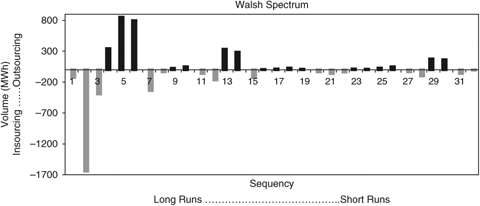
Analysis of the spectrum could also reveal potential difficulties. For example, high sequency and large volume, or low sequency and high volume, are likely to be difficult combinations for any subcontractor. Other portions of the spectrum might be problematic for industry‐specific reasons as well. Even the number of basis functions, i.e., insourcing/outsourcing agreements, may be larger than that which Company A prefers to maintain or manage. The mathematical programming models presented in the next section allow managers to deal with such practical issues by choosing decision variables to “filter out” certain sequencies, or by choosing appropriate cost coefficients, or by formulating appropriate constraints.
4. Mathematical Programming Models for Recurrent Contracts
An important contribution of this research is the use of mathematical programming to select an appropriate portfolio of insourcing and outsourcing contracts. Our preliminary results suggest that simply fitting discrete modified‐Walsh functions to our data leads to certain practical difficulties. For example, the amplitudes of some basis functions, which represent the quantities to be outsourced/insourced, are smaller than any company would practically provide. In other cases, the number of basis functions, i.e., number of outsourcing/insourcing agreements, is larger than Company A can effectively maintain or manage. Therefore, in this section we construct models that select the basis functions that satisfy certain feasibility criteria related to amplitude and number of functions. Our proposed mathematical programs incorporate several features common in goal programming. In particular, we separate positive and negative deviations of the resulting portfolio of insourcing and outsourcing contracts from the desired capacity utilization level using a formulation often seen in goal programming models.
Our first model seeks a best‐constrained fit of basis functions in the L 1 norm by minimizing an objective function consisting of the sum of these positive and negative deviations. Several results about the convergence of Walsh series in the L 1 norm were surveyed by Wade (1982). Most relevant here is that for a function f∈L 1 (2 ω ) possessing a “continuity‐like” condition, the Walsh series converges to f in the L 1 (2 ω ) norm; see also Onneweer (1978). This result implies that as the scale of dyadic sampling applied to an appropriate continuous commitment profile f is refined, i.e., as N increases, the Walsh series converges to this profile.
Use of the L 1 norm, also known as the LAD measure of fit, avails us of the powerful capabilities of integer linear programming. Consider a general discrete commitment profile ζ t , sampled at equally spaced instances in time, over a certain time horizon, and indexed by t∈{0, …, T=2 N −1}; here N is also called the order of the problem instance. Note that in all our numerical trials we employ samples with a power‐of‐two number of elements (2 N ). Thus, we first formulate a mixed integer linear programming model which seeks the best L 1 approximation to ζ t using only a subset J⊆J(N) of basis functions, where J(N) represents a specified set of modified‐Walsh basis functions. This consists of finding a fit using only the functions in the subset, which minimizes the sum of absolute deviations. In this model, the cardinality K=|J| of the subset of basis functions is specified, but not the subset itself. The model then selects the K basis functions that comprise the subset as well as the multipliers yielding the best‐constrained L 1 fit. In the following sections, we extend this model to reflect the impact of subcontracting on Company A's operating costs. All our models are implemented using the CPLEX callable library via code written by the authors.
4.1. Base Model
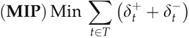





Note that here  represents the element of a Walsh matrix of rank 2
N
in row t (corresponding to data point t) and column j (corresponding to basis function j), and a
j
is the multiplier associated with function j, which represents its amplitude or volume. Further, M represents an arbitrarily large number. Each constraint (2) decomposes a deviation of the composite function from a data point into “negative” (δ
t
−) and “positive” (δ
t
+) components, which practically represent unmet demand and excess production/capacity in period t, respectively. Both δ
t
− and δ
t
+ are required by (6) to be non‐negative. The objective function (1) thus represents the sum of absolute deviations from the data points of the commitment profile, and it will compel at least one deviation (either δ
t
− or δ
t
+) to be zero ∀t∈T. The cardinality limit for the set J is enforced by (3), while logical forcing constraints (4) and (5) link each multiplier a
j
to the corresponding function selection variables y
j
. Note that we use (5) for the cases when multiplier a
j
takes negative values.
represents the element of a Walsh matrix of rank 2
N
in row t (corresponding to data point t) and column j (corresponding to basis function j), and a
j
is the multiplier associated with function j, which represents its amplitude or volume. Further, M represents an arbitrarily large number. Each constraint (2) decomposes a deviation of the composite function from a data point into “negative” (δ
t
−) and “positive” (δ
t
+) components, which practically represent unmet demand and excess production/capacity in period t, respectively. Both δ
t
− and δ
t
+ are required by (6) to be non‐negative. The objective function (1) thus represents the sum of absolute deviations from the data points of the commitment profile, and it will compel at least one deviation (either δ
t
− or δ
t
+) to be zero ∀t∈T. The cardinality limit for the set J is enforced by (3), while logical forcing constraints (4) and (5) link each multiplier a
j
to the corresponding function selection variables y
j
. Note that we use (5) for the cases when multiplier a
j
takes negative values.
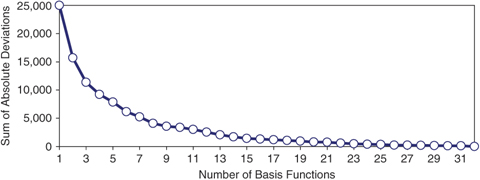
We are interested next in characterizing matrix
The
4.2. Operational Cost Minimization Model
 , and a cost of p for each unit of unmet demand when
  . A key assumption here is that Company A has no ability to hold inventory and, therefore, idle capacity in a period cannot be used to build inventory in anticipation of future demand. We relax this assumption in a following section.
Rather than restricting the number of contracts allowed, we can impose a fixed cost for each insourcing/outsourcing contract signed by Company A to account for administrative, processing, and managerial costs. We use Γ
j
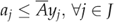
in the objective function to represent the fixed cost associated with contract (basis function) j. This feature enables our program to select, based on their fixed cost, only a subset of basis functions. Another characteristic of this model is that it allows us to place minimum and maximum constraints on the amplitude of basis functions as needed. This is intended to represent the situation where Company A, or its subcontractors, has minimum contract levels required for economies of scale or where the company is seeking to place a cap on its individual subcontracting commitments. In our model,
 in constraints (8)–(11) represent the minimum and maximum contract volumes, respectively, for Company A and x
j
, j∈J, in constraints (8)–(9) are auxiliary binary variables used to enforce the minimum contract volume constraints.
in constraints (8)–(11) represent the minimum and maximum contract volumes, respectively, for Company A and x
j
, j∈J, in constraints (8)–(9) are auxiliary binary variables used to enforce the minimum contract volume constraints. 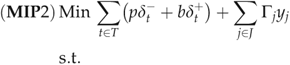



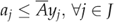


 and set unit costs to b=1 and p=2. Table 1 presents the solution to
  and
and  in Table 1).

4.3. Model that Includes Inventory
Our previous models assume that Company A has no ability to hold inventory. Here we consider a scenario where Company A has some limited ability to hold inventory from period to period. Such a situation may be applicable to industries outside of power generation where both subcontracting and inventory can be used to balance workload requirements over time. However, even within the power generation industry, such models may have an application due to advances in storage technology. While storing electricity remains technologically difficult and expensive, there exist both traditional and emerging technologies to offer limited storage capabilities for power generation (see Tennessee Valley Authority 2003, 2006 for examples related to hydro and battery‐like storage facilities). This would represent a tremendous advantage, as “by storing power generated during periods of low demand, [a company] can avoid having to search the open market for power during peak times which may not be there” (Paulk, 2002). By using such technologies, Company A could rely less on subcontracting, and, thus, trade off periodic insourcing and outsourcing contracts with the use of inventory. To modify our models to allow for the limited use of inventory, we define β
t
as the amount of idle capacity used in period t for production of inventory to be used in some future period. Also, define  as the maximum amount of inventory that can be held from period to period. Thus,
  can be thought of as a space constraint for traditional inventory or a limitation on storage amount of electricity for power plants. Let h be the per unit cost for holding inventory for one time period. Similar to







We keep the parameters Γ
j
, p, b,  , and
, and
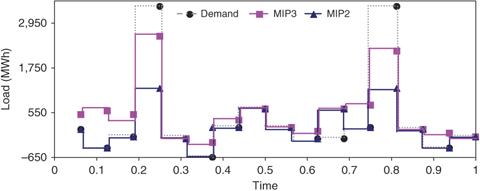
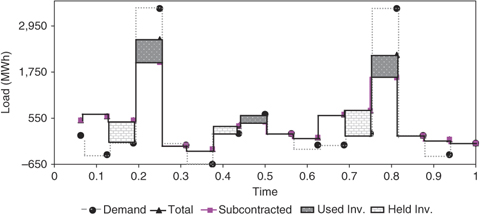
 and h=0.50. The optimal solution and resulting total costs are shown in Table 3. Allowing the company to hold inventory leads to cost savings of 1.39% in this example. The lower cost under

To better illustrate how the use of inventory interacts with subcontracting, we apply models  is particularly apparent in the two large demand spikes shown in Figure 7. Figure 8 illustrates that this is because
5. Alternative Contract Forms
The above results illustrate the practical advantages of using recurrent contracts as a means to achieve a level production load. The methodology we propose in this research is general and does not depend on the specifics of a certain category of basis functions; alternative basis functions may be more appropriate for decision making in other settings. Thus, for example, a company may be seeking additional sources of supply or outlets for its products which include non‐recurrent, one‐shot agreements with new partners to supplement its current portfolio of recurrent contracts. Alternatively, given its internal technical processes Company A may face a certain learning curve or setup each time a contract, be it recurrent or one‐shot, is initiated. In such cases, basis functions that allow for a gradual ramp‐up of output may be more appropriate. In this section, we consider such alternative basis function forms.
5.1. Use of “One‐Shot” Contracts
Our results above show that the use of recurrent contracts provides an effective mechanism for Company A to rely on its traditional partners to balance workload. However, Company A may be interested, for example, in finding new business partners or exploring opportunities in new markets that are not guaranteed to be recurrent relationships. Thus, while such endeavors are likely to lead to higher costs, e.g., cost of entry on new markets, costs due to the higher uncertainty of future cash flows or reliability of new partners, etc., Company A may seek to enter one‐time agreements that allow for more accurate assessments of the capabilities of new partners or of the characteristics of new markets. One‐shot contracts assume a one‐time exchange of products or services between parties, without any further commitments. One‐shot contracts can also help Company A better cope with spikes in the commitment profile. As such, we believe that, while recurrent contracts are adequate to model relationships with traditional partners, non‐recurrent, or one‐shot, contracts are appropriate business exploration instruments for new and volatile markets.
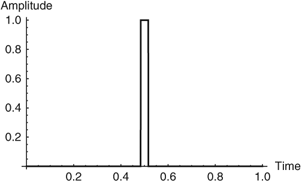
An appropriate way to model the characteristics of one‐shot contracts is using pulse functions. We propose pulse functions that, as illustrated in Figure 9, assume unit values over a defined sub‐interval and zero otherwise. When considered together with their multipliers (similar to the modified‐Walsh multipliers a
j
introduced in Section 4) and aggregated over the time horizon, the pulse functions are very flexible and can represent any general step function. To demonstrate the benefits of using pulse functions in addition to modified‐Walsh functions, we run model
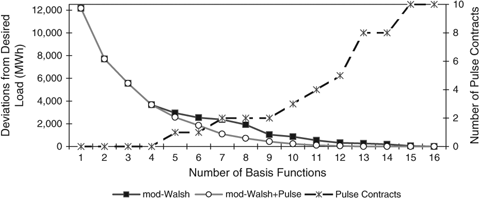
To further capture the benefits of using one‐shot and recurrent contracts, we apply model
5.2. Ramp‐Up Production Models
In the above examples, it has been assumed that Company A, and its subcontractors, can immediately reach the production level dictated by the functional decomposition procedure. For example, if Company A is required to supply 100 MWh per period as part of an outsourcing contract, it is assumed that this production level can be reached instantaneously, without any learning curve or gradual ramp‐up in production output. Here, we discuss alternative basis functions that relax this assumption.
A significant number of industries require, due to the nature of their technological processes or necessary setups, a gradual ramp‐up of their production output before reaching a desired level. In such cases, the use of modified‐Walsh or pulse basis functions to represent production output is not entirely appropriate. Instead, we can use a ramp‐up basis function as shown in Figure 11. The methodology for obtaining the portfolio of insourcing and outsourcing contracts is the same here as described in Section 4.
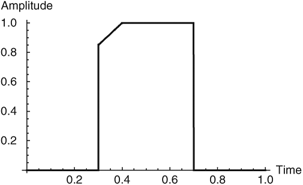
For illustration, we again consider the input profile in Figure 2 and model
6. Conclusions
In this paper, we present a novel approach to balance workload for a company facing deterministic, predictably variable demand. Because it is often easier to find subcontracting partners more interested in recurrent contracts than in one‐shot contracts, we develop models to find portfolios of periodic insourcing/outsourcing contracts to balance workload. Specifically, we propose the use of harmonic analysis to decompose an input workload profile into a portfolio of insourcing and outsourcing contracts. We present models using modified‐Walsh basis functions to represent recurrent contracts due to their inherent shape and form.
We then turn to combinatorial optimization to enhance the practicability of recurrent subcontracting solutions. Specifically, we consider mathematical programs that more closely reflect the constraints encountered in industry. We develop several mathematical models based on formulations common in goal programming which allow for constraints on the amplitude of the basis functions (which corresponds to the volume of insourcing and outsourcing subcontracts). The inclusion of integer variables in these models further allows for constraints on the number of basis functions (which represents the number of subcontracts in the portfolio). We present several numerical examples of our models using data from a power company located in New South Wales, Australia. We also study a more complex model formulation which seeks to minimize the operational costs of creating a portfolio of subcontracts by assessing costs for idle capacity, unmet demand, and administration of contracts. We then consider the impact of being able to hold limited amounts of inventory in addition to a portfolio of recurrent contracts. Finally, we present several alternative basis functions, such as simple pulse functions, to represent non‐recurrent, or one‐shot, contracts and contracts that allow for gradual ramp‐ups in output volume, which may be more representative of some industry scenarios.
There are several possible extensions of our work. Allowing demand to be stochastic is a natural extension that would introduce, however, considerable modeling challenges. It would also be of interest to include the possible use of spot markets to provide one‐shot outsourcing capabilities. In reality, the availability and price of such spot markets are also stochastic and could be captured in a more complicated model.
Our work represents, to the best of our knowledge, the first application of harmonic analysis to workload balancing. Our models provide simple and effective means for generating an optimal portfolio of recurrent subcontracts and limited inventory quantities to balance workload while also allowing for the incorporation of several practical operational constraints related to the subcontracts. We believe that our approach to workload balancing can be applied in diverse manufacturing and service environments where holding inventory is technically challenging or very expensive and there exists a significant number of providers of similar products or services willing to enter into recurrent subcontracts. Power generation is one example of an industry that generally has limited, or no, ability to hold inventory and which may find recurrent subcontracting to be a preferable option to other means of balancing workload. In a recent Newsweek article, former United States Vice President Al Gore discussed the continued emergence of the “electranet,” a group of small, alternative energy providers that would be linked through an intelligent network to provide and share energy (Gore, 2006). Such a network could provide further opportunities in the power industry for the types of recurrent subcontracting options that we discuss here. We hope this research will spark additional models and investigations into the use of subcontracting to reduce costs and better cope with the operational challenges facing many businesses.
Footnotes
Acknowledgments
The authors are grateful to the associate editor and two referees, whose constructive comments have significantly improved the paper.