






Abstract
Shelf‐space scarcity is a predominant aspect of the consumer goods industry. This paper analyzes its implications for category management. We consider a model where two competing manufacturers sell their differentiated products through a single retailer who determines the shelf space allocated to the category. The scope of category management is pricing. We consider two category management mechanisms: retailer category management (RCM), where the retailer determines product prices and category captainship (CC), where a manufacturer in the category determines them. Our analysis reveals that the retailer can use the form of category management and the category shelf space to control the intensity of competition between manufacturers to his benefit. We also show that the emergence of CC depends on the degree of product differentiation, the opportunity cost of shelf space, and the profit sharing arrangement in the alliance. The equilibrium category shelf space under CC may be higher than under RCM if the value to the retailer of eliminating double marginalization and putting price pressure on the non‐captain manufacturer dominates the loss from sharing the profit with the category captain. CC has been criticized for disadvantaging non‐captain manufacturers. While we provide some support for this claim, we also find that CC may benefit non‐captain manufacturers when implemented by a powerful retailer in categories with sufficiently differentiated products, because the shelf space allocated to the category increases in this case.
Keywords
1. Introduction
A product category is defined as a group of products that consumers perceive to be interrelated and/or substitutable. Soft drinks, oral care products, and breakfast foods are some examples of retail categories. Category management is a process for managing entire product categories as business units. Unlike the traditional brand‐by‐brand or SKU‐by‐SKU focus, category management emphasizes the management of a product category as a whole, allowing the decision maker to take into account the customer response to decisions made about substitutable or interrelated products. In particular, category management involves decisions such as product assortment, pricing, and shelf‐space allocation to each product on the basis of category goals. Taking into account the interdependence between products increases the effectiveness of these decisions. However, category management requires that significant resources be dedicated to understanding the consumer response to the assortment, pricing, and shelf placement decisions of products within a category.
Traditionally, category management decisions were taken by the retailer, a practice that we henceforth call “retailer category management” (RCM). Recently, retailers have started to outsource category management to their leading manufacturers, a practice often referred to as “category captainship” (CC). For example, Carrefour implements CC with Colgate in the oral care category (ECR Conference 2004), and Walmart designates category captains in some of their product categories (Gjaja et al. 2002). Factors such as the increase in the number of product categories offered by retailers, combined with the scarcity of resources to manage each category effectively, have given rise to this new trend. In a typical CC arrangement, the retailer shares pertinent information such as sales data, pricing, turnover, and shelf placement of the brands with the category captain. The category captain, in return, conducts analysis about the category and provides the retailer with a detailed plan that includes recommendations about which brands to include in the category, how to price each product, how much space to allocate to each brand, and where to locate each brand on the shelf. The retailer is free to use or discard any of the recommendations provided by the category captain. In practice, retailer response ranges from adoption of all recommendations to a process for filtering and selectively adopting manufacturer recommendations.
The number of products in the consumer goods industry increased by 16% per year between 1985 and 1992, while shelf space increased by only 1.5% per year during the same period (Quelch and Kenny 1994). The persistent scarcity of shelf space has two important implications.
First, in a typical implementation of category management, the retailer first determines the category shelf space on the basis of category goals, and then gives each category manager the responsibility of making within‐category decisions. With many categories to place in a limited amount of store space, retailers carefully scrutinize the relative profitability of each category to determine how much space is allocated to it (Chen et al. 1999). For best results, this decision should depend on the characteristics of the products in each category. Since using RCM vs. CC changes the profitability of a category, the optimal level of category shelf space differs between the two forms of category management. The consequences of such a difference for the parties involved is not clear.
Second, shelf‐space scarcity intensifies manufacturer competition. In Store Wars, Corstjens and Corstjens (1995) describe contemporary national brand manufacturers as being in a continuous battle for shelf space at the retailer. In this context, CC may disadvantage the non‐captain manufacturers. Indeed, there is an emerging debate on whether or not CC poses antitrust challenges such as competitive exclusion, where the category captain takes advantage of its position and harms the other manufacturers in the category (Desrochers et al. 2003, Greenberger 2003, Klein and Wright 2010, Leary 2003, Steiner 2001).
Motivated by these issues, we pose the following research questions:
How should the retailer assign shelf space to a category? How does the optimal category shelf space depend on product characteristics and the choice of category management mechanism? Under what conditions does CC benefit each stakeholder? Does CC always result in competitive exclusion, i.e., is the sales volume of the non‐captain manufacturer lower under CC?
To answer these questions, we consider a two‐stage supply chain where two competing manufacturers each sell one product to consumers through a common retailer. The products are substitutes and the scope of category management is pricing. To capture the retailer's shelf‐space concern, we incorporate an opportunity cost for shelf space in the model. With either RCM or CC, the retailer first determines the category shelf space by trading off his expected share of category profits with the opportunity cost of the shelf space. In RCM, the retailer then determines the retail prices of the two products subject to the shelf‐space constraint and the wholesale prices quoted by the manufacturers. In CC, the retailer forms an alliance with one of the manufacturers, whom we refer to as the category captain. This manufacturer determines the retail prices of the two products subject to the shelf‐space constraint and the wholesale price quoted by the non‐captain manufacturer. We characterize the equilibrium category shelf‐space level, wholesale prices, retail prices, and equilibrium sales volumes in the two scenarios. This analysis sheds light on how the retailer should utilize the scarce shelf space. We compare the two scenarios to investigate the impact of using CC vs. RCM on all stakeholders.
The rest of this paper is organized as follows. The next section places our paper in the context of the existing literature and outlines our contributions. In section 3, we describe the model and discuss our assumptions. Section 4 analyzes the RCM and CC scenarios, while section 5 investigates the impact of CC on all the parties in the supply chain. Section 6 concludes with various implications of our analysis.
2. Contributions to the Literature
Despite more than a decade of implementation, there is limited academic research concerning CC. Only two papers address this topic (Niraj and Narasimhan 2003, Wang et al. 2003); most of the focus has been on RCM. For example, Choi (1991) and Basuroy et al. (2001) analyze the impact of RCM on retailer prices and performance. The main focus of papers on RCM has been the transition from a brand focus to a category focus. Our research, on the other hand, focuses on the transition from RCM to CC.
Our research makes several contributions to the literature: First, shelf‐space scarcity is an important feature of the consumer goods industry. Therefore, it is important to understand how retailers should use category shelf space to maximize profitability under both RCM and CC, and to identify the resulting impact on the manufacturers. Previous literature has analyzed shelf‐space allocation from different perspectives. For example, Corstjens and Doyle (1981, 1983) consider a model where limited shelf space is allocated among products with shelf‐space‐dependent demand. Martin‐Herran et al. (2006) extend the basic Corstjens and Doyle model to investigate the impact of limited shelf space on manufacturer competition (i.e., wholesale prices) and the equilibrium space allocated to each product. These papers take the level of shelf space as given. In our model, the category shelf‐space level is determined endogenously before within‐category shelf‐space allocation decisions. An important consequence is that our model allows us to investigate how the retailer's category shelf‐space choice depends on the degree of product differentiation, market potential, and production cost, as well as the category management scenario in use.
Second, we broaden the knowledge base concerning the emergence of CC. Niraj and Narasimhan (2003) develop a model with two manufacturers who sell their differentiated products to a retailer facing uncertain demand. The manufacturers and the retailer each observe a demand signal before entering into a wholesale price contract. CC is defined as an exclusive information sharing alliance that one manufacturer and the retailer enter into before the wholesale price game. They conclude that such an alliance would emerge in equilibrium when the retailer's demand signal reliability is high and the manufacturers' reliability is intermediate. Our research complements Niraj and Narasimhan (2003) by investigating the emergence of CC when CC is defined as a pricing alliance in an environment with limited shelf space. We show that the emergence of CC depends on the degree of product differentiation, the opportunity cost of shelf space, and the profit sharing arrangement in the alliance.
Third, we identify the fundamental ways in which limited shelf space affects the impact of CC. Wang et al. (2003) also model CC as an alliance between the retailer and the category captain, but do not incorporate shelf‐space considerations. They show that the alliance profit always increases under CC, whereas we find that including the opportunity cost of shelf space reverses this result under some conditions. This happens when the retailer's share of alliance profits is low enough that he significantly reduces the category shelf space, leaving at least one of the alliance members worse off. Irrespective of shelf space concerns, there are a wide range of conditions where both the retailer and the category captain benefit from CC. At the same time, the existence of an opportunity cost significantly changes the range of profit sharing arrangements where these two parties are both willing to enter into a CC alliance.
Wang et al. (2003) conclude that CC benefits the retailer and the category captain, but disadvantages the non‐captain manufacturer. The non‐captain manufacturer can only benefit from a restricted form of CC where the category captain is only given the authority to determine his own product's retail price. In contrast, we find that even with full pricing authority, there exists conditions where the non‐captain manufacturer benefits from CC when the opportunity cost of shelf space is taken into account. The reason is that the increase in the relative profitability of the category from switching to CC can result in an increase in the category shelf space and can create value for the non‐captain manufacturer. The threshold determining whether competitive exclusion takes place or not depends on the degree of product differentiation and the retailer's share of alliance profits. We also find that high opportunity cost exacerbates competitive exclusion.
Finally, as discussed earlier, some economists have voiced antitrust concerns related to CC (Desrochers et al. 2003, Klein and Wright 2010, Leary 2003, Steiner 2001). Our research contributes to the ongoing debate by offering theoretical support for the existence of competitive exclusion, but also identifying conditions under which such concerns need not arise.
3. The Model
We consider a two‐stage supply chain model with two manufacturers that each produce one product in a given category and sell them to consumers through the same shelf‐space‐constrained retailer. Below, we discuss our main modeling assumptions.
The demand for each product at the retailer is given by the linear demand functions 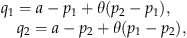
 . The unit production cost of both products is c. The production cost and the demand are common knowledge.
The parameters in the demand system have the following interpretation. If the retail prices for both products are set to zero, the demand for each product is a. Therefore, we interpret a as the market potential of each product. The parameter θ is the cross‐price sensitivity parameter that shows by how much the demand for product j increases as a function of a unit price increase in product i. The assumption  implies that the products are substitutable. As θ increases, the demand for product i, qi
, becomes more sensitive to price changes of product j, pj
. Hence, the parameter θ measures the degree of substitution across the products (hence, the degree of competition). The parameter θ is also inversely related to the degree of product differentiation.
implies that the products are substitutable. As θ increases, the demand for product i, qi
, becomes more sensitive to price changes of product j, pj
. Hence, the parameter θ measures the degree of substitution across the products (hence, the degree of competition). The parameter θ is also inversely related to the degree of product differentiation.
The linear demand system described in (1) is consistent with Shubik and Levitan (1980) and is widely used in marketing (Choi 1991, McGuire and Staelin 1983, Wang et al. 2003) and economics (Vives 2000, and references therein). The demand functions can be justified on the basis of an underlying consumer utility model: They are derived by assuming that consumers maximize the utility they obtain from consuming quantities q 1 and q 2 at prices p 1 and p 2, respectively. The underlying utility model and the corresponding demand function derivation are given in Appendix S1(A). The utility representation is useful as it allows us to calculate consumer surplus.
Since retailers operate on very thin margins, every unit of shelf space is scrutinized for profitability. In particular, retailers have to make decisions on how to allocate the total store space between categories. Retailers typically allocate category shelf space based on the profitability of each category relative to the other categories (Chen et al. 1999, Corstjens and Doyle 1981); space allocated to one category means profits foregone from another. To capture this within our model consisting of one focal category, we assume that the retailer determines the shelf space for the category based on the opportunity cost of the shelf space, C(S), a convex increasing function. For tractability, we assume that  .
.
Once the retailer decides on the category shelf space S, the pricing decisions are made subject to the constraint  . This model admits two interpretations. In the first interpretation, q
1 and q
2 can be viewed as demand rates for each product per replenishment period; the retailer prices the products so that the total demand rate does not exceed the shelf‐space availability. In the second interpretation, q
1 and q
2 can be viewed as the long‐term volumes to be purchased and sold subject to a total volume target for the category.
. This model admits two interpretations. In the first interpretation, q
1 and q
2 can be viewed as demand rates for each product per replenishment period; the retailer prices the products so that the total demand rate does not exceed the shelf‐space availability. In the second interpretation, q
1 and q
2 can be viewed as the long‐term volumes to be purchased and sold subject to a total volume target for the category.
We consider the following two scenarios that differ in who manages the category, i.e., who determines retail prices. In the first scenario, RCM, we assume the retailer determines the retail price for each product to maximize the category profit subject to the category shelf space already determined by the retailer. In this scenario, the manufacturers are in wholesale price competition to sell to the retailer, modeled as a simultaneous‐move wholesale price game.
In the second scenario, CC, the retailer designates one of the manufacturers as the category captain and delegates the pricing decisions to him. We model CC as in Wang et al. (2003) by assuming that the retailer and the category captain form an alliance. The non‐captain manufacturer offers a wholesale price to the alliance strategically in expectation of the quantity demanded of its product. The category captain then determines retail prices to maximize the alliance profit. In making the category shelf‐space decision, the retailer assumes that he will get a fraction φ of the alliance profit. The value of φ is either set at the beginning of the CC agreement, or it is the fraction of profits the retailer expects to obtain in ex‐post negotiation with the category captain.
4. Analysis
In sections 4.1 and 4.2, we analyze the RCM and CC scenarios, respectively, and in section 5, we compare them to identify the impact of CC on all stakeholders.
4.1. RCM
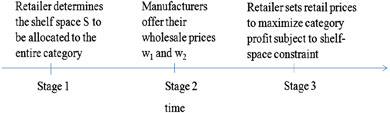
In the RCM scenario, the retailer first decides on the category shelf space and announces this category shelf space to the manufacturers. The manufacturers then play a simultaneous‐move Nash game in the wholesale prices. Finally, given the wholesale prices, the retailer determines the retail prices for both products. Figure 1 illustrates the sequence of events in the RCM scenario.
We solve the problem by backward induction. In the third stage of the game, the retailer solves the following constrained profit maximization problem for a given category shelf space S and wholesale prices w
1 and w
2: 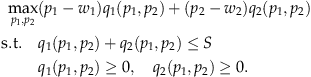
Let  and
and  denote the optimal quantities determined in the above optimization problem for given wholesale prices
  and category shelf space S. Appendix S1(B.1) characterizes
  and
and  .
.
Manufacturer i's profit is 
In the second stage of the game, anticipating the retailer's response functions  and
and  , the manufacturers play a simultaneous‐move wholesale price game. The resulting Nash equilibrium wholesale prices are characterized in Appendix S1(B.2).
In the first stage of the game, the retailer determines the category shelf space taking into account the subgame starting in stage two, and the opportunity cost associated with the category shelf space, kS 2. The following proposition provides the equilibrium category shelf space in the RCM scenario, denoted by SR , and the resulting equilibrium sales volumes, wholesale and retail prices, and equilibrium manufacturer and retailer profits.
P . Then
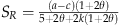 . The equilibrium sales volumes are given by
 The equilibrium wholesale and retail prices are given by
 and
and
 . The retailer's profit in equilibrium is given by
 , and the manufacturer profits are given by
 .
.
P
The condition  assures that the opportunity cost of shelf space is high enough that the retailer's equilibrium category shelf space choice results in a binding constraint; this allows us to focus on environments where the category shelf space is scarce.
The equilibrium category shelf‐space level, manufacturer profits, and retailer profits all increase in the market potential parameter a, which is intuitive. The opportunity cost parameter has the opposite effect on these values, as expected.
Interestingly, the equilibrium category shelf space increases in the parameter θ, i.e., the retailer allocates more category shelf space as the products in the category become less differentiated. To explain this, note that for a fixed level of category shelf space, less differentiation between products creates more competition between the manufacturers and drives wholesale prices down, while retail prices are unaffected. Thus, less differentiation increases the profitability of the category, incentivizing the retailer to increase the category shelf space. A counterbalancing force is the retailer's incentive to keep category shelf space limited to fuel the competition between the manufacturers. We observe that the equilibrium wholesale price decreases in θ in conjunction with an increase in category shelf space. In other words, in response to an increase in θ, the retailer strikes a balance between keeping category shelf space limited to maintain wholesale price competition and allocating more space to sell more of that category's products.
The equilibrium retailer profit increases in θ. This follows directly from the discussion above: The retailer transforms the increased competition between manufacturers into a profit increase. The equilibrium effect on manufacturer profits is positive for  , and negative for k larger than this threshold. This outcome is explained by the opposing impacts of increased manufacturer competition and increased category shelf space on the manufacturer. When k is small, i.e., the opportunity cost of shelf space is low, the equilibrium increase in shelf space in response to an increase in θ is large and the revenue effect due to the sales volume increase dominates the wholesale price decrease due to the increased manufacturer competition. When k is large, the shelf space increase is less sensitive to an increase in θ. Therefore, the wholesale price competition effect dominates the volume effect and the manufacturers are worse off from an increase in θ.
4.2. CC
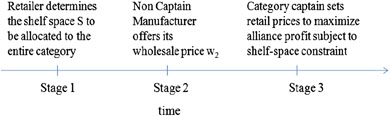
In the CC scenario, the retailer again determines the amount of category shelf space S and announces it. The second manufacturer then offers a wholesale price for its product to the alliance. Finally, the category captain determines the retail prices for both products subject to the shelf‐space constraint. The retailer obtains a share φ of the alliance profit. The sequence of events in the CC scenario is illustrated in Figure 2.
We solve the problem by backward induction. In the third stage, the category captain determines retail prices for both products to maximize the alliance profit for a given wholesale price w
2 and subject to the category shelf‐space constraint S. The category captain solves the following optimization problem: 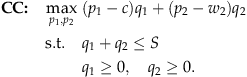
Let  and
and  denote the optimal quantities determined in the above optimization problem for a given w
2 and S. Appendix S1(C.1) characterizes
denote the optimal quantities determined in the above optimization problem for a given w
2 and S. Appendix S1(C.1) characterizes  and
and  .
.
In the second stage, given the category captain's response function  , the second manufacturer sets its wholesale price w
2. The resulting equilibrium wholesale price
, the second manufacturer sets its wholesale price w
2. The resulting equilibrium wholesale price  and equilibrium sales volumes
  and
and  for a given S are characterized in Appendix S1(C.2).
In the first stage, the retailer determines the category shelf space based on its expected share φ of the profits in the subgame starting in stage two, and the opportunity cost of shelf space, kS 2. The following proposition provides the equilibrium category shelf space in the CC scenario, denoted by SC , and the resulting equilibrium sales volumes, wholesale and retail prices, and equilibrium manufacturer and retailer profits.
P . Then
 . The equilibrium sales volumes are given by
 and
and
 . The equilibrium wholesale and retail prices are given by
 ,
,  , and
, and
 . The retailer's profit in equilibrium is given by
 . Equilibrium manufacturer profits are given by
 and
and
 .
.
P
As in the RCM scenario, the condition  allows us to focus on environments where the category shelf space is scarce.
Note that even though the manufacturers are symmetric, the category captain is allocated three quarters of the category shelf space compared with the non‐captain manufacturer who only gets one quarter of the category shelf space.
As in the RCM scenario, an increase in a increases the equilibrium category shelf space and benefits all parties, while an increase in k reduces the equilibrium category shelf space and hurts all parties. Equilibrium category shelf space and retailer profits increase in θ as in RCM, and the intuition is the same. The main qualitative difference between the two scenarios is observed in manufacturer profits. While under RCM, the opportunity cost of shelf space determines whether manufacturer profits increase or decrease in θ (based on whether the manufacturer competition effect or the volume effect dominates), in the CC scenario, the category captain profits always increase in θ, while the non‐captain manufacturer's profits always decrease in θ. This can be explained by the level of competition between the manufacturers. Because the category captain is in an alliance with the retailer, he is “protected” from wholesale price competition, while the non‐captain manufacturer essentially “competes” against a manufacturer who sets a wholesale price c. As a result, irrespective of k, the negative competition effect dominates the positive volume effect for the non‐captain manufacturer and his profits decrease as the products become less differentiated.
5. Analyzing the Impact of CC
In this section, we compare RCM and CC by comparing the results in Propositions 1 and 2, and investigate the effect of the transition to CC on all stakeholders. The results in this section are driven by what we dub the “profit potential” of the category for the retailer. All else being equal, a category has more profit potential for the retailer if the wholesale prices of the products are lower. Since wholesale prices differ under RCM and CC, the effective profit potential of the category for the retailer is affected by the category management scenario. The importance of the profit potential in our analysis comes from the fact that a category with higher profit potential commands more shelf space.
To compare the profit potential of the category under the two scenarios and tease out the drivers of our results, in Figure 3, we create an RCM‐like representation of the CC scenario with φ=1 that parallels the representation of the RCM scenario. For a given S, in RCM, the retailer maximizes his profits from the category taking as input wholesale prices  and
and  . The key to our RCM‐like representation is the observation that maximizing retailer profits when
  ,
,  , and φ=1 yields the same solution as maximizing alliance profits when
  . Thus, in our RCM‐like representation of CC, we view the wholesale price of the category captain's product as c. The wholesale price of the non‐captain manufacturer's product is
  . The retailer then sets prices to maximize his own profits.
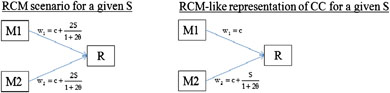
This representation highlights the two effects that distinguish RCM and CC. The elimination of double marginalization (“double marginalization effect”) is captured in the drop in w
1 from  to c, a drop of
  . The pressure that selling to the alliance creates on the second manufacturer (that we dub the “competition effect”) is captured in the drop in w
2 from
. The pressure that selling to the alliance creates on the second manufacturer (that we dub the “competition effect”) is captured in the drop in w
2 from  to
to  , a drop of
  . Thus, for a given category shelf space, the focal category has more profit potential for the retailer under CC wholesale pricing. We therefore expect the retailer to strategically allocate more category shelf space under CC if he appropriates the entire alliance profit (φ=1). However, as φ decreases, the effective profitability of the category for the retailer under CC decreases, and the equilibrium category shelf‐space SC
decreases. In fact, as the next proposition shows, for low enough φ, the equilibrium category shelf space under CC is lower than the equilibrium category shelf space under RCM.
. Thus, for a given category shelf space, the focal category has more profit potential for the retailer under CC wholesale pricing. We therefore expect the retailer to strategically allocate more category shelf space under CC if he appropriates the entire alliance profit (φ=1). However, as φ decreases, the effective profitability of the category for the retailer under CC decreases, and the equilibrium category shelf‐space SC
decreases. In fact, as the next proposition shows, for low enough φ, the equilibrium category shelf space under CC is lower than the equilibrium category shelf space under RCM.
P such that if
 , then
 , and otherwise,
  .
.
As mentioned earlier, one of the concerns about CC is that it may lead to competitive exclusion, i.e., the non‐captain manufacturer may lose shelf space or be otherwise disadvantaged. To investigate this in our setting, we say that CC creates competitive exclusion if the shelf space allocated to the non‐captain manufacturer is lower under the CC scenario. The following proposition compares the two scenarios from the non‐captain manufacturer's perspective.
P such that if
 , then
 , and otherwise,
  . Moreover, for
 ,
,  , and for
 ,
,  .
.
When the retailer's share of alliance profits is relatively low (i.e.,  ), competitive exclusion takes place (
 ) and the non‐captain manufacturer's profit decreases relative to his profit under RCM (
 ). In this region, the category shelf space either decreases, or it increases, but not enough to compensate the loss in the non‐captain manufacturer's share of category shelf space. For
  , the increase in category shelf space is large enough that it translates into more shelf space and higher profit for the non‐captain manufacturer.
It is easy to show that  for relatively small values of θ (i.e.,
  ). Therefore, the non‐captain manufacturer benefits from CC if the products are sufficiently differentiated (θ low enough). This is because Δ1 (the double marginalization effect) and Δ2 (the competition effect) both increase as θ decreases. Thus, the increase in the profit potential of the focal category as a result of switching to CC is larger when θ is lower and, consequently, the increase in the category shelf space is larger. When this increase is large enough, the non‐captain manufacturer benefits from CC.
To summarize, we have found that, contrary to concerns expressed about competitive exclusion, CC does not necessarily put the non‐captain manufacturer at a disadvantage. It is true that if the category shelf space was independent of who managed the category, CC would always lead to competitive exclusion. However, if the retailer acts strategically when moving from RCM to CC by making adjustments to the category shelf space, CC may lead to more shelf space and profit for the non‐captain manufacturer. This happens if the products are sufficiently differentiated.
Propositions 3 and 4 are only meaningful when the thresholds they identify fall in the region where CC can naturally emerge (where both the retailer and the category captain are better off under CC). In the next proposition, we investigate the impact of CC on the alliance members and the consumers.
P , and
, and
 such that the retailer is better off under CC if and only if
 ; the category captain is better off under CC if and only if
 ; and consumer surplus is higher under CC if and only if
 .
.
Figure 4 illustrates the result in Proposition 5. As expected, the retailer prefers CC only if he expects to appropriate a larger share of the alliance profit (i.e.,  ). The category captain, on the other hand, prefers CC for intermediate values of φ. As his share φ decreases, the retailer reduces the category shelf space, resulting in low alliance profit. This eventually hurts the category captain although he gets a larger share of the alliance profit. As φ increases, these effects are reversed and the category captain prefers RCM over CC for sufficiently large φ.
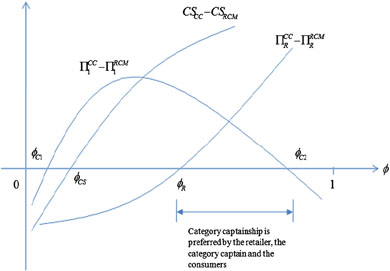
Under CC, category shelf space increases in φ. In turn, consumer surplus monotonically increases in category shelf space since both the total volume consumed (S) increases and product prices decrease. Thus, the gain in consumer surplus from switching to CC increases in φ. For low enough φ, not only is a lower quantity consumed, but it is consumed at a higher price than under RCM, and RCM dominates.
5.1. Numerical Analysis
We have found that, when the opportunity cost of shelf space is taken into account, CC may or may not be desirable for any of the parties. In the remainder of this section, we present a numerical study to understand how the parameters φ, θ, and k affect whether each party prefers the RCM or CC scenario; it can be shown analytically that a and c do not play a role. Figure 5 plots the regions in the φ–θ space for k=0, 0.3, and 0.6. The graph for k=0 corresponds to a shelf‐space‐unconstrained analysis of the problem. We make several observations:
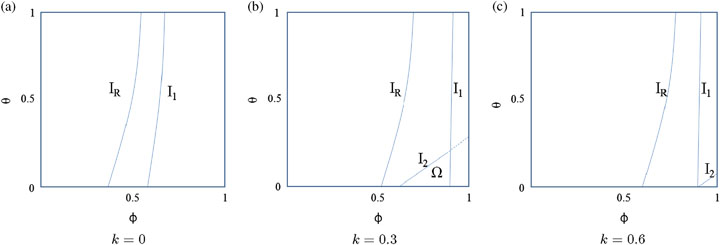
Observation 1: Both the retailer and the category captain prefer CC in the region between indifference curves IR and I 1. Therefore, we can interpret this region as the one where CC can naturally emerge. This requires that the retailer take a large enough share of profits that he is better off, but not so large that the category captain is worse off. This region is sensitive to the opportunity cost. For higher opportunity costs, the retailer needs a higher share of the alliance profit to benefit from CC. Interestingly, the category captain is willing to decrease his share of the alliance profit as the opportunity cost increases. For example, with k=0.3, the category captain prefers CC even with only 10% of the alliance profit (see Figure 5b where the category captain's indifference curve I 1 passes through φ=0.9, which corresponds to the case where the category captain gets 10% of the alliance profit), while he requires at least 40% share where the opportunity cost is zero (see Figure 5a where the category captain's indifference curve I 1 passes through φ=0.6). This is because the category shelf space increases in the retailer's share of the alliance profit. The relative benefit of this shelf‐space expansion is higher when opportunity cost is high, therefore, the category captain is willing to switch to CC with a smaller share of the alliance profits than he would require to switch when opportunity cost is low (and relative benefit of expansion is low).
Observation 2: If the opportunity cost of shelf space is positive and low enough (Figure 5a and c), there is a region where the non‐captain manufacturer is also better off. This occurs at relatively high φ and relatively low θ values. Switching to CC means more price pressure on the non‐captain manufacturer. This pressure is lower when products are more differentiated and there is more category shelf space. Therefore, for the non‐captain manufacturer to benefit from switching to CC, the products must be sufficiently differentiated. In addition, the retailer's share of the profit should be such that the category shelf space is high enough. This result is in contrast to Wang et al. (2003) where the non‐captain manufacturer is always disadvantaged under the CC. This is corroborated in our model by observing that region Ω does not exist for the case where the opportunity cost of shelf space is 0 (Figure 5a).
Observation 3: The threshold θ up to which the non‐captain manufacturer prefers CC increases in φ: As the retailer's share of the alliance profit increases, he allocates more space to the category, relieving some of the pressure on the non‐captain manufacturer, so this manufacturer benefits from CC over a larger range of product differentiation profiles.
Observation 4: There exists a  such that for
  , Ω does not exist. In other words, when the opportunity cost of shelf space is high enough, the non‐captain manufacturer prefers RCM for the entire region where both the retailer and the category captain prefer CC. Recall that the non‐captain manufacturer only benefits from a switch to CC when the resulting shelf‐space increase is large enough. Since the equilibrium shelf space chosen by the retailer decreases in the opportunity cost, there exists a threshold over which Ω disappears.
6. Conclusions and Discussion
Shelf‐space scarcity is a predominant aspect of the consumer goods industry. Our research shows that it has significant implications regarding the implementation of category management. We develop several recommendations for retailers regarding the use of category shelf space. We confirm the intuition that the retailer should allocate more category shelf space to categories with higher demand potential or lower cost. Since these properties increase the profit potential of the category for the retailer, he should capitalize on this by allocating more shelf space to it. This results in a win–win situation for all the parties in the supply chain. More interestingly, we recommend that the retailer allocate more shelf space to categories with less differentiated products to capitalize on the increased manufacturer competition. At the same time, the retailer should strike a balance between allocating more space to the category to sell more of that category's products and keeping shelf space limited to fuel wholesale price competition. While the retailer always benefits from less differentiation in the category, the impact on the manufacturers depends on the opportunity cost and the category management mechanism in use.
We analyze the impact of switching from RCM to CC on the category shelf space and the profits of each party. The key factor in understanding the drivers of these quantities is the profitability of the category net of opportunity costs. All else being equal, when switching to CC, the profitability of the category for the retailer increases through the formation of the alliance via two effects: the elimination of double marginalization and the increased price pressure on the non‐captain manufacturer. In contrast, it decreases in his share of the alliance profits. Thus, the equilibrium category shelf space under CC may be higher if the positive effect dominates, but lower if the negative effect dominates.
The possible increase in the category shelf space under CC has important implications for competitive exclusion. In particular, we conclude that CC arrangements should not immediately raise antitrust concerns, or be viewed negatively by non‐captain manufacturers as the resulting increase in the relative profitability of the category vis‐à‐vis the retailer's other categories can create value for non‐captain manufacturers via an increase in the category shelf space. The threshold determining whether competitive exclusion takes place or not depends on the degree of product differentiation and the retailer's share of alliance profits. In particular, CC does not result in competitive exclusion when the products are well differentiated and the retailer's share of alliance profits is high enough. With differentiated products, the gain from avoiding double marginalization and the drop in the non‐captain manufacturer's wholesale price are higher. Coupled with obtaining a high share of the alliance profit, these effects result in a large enough allocation to the category by the retailer that it offsets the non‐captain's loss in the fraction of shelf space he receives.
At the same time, we find that the concerns raised about the impact of CC practices on the non‐captain manufacturers should not be dismissed either. Our research provides clear support for the competitive exclusion hypothesis and concludes that CC practices should be scrutinized for competitive exclusion when implemented in categories where either the category includes many similar products and/or the retailer is not powerful enough compared with the category captain.
Our model also allows us to determine the role of opportunity cost on competitive exclusion. We find that the competitive exclusion region is larger when the opportunity cost of shelf space is high. Increasing the opportunity cost of shelf space reduces the amount of category shelf space and therefore that allocated to the non‐captain manufacturer, with the decrease in the shelf space allocated to the non‐captain manufacturer being more pronounced under CC. Therefore, our model predicts that, all else being equal, CC may lead to competitive exclusion at smaller retail formats with very limited store space.
We also investigate the impact of CC on the remaining parties. Not surprisingly, both parties are better off when the retailer appropriates enough of the alliance profit, but not so much that the category captain is disadvantaged. What is surprising is that, when the opportunity cost of shelf space is taken into account, the category captain is better off with CC even if he obtains a much smaller share of the alliance profits. This is because the category shelf space increases in the retailer's share of the alliance profit. The benefit due to the category shelf‐space expansion in going from RCM to CC that accrues to the category captain increase in the opportunity cost. This suggests that retailers can use the adjustment to category shelf space as a powerful mechanism to secure the cooperation of category captains even while appropriating a significant share of the alliance profit.
Finally, we find that consumers are always better off in those cases where the retailer is better off, regardless of opportunity cost. We conclude by underlining that, when the implicit cost of increasing category shelf space is taken into account, category management emerges as a tool that can leave all parties better off if applied to categories with differentiated products.
Our model is based on several assumptions that could be relaxed. For example, we assume that manufacturers are symmetric in terms of demand potential, cost and cross‐price sensitivities, and that retailer's cost of shelf space is convex. Relaxing these assumptions by considering asymmetric manufacturers or considering a linear cost of shelf space for the retailer would not impact the qualitative insights, but would change the magnitude of the effects observed. We assume that the retailer determines the shelf space before being quoted wholesale prices. It would be interesting to analyze the problem with the sequence of events reversed, although we expect the fundamental insights to hold as the manufacturers would still implicitly be competing for limited shelf space even if the actual level of shelf space is not yet announced. As pointed out in Lus and Muriel (2009), the linear demand model used in this paper should be treated with caution when interpreting the effect of the parameter θ that measures the degree of substitution. Therefore, future research could consider CC in the context of alternative demand models.
Our model can be extended in several other ways. First, we assume that the scope of CC is pricing only, however, in practice, the scope of CC is broader. In addition to pricing recommendations, the category captains would usually also provide recommendations on category assortment and category shelf‐space management. Future research could consider a model where the retailer relies on a category captain that provides a combination of assortment, pricing, and shelf‐space management recommendations. Second, we assume that the information available to the retailer and the category captain are the same. However, in practice, the basis for CC relationships is the category captain's superior knowledge about some aspect of the category. Future research should investigate the impact of CC and the possibility of competitive exclusion under asymmetric information.
Footnotes
Acknowledgments
This research was partly funded by the INSEAD‐PricewaterhouseCoopers Research Initiative on High Performance Organizations. The authors would like to thank Marcel Corstjens, Paddy Padmanabhan, Christian Terwiesch, and Ludo van der Heyden for helpful discussions, comments, and suggestions. We gratefully acknowledge the suggestions of the review team that strengthened the contributions of our paper.