






Abstract
We study the pricing problem of a “platform” intermediary to jointly determine the selling price of the platforms (hardware) sold to consumers and the royalty charged to content developers for content (software), when the demands for content and for platforms are interdependent. Our model elucidates the impact of supply chain replenishment costs and demand uncertainty on the strategic issues of platform pricing in a two‐sided market.
1. Introduction
In the classical newsvendor pricing model (cf. Whitin 1955), the challenge is to determine jointly the price and the ordering quantity of a product when demand for the product is a (random) function of the price charged (cf. Petruzzi and Dada [1999] and the references therein). Unfortunately, for products like the Xbox 360, the demand–price relationship may be so complex that it cannot be captured by conjoint data collected at the consumer end alone (cf. Raz and Porteus 2006). Each consumer needs an Xbox 360 console to play the console games developed by the content developers. Microsoft plays more the role of a “platform” intermediary. In this market, there is a strong cross‐side network effect, that is, the value of the product on one side of the platform intermediary is correlated to the number of users on the other side. This property is also known as an indirect network externality. Such network externalities play an important role in the pricing strategies of intermediaries in many two‐sided markets, and provide the theoretical basis to justify the pricing strategy adopted by numerous two‐sided markets—where one side of the market is often treated as a profit center, while the other is treated as a loss leader, or at best financially neutral.
Interest in understanding two‐sided markets is relatively new (cf. Eisenmann et al. 2006, Parker and van Alstyne 2005, Rochet and Tirole 2003, 2006). Their recent popularity is mainly the result of the need to explain the workings of the software market and related industries. One of the most counter‐intuitive observations in a two‐sided network market is that profits can still accrue to the intermediary even if one side of the market is heavily subsidized by the intermediary (cf. Parker and van Alstyne 2005). Other works on two‐sided markets include Argentesi and Filistrucchi (2007), Armstrong (2006), Caillaud and Jullien (2003), Parker and van Alstyne (2005), and Rochet and Tirole (2003, 2006).
In this paper, we examine a class of pricing and inventory problems faced by such platform intermediaries in a two‐sided market. We propose a model to integrate the effects of indirect network externalities into the newsvendor pricing decisions. Recent results in the two‐sided network literature synthesizes the spillover effect with optimal pricing decisions (cf. Parker and van Alstyne 2005) and shows that the optimal pricing decision necessitates subsidizing one side of the market so that profits can be accrued at the other side. Interestingly, despite adding supply chain operational costs in our model, such peculiar pricing behavior in the optimal solution may persist, though we discover another strategic option: the intermediary could also charge a surplus to both sides of the market to compensate for supply chain costs, despite the positive indirect network externalities in the markets. This appears to be the preferred strategy in the high‐end fashion magazine industry, where both readers and advertisers are charged a surplus despite the positive network externality of readership on the advertising market. The key contribution of this paper is the complete characterization of the different regimes of strategic pricing options, demonstrating clearly the importance of supply chain operational concerns on the strategic pricing decisions of a firm operating in a two‐sided market.
2. Demand Models in Two‐Sided Market
The key decision variables in our model are as follows. p
c
denotes the price charged to consumers for an Xbox console. p
j
denotes the price (royalty) charged to content providers for each unit of software sold. Let q
c
(p
c
, p
j
, 

Here, D
c
denotes the (inherent) demand from consumers for Xbox consoles without taking into account the cross‐network effect. It depends on p
c
and a random parameter  . The parameter
We augment the demand models with the additional terms of e
jc
D
j
(p
j
) and e
cj
D
c
(p
c
, 

Let us consider (3). Differentiating q
c
w.r.t. p
j
using (3), we obtain  , while differentiating q
j
w.r.t. p
c
using (4), we obtain
, while differentiating q
j
w.r.t. p
c
using (4), we obtain  . The parameters e
jc
and e
cj
have the following natural interpretations: e
jc
denotes the content‐to‐console internetwork externality term, which measures how much purchases on the content side affect sales of the console market, while e
cj
denotes the console‐to‐content internetwork externality term, which measures how much purchases on the console side affect the purchases of copies of game titles in the content market.
. The parameters e
jc
and e
cj
have the following natural interpretations: e
jc
denotes the content‐to‐console internetwork externality term, which measures how much purchases on the content side affect sales of the console market, while e
cj
denotes the console‐to‐content internetwork externality term, which measures how much purchases on the console side affect the purchases of copies of game titles in the content market.
Let  We define
 =spillover effect from the content side to the console side;
 =spillover effect from the console side to the content side; and
 =ratio of spillover effects.
The parameter r plays a key role in the two‐sided network literature, as the optimal pricing behavior (which side to subsidize) can be connected to this single parameter in the existing theory (cf. Parker and van Alstyne 2005). We further assume that  , where either H
c
(p
c
)>0 for all p
c
, or H
c
(p
c
)=0 for all p
c
. The latter reduces to the classic two‐sided market problem, because there is no demand uncertainty. Henceforth, we assume the more interesting case, where H
c
(p
c
)>0 for all p
c
. Note that as H
c
(p
c
) need not be monotonic in p
c
, the above demand model allows us to handle the situation where the variability of demand could be small for either low or high values of p
c
. This appears to be the norm, rather than the exception, in most settings.
, where either H
c
(p
c
)>0 for all p
c
, or H
c
(p
c
)=0 for all p
c
. The latter reduces to the classic two‐sided market problem, because there is no demand uncertainty. Henceforth, we assume the more interesting case, where H
c
(p
c
)>0 for all p
c
. Note that as H
c
(p
c
) need not be monotonic in p
c
, the above demand model allows us to handle the situation where the variability of demand could be small for either low or high values of p
c
. This appears to be the norm, rather than the exception, in most settings.
To cope with demand uncertainty, let x denote the total number of the commodity (e.g., Xbox consoles) that will be produced at the beginning of the selling season. The decision for x is affected by the following parameters: w—wholesale price per unit of commodity; s—salvage value per unit of commodity; and p—penalty cost per unit of commodity shortage. Note that w>s. The total profit that can be attained is given by 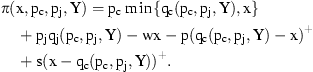
We would like to choose x, p
c
, and p
j
to maximize the expected total supply chain profit E[π(x, p
c
, p
j
,
In the rest of the paper, for ease of exposition, we assume the following: (A) e
cj
e
jc
<1, omitting the degenerate case when e
cj
e
jc
=1. Also, we assume that e
cj
≥0, which means that sales of Xbox consoles always have a nonnegative internetwork effect on sales of titles; (B) Any optimal solution
 to
(6)
, where π(x, p
c
, p
j
,
to
(6)
, where π(x, p
c
, p
j
,  ,
,  , and
, and
 . Assumption A is an assumption often used in the literature on two‐sided network effects, as in Parker and van Alstyne (2005). Assumption B is a technical assumption introduced for ease of exposition, and removes the need to digress to the discussion of degenerate cases.
3. Additive Demand Model
To determine jointly the optimal supply of Xbox consoles and the optimal selling prices in different markets, we consider the following maximization problem: 
We consider additive (inherent) console demand, whereby H c (p c )≡1. Its extension, when H c (p c ) may not be a constant, will be discussed in section 3.4.
3.1. Preliminaries
Let us rewrite the maximization problem (6) in an equivalent form. The latter will be used instead of (6). Let  be an optimal solution to the maximization problem (6). Now, there exists
  such that
  . Note that
  is the difference between actual expected console demand and the supply of Xbox consoles at optimality. Introducing this difference into (6), we can rewrite (6) as
 . Equation (7) is equivalent to
Henceforth, we use (8) in our investigation. Let us now give an explicit form for the objective function in (8) in Proposition 2. First, let  .
.
R and
and  depends on p
c
and p
j
. From now onwards, we suppress this explicit dependence for ease of exposition. We also use
depends on p
c
and p
j
. From now onwards, we suppress this explicit dependence for ease of exposition. We also use  and
and  to denote
  and
and  , respectively.
P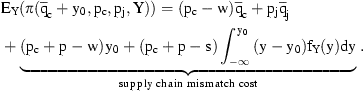
From the explicit expression for  in Proposition 1, we see that the objective function in (8) comprises of production cost, revenue gained from the console and content markets, and also supply chain mismatch cost.
In Proposition 2, we provide a system of equations that  —an optimal solution to (8)—needs to satisfy. Based on this system of equations, we are able to derive a set of criteria that decide which market to subsidize or surcharge under optimality.
Note that we have  , by Assumption B, where we assume that
  . From the KKT conditions, the following holds:
P be an optimal solution to
(8)
. It then satisfies
be an optimal solution to
(8)
. It then satisfies
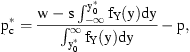


Note that (10) is equivalent to 
This is merely the optimality condition for the newsvendor problem with  and
and  fixed. Equations (11)) and (12) are standard conditions relating demand with price at optimality. In Equation (11), the last term arises to account for lost sales due to demand uncertainty. When
We now introduce an important assumption in this paper: (C) When e
cj
=e
jc
=0,  is the optimal solution to
(8)
if and only if it satisfies the KKT conditions for
(8)
. Also, it is the only optimal solution to
(8)
. This assumption is a technical assumption introduced to remove the need to digress to the issues of uniqueness of the optimal pricing strategy. While it rules out some special cases, it nevertheless holds for the majority of interesting problem instances.
is the optimal solution to
(8)
if and only if it satisfies the KKT conditions for
(8)
. Also, it is the only optimal solution to
(8)
. This assumption is a technical assumption introduced to remove the need to digress to the issues of uniqueness of the optimal pricing strategy. While it rules out some special cases, it nevertheless holds for the majority of interesting problem instances.
Let us define 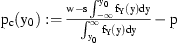 . Using p
c
(y
0), we can then write (10) in a more compact form as
. Using p
c
(y
0), we can then write (10) in a more compact form as  .
.
P
Let  where
where 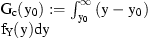 . G
c
(y
0) can be thought of as expected lost sales at inventory level y
0, when demand is Y.
. G
c
(y
0) can be thought of as expected lost sales at inventory level y
0, when demand is Y.  can be thought of as the effective consumer demand captured in the console market, after taking into account the expected lost sales, denoted by G
c
(y
0). If there is no console demand uncertainty, e.g.,
can be thought of as the effective consumer demand captured in the console market, after taking into account the expected lost sales, denoted by G
c
(y
0). If there is no console demand uncertainty, e.g.,
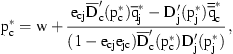
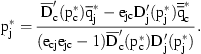
The conditions (10)–(12) can be rewritten in the following manner:
P be an optimal solution to
(8)
. It satisfies
be an optimal solution to
(8)
. It satisfies

3.2. Results
To determine whether to subsidize or surcharge the markets, we use the situation when there are no internetwork effects, that is, when e cj =e jc =0, as the basis for comparison.
Suppose  is the optimal solution to (8) when e
cj
=e
jc
=0. We have the following characterization of
is the optimal solution to (8) when e
cj
=e
jc
=0. We have the following characterization of  :
:
P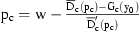 , and
, and
 .
.
To highlight that we are considering the ratio of spillover effects at optimality, let  be the ratio of spillover effects, r, evaluated at
  . That is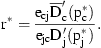
As mentioned earlier, the ratio of spillover effects alone is not sufficient to characterize the strategic pricing decision. We now introduce another two key parameters  and
and  that affect optimal pricing behavior. Their relationships with
  affect how the optimal prices
  behave w.r.t.
  —the prices when there are no cross‐network effects.
D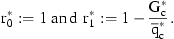
Let us call  the console pricing threshold, and
  the content provider pricing threshold. Since
  measures the expected lost sales in the additive demand case,
  can be viewed as the proportion of console market demand captured relative to the size of the total market demand for console, at the optimal pricing strategy. Similarly, in view of the spillover effect,
  can be viewed as the proportion of content market demand captured relative to the size of the total market demand for content, at the optimal pricing strategy. By comparing
  with
with 
 , we can determine the pricing strategy of the platform, that is, whether to surcharge or subsidize the console (content provider). In other words, measuring the console and content provider pricing thresholds, and comparing them with the ratio of spillover effects, provides a means to decide the pricing strategy of the platform.
T
If e
jc
>0, then
If e
jc
<0, then
 .Equality holds on the left‐hand side if and only if equality holds on the right‐hand side.
 .Equality holds on the left‐hand side if and only if equality holds on the right‐hand side.
We examine next the relationship between  and
and  (the console pricing threshold) and how it affects
  and
and  . For ease of exposition, we first describe our main result for the case when the console demand function is linear in p
c
.
. For ease of exposition, we first describe our main result for the case when the console demand function is linear in p
c
.
T for some A
c
, b
c
>0.
for some A
c
, b
c
>0.
If e
jc
>0, then
If e
jc
<0, then
 . Equality holds on the left‐hand side if and only if equality holds on the right‐hand side.
 . Equality holds on the left‐hand side if and only if equality holds on the right‐hand side.
Again, as in Theorem 1, we see from Theorem 2 that the console pricing threshold,  , serves as a threshold, such that depending on whether
  is less than or greater than
  , the console market is surcharged or subsidized accordingly.
In the above proposition and theorems, Assumption C plays an important role in the proof to show that our criteria—which is comparing  with
with  ,
,  —can be used to decide the subsidizing/surcharging strategy for different markets.
  and
and  are thresholds that reflect operational considerations—due to the presence of
  —and through them, we see the effect of these considerations in deciding optimal pricing strategy.
3.3. Summary
Theorems 1 and 2 provide generalizations of similar results in Parker and van Alstyne (2005). Our results indicate that if  lies between
  and
and  , then it is possible to charge both sides more than the base selling prices in the case when e
jc>0. This situation of charging both sides more at the same time cannot be reflected in the model of Parker and van Alstyne (2005). This situation arises when
, then it is possible to charge both sides more than the base selling prices in the case when e
jc>0. This situation of charging both sides more at the same time cannot be reflected in the model of Parker and van Alstyne (2005). This situation arises when  , that is, when the spillover effect from the console side to the content side is small enough compared with that from the content side to the console side for the console market to be surcharged, but not small enough for the content market to be subsidized. Table 1 provides a summary of results obtained thus far. As shown in Table 1, the subsidy direction depends on whether e
jc
is positive or negative. The subsidy direction reverses when e
jc
changes sign.
, that is, when the spillover effect from the console side to the content side is small enough compared with that from the content side to the console side for the console market to be surcharged, but not small enough for the content market to be subsidized. Table 1 provides a summary of results obtained thus far. As shown in Table 1, the subsidy direction depends on whether e
jc
is positive or negative. The subsidy direction reverses when e
jc
changes sign.
R , while
  .
.
Although we can use  and
and  , and compare them with
  to determine the console and content provider pricing strategy through Theorems 1 and 2, a limitation is that we cannot determine the exact subsidy or surcharge made.
3.4. Extension
In this subsection, we consider the case when H
c
(p
c
) is not a constant. In this case, G
c
in section 3.1 has to incorporate the change in console demand variance as p
c
changes, and is given by 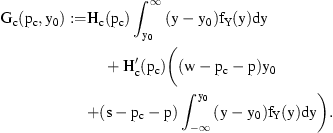
In this general case, which includes multiplicative demand, Theorem 1 still holds. It turns out that the console pricing strategy for this general case is the same as for the additive, linear demand case (Theorem 2). Unfortunately, in this general demand setting, we do not know of any nice physical meaning on the parameter  , nor do we have the physical interpretation of G
c
(·) vis‐a‐viz the supply chain operation.
, nor do we have the physical interpretation of G
c
(·) vis‐a‐viz the supply chain operation.
Footnotes
Acknowledgments
The authors are grateful to the Departmental Editor, the Senior Editor, and the anonymous referees for their valuable comments and suggestions. This research is supported by National Natural Science Foundation of China (70901050), and A*STAR grant 521160079, R‐314‐000‐072‐305.