






Abstract
E‐Services, or the company's portfolio of service offerings available to its customers through the Internet, are an emerging area of interest to operations management. Yet little is known about the operations and capabilities needed for provision of business‐to‐business (B2B) e‐services. This paper aims to make a contribution toward closing this gap. First, we develop a new construct of B2B e‐service capability, a term that captures a generic set of five interrelated and complementary dimensions: (1) e‐service recovery, (2) e‐customization, (3) ease of navigation, (4) service portfolio comprehensiveness, and (5) information richness. These combined operational abilities are associated with B2B service delivery, including its portal design, technology architecture, and mix of product and service offerings. They are posited to be necessary for delivering effective B2B e‐services. We also argue that, both service orientation (SO) and customer receptivity to technology, influence B2B e‐service capability. We empirically test a path model using structural equation modeling on a sample of 181 businesses that have deployed B2B e‐services. We find that the influence of SO on performance is not direct but rather mediated by the e‐service capability, a finding that holds for both goods producers and service providers. We suggest that a firm's SO may mitigate industrial customers' resistance toward conducting business online.
Keywords
1. Introduction
Practitioners and researchers alike are keenly interested in understanding the ways that services can be used strategically to differentiate and facilitate business‐to‐business (B2B) relationships in electronic commerce (Bolton et al. 2003, Dwyer et al. 1987, Iacobucci and Ostrom 1996, Jap et al. 1999, Menor and Roth 2008, Rosenzweig and Roth 2007). Notably, services represent almost 80% of employment and 76.9% of the gross value added in the United States in 2008 (Hatzakis et al. 2010, OECD 2010). In parallel, Internet‐based commerce is of increasing importance to the economy overall. According to the US Census Bureau (2010), e‐commerce reached 3.7 billion dollars in shipments, sales, and revenues in 2008. B2B e‐commerce accounted for approximately 92% of the total e‐commerce value, amounting to about 3.4 billion dollars. Thus, the Internet is an important vehicle for adding complementary services to traditional offerings; i.e., e‐services that “wrap around” the e‐commerce activities among business entities. These e‐services are comprised of “all interactive services that are delivered on the Internet using advanced telecommunications, information, and multimedia technologies” (Boyer et al. 2002, p. 175). However, despite the importance of e‐services, little is known about which operations‐based service competencies and electronic customer‐facing capabilities are necessary for enhancing the effectiveness of B2B e‐service delivery systems. This research aims to provide empirical insights to close this gap.
To gain these insights, we address the following three strategic questions: (1) Can we develop an operationally meaningful, generic measure of B2B e‐service capability? (2) How does a business' overall service orientation (SO) (Oliveira and Roth 2011) and its customers' receptivity to Internet services act to enhance the electronic interactions between sellers and business customers, and in turn, influence business customer‐based performance outcomes (e.g., satisfaction, attracting new customers, etc.)? (3) Do these structural relationships hold for both traditional goods producers and service providers that have implemented B2B e‐commerce?
In answering these questions, we focus on how B2B e‐services act to virtually connect trading partners with each other for a range of operational tasks, including routine electronic transactions (e.g., bill payment, order entry, financial and accounting controls); enhancing product/service functions (e.g., purchasing, order entry, materials management); and virtual cross‐business collaboration (e.g., production planning, logistics and quality management, asset management, and research and development) (Rosenzweig and Roth 2007). B2B market exchanges, virtual market places that bring buyers and sellers together and facilitate their purchase transactions with dynamic pricing and B2B auctions, are excluded from this study. We employ measurement and structural equation modeling (SEM) using a sample of 181 business units engaged in B2B e‐services. Further, we develop a new construct that taps into a firm's B2B e‐service capability through its e‐commerce portal. More specifically, we operationalize B2B e‐service capability in terms of five interrelated and complementary dimensions: (1) e‐service recovery, (2) e‐customization, (3) ease of navigation, (4) service portfolio comprehensiveness, and (5) information richness. 1 Each of these B2B e‐service capability dimensions was identified by an extensive multi‐disciplinary literature review. We also used a series of interviews with knowledgeable industry consultants, as well as executives responsible for delivering B2B services in both manufacturing and service firms. Importantly, our notion of B2B e‐service capability captures customer‐facing, mediating attributes of the firm's B2B technology infrastructure, service and product offerings, and portal that influence the business customers' portal experience. Building on Roth and Jackson (1995, p. 1722), capabilities are “realized” in that they “represent the ability of the total firm to meet customer requirements, [and] they are often highly perceptible to customers.” We propose that each e‐service capability dimension is enhanced (or complemented) by the presence of others (Jarvis et al. 2003, Martínez and Martínez 2007, Menor and Roth 2008, Rivkin 2000, Venkatraman 1989, 1990). Furthermore, we argue that B2B e‐service capability is influenced by (1) the general level of customers' receptivity to engage in e‐commerce, and (2) the level of SO competence. Following Roth and Jackson (1995, p. 1722), operational competencies “refer to [the firm's] more localized production expertise, such as the bundle of people skills, system integration, or specific production technologies … that create competitive capabilities … they constitute a complex pattern of strategic choices.” The notion of a firm's internal competence for delivering high‐value services is referred to as SO—a term we borrowed from Oliveira and Roth (2011), who define SO “as the business' overall propensity for delivering service excellence.” These authors empirically determined that five second‐order dimensions of best practices—(1) service climate, (2) market focus, (3) process management, (4) human resource (HR) policies, and (5) metrics and standards—operationally define a business entity's overall SO. Oliveira and Roth's (2011) SO reflects an internally acquired, complex pattern of internal competencies, which area set of mostly tacit, knowledge‐based resources that, when bundled, are potentially a unique and inimitable source of sustainable customer value. These characteristics have been attributed to the resource‐based view (RBV) (Barney 1991, Peteraf 1993) and the knowledge‐based view (KBV) (Grant 1996a, 1996b; Hoskisson et al. 1999, Zack 2003) of competitive advantage.
Finally, we examine whether SO is equally important to manufacturers engaged in B2B e‐services and their service counterparts. Understanding this issue is increasingly important as more manufacturers complement their product offerings with services in order to improve competitiveness and revenues. Vargo and Lusch (2004, 2008) even suggest that all firms should be considered service firms. Caterpillar and Toyota are classic examples of manufacturers with exemplary e‐service in B2B and B2C, respectively.
This study makes several contributions to the extant literature in the emerging area of Internet‐enabled B2B operations. First, the vast majority of research on the practices of service exemplars focuses on building service capabilities in traditional “brick and mortar” B2C services, including hotels, hospitals, retailers, banks, and restaurants (Heskett et al. 1990, Roth and van derVelde 1991). While empirical research in this traditional venue is increasing, the past 5 years have given rise to scholarly inquiry into web‐enabled B2C marketspaces (Boyer et al. 2002, Heim and Sinha 2002, Tsikriktsis et al. 2004, Wu et al. 2003). Yet research that subjects operational practice issues regarding B2B electronic channels to rigorous empirical scrutiny is scant, with a few exceptions (Chakraborty et al. 2002, Mukhopadhyay and Kekre 2002, Rosenzweig and Roth 2007, Standing and Lin 2007, Vickery et al. 2004). This study provides a foundation for a new theory of inter‐firm e‐service capability by drawing on established frameworks from traditional services and on theoretical views from different fields.
Second, we apply rigorous psychometric measurement theory in order to develop seven new multi‐item measurement scales that tap into the five constructs of B2B e‐service capability, customer receptivity, and impact in the context of B2B e‐commerce. These newly developed and theoretically sound metrics lay the groundwork for future OM scholarly inquiry into B2B e‐services, and are useful for evaluating aspects of successful practices that enable inter‐firm services.
Third, OM practitioners can benefit from a deeper understanding of the strategic ways in which the Internet enables firms to coordinate the exchange of goods and services among business partners. We demonstrate that the more service‐oriented the business unit is in general, the higher its B2B e‐service capability, which in turn affects its business customers' satisfaction, its ability to attract new customers, as well as its sales. Our results demonstrate how traditional service operations logic can be parlayed into delivering effective e‐commerce—regardless of whether the business unit is classified as a traditional service provider (e.g., FedEx or CISCO) in dealing with industrial customers or as a “goods” producing manufacturer (e.g., Boeing, Dell, or John Deere). There is much anecdotal evidence to suggest that manufacturers with superior service abilities have a better customer‐based performance than those without them. Our empirical study corroborates this point in a B2B setting.
The rest of this paper is organized as follows. In section 2, we formally develop the model and hypotheses. We draw upon the extant literature and interviews with executives to conceptualize the nomological network of key constructs for B2B e‐service capability and its antecedents and consequences. Section 3 describes the research approach including the database, the operationalization of constructs and their measurement properties, and other methods. The empirical results are given in section 4, and in section 5 we conclude with our research limitations, areas for future research, and contributions.
2. Model Development
As indicated earlier, B2B commerce can be conducted through different mechanisms, such as what Rosenzweig and Roth (2007, p. 1313) refer to as B2B marketspaces that range from “transaction‐oriented Internet sites … to more collaboratively oriented private trading networks.” This section introduces the hypothesized structural model that we develop and test in this study (see Figure 1). We propose a new theory of B2B e‐service capability, which contends that in competitive and dynamic B2B electronic environments, maximizing customer impact (CI) requires the simultaneous acquisition, maintenance, and tight integration of five salient, Internet portal‐ and service‐based dimensions: (1) e‐service recovery, (2) ease of navigation, (3) service portfolio comprehensiveness, (4) e‐customization, and (5) information richness. Taken together, these five dimensions are deemed to be generic underpinnings that reflect a holistic notion of e‐service capability. Our theoretical model also identifies two important antecedents of B2B e‐service capability, namely the level of SO and the customer technology receptivity (CTR). The International Service Study (ISS) formed the basis for the SO. The ISS was among the first to empirically identify sets of best practices in service management that are consistent with the delivery of service excellence across traditional services (Meyer et al. 1999, Roth et al. 1997, Voss et al. 2004). Bundled together, the ISS practice dimensions form a set of highly related internal practices that comprise a firm's internal competencies or organizational know‐how. These competencies explain, in part, the firm's orientation for delivering outstanding, value‐added services to consumers (e.g., B2C). However, with the exception of Oliveira and Roth (2011), prior related research has not considered SO in B2B e‐service delivery systems.
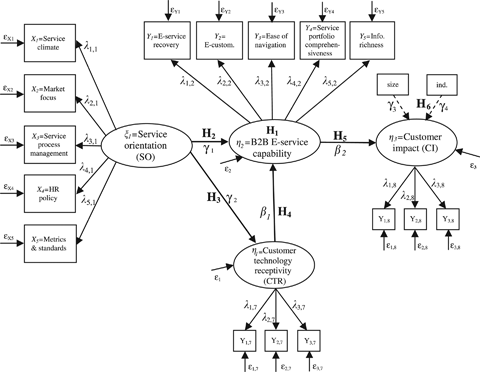
Hypothesized Model of Antecedents and Consequences of B2B E‐Service Capability
In the theory development phase, which is phase 1 of our research methodology, we identified the key constructs for B2B e‐service capability and items tapping into them, then formulated the nomological network of relationships that guided our empirical model development (see Figure 1). This process involved in‐depth and iterative multi‐disciplinary literature searches, as well as structured interviews with knowledgeable managers from CISCO, IBM, Motorola, Georgia Power, and others who were responsible for B2B in their company or were knowledgeable consultants. Phases 2 and 3 of our research methodology will be described in section 3.
2.1. B2B e‐Service Capability
B2B companies deal with a very different market mindset than B2C companies. For example, Dell's high‐end server customers generally have less time and patience versus consumers and prefer to transact business with professionals (Frei et al. 2007). Additionally, in B2B contexts typically more than one function is involved in making complex buying decisions, such as purchasing and engineering; whereas in B2C, the end user (consumer) usually makes the purchasing decision and moves relatively quickly through the buying process. Another important aspect is that in B2B contexts, end users and buyers are characteristically different from each other. As a result, the B2B purchasing time frame is usually longer and more interactive than the typical B2C transaction. The mindset is also influenced by the relative revenue base, with the typical business customer representing a significantly larger value to the firm versus any single consumer. Furthermore, B2B companies typically establish a broader view of the entire supply chain in order to better understand the full ownership experience, from their suppliers to intermediaries to end users.
In this section, we discuss the dimensions of B2B e‐service capability using the theoretical lens of the RBV of the firm (Penrose 1959). Following Barney (1991), Wernerfelt (1984), and Penrose (1959), Amit and Zott (2001, p. 497) state that RBV:
… builds on Schumpeter's perspective on value creation, [and] views the firm as a bundle of resources and capabilities … [Moreover,] marshalling and uniquely combining a set of complementary and specialized resources and capabilities, which are heterogeneous within an industry, scarce, durable, not easily traded, and difficult to imitate, may lead to value creation.
Wade and Hulland (2004) contend that the RBV offers a valuable approach for linking information systems (IS) to strategy and performance. These authors also argue that “the theory provides a basis for comparison between IS and non‐IS resources, and, thus, can facilitate cross‐functional research” (Wade and Hulland 2004, p. 109). Roth and Jackson (1995) suggest that RBV is useful in formulating and testing operationally oriented theory in service strategy, wherein a collection of synergistic internal competencies can lead to competitive capabilities, and in turn, create unique customer value. In service delivery systems, many of the competencies are tacit and knowledge‐based resources (e.g., know‐how derived from best practices, skills of people, etc.). Thus, a KBV is a relevant extension of the RBV, where knowledge is a strategic resource that does not depreciate in the way traditional economic productive factors do and can generate increasing returns (Grant 1996a, 1996b, Hoskisson et al. 1999, Zack 2003).
Following Venkatraman (1989, 1990) in strategy and Menor and Roth (2008) in services, we conceptualize that the five dimensions of B2B e‐service capability co‐vary as a system of portal‐based delivery attributes, which, when taken together, are complementary and self‐reinforcing. Further, due to the inherent “complex complementarities” (Rivkin 2000), a firm's overall B2B e‐service capability is not easily achievable, even if one or more dimensions are similar across different companies. These five dimensions of e‐service capability were informed by a combination of literature reviews and in‐depth interviews with experienced B2B managers, and six rounds of item sorting for construct and item reliability and validity. Collectively, the managers agreed that these five were the most “basic” and essential generic ingredients for any company to be successful with their B2B initiatives. We also note here that executives cited Internet security as an important dimension. However, since security is ex ante for any B2B e‐commerce activity—and unless it is breached—it is a competence that is not directly perceptible to customers. For this reason, security was not considered as an e‐service capability dimension per se. Instead, we recognize that customer concerns about security may influence their propensity to use the Internet channel; therefore, security is captured indirectly in our CTR construct given in section 2.4.
Accordingly, the five dimensions of e‐service capability depicted in Figure 1 were deemed to be generic and generally devoid of idiosyncratic aspects of any particular industry sector. By examining the link between these five interrelated and complementary dimensions and our business performance measure (CI), we are extending the notion of combinative operational competitive capabilities—which are difficult for others to replicate—to a B2B context. In the following sections, we discuss each e‐service dimension specifically.
2.1.1. e‐Service Recovery
e‐Service recovery is operationally defined as the process of electronically handling customer problems and turning them from a negative into a positive experience. The explicit goal of e‐service recovery is to adequately address customers' expressed dissatisfaction with the service offering or its delivery. Although service failure and recovery issues have received considerable attention in the literature (Hart et al. 1990, Parasuraman et al. 2005, Smith et al. 1999), these topics have received only limited attention in the context of online retailing (DeWitt and Brady 2003, Holloway and Beatty 2003). Previous research in traditional service operations has shown that customers who have a service failure resolved quickly and fairly, in contrast to those who never experience a service failure, are apt to exhibit greater loyalty and repurchase behaviors (Miller et al. 2000). Some studies suggest that a firm's response to failures acts either to strengthen and reinforce customer relationships or to intensify their negative effects (Fisk et al. 2000). Parasuraman et al. (2005) were among the first to study this issue in a B2C online context. These authors developed the E‐RecS‐QUAL scale specifically for measuring e‐service quality, utilizing valuable consumer information on service recovery issues. When a failure occurs in B2B, it can be a major catastrophe. Sims (2001, p. 1) states:
… the entire supply chain can come to a grinding halt, and transaction rollback and recovery may be nontrivial. Compound these effects with the economic loss of idle production facilities while the system is under repair, and the costs add up quickly … short‐term financial damage and long‐term damage to business relationships will be severe.
In a B2B setting, the manner in which firms respond to service failures is viewed as a key differentiator in building customer satisfaction; therefore, organized service recovery programs are increasingly important enablers of a B2B firm's ability to maintain the loyalty of targeted customers (Frei et al. 2007).
2.1.2. e‐Customization
e‐Customization refers to the extent to which a company tracks customers' explicit and implicit preferences and provides unique responses to customers' requests based on those preferences in the Internet portal. The level of customization of a B2B portal can dramatically enhance the customers' experience and the efficiency of the transaction. The higher the level of customization, the more control or influence business customers feel over the process. For example, Worldwide Interactive Services Inc. allows its bank and credit union customers to customize their own web pages on its portal (Business Wire 2011).
In general, customization helps customers weed out superfluous information and increases the efficiency and completeness of their searches and transactions, minimizing the need to repeat information on their preferences with each transaction (Chakraborty et al. 2002). Holland and Baker (2001) argued, based on B2C case‐study evidence, that personalization increases the odds of repeat website visits—a finding that was confirmed by Froehle and Roth (2004) in a sample of 2001 Internet service provider customers. We believe the same holds for the B2B channel. Mounting anecdotal evidence suggests that business customers are more satisfied when they receive customized service. Some manufacturers are already actively promoting the customization of their B2B portals to customers' preferences and needs. For example, Voss (2003, p. 98) noted that “CISCO allows customers to configure their routers on‐line and has sophisticated systems to support this and to ensure that the customer design is both technically feasible as well as meeting customer needs.”
2.1.3. Ease of Navigation
The perceived ease of navigation is operationally defined as the extent to which the B2B portal design is simple and effortless for customers to use and facilitates the process of purchasing and managing accounts in an efficient and effective manner. In other words, it reflects “the degree to which a person believes that using a particular system would be free from effort” (Davis 1989, p. 320). When Boeing developed its portal (
Conventional wisdom purports that the easier to navigate and the more efficient the portal is, the more likely that customers will stay longer and increase their “share of wallet.” The implication for B2B firms is this: the ease of portal navigation is a signal of how easy it will be for customers to conduct business with the seller, as well as how much the seller values their time. The navigability of a company's website (Zeithaml et al. 2002) is particularly important in view of the increasing complexity of the products and services available in a B2B context. Thus, it reflects an important e‐service capability for businesses.
2.1.4. Service Portfolio Comprehensiveness
In this study, service portfolio comprehensiveness indicates the perceived completeness of the bundle of goods, services, and technologies offered by a company to its business customers online, including the complementarities between the online and offline delivery of the offering bundle. Complementarities have been recognized as a driving force in manufacturing (e.g., Milgrom and Roberts 1990). In a B2C context, Alba et al. (1997) argue that successful Internet vendors need to offer buyers such advantages as a selection of complementary merchandise, distribution efficiency, and electronic information. Accelerating economic, technological, and social changes and an increasingly complex business environment are especially challenging for companies that operate in multiple channels and have other businesses as customers. Therefore, online B2B sellers that provide more comprehensive service offerings tend to maintain customer loyalty and revenue.
2.1.5. Information Richness
Information richness in the context of this research refers to the quality of information provided in the Internet portal, including completeness, currency, interactivity, scope, and relevance. In information richness theory (IRT), Daft and Lengel (1986) propose that communication richness is an unchanging, objective property of communication media. While this theoretical perspective has been applied extensively in the management information literature, the concept has extended into the OM literature, such as in customer contact theory (Kellogg and Chase 1995) and for describing channel attributes in electronic communications (Froehle and Roth 2004, Rosenzweig and Roth 2007, Vickery et al. 2004). In the IS literature, Ngwenyama and Lee (1997, p. 147) claim that “For practitioners, IRT has served as a normative theory for the selection of communication media based on content leanness to richness.” The exchange of rich information is particularly valuable in reducing ambiguity and equivocality, which mitigates the multiple conflicting interpretations of situations (Daft and Lengel 1984, 1986); therefore, in this research, information richness is a salient dimension of B2B e‐service capability. A case in point is
2.1.6. Combinative B2B e‐Service Capabilities
The five B2B e‐service capability dimensions previously delineated are perceptible to the seller's business customers in the course of e‐commerce. Moreover, our B2B e‐service capability construct is a combinative capability that is conceptualized as a second‐order construct; it is reflected by five first‐order, latent dimensions. Sets of measured variables tap into each of the first‐order constructs, respectively. The notion of combinative capabilities has resonated in general operations strategy literature since Nakane (1986), who first proposed that trade‐offs among competitive capabilities were not necessary—suggesting that companies could excel simultaneously on several capabilities. A number of studies have empirically addressed combinative capabilities, mostly in a manufacturing environment (e.g., Ferdows and De Meyer 1990, Rosenzweig and Roth 2004, Roth 1996), with the exception of Menor et al. (2001) in retail banking. The notion of combinative capabilities is also found in the strategy literature. Kogut and Zander (1992, p. 3911) state: “By combinative capabilities, we mean the intersection of the capability of the firm to exploit its knowledge and the unexplored potential of the technology.” We note that Kogut and Zander's use of the term “combinative” parallels Grant's (1996a,1996b) conceptualization of “integration” terminology.
In the context of this research, we build upon Venkatraman (1989, 1990), Menor and Roth's (2008) and Oliveira and Roth's (2011) logic of construct co‐variation to theoretically investigate the complementarities among the five dimensions as an integrated whole, versus their individual effects. Menor and Roth (2008, p. 270) state that “all are important indicators, or manifestations of [e‐service capabilities]. Each complements the other.” This prior research also forms the conceptual basis for modeling e‐service capability as a higher‐order construct (see Edwards and Bagozzi 2000, Jarvis et al. 2003). Jarvis et al. (2003) argue that reflective models are appropriate to model attitudes toward an object.
Accordingly, the co‐variation among the five dimensions reflecting B2B e‐service capability is posited to indicate that each is intrinsically related to and synergistic with the others to simultaneously influence performance (see Venkatraman 1989, 1990 for a complete discussion of this type of synergy). We offer the following illustrative examples in support of our arguments. The process of electronically handling customer problems and turning them from a negative into a positive (i.e., e‐service recovery) is intrinsically related to a company's ability to track customers' explicit and implicit preferences and provide unique responses to customers' requests based on those preferences (i.e., e‐customization). Changing one of these processes will have an impact on the other. Moreover, it would be difficult to separate the richness of the information provided in the portal from the extent to which the portal is simple to use, and from how it facilitates electronic transactions in an efficient and effective way (i.e., ease of navigation). Also, the service portfolio comprehensiveness can be related to factors of customization of the richness of information. Thus, we propose that the B2B e‐service capability construct is combinative and can be operationally defined and tested by an appropriate measurement model in SEM (Bollen 1989). In accordance with measurement theory, we posit:
H
2.2. SO in a B2B Context
Service can be a means by which firms sustain competitive advantage via Porter's (1980) strategy of differentiation. In traditional services (e.g., hotels, banks, hospitals, etc.), sets of best practices were found in the ISS (Roth et al. 1997) to be internal competencies that exist across service exemplars. To assess the business unit's general propensity toward service, we adopt the SO competency construct operationalized by Oliveira and Roth (2011), who refined the ISS measurement scales for the B2B context in prior related research using a rigorous approach. Similar to Roth et al. (1997), Oliveira and Roth (2011) modeled SO as “an integrated, holistic, third‐order construct comprised of five latent variable competencies: 1) service climate, 2) market focus, 3) process management, 4) HR policies, and 5) metrics and standards.” These authors operationalized the five SO competencies as second‐order dimensions of best practices in service delivery. For semantic clarity, we note that the management information literature uses the terms “service‐oriented infrastructure” and “architecture” as they pertain to technology and/or systems architecture (Cherbakov et al. 2005, Crawford et al. 2005). In contrast, Oliveira and Roth (2011), using an OM perspective, view technology as an enabler of e‐services. Their notion of SO focuses on knowledge‐based resources derived from the consistent and holistic application of a bundle of broad‐based practices, which are typically associated with overall service delivery prowess. As they pertain to this study as antecedents, we paraphrase and add to Oliveira and Roth's (2011) five constituent dimensions of SO in the following sections.
2.2.1. Service Climate
Service climate refers to the “organizational leadership, culture, and values that represent its internal ‘DNA’ toward customers and service” (Oliveira and Roth 2011). Culture is deeply rooted in all organizations and can affect all organizational entities, including systems, processes, and individuals (Deshpande and Webster 1989). An important component of a company's service climate is the organizational leadership, which is widely recognized as important to realized service excellence (Heskett et al. 1994).
Closely related to leadership is the notion of service culture, which connotes that a high degree of customer centricity is embedded in the attitudinal and behavioral responses of employees in all their customer encounters. Consequently, service culture is critical because of its transformational and interactive role in moving the organization from a transaction‐based model to a relationship‐based model. Thus, cultural mechanisms, including shared norms and values, have been adopted by service exemplars for creating their service climate (Antioco et al. 2008, Heskett et al. 1990, Roth et al. 1997). Heskett et al. (1994) reported in their service profit chain research that employees' attitudes toward the way they serve other employees are paramount to both internal quality and employee satisfaction, which in turn affects external customer satisfaction and loyalty. Finally, considering that a main objective of the leadership is the creation of value for the firm, Oliveira and Roth (2011) posit that “the extent to which a company's management team gives attention to the productivity level of the company, the value delivered to the customer, and the cost charged for the services provided,” is also a key dimension of SO.
2.2.2. Market Focus
Market focus pertains to the “organization's ability to understand its market and the customers' needs, to establish and manage relationships with customers, and develop new products and services” (Oliveira and Roth 2011). Effective services invest in understanding the voice of the customer and of the marketplace. Wade and Hulland (2004) classify a related construct of market responsiveness as an outside‐in resource because it involves the collection and dissemination of market‐based information from external sources to internal units in the firm, and in turn, the firm's response to that learning (Day 1994). For B2B e‐services, online applications must be developed to facilitate customer relationships. Schultze and Orlikowski (2004, p. 87) argued that “embedded relationships with customers have been key in generating repeat business and economic advantage, especially in business‐to‐business settings.” Two relevant relationships in B2B are those that are (1) intra‐organizational personal relationships spanning across functions and (2) inter‐organizational spanning across firms (Doney and Cannon 1997). Both types of these relationships provides managers and employees opportunities gain deep insights into the behavior of their business customers. This knowledge will affect the firm's ability to create a virtuous service cycle, from simplification of marketing and sales processes to more effective cross‐selling of products, and from efficient closing of deals to increased sales revenues.
2.2.3. Process Management
According to Oliveira and Roth (2011), process management connotes “the organization's emphasis on processes that are directed toward customer value and the supporting technological architectures.” These include the extent to which the organization has adopted and implemented information and communications technologies (ICT), as well as the front‐line and back‐office processes designed and managed to deliver services. The extant service management literature has revealed the importance of both front‐ and back‐office processes that support employees in delivering superior value to customers (Heskett et al. 1990). Configurations of process technologies have been frequently associated with service excellence (Roth and Jackson 1995, Tsikriktsis et al. 2004). Heim and Sinha (2002) indicated that the dynamic and complex requirements of customers are often predicated upon the effective use of electronic technologies. However, technology is just an instrument and many firms have failed despite their superior technology. Weddle and Bullukian (2004) examined a number of failed B2B projects and found that most failures were related to the fact that stakeholders had a “technology‐only view” of B2B implementations. Asher (2007) shows that there are different inter‐organizational systems and e‐business partnership solutions that can be pursued, depending on the volume purchased by the supplier and the transactional complexity. However, while web technologies and IT practices are important (Lin et al. 2007), many firms have difficulty in leveraging these functionalities in their e‐commerce activities (Chatterjee et al. 2002).
2.2.4. HR Policy
HR policy captures “the ways the organization builds and rewards human capital” (Oliveira and Roth 2011) and has been found consistently to be a significant contributor to delivering exemplary services (Heskett et al. 1990). Edvinsson and Malone (1997, p. 34) describe human capital as “all individual capabilities, the knowledge, skill, and experience of the company's employees and managers.” Roth and Jackson (1995, p. 1724) argue that “organizational knowledge embedded in the minds and skills of people who understand the rationale for their work is a precondition to delivering service.” They suggest that investments in people's capabilities should coincide with, if not precede, those in ICT. The company's approach to rewarding its employees is critical because of its effect on employee satisfaction (e.g., Hartline and Ferrell 1996, Oliver and Anderson 1994). In addition, Hallowell and Schlesinger (2000) pointed out that employee satisfaction is related to service organizational outcomes.
2.2.5. Metrics and Standards
The metrics and standards dimension refers to “the metrics captured by the measurement system on customers and services, and the establishment of service standards” (Oliveira and Roth 2011). Such metrics and standards have been identified as key factors for the success of service companies (Voss et al. 1997). The measurement system can be an essential link between a company's strategy, operations, and value creation. Measurement systems are also a requirement for companies that want to conduct benchmarks against competitors. As an example, measuring the returns, usage, and feedback of
2.3. Influence of SO on B2B e‐Service Capability
Oliveira and Roth (2011) conceptualized and empirically tested the measurement model of SO as a high‐order reflective meta‐construct on the five dimensions previously described. Using criteria of Edwards and Bagozzi (2000), these authors found the measurement of items tapping into the third‐order SO construct to be reliable and valid. Similarly, we operationalize SO in terms of its constituent dimensions (see Figure 1 and Appendix 2). One of the central hypotheses of our research is that a business unit's overall SO, as a combinative competency, will have a pervasive influence in creating value for customers. In turn, this influence will carry over toward the design and operations of e‐service architecture capability. This hypothesis is grounded in the RBV (Barney 1991, Grant 1991, Peteraf 1993, Wernerfelt 1984) and the KBV (Grant 1996a, 1996b, Hoskisson et al. 1999, Zack 2003) that firms can exploit their internal competencies to build unique capabilities that enable them to garner excess rents. Further, following arguments made by Menor and Roth (2008), holistic, integrated collections of service‐based sets of internal practices and resources create internal competencies that are unique and difficult to imitate. The B2B SO practices are consistent with traditional B2C service exemplars, which recognize service climate, market focus, process management, metrics and standards, and HR policy as the central values driving their capability to deliver electronic services (Heskett et al. 1990, Roth et al. 1997). e‐Service recovery, e‐customization, ease of navigation, service portfolio comprehensiveness, information richness, and collaborative knowledge creation are identified as the dimensions of e‐service capability (Figure 1). Therefore:
H
2.4. CTR
The level of CTR refers to the willingness of the company's customer base to engage in electronic commerce (Barua et al. 2001, Massey et al. 2007). Parasuraman (2000) develops a comprehensive technology readiness index based on individuals' state of mind regarding technology (B2C) (Massey et al. 2007, Tsikriktsis 2004), whereas our CTR construct refers to business customers' receptivity to engage in electronic transactions. Typically in B2B, very few customers account for a high percentage of sales; therefore, the loss of one or two important customers can often have a significant impact on the bottom line. We posit that businesses with a higher level of SO are more prone to interact routinely with their business customers in determining customer needs; therefore, it is highly plausible that customers will actively participate in the portal design and content. For example, Boeing allows its customers to customize their own working areas at its portal (
H
The level of organizational readiness for dealing with technologies has not been adequately explored by the management literature. Truong (2008) analyzes the impact of buyers' e‐readiness on the range of B2B electronic marketplace usage to conclude empirically the following: e‐readiness at the organizational level is an important factor influencing the extent of electronic marketplace usage for purchasing. Humphreys et al. (2006) argue that B2B e‐commerce facilitates both the redesign of internal organizational processes and the buyer–supplier processes. Thus, e‐commerce innovations play a central role in drawing together the inter‐organizational networks of supply chain members. In line with this, we hypothesize that while CRT—an attribute of the business customer—is external to the seller, it actually can impact the seller's capabilities. One reason for this is that more technologically savvy customers will press the seller to adopt best practices in technology and business. Take, for example, CISCO (2007, p. 16):
… customer expectations have evolved, and are continuing to do so, in what they need—and expect—from a supplier. Business executives will spend time with vendors who understand their business and its drivers and have the capability to build a strategic partnership with them. Expectations are for this vendor to be not only technically proficient but more attuned to its specific business problems and to be able to provide full business solutions that meet their needs.
Customers can directly affect the set of abilities required for a company to deliver B2B services effectively (Barua et al. 2001). Therefore, we logically hypothesize that CTR has an indirect impact on the five capabilities of e‐service recovery, e‐customization, ease of navigation, service portfolio comprehensiveness, and information richness.
H
2.5. Influence of B2B e‐Service Capability on CI
Kumar (1999) investigates the role of long‐term client relationships and concludes that they mitigate against price pressures from customers and, with time, enhance the value of their service offerings. Power (2005) found that “capability” is a strong and significant determinant of performance. Gupta and Zeithaml (2006) explained how customer metrics influenced firms' financial performance by delineating the linkages among a firm's actions, its customer behaviors, and financial performance. Narayandas (2005) argues that while the potential benefits of customer loyalty in B2B markets is substantially greater than in B2C, the means of creating and sustaining it are very different. One way of measuring performance in B2B e‐services is to consider the resulting CI—a term indicative of customer satisfaction, attraction of new customers, and sales growth. The CI metric is conceptually consistent with outcomes of the service profit chain model (Boyer et al. 2002, Froehle and Roth 2004, Heskett et al. 1994) and the ISS (Roth et al. 1997). In contrast to traditional B2C direct customer‐facing services, many transactions in B2B contexts are technology based. Accordingly, it is reasonable to assume that the influence of SO will be mediated by the technology channel attributes that link the sellers to the buyers, which in this study is the B2B e‐service capability. Therefore, the set of abilities required for a company to deliver B2B services effectively will ultimately lead to superior CI as posited:
H H
2.6. Manufacturing vs. Services Companies
In this section, we attempt to shed some light on the capabilities required by both goods producing and service firms engaged in B2B e‐services to be successful. Vargo and Lusch (2004, 2008) proposed the service‐doming (S‐D) logic and demonstrated that service components (rather than the core or technical service) are becoming the key differentiator in our competitive market. The ultimate implications of the S‐D logic are that a physical good produced by manufacturers is no more than a mechanism for service provision, and that the customer buys a service flow rather than a tangible thing. In other words, this view suggests that all firms can be seen as service firms because all firms should focus on selling a flow of service. Schmenner (2009) analyzes the integration (bundling) between manufacturing and services companies and concludes that the drive toward integration of goods and services was led by companies that wanted to establish barriers to entry against their competition. Companies with new and novel products but no great manufacturing strengths led the charge, and they began not only to control their supply chains but to own large chunks of them. Brown et al. (2009) report that there are, on average, significant differences between manufacturers and service providers regarding their orientation toward services. Davis (1989) states that the intangibles that firms provide are the most important source of value in the new economy. Further, he suggests that manufacturing companies can be managed using service management models. Arguably, product companies like Toyota, Dell, Caterpillar, and CISCO are in this camp. In a study of B2B manufacturers, Brown et al. (2009, p. R7) report that a leading barrier to service success was that the organization was not ready:
For all that promise, though, making services work isn't easy, and success is far from assured. Many companies are unprepared when they make the move into new territory, and fall into a number of traps, such as introducing services the wrong way and focusing on the wrong points when pitching them to customers.
Understanding how SO influences B2B e‐services capability may provide traditional manufacturers with a blueprint to recast their internal practices and relationships with their trading partners by using a service management model. Accordingly, we posit that the nomological network of hypothesized relationships in Figure 1 (i.e., the structural model) will hold across both manufacturing and service firms. Therefore:
H
2.7. Competing Models
For completeness, we will also test three competing models that are illustrated in Figure 2 against Model 1 (Figure 1). These include the baseline Model 2—a direct effects model in which each of the five dimensions of SO are posited to have a direct positive impact on B2B e‐service capability and a competing Model 3—where SO has a positive direct effect on CI. Model 3 is necessary for testing H5a, regarding the mediating effect of B2B e‐service capability. Model 4 assesses the direct effects of the individual dimensions of B2B e‐service capability on CI.
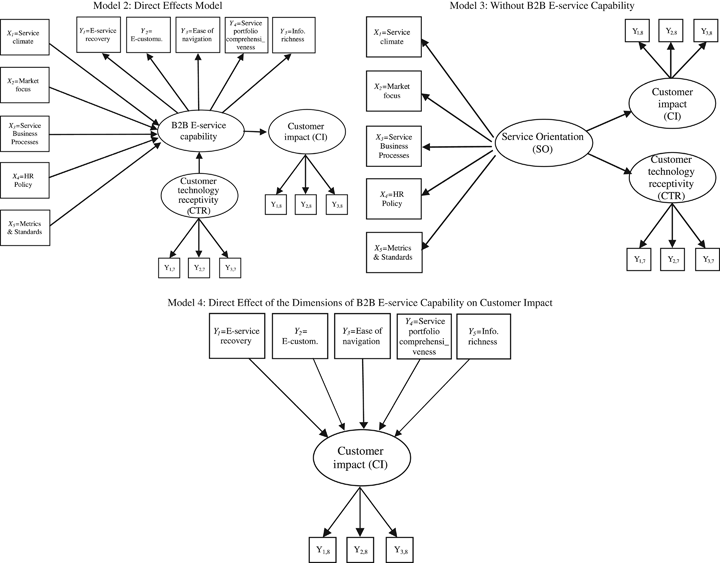
Competing Models 2, 3, and 4
3. Research Methodology
This study follows a three‐phased approach, which is part of a larger research program on B2B e‐services. The first phase was devoted to theory development, which was described in section 2. In the second phase, we further refined the construct definitions and coverage, as well as the items tapping into them, through a rigorous, multi‐stage item‐sorting procedure (Menor and Roth 2008, Roth et al. 2008, Oliveira and Roth 2011). As a result, new multi‐item measurement scales for the B2B e‐services capability, the CTR, and the CI constructs were obtained. In the third phase, we developed the survey protocol and sample frame, pilot tested it, and conducted our field survey. Following Anderson and Gerbing (1991) and using Amos 7 software, in this paper, we first applied the measurement model to confirm our B2B e‐services, CTR and CI measures determined in phase 2; the SO scales were developed and validated in Oliveira and Roth (2011). We subsequently applied the SEM to confirm the overall structural representation in Figure 1 against competing models given in section 2.7.
3.1. Field Data
To identify a population of companies that had implemented B2B Internet portals and were active in e‐commerce, we obtained information from Dechert‐Hampe & Co., CorpTech, and the Association for Financial Technology. In addition, using Internet browsers and trade magazines, we conducted online searches for companies that were active in B2B e‐commerce. In most cases the results of this search validated the initial list of companies. This resulted in a sample frame of 1005 distinct companies covering a broad range of service and manufacturing firms. We located individuals with B2B experience and a range of job titles, including B2B portal director, e‐business director, supply chain manager, marketing director, sales manager, and management of IS director. The unit of analysis for our study is the B2B unit, which we define as the business unit within the overall corporation that is distinguishable from other business units because it uses the same B2B portal to serve a defined external market. Large companies are best thought of as being composed of a number of business units.
We followed the approach recommended by Dillman (2000) for the field study. First, we sent out both emails and letters announcing our study and then followed up by telephone to invite respondents to participate. If they declined, we ended contact. We sent a web‐based survey to those who agreed. A follow‐up email reminder was sent to non‐respondents after two weeks; and one week later, if the survey was not complete, we conducted a telephone follow‐up reminder to determine the status. During this process, a number of these companies indicated that they had not yet invested in B2B technology or that it was not fully implemented. This group was deemed to be “ineligible.” Out of the remaining eligible 755 businesses, we received a total of 181 completed surveys, representing a 24% response rate (18% of the initial 1005 contacts made). Of these, based on the dominant nature of the business units' products, we classified 96 business units (53%) as traditional service providers and 85 business units (47%) as primarily manufacturers of physical goods. The variables exhibited less than 3% missing information, and we assumed that these data were missing completely at random, using the sample mean of the observed values (Bollen 1989).
3.1.1. Non‐Response Bias
Because of the potential for B2B e‐commerce to favor larger firms that might influence practices (Klaussen and Jacobs 2001), we checked for the existence of non‐response bias. First, we made an assessment during the follow‐up phone calls. The primary reason for non‐response was that respondents “anticipated too much effort to complete the survey.” Second, classifying the first 115 of returned surveys as “early respondents” and the remaining 66 as “late respondents,” we tested whether there were differences across the two groups. Using SEM, we compared the early respondents for form invariance (Hform) against the late respondents and produced a χ 2‐statistic of 63.243 (df=64) and an associated p‐value of 0.503, using a reduced version of Figure 1 (e.g., Armstrong and Overton 1977) where the averages for each of the B2B e‐service capability and CTR dimensions were used in place of the latent variables. The large p‐value and the associated fit indices (NFI=0.94 and IFI=0.89) provide reasonable empirical evidence that there was no significant difference in responses across the two groups.
3.1.2. Normality of Data Distribution
We checked for skewness and kurtosis. The statistics for the individual items indicate that our items tend to be skewed, i.e., their distributions are asymmetric and extend toward the high end of the scale. Excessive skewness exists when test values are outside the range of −2 to +2; excessive kurtosis occurs when test values are outside the range of −7 to +7 (Curran et al. 1996). The standard error of the kurtosis statistics in our case is 0.36. Our data indicate that the kurtosis statistics for a few of these items are higher than two standard errors, which is not problematic. We also examined univariate skewness and kurtosis for the constructs represented in our model and all test values are well within their respective rule‐of‐thumb ranges.
3.2. Operationalization of the Constructs
Using rigorous psychometric measurement theory, we develop a set of reliable and valid items and scales for the B2B e‐service capability, CTR, and CI constructs. We operationalized the SO measures directly from Oliveira and Roth (2011) as reflective of the five multi‐item measurement scales depicted in Figure 1.
3.2.1. New Scale Development
We followed the Menor and Roth (2008) two‐stage approach for new scale development (see Roth et al. 2008); and was the same database and approach used by Oliveira and Roth (2011) for the development of the SO scales. First, we conducted an extensive literature review and search for existing constructs and items. This yielded the initial set of items, as well as their initial allocation to their respective constructs. For completeness, scholars and knowledgeable managers from several companies also reviewed these constructs. Once a set of relevant constructs was identified, we pulled together items from existing scales, where possible, and generated additional items that were deemed to be a good fit with the construct definitions. Similar to Menor and Roth (2008), we used an iterative scale development methodology called item‐sorting. In each iteration we purified the constructs and items using six independent panels of expert judges—managers of different ranks who were familiar with the B2B side of their businesses and knowledgeable about the research topic. Judges were generally representative of the sample of respondents who completed the final survey instrument. To assess the design stage, tentative scale reliability, and validity of the qualitative judgments made by the respondents, we used the following item‐sorting statistics: Perreault and Leigh's (1989) measure of inter‐judge agreement, Cohen's κ statistic, the proportion of observed agreement, and Moore and Benbasat's (1991) item‐placement ratios. We completed the item sorting when each multi‐item measurement scale for each B2B e‐service capability dimension and CTR met the statistical thresholds for the item‐sorting statistics given above.
Next, we constructed the survey and pilot tested it with executives, after which some minor modifications were made. We used a “split‐sample” approach (e.g., Froehle and Roth 2004), which means that we divided our data sample into two parts. The calibration sample included the first 115 returned surveys, and the validation sample consisted of the remaining 66 surveys. Using the field data described in section 3.1, we first tested the measurement model for B2B e‐service capability (Figure 3) on the calibration and validation samples; we determined that the measurement models across the two groups were structurally invariant (Bollen 1989).
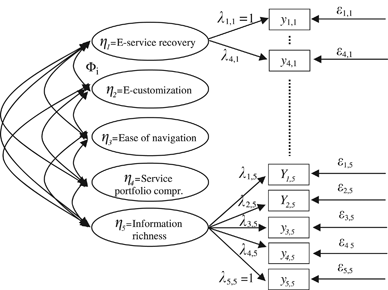
Measurement Model of B2B E‐Service Capability
The proposed measurement model is identified and all latent constructs have at least three indicators (Bollen 1989). No modification was deemed necessary for the B2B e‐service capability items (see Appendix 1 for details), and the fit statistics of the measurement model for the combined sample show reasonable fit: χ 2=341.72 (df=179, p<0.01); χ 2/df=1.91; incremental fit index (IFI)=0.89; Tucker‐Lewis index (TLI)=0.87; comparative fit index (CFI)=0.89; and RMSEA=0.09. Discriminant validity is indicated by the correlations among the five indicator variables representing dimensions of B2B e‐service capability, which range from 0.30 to 0.58 (the supporting information Appendix S1).
The same front‐end new measurement scale and development procedures given above were used for both the CTR and the CI constructs and metrics. Measures for these constructs were developed during the pilot study. Of the performance items included in the survey, three represented CI variables associated with service profit chain outcome measures (e.g., customer satisfaction, sales, and new customers) (Heskett et al. 1994). Using the field data applied to the measurement model (SEM), we assessed the fit on these two multi‐item scales. The results indicated a good fit: χ 2=12.26 (df=8, p=0.14); χ 2/df=1.53; IFI=0.99; TLI=0.98; CFI=0.99; and RMSEA=0.07 (see Appendix 1). Discriminant validity was indicated by the correlation between the two latent variables CTR and CI (φ=0.55). The CI measure was checked for criterion validity with objective measures of performance. It correlated with two other measures of performance, namely the percentage change (before and after B2B implementation) in labor productivity (r=0.54, p<0.01 level, N=129); and percentage change in profit level (r=0.54, p<0.01 level, N=118) (see the supporting information Appendix S2).
3.2.2. Other Variables
To assess the level of orientation of a company toward service, we use the SO construct developed by Oliveira and Roth (2011). Appendix 2 presents the reliability and validity results for the dimensions of SO scale; the supporting information in Appendix S1 depicts the correlations among the indicator variables ranging from 0.37 to 0.64, indicating discriminant validity. We control for the size of the company, measured by the number of employees of the unit of analysis (i.e., the business unit). In addition, to test H6, we use a measure of the dominant nature of the business units' products as classified by services (=0) or physical goods (=1).
3.3. Common Method Bias
The potential for inflated empirical relationships can result when the data for independent variables and dependent variables are gathered using the same method or use the same single source (Crampton and Wagner 1994, Podsakoff et al. 2003, Siemsen et al. 2010). Common method variance (CMV) can potentially have deleterious effects on research findings; it is important to determine if it exists and to understand its sources. We addressed the issue of CMV in the initial design of the study and in statistical tests afterwards. First, following Phillips (1981), we used knowledgeable key informants. Next, we applied the Harman's one‐factor test by loading all the variables in our study into an exploratory factor analysis and examining the number of unrotated factors that are necessary to account for the variance in the variables. As stated by Podsakoff et al. (2003, p. 889), “The basic assumption is that if a substantial amount of common methods variance is present, either a) a single factor will emerge from the factor analysis or b) one general factor will account for the majority of the covariance among the measures.” In our analysis, nine factors emerged. The first factor accounts for about 30% of the variance. This procedure, however, does not provide specific guidelines on what constitutes a general factor, based on how much variance the first factor should extract. Finally, we tested the effect of CMV on the correlations between the latent variables developed in this study by estimating two confirmatory factor analyses—one including a methods factor and another one not including it (Podsakoff et al. 2003). The comparison of the latent variable correlations between these two estimations revealed that the differences between the two sets of latent variable correlations were minimal, i.e., below 0.5% on average.
4. Findings
Below are the findings for our hypothesized model of Figure 1 (Model 1). Froehle and Roth (2004) and Shah and Goldstein (2006) suggest reporting fit indicators in each of the three broad categories: first, the χ2 goodness‐of‐fit statistic; second, the absolute fit indices, including the goodness‐of‐fit index (GFI) and RMSEA; and third, the general category of fit index containing incremental fit indices, including Bollen's Delta2 IFI, TLI, Bentler's CFI, Bentler's and Bonett's NFI, and Bollen's Rho1 RFI. Overall our hypothesized model reveals good fit (Table 1) (Bollen 1989). The p‐value of the model's χ 2 statistic was <0.01 but the χ 2/df is below 2.0. Model 1 dominates Models 2, 3, and 4.
Model 1: Our hypothesized model (without size and industry, both non‐significant); Model 2: Baseline model–direct effects model; Model 3: Competing model without B2B e‐service capability; and Model 4: Competing model of direct impact of the five dimensions of B2B e‐service capability on customer impact (see Figure 2).
Additionally, all parameter estimates are statistically significant for Model 1 (Figure 1 and Table 2), indicating that H1–H5 are supported. Table 3 depicts the direct, indirect, and total effects of the posited relationship (Model 1). SO influences B2B e‐service capability both directly (γ 1 =0.23, p<0.01) and indirectly =0.34 (p<0.01), with the total effect =0.56 (p<0.01). SO also directly influences CTR (γ 2 =0.57, p<0.001). The direct effect of CTR on B2B e‐service capability is β 1=0.59 (p<0.001). In addition, we find that the direct effect of B2B e‐service capability on CI is β 2=0.69 (p<0.001). The total impact of SO on CI performance is 0.39 (p<0.001). Evaluating control variables, we found that neither size (γ 3=−0.06, p=0.28) nor primary sector (i.e., manufacturing vs. services) (γ 4=0.00, p=0.99) have an influence on our results, thus confirming H6.
This regression weight was fixed at 1.0. The SE, CR, and p‐value were not estimated. By fixing a different parameter, we determined that the p‐value is significant at the 0.001 level (two‐tailed). p‐values: ***Parameters are significant at the 0.001 level (two‐tailed). **Parameters are significant at the 0.01 level (two‐tailed) (see Appendices 1 and 2 for construct definitions).
Parameters are significant at the 0.01 level (two‐tailed) and ***Parameters are significant at the 0.001 level (two‐tailed).
The competing model (Model 3) was found not to be a good fit, which suggests that the impact of SO on CI is mediated by B2B e‐service capability. Model 4, which hypothesizes a direct impact of the five dimensions of B2B e‐service capability on CI, was also found to have poor fit, which supports the importance of e‐service capability complementarity for B2B delivery systems. Additional analyses are required to test mediation (i.e., H5a). We followed the approach described by Bollen (1989) and James et al. (2006) and decomposed the mediated impact of SO on CI (through B2B e‐service capability) into an unmediated direct effect, a mediated effect through CTR, and total effect. In other words, we added two direct paths to our hypothesized model of Figure 1—one from SO to CI and the other from CTR to CI. The overall fit of the mediation model (with the two direct paths) indicates that this model is consistent with the data (χ 2=163.39 (df=86, p<0.01); χ 2/df=1.90; IFI=0.96; TLI=0.94; CFI=0.96; and RMSEA=0.07). However, the direct effects are not statistically significant: SO−CI (p=0.98) and CTR−CI (p=0.03). We conclude that B2B e‐service capability fully mediates the relationship between SO and CI, thereby supporting H5a.
5. Discussion and Conclusions
This research aims to address the question of why some firms are better able to use the Internet in commerce with their business customers than others. Our overall premise is that B2B marketspace service delivery systems can benefit from an understanding of what constitutes service excellence in traditional services. We first develop a new measure of B2B e‐service capability and then evaluate two key antecedents: (1) SO, which is an indicator of a firm's internal competence toward delivering services and (2) CTR—an external indicator of business customer readiness to engage in B2B commerce. Our empirical results demonstrate that companies that are generally more service‐oriented will be more successful in B2B electronic commerce, using CI as the performance measure. Not surprisingly, the influence of SO on customer outcomes is indirect; it is mediated by the business' level of B2B e‐service capabilities. By comparing the structural results between traditional manufacturing and service providers, this research fills, in part, an important gap in the extant service operations strategy literature regarding B2B service encounters, and it opens the door for future inquiry. Importantly, our results hold whether the business unit is classified as a “goods” producing manufacturer or as a traditional service provider in dealing with industrial customers. This is in line with the so‐called S‐D logic (Vargo and Lusch 2004). We could also argue that all firms are service firms, in the sense that our model holds not only for service providers but also for manufacturers. Service know‐how adds unique customer value. Our theory‐based guidance, particularly from the RBV and KBV of the firm, provides insight into how firms can capture excess rents through effective B2B e‐commerce delivery and net‐enabled customer relationships. Accordingly, our results are especially useful for the growing number of manufacturers that aspire for differentiation through services; they provide guidance on the practices that are necessary to achieve SO, as well as on the importance of the customers' ability to engage in e‐services.
We argue that much can be learned about the effective delivery of B2B e‐services from traditional B2C service exemplars like the Ritz‐Carlton, Southwest Airlines, Shouldice Hospital, and Disney (Heskett et al. 1990)—not necessarily from their web prowess alone. Rather, we consider portfolios of best practices that reflect overall SO competence; in other words, the business entity's overall know‐how and propensity for delivering service excellence (Oliveira and Roth 2011). From an operations management perspective, much of the richness and depth of understanding about these best practices in services are derived from anecdotal accounts, conceptual frameworks, and case studies (Roth and Menor 2003, Sasser and Fulmer 1990); and this research provides broad‐based empirical support regarding the importance of an SO.
The findings of this research are limited by certain choices made during the research design that offer opportunities for future research. First, and consistent with Phillips (1981) and Mitchell (1994), we addressed the survey to knowledgeable experts within each business unit but used single respondents from each unit of analysis. Second, our research only targeted companies that had already implemented B2B portals. In order to assess how SO and CTR drive B2B e‐service capability and performance, future research could address a group of non‐adopters of B2B e‐service systems, which would examine the influence of SO on performance and get a deeper understanding of the role of customer receptivity in building e‐service capabilities. Third, the cross‐sectional nature of the data limits our ability to address causality because our data lack a temporal element. Consequently, we leave for future research the investigation of any possible dynamic influences, such as the cumulative effect of SO on B2B e‐service capability, and in turn, on CI, or the investigation of reverse causation, such as the influence of performance on B2B e‐service capability. Longitudinal research will be helpful to further explore some of the results obtained here, particularly in terms of managerial choices (or the dimensions of SO) and their impact on e‐service capability, and ultimately on performance. Fourth, due to sample‐size limitations in this study, context‐specific relationships, including technological sophistication or information intensity effects, are not controlled for (we control for industry and size effects). Fifth, we include several elements of the service profit chain under service climate; however, the employee satisfaction and reaction to technology implementation were not included in our measurement model. Thus, a full service profit chain model in B2B e‐services is left for future research.
This research contributes to research and practice in a number of ways. First, the study develops a theoretically sound understanding of the antecedents of B2B e‐service capability—a term we coin that reflects combinative e‐service capabilities regarding attributes of the Internet portal's interface with business customers. We found that B2B e‐service capability can be measured with sufficient reliability and validity as a second‐order construct that is reflected by five dimensions of service management best practices: (1) e‐service recovery (e.g., the existence of effective complaint‐handling procedures to solve problems when they occur, coupled with the empowerment of the company's employees to deal with those problems); (2) ease of navigation (e.g., in the virtual marketspace the competition is only a few clicks away, and if customers are dissatisfied with the portal's ease of use, they can easily go elsewhere); (3) service portfolio comprehensiveness (e.g., the goods and services offered by a company in the various channels in which it operates); (4) e‐customization (e.g., the extent to which a company tracks customer preferences and provides customized responses); and (5) information richness, which is consistent with the service literature (Daft and Lengel 1984, 1986, Froehle and Roth 2004, Kellogg and Chase 1995).
Second, we find that SO and CTR are key antecedents of e‐service capability. The impact of SO on e‐service capability is consistent with Porter's (1980) assertion that service can be a means by which firms sustain competitive advantage. More importantly, another key finding is this: our theory‐based model building on the best practices of traditional service exemplars in the ISS (Roth et al. 1997) holds for both manufacturing and service firms in a B2B context. Our results suggest that the best practices of excellent service companies, like the Ritz‐Carlton and Disney, can have a spillover effect as companies navigate to B2B service.
Third, and perhaps one of the most intriguing insights from the research, is that the effect of SO on CI is mediated by B2B e‐service capability. In fact, the Roth‐Chase‐Voss model (Roth et al. 1997) suggested the possibility of a direct relationship among the sets of best practices (which comprise aspects of our SO construct) and service performance in traditional B2C services. However, in the context of B2B, we find counterintuitive results in examining Model 3: this direct relationship of SO on CI performance is non‐significant (p=0.98). B2B e‐service capability greatly influences satisfying existing customers, attracting new customers, and increasing sales by mediating the impact of SO on CI. Importantly, this particular finding of mediation constitutes a major difference between B2B and traditional B2C services. In the context of B2B e‐services, our results also indicate an increased need for technology capable of emulating some of the “human” attributes that make traditional service companies successful. We believe that as B2B commerce continues to flourish, further study on the nature and mediating role of e‐service capabilities will provide valuable theoretical and managerial insights into the unique needs and characteristics of B2B.
Footnotes
Appendices
Acknowledgments
The first author acknowledges the support of the Portuguese Foundation for Science and Technology‐FCT's grant PTDC/GES/72303/2006.
1
The e‐service capabilities dimensions were developed in the context of B2B using some notions from B2C. Therefore, we note that while not part of the scope of this research, at least some of the e‐service capabilities' dimensions may also be applicable in a B2C environment.