






Abstract
Protecting throughput from variance is the key to achieving lean. Workload control (WLC) accomplishes this in complex make‐to‐order job shops by controlling lead times, capacity, and work‐in‐process (WIP). However, the concept has been dismissed by many authors who believe its order release mechanism reduces the effectiveness of shop floor dispatching and increases work center idleness, thereby also increasing job tardiness results. We show that these problems have been overcome. A WLC order release method known as “LUMS OR” (Lancaster University Management School order release) combines continuous with periodic release, allowing the release of work to be triggered between periodic releases if a work center is starving. This paper refines the method based on the literature (creating “LUMS COR” [Lancaster University Management School corrected order release]) before comparing its performance against the best‐performing purely periodic and continuous release rules across a range of flow directions, from the pure job shop to the general flow shop. Results demonstrate that LUMS COR and the continuous WLC release methods consistently outperform purely periodic release and Constant WIP. LUMS COR is considered the best solution in practice due to its excellent performance and ease of implementation. Findings have significant implications for research and practice: throughput times and job tardiness results can be improved simultaneously and order release and dispatching rules can complement each other. Thus, WLC represents an effective means of implementing lean principles in a make‐to‐order context.
Introduction
This paper re‐examines the use of workload control (WLC) given recent developments not only in WLC theory but also in our understanding of lean operations. Hopp and Spearman (2004) argued that protecting throughput from variance is the key to achieving lean; and that limiting work‐in‐process (WIP) is essential for an effective pull production system. The WLC concept is a production planning and control (PPC) solution that achieves this in the complex world of make‐to‐order (MTO) production. It simultaneously controls lead times, capacity, and WIP on the shop floor, integrating production and sales into a hierarchical system of workloads which buffer against variance (Tatsiopoulos and Kingsman 1983). The hierarchy consists of: the shop floor workload (or WIP); the planned workload (all accepted orders); and the total workload (the accepted load plus a percentage of customer enquiries based on order winning history). The lowest level, the WIP, is controlled through an order release method which decouples the shop floor from a pre‐shop pool of orders; jobs for which materials are available are held in the pool and released onto the shop floor in time to meet due dates (DDs) while keeping workload levels (i.e., WIP) on the shop floor within limits or norms. While orders remain in the pre‐shop pool, design, quantity and DD changes can be accommodated (Land and Gaalman 1996). The two higher levels—the planned and total workload—are controlled through customer enquiry management, which matches required and available capacity over time and controls delivery lead times by molding the total workload into a shape that can be produced profitably and on‐time (Hendry et al. 1998, Kingsman 2000, Tatsiopoulos and Kingsman 1983).
The majority of research into PPC systems focuses on solutions for large organizations and shops with limited routing complexity, but there is a need to give more attention to concepts such as WLC that are simple, suitable for small and medium sized enterprises with limited financial resources, and perform well in job shops (Land and Gaalman 2009, Stevenson et al. 2005). Yet many authors have long‐since dismissed the concept, arguing that WLC order release mechanisms can only control WIP and reduce shop floor throughput times (i.e., the manufacturing lead time) by deteriorating tardiness results and restricting the effectiveness of the dispatching rule (Baker 1984, Kanet 1988, Kim and Bobrowski 1995, Ragatz and Mabert 1988). Here, it is argued that WLC theory has overcome these problems and that, today, WLC order release offers a PPC solution which not only controls WIP and reduces both throughput times and the number of tardy jobs but—in conjunction with customer enquiry management—allows variance to be reduced and helps companies become lean.
As an example, Kanet (1988) criticized WLC order release for leading to premature work center idleness (i.e., idleness that could have been postponed). This refers to when a work center “starves” because it has a high indirect load (i.e., the load which is still upstream of the work center), which hinders the release of direct load to the work center (Land and Gaalman 1998). However, premature idleness only occurs when periodic release methods are used, that is, when an upper bound restricts the workload (direct and indirect) and release takes place in periodic time intervals. In contrast, most continuous release methods use a workload trigger (WLT) which releases a job onto the shop floor at any moment in time if the direct load in front of a work center falls to a certain level. In addition, as early as 1991, Hendry and Kingsman (1991) presented the “LUMS OR” (Lancaster University Management School order release) method, which combined periodic release with continuous release by using an upper bound to restrict the workload and a lower bound WLT to pull a job onto the shop floor if a work center is starving. However, the method has never been tested in its entirety; studies ignore the continuous part thereby simplifying it to a periodic method (e.g., Cigolini and Portioli‐Staudacher 2002, Hendry and Wong 1994). As a result of this simplification, LUMS OR has performed poorly relative to alternative WLC approaches.
Periodic release methods, which result in premature idleness, dominate contemporary WLC literature (e.g., Land 2006, Oosterman et al. 2000, Sabuncuoglu and Karapinar 2000, Stevenson 2006) even though they are outperformed by continuous release methods (e.g., Hendry and Wong 1994, Sabuncuoglu and Karapinar 1999). This may be because periodic decision making is thought to be a better fit with the behavior of planners in practice who typically make release decisions once a shift, day, or week, and because the implementation of periodic methods does not rely on the continuous flow of information on order progress back from the shop floor. However, with shorter customer delivery lead time demands and advances in technology which facilitate faster information flow, this assumption needs revisiting. We argue that continuous order release methods are a viable alternative that must not be ignored.
In light of the above, the objectives of this paper are threefold. First, a literature review is conducted to assess the current state‐of‐the‐art and refine LUMS OR in light of advances in the field since 1991. The refined version of LUMS OR is referred to as “LUMS COR” (Lancaster University Management School corrected order release) in what follows. Second, the LUMS COR method and the leading purely periodic and continuous release methods from the literature are tested through simulation to determine the best‐performing, and most robust, release method. Third, the paper revisits the original criticism of WLC to evaluate whether WLC order release limits the effectiveness of the dispatching rule and can only control WIP and reduce shop floor throughput time at the expense of deterioration in tardiness results.
The remainder of the paper is organized as follows. Section 2 presents a review of the literature on WLC release mechanisms. Section 3 then describes the characteristics of the simulation model before the results of the study are presented and analyzed in section 4. Final conclusions are provided in section 5, including managerial and future research implications.
Literature Review
This study focuses on the order release stage of the WLC concept; it assesses the performance of LUMS COR and compares it against the best‐performing release methods from the literature. Section reviews the literature on WLC order release to determine the best‐performing periodic and continuous release methods before section 2.1 identifies how LUMS OR should be refined (into LUMS COR) to reflect advances in WLC theory over the last 20 years (i.e., since Hendry and Kingsman 1991). An assessment of the literature then follows in section 2.3.
WLC Order Release Mechanisms
The main objective of WLC release methods is to control the workload on the shop floor. For the purposes of this study, alternative methods are categorized according to when the release decision takes place: periodically (i.e., at regular intervals) or continuously (i.e., at any moment in time, usually triggered by an event on the shop floor; for example, when the load falls below a certain pre‐determined level). Several other approaches to classifying release methods relevant to other types of studies have been proposed; for alternatives, the reader is referred to Philipoom et al. (1993), Wisner (1995), Bergamaschi et al. (1997), Sabuncuoglu and Karapinar (1999) and Fredendall et al. (2010).
Periodic WLC Order Release Mechanisms
Most recent studies on WLC have concentrated on periodic order release methods (e.g., Land 2006, Oosterman et al. 2000, Sabuncuoglu and Karapinar 2000). For most periodic methods, the release procedure is similar (Land and Gaalman 1998). Accepted orders are retained in a pre‐shop pool and considered for release at periodic intervals according to a simple rule, for example, shortest slack, planned release date (PRD), or first‐come‐first‐served (FCFS). The workload of a job contributes to the loads of the work centers in its routing, which are compared against workload norms or limits. If one or more norms are violated, the job is retained in the pool until the next release date; if norms are not violated, the job is released onto the shop floor and its load assigned to the load of the work centers in its routing.
Periodic release methods differ from each other in the way a job contributes to the current load of work centers over time; in other words, the treatment of the direct and indirect load. Two key approaches are typically applied: the probabilistic approach, which estimates the input to the direct load of each work center over time and converts the indirect load contributed at release using a depreciation factor based on historical (probabilistic) data (see e.g., Bechte 1988, 1994); and the classical aggregate load approach (also known as the atemporal approach) which does not consider the position of a work center in the routing of a job and thus does not distinguish between direct and indirect load. Instead, the load of the job and the load of the work center are simply aggregated (see e.g., Bertrand and Wortmann 1981, Hendry 1989). The periodic element of LUMS OR is based on the classical aggregate load approach.
Building on their review of WLC concepts (Land and Gaalman 1996), Land and Gaalman (1996) proposed an extension to the classical aggregate load approach—the corrected aggregate load approach—which divides the contributed load by the position of a work center in the routing of a job. In a comparison of the corrected aggregate load approach against several other approaches under different flow characteristics, Oosterman et al. (2000) concluded that the probabilistic and corrected aggregate load approaches performed the best. Like the probabilistic approach, the corrected aggregate load approach distinguishes between direct and indirect load but it is much simpler. Since its simplicity increases the likelihood that it will be implemented in practice, it is included in our study to represent periodic release methods.
Continuous WLC Order Release Mechanisms.
In contrast to periodic methods, most continuous order release methods do not apply a workload norm (or limit); instead, a WLT is used. A critical load is determined which, if violated, triggers the release procedure thereby pulling orders from the pool until the critical load is no longer violated. This may allow the next job to be selected even if its load contribution will exceed the critical load (i.e., there is no maximum workload constraint).
Continuous order release methods can best be classified by the load used to trigger the release (bottleneck, work center, or shop load), as explained below: Bottleneck: The bottleneck WLT activates the release procedure if the direct load of the bottleneck falls below a pre‐determined load limit (indirect load is not controlled). Only jobs which have to pass through the bottleneck are controlled by the order release method. As soon as the bottleneck load falls below the limit, a job is released according to a selection rule such as earliest due date (EDD) or PRD. Examples are the starvation avoidance (SA) rule by Glassey and Resende (1988) and the bottleneck load oriented release method applied by Enns and Prongue‐Costa (2002). These approaches are based on the principles of the theory of constraints, as outlined by Goldratt and Cox (1984), and thus are similar to Drum‐Buffer‐Rope (DBR); however, DBR is not considered to be a WLC order release rule in the literature (see e.g., Stevenson et al. 2005, Zäpfel and Missbauer 1993). Work center: The work center WLT activates the release procedure if the direct load of any work center falls below a predetermined load limit (again, the indirect load is not controlled). Jobs in the pool for which the work center in danger of starving is the first work center to be visited are considered for release according to a selection rule such as EDD or PRD. An example is the Work Center workload trigger Earliest Due Date (WCEDD) selection rule presented by Melnyk and Ragatz (1989). Shop load: The shop load WLT activates the release procedure if the load of the whole shop floor falls below a predetermined load limit (both the direct and indirect load is controlled). Jobs are released onto the shop floor according to a selection rule such as EDD, PRD, or the work‐in‐next‐queue rule which selects a job that has the work center with the smallest queue as the first work center in its routing. Examples are the AGGregate workload trigger Work‐in‐next‐Queue (AGGWNQ) selection rule presented by Melnyk and Ragatz (1989) and the WIPLoad control rule applied by Qi et al. (2009). Constant Work‐In‐Process (ConWIP), as outlined by Spearman et al. (1989), can also be considered an aggregate WLT; however, it is not categorized as a WLC order release rule in the literature (see e.g., Land and Gaalman 1996, Stevenson et al. 2005). ConWIP does not control the workload directly; instead, it focuses on the number of jobs in the system.
Research into continuous WLC release methods is scarce; the most notable contributions are by Melnyk and Ragatz (1989), Hendry and Wong (1994), and Sabuncuoglu and Karapinar (1999). Melnyk and Ragatz (1989) compared the AGGWNQ rule against the WCEDD rule; the authors concluded that WCEDD performs better than AGGWNQ—a finding later confirmed by Hendry and Wong (1994) and Sabuncuoglu and Karapinar (1999). While valuable, only simple shop floor models were applied in this work. To improve the applicability of continuous release methods in practice, performance analysis under a wide range of complex shop floor characteristics—as recently undertaken for periodic release methods by Thürer et al. (2011)—is required. Hendry and Wong (1994) and Sabuncuoglu and Karapinar (1999) also compared continuous methods against periodic release methods. In both papers it was concluded that continuous rules outperform periodic rules across a wide range of performance measures, including throughput time and percentage tardy (i.e., the percentage of tardy jobs). This underlines the need to include continuous release methods in our study. The WCEDD rule has obtained the best job shop results of all continuous order release methods, and will therefore be included. We will also consider ConWIP in our analysis; ConWIP represents a release method commonly applied in practice.
In addition to the above, superfluous load avoidance release (SLAR)—developed and tested by Land and Gaalman (1998)—has obtained outstanding results compared to other continuous order release methods, including WCEDD, and will therefore also be included. It was not grouped with the other WLTs above given that it uses both a time and a load‐oriented trigger. SLAR distinguishes between urgent jobs (i.e., jobs for which the Planned operation Start Time [PST] has passed) and non‐urgent jobs. The PST is given by the DD minus the sum of the remaining processing times and the remaining number of operations multiplied by a time‐related slack factor k. As a result, the performance of SLAR depends only on k. SLAR releases work under two conditions: (i) a starving work center; and (ii) no urgent jobs queuing in front of a work center (but urgent jobs waiting in the pre‐shop pool). In the first case, a job for which the first work center in its routing is the starving work center is selected from the pre‐shop pool according to PRD. In the second case, an urgent job for which the triggering work center is the first work center in its routing is released according to the shortest processing time (SPT) rule.
Refining LUMS OR Based on Advances in the WLC Literature—LUMS COR
As stated in section 2.1.1, the corrected aggregate load approach is considered the best periodic release solution; it outperformed the classical aggregate load approach (included in the original LUMS OR method) in several recent studies (e.g., Oosterman et al. 2000, Thürer et al. 2011). Given this new evidence, LUMS OR, as introduced by Hendry and Kingsman (1991), is refined to incorporate the corrected aggregate load approach and hereafter referred to as LUMS COR. The resulting release procedure is summarized as follows: Periodic release: Jobs are released at periodic time intervals according to the corrected aggregate load approach (instead of the classical aggregate load approach). Continuous release: If the direct load of any work center falls to zero (i.e., if the work center is starving), the WLT actively pulls a job forward from the pool. The job with the earliest PRD, and for which the work center that triggered the release is the first in its routing, is released and its load is attributed according to the corrected aggregate load approach (Land and Gaalman 1996). The job is not subject to any workload norm restrictions; this accommodates job size variance and improves the performance of large jobs which are often difficult to fit within a norm limit (see Thürer et al. 2010).
The following example illustrates the LUMS COR release method, and its balancing and SA capabilities. A pre‐shop pool contains multiple jobs with different routings, routing lengths, and PRDs. All jobs in the pre‐shop pool are considered for release at periodic time intervals (e.g., once a day or week). “Job J” has the earliest PRD, so is considered for release first. The job must visit three work centers—A, B, and C—in sequence. Job J's operations at work centers A, B, and C have processing times of 2, 1, and 3 time units, respectively. At the moment of release, the workload at each work center (A, B, and C) is 5 time units. This consists of: (i) direct load, that is, the workload of all jobs currently queuing, and which will be processed, at the work center; and (ii) indirect load, that is, the workload of jobs currently elsewhere on the shop floor (and yet to visit the work center) which will be processed at the work center. For this example, the workload norm (N) is set to 8 time units for all work centers, that is, the released workload of each work center (direct and indirect) is limited to 8 time units. Releasing Job J would have the following impact on work centers A, B, and C under the corrected aggregated load method incorporated in LUMS COR: Work Center A: The workload would increase to 7 time units as Job J's full workload at Work Center A would be added, because it is first in the routing of the job (i.e., 5 + 2/1 time units), Work Center B: The workload would increase to 5.5 time units as only half of Job J's workload at Work Center B would be added, because it is second in the routing of the job (i.e., 5 + 1/2 time units) Work Center C: The workload would increase to 6 time units as only one‐third of Job J's workload at Work Center C would be added, because it is third in the routing of the job (i.e., 5 + 3/3 time units).
If any of these new workloads exceed the corresponding norm, then Job J is retained in the pool; otherwise, it is released. Thus, the workload on the shop floor will remain in a balanced state. In our example, the job is released since the new workload at all three work centers will remain below 8 time units. Once all jobs in the pool have been considered for release, all remaining jobs must wait until the next release period unless the direct load of any work centers falls to zero. If this occurs, a release is triggered—thus starvation is avoided. For example, if there are no jobs currently queuing at Work Center B (i.e., its new workload of 5.5 time units is entirely indirect), all remaining jobs in the pre‐shop pool with Work Center B as the first operation are considered; the job with the earliest PRD is then selected for release regardless of its size. Releasing the job with the earliest PRD without subjecting it to norms (in accordance with the continuous WLT) may reduce balancing possibilities during periodic releases and prevent another job from being released. However, using the corrected aggregate load approach the job only contributes fully to the direct load of the first work center in its routing. This workload is processed immediately after release while the downstream load is converted, and thus should not hinder the release of other jobs to these work centers significantly.
Assessment of the Literature
Several studies have questioned the effectiveness of WLC order release, arguing that it reduces the effectiveness of the dispatching rule (e.g., Baker 1984, Kim and Bobrowski 1995, Ragatz and Mabert 1988) and leads to premature work center idleness (e.g., Kanet 1988, Land and Gaalman 1998), which deteriorates tardiness results. The literature review suggests that combining continuous with periodic release may overcome the problem of premature work center idleness; however, research to date has focused on a simplified (and purely periodic) version of LUMS OR. Moreover, while there has been much research into periodic order release methods in the last decade (e.g., Cigolini and Portioli‐Staudacher 2002, Land 2006, Oosterman et al. 2000), continuous order release has been neglected. This is considered a significant research gap. First, because the true performance effects of combining continuous with periodic release are largely unknown and second, because the few studies that have investigated continuous and periodic release methods have demonstrated the superior performance of continuous release (e.g., Hendry and Wong 1994, Sabuncuoglu and Karapinar 1999). Therefore, and to meet the criticisms of WLC, this research considers the following two research questions (RQ1–2): RQ1: How does the performance of LUMS COR compare with that of purely continuous and purely periodic release methods? RQ2: Does the use of WLC really deteriorate tardiness results, restricting the effectiveness of dispatching and introducing premature work center idleness?
To answer the first research question, LUMS COR is compared with arguably the best‐performing periodic and continuous WLC release methods presented in the literature (the corrected aggregate load approach and the WCEDD and SLAR methods, respectively) and with ConWIP. The performance is assessed under different flow directions (i.e., routing sequences from the pure job shop [PJS] to the general flow shop [GFS]). This allows the robustness of the methods to be compared and extends recent studies which focused only on the influence of flow direction on the performance of periodic release methods (e.g., Oosterman et al. 2000, Thürer et al. 2011). ConWIP is included as it has well‐established theory (e.g., Spearman et al. 1989) and is one of the most commonly applied release methods in practice. In light of the results, we then seek to answer the second research question and assess the true impact of WLC on shop floor performance.
Simulation Model
Overview of Shop Characteristics
A simulation model has been developed using SIMUL8© software (Simul8 Corporation, Boston). The model represents a shop with six work centers, where each is a single and unique capacity resource; capacity is equal for all work centers and remains constant. The model represents different flow directions (or characteristics) along the spectrum between a PJS, according to the characteristics outlined by Melnyk and Ragatz (1989), and a GFS (Oosterman et al. 2000). To obtain the different flow characteristics, a routing vector (which determines the sequence in which work centers are visited) is sorted to 0%, 25%, 50%, 75%, and 100%, as in Thürer et al. (2011); the GFS is represented by a 100% sorting (or fully directed routing) and the PJS by a 0% sorting. As in most recent studies (e.g., Land 2006, Oosterman et al. 2000), it is assumed that a job does not visit the same work center twice and all work centers have an equal probability of being visited. Each operation requires one specific work center and the routing and operation processing time characteristics are known upon job entry.
Order Release Mechanisms
As in previous studies (e.g., Land 2006, Sabuncuoglu and Karapinar 1999), it is assumed that all orders are accepted, that materials are available, and that the process plan (which includes all necessary information regarding routing sequence, processing times, etc.) is known. Orders flow directly into the pre‐shop pool without being reviewed. Five different release methods are considered: the corrected aggregate load approach (periodic), WCEDD (continuous), SLAR (continuous), LUMS COR (periodic and continuous), and ConWIP (continuous).
The WCEDD release method has been transformed into the work center planned release date (WCPRD) method to incorporate the PRD rule for selecting orders for release from the pool—in other words, the job with the earliest PRD (equal to the planned start time of the first operation) is selected. This allows the same rule for selecting orders for release from the pool (the PRD rule) to be used for all release methods and makes results more comparable. PRD is determined similarly to the PST dispatching rule, as discussed in section 3.3.
Shop Floor Dispatching Rules
The dispatching rules applied are the FCFS and PST rules; the latter is given in Equation (1) below. PST has been chosen because (like the PRD selection rule) it is an integral part of the SLAR method and has interacted well with other WLC release methods in previous studies (e.g., Land and Gaalman 1998). The job with the earliest PST, given by the DD minus the remaining total processing time and the number of remaining operations multiplied by a slack parameter k, is selected.

For all experiments except those including SLAR, k is set to 2 time units as varying it did not significantly affect overall performance. As in Land and Gaalman (1998), k is the same in the PRD selection rule and the PST dispatching rule. In experiments that include SLAR, the slack factor (k) determines the performance of the release rule, thus k is varied throughout the experiments. The order release and dispatching rules applied in this study are summarized in Table .
Summary of Release and Dispatching Rules Applied in This Study
Summary of Release and Dispatching Rules Applied in This Study
Processing times follow a truncated 2‐Erlang distribution with a non‐truncated mean of 1 time unit and a maximum of 4 time units. The arrival rate of orders is such that the utilization level is 90%. To set job DDs, the same approach as described in Land (2006) is used, that is, adding a random allowance to the job entry time. The minimum value will be sufficient to cover a minimum shop floor throughput time corresponding to the maximum processing time (4 time units) for the maximum number of possible operations (6) plus 1 operation to account for the waiting time. Tables 2 and 3 summarize the shop and job characteristics of the simulation model, respectively.
Summary of Simulated Shop Characteristics
Summary of Simulated Shop Characteristics
Summary of Simulated Job Characteristics
Results for the periodic release method and LUMS COR are obtained by loosening the norm level stepwise from 4.5 time units. The tightness steps are set to 5% increments from 100% to 110% of the original norm level as here the effects are most significant and need to be examined closely. The tightness steps are set to 10% increments from 110% to 200%. Results for the continuous WCPRD rule are obtained by loosening the WLT stepwise from 0 to 4 time units; results for SLAR are obtained by varying the slack factor k stepwise from 2 to 6 time units; and results for ConWIP by loosening the restriction on the number of jobs in the system stepwise from 35 to 55. Preliminary simulation experiments showed that these parameters result in the best balance between throughput time and percentage tardy performance.
The experiments are full factorial for the five different release methods and flow directions. The strength of the effects of two key factors—flow direction and release parameter—have been tested by ANOVA for each release method. All of the effects that are discussed in section 4 are confirmed by the ANOVA results. The significance of the differences between the outcomes of individual experiments have been verified by paired t‐tests which comply with the use of common random number streams to reduce variation across experiments. Whenever we discuss a difference in outcomes between two experiments, the significance can be provenby a paired t‐test at a level of 97.5%.
Each experiment consists of 50 runs and results are collected over 10,000 time units. The warm‐up period is set to 3000 time units to avoid start‐up effects. These simulation parameters are chosen in line with previous studies applying similar job shop models (Land 2004, 2006, Oosterman et al. 2000). The parameters are suitable, even with experimental settings that lead to extremely long initial transients (Land 2004).
Results
Our results are presented in four stages and culminate in determining the best release method in terms of overall performance, robustness, and practicality. In response to criticisms of WLC, we demonstrate that throughput time and job tardiness results can be improved simultaneously and order release and dispatching rules can complement each other. First, the performance of alternative release methods under different flow directions (from the PJS to the GFS) is assessed and compared in section 4.1. Second, the sensitivity of release method performance to changes in flow direction is assessed in section 4.2. The objectives here are: (i) to diagnose which elements of the release methods lead to changes in performance and (ii) to evaluate the robustness of the methods. Third, the differing performance of LUMS COR and the corrected aggregate load approach (pure periodic release) is investigated in section 4.3. Finally, the best‐performing release method is determined in section 4.4.
Summary of Order Release Method Performance Under Different Flow Directions
Performance results for the five order release methods are summarized in Table 4. The results presented are the: (shop floor) throughput time (T t), percentage of tardy jobs (P tardy), and mean tardiness (Td mean). These measures were chosen because WLC has been criticized for only controlling WIP and achieving throughput time reduction at the expense of deterioration in tardiness results. Results are shown for the parameters of the order release rules which achieved the best balance between throughput time and tardiness results. These parameters are given in parentheses in Table 4. This table also indicates for each parameter level whether flow direction had a significant main effect on the performance variables.
Results for the Order Release Methods Under Different Flow Directions
Results for the Order Release Methods Under Different Flow Directions
FCFS, first‐come‐first‐served; PST, Planned operation Start Time; WLT, workload trigger; WCPRD, work center planned release date; SLAR, superfluous load avoidance release; ConWIP, Constant Work‐In‐Process; PJS, pure job shop; GFS, general flow shop.
Flow direction had no significant influence on performance (ANOVA; α = 0.05) for:
throughput time,
percentage tardy,
mean tardiness.
In a PJS (0% directed routing), the best performance in terms of throughput time (and WIP) reduction is achieved by WCPRD but this method is clearly outperformed by SLAR and LUMS COR in terms of the percentage of tardy jobs and mean tardiness. Compared to immediate release and FCFS dispatching, LUMS COR and SLAR (in conjunction with effective PST dispatching) reduce the percentage of tardy jobs by up to 75%—allowing shorter delivery lead times to be promised at the customer enquiry stage—and achieve an average throughput time reduction of 50%, as WIP is cut in half. ConWIP and the corrected aggregate load approach (periodic release) performed the worst according to all performance metrics.
As the flow becomes more directed (i.e., moving from 0% to 100% directed—the GFS), the corrected aggregate load approach (periodic release) and ConWIP maintain similar results to those achieved in the PJS; flow direction was found to have a weak effect on performance. Although the two methods do not perform the best, they are reasonably robust to changes in flow direction. In contrast, release methods incorporating a continuous WLT (WCPRD, SLAR, and LUMS COR) are more affected. WCPRD and SLAR—the pure continuous methods—appear heavily influenced while results for LUMS COR (continuous and periodic combined) are more stable; this is further explored in section 4.2. Nonetheless, all three—WCPRD, SLAR, and LUMS COR—outperform ConWIP under all tested flow characteristics. ConWIP relies heavily on its ability to balance the load in the pool prior to release, for example, by batching jobs together, without considering detailed information on the current shop load. The conditions in the job shop tested here would require that ConWIP has an additional balancing mechanism to perform well. In contrast, most WLC methods balance the shop load by matching the load in the pool with the load on the shop floor as part of the order release decision‐making process. This corresponds to the lean concept of heijunka which seeks to level production both according to the type and quantity of work over a period of time (Marchwinski et al. 2008).
In conclusion, the results demonstrate that not only can WIP and throughput times be reduced by adding an effective WLC order release rule to dispatching but that tardiness results can also be improved; this is true for all tested flow directions. Therefore, results suggest that an effective order release rule (e.g., LUMS COR) can and should complement an effective dispatching rule such as PST.
The results above indicate that pure continuous release methods are not robust—they are heavily influenced by changing flow direction. While WCPRD improves partially as flow becomes more directed, SLAR worsens. To better understand this phenomenon, the underlying mechanisms which contribute to the sensitivity of performance as flow direction changes are identified. Section 4.2.1 focuses on WCPRD as it isolates the continuous WLT which also forms part of SLAR and LUMS COR. Section 4.2.2 then seeks to assess the overall differences between WCPRD, SLAR, and LUMS COR.
Analyzing the WLT—WCPRD
The performance sensitivity of WCPRD is explained by the impact of flow direction on the performance of small and large jobs. Small and large jobs are defined as follows: Small jobs: jobs for which the routing length is less than four operations (i.e., 1, 2, or 3). Large jobs: jobs for which the routing length is more than three operations (i.e., 4, 5, or 6).
Figure 1 presents the throughput time and percentage tardy results obtained for WCPRD with an undirected (0%) routing (PJS) and fully (100%) directed routing (GFS). A WLT of 0 time units is given by the left‐hand starting point of each curve. The WLT becomes higher moving from left to right in the figure.
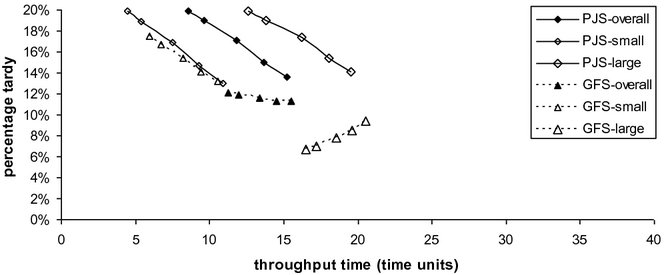
Performance of Small and Large Jobs in the Pure Job Shop (PJS) and the General Flow Shop (GFS) Under the Work Center Planned Release Date (WCPRD) Rule
At low values of the WLT (i.e., toward a trigger value of zero), throughput time performance for all job sizes deteriorates as flow direction is changed from the PJS (undirected routing) to the GFS (fully directed routing). Simultaneously, the overall percentage of tardy jobs decreases as flow becomes more directed. There is a significant reduction in percentage tardy for large jobs while only a marginal percentage tardy reduction for small jobs. The percentage tardy reduction for large jobs is made possible by a mean tardiness increase for small jobs; hence, although the percentage tardy for small jobs does not increase, the release of small jobs is delayed contributing to an increase in mean tardiness for this category of jobs. This can be seen in Table 5 where the mean tardiness results for the different job types (overall, small and large) are given in time units for each value of the WLT. The performance change for both throughput time and percentage tardy will be further explored in what follows.
Mean Tardiness Results (in Time Units). Results Shown According to Job Size (Overall, Small, and Large) and Shop Type (Pure Job Shop and General Flow Shop) for the WCPRD Release Rule
WLT, workload trigger; WCPRD, work center planned release date.
To improve our understanding of the mechanisms at work which lead to the change in performance, we recorded the two most important time‐related measures of performance: the operation throughput time for each work center (i.e., waiting and processing time) and the time‐to‐release (i.e., pool delay) for a job triggered by a certain work center according to the routing length (number of operations) of jobs. Table summarizes the results for operation throughput times (in time units) and Table summarizes the results for time‐to‐release (in time units) for WCPRD with a WLT of 2 time units. Results are shown for both an undirected routing (the PJS) and a fully directed routing (the GFS); the former is represented by the first number in each cell and the latter by the second.
Operation Throughput Times of Each Work Center (in Time Units). Results Shown According to Routing Length (1–6 Operations) and Work Center (WC 1–6) for WCPRD (WLT = 2 time units) in the Pure Job Shop (PJS) and General Flow Shop (GFS)
WLT, workload trigger; WCPRD, work center planned release date.
Time‐To‐Release or Pool Delay (in Time Units). Results Shown According to Routing Length (1–6 Operations) and Work Center (WC 1–6) for WCPRD (WLT = 2 Time Units) in the Pure Job Shop (PJS) and General Flow Shop (GFS)
WLT, workload trigger; WCPRD, work center planned release date.
Table 6 shows that, in the GFS, operation throughput times at upstream work centers (e.g., WC1&2) are shorter than in the PJS. However, these shorter operation throughput times do not fully compensate for the longer throughput times at downstream work centers (e.g., WC5&6), and so the average throughput time increases compared to the PJS. When the routing is directed, most releases are triggered by upstream work centers, thus the load of downstream work centers is mainly determined by order completion at other work centers rather than orders released directly to the work center from the pool. Thus, the average throughput time increases because the greater control of upstream work centers (when the WLT is set low) does not adequately compensate for the longer waits at downstream work centers due to the irregular arrival pattern.
While the above may explain why throughput time deteriorates as the routing becomes more directed and a low WLT is applied, it does not explain why the percentage tardy reduces. Table 7 shows that, in the GFS, large jobs spend less time in the pool waiting to be released than small jobs; that is, the continuous WLT postpones the release of small jobs and speeds up the release of large jobs. This is especially evident for jobs with a routing length of 6. If the routing is fully (100%) directed all releases are triggered by the first work center (WC1) because, when the routing length is 6, WC1 is the first work center in the routing of every job. As the workload of the first work center consists entirely of direct load, which can be controlled more tightly than indirect load, jobs are released faster and enter the shop floor earlier. On the other hand, jobs with a routing length of 1 which only visit the last work center (WC6) have to wait until the workload in front of WC6 falls below the WLT level. This can take a long time because WC6 is also regularly supplied with work by upstream work centers. Hence, in general, the release of jobs with a short routing length which enter at a downstream work center is postponed, resulting in higher mean tardiness for this category of job. However, these jobs have short routings and thus have a smaller risk of becoming tardy because of late release from the pool.
The performance pattern of LUMS COR is similar to that for WCPRD, as shown in Figure 2; this is because it also incorporates a continuous WLT. However, unlike WCPRD, the periodic element of LUMS COR provides load balancing and evaluates the urgency of jobs without giving special consideration to the load of the first work center in the routing of a job. This contributes to reducing the percentage tardy compared to WCPRD.

Performance of Small and Large Jobs in the Pure Job Shop (PJS) and the General Flow Shop (GFS) Under the LUMS COR Rule
As with WCPRD, if the routing is directed (GFS) and norms are tightened from infinite workload norms (the right‐hand starting point of the curves in Figure 2), then the percentage tardy for large jobs is significantly reduced compared to the PJS with undirected routing. However, this is at the expense of deterioration in tardiness performance for small jobs.
Like WCPRD and LUMS COR, SLAR increases throughput time as the flow becomes more directed. Although percentage tardy results for large jobs are not improved, SLAR still outperforms WCPRD in terms of percentage tardy. This is illustrated in Figure 3, where a k factor of 6 is represented by the lower starting point of the curves.
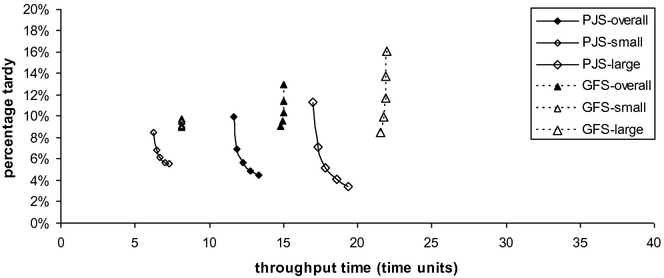
Performance of Small and Large Jobs in the Pure Job Shop (PJS) and the General Flow Shop (GFS) Under the Superfluous Load Avoidance Release (SLAR) Rule
In contrast to WCPRD and LUMS COR, the performance of SLAR largely depends on the time‐related factor k; varying k creates the different performance curve patterns for SLAR. SLAR differs from the other release methods in this study in two respects: first, the release of urgent jobs may be triggered even if the load queuing in front of a work center is sufficient, thus balancing the urgency of jobs in the queue in front of a work center with the urgency of jobs in the pool; and, second, it uses the SPT rule to choose between multiple urgent jobs. The first of these two elements is responsible for the low percentage tardy; the second reduces throughput time on the shop floor. Both effects weaken as the flow becomes more directed, which explains the curve shift in Figure 3. As a result, in a GFS, SLAR loses the advantage it has over alternative release methods in the PJS, although the mean tardiness remains relatively low.
The low mean tardiness of SLAR can be explained by its double‐mode lateness distribution, as illustrated in Figure 4a for a k factor of 2; as a comparison, the single‐mode lateness distribution of LUMS COR is shown in Figure 4b for a workload norm of 6.75 time units. The values for k and the workload norm were chosen such that the mean tardiness for the two release methods was similar. SLAR gains an advantage from the second mode in the distribution attributable to the constant evaluation of the urgency of jobs. However, when the flow becomes directed (GFS), this mechanism can only be applied to a limited extent at downstream work centers. This reduces the second mode; as a result, the first mode and the mean tardiness increase for directed routings.
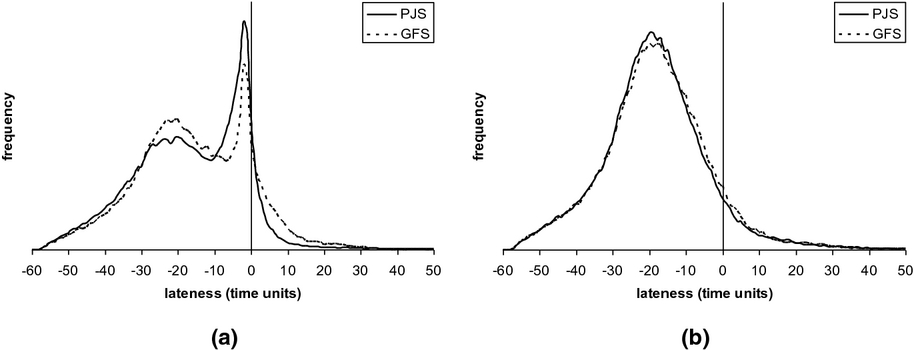
Lateness Distribution in the Pure Job Shop (PJS) and the General Flow Shop (GFS) Under: (a) Superfluous Load Avoidance Release (SLAR); (b) LUMS COR
Pure periodic release (e.g., the corrected aggregate load approach) does introduce work center idleness, as highlighted by Kanet (1988) and Land and Gaalman (1998). This phenomenon is also known as “premature” work center idleness because the idle time could have been postponed. Figure 5 shows the percentage of the total number of jobs which are released by the WLT of LUMS COR for the throughput time results obtained in a PJS. This figure supports the argument by Kanet (1988) and Land and Gaalman (1998) in the sense that if workload norms are tightened from infinite (the right‐hand starting point of the curves), the number of jobs triggered (i.e., released by the continuous part of the method) increases. This figure illustrates that—in contrast to pure periodic release—LUMS COR (periodic and continuous) does postpone idle periods by triggering releases if a work center is starving. This allows jobs to be processed earlier and performance to be improved.
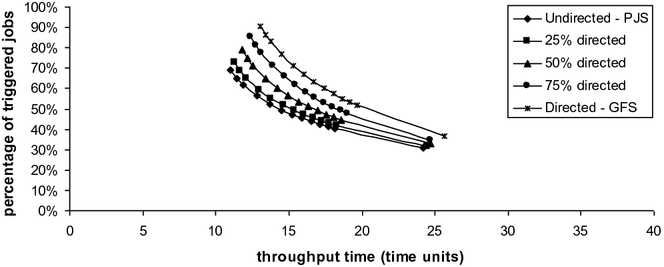
Percentage of Triggered Jobs for the Five Levels of Flow Direction Studied Under the LUMS COR Rule
When the workload norms are infinite, the periodic release method does not control the workload—all jobs present in the pool when a periodic release decision is made will be released. Due to its WLT, LUMS COR is still able to achieve a performance improvement of approximately 10% in throughput time and 20% in percentage tardy over the corrected aggregate load approach (periodic release). This has important implications for the use of WLC in practice. LUMS COR can be implemented independent of setting precise norm levels—a major advantage, as norm setting and “gaining control” of the shop are significant implementation challenges (e.g., Silva et al. 2006). Through the WLT, a direct performance improvement can be demonstrated in practice even with infinite norms, which should motivate stakeholders within a company to continue with the implementation process. Norms for the periodic mechanism can then be gradually tightened once the company is accustomed to the system, thus gaining control of the shop step‐by‐step. Alternatively, if the norms are set too tight, the same performance can still be achieved as under WCPRD (WLT = 0), as all jobs are triggered for release. LUMS COR avoids the problem of setting workload norms which research has struggled to overcome in the context of periodic release methods (e.g., Perona and Portioli 1998, Thürer et al. 2011).
To definitively compare the five release methods, performance measures have been classified into three categories: Category 1 considers performance using “traditional” measures, that is, in terms of throughput time performance, WIP, and reductions in percentage tardy. Category 2 considers the robustness of the methods to changes in flow characteristics, as investigated in sections 4.1 and 4.2. Category 3 considers practical issues, including the simplicity of the method, how intuitive it is, and its ease of implementation. Performance in each category is described below before an overall assessment of the release methods is provided: Category 1—traditional performance measures: SLAR and LUMS COR perform best in terms of percentage tardy followed by WCPRD which performed best in terms of reduced WIP and thus throughput time but suffered from a relatively high percentage of tardy jobs in the PJS. The corrected aggregate load approach (periodic release) and ConWIP clearly performed the worst. Category 2—robustness: All of the best‐performing release methods from Category 1 above (LUMS COR, SLAR, and WCPRD) were influenced by changes in flow direction. Although the corrected aggregate load approach (periodic release) and ConWIP were not or only marginally influenced by changes in flow direction, both were still consistently outperformed by the other three methods. LUMS COR is clearly the most robust of the best‐performing release methods from Category 1; however, the job type (small vs. large) which contributes most to its good performance is contingent on the flow characteristics. Category 3—practicality: LUMS COR may be considered the best solution for practice as it allows performance improvements to be achieved even under infinite norms. Thus, no workload norms have to be determined when implementing the approach. Once the WLT mechanism has been embedded in an organization and its production process, the periodic mechanism can be gradually introduced by tightening the upper workload norms to determine the best level, thereby achieving further improvement. ConWIP, WCPRD, and the corrected aggregate load approach (periodic release) are also relatively “straightforward” to implement; however, in all three cases, production is regulated entirely by one release mechanism. Finally, SLAR may be considered the most difficult to implement as it is not as simple and intuitive as the other methods and it does not allow control to be gained gradually. Moreover, a distinct workload level—which is not specified for SLAR—can be useful for maintaining clear dialogue between different tiers of command in a company; for example, between the shop floor supervisor and operators and between the supervisor and planning officer.
Previous research has indicated that WCPRD (e.g., Melnyk and Ragatz 1989) and the corrected aggregate load approach (e.g., Oosterman et al. 2000, Thürer et al. 2011) are the best‐performing release methods; however, this paper has drawn attention to LUMS COR. Among the release methods tested here, LUMS COR provided the best overall option due to its excellent performance under all flow characteristics and ease of implementation. Hence, it should be the order release method incorporated within the design of a comprehensive PPC concept intended for a wide range of shop characteristics in practice.
Conclusion
In answer to our first research question, concerning how performance compares across the release methods, the results of this study confirm that continuous release mechanisms (SLAR and WCPRD) and LUMS COR (which combines continuous and periodic release) outperform pure periodic release mechanisms (the corrected aggregate load approach). It has also been demonstrated that these methods outperform ConWIP under all tested conditions. LUMS COR is considered the best solution in practice due to its excellent performance and ease of implementation.
In answer to our second research question, it has been demonstrated that WLC release methods clearly have the potential to overcome prior criticisms (e.g., from Kanet 1988)—both throughput time and tardiness results improve if continuous release methods are applied (WCPRD and SLAR) or if periodic release is coupled with continuous release (LUMS COR). In addition, WLC release methods can lead to significant performance improvements even when an efficient dispatching rule (such as the PST rule) is already in place. WLC reduces the effectiveness of the dispatching rule, as argued, for example, by Baker (1984) and Ragatz and Mabert (1988), especially if WIP is very restricted. However, efficient release methods, as discussed in this study, have the potential to offset this performance loss. Hence, instead of playing conflicting roles, controlled order release and dispatching can and should in fact complement each other.
Managerial Implications
Much of the available PPC literature, including work on lean operations, is set in the context of large organizations. This paper demonstrates that—through the use of WLC—lean can also be achieved in the context of small and medium sized MTO companies. For example, Hopp and Spearman (2004) argued that controlling WIP is the key to a successful pull production system—although the authors did not refer to WLC, it has been shown here that the concept provides an effective means of controlling WIP that is consistent with the lean principles Hopp and Spearman (2004) outlined. To the best of our knowledge, WLC is the only PPC concept that allows the WIP of each work center to be controlled in high‐variety production environments with complex flow characteristics, thus effectively protecting throughput from variance. By choosing LUMS COR, managers are able to implement WLC without having to set precise workload norms from the outset. Further, by selectively releasing work to the shop floor, LUMS COR is able to smooth the workload seen by each work center, which allows non‐repetitive manufacturing to implement the heijunka principle of lean.
Therefore, WLC is of particular significance for small and medium sized MTO companies, as: It allows lead times to be short, predictable, and feasible. It allows capacity to be controlled and used effectively. It controls WIP and inventory, resulting in a lean shop floor. Its core principles are simple in use and application.
Future Research Implications
Finally, the most important implications from this study for future conceptual, analytical, simulation‐based, and field research can be summarized as follows: Conceptual research: Hopp and Spearman (2004) argued that all shops use a combination of three buffers (lead time, capacity, and inventory) to protect throughput from variance. This research creates a basis for examining components of the inventory buffer. The key components appear to be the pre‐shop pool of orders (the pre‐inventory) and the actual shop floor inventory (WIP). It has been demonstrated that the shop floor inventory buffer is most effective when it is a stable load in front of each work center. To maintain the load at a stable level, this buffer should be protected against variance in the incoming load. This can best be achieved with the aid of a higher level approach and the use of a pre‐shop pool of orders, as provided by controlled order release (e.g., WLC). Future WLC research should integrate the findings of this study with customer enquiry management, where the other two buffer types—lead time and capacity—are controlled, thereby creating a comprehensive system that protects throughput from variance. Analytical research: One of the qualities of WLC release methods such as LUMS COR is that they can change the distribution of busy periods at work centers. This research has shown that actively influencing this distribution, e.g., by postponing periods of idleness using a SA mechanism (i.e., the continuous WLT), improves performance. This provides a promising starting point for analytical research into how the distribution of busy periods at work centers influences performance in job shops. Simulation research: Several simulation studies have ignored the continuous part of release methods, transforming or simplifying methods—such as the original LUMS OR rule—into periodic release methods (e.g., Cigolini and Portioli‐Staudacher 2002, Fredendall et al. 2010, Hendry and Wong 1994). The findings of this paper suggest that simplifying methods in this way significantly deteriorates the results. Much better results are obtained here without simplification, that is, continuous release methods have consistently outperformed periodic release methods. Therefore, future research should consider how the results obtained, and the conclusions drawn, in previous studies would differ if continuous release were incorporated. Field research: A key issue which researchers have faced when attempting to implement WLC in practice is how to set appropriate initial WLC norms. LUMS COR can avoid this problem altogether; however, further field research is required to validate its effectiveness in practice. Implementing LUMS COR would also contribute toward: (i) determining the extent to which current WLC theory is aligned with the problems managers face in practice and (ii) developing a strategy or roadmap for WLC implementation.