






Abstract
Online marketplaces, such as those operated by Amazon, have seen rapid growth in recent years. These marketplaces serve as an intermediary, matching buyers with sellers, whereas control of the good is left to the seller. In some cases, e.g., the Amazon marketplace system, the firm that owns and manages the marketplace system will also sell competing products through the marketplace system. This creates a new form of channel conflict, which is a focus of this article. We consider a setting in which a marketplace firm operates an online marketplace through which retailers can sell their products directly to consumers. We consider a single retailer, who currently sells its product only through its own website, but who may choose to contract with Amazon to sell its product through the marketplace system. Selling the product through the marketplace expands the available market for the retailer, but comes at some expense, e.g., a fixed participation fee or a revenue sharing requirement. Thus, a key question for the retailer is whether she should choose to sell through the marketplace system, and if so, at what price. We analyze the optimal decisions for both the retailer and the marketplace firm and characterize the system equilibrium.
Introduction and Motivation
Online marketplaces, such as those operated by Amazon, eBay, and Google, have seen rapid growth in recent years. These marketplaces serve as a “two‐sided platform,” in which the intermediary, or marketplace firm, provides the service of matching buyers with sellers, whereas control of the good is left to the seller (Hagiu 2007). For example, while Amazon offers several programs through which merchants (i.e., sellers or retailers) can sell their products to consumers, their popular marketplace program, works as follows: Amazon Marketplace is for selling new, used, refurbished and collectible items—you can list your item right alongside the same item carried by Amazon.com. Marketplace transactions occur between the seller and the customer directly.1
Some retailers suggest that conflicts … are inevitable on Amazon's site. Unlike Amazon, other Web shopping malls, such as those of Google Inc. and Yahoo Inc., don't peddle their own wares in competition with the tenants. “Before anyone gets into bed with them, they need to think about whether they're a successful business, because Amazon or one of its partners one day will compete with them,” says Pinny Gniwisch, executive vice president of online jeweler Ice.com. Ice.com began selling jewelry through Amazon's site in April 2002. In 2004, Mr. Gniwisch says, Ice.com executives noticed that Amazon itself had begun selling pearl necklaces and diamond earrings—some of Ice.com's best‐selling products. Ice.com still generates revenue from its presence on Amazon, but Mr. Gniwisch says it's possible that his company will terminate its relationship some day. (Mangalindan 2006)
We are also interested in the problem from the perspective of the marketplace firm, e.g., Amazon. In this case, we are interested in the marketplace firm's decision regarding whether to sell a competing (i.e., identical) product, how to price that competing product, and how to design the contract with the participating retailer. A description of the contractual agreement between Amazon and the retailers participating in the marketplace program can be found on the Amazon website.2 Essentially, the contract consists of a flat monthly fee along with a fixed proportion of the retailer's sales revenue, which is called the referral fee. Thus, we will model this contract as a revenue sharing contract with a fixed fee for participation, and we will determine the equilibrium contract parameters for our model setting.
Given this motivation and problem framework, our research questions include: Under what conditions should the marketplace firm sell products that compete with those offered by its merchants? That is, should the marketplace firm introduce competition into the system? Under what conditions does the online retailer prefer to sell products through the marketplace? How does competition from the marketplace firm affect the performance of the online retailer? Is the marketplace contract efficient? Can the existing contract be used to coordinate the system?
We make two key assumptions in our model. The first is that selling through the marketplace system helps the online retailer obtain access to a larger segment of customers. This assumption reflects the relative prominence and name recognition of a marketplace firm such as Amazon (see Bakos 1997 and Bhargava and Choudhary 2004). The second assumption is that, all else equal, consumers prefer to purchase products through the marketplace system, rather than through the retailer's own website. Specifically, we assume that while the physical product provides the same utility regardless of which channel it is purchased through, the utility associated with the actual purchasing process (including search, payment, shipment, and order tracking) may differ across the channels. This assumption reflects the relative prominence and name recognition of a marketplace firm such as Amazon, as well as the marketplace firm's “ability to recommend products, create consumer trust and … perceived neutrality” (Bakos 2001). In addition, the process of placing the order, making payment, and tracking the order is likely to be easier for purchases made through the marketplace system.
Contributions
We believe we are the first to analyze the impact of competition in an online marketplace system in which the marketplace firm may sell a product that directly competes with the good sold by its merchant. Thus, our model allows us to capture a specific form of channel conflict created by an Amazon‐type marketplace system. Specifically, the agreement between Amazon and its merchants can be considered to be a marketing alliance. As Chatterjee (2002) notes, marketing alliances are “contractual relationships undertaken by firms who perform complementary activities in facilitating marketing exchanges. Unlike manufacturer‐distributor partnerships, marketing alliances are horizontal relationships between firms at the same level of the value‐added chain and represent a form of ‘symbiotic marketing’ (Adler 1966, Vardarajan and Rajaratnam 1986).”
However, the relationship between the marketplace firm and its merchant is not simply a horizontal one. As Chatterjee (2002) further notes, marketing alliances “may not be equally beneficial to all partners and the dominant role of one branded component can affect the value of the partnering component. The potential for serious conflict is always present as partners may compete with each other in other product lines and, on occasion, in those directly covered by the alliance agreement.” This latter situation is the one studied in our article, with Amazon the dominant partner due to its name recognition, as well as its role as owner of the marketplace system. In addition, the relationship is further complicated by the nature of the revenue sharing contract between the marketplace firm and the merchant. We believe we are the first to study this particular form of channel conflict. In addition, given the rapid growth of marketplace systems, we believe that understanding the impact of competition and channel conflict in these systems is of critical importance to the success of marketplace firms such as Amazon, as well as their merchants.
The remainder of this article is organized as follows. In section 2, we review the relevant literature. In section 3, we provide a model description and formal problem statement. In Sections 4and 5, we analyze a number of potential system configurations to help us to understand the channel choices made by each firm. In section 6 we characterize the overall system equilibrium and present a series of numerical examples to provide additional insights into the equilibrium results. We conclude, in section 7, with a discussion of the managerial insights provided by this research, as well as directions for future work.
Literature Review
We next review the relevant literature, which falls into four categories: a) single supplier, multi‐retailer models, b) dual channels of distribution, c) online retailing, and d) coordination through revenue sharing contracts.
As we consider a product that can be distributed through multiple, competing channels of distribution, our research has some similarities to the literature considering competition in a general single supplier, n‐retailer supply chain. For our purposes, the most relevant papers are those in which the retailers compete only on price, e.g., Bryant (1980), Bernstein and Federgruen (2005), and Birge et al. (1998). However, one critical difference is that, while our model has three potential channels of distribution, two of those channels are controlled by a single firm (the retailer controls sales of her product on both her own website and through the marketplace system). In addition, much of the research on competition in single supplier, n‐retailer systems, has focused on the case of n = 2. In our case, we have three sources of the product, each with their own price, a fact that significantly complicates the analysis. Finally, Choi (1996) considers a duopoly of so‐called “common retailers,” i.e., retailers who sell multiple, competing brands. He studies a system with two competing manufacturers providing goods to each of the two competing retailers. This model not only has some similarities to our own but also has some key differences. Most importantly, Choi (1996) assumes that the firms that provide the goods are independent of the firms that sell the goods, which is not the case in our model.
As we consider a retailer who, in addition to selling its product through her own website, is considering selling its product through a secondary channel of distribution, i.e., the marketplace, our research has some overlap with the literature on dual channels of distribution and, in particular, on supply chains with manufacturer‐direct sales. A variety of authors, e.g., Dumrongsiri et al. (2008), Chiang et al. (2003), Wu and Mallik (2010) and Cattani et al. (2006), have considered models in which the retail price is a decision variable, and thus the two channels (direct and retail) compete on price. Other research on manufacturer‐retailer competition in dual channel supply chains takes price as fixed. Here, the locations may compete on inventory (e.g., Geng and Mallik 2007 and Boyaci 2005) or on other factors such as sales effort (e.g., Tsay and Agrawal 2004 and Hendershott and Zhang 2006). Finally, Seifert et al. (2006) consider a supply chain with multiple independent retailers and a single “virtual” store. The main differences between this article and the existing research are three‐fold: First, in our model, consumers have three purchase options, rather than two. Second, the retailer controls the pricing decision on both channels of distribution for her product, i.e., on her own website and on the marketplace system. Using the terminology introduced in Hagiu (2007), while most of the literature on dual channels of distribution considers the “merchant” model, in which the intermediaries take ownership of the seller's goods, we consider the “two‐sided platform” model, in which control of the goods is left to the seller, and the intermediary simply matches buyers with sellers. Third, the nature of the contract between the retailer and the secondary channel is quite specific to and motivated by the practices of leading marketplace firms, such as Amazon.
There is also a vast literature that has developed on electronic marketplaces, bridging operations management, management information systems, and marketing. See Greiger (2003) and Wang et al. (2008) for reviews of this literature. We will focus on those papers that are directly relevant to our research. Bernstein et al. (2008) study a traditional retailer who is considering selling its product online. They consider two options for entering the online market: the retailer may develop its own website for online sales or may “align with pure e‐tailers to reach the online market.” Wang et al. (2004) consider a model of a consignment contract with revenue sharing, inspired by Amazon's marketplace program. Ru and Wang (2010) consider a similar model in which a retailer sells its product through Amazon on a consignment basis with revenue sharing. Unlike in Wang et al. (2004), they also consider a setting in which Amazon makes the procurement decisions and owns the inventory of the product until it is sold. In this setting, the manufacturer determines a recommended price, which Amazon may or may not use as the actual selling price. While both papers consider settings that are motivated by the same practical example as our research, they differ in that they do not consider the possibility of competition, either between the retailer's own website and the marketplace or between similar products being sold on the marketplace.
In this article, we model the contract between the marketplace firm and retailer as a revenue sharing contract with fixed participation fee. Pasternack (2002) considers a revenue sharing contract in a newsvendor setting and shows that it can be used to achieve channel coordination. Cachon and Lariviere (2005) show that “[r]evenue sharing generally does not coordinate competing retailers when each retailer's revenue depends on its quantity, its price, and the actions of the other retailers, e.g., competing price‐setting newsvendors with each retailer's demand depending on the vector of retailer prices.” Dana and Spier (2001) consider revenue sharing in a supply chain in which a single supplier sells to multiple retailers, each of which is modeled as a newsvendor who must choose price and order quantity. While our model has competing retailers and demand that depends on price, there is no quantity decision.
The most relevant segment of the coordination literature, for our purposes, considers a manufacturer who owns a direct sales channel. Coordination in this setting has received little attention. If the selling prices for each channel are fixed, the price‐only, buy‐back, rebate, and revenue sharing contracts cannot coordinate the supply chain (Boyaci 2005). However, a new type of contract proposed in Boyaci (2005), the compensation‐commission contract, has been shown to coordinate the system. Chiu et al. (2011) also demonstrate that most popular contracts cannot coordinate when the underlying demand depends on the retail price. They show that a contract combining wholesale price, channel rebate, and returns can achieve channel coordination with both additive and multiplicative price‐dependent demands. Su and Mukhopadhyay (2012) study contracts between a dominant retailer and a number of fringe retailers. They design a contract that not only prevents the dominant retailer from conducting any gray market activities but also coordinates the supply chain.
Problem Description
We consider the following problem setting. An online retailer (which we will refer to as “the retailer”) sells goods through its own website (referred to as channel b) and, in some cases, has the option of selling its goods through an online marketplace (referred to as channel B). In addition, the firm that owns the online marketplace system (which we will refer to as “the marketplace firm”) may also offer the product for sale through the marketplace system (referred to as channel A). Each firm decides the price(s) for the channel(s) it operates, i.e., the marketplace firm chooses


We assume that, when selling on channel b, the retailer incurs a cost, denoted

Sequence of Events and Decisions
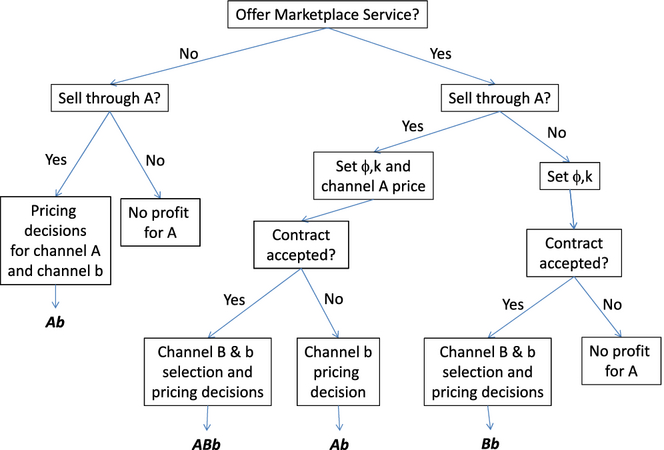
We next specify the sequence of events and decisions in our model. This sequence is depicted in Figure 1. The labels in bold at the end of the branches denote the resulting system configuration.
Sequence of Events and Decisions
The first decision is always made by the marketplace firm and is the decision regarding whether or not to offer the marketplace service to the retailer, i.e., whether to allow the retailer to sell through channel B. The sequence of subsequent events depends on this decision. Specifically: If the marketplace firm offers the marketplace service, the marketplace firm must next decide whether to sell competing goods, i.e., whether to offer the product through channel A. The firm must then determine the contract parameters, ϕ and k, and, if the product is offered through channel A, the selling price If the marketplace firm chooses not to offer the marketplace service, it must instead sell the product through channel A to earn some revenues. In this case, the marketplace firm and the retailer simultaneously set their respective prices (


Notice that the sequence of decisions and the nature of the game between the marketplace firm and the retailer depend on the marketplace firm's initial decision regarding whether or not to offer the marketplace service. Specifically, if marketplace service is offered, the remainder of the game is Stackelberg, with the marketplace firm serving as leader. However, when the marketplace service is not offered, the remainder of the game is simultaneous, i.e., the marketplace firm and the retailer choose their selling prices at the same time.
Given this setting, Figure 1 indicates that there are several system configurations to be considered. We will use the notation Ab to indicate the configuration in which the marketplace system is not offered to the retailer, and hence sales can occur only on channels A and b. We use ABb to denote the configuration in which the marketplace system is offered to the retailer and the marketplace firm chooses to sell the product. Thus, we have potential sales through all three channels. Finally, we use the notation Bb to denote the configuration in which the marketplace system is offered to the retailer and the marketplace firm chooses not to sell the product. Thus, we have potential sales through just two channels. Notice that in the ABb and Bb configurations, it is possible that, in equilibrium, some of the available channels may see no sales. For example, in the Bb configuration, the equilibrium prices may result in a zero demand on channel B, or perhaps zero demand on channel b. We will use the notation 0b and B0 to denote those outcomes, respectively. Similarly, the notation A0b (AB0) will be used to denote the three channel configuration with no demand on channel B (b).
We consider a single segment of customers with Poisson arrival rate λ per unit time. As the marketplace firm has name recognition and high visibility (e.g., Amazon.com), we assume that all customers are aware of the marketplace channels (i.e., channels A and B). However, not all customers will be aware of channel b. Rather, if the retailer sells goods only through her online store, i.e., only through channel b, then a proportion, α, of all customers will not know about the existence of channel b. If, however, the retailer decides to sell through the marketplace, i.e., if channel B exists, then the visibility of the retailer is increased and, as a result, all customers become aware of channel b.
Customers are strategic, i.e., their purchase decisions are based on utility maximization. We assume that customers have heterogeneous product valuations, v. Thus, we assume that v is uniformly distributed in the interval [0,1]. We assume that, due to its strong reputation and high visibility, customers prefer to purchase from the marketplace firm. As a result, all customers incur a disutility,



Marketplace Firm Does Not Offer the Marketplace Service
We are now ready to analyze the equilibrium behavior for each of the potential system configurations. We start by assuming that the marketplace firm chooses not to offer the marketplace service. Then, in section 5, we assume that the marketplace firm chooses to offer the marketplace service and we consider two cases, depending on whether or not the product is sold through channel A. Finally, in section 6, we consider the marketplace firm's problem of determining the overall system equilibrium.
We first consider the Ab system, which we refer to as the pure competition setting, in which the marketplace firm chooses not to offer the marketplace service to the retailer. Thus, the retailer sells the product only through her own online channel, channel b, whereas the marketplace firm also sells the product through the marketplace system, i.e., channel A, to earn some revenues. In this case, while all customers are aware of channel A, only a fraction, (1 − α), of customers are aware of channel b. Those customers who are not aware of channel b will never choose channel b and will only choose channel A if








Using this logic, assuming that


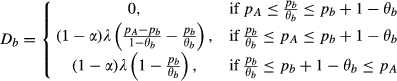

Thus, there are three possible cases to consider. For the remainder of this section, case 1 will refer to the case in which










Given the demand functions, we can write the profit function for each channel as



When When these conditions are not satisfied, a unique equilibrium may not exist for the Ab system.

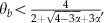
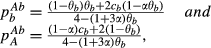
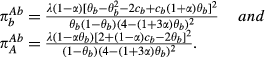
Theorem 1 indicates that two conditions are required to ensure the existence of a unique equilibrium in the pure competition setting, in which sales occur only through channels A and b. First, the cost incurred for selling on channel b,


We are also interested in the behavior of the equilibrium demands for each firm. Given the equilibrium prices, we can write the equilibrium demands for channels A and b as follows:
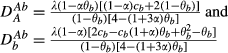
Finally, the equilibrium profits are
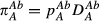

The equilibrium profit earned by the retailer in this case,


We next consider the setting in which the marketplace firm has chosen to offer the marketplace service, that is, has offered the marketplace contract to the retailer, with contract parameters ϕ and k. Note that by adjusting the contract parameters appropriately, the marketplace firm can influence the retailer's choice of channels, that is, the retailer's decision regarding whether to offer the product through channels B and/or b. In this setting, we are interested in several questions: Under what conditions will the retailer choose to offer the product through channel B? Should the marketplace firm also sell the product, that is, should the firm offer channel A? How should the marketplace firm design the contract, that is, set ϕ and k, to encourage the retailer to participate in the marketplace and maximize his profits?
We first analyze, in section 5.1, the situation in which the marketplace firm does not sell through channel A, and thus there are two possible channels, b and B. Then, in section 5.2, we consider the situation in which the marketplace firm does sell through channel A. To characterize the equilibrium for each setting, we must address two issues: (i) how the marketplace firm will set ϕ and k and (ii) which channels the retailer will choose to sell through and how she will set the price(s) on those channel(s). As the setting in which the marketplace firm offers the marketplace service is modeled as a Stackelberg game, in each case, we will find the equilibrium by working backwards, that is, by first characterizing the retailer's optimal decisions for given ϕ and k, and then determining the marketplace firm's optimal contract parameters, i.e., the ϕ and k that maximize the marketplace firm's profits.
Marketplace Firm Does Not Sell through Channel A
In this setting, there are two channels to consider: B and b. We start, in section 5.1.1, by analyzing the retailer's pricing and channel selection decisions, given that she has chosen to accept the marketplace contract. Then, in section 5.1.1, we consider the retailer's decision of whether or not to accept the marketplace contract. Finally, in section 5.1.2, we study how the marketplace firm will set ϕ and k.
Retailer's Pricing and Channel Selection Decision
If the retailer accepts the marketplace contract, all customers become aware of her channel, that is, all customers become aware of channel b. Thus, when choosing which channel to purchase through, all customers will compare












Given these demand functions, we can write the profit function for each channel as






If the retailer participates in the marketplace system, with contract parameters k and ϕ, her channel selection decision can be characterized as follows: If If If If If If If The optimal prices and profits under each system are as follows. System B0: System Bb: System 0b: In the above, recall that B0 (0b) denotes a Bb system with no sales on channel b (B).



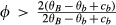

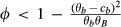
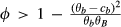



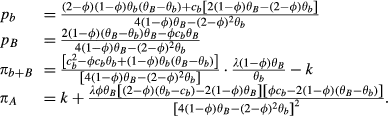



The retailer's channel selection depends on the interactions between the problem parameters, ϕ,


The above analysis considers the retailer's decisions under the assumption that she accepts the marketplace contract. In the next section, we consider the question of when it is optimal for the retailer to accept the contract terms and participate in the marketplace program.
For a given contract (ϕ,k), the retailer decides whether or not to participate in the marketplace system by comparing the optimal profit. When the marketplace firm offers the marketplace service, he acts as the Stackelberg leader, i.e., he offers the contract with parameters ϕ and k to the retailer, who must then decide whether or not to accept the contract. If the retailer decides not to accept the contract, we assume that the marketplace firm will choose to sell through channel A to obtain some revenues. Therefore, when evaluating the offered contract, the retailer will compare the equilibrium profit obtained from the Ab system, denoted

The retailer will choose to participate in the marketplace system if and only if the parameters of the marketplace contract satisfy one of the following five sets of conditions: If If If If If If If





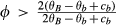


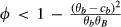



These conditions are derived from simple profit comparisons, ensuring that the retailer's profit, if she accepts the marketplace contract, is at least equal to


Finally, we consider how the marketplace firm, as the Stackelberg leader, would set the contract parameters, ϕ and k. Notice that, as he does not sell through channel A, the marketplace firm receives zero profit if the retailer chooses not to participate in the marketplace. Thus, the marketplace firm would like to design a contract that will motivate the retailer to join the marketplace. The following theorem presents the marketplace firm's optimal contract parameters:
If the marketplace firm offers the marketplace service to the retailer, but does not sell the goods himself, the marketplace firm's optimal contract parameters are The total profit earned by the marketplace firm is Under the ( In addition, the (

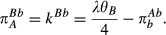


Using the results of Theorem 2, it is easy to verify that if ϕ = 0, then





Notice that the marketplace firm's optimal strategy is to set the contract parameters in such a way as to guarantee retailer's participation in the marketplace, while ensuring that all sales take place through the marketplace system. Also, notice that the marketplace contract achieves channel coordination and, due to its role as Stackelberg leader, the marketplace firm is able to extract all of the retailer's profits in excess of what she would earn in the Ab system.
In this setting, the marketplace firm sells the product through channel A. Thus, there are three channels to consider: A, B, and b. We analyze this three channel system, under the assumption that the marketplace firm offers channel A and wants the retailer to accept the marketplace contract. In section 6, we consider the overall equilibrium, i.e., we determine conditions under which it is optimal for the marketplace firm to offer channel A and to offer the marketplace contract to the retailer.
As we saw in section 5.1, by adjusting the contract parameters, the marketplace firm can manipulate the retailer to sell through any combination of channels B and b. That is, when there are three potential channels, the system can end up in one of three possible outcomes: AB0, A0b, or ABb, where AB0 (A0b) denotes a three channel system with sales only through channels A and B (A and b), whereas ABb denotes a three channel system with sales through all three channels. As the Stackelberg game leader, the marketplace firm is able to select the system that generates the most profit for him. In the following sections, we will analyze each of the three possible outcomes individually. In Section 6, we will use these results, along with those from Sections 4 and 5.1, to determine the overall equilibrium, i.e., to determine which system provides the marketplace firm with the highest overall profit.
AB0 System: Sales through Channels A and B Only
We first consider the system in which the retailer chooses to sell the product through the marketplace system, but not through her own online channel. Thus, as the marketplace firm also sells the product, there are two channels to consider, channel A and channel B. In this system, as the retailer sells through the marketplace system, all customers are aware of both channels. Therefore, when choosing which channel to purchase through, all customers will compare








Using this logic, assuming that







We are now ready to characterize the equilibrium prices and contract parameters for the AB0 system. Recall that the marketplace firm serves as the Stackelberg leader, choosing the contract parameters to optimize his own profits. Also, recall that the retailer will agree to participate in the marketplace system only if her profit under the marketplace contract is at least equal to

To ensure that the retailer chooses the AB0 system, while maximizing his own profits, the marketplace firm should set the contract parameters as follows:




The theorem says that to ensure that the retailer chooses the AB0 system, the marketplace firm should set ϕ = 0, i.e., the marketplace contract should have no revenue sharing. This, coupled with the fact that the unit cost of selling through channel b is


We next consider the system in which the retailer chooses to participate in the marketplace system, but with sales occurring only through her own online channel. Thus, there are two channels with positive sales, A and b. Recall that by participating in the marketplace system the retailer is able to increase her potential market from (1 − α)λ to λ. Thus, there may be instances in which the retailer would find it beneficial to pay the fixed cost, k, to participate in the marketplace system, even if she will not have any actual sales through channel B.
When making their purchasing choice, all customers will compare the net utilities offered by channels A and b. Using the same logic as applied in the previous sections, assuming that







We are now ready to characterize the equilibrium prices and contract parameters for the A0b system. We do so in the following theorem.
If
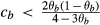




The condition
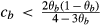

Finally, we consider the system in which the retailer chooses to sell the product through the marketplace system, as well as through her own online channel. Thus, there are three channels to consider: channel A, channel B, and channel b. In this system, as the retailer sells through the marketplace system, all customers are aware of three channels. Therefore, when choosing which channel to purchase through, all customers will compare


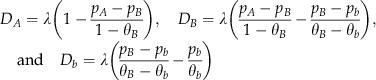
To ensure positive demand on all three channels, we require the prices to satisfy the following conditions:


We can now write the profit functions for each channel as








We are now ready to state our main result for this three channel case:
No equilibrium with strictly positive demand on all three channels exists for the ABb system.
We prove Theorem 7 by demonstrating that, in the ABb system, the marketplace firm will choose to set the revenue sharing parameter, ϕ, so that there are no sales on channel B. The intuition behind this result is that, when there are positive demands on channels b and B, to maximize his profits, the marketplace firm will take a large portion of the revenue earned on channel B, i.e., ϕ will be large. In contrast, when ϕ is large, the retailer will find it optimal to forgo the potential revenue from channel B, and will instead set

Our goal is to characterize the overall system equilibrium, i.e., to determine whether the marketplace firm will offer the marketplace contract to the retailer, to determine whether the marketplace firm will choose to sell the product through channel A and at what price, and to characterize the retailer's channel selection and pricing decisions. Before doing so, we summarize the analysis completed so far. We considered the case in which the marketplace firm chooses not to offer the marketplace service. We analyzed this Ab system to determine the equilibrium prices and profits. We then considered the case in which the marketplace firm chooses to offer the marketplace service. There were two subcases to consider: The case in which the marketplace firm does not offer the product through channel A and thus only channels B and b exist. For this system, we demonstrated that the marketplace firm, as Stackelberg leader, will set the contract parameters such that the overall equilibrium has sales only through channel B. Thus, the resulting equilibrium is the B0 system. The case in which the marketplace firm offers the product through channel A, and thus, all three channels (A, B, and b) exist. For this system, a retailer who participates in the marketplace system has three options: Sales through B only, the AB0 system Sales through b only, the A0b system Sales though both B and b, the ABb system
We analyzed the marketplace firm's optimal contract design for each of these three cases, and demonstrated that no equilibrium exists for the ABb system.
Thus, to determine the overall system equilibrium, we must compare four systems: Ab, B0, AB0, and A0b. In section 6.1, we present our results regarding this comparison and mathematically characterize the conditions under which each of these systems will be the overall equilibrium. Then, in Section 6.2, we provide some intuition behind these results and present some numerical results.
As the marketplace firm is the Stackelberg leader, it is able to select his preferred system from among these four potential equilibrium systems (Ab, B0, AB0, and A0b) by adjusting the parameter values of the contract. Thus, by comparing the four systems, we just need to consider the marketplace firm's profits and find the system that provides the highest profits. The results for the four systems are summarized in Table 1. Notice that, for ease of comparison, we have rewritten the expression for


Potential Equilibrium Systems
Potential Equilibrium Systems
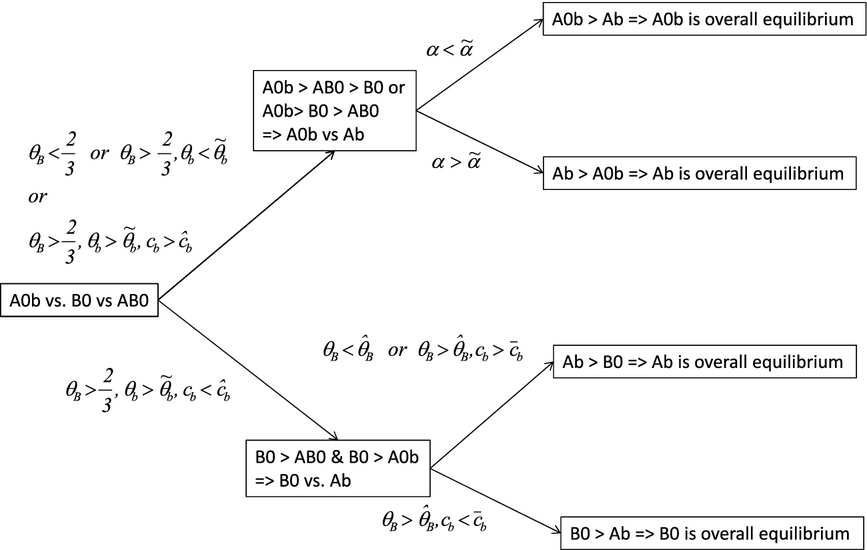
There exist a series of thresholds whose precise definitions are provided in the proof of this theorem, such that the overall equilibrium can be determined as followed: If all four system equilibria exist according to the conditions specified in Table 1, then use the logic shown in Figure 2. If only the AB0, B0, and A0b system equilibria exist according to the conditions specified in Table 1, then use the logic shown in Figure 5 in the Online Appendix. If only the AB0, B0, and Ab system equilibria exist according to the conditions specified in Table 1, then use the logic shown in Figure 6 in the Online Appendix. If only the AB0 and B0 system equilibria exist according to the conditions specified in Table 1, then AB0 is the overall equilibrium if

Overall System Equilibrium: All Systems (AB0, B0, A0b, and Ab) Exist
The tree shown in Figure 2 can be used to determine which of the systems is the overall equilibrium for any given set of parameter values. In the tree, we use the > symbol to denote when one system dominates the other, in terms of the total system profit.
We will focus our discussion of these results on the tree shown in Figure 2, which applies in settings in which an equilibrium exists for all four potential systems (B0, AB0, A0b and Ab). In this tree, we start by comparing the three systems in which the retailer agrees to the marketplace contract, i.e., B0, AB0, and A0b, to determine which is preferred by the marketplace firm. Once we have determined the best of these three systems, that best system is then compared with the “pure competition” system, i.e., Ab, in which the marketplace firm does not offer the marketplace contract, and thus enters into a purely competitive relationship with the retailer.
We start by discussing the first node in the tree, in which the marketplace firm chooses among B0, AB0, and A0b. We first note that AB0 is never selected by the marketplace firm in this setting. As shown in the proof of the theorem, this is due to the fact that the marketplace firm always prefers A0b to AB0. In other words, given that the retailer agrees to the marketplace contract and that the marketplace firm chooses to sell through channel A, the marketplace firm prefers to compete against channel b, than against channel B. This is because channel b can be considered to be a weaker competitor than channel B due to its higher unit cost (


We next consider the remaining two nodes in the tree, in which we compare the best system from the first node (B0 or A0b) with the pure competition system, Ab. In the top part of the tree, we compare A0b and Ab. The marketplace firm's choice between these systems depends on the value of α, the fraction of customers who are not aware of channel b when the retailer does not sell through the marketplace system. When α is small, i.e., 


Overall System Equilibrium as a Function of α and

Overall System Equilibrium as a Function of

Figures 3 and 4 are contour graphs, i.e., they were created by comparing the profits for each system. Each region's label represents the system preferred by the marketplace firm and the lines represent the thresholds shown in Figure 2. In Figures 3a and 4a, we have 

In the A0b system, all customers are aware of channel b, whereas in the Ab system, a fraction (α) of customers are not aware of channel b. Thus, the A0b system provides the retailer with a larger market share and creates a higher level of competition for the marketplace firm. In the A0b system, the marketplace firm uses the marketplace contract to extract all excess profits (beyond those earned in the Ab system) from the retailer.
Intuitively, (1) makes the A0b system less attractive to the marketplace firm, whereas (2) makes the A0b system more attractive to the marketplace firm. When α is small, the effect of (1) is minimal, and thus (2) dominates, making the A0b system attractive to the marketplace firm. If α is large, but 
Figure 4a can be interpreted in a similar manner. When channel b is seen as a strong competitor (sufficiently small unit cost, 


Figures 3b and 4b can be understood by noting that 


In summary, there are three possible equilibria, representing different degrees of coordination and competition between the marketplace firm and the retailer, as outlined below: Pure Coordination (System B0): Sales in this system only take place through channel B, with the retailer and the marketplace firm sharing the overall profits. This system will be the equilibrium when the retailer is a sufficiently strong competitor, i.e., when the utilities associated with channels B and b are sufficiently high and the unit cost for channel b is sufficiently low. Pure Competition (System Ab): The marketplace firm does not offer the marketplace contract, and thus, enters into a purely competitive relationship with the retailer's online channel. This case will be the equilibrium when the retailer is viewed as a weak competitor to the marketplace firm, i.e., if the utility associated with either of the retailer's channels (B and/or b) is sufficiently low or if the fraction of customers who do not know about the retailer's online channel is large. Competition and Coordination (System A0b): In this system, the marketplace firm and the retailer simultaneously coordinate (the retailer agrees to the marketplace contract) and compete (the retailer sells through her own channel). This case is preferred to pure competition only when allowing the retailer to be visible to all customers poses a minimal threat to the marketplace firm's own sales through the marketplace system. This case is preferred to pure coordination except in settings in which the retailer's channels (B and b) are viewed favorably by customers (have a low disutility) and the retailer's unit cost for sales on her own channel is small.
Finally, while we will not discuss the trees shown in Figures 5 and 6 the Online Appendix, which apply in settings in which one or more of the systems does not have a feasible equilibrium solution, we note that the results can be explained using the same logic used to explain the tree in Figure 2. However, there is one additional result worth noting. As noted in the final bullet of Theorem 8, when neither the A0b nor the Ab systems have a feasible equilibrium, it is possible that the AB0 system will be the overall equilibrium. However, this will only occur when 

In this article, we consider a setting in which a marketplace firm, such as Amazon, operates an online marketplace through which retailers can sell their products directly to consumers. We consider the question of under what conditions an online retailer would choose to contract with the marketplace firm to sell its product through the marketplace system. Selling the product through the marketplace expands the market of available customers for the retailer, but also comes at a cost, i.e., a fixed participation fee plus revenue sharing. We also consider the problem from the perspective of the marketplace firm, studying how the firm would decide whether or not to offer the marketplace contract to the retailer, how the firm would set the marketplace contract parameters, and whether the marketplace firm would choose to sell a competing product through the marketplace system.
This research was inspired by the experience of companies such as Ice.com, who are initially motivated to join the marketplace system to access a larger segment of customers, but who later find that they must compete directly with the marketplace firm, and thus must confront the question of whether to continue selling through the marketplace system. The results of our research indicate that the situation Ice.com found itself in during 2004, with sales of its goods occurring through both its own online store and through the Amazon marketplace, the latter in direct competition with similar products being sold by Amazon, may not be a stable one. In other words, we find that the three channel system will not exist in equilibrium. Instead, the equilibrium will be one of four types, all of which have sales through only two channels. We summarize each of these possibilities below: In the pure coordination equilibrium, the retailer agrees to participate in the marketplace contract, while the marketplace firm chooses not to sell the product itself. The retailer sets the prices in such a way that there is no demand through her own online channel, i.e., sales occur only through her marketplace channel. The marketplace firm sets the contract parameters, i.e., the fixed payment and degree of revenue sharing to coordinate the system, i.e., to maximize total profit for the system, while extracting as much profit from the retailer as possible, making the retailer indifferent between participating in the marketplace system and not participating. In the pure competition equilibrium, on the other hand, the retailer does not participate in the marketplace system. Instead, the retailer's online store and the marketplace firm coexist and compete for a portion of the market, each setting their own prices to maximize their own profits. In this system, as there is no contract between the retailer and the marketplace firm, the total system profit is unlikely to be maximized, i.e., the system is not coordinated. In the competition and coordination equilibria, the marketplace firm and the retailer simultaneously coordinate (the retailer agrees to the marketplace contract) and compete (the retailer sells through either her own channel or through the marketplace system, but not both).
We have also characterized the conditions under which each of these systems is likely to be the equilibrium. First recall that, as the Stackelberg leader, it is the marketplace firm who, in the end, determines which equilibrium will result, i.e., the overall system equilibrium will be whichever system provides the marketplace firm with the highest profits. We find that the pure competition equilibrium becomes more likely when the retailer is seen as a weak competitor to the marketplace firm (i.e., the retailer has low name recognition or low utility). In other words, if the marketplace system is viewed as being more secure or as providing a greater level of service than the retailer, and thus consumers have a clear preference for engaging in transactions with the marketplace firm rather than with the retailer, then the competitive equilibrium is more likely. On the other hand, we find that the pure coordination equilibrium becomes more likely when consumers do not have a strong preference for purchasing from the marketplace system relative to purchasing from the retailer, i.e., when the utilities gained from purchasing through either of the retailer's channels are large, and when the retailer's unit cost is low. In particular, as the utility associated with purchasing through the retailer's online store increases, getting closer to the utility obtained from purchasing through the marketplace firm, the two channels become more competitive, and the profits earned by the marketplace firm in the competitive equilibrium decrease, making the coordinated equilibrium more attractive.
Finally, this article contributes to the existing literature by studying a specific form of channel conflict created by an Amazon‐type marketplace system. Specifically, we study the impact of competition in an online marketplace system in which the marketplace firm both designs the marketplace contract with the retailer and, potentially, sells a product that directly competes with the good sold by the retailer. In such a system, the relationship between the marketplace firm and the retailer is both horizontal and vertical. In addition, the marketplace firm is the dominant partner in the system due to its name recognition, as well as its role as owner of the marketplace system. We believe we are the first to study this particular form of channel conflict and to understand the potential equilibrium outcomes for such a system. Given the rapid growth of such marketplace systems, understanding the impact of competition and channel conflict in these systems is of critical importance to the success of marketplace firms such as Amazon, as well as the retailers who take part in these systems.
Limitations and Future Research
We conclude this article with a discussion of several limitations of our current model. First, as noted above, we assume that both marketplace channels (B and A) have the same unit cost, and we normalize these costs to zero, leaving only the unit cost, 



Next, we note several other limitations of our model setting. First, while we have assumed a certain sequence of decisions in our problem setting, other sequences are possible. Specifically, we have assumed that the marketplace firm, as the Stackelberg leader, acts first and sets the contract parameters, ϕ and k, as well as his selling price, 

Footnotes
Acknowledgments
The authors thank the departmental editor (Professor Amiya K. Chakravarty), senior editor, and two referees for their contribution in improving the clarity and quality of this paper.
1
Author names are listed alphabetically and all authors contributed equally.
2
3