






Abstract

Iceland's financial crisis was precipitated by mass privatisation, deregulation of the banking sector and soaring personal debt. But the IMF solution has not been as radical as many feared, write
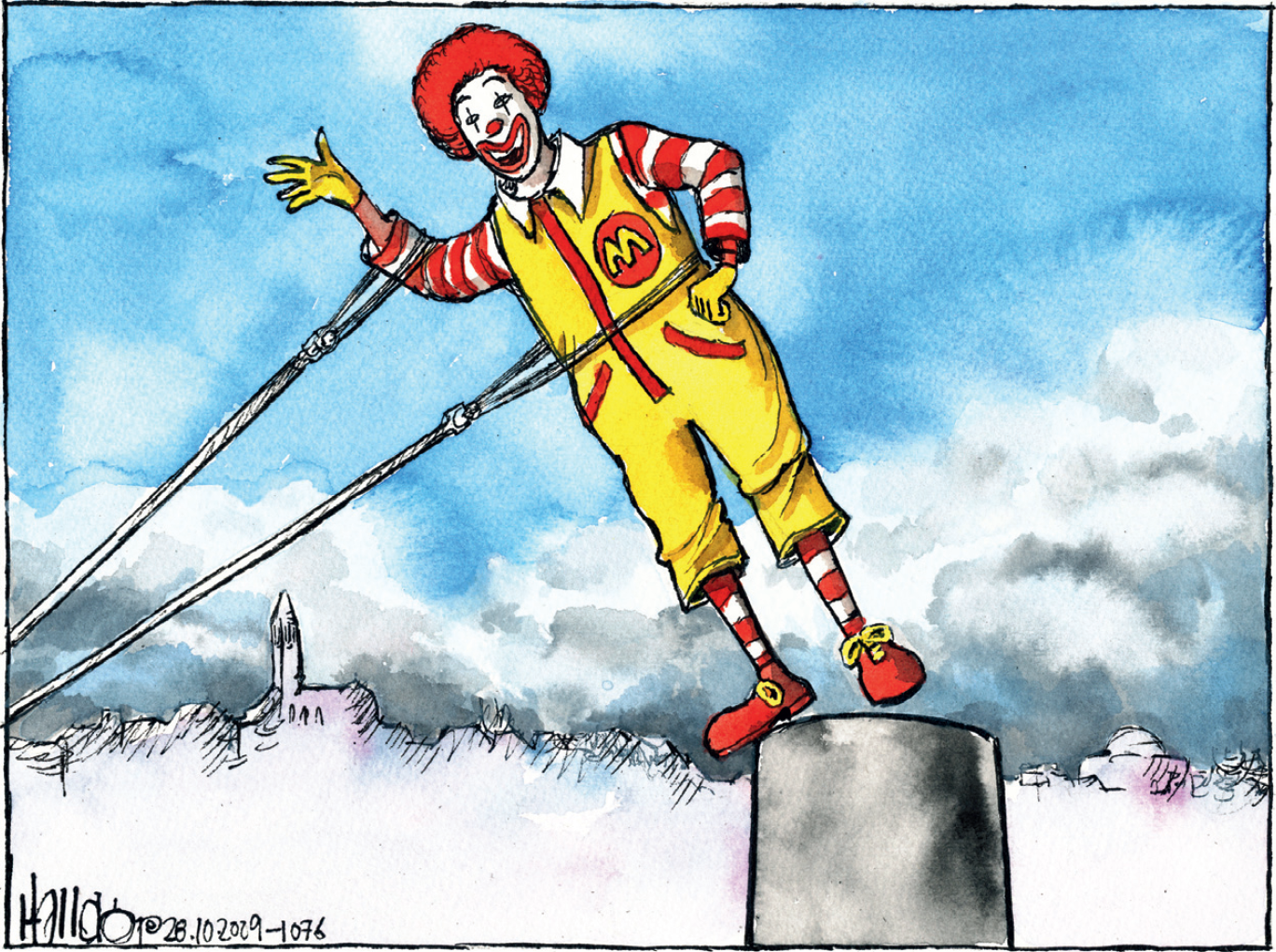
On 1 November 2009, the last McDonald's franchise holder in Iceland closed, citing ‘the rocketing cost of imports’
Sixteen years later, on 1 November 2009, Iceland's last McDonald's franchise holder closed his doors, citing ‘the rocketing cost of imports’. As the Icelandic krona plummeted in the wake of a complete meltdown of the financial sector the previous autumn, he was no longer able to afford the imported products he was forced to use under the terms of his franchise licence. Iceland's foremost political cartoonist Halldór depicted the Saddamesque fall of Ronald McDonald against a backdrop of the Reykjavík skyline.
The roots of the Icelandic bubble, and its collapse, sprouted in the early 1990s. In 1993, Davíð Oddsson — who Time recently listed as one of the 25 people to blame for the financial crisis — became prime minister; his right-wing Independence Party was to stay in power for the next 15 years. Acting on advice from Hannes Hólmsteinn Gissurarson, professor of political science at the University of Iceland, Oddsson introduced Reaganite and Thatcherite policies into Iceland, a decade later than in the US and Britain.
The step-by-step privatisation of various state-owned factories and service companies culminated in the simultaneous privatisation of two of the Icelandic state banks in 2003. This was followed by the privatisation of the national phone company and the deregulation of the energy sector. Concomitantly tax ‘reforms’ were implemented; these entailed a massive lowering of corporate tax (it was also made extremely easy to set up a private holding around even the smallest of assets), tax incentives for investors, lowering of capital income tax, lowering of income tax and the abolition of property and high-income tax. Underlying these government actions was an unwavering commitment to the neo-liberal dogma of entrepreneurial freedom, self-regulation of markets, private over public ownership and, ultimately, the dissolution of the public realm. All of which is neatly captured in the title of a now infamous book by professor Gissurarson, How Iceland Can Become the World's Richest Nation.
A year or so before the collapse, nearly all public assets in production or services had been privatised. The welfare system was next on the agenda, along with Iceland's abundant natural energy supplies. The educational sector had already been opened to privatisation with private schools at all levels open to businesses; doctors could outsource work to their own private practice; and public utilities in Reykjavík were only saved from privatisation by a backlash from the municipalities.
Despite mass privatisation, government spending spiralled upwards, mainly due to massive public investment in the welfare system and infrastructure, most notably the building of Europe's largest earthen dam at Kárahnjúkar and massive road improvements. All seemed well, the economy was booming, but clouds were gathering on the pristine neo-liberal horizon.
Post-war Iceland had been one of the most egalitarian societies in Europe but, as the tax burden was transferred to pensioners and lower-income families, signs of social stratification and even exclusion began to show. Stoking the furnace of massive economic growth were the soaring debts of households, municipalities and corporations: between 1990 and 2008 the average Icelandic household's debt-to-income ratio went from 80 per cent to around 270 per cent. Even more perturbing was the fact that the currency remained disproportionately strong due to the boom, attracting speculative investors. Iceland had become the world's largest hedge fund’.
Icelanders were earning credit in krona but racking up mountains of foreign currency debt. Imports soared, especially cars. American SUVs became the vehicle of choice for many Icelandic families — with American-style fuel prices they could afford to gas guzzle. Lack of money was no hindrance. Car dealers were known to arrange loans on the spot for any amount within five minutes — all you had to do was sign.
Iceland's vertiginous negative trade deficit was not, however, the most worrying feature of the economy. The newly privatised, and almost completely unregulated, banks had grown to eight times the size of the country's gross domestic product.
In September 2008, as liquidity dried up on the world market, these cracks became impossible to paper over. In October, an aeroplane filled with the world's media came to report live as Iceland ‘went bust’. In a live television broadcast, Oddsson's successor, Geir Haarde, a US-trained economist and close friend of the former PM, announced that Iceland's debt was unsustainable. The next day Parliament passed emergency laws granting the government extensive powers to nationalise the financial sector. The failing banks were immediately absorbed. Nearly a week later the Icelandic government appealed to the International Monetary Fund for assistance.
That after a decade and a half of neo-liberalism Iceland is now on IMF life support is truly remarkable. As Ronald is being pulled from his pedestal, the IMF is being introduced, but the fund's policies for failing economies have been enacted in Iceland before — by Oddsson's government. This might explain why it appears that Iceland is enjoying considerable leeway from the IMF.
At present the IMF seems willing to co-operate with the now left-wing government on multi-step tax levies in combination with budget cuts, as opposed to draconian budget cuts alone. The IMF has also allowed the government to maintain capital control in stark contrast to its former opposition on this. Similarly, the fund has not opposed the government in running a large budget deficit over the next couple of years, and no demands have been made for the privatisation of resources or companies. However, the IMF's familiar face as capital's watchdog was evident in the debate around the responsibility to depositors of the iniquitous Icesave accounts, many of whom were based in the United Kingdom. Their insistence that the Icelandic Central Bank maintains high interest rates, given the indebtedness of regular households and companies and following a collapse in consumer demand, has also proved controversial.
Perhaps this leeway is due to the fact that the IMF is intervening in a westernised, neo-liberalised economy that has ‘gone bust’ so close to its own geographical and ideological heartland. But the question of whether there will be a genuine shift from the neo-liberal ethos back to the egalitarian principles of the Nordic welfare states remains.
The former McDonald's franchise-holder opened a new chain of fast-food outlets, named Metro. Now free from franchise demands, Metro can use locally produced ingredients for its hamburgers.
In much the same way many of the companies at the forefront of the collapse are still operating. The banks have been resurrected under new names: Kaupthing became New Kaupthing and now Arion bank; Glitnir reverted back to its old name Íslandsbanki; and Landsbanki became New Landsbanki.
Iceland's financial sector totally collapsed, but on the surface it appears as if not much has changed. Or, as is often said in Iceland today, this is so 2007.
By 2008, Iceland's newly privatised banks had grown to eight times the size of the country's gross domestic product