






Abstract

Within a generation Mexico has gone from authoritarianism to democracy and market reform. But despite some successes the Mexican state has become weaker internally and its economy more dependent on the US. Meanwhile the country is increasingly vulnerable to spiralling drugs-related violence, writes
Ageneration ago, Mexico had one of the most effectively run authoritarian systems in the world. The political system was characterised as a ‘six-year dictatorship’. This referred to the fact that the president was not allowed to serve for more than a single six-year term but he did the next best thing and chose his successor.
Today Mexico's democratic executive is dangerously weak given the problems that it faces. The reason is partly the institutional weakness of the presidency and partly because the current balance of political forces makes it almost impossible for a Mexican president to make full use of such powers as he has. No president has enjoyed a congressional majority since 1997 — a situation that cannot change until 2012 at the earliest — and the vast majority of state governors are members of Mexico's opposition parties.
Meanwhile policy issues press. There is a major problem with the illegal drugs trade and the Mexican government is potentially short of revenue. It collects comparatively little tax in comparison with other Organisation for Economic Co-operation and Development (OECD) countries and its oil production, which provides around 40 per cent of public revenue, is in long-term decline.
Mexico's democratic executive is dangerously weak given the problems that it faces
President Calderon (2006–12) has been desperately trying to make some headway on the fiscal side with an ambitious programme of tax and oil reform but progress has been disappointing. Meanwhile Mexico's social and economic problems — particularly drug-related violence — have hit the headlines. Indeed, given the recent salience of the drugs issue, some US commentators are starting to speculate as to whether Mexico is on the way toward becoming a failed state — though that is clearly an exaggeration. However, the tendency of successive Mexican presidents to prioritise issues that they cannot resolve puts one in mind of a statement once attributed to Mussolini: ‘It is not impossible to govern Italy — but merely useless’. Is this now true of Mexico?
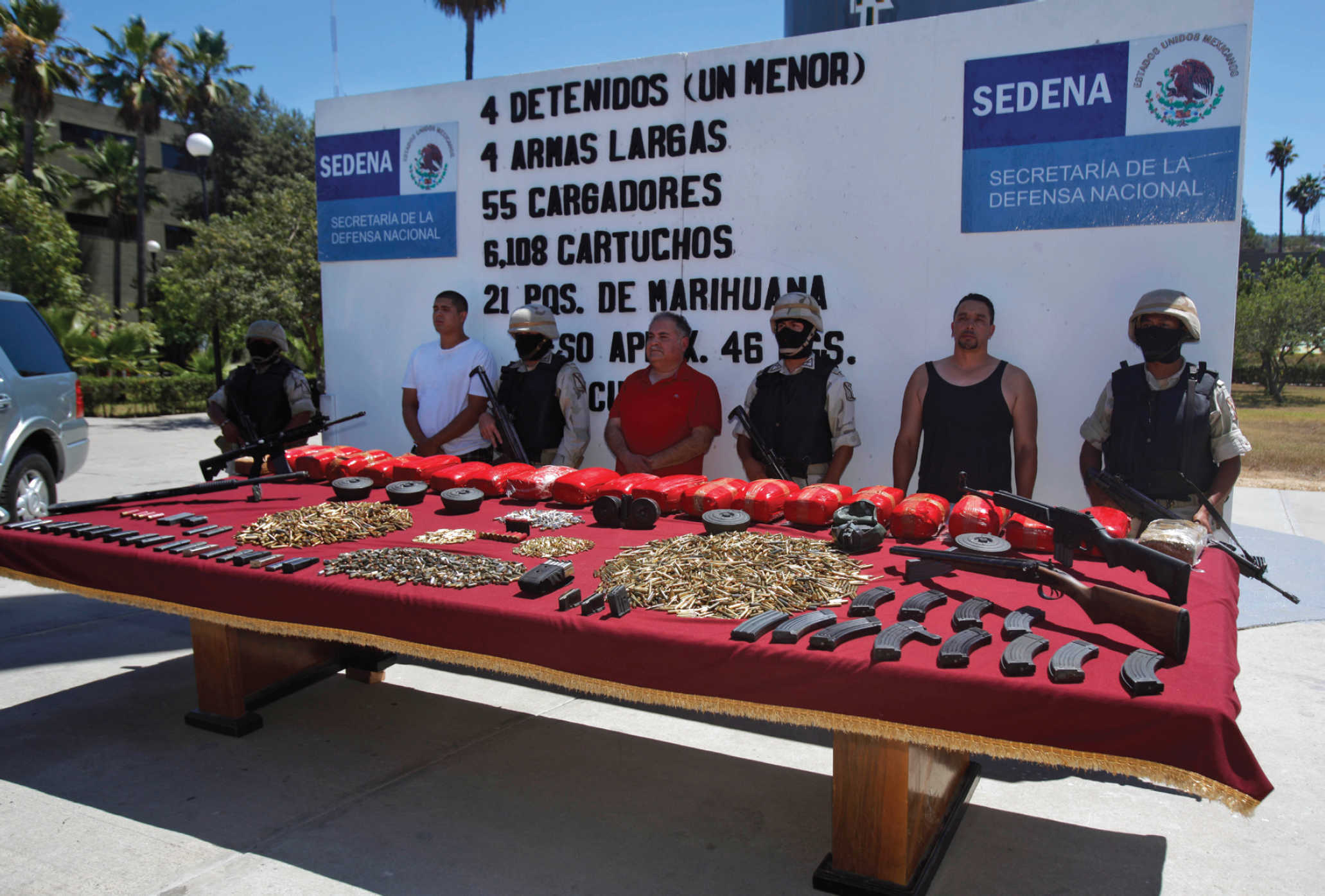
Seizures of weapons and drugs have increased dramatically as Mexico's drugs war worsens
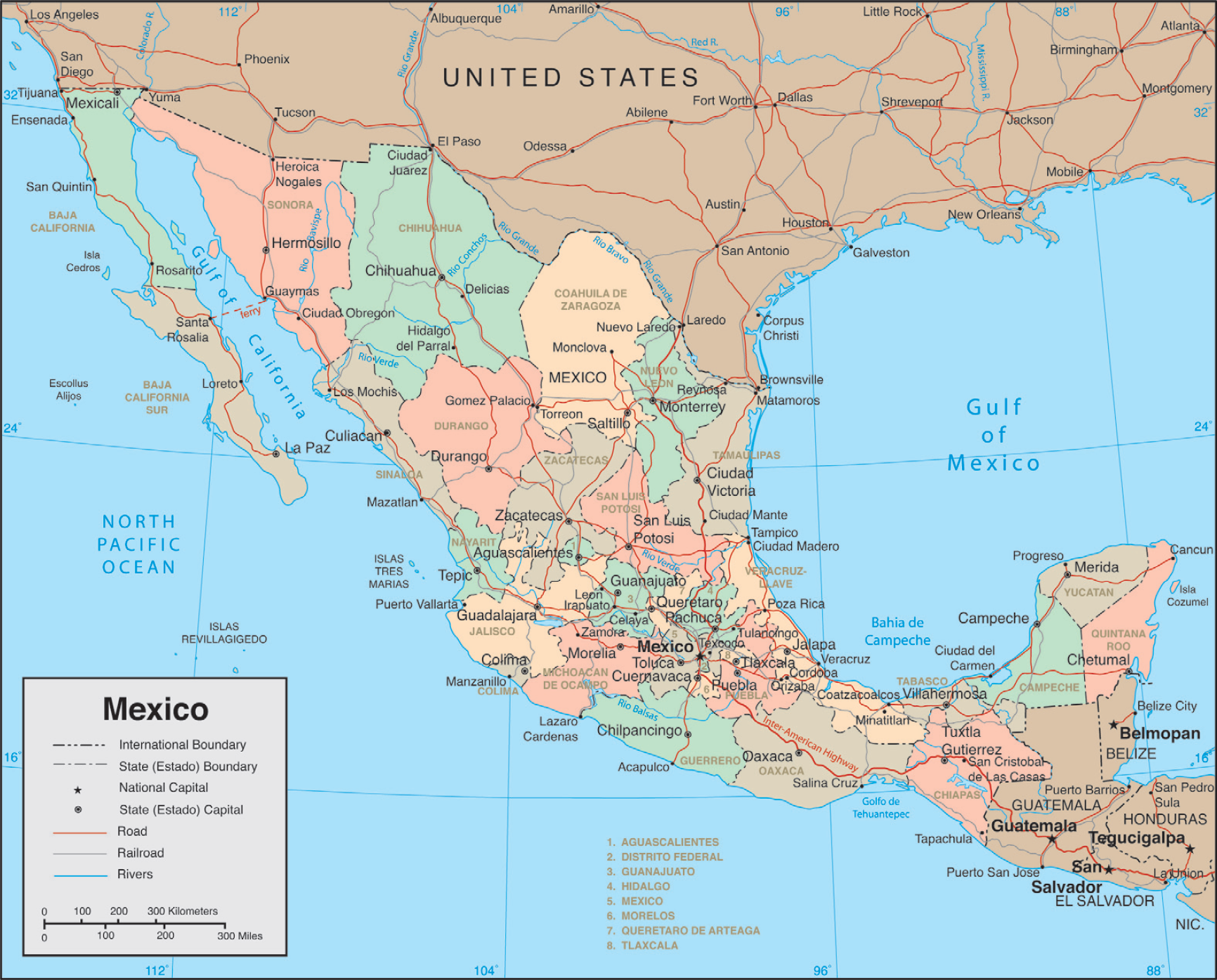
The 1917 Revolution's key slogan — ‘an effective vote and no re-election’ — retains resonance to this day
From Despotism to Weak State
To answer this question, we need first to explain how Mexico transformed itself from despotism to a weak state. Democratisation has played a part in this, though it has been the unintended consequences of democratisation that have caused most of the problems.
The old authoritarian system was complex (and quite effective) in terms of its legitimation, even if simple enough in terms of its governance. The key legitimating events were the Revolution (1910–17) and the 1917 Constitution. The Constitution was aspirational and contains many eloquent passages. The key revolutionary slogan — ‘an effective vote and no re-election’ — retains resonance to this day.
What conscribes the formal procedures for governing, however, is not so much the original constitutional document of 1917 as a series of measures agreed in the early 1930s. These were intended not to democratise Mexico but to allow control of the political system by the boss of a single official party. President Plutarco Elias Cables (1924–28) set up the official party in 1929 with the aim of using it as a means of exerting political control.
Events did not go Calles' way. Instead a particularly Mexican form of authoritarian presidentialism was created by a form of presidential coup under Lazaro Cardenas (1934–40) who harnessed Mexico's social organisations to take political control away from the party machine and vest it in the executive. While authoritarian, Cardenas' form of presidentialism was socially progressive and was based on some quite inclusive (at least by Latin American standards) forms of social mobilisation.
Social mobilisation weakened over time, but the key question of power, namely that the government dominated the official party, lasted for around 60 years before it was dismantled under Ernesto Zedillo (1994–2000) as part of Mexico's democratisation process. When this happened, it was like removing a layer of carpet only to find another layer beneath. The lower layer featured the 1917 Constitution and a deliberately weakened presidential institution. The problem is that the Constitution is seen as legitimate but in some key respects is no longer fit for purpose.
Meanwhile the dominant party, renamed the Institutional Revolutionary Party (PRI) in 1946, has also become a competitive political party. Instead of a ruling party, Mexico has acquired a three-party system where, even in the best of cases, it is hard for a majority government to emerge.
Many observers expected the PRI to collapse under conditions of democratisation. However, the defeat of the PRI in landmark presidential elections in 2000 did not lead to its disintegration. Instead, the PRI regrouped around its regional strongholds. It now controls the vast majority of state governorships and enjoys significant weight in Congress. The party retains by far the strongest political machine in Mexico. What it has not been able to do is to find electorally plausible candidates for the presidency, and it is mainly this that has kept the PRI out of the presidency since 2000. However the PRI, in opposition, enjoys as much influence over most policies as the government does.
The main causes of executive weakness in Mexico are, however, clear. They include limited formal presidential powers, high political turnover due to a demanding ‘no re-election’ rule, three-party politics with the PRI playing a key role, and a set of rules that are difficult to change because of the legitimatory significance of the 1917 Constitution. There has emerged from this a hybrid political system that nobody was really expecting. Power has moved toward party elites — three rather than one — which have no interest in over-strengthening the president of the day. They are more interested in doing deals and using their control over the legislature to exclude outsiders.
The Economy and the US
Just as Mexico has had to face a long period of weak government, so its policy problems have become more complex and harder to resolve. A generation of significant economic progress may therefore now be coming to an end.
Thirty years or so ago Mexico had the typical economic profile of a middle-income Latin American country. Its manufacturing sector was heavily protected and not very competitive. Agriculture, which had proved unexpectedly successful in the 1950s and 1960s, subsequently started to decline. The population was rising, and there was massive internal migration to the cities, which struggled to cope. The authorities used oil revenues to expand the public sector and co-opt the politically discontented. This was an unsound strategy, ineptly executed, and in 1982 the country suffered a major economic crisis.
Starting in the mid-1980s, however, the Mexican government adopted a pro-market policy orientation. Important steps included Mexican membership of the General Agreement on Tariffs and Trade (GATT) and the North American Free Trade Agreement (NAFTA). It must be said that economic progress since then has been bumpy. There have been policy mistakes and some major economic crises. But one thing has stood out. Mexico has become a major exporter of manufactured goods and has shown itself capable of competing in US markets. Thirty years ago, manufactured exports from Mexico to the US were negligible. Since then they have increased impressively and growth has been sustained despite some scepticism about the long-term viability of the export model. Strength in the export sector has contributed to a climate of low inflation, reasonably low interest rates and a general improvement in the quality of life for the majority of Mexicans. There has even been some reduction in poverty.
There is, though, a downside to this undoubted progress. The Mexican economy has become decisively dependent on its American counterpart, and just when the US has started to look weak. Given the size of the US government deficit and the increasingly polarised political atmosphere in the US — not least towards the issue of illegal Mexican migration — the American locomotive may be running out of steam just when Mexico most needs it to work. In 2009 economic conditions in the US were unfavourable and Mexican GDP fell by 5 per cent.
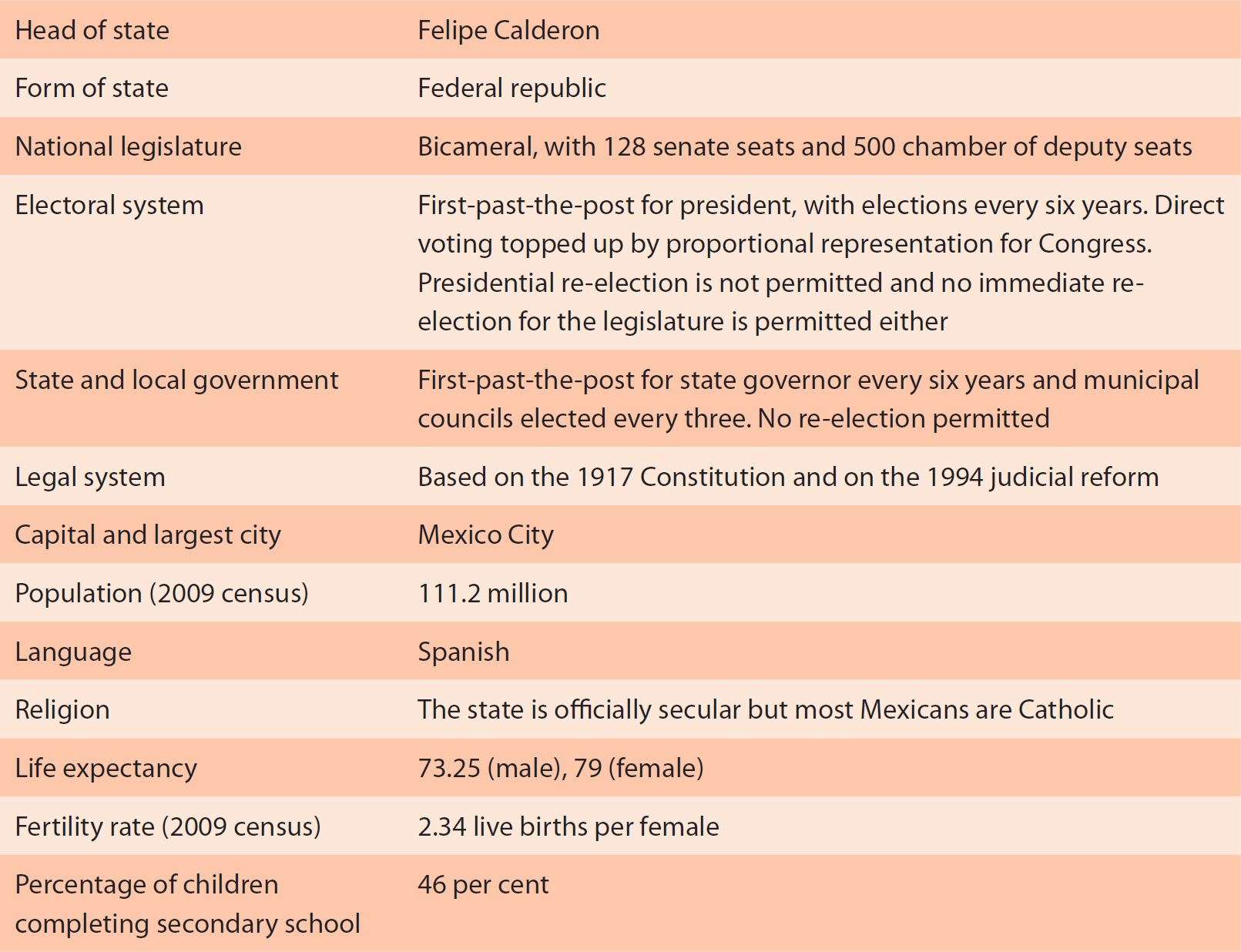
Mexico: Key Facts
Meanwhile other results of executive weakness are that tax collection is low, oil production is slowly falling and too much government spending is tied up with assuaging political lobbies. Mexico's economy is also producing a disproportionate number of billionaires, including Carlos Slim who is now believed to be the richest man in the world.
The current Calderon government (2006–12) has worked hard to get some economic reforms through Congress but these have not made much real difference. Nor did the reforms attempted by the Fox presidency before it (2000–06). A weak presidency has been unable to reform a vulnerable economy. Looking ahead, the politics of either will not be easy.
Mexico's Narcotics Problem
Finally it is impossible to avoid the drugs issue, which has become much worse in recent years. It must be admitted that drug problems exist in many countries rather than just Mexico and Mexican homicide rates are by no means the worst in Latin America. Nevertheless, the Mexican state is not even close to commanding the resources that would be necessary to fight what Calderon has described as a ‘war on drugs’ effectively. The drugs gangs have more money and often better weaponry than the Mexican army, and this is even truer of the police. Increasingly it also seems that the war on drugs is not one that many Mexicans wish to fight, with significant domestic pressure for the legalisation of some drugs within Mexico.
Instead Mexico is being pressed into service of anti-narcotics campaigning by the US and, given its economic dependency on its northern neighbour, is in no position to resist. Meanwhile there are fears that drug traffickers –whose activities have remained thus far mainly criminal — may start challenging the state at its core. It is not at all clear that Mexico would be able to cope unaided if that happened, though the US would surely find it necessary to increase its involvement if the Mexican state looked set to fail — which it does not, at present.
Regardless, any idea that Mexicans may have had that democratisation and market reform could produce benefits without costs has clearly not worked out.