






Abstract

The coalition's decision to ring fence international development spending has focused attention on the UK aid budget. How much does Britain really spend on aid? And why has international development remained high on the political agenda?
Context of UK Aid
The establishment of the Department for International Development (DFID) as a separate government department by the Labour government in 1997 was a significant move, which helped to place development higher on the national agenda. Prior to the establishment of DFID, issues relating to international development had been dealt with by the Overseas Development Agency, which formed part of the Foreign and Commonwealth Office. Since then, Britain has also taken a leading role in numerous international agreements concerned with development, in particular the G8 summit at Gleneagles, which pledged to double aid to Africa and significantly reduce bilateral debt.
The coalition government generally has accepted the increased level of importance assigned to international development by the Labour administration. The decision to ring fence and even increase spending on international development at a time when every other government department, except health, was facing huge cuts in their budgets generated plenty of headlines. The commitment to spend 0.7 per cent of GNI on overseas development assistance (ODA) by 2013, enshrined in law, is a significant step, given that in 2009 the figure was around 0.52 per cent and only a limited number of countries had reached this level. However, it is worth noting that if GNI goes down, as some expect it to, then the actual spend need not increase that much. The coalition also agreed on the need to maintain DFID as an independent government department separate from the Foreign Office. Finally there was support to ensure that aid was directed to providing the most basic of needs to those living in poverty.
Britain has played a leading role in numerous international development agreements
Top 10 recipients of DFID bilateral aid 2008/09
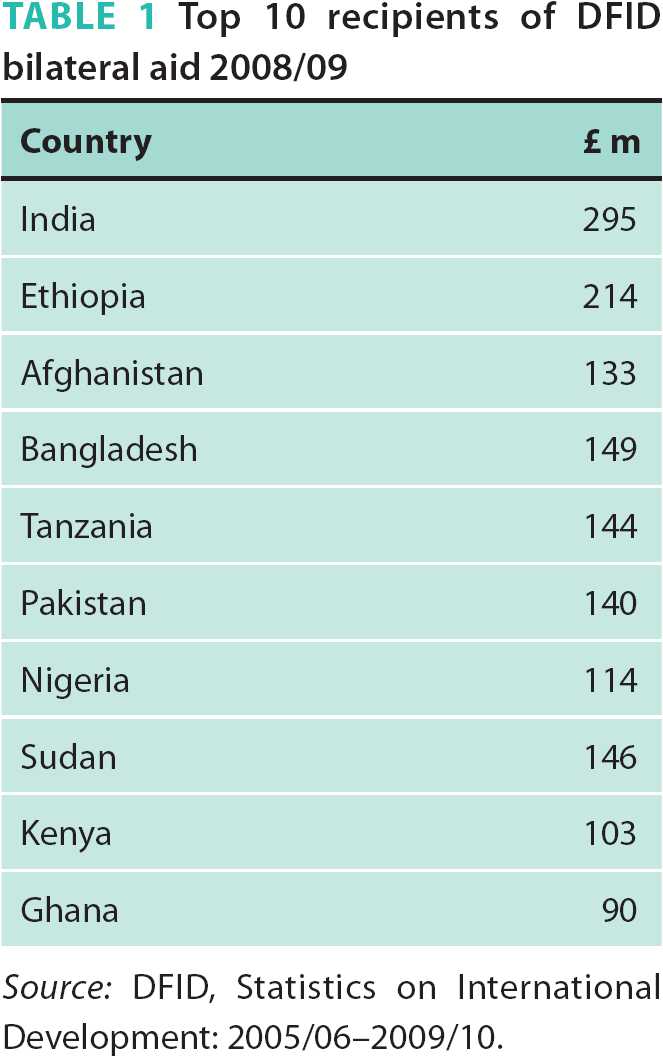
Source: DFID, Statistics on International Development: 2005/06–2009/10.
Where does UK Aid Go?
In 2009/10, out of the overall DFID budget, ţ4 billion was spent in 90 countries through bilateral programmes. The top 20 recipients of DFID bilateral aid accounted for 83 per cent of the bilateral aid budget, with the top three recipients of net bilateral ODA in 2009 being India, Ethiopia and Afghanistan (see Table 1). In addition, ţ2.5 billion was spent via multilateral organisations, with the greatest amounts going to the European Union (ţ1,186 million), World Bank (ţ560 million) and United Nations (ţ216 million).
The largest percentage of UK aid was spent on the ‘economic’ sector
On-going aid to India has proved controversial

Aid to India
The case of India highlights the complexity of modern aid. India is the largest recipient of UK aid, yet its economy is growing at about 10 per cent per year, it has a large defence budget, including a nuclear programme, and even a (small) aid budget.
However, recent figures suggest that nearly 40 per cent of the Indian population live below the poverty line. The target of the first Millennium Development Goal (MDG) was to halve, between 1990 and 2015, the proportion of people whose income is less than $1 a day. Despite the World Bank's classification of India as a middle-income country, poverty there still poses massive challenges to the UK government's commitment to achieving the MDG targets. Meanwhile India has indicated that it could voluntarily reject UK aid rather than appear to suffer the slight of having aid cut.
A central plank of the coalition's aid policy is an attempt to refocus aid on the most deserving cases. At present there is a belief that aid spending is spread too thinly. In particular, there is the question of aid to countries such as China and Russia. The pace of economic growth in these countries means that they are now seen as middle-income nations, which are even providing overseas aid to developing countries. Consequently UK aid to both China and Russia will be stopped. Recent research, though, questions the wisdom of this decision, showing as it does that nearly three-quarters of the world's population living below the $1.25 a day poverty line live in middle-income countries, such as India, Nigeria and Indonesia.
Aims of UK Development Policy
DFID, in its Business Plan:2011–15, says that ‘DFID's overall aim is to reduce poverty in poorer countries, in particular through achieving the Millennium Development Goals (MDGs)’. The International Development Act (2002) states that DFID ‘can provide development assistance lor sustainable development and welfare provided they are satisfied this assistance is likely to contribute to poverty reduction’. Alongside the commitment to spend 0.7 per cent of GNI on international development, the coalition outlined a number of aid priorities: increasing transparency in aid; boosting wealth creation; strengthening governance and security in conflict-affected countries; leading international action to improve the lives of girls and women; and combating climate change.
The desire to boost wealth creation is evinced by the fact that the largest percentage of UK aid was spent on the ‘economic’ sector, which was also the sector seeing the greatest increase in 2009/10 (up by 64 per cent). The economic sector includes transport, communications, construction and manufacturing. This reflects a strong belief that trade is the best way to raise countries out of poverty. Regionally more funding was spent on basic service sectors in Africa and Asia than in the rest of the world, with the most spent on the ‘Health’ sector in Africa and Asia (see Figure 1).
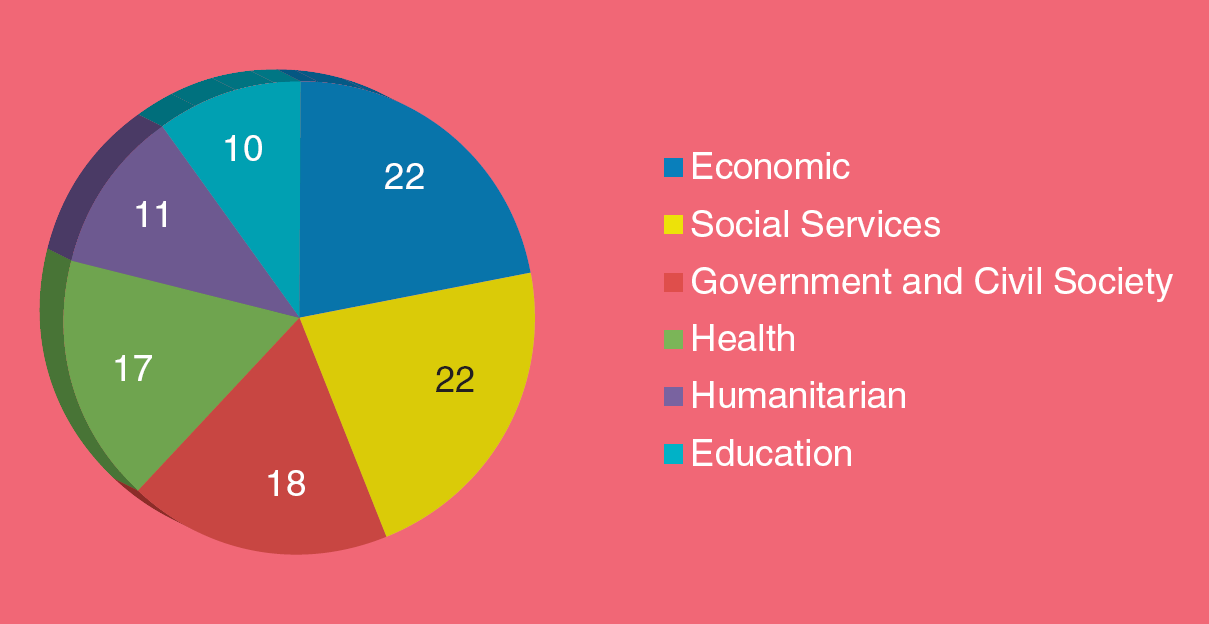
UK aid spending by sector 2009/10 in percentage terms
Future Direction of UK Aid Policy
On 31 December 2010, the government launched ‘Framework for Results’, a series of plans for development. One focuses on the fight against malaria (a personal interest of Chancellor George Osborne) and the other on the promotion of safe abortion and contraception within the framework of maternal health (a key interest of International Development Secretary Andrew Mitchell). These frameworks fit within the broad thrust that development policy must deliver results and be open and accountable. Mitchell has launched the ‘UK Aid Transparency Guarantee’, as well as pledging to ‘test the concept of cash on delivery aid’. States need to demonstrate that projects or reforms are successful before aid money is released. There is also a much greater focus on the role of the private sector, as typified by the creation of the Private Sector Department in 2011.
The UK government's desire to ‘provide a more integrated approach to post-conflict reconstruction’ is reflected in its decision to establish a ‘Stabilisation and Reconstruction Force’. A National Security Council to handle issues of development, defence and diplomacy is also to be created. There are some concerns that the focus of development policy is becoming less about ending poverty than promoting Britain's interests abroad. For example, there have been questions over whether the sharp rise in development expenditure in Afghanistan should count towards the overseas development assistance target. However, development policy is inexorably tied up with foreign policy objectives, with the government believing that lifting people out of poverty has a positive impact, not just in economic and social terms, but security terms as well. In Afghanistan, for example, there is a clear link between reducing poverty and supporting good governance in order to marginalise the Taliban's influence over the population, thereby allowing the withdrawal of British troops. As Andrew Mitchell explained, ‘while the military bring much-needed security, peace will only be achieved by political progress backed by development’.
International Development on the Political Agenda
Mitchell has said that the coalition government, ‘will not balance the books on the backs of the poorest people in the world’. It is commonly believed that the more conservative a government, the more likely it is to cut development aid. Yet the coalition government has not favoured cuts to the international development budget. It would seem that other factors are of importance, aside from political ideology, when determining support for international development.
One take on the matter is that by ring fencing the international development budget, the coalition government, and particularly the Conservatives, are trying to remain ‘the nice guys’. The Institute for Public Policy Research supports this thesis, arguing that, for the Conservative Party, ‘a public commitment to international development and aid was a “quick win” in their efforts to shed their image as the “nasty party”’. International development is viewed as a moral matter and the coalition, whether for political or altruistic reasons, have recognised this. Indeed the opening line of the international development section of the coalition agreement between the Tories and the Lib Dems says: ‘the Government believes that even in these difficult economic times, the UK has a moral responsibility to help the poorest people in the world.’
Another political motivation to consider is that international development is viewed to be in the interest of donor countries. Indeed, both the previous Labour government and the present administration have linked the moral case for assisting developing countries with the more established aim of pursuing national interests. Mitchell has stated that ‘tackling deprivation around the world is a moral imperative and firmly in Britain's national interest.’
National interest traditionally refers to the strategic and commercial interests of the donor country. Both political and strategic considerations remain major determinants of aid allocation, and donors may also provide aid with the intention of gaining a larger share of the recipient nations' imports. The UK is relatively unusual, even within the Organisation for Economic Co-operation and Development's (OECD) Development Assistance Committee, in that it does not tie its aid; that is, it does not stipulate that aid money must be spent in Britain. Increasingly politicians are keen to highlight the global benefits of economic and social development in the world's poorest countries. A healthier, wealthier, more secure world is the one important vision politicians use to sell their development policies to the electorate. Furthermore, committing to international development policy is viewed as a means to enhance a state's international reputation.
Public opinion research carried out in February 2010 found that roughly similar numbers of UK citizens felt that aid should be distributed only according to need (16.7 per cent) as believed it should only be distributed according to our national interest (15.6 per cent). A high level of public support has been considered a factor in increased levels of development aid, although the academic evidence is mixed. The same survey found that 16.8 per cent of those polled felt the UK gave too much aid to developing countries, while 30.7 per cent thought it was about right. Given that there has been little positive press on the decision to ring fence the budget, the coalition may have been influenced by development lobbyists. The ‘development constituency’ comprising non-governmental organisations, think tanks and pressure groups has been largely supportive of the government's decision. While public support may fluctuate, the development constituency in the UK continuously pushes for government commitment on key aid issues.
Conclusion
The UK is considered to be one of the world leaders on international development issues and is often seen as a model by other donors. The coalition's decision not to cut development spending despite slashing budgets in nearly every other department has been welcomed by many involved in aid provision. The commitments to spend 0.7 per cent of gross national income on overseas development assistance and to enshrine this in law by 2013, increase spending in order to try and achieve the Millennium Development Goals, and improve transparency and accountability, are significant pledges with cost implications. This government, like its predecessor, is also keeping up the pressure on the international community to maintain their commitments in this area.
The traditional assumption that a Conservative government would favour lower levels of development assistance has not, so far, been borne out under the coalition. However, a fierce debate is taking place that may see a refocusing of UK aid away from middle-income countries in order to prevent a major public opinion backlash against aid. Headlines in the Daily Mail about ‘first world India’ not needing UK aid highlight the current complexity of UK aid. Nevertheless, tackling poverty within middle-income countries remains probably the biggest challenge to ensuring that the aims of UK development policy are achieved. Like all government departments, the Department for International Development will need to demonstrate value for money and also that its money is being well spent.