






Abstract

Traditionally seen as powerless, the role of United States vice president has been transformed over the past 50 years.
‘
This article looks at the office of vice president, asking whether it is really as powerless as it has historically been regarded — is the main role of the VP ‘gathering moss while you wait for the boss to sneeze’, as Tom Lehrer put it? We will examine the criteria that presidential candidates use when choosing their running mate and discuss to what extent the role has changed in recent years under Dick Cheney and Joe Biden.
Choosing a Mate
US presidential nominees generally choose their running mates to complement, rather than merely duplicate, their own qualities or background, whether it is home state, political wing of the party, age, gender or experience. In 2008, considerations of age and experience seemed to influence both candidates' choice of running-mate. Democrat nominee Senator Barack Obama's greatest electoral weakness was his limited experience — he had not yet served even one complete term in the Senate and was virtually unknown before 2004. His track record was particularly thin in the field of foreign policy. So he chose Joe Biden, a veteran senator, with many years of experience on the Foreign Relations Committee.
On the other hand, his septuagenarian Republican opponent Senator John McCain, chose the little-known, but young and feisty, Governor Sarah Palin of Alaska. Some commentators felt that this choice backfired on McCain by making him appear even older beside his youthful running mate, and by raising doubts about whether it was wise to put a highly divisive figure, whose inexperience was quickly exposed on the campaign trail, just a 72-year-old heartbeat away from the presidency. McCain, with a reputation as a maverick somewhat removed from mainstream Republican opinion, also hoped to shore up his support from the party's traditional base by choosing a creationist, anti-abortion, pro-hunting running mate. The need to broaden the ticket's experience, political appeal or regional balance can also be seen in many examples from the past, such as Kerry-Edwards in 2004 or Kennedy-Johnson in 1960, and no doubt the same considerations will be in play in the 2012 Republican candidate's choice.
The Second Stage of a Rocket?
What the vice presidential candidate can bring to the ticket in electoral terms is clearly important — but does this imply that once the election is won, the vice president's usefulness is over? An aide to Vice President Hubert Humphrey compared the VP's role to the second stage of a rocket — important going into orbit, but then thrown off to burn up in the atmosphere.
Yet all but one of the vice presidents from Walter Mondale on have been important figures in successive administrations, and wise presidential candidates look beyond the electoral appeal of their running mate to what qualities he or she can offer to the administration as vice president. Presidents Jimmy Carter, Ronald Reagan, Bill Clinton and George W Bush were each former state governors with no Washington experience; and herein lies one of the most significant causes of the increase in the importance of the vice president. However important their image as untainted by DC politics was in their election, once they became president they needed someone with Washington experience at their side to guide them through the minefield. Significantly, the most lightweight vice president of the last 35 years, Dan Quayle (1989 to 1993), was chosen by George H.W. Bush — the only president since 1977 to have had previous experience in office in Washington.
Carter chose Walter Mondale, senator for Minnesota for more than a decade. Reagan continued the pattern of outsider-insider tickets by choosing George H.W. Bush, whose CV included congressman, US ambassador, chairman of the Republican National Committee, and ultimately director of the CIA. Clinton also chose an archetypal DC man — Al Gore, Jr had been born in Washington, the son of a senator for Tennessee, a position he himself later filled.
There would have been little point in choosing these consummate Washington men as running mates and then not using their experience, and certainly Mondale, Bush and Gore all played significant roles in the administrations in which they served. Joel K. Goldstein, author of The Modern American Vice-Presidency, argues that Mondale began the expansion in the role of the vice presidency.
Cheney
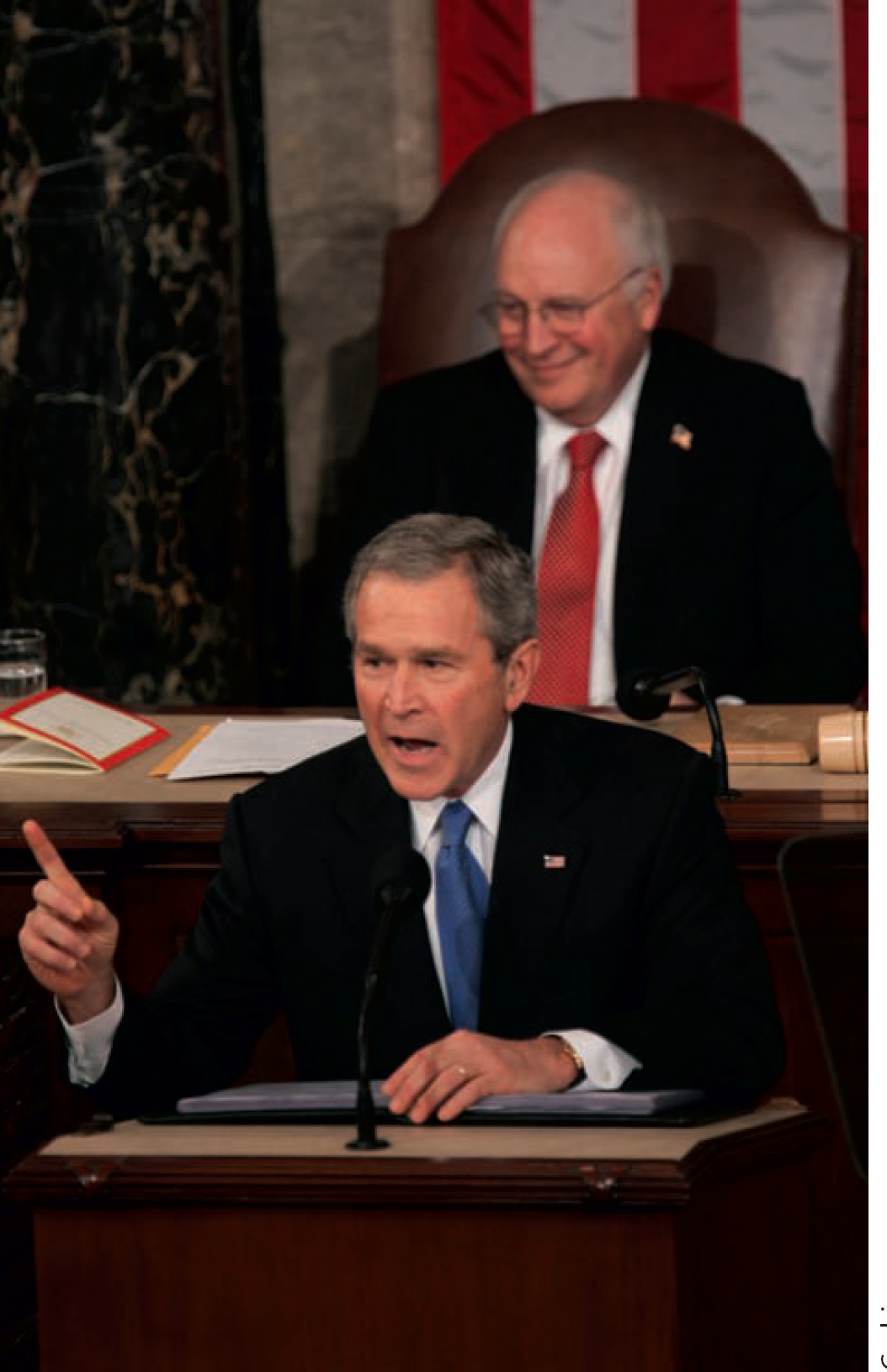
President George W. Bush chose Dick Cheney for similar reasons. To Bush, Cheney was ‘the kind of guy that would be a good fit for a two-term governor from Texas who … didn't have a lot of what they call ‘Washington experience“. Cheney's rise from 27-year-old intern in a Republican senator's office in 1968 to President Gerald Ford's chief of staff just six years later had been extraordinarily rapid. The 1980s found Cheney sitting in Congress for eight years and then being made defense secretary by President George H.W. Bush.
A very experienced Washington man, then — but Cheney was not just another Mondale or Gore, a useful adviser to an out-of-town president. He was in many ways the driving force in what became widely known as the Bush-Cheney administration. He had a long-standing mission to restore the power of the executive branch to what it had been before Watergate. Jonathan Mahler of The New York Times sees Cheney as the chief architect of the Bush administration's expansive view of executive power, with an interest in pumping up the presidency dating back to his time as White House chief of staff in the mid-1970s.
Bush, preoccupied with Florida recounts, delegated to Cheney responsibility for making provisional appointments to the presidential staff. Cheney used the power this gave him to build a network of his own allies and proteges throughout the executive branch. So Paul Hoffman became deputy assistant secretary of the Interior, Sean O'Keefe deputy director of the Office of Management and Budget, and Stephen Hadley, deputy national security adviser. This was a key part of the Cheney method of working. Barton Gellman argues that Cheney did not try to micromanage every decision, but rather put people in place he thought he could rely on and who shared the same outlook as him and let them do their work. Lawrence Wilkerson, chief of staff at the State Department from 2002 to 2005, described Cheney as ‘the most powerful vice president in the history of our country. His network is positioned almost everywhere in the government that's important. It was marvelous to watch his network work.’
Critics like Charlie Savage and Barton Gellman argue that Cheney's accumulation of power amounted to a subversion of democracy. From his first day as vice president, Cheney insisted on attending meetings of Republican senators. Jonathan Mahler observed that so regular was Cheney's attendance at the Republican caucus's weekly strategy meetings that you could set your watch by the arrival of his motorcade on Capitol Hill. This was evidence of a strategy to suppress congressional dissent from the Bush-Cheney agenda. As Republican senator Patrick Leahy of Vermont comments, ‘this administration set out to make the Republican Party on the Hill an arm of the White House.’
Vice President Dick Cheney built a powerful network within the George W. Bush administration
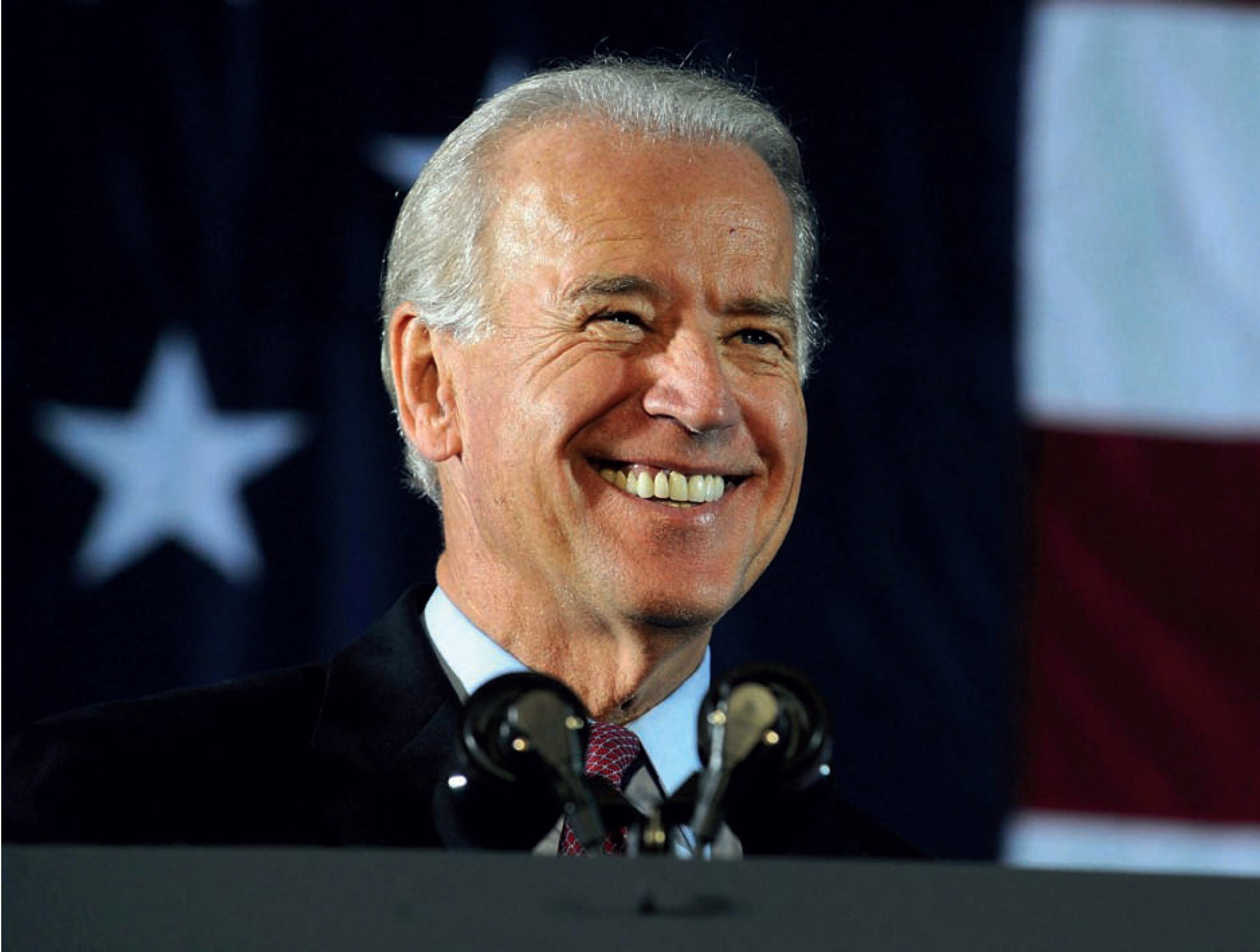
Vice President Joe Biden's deep knowledge of people and places has often been an asset to Barack Obama
Cheney was able to participate in forums closed to previous vice presidents, and therein lies one of the secrets of his power. Joshua Bolten, Bush's chief of staff, has testified that Bush made it clear from the outset that the vice president was welcome at every table and at every meeting. So for example, Cheney attended almost all meetings of the executive branch's main foreign policy forum, the Principals Committee, which no previous vice president had done regularly since the committee's creation in 1947.
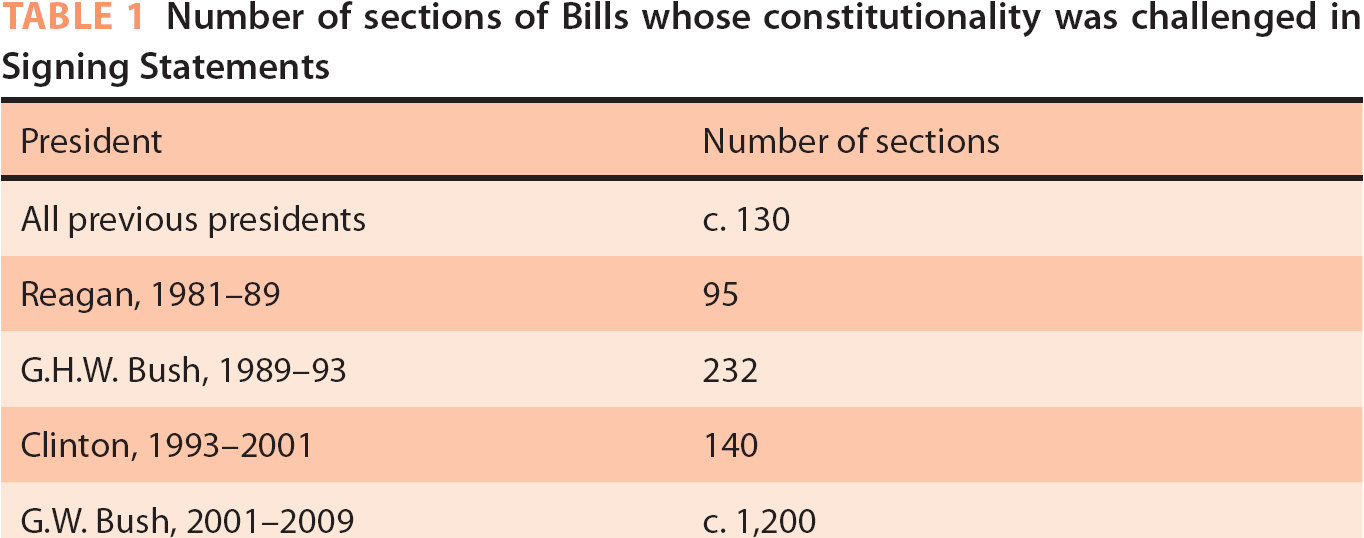
It also seems clear that Cheney was behind the huge expansion in the use of signing statements during the Bush presidency. Signing statements are declarations made by presidents when signing bills, which interpret how the law just made is to be put into practice, often to declare that in the president's view one section of a bill is unconstitutional and therefore need not be enforced. Unlike a veto, a signing statement cannot be over-ruled by Congress. They were rarely used until the 1980s, but the use of signing statements increased exponentially under President George W. Bush (see Table 1). Bush broke all records, using signing statements to challenge about 1,200 sections of bills over his eight years in office, twice as many as all the previous presidents put together, based on research by Christopher Kelley, of Miami University, Ohio. Charlie Savage argues that the primary architect of this increased use of signing statements was David Addington, a close adviser to Vice President Cheney.
Number of sections of Bills whose constitutionality was challenged in Signing Statements
Biden
Cheney's authority at times seemed to eclipse that of President Bush, leading one commentator, John M. Broder of The New York Times, to observe that the vice presidency had been transformed into a fourth branch of government. But to what extent has this enhancement in the role of vice president outlasted Cheney? Barack Obama is a much more hands-on president than his predecessor and had no intention of handing over the wide-ranging power exercised by Cheney to his vice president. Yet he has given Joe Biden a number of important roles. Foreign policy, as already noted, is one area where Biden's experience has made him a valued adviser to Obama, especially over Afghanistan and Iraq. James Traub of The New York Times noted in November 2009 that on foreign policy issues in his first year as president, Obama had frequently made use of Biden's deep knowledge of people and places which were still new to the president.
As Table 2 shows, Biden had served far longer in Congress than any vice president in the last 50 years. His contacts in the Senate have come in useful to the administration and he sees himself as a liaison man between the White House and Congress. This paid dividends, for example when he talked Pennsylvania senator Arlen Specter into becoming a Democrat, and when he persuaded Republican senator for Maine, Susan Collins, to vote for Obama's $787 billion American Recovery and Reinvestment Act in 2009.
US Vice Presidents since 1961
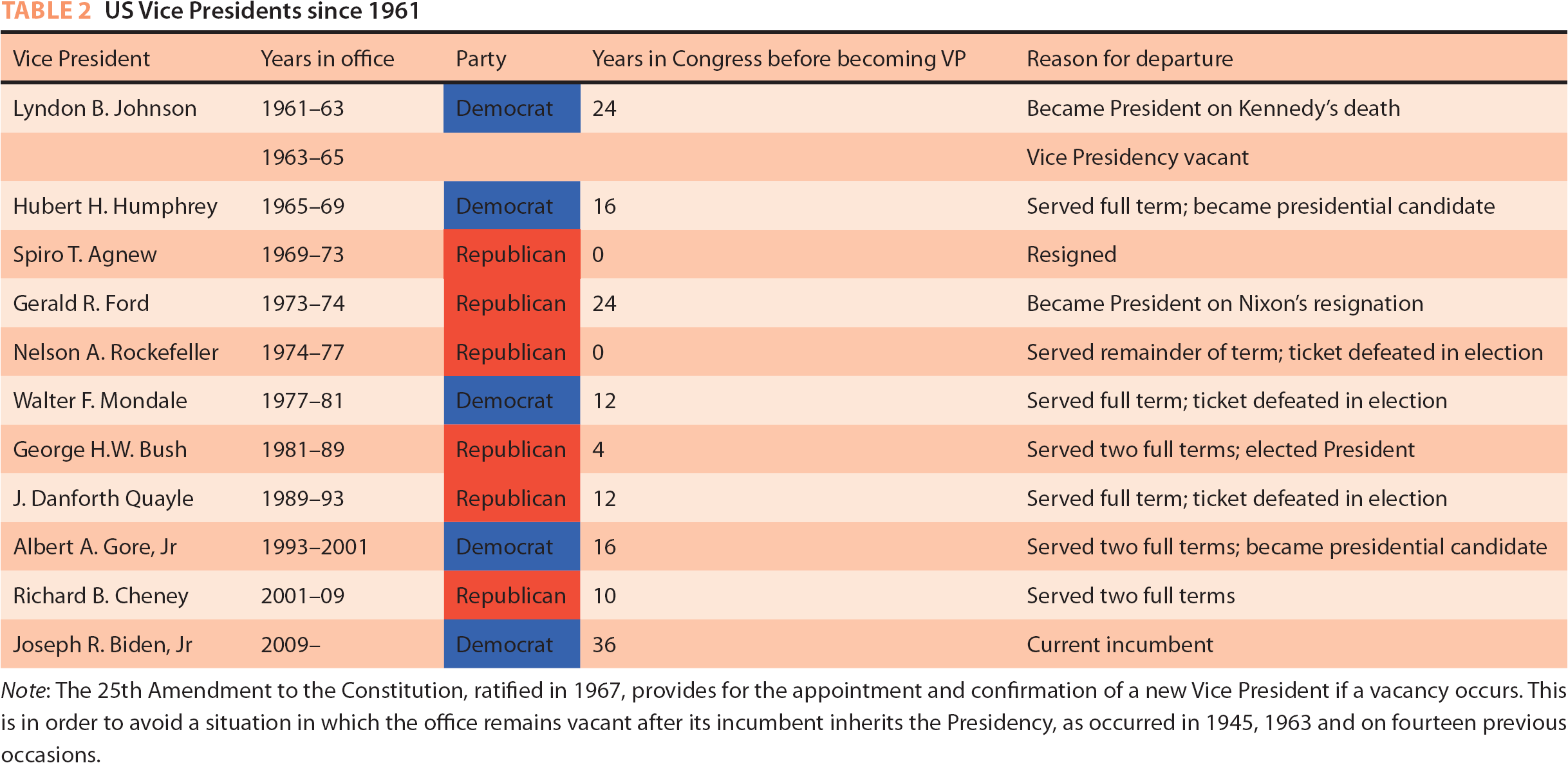
Note: The 25th Amendment to the Constitution, ratified in 1967, provides for the appointment and confirmation of a new Vice President if a vacancy occurs. This is in order to avoid a situation in which the office remains vacant after its incumbent inherits the Presidency, as occurred in 1945, 1963 and on fourteen previous occasions.
Once that act was passed, Biden was given the task of implementing it, chairing the Recovery, Accountability and Transparency Board, a role which was partly selling the package to a fairly sceptical American public. Biden has taken what Katie Connolly of Newsweek calls ‘his trademark pearly-white smile and hearty back-slapping energy’ to schools, factories and town halls across the country to explain the tax benefits, roads, jobs, grants and vaccination programs to ordinary Americans. The post also involves allocating the cash and trying to ensure that it is spent effectively. He has done a thorough job, for example holding regular conference calls with state governors and city mayors.
His position as chair of the Middle Class Task Force is another role that gives the vice president plenty of opportunity for public relations activity. The task force holds public meetings to listen to the concerns of America's middle class and its composition includes cabinet members and economic officials.
Biden's reputation for plain speaking has made him appear gaffe-prone, as at the signing ceremony for Obama healthcare bill when he was overheard saying to the president, This is a big f — –ing deal’. Yet it is also an asset, in that he is not afraid to challenge and question policy assumptions, forcing others in the administration to defend their proposals. ‘The best thing about Joe,’ Obama has said, ‘is that when we get everybody together, he really forces people to think and defend their positions, to look at things from every angle, and that is very valuable for me.’
Biden is not a Cheney-like dominant figure driving the administration from behind the scenes — in his 2008 speech accepting the nomination he pledged that, ‘no longer will the eight most dreaded words in the English language be “The vice president's office is on the phone”’. Nevertheless, he does fulfil a number of useful and high-profile roles. Joel Goldstein, author of a classic study of the vice presidency nearly 30 years ago, rates today's incumbent as one of the most consequential vice presidents in US history. Second fiddle he may be, but Biden is not without a bow, and no one can characterise his job as ‘gathering moss while you wait for the boss to sneeze’.
Conclusion
Since the 1970s, the VP has grown in importance as a succession of State governors running for president chose experienced Washington insiders as running mates and valued their advice once in office. Dick Cheney and Joe Biden have been powerful figures in the Bush and Obama administrations, although in very different ways — demonstrating that the office remains a very malleable one. Dan Quayle may have had his difficulties with spelling, but he was not far wrong when he said that ‘the role of the vice president is what the president wants’.