






Abstract

The reformist agenda has become a familiar feature of the UK's ongoing constitutional turbulence, but it wasn't always so.
Well, it works, doesn't it? So I think that's the answer, even if it is on the back of an envelope and doesn't have a written constitution with every comma and every semi-colon in place. Because sometimes they can make for difficulties that common sense can overcome.
Delivered in 1991, Lord Callaghan's ponderous but charitable homage to the character of the UK's traditional constitutional arrangements echoed countless other tributes, tendered over several centuries, to the rules that governed the UK.
Sound and Lasting Institutions
For many constitutional commentators it was not simply that the traditional UK constitution worked. From the pomp and pageantry of seventeenth century England to the bleak post-war landscape of a previous age of austerity, constitutional arrangements, emphatically confirmed by Edward Shils in his 1972 text The Intellectuals and the Powers, were declared to be ‘as nearly perfect as a human institution can be’.
And yet in the two decades since Callaghan's ‘it works’ verdict, the UK constitution has been subject to the most rapid and radical reform ever witnessed. Changes have had an impact on almost every aspect of the political process and the functioning of the UK state, from the organisation of central, regional and local government to the everyday rights that citizens enjoy. Now, with a coalition government – historic and constitutionally ambiguous in equal measure – constitutional reform sits atop the political agenda once more. Reforming, reshaping, renewing – of the legislature, the union and civil rights -remain the watchwords of reformers faced with a constitution of unsettled shape that is uneven and, at crucial times, unhelpful.
Why did the traditional constitution fall out of favour so rapidly? Why, despite a commitment to wholesale reform, did successive Labour administrations fail to settle upon a new constitutional model for the UK? Why, and with what likely consequences, is constitutional reform so high upon the Conservative-dominated coalition government's political agenda?
Constitution under Pressure
The broad consensus of support for the constitution and for the interplay between key institutions of state centred on a widely held view that its strengths – those of durability, evolution, adaptability and the fashioning of an organic body of rules to reflect the deepest values and ideals of its people – were of supreme value. So exactly when and why the UK fell out of love with its constitution is the subject of intense debate. Perhaps the key lies in what Vernon Bogdanor (2009) explains as ‘a striking loss of national self-confidence … reflected in a loss of confidence in our institutions and in our constitutional arrangements’ – all occurring amidst worrying social and economic pressures that served to marginalise any form of genuine constitutional debate.
At the heart of this lack of popular discourse, writes Peter Hennessey in The Hidden Wiring (1995), laid an obstructive sense of deference bordering upon indifference among the British people towards their constitutional arrangements. Hennessey notes that ‘the British … have been profoundly uncurious about the rules under which the hugely important “national game” of politics and government are played’, which he puts it down to ‘a powerful combination of smugness, insularity and sheer incomprehension’.
The failure to find effective, lasting solutions to the UK's social and economic difficulties between the 1950s and 1980s resulted in escalating doubts about whether the institutions themselves were adequate to meet the challenges of the modern world. This crisis of national confidence was accompanied by a sequence of events that tested the existing constitutional arrangements to the limit, challenging the very framework of the state.
The centralisation and consolidation of executive power was a process entirely at odds with traditional understandings of the distribution of power in the state. The UK's ‘membership’ of Europe saw the erosion of principles such as parliamentary sovereignty in the face of a supranational organisation with its own sovereignty in key areas of policy and law. Meanwhile the rapid decline of traditional ways of governing and of government accountability, the rise of quangos and the privatisation of many publicly owned industries resulted in the steady loss of faith in arrangements that seemed to support an increasingly discredited political system.
In short, the informal nature of the traditional constitutional arrangements proved incapable of resisting profound, destabilising shifts in the relationship between the institutions of government and in the political processes that underpinned them.
New Labour
The sheer scope of New Labour's reforms makes finding comparatively similar periods of constitutional upheaval remarkably difficult (see Table 1). Indeed, the list of changes to the constitutional arrangements of the UK made between 1997 and 2010 is as impressive as it is wide-ranging. It includes the creation of a supreme court, devolved assemblies with new electoral systems, a reformed House of Lords, freedom of information legislation and statutory human rights. And yet the achievements are repeatedly said to lack coherence. The party that enacted them is described as having no ‘guiding philosophy’ behind permanent and (for the most part) irreversible changes that took place without a clear idea of what a ‘new’ UK constitution would look like.
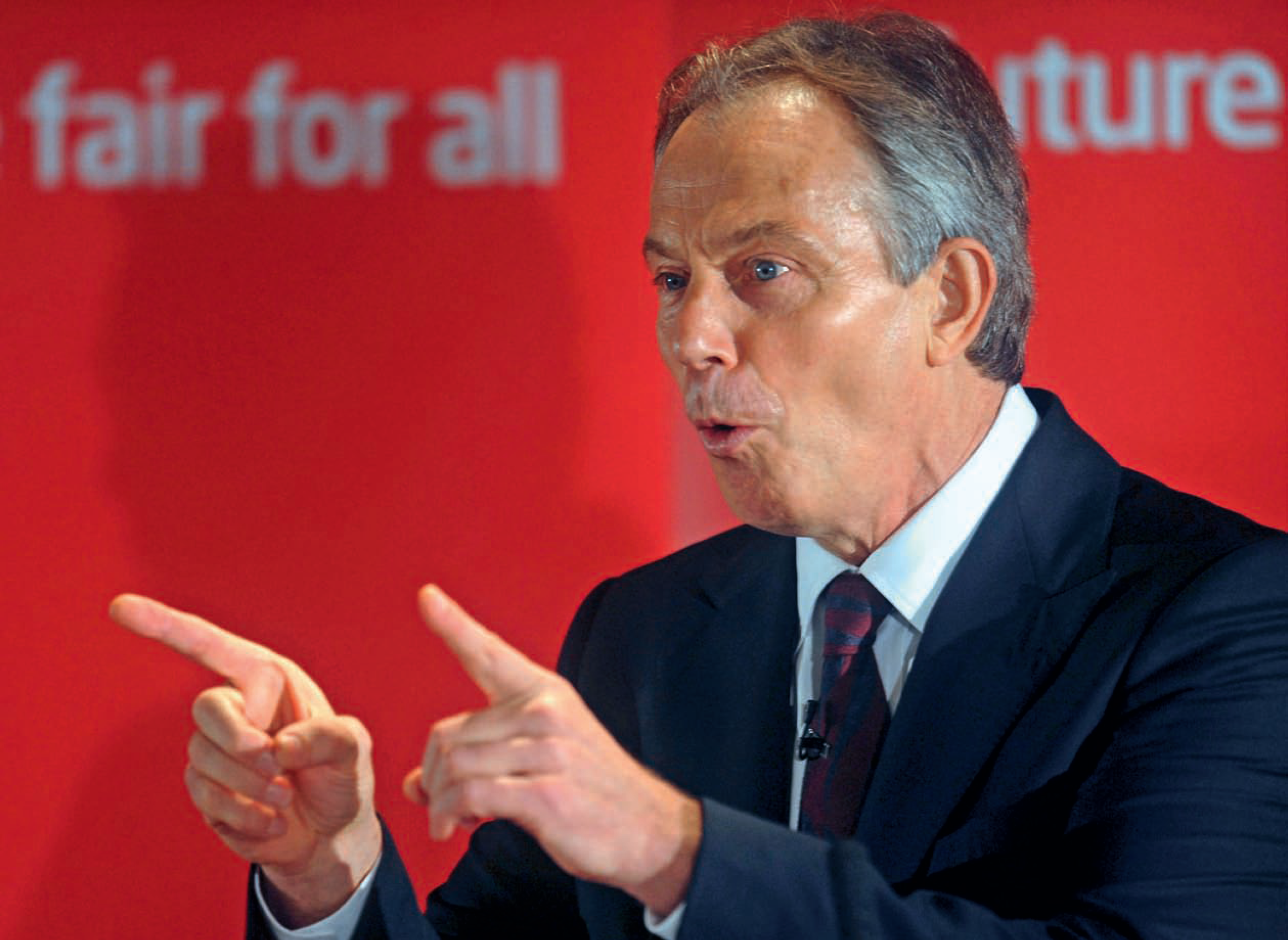
After 1997, Tony Blair and New Labour ushered in a period of almost unparalleled constitutional upheaval.
In explanation, it seems clear that whilst the factors behind the adoption of the radical programme – by a party that had traditionally eschewed constitutional matters – were indeed deep-rooted, they were also disparate. Such factors ranged from embracing policy legacies left by John Smith (devolution) to ones born out of the intense frustrations of endless years in opposition (Lords reform), to ones that, in true New Labour style, appeared to respond to the hardening of public support (rights and electoral reform).
In spite of this, by 2010 the UK still had neither a codified constitution nor a Bill of Rights. The passage of the Human Rights Act did not mean that offending legislation was struck down, since the principle of parliamentary sovereignty preserves Parliament's ability to choose whether to amend offending items or not. In addition, the simultaneous growth of state regulation and anti-terror legislation has arguably extended the state's reach and infringed rights further than ever before. Devolution has been ‘asymmetric’, meaning that the power and scope of each regional assembly is different and, consequently, the levels of public services provided are different too. The use of different electoral systems for different tiers of government means that votes remain of unequal value, and the continued use of the first-past-the-post voting system for Westminster elections produces unrepresentative results.
In late 2011 and early 2012, constitutional matters return to the fore. The electoral legitimacy of the coalition government, the ongoing perception that MPs remain insufficiently accountable, the back-handed renegotiation of the UK's relationship with the European Union, revelations that gross infringements of privacy rights are routine and widespread in the media, and an ongoing debate over the future and structure of both the second chamber and the union of the United Kingdom itself all place the informal and uncodified nature of a constitution that sustains such arrangements under the spotlight – and throw into sharp relief the failure of successive Labour administrations to settle the UK constitution.
Coalition and Constitution
With just three peacetime coalitions in well over a century, there is hardly a wealth of evidence to base assumptions on when considering the current one. But as if to underscore the current prime minister's dark pre-election warnings of decisions being taken ‘behind closed doors’ with policies spawned ‘of compromises and half-measures’, the greatest irony of the agreement between the Liberal Democrat and Conservative parties remains the prominent part that constitutional reform played in the deal. In both ideology and policy the two parties could hardly be more opposed on the nature, structure and future of the UK's constitution.
New Labour's Constitutional Reforms
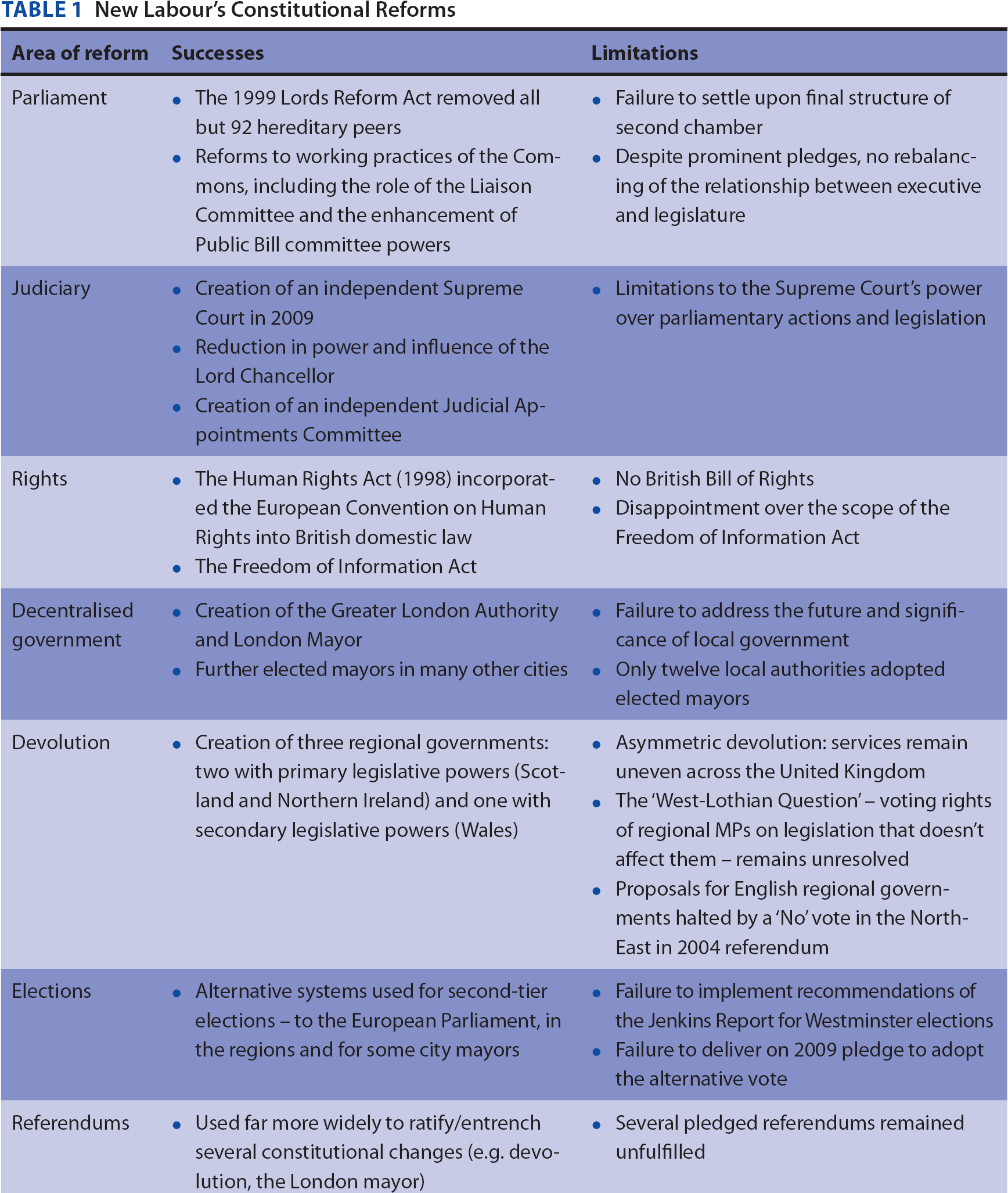
New Labour's Constitutional Reforms
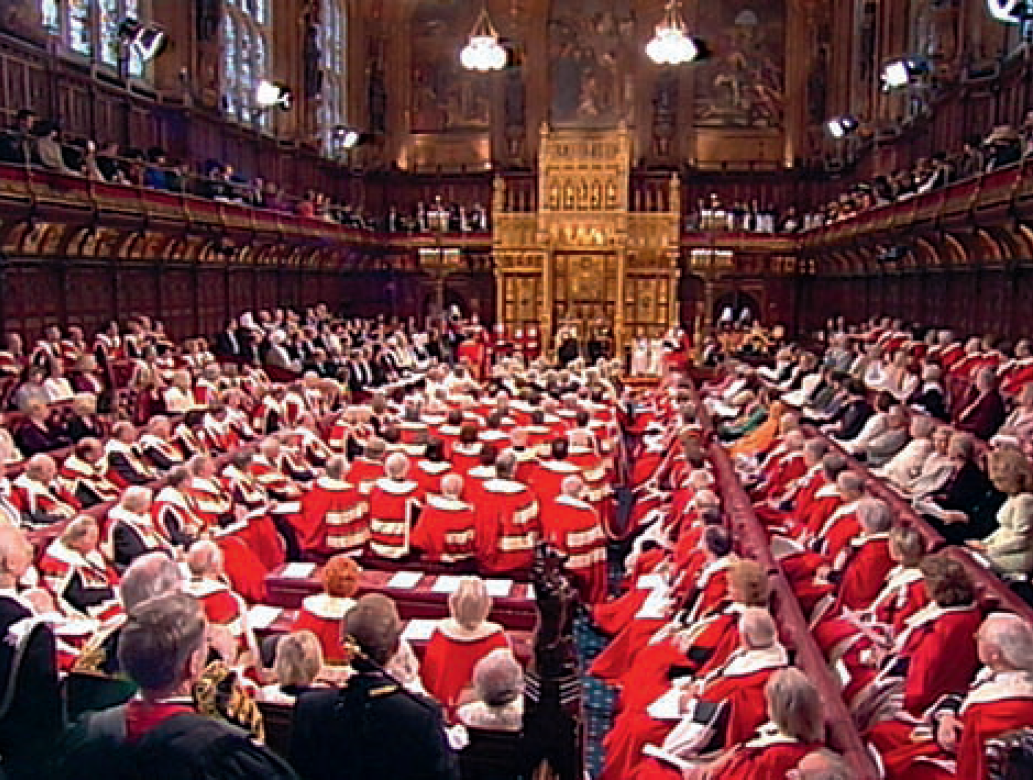
Nick Clegg has threatened to use the Parliament Act to force changes that would reduce the House of Lords to just 300 members
The sour public mood towards elected officials in the wake of the expenses scandal – alongside David Cameron's ‘Big Society’ reformist agenda, which has liberalised and shifted the focus of the Conservative Party – has laid the foundations for adopting policies much more geared towards rights, the environment, the accountability of public servants and making the functioning of Parliament more responsive and efficient. An implausible coupling had become a viable one.
Early coalition publications sought to emphasise a shared reformist agenda (see Box 1). Where negotiations could have foundered, over electoral or parliamentary reform, the agreements reached each possessed the ideal blend of being high-profile and low-cost. But, in moves highly resonant of Labour's ‘bottom-up’, pragmatic but piecemeal approach to reform, the coalition government was to embark upon a programme of constitutional change born out of political circumstance and electoral accident rather than a clear view of a coherent constitutional settlement.
Electoral Reform
Moves to reform the electoral system used for the Westminster Parliament may well have been a central plank in the original coalition agreement, but an emphatic 70:30 rejection of the alternative vote in the May 2011 referendum ended all prospects of change. The campaign itself, and subsequent defeat, appeared to be something of a nadir for Liberal Democrat leader Nick Clegg, whose personal unpopularity was manipulated artfully by Conservative bedfellows, themselves with a long history of resistance to electoral reform. For Lord Mandelson, reasons for the no vote were all too clear: ‘nobody could have foreseen the extent to which the whole vote … has become a referendum on the Liberal Democrats in general and Nick Clegg in particular’.
Fixed-term Parliaments
At the coalition's birth, Nick Clegg, in a parliamentary statement, asserted that the government's ambitious package of reforms lay in the ‘transferring of power away from the executive to empower parliament, and away from parliament to empower people’. In outlining the revolutionary potential of fixed-term Parliaments, Clegg later acclaimed that a prime minister ‘giving up the right to pick and choose the date of the next general election’ represented ‘a true first in British politics’ – a true first for the UK maybe, but one that brought the country into line with most other modern democratic states, and also with the UK's devolved assemblies.
The Identity Documents Act 2010 reversed legislation to introduce ID cards and ordered the destruction of data held on the National Database
The Parliamentary Voting System and Constituencies Act 2011 ordered a referendum on the alternative vote (rejected by 68 per cent to 42 per cent in May 2011) and set the number of UK parliamentary constituencies at 600.
The European Union Act 2011 requires that amendments to key European Treaties are subject to ratification by referendum
The Fixed-term Parliaments Act 2011 requires that parliamentary elections are held every five years from 2015
The Protection of Freedoms Bill 2011 aims to restore freedoms, includes measures on CCTV surveillance, wheel-clamping, police stop-and-search powers and the detention of terror suspects.
Needless to say, the full impact of five-year fixed-term Parliaments is yet to be felt. But whilst the Act – given Royal Assent in September 2011 – appears to restrict the power of the prime minister, providing greater stability and improved clarity, it also serves to present smaller coalition partners with regular opportunities to hamstring their coalitions without fear of immediate electoral consequences. Some critics suggest that it will also allow ineffectual governments to limp on without fear of dissolution, so long as defeat in an organised vote of confidence looks unlikely.
The House of Lords
Fears of an over-assertive, under-appointed, over-large or under-representative House of Lords have stalled reform to Parliament's second chamber for well over a decade. Early in 2012 the sabre-rattling began with Nick Clegg threatening to use the Parliament Act to force though his 300-strong model of a future House of Lords, which would include just 60 appointed peers. Whilst it would retain the existing power balance between the two Houses, the reduction in size involved, according to ex-Cabinet Secretary Lord Armstrong, looks set to produce ‘much blood in the Thames’. George Osborne pointed out that whilst the coalition agreement may have promised to bring forward the proposals for reform, it stopped well short of actually delivering them.
Civil Liberties
With a pledge ‘to restore the rights of individuals in the face of encroaching state power, in keeping with Britain's tradition of freedom and fairness’, according to Henry Porter writing in The Guardian in early 2011, Nick Clegg's ‘own firm belief in individual liberty has been placed at the heart of the coalition's programme’. With the Protection of Freedoms Bill, the focus of which included ID cards, police powers and the protection of jury powers, Clegg himself maintained that he was ‘amazed how far we pushed the whole security establishment and the Home Office in a liberal direction’. In March last year a commission to investigate the case for a UK Bill of Rights was launched. It was a key pledge in the coalition agreement and, whilst being welcomed by Conservative critics of the Human Rights Act, it represented a major goal for the Liberal Democrat Party. The terms of the commission are clear: that there will be no withdrawal from legislation incorporating the ECHR into UK domestic law. Instead the Commission is charged with creating a Bill of Rights that ‘incorporates and builds on all our obligations under the European Convention on Human Rights, ensures that these rights continue to be enshrined in UK law, and protects and extend our liberties.’ The Commission is set to produce its final report by the end of 2012 – a report that may well, in the words of Justice Secretary Ken Clarke, result in ‘no change at all’.
Europe and the UK
By 2010, Conservative fears over the fragmentation of the UK had given way to an acknowledgment of the pragmatic basis to the power-sharing structure. And yet two years on, the success of the Scottish National Party north of the border and the forthcoming referendum on Scottish independence lays bare the far from settled relationship between nations within the union of the United Kingdom. 2012 began acrimoniously amidst accusations of ‘interference by a Tory-led London government’, disagreements over the timescale within which a referendum should be held and widespread uncertainty over who was constitutionally responsible for either the scope of the question or the project as a whole.
In a typical constitutional twist, the UK's relationship with Europe faltered almost simultaneously. The issue of the UK's relationship with Europe has long dogged the Conservative Party and the fact that the coalition partners – arguably on polar opposites of the euro-spectrum – could reach agreement on this subject was particularly surprising. But 2011 ended in confusion when David Cameron vetoed an EU-wide treaty change to facilitate closer union -much to the dismay of his deputy prime minister, who was left to warn of ‘needless rivalry and isolation’. Cameron conceded that the issue remained a ‘pressure point’ between the two parties, as coalition wrangling supplanted coherent moves towards clarity and transparency.
Conclusion
A new constitution is not merely a composite of parts – a repository for details on the composition of the Lords, the mechanisms for translating votes into seats or the details of the UK's relationship with Europe. It is about a framework that reflects an age appropriately, that ensures governments are effective but responsive and that provides for and protects the sovereignty of the people. The current constitutional arrangements in the UK perform none of these functions adequately.
The constitutional reforms being pushed or pulled by the coalition government have many unlikely and disparate drivers: quirks of electoral fate on both sides of the border, economic crisis in the eurozone and expenditure of political capital on the part of the Liberal Democrats. The only certainty is that neither constitutional coherence nor a final settlement looks likely any time soon.