






Abstract

The UK ranks among the world's oldest democracies and its political system has been the focus of extensive reform efforts since 1997.
It is doubtful that any political scientist would dispute that the UK is a democracy. Across a variety of international indices, compiled by a range of academic and non-academic research institutes, the UK is consistently categorised as a ‘full democracy’. The UK has never failed to meet Freedom House's benchmark for ‘electoral democracies’ since the organisation began using the designation in 1989. Taking a longer view, the Polity IV database records the UK as one of a handful of countries that have operated continually as democracies since the 1880s.
Global indices of democracy enable us to track change in the number of democracies over time. But they have acute limitations if our objective is to consider whether, and how, a specific country is becoming more or less democratic. In essence, the Freedom House and Polity IV datasets define democracy as a threshold that political systems pass by establishing particular institutions and guaranteeing specific rights. As with most established democracies, the UK has scored a maximum 10 points on the Polity IV scale of democracy annually since 1945. Yet it seems unlikely that anyone, political scientist or not, would argue that the UK is already as democratic as it would be possible, or desirable, for it to be.
Indeed, judging by the scale of constitutional reform since the mid-1990s, UK governments themselves appear motivated to respond to identified democratic shortcomings. Reforms initiated by Tony Blair's first Labour government from 1997 to 2001 were perhaps the most far-reaching. The Human Rights Act 1998, the Freedom of Information Act 2000, independent regulation of donations to political parties and the establishment of devolved government in Scotland, Wales and Northern Ireland have all had a significant impact on the UK political system. To these we may add notable measures introduced by subsequent administrations, including the Constitutional Reform Act 2005, reforms of the House of Commons arising from the Wright Committee report and the Fixed-term Parliaments Act 2011.
But, what has been the overall effect of these, and other, constitutional reforms? How can we assess whether they have helped make the UK more democratic? And how can we identify what more needs to be done to broaden and deepen democratic governance?
Auditing Democracy
Clearly, if our objective is to assess how the quality of democracy is changing, a finer-grained analysis is required than that provided by the indices highlighted above. One means of achieving this is by conducting periodic democratic audits. Using a framework pioneered by Professor David Beetham, a democratic audit is a comprehensive and systematic assessment of a country's political life undertaken to evaluate how well it corresponds to established international norms and standards. Since the early 1990s, the Joseph Rowntree Charitable Trust has financed four audits of democracy in the UK, with the latest, published in July 2012, evaluating change over a ten-year period since 2002.
The assessment methodology for a democratic audit is based on the two basic principles of representative democracy, namely:
Popular control: how far do the people exercise control over political decision-makers and the processes of decision-making? Political equality: how far is there political equality in the exercise of popular control?
Derived from these two principles, the full framework comprises the 15 separate sections listed in Figure 1. The audit takes an expansive approach, encompassing all aspects of citizenship and law, representative and accountable government, and civil society and popular participation. Taken as a whole, the audit provides answers to 75 individual ‘search questions’, covering issues as diverse as the fairness of the electoral system, the independence of the media and public accountability of the police and security services.
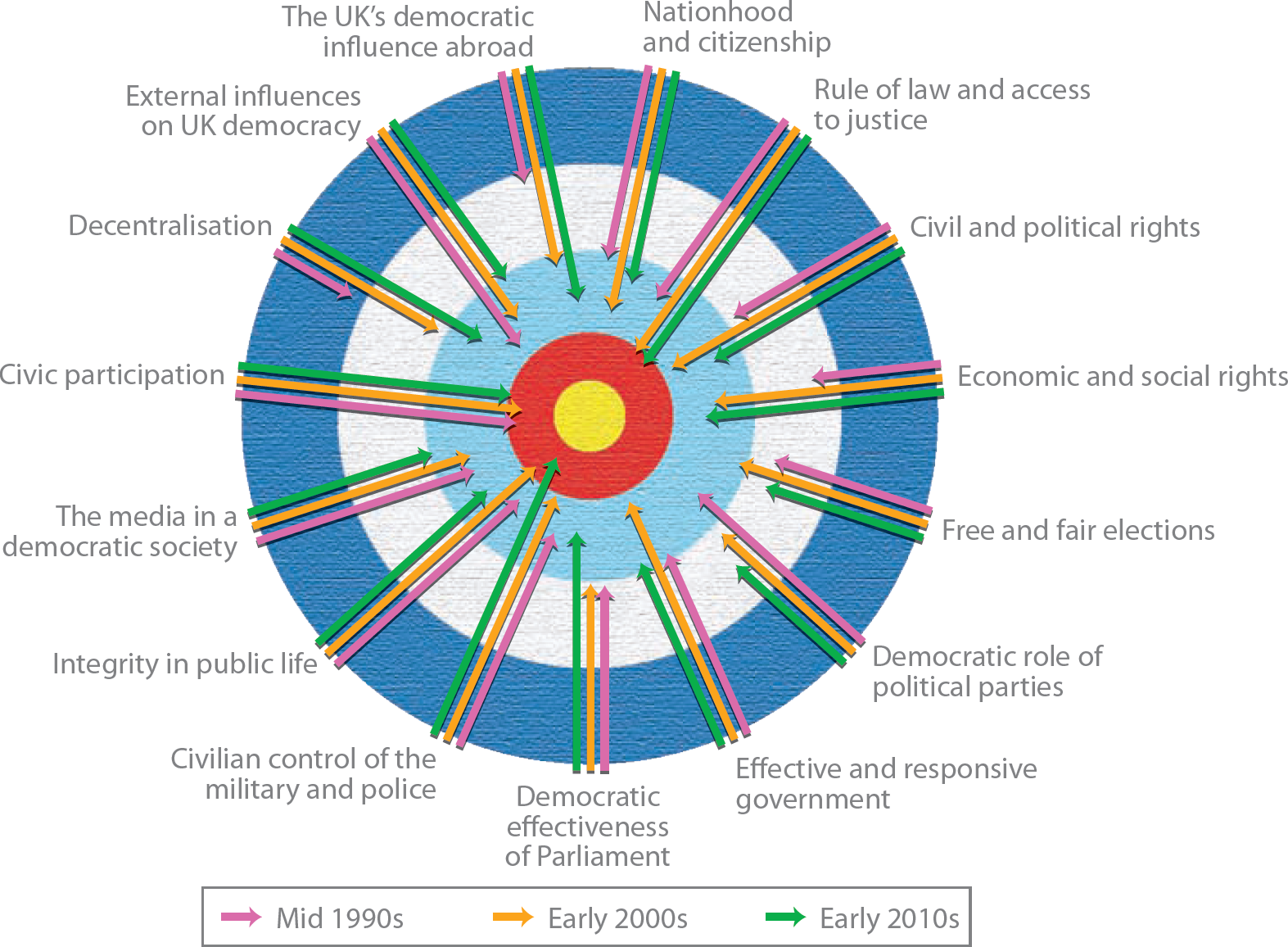
Extent that areas of British democracy have moved towards, or away from, the very best standards found internationally
In contrast to other democracy assessment methods, a democratic audit does not yield a numerical score or index based on questions designed to elicit yes/no responses. Instead, the search questions are designed to evaluate the relative degrees to which democratic principles are being promoted, as well as being realised, in practice. A wide range of qualitative and quantitative information is used to answer each question, providing a detailed and broad-ranging picture of the state of democracy.
Is UK Democracy Getting Better or Worse?
The audit methodology also enables specific democratic changes to be identified. By evaluating shifts over a decade, the 2012 Audit identifies a total of 74 areas of democratic improvement, 92 continuing concerns and 62 new and emerging concerns. However, it would be highly misleading to read the relative balance between improvement and concerns as a simple scorecard, for four reasons.
First, not every change identified, whether positive or negative, carries equal weight. For example, while there is encouraging evidence of political parties reaching more electors during general election campaigns, this development is clearly outweighed by the persistence of low turnouts in elections.
Second, many of the concerns identified are serious and long-standing ones. Issues such as the dependency of political parties on big donations or the overwhelmingly male composition of Parliament were identified as problems decades ago, but seem almost immune to reform. Many recent improvements are modest and must be considered alongside the persistence of these weighty concerns.
Third, it is by no means clear that all the improvements documented have become fully embedded features of UK democracy. For instance, evidence of progress on economic and social rights under New Labour is likely to be undone rapidly by the current Conservative–Liberal Democrat coalition.
Finally, many reforms have proved double-edged, resulting in identifiable improvements while simultaneously giving rise to new sets of concerns. For example, devolution is associated with a number of democratic improvements for the 16 per cent of UK citizens who live in Scotland, Wales or Northern Ireland. But the absence of devolution in England represents a growing constitutional tension, exacerbated by demands for greater autonomy in Scotland.
Given these observations, any assessment of whether UK democracy is improving or deteriorating is necessarily a subjective one. Nonetheless, the robust nature of the audit criteria and the volume of evidence collated enable informed judgements to be made about change. Figure 1 represents these assessments graphically, showing the extent to which each of the 15 areas of democracy evaluated has moved towards, or away from, the very best standards found internationally (represented by the bull's-eye at the centre of the target).
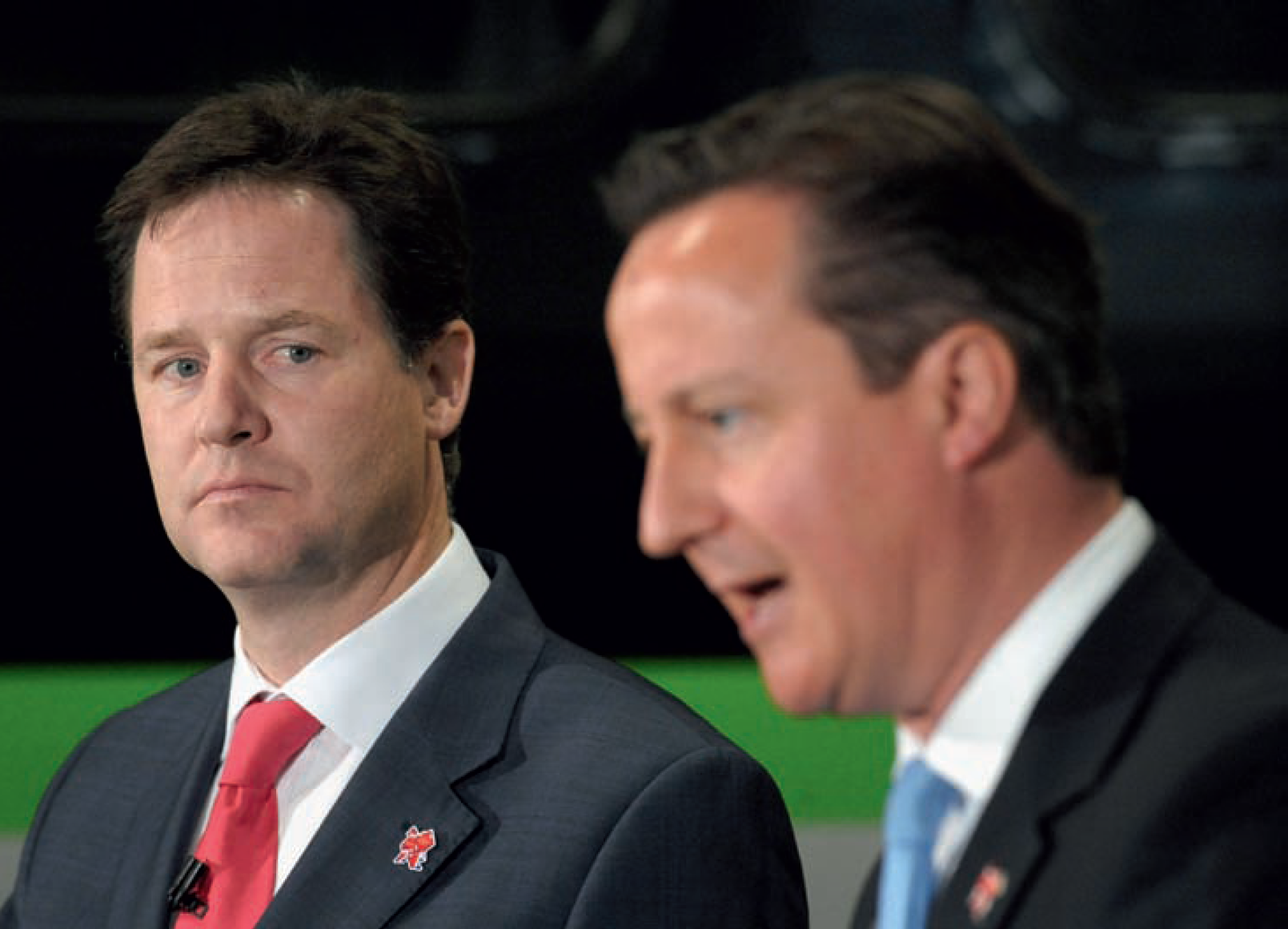
Progress in economic and social rights is being undone by the Conservative-Liberal Democrat coalition
The UK, as a whole, measures up relatively well against the audit criteria. Moreover, there is identifiable improvement in four areas since the early 2000s, while the picture in three further areas is broadly static. However, the graphic also shows deterioration, albeit mostly moderate, across the remaining eight dimensions of democracy.
Some obvious ‘weak links’ are also apparent, as represented by those areas that are furthest from the centre of the target and/or demonstrate the greatest movement away from it. These areas include ‘free and fair elections’, ‘the democratic role of political parties’, ‘the media in a democratic society’, and ‘integrity in public life’.
How Does UK Democracy Compare?
The 2012 Audit also uses a range of statistical measures to assess how well the UK compares to other established democracies. Wherever possible, the UK is compared against the averages for all advanced industrial nations (the OECD-34), Western Europe (the EU-15), and each of the following groups of democracies:
The Nordic countries: Denmark, Finland, Iceland, Norway and Sweden. The consensual democracies: Austria, Belgium, Germany, Luxembourg, the Netherlands, Switzerland. The Westminster democracies: Australia, Canada, Ireland, New Zealand, the UK.
The groups of comparators represent three contrasting traditions of representative democracy. The distinction drawn between Westminster and consensual models of democracies is a long-standing one, associated with the work of Arend Lijphart. The Westminster model comprises a centralised political system, in which a majoritarian electoral system, limited party competition, a weak separation of powers and constitutional flexibility concentrate power in the hands of single-party governments. By contrast, consensual democracies are characterised by greater fragmentation of power, including a decentralised state; a stronger, formal constitutional separation between the executive, the legislature and the judiciary; and proportional electoral systems and multi-party systems that make coalition government the norm.
The Nordic countries, which have much in common with the consensual democracies, also exhibit the long-standing influence of social democracy, which has resulted in a particular commitment to goals associated with political equality, notably measures to promote the participation of women in public life.
Cross-national comparison of democracy datasets
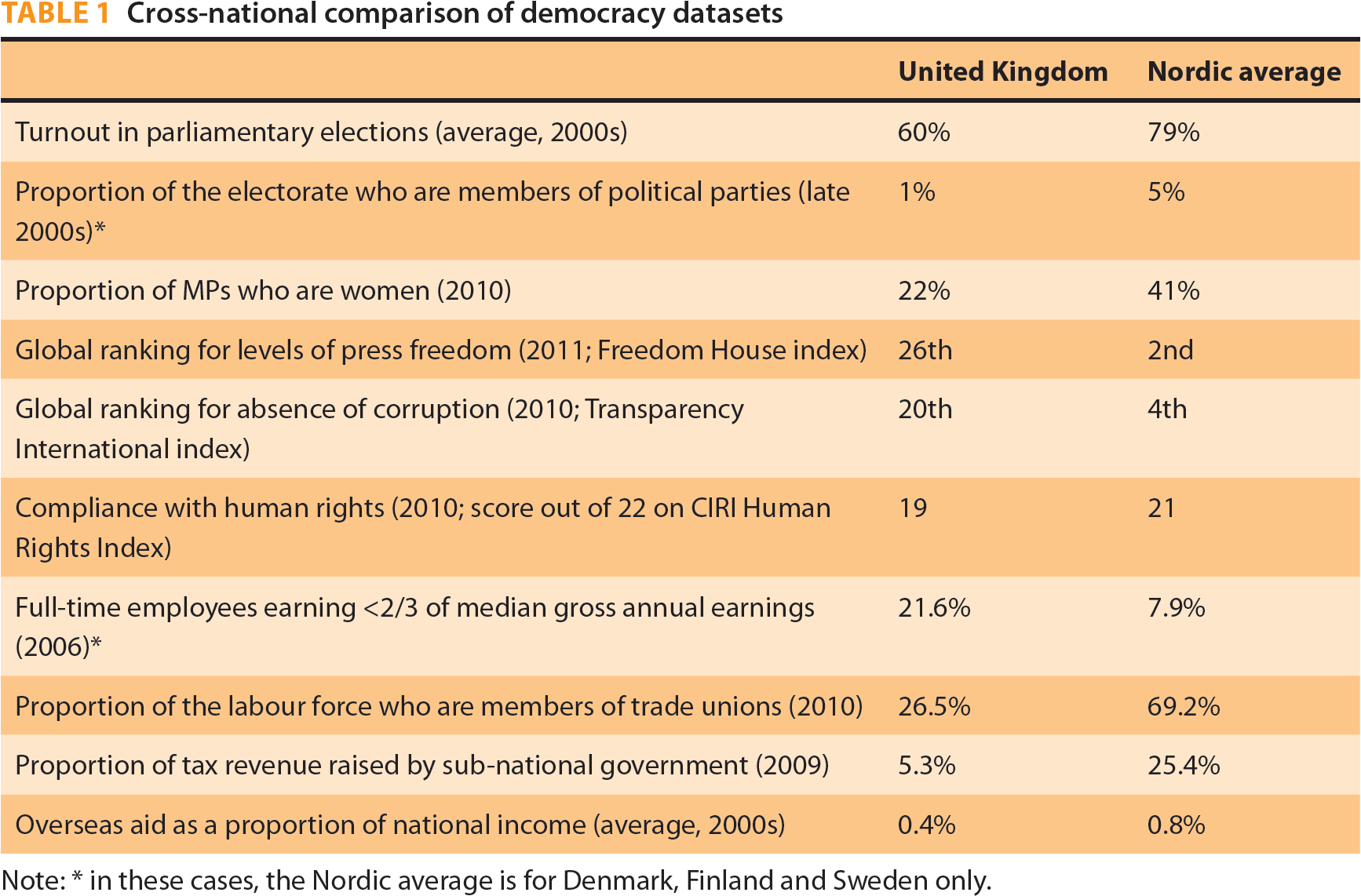
Note: * in these cases, the Nordic average is for Denmark, Finland and Sweden only.
In total, the audit includes over 40 comparative datasets, although not all compare the UK to the full range of comparators listed above. In virtually every case, the UK ranks below the EU-15 and OECD-34 average. The contrasts between the UK and the Nordic countries are particularly stark. Indeed, the Nordic countries out-perform the UK on just about every quantifiable measure of democracy used for cross-national comparison. The sample of indicators in Table 1 clearly illustrates this pattern.
Where Do the Problems Lie?
The audit identifies five overarching thematic concerns about the contemporary operation of UK democracy. Several of these themes are common to all established democracies, although all seem especially pronounced in the UK.
First, the UK's constitutional arrangements appear increasingly unstable, and it is unclear what a reformed Westminster model would look like. Some constitutional reform since 1997 has proved less effective than expected, while several facets of the UK political system have proved stubbornly resistant to reform. But some reforms have had profound consequences, many of them unintended or unanticipated. Devolution is the most obvious example of this tendency, and it is not just demands for Scottish independence that illustrate the instability of the current devolution settlements. As Figure 2 illustrates, Welsh constitutional preferences are also driving towards progressively greater autonomy.
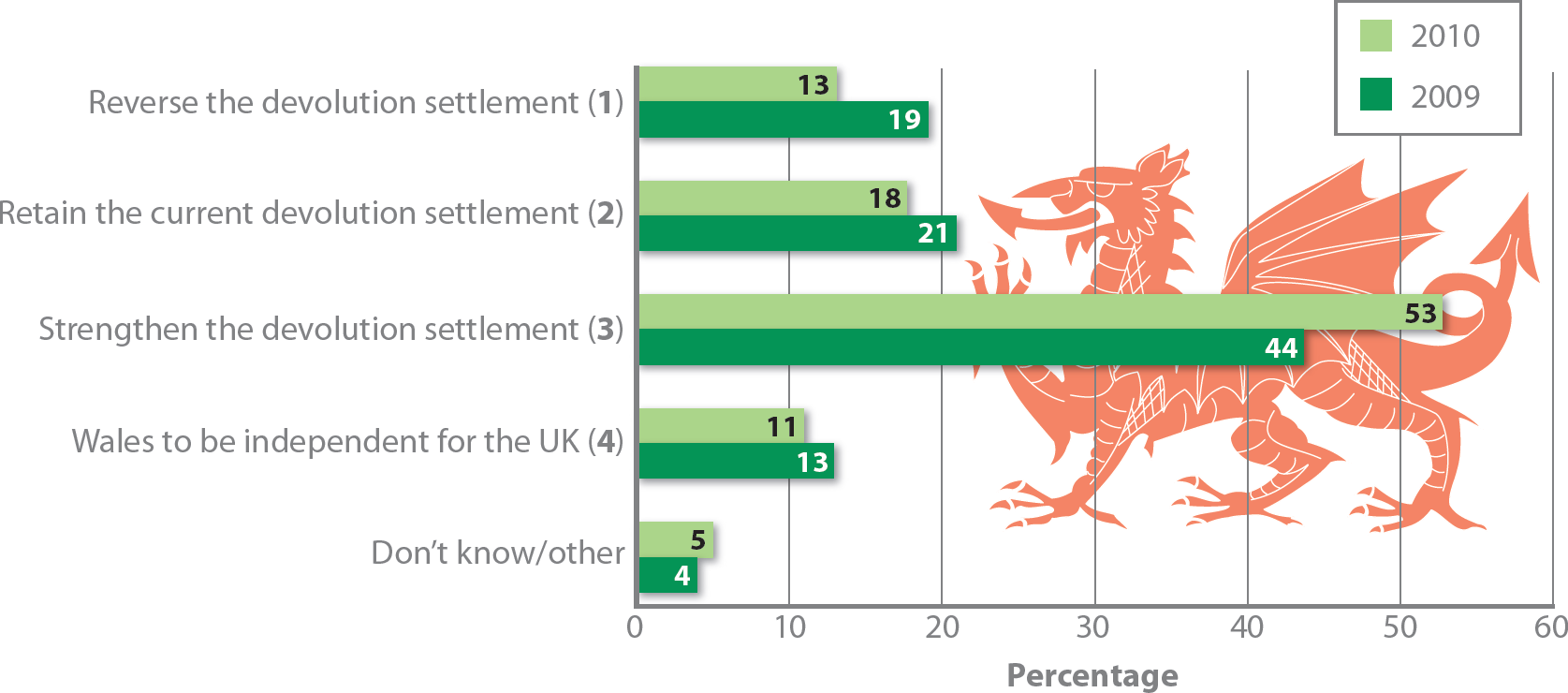
Welsh constitutional preferences (per cent)
Second, public faith in democratic institutions is decaying, with reforms aimed at restoring public confidence tending to prove ineffectual and, sometimes, counter-productive. There is a long-term decline in public trust in politicians and political parties, and democratic institutions such as Parliament are seen as increasingly irrelevant. Measures transferring functions to independent bodies, regulating political activity and promoting greater transparency and access to information have not reversed these trends.
Third, political inequality is widening rapidly. While representative democracy is notionally built on principles of political equality (such as one person, one vote), there have always been wide variations in the extent of political participation, and degree of political power exercised, by different social groups. However, political inequalities in the UK have grown over the past four decades, in tandem with the widening of economic and social divisions.
Fourth, corporate power is growing, partly as a result of wider patterns of globalisation and deregulation, and threatens to undermine some of the most basic principles of democratic decision-making. Business interests have always enjoyed privileged status in modern democracies. However, the influence that large corporations and wealthy individuals now wield on the UK political system seems unprecedented in the post-war period. There is powerful evidence of politics and business interests becoming increasingly interwoven. The density of connections (directorships, consultancies or shareholdings) between major corporations and MPs is many times greater in the UK than in other established democracies (see Figure 3).
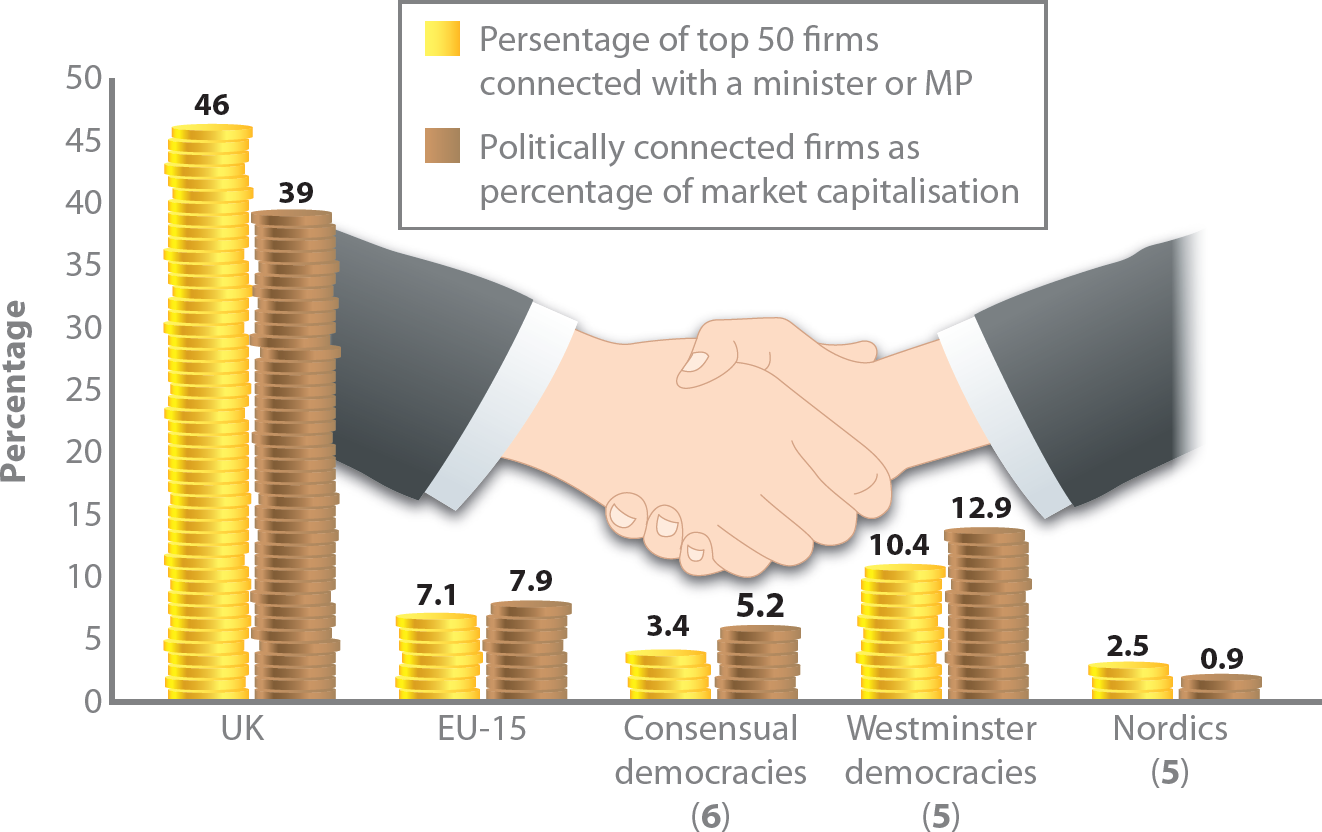
Connections between major corporations and politicians
Finally, while available indicators suggest representative democracy is in long-term decline, no viable alternative model of democracy currently exists. Turnout in elections, membership of political parties and a variety of other measures all point to a waning of democratic engagement. The same trends are found in all established democracies, but the UK compares especially poorly on most measures. Despite growing interest in forms of direct and participatory democracy, it remains unclear how these alternative models can co-exist with existing traditions of UK representative democracy.
Where Next for Constitutional and Political Reform?
Constitutional change since 1997 has been extensive, but it has also tended to be piecemeal and incoherent. The lack of any clear sense of direction arises, in part, because periods of crisis have acted as triggers for reform, notably measures designed to make politics and government more open and transparent. Meanwhile concerns about declining engagement, particularly turnout, have fostered attempts to tackle ‘political disengagement’, often by expanding the ‘menu’ of participation options.
Yet, as we have noted, there is little evidence that recent reforms have had any success in restoring public faith or reviving popular participation in democracy. This failure is not surprising. With the exception of devolution, reforms have not challenged the centralised nature of power in the UK state. Neither greater transparency and openness, nor an extended range of ways to participate, can compensate for the dominance of the executive, arguably the UK's greatest democratic shortcoming.
There are some foundations for democratic renewal. Recent reforms to the UK Parliament are an encouraging development, and parliamentarians are becoming more assertive in their role as scrutinisers of government legislation and action. There is also much to be learnt at Westminster from the way in which the Scottish Parliament and the Welsh Assembly have forged links between representative institutions and civil society.
But perhaps the most significant lesson is that the successes of devolved governments in Scotland, Wales and Northern Ireland are the products of new constitutional settlements, from which the residents of England, by far the great bulk of the UK population, have been excluded. If significant and sustained improvements in UK democracy are to be achieved, then a fresh constitutional settlement will almost certainly be required for the UK as a whole.