






Abstract

Despite apparent cross-party and public support, Nick Clegg's plans to reform the House of Lords are dead.
All of Britain's main political parties called for a wholly or largely elected second chamber in their 2010 election manifestos. Steps in that direction were enshrined in the coalition agreement. A white paper and draft Bill set out detailed reform proposals in May 2011. Legislation was introduced in the House of Commons in June 2012. Public opinion appeared also to be on side: for several decades, polls have suggested clear majority support for at least a substantial elected element in the second chamber. (For a compendium of polling data on Lords reform, see House of Lords Library, ‘Public Attitudes towards the House of Lords and House of Lords Reform’, LLN 2012/028, 26 July 2012.)
Today, however, Lords reform – or at least this latest attempt at Lords reform – is dead. That leads to several questions; the most obvious is how a policy that appeared to have cross-party and public support could collapse so quickly amid ridicule. But there are also longer-term issues. How do recent events fit in with broader patterns of political reform? Do these patterns tell us anything about what might happen to Lords reform over the coming years?
One thing we can confidently say is that the fate of the government's Lords reform proposals was not decided on the merits of the case. Hours of parliamentary time were devoted to the issue, but most speakers on both sides of the argument justified their positions using claims that were at best unsubstantiated and at worst manifestly false. Those who had thought about the issue seriously were rarely heard.
The Predominance of Interest
Instead, the matter was decided primarily by politicians' interests. Members of the current House of Lords clearly have a personal interest in maintaining something like the status quo. In the House of Commons, many Conservative and Labour MPs see a rejuvenated second chamber as threatening their party's capacity to govern without fetters when in office, while Liberal Democrats have an equally strong interest in the opposite direction. We should not be too cynical about politicians: many did also view the matter from positions of principle. But the basic logic of self-interest predominated.
A second factor was also crucial to the outcome: the public did not care. It was this absence of public concern that allowed politicians' interests to take centre stage. Several polls over the summer months showed that, while overwhelming majorities of respondents continued to back Lords reform, they did not regard it as a priority in current circumstances. Politicians therefore felt no pressure to deliver on their campaign pledges. Indeed, quite the opposite was true: they feared public opprobrium if they devoted substantial time to an issue that appeared to most voters so esoteric.
The Evolving House of Lords
Until the late 19th century, in most respects the House of Lords was formally coequal with the House of Commons and was composed entirely of hereditary peers and bishops.
Its powers have been cut back twice in the years since. In 1911, its capacity to block legislation was replaced with a two-year suspensory veto and the long-standing convention that it would not interfere in financial matters (which it had breached in 1909 by rejecting the government's budget) was codified. In 1949, the suspensory veto was reduced to one year.
The composition of the chamber has changed more gradually. The first handful of life peers, in the form of Law Lords, were admitted in 1876. General provision for life peers – including women as well as men for the first time – was introduced in 1958. Hereditary peers were allowed to renounce their peerages and women hereditary peers were allowed to take their seats from 1963. In 1999, all but 92 of the hereditary peers were removed.
The combined effect of the 1958 and 1999 acts was to transform a largely aristocratic chamber into one overwhelmingly of prime ministerial patronage. That patronage power was curtailed somewhat in 2000 through the creation of an Appointments Commission, which vets political appointees and nominates crossbenchers.
Today there are 650 life peers, 89 hereditary peers, and 26 bishops (excluding disqualified peers and peers on leave of absence). The Appointments Commission has nominated 61 crossbenchers since it was established.
In taking on this character, the Lords reform debate conformed to the pattern shown by debates over political institutions in most democracies most of the time. Politicians' interest in the character of such institutions is intense, while any wider effects upon society as a whole or upon average citizens' personal welfare are indirect and obscure. Public opinion in this circumstance can somewhat constrain shifts away from the status quo: egregiously self-interested manipulations can attract attention in themselves, whatever the content of the manipulation might be. But self-interested maintenance of the status quo is likely to carry no such penalty, for this is not a status quo that the public are thinking about. Thus, if the interests of the politicians in power are served by the institutional status quo, that status quo will normally survive.
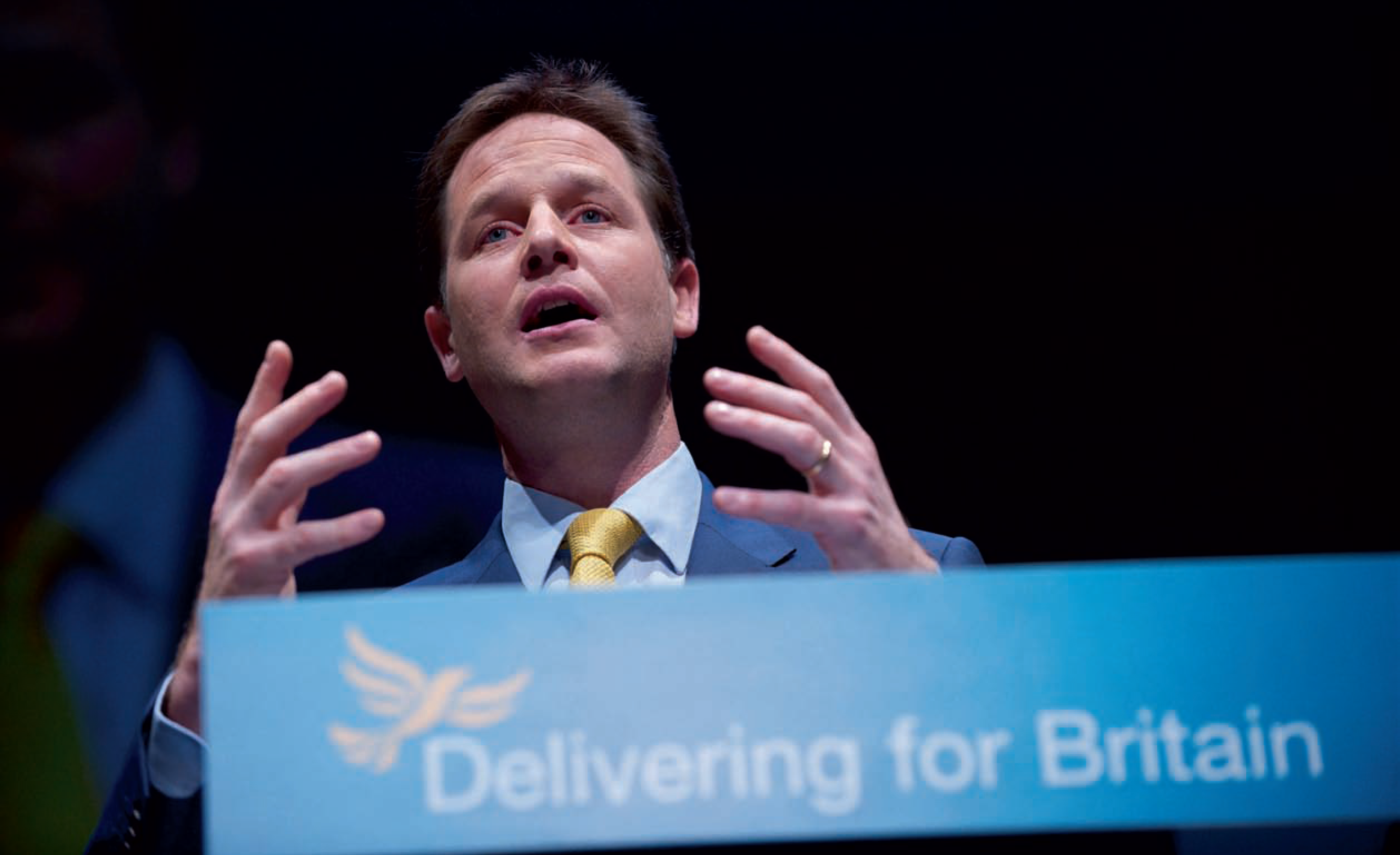
Nick Clegg's plans to reform the House of Lords have perished in the face of Conservative backbench opposition.
The same pattern is displayed by all previous attempts at Lords reform over the past century. The four significant reforms that have passed all served the interests of those in power at the time. In 1911 and 1949, non-Conservative governments moved to limit the powers of the House of Lords (which then had a permanent Conservative majority) by eliminating its veto power and then shortening the period of delay it could impose. In 1999, the Labour government eliminated the Conservative majority by removing most of the hereditary peers. The other reform – the introduction of life peers by the Conservative government in 1958 – was defensive. The House of Lords at the time was moribund: few of its members attended with any regularity and its composition was so manifestly anachronistic that it lacked any legitimacy in confronting the elected chamber. Still, it was useful to the Conservatives. The introduction of life peers injected new blood and strengthened the defence of the Lords as a chamber founded in meritocracy.
By contrast, reform proposals that have not clearly advanced the interests of those in power – such as the recommendation of the Bryce Conference in 1918 for a second chamber largely elected by MPs and the proposals of the Wilson government in 1968–9 for a wholly appointed chamber – have foundered. The Clegg proposals have now suffered the same fate.
Is an Elected Second Chamber Possible?
It may appear straightforward to conclude at this point – as many have concluded over recent months – that the UK will never, in the absence of revolution or civil war, see the introduction of an elected second chamber. Given the interests of members of the current Lords, such a move could be achieved only by invoking the Parliament Acts – and too many Conservative and Labour MPs want unfettered single-party government for such a move to be likely. Even in times of coalition, as we now know, the pro-reform force is too weak to deliver change.
There is much in this analysis, but we should not accept it without at least investigating some possible caveats. One caveat – the possible breakdown of the two-party system – merits note. The share of the vote won by the two largest parties has progressively dwindled, but the capacity of third and fourth parties to win seats would need to increase considerably before this potential route to reform might become viable.
A Popular Movement for Reform?
A second possibility is the emergence of a popular movement for reform. I said above that low public engagement is a feature of political reform discussions in most countries most of the time. But there are exceptions: sometimes it is possible for reform supporters to create a popular movement behind institutional change by linking the existing institutions to governance failures that are of direct and pressing interest to wide swaths of the public.
This process has characterized several notable cases of electoral reform. In New Zealand in the early 1990s, voters became enraged by successive governments that appeared to act without regard to public opinion, and activists successfully persuaded them that a proportional system would keep politicians on a shorter leash. At around the same time, the prevailing electoral institutions in Italy and Japan were blamed for severe corruption scandals. I have elsewhere labelled such processes reforms by ‘elite-mass interaction’. They belong to the wider category of what the late American political scientist James Q. Wilson called ‘entrepreneurial politics’.
The difficulty that supporters of Lords reform face in utilising this mechanism, however, is that it is not clear what the problem might be to which democratising the House of Lords could be portrayed as the solution. The problem needs to be one that the public care about, which means that it needs to relate to their personal interests in a direct and manifest way. And there needs to be an intuitive case for saying that the proffered institutional reform would alleviate that problem. In New Zealand, the prevailing first-past-the-post electoral system generated single-party governments that – in the context of a unicameral, unitary system with very strong party discipline – allowed the tiny group of politicians in office to act almost entirely as they liked. In Italy and Japan, the case for saying that the existing electoral institutions facilitated corruption was again simple and plausible. In the UK's electoral reform referendum in 2011, by contrast, much as reform advocates tried to link the electoral system to public anger over the MPs' expenses scandal of 2009, in fact, the scandal was not a high public priority, and the case for claiming that AV would help prevent recurrence of such behaviour was never clear.
Similarly, any argument that attributed a crisis of governance or politics to the current composition of the House of Lords – an institution of secondary importance – would stretch credulity. We can imagine a situation in which Their Lordships started systematically to obstruct the will of the government in a way that the public saw as directly harming their interests, but there is no reason to expect such behaviour.
A Salve for Citizens' Disillusion?
If an active popular movement for Lords reform is improbable, one final possible route to reform remains. In various European countries in recent years – including Belgium, the Netherlands, Austria, Sweden, Iceland, the Czech Republic and Poland – electoral systems have been changed to give voters a greater say not just over the partisan composition of parliament, but also over which individual candidates will win seats. This is again a form of elite-mass interaction, but here the mass impetus is more passive than active.
Such reforms have been enacted on the whole not because political leaders wanted to lose control over who is elected, nor because popular movements coalesced around the electoral reform cause. Rather, they happened because politicians saw voters as increasingly disengaged from and disillusioned with conventional politics and hoped that electoral reforms that increased voters' power might be an attractive response. Some politicians may have hoped that such reforms would genuinely encourage re-engagement among voters; others probably expected no more than that a policy of empowering voters would sound good on the campaign trail. The cost of a limited dilution of their power over candidate selection was one they were prepared to pay.
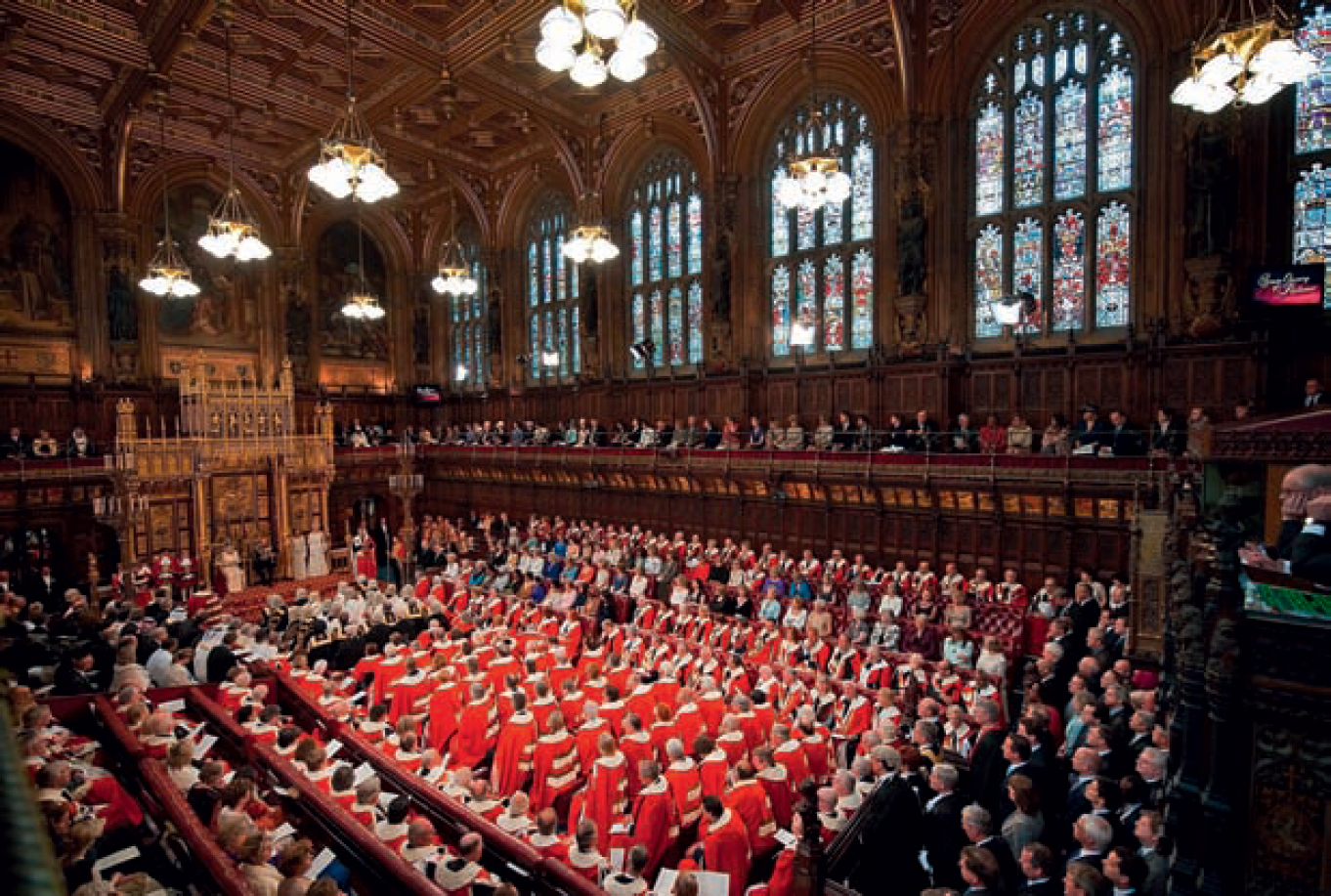
Lords reform has been frustrated for now but a future government might actually carry out changes to the second chamber.
We can already see something of this mechanism in the UK in the fact that the three main parties all proposed a wholly or largely elected second chamber in their 2010 election manifestos. Indeed, looking over a longer period, we can see a gradual shift in the terms of debate surrounding Lords reform. We can get a rough impression of the intensity of interest in Lords reform by counting the number of newspaper articles that mention the subject. Figure 1 shows such data for the Guardian and Times since 1945. (Limitations on coverage mean that data are drawn from two databases for each newspaper; the periods of overlap suggest that differences are, however, small.) It is evident that talk of Lords reform has been much more common over the last 15 years than it had been previously.
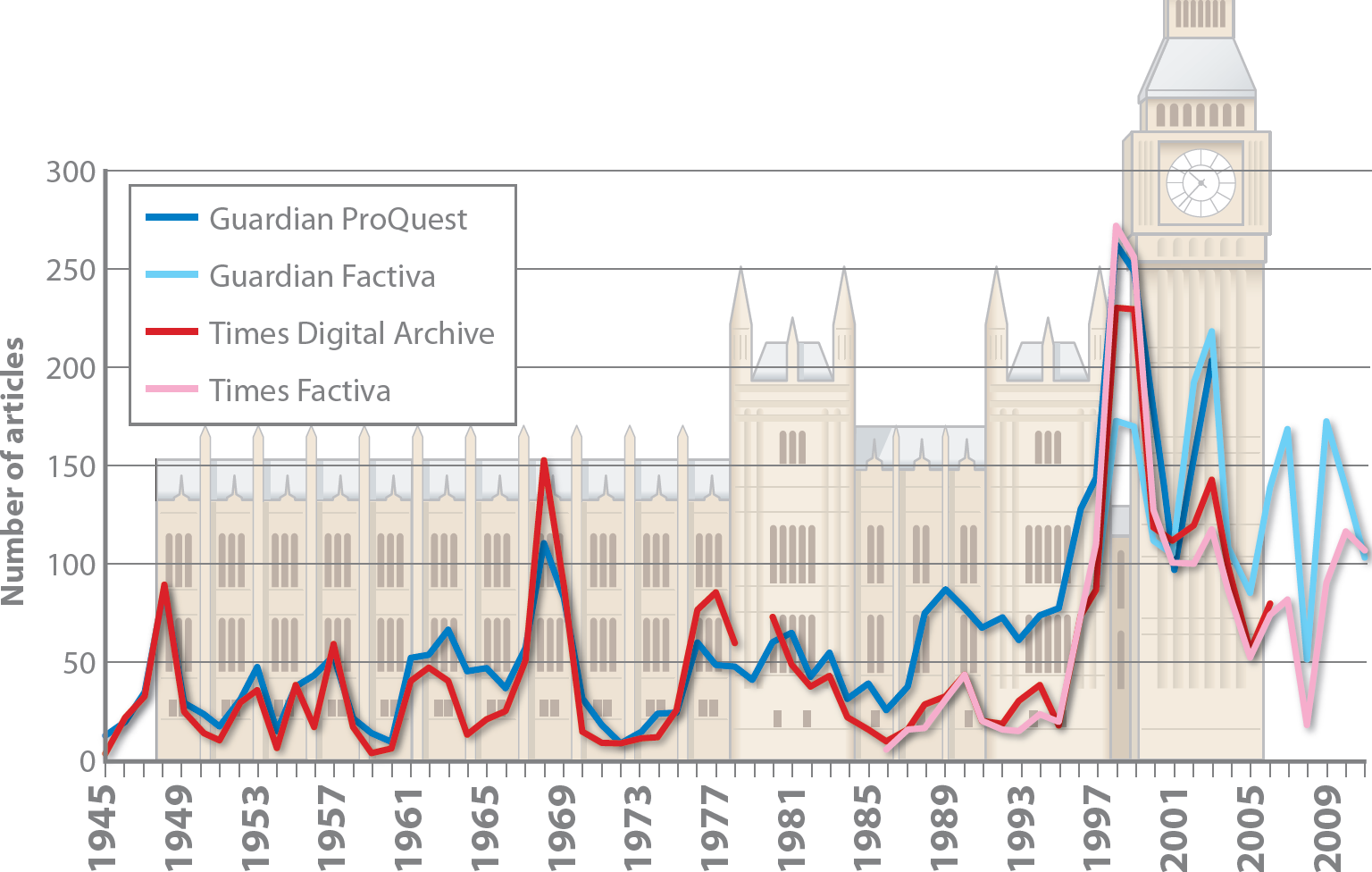
Guardian and Times articles mentioning Lords reform, 1945–2011
More striking still are the data in Figure 2, which include only articles that mention the idea of an elected second chamber. Hardly anyone advocated direct election before the 1990s-indeed, in the 1950s and 1960s, it was still more common to hear support for the principle of heredity – but the idea has since become commonplace. Charter 88, published in November 1988, went no further that calling for Lords reform ‘to establish a democratic, non-hereditary second chamber’. Labour supported 100 per cent election in its 1992 manifesto, but was much more cautious in the next three elections, returning to the wholly elected model only in 2010. The Liberal Democrats first gave unambiguous support for a wholly elected chamber in 2001. The Conservatives opposed any reform in 1997, but by 2001 advocated a ‘substantial elected element’ and in 2010 endorsed a ‘mainly-elected second chamber’.
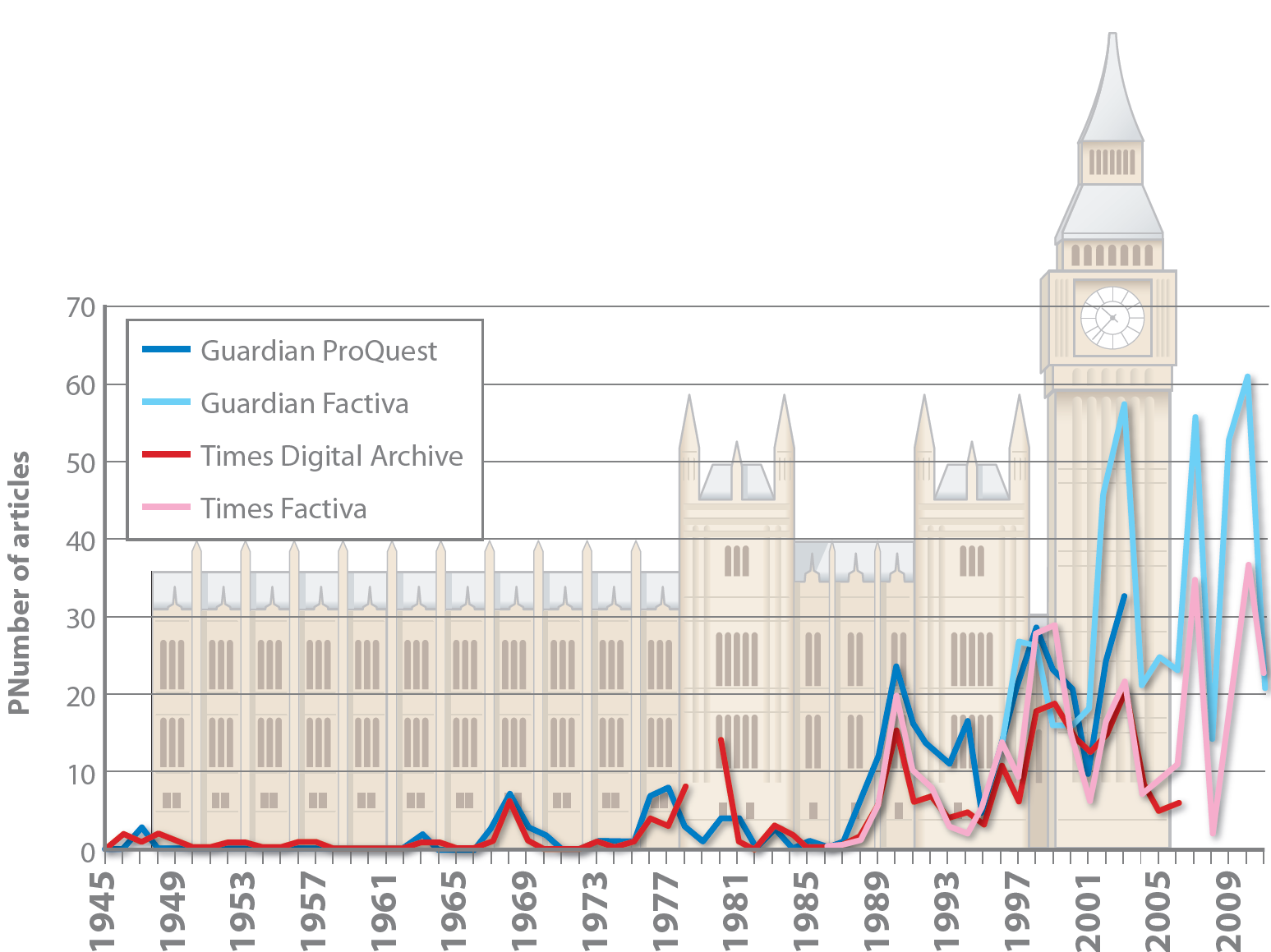
Guardian and Times articles mentioning an elected second chamber, 1945–2011
A Changing Environment
The Royal Commission on the Future of the House of Lords, chaired by Lord Wake-ham, reported in 2000 in favour of only a small elected component. But the tide thereafter turned. In 2002, the Commons Public Administration Select Committee pitched for a 60 per cent elected model, and a 2005 report by a cross-party group of senior backbenchers suggested 70 per cent election. In 2007, the Commons voted for either an 80 per cent or a 100 per cent elected second chamber.
Over time, therefore – and particularly over the last decade – the balance of debate has tended to move away from appointed or indirectly elected models towards direct election. This mirrors trends seen in the UK and across the democratic world towards institutions that permit greater popular involvement in the political process, and we should therefore expect the pattern to survive the current reverse.
The environment in which Lords reform is debated has thus shifted. The incentive for politicians to offer Lords reform as a crowd-pleasing gesture to disillusioned voters is stronger than ever before. It is not inconceivable that a future government, coming to office in more benign times than the present, might actually carry such a promise through. The barriers to an elected second chamber remain high, but they are not entirely insurmountable.