







Abstract
Content analyses of journals in the field of LD provide a means of surveying research and publication trends, the knowledge of which may inform policy and practice related to future research agendas. As the first decade of the current millennium was particularly contentious for the field of LD, we felt that a content review would be timely. In this paper, the content of three refereed LD journals—Journal of Learning Disabilities, Learning Disabilities Research & Practice, and Learning Disabilities Quarterly—was analyzed. Articles from 2001–2010 (n = 841) were systematically coded to capture article type, area of interest, population of interest, sample characteristics, and inclusion of students with LD. Results indicate that across the decade, (a) 68% of articles reported empirical research; (b) empirical research trended up; (c) publication of intervention research remained steady; (d) the most common foci were literacy and the non–academic characteristics of individuals with LD; and (e) inclusion of participants labeled as having a LD declined. We discuss trends, possible explanations, and implications, highlighting areas for future research.
Since reaching an apex of approximately 2.86 million in 2000–2001, the number of students identified with learning disabilities (LD) in the United States steadily declined by approximately half a million students over the subsequent 6 years (U.S. Department of Education, 2011). Despite this recent decline, students identified as having specific LD still comprise 38 percent of all students receiving special education services (U.S. Department of Education, 2011). Because of the prevalence of LD among the population of individuals eligible for special education services, it is incumbent upon professionals in the field of special education to remain aware of current trends and issues affecting the discipline of LD. Professional journals provide researchers and practitioners alike a means by which they may stay informed of such trends and issues as well as the latest research. Arguably, information published in professional journals influences policy, practice, and the preparation of future professionals in a manner unlike any other medium (Mastropieri et al., 2009). Because of this influence on policy and practice, there is a need to carefully examine the content of professional journals to determine the types of articles published, the portion of original research published, the topics that are investigated, and the populations that are studied (Mastropieri et al., 2009). Content analyses of professional journals thus contribute to the field by identifying trends and gaps in the research with the purpose of detecting imbalances and informing future work. Several content analyses of special education journals have been conducted in the past decade (Gage, Lewis & Adamson, 2010; Heath, Toste & Rogers, 2007; Mastropieri et al., 2009; Vostal, Hughes, Ruhl, Benedek–Wood & Dexter, 2008), however, these analyses have either reviewed a broad scope of special education research including but not limited to LD (e.g., Mastropieri et al., 2009) or have focused on a single journal (e.g., Gage et al., 2010; Vostal et al., 2008). The first decade of the current millennium saw significant debate regarding: (1) LD identification (ID) methods (Bradley, Danielson & Hallahan, 2002); (2) instructional service delivery systems (Vaughn & Fletcher, 2009); and (3) seminal policy changes that impacted the education and ID of individuals with LD in the United States (e.g., No Child Left Behind Act, and the Individuals with Disabilities Education Act [IDEA] (2004). We thus feel it is an opportune time to conduct a thorough content analysis specifically dedicated to journals nominally associated with LD in hopes that a review with such a focus will be of interest to policy makers, academics, and special education practitioners.
Historical Context for Review
Fundamental disagreements about the characteristics, prevalence, and proper ID of LD have plagued the construct since its initial conceptualization by Samuel Kirk in 1962. With the passage of Public Law 94–142, the Education for All Handicapped Children Act (EAHCA; 1975), which included LD as a category eligible for federal funding in the United States, these controversies entered public education discourse. From codification within EAHCA until 2001, the number of students served under the LD category grew by 260 percent (U.S. Department of Education, 2010). Despite this growth—or perhaps because of it—disagreements on fundamental aspects of LD did not subside. From 1975 to 2000 these debates defined a turbulent period, which many worried could permanently divide the field of Special Education (Hallahan & Mercer, 2002). A central focus of these debates concerned the validity and desirability of an IQ–achievement discrepancy (IQ discrepancy hereafter) as the primary criterion for LD ID. Critics questioned the validity of the IQ discrepancy ID method, arguing it identified students with LD too late for effective intervention, misclassified students, and overidentified minority students (Hallahan & Mercer, 2002; Kavale, Spaulding & Beam, 2009). A second controversy centered on whether students with LD were best served in specialized classrooms or by being included in general education classrooms with individualized support (Hallahan & Mercer, 2002; Newman, 2006). At the dawn of the 21st century, these controversies set the stage for fundamental changes in the ID and education of students with LD, such as (1) the introduction of accountability measures in No Child Left Behind (NCLB) (2002), and (2) the changes in ID methods introduced in IDEA (2004).
The Present Review
Presently, the field of LD is at a crossroads, as discussion related to the potential elimination of a codified LD category is occurring (National Joint Committee on Learning Disabilities, 2011) and prominent special education advocacy groups are debating the value of maintaining a LD construct (Hallahan, Fuchs, Gerber, Scruggs, & Zigmond, 2010). Given the current state of affairs, the present review sought to describe the amount and foci of research published in three prominent LD journals during the decade spanning 2001–2010.
Research questions guiding this systematic review include: (1) What types of articles were published? (2) How much empirical research was reported in these journals? (3) What types of research were reported? (4) What general topics were investigated? (5) What age/grade levels were studied? (6) What labels (e.g., learning disabled, at–risk, struggling) were used to describe participants, and (7) What trends were evident over time?
Method
Journal Selection
We sought to review research published in refereed journals focusing specifically on the ID, description, and remediation of LD. To begin the journal identification process, we accessed the Journal Citations Report: Social Sciences Edition (JCR, 2009) under the subject category Special Education. From this list, we identified two journals dedicated to LD: Journal of Learning Disabilities (JLD) and Learning Disability Quarterly (LDQ). We then accessed the Web sites of the Council of Learning Disabilities and the Council for Exceptional Children's (CEC) Learning Disabilities Special Interest Group (SIG). This process yielded one additional journal: Learning Disabilities Research & Practice (LDR & P), the journal of the CEC Learning Disabilities SIG. The final step was to investigate whether the three identified journals had been previously grouped based on interest in LD research. The search identified a review on the use of effect sizes in LD research (Ives, 2003) and a content analysis (Heath et al., 2007) utilizing the same three journals. In addition, Mastropieri et al. (2009) conducted an analysis of 11 special education journals. As a part of this review, JLD, LDQ, and LDR & P were identified as the only journals “addressing” LD (p. 97).
Coding
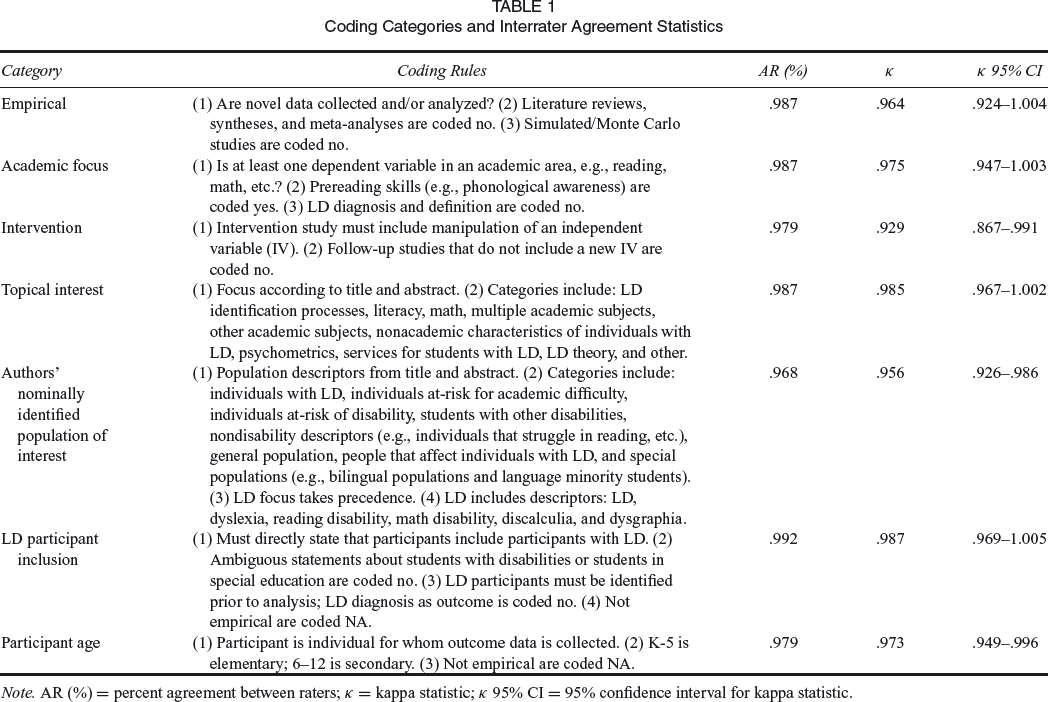
Together, the three journals reviewed yielded 841 articles published from 2001 to 2010, all of which were systematically coded by at least one member of the research team. All coding decisions were documented in a shared spreadsheet hosted on the Google Docs suite (www.docs.google.com). This Web–based spreadsheet allowed access by multiple coders simultaneously, maintaining a sole, current version of the coding sheet at all times. Individual articles were assigned to rows while each of the coding categories were given a column. Development of coding categories was driven by the aforementioned research questions. As a result, most of the coding categories and decision rules were established a priori, however additional coding categories did evolve during the process of coding. Seven closed coding categories allowed us to categorize each article as follows: (A) whether or not the article was empirical, describing original research; (B) whether or not the article's primary focus was academic (e.g., literacy, math, etc.); (C) whether or not the research described in the article included the implementation of an intervention; (D) what was the expressed topic of interest for the article; (E) whom did the author nominally identify as the population of interest; (F) was the label of learning disabled used to describe study participants or the population of interest; and (G) what were the ages of participants included in empirical studies. Mutually agreed upon decision rules specified that for coding category A, an article was considered empirical if the authors reported the collection of novel data. For an empirical study to be coded as an intervention study (coding category C), it had to manipulate an independent variable in order to assess its effect on one or more specific, measurable outcomes.
Throughout the coding process, we employed closed coding choices (i.e., yes or no) with explicit decision rules. We chose this approach to maximize the reliability of coding decisions and facilitate subsequent data analysis. Closed coding choices of yes or no, were utilized straightaway for five of the seven aforementioned categories. The categories pertaining to the population and topical areas of interest were initially left open allowing us to record the authors’ language verbatim. Once an initial 100 articles were coded in this way, a set of closed categories was derived. The initial 100 articles plus all subsequent articles were then coded using these closed categories. Coding decision rules, which were determined by consensus, evolved throughout the process and were recorded within the Google workbook so that each coder had easy, real–time access to decision rules during group and individual coding. The decision–rules sheet also enabled individual coders to address ambiguities in coding rules by creating and documenting new, clearer decision rules to be followed in all subsequent coding. Further descriptions of each coding category and corresponding decision rules are presented in Table 1.
Coding Categories and Interrater Agreement Statistics
AR (%) = percent agreement between raters; κ = kappa statistic; κ 95% CI = 95% confidence interval for kappa statistic.
Throughout the coding process, we took multiple steps to ensure that all raters reliably applied coding rules. The three co–authors completed all coding over a 4–month period. During that time, we utilized group coding, co–coding, individual coding, and independent double coding to ensure high interrater reliability and protect against rater drift. Coding proceeded in phases by journal. Prior to completing individual coding within a specific journal, we coded one full year as a group. Then, we individually coded 4 years divided between three coders. We did this for all three journals completing half of all coding. To complete the second half, we coded one year of each journal in pairs before individually coding the remaining 4 years in each journal. One hundred sixty–eight of the total 841 (20 percent) articles were coded collaboratively by at least two members of the research team. In addition to these steps, we double–coded 247 of the 673 (38.4 percent) independently coded articles to assess reliability. Reliability was high between raters and within categories. The 247 articles independently double–coded yielded 2,470 coding decisions, with only 45 documented coding disagreements. This results in an agreement rate (AR; also called percentage agreement) of. 981. We also calculated AR by coding category, yielding consistently high rates, ranging from. 944 to. 992. Given that we utilized a limited option, closed coding sheet, however, AR is not an ideal measure of reliability. AR is susceptible to inflated agreement because of chance. Cohen's kappa (κ) is an alternative statistic for reporting interrater reliability for categorical data. In contrast to percentage agreement, Cohen's kappa statistic removes chance agreement from the index of agreement. Kappa represents the greatest improvement over chance achieved by the independent raters (Orwin & Vevea, 2009). Table 1 includes kappa statistics by coding category. In our study, κ by category ranged from. 929 to. 987. A kappa statistic above. 81 is considered almost perfect (Landis & Koch, 1977).
Results
Aggregate Findings
Topics of Interest
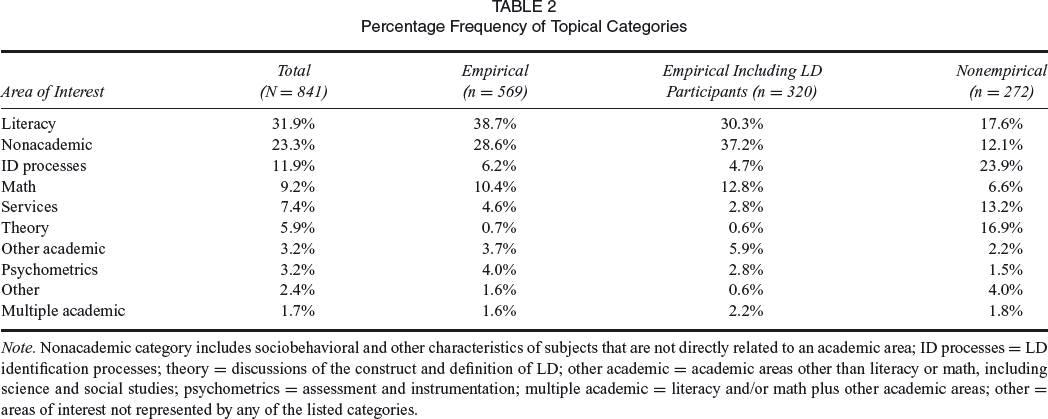
Table 2 presents identified topics of interest for the corpus of articles (N = 841), as well as a disaggregation of data for: (1) empirical articles (n = 569), (2) empirical articles including participants identified as learning disabled (n = 320), and (c) nonempirical articles (n = 272). Fifty–one percent of all included articles had a nonacademic focus. However, the majority (57 percent) of empirical studies focused on academic outcomes. Among the aggregate, the most prevalent topical category was literacy (32 percent) followed by nonacademic characteristics of students with LD (23 percent), which includes sociobehavioral and other characteristics of subjects that are not directly related to an academic area such as literacy and math, and LD ID processes represented the third most prevalent topic at 12 percent.
Percentage Frequency of Topical Categories
Nonacademic category includes sociobehavioral and other characteristics of subjects that are not directly related to an academic area; ID processes = LD identification processes; theory = discussions of the construct and definition of LD; other academic = academic areas other than literacy or math, including science and social studies; psychometrics = assessment and instrumentation; multiple academic = literacy and/or math plus other academic areas; other = areas of interest not represented by any of the listed categories.
Among empirical studies and nonempirical articles for the 10–year period, ID processes were the focus for 6.2 percent of empirical studies and 23.9 percent of all nonempirical articles, for which it was the most prevalent area of interest. With respect to empirical studies, literacy and nonacademic characteristics of individuals with LD remained the most prevalent topics (39 percent and 29 percent, respectively), followed by math (10 percent). Primary interest categories for empirical studies that included participants with LD were nonacademic characteristics (37 percent), literacy (30 percent), math (13 percent), and other academic areas (6 percent; see Table 2).
Populations of Interest
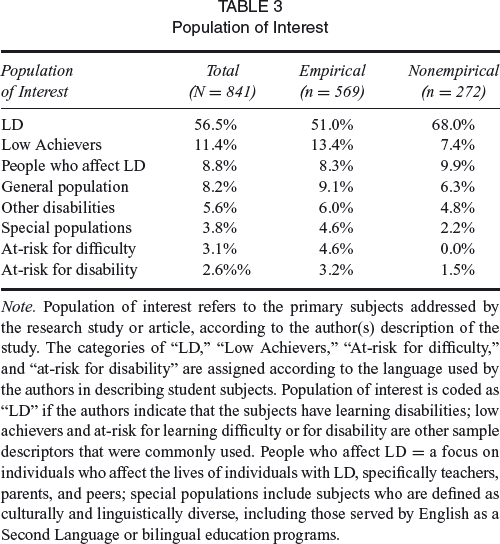
Table 3 presents the author–identified populations of interest within the complete collection of articles (N = 841) and the subcategories of empirical studies (n = 569) and nonempirical articles (n = 272). Within all articles, the majority (56 percent) identified the population of interest as individuals with LD. The second most prevalent population–of–interest category was low achievers (11 percent), where subjects were typically students in general education and students with learning problems not explicitly identified as LD (e.g., struggling readers, students with poor math skills, etc.). An additional 9 percent of the total articles were concerned with individuals who affect the lives of people with LD (e.g., teachers, peers). Similarly, among empirical and nonempirical articles the most predominant author–identified population of interest was students with LD (51 percent and 68 percent).
Population of Interest
Population of interest refers to the primary subjects addressed by the research study or article, according to the author(s) description of the study. The categories of “LD,” “Low Achievers,” “At–risk for difficulty,” and “at–risk for disability” are assigned according to the language used by the authors in describing student subjects. Population of interest is coded as “LD” if the authors indicate that the subjects have learning disabilities; low achievers and at–risk for learning difficulty or for disability are other sample descriptors that were commonly used. People who affect LD = a focus on individuals who affect the lives of individuals with LD, specifically teachers, parents, and peers; special populations include subjects who are defined as culturally and linguistically diverse, including those served by English as a Second Language or bilingual education programs.
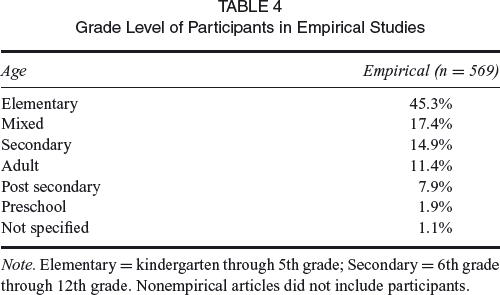
Table 4 reports the grade level of participants in empirical studies only. Within empirical studies, 45 percent of participants were of elementary age (kindergarten through 5th grade), 17 percent included a mixed age group of participants (elementary and secondary), 15 percent included participants enrolled in the secondary grade levels (6th grade through the 12th grade), 11 percent included adult participants who were not included in an educational environment, 8 percent included participants enrolled in postsecondary education settings, 2 percent included students of preschool age, and 1 percent of empirical articles did not specify an age for participants.
Grade Level of Participants in Empirical Studies
Elementary = kindergarten through 5th grade; Secondary = 6th grade through 12th grade. Nonempirical articles did not include participants.
Trends over Time
When looking at trends over time, some interesting patterns emerge. The portion of empirical studies published in the three journals reviewed increased by 15 percent from 2001 to 2002, decreased steadily until 2004–2005, then increased sharply again in 2006, decreased by 20 percent in 2007, and has been climbing steadily since then (see Figure 1). The inclusion of participants described as students with LD in the empirical research published in these three journals sharply declined in 2005 and remained about 20 percent lower throughout the latter half of the decade than it was prior to 2005 (see Figure 2).
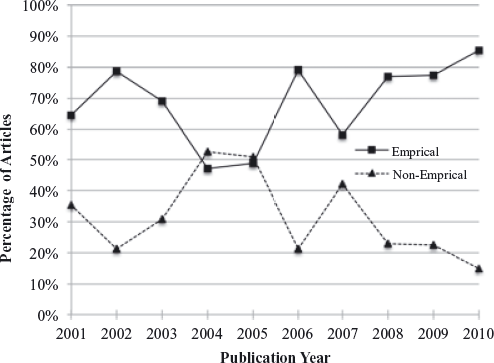
Empirical versus non–empirical by year.
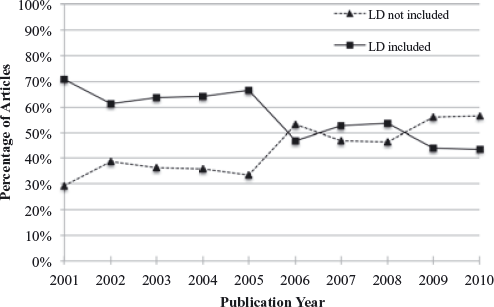
Empirical studies including participants identified as LD by year.
Despite these peaks and troughs in total empirical research, the percentage of intervention studies conducted over the course of the decade remained fairly constant at around 20 percent (see Figure 3). Finally, across the decade 12 percent (n = 100) of all published articles focused on LD ID processes. However, a pronounced increase of articles addressing this topic is evident in 2005, a year in which articles with an expressed interest in ID processes represented 29 percent of all articles published (see Figure 4). Throughout the decade the greater share of articles centered on ID processes were nonempirical (8 percent, n = 65), or articles providing theoretical or methodological discussions of the LD ID process (e.g., Fletcher, Denton & Francis, 2005; Stanovich, 2005). By comparison, empirical articles reporting original research related to LD ID processes represented 4 percent (n = 35) of the overall sample of articles (see Figure 5).
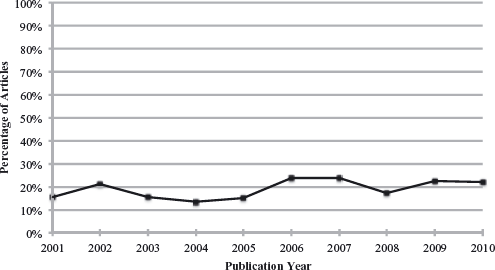
Intervention studies by year.
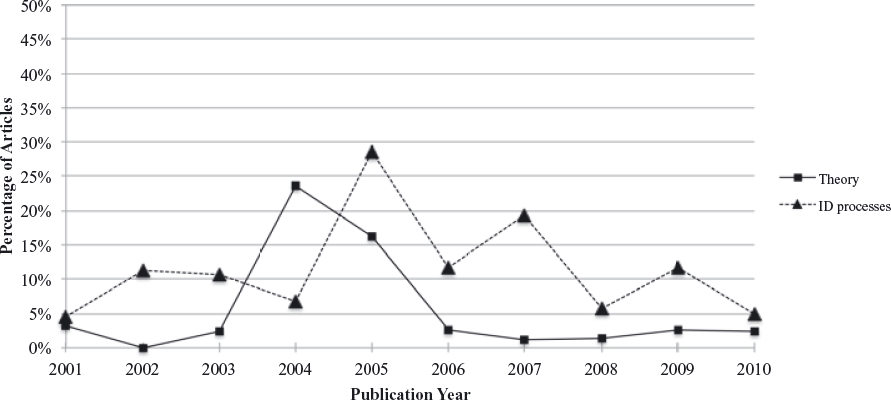
Percentage of articles focusing on theory and ID processes by year.
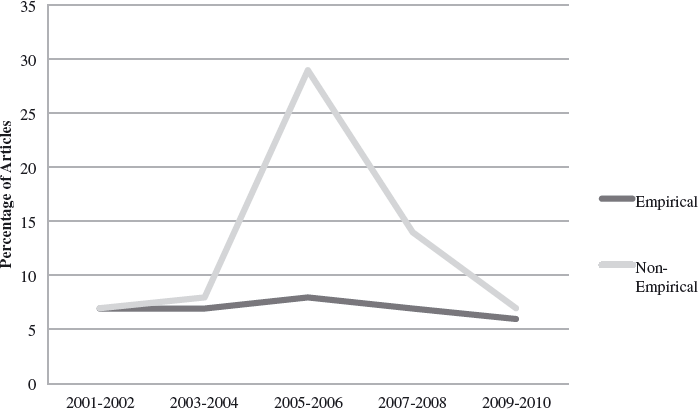
Percentage of empirical and non–empirical articles focusing on identification (ID) processes.
The 2005 spike in interest relating to LD ID was preceded in 2004 by a similar increase in the number of articles focusing on the theoretical underpinnings of LD. During 2004, 24 percent of all articles published in the three reviewed journals focused on LD theory, dropping to 16 percent in 2005. This is in contrast to the rest of the decade for which articles with a theoretical focus comprised generally no more than 3 percent of all articles included in this review (see Figure 4). Combined, 38 percent of all published articles in 2004–2005 focused on either LD ID processes or LD theory (see Figure 6).
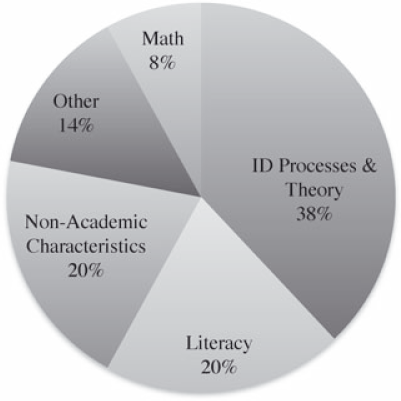
Areas of interest (2004–2005).
Discussion
The purpose of this review was to examine the amount and foci of research published in three high–impact LD journals during the decade 2001–2010. This exploration was motivated by a desire to provide special education professionals and policy makers with a summary of research specific to LD during a decade involving prominent discussion surrounding the ID of and educational provision for students with LD. Findings of the present review suggest that the amount and foci of published research fluctuated across the decade. The following discussion will consider results with the aim of identifying gaps and issues that can be addressed by future research.
Trends in Publication of LD Research from 2001 to 2010
Upon inspection of findings over the course of the decade, two years particularly stand out. Specifically, the years 2004–2005 evidence shifting patterns and/or anomalies in publication trends for a number of the categories included in this review. For example, as Figure 1 illustrates, the proportion of published empirical studies reporting original research was lowest in 2004–2005. Nonempirical articles therefore represented a greater portion during these 2 years. Simultaneously, the foci of published articles shifted, emphasizing theoretical discussions about LD and its ID processes (see Figures 4 and 5). Others have noted these trends as well upon comparing the 5–year period that encompasses 2001–2006 with previous 5–year periods (see Heath et al., 2007; Mastropieri et al., 2009). Since we compared publication trends by year rather than by 5–year period, we were able to observe that these shifts occurred predominantly between 2004 and 2006.
While the problem of definition (Kavale et al., 2009) has existed in the field of LD since its inception, the heightened interest in theory and ID processes during the middle part of the decade may reflect the field's concern with the 2004 reauthorization of IDEA, in which responsiveness to instruction was introduced as a viable alternative to IQ–achievement discrepancy criteria for the ID of LD. Heath et al. (2007), Mastropieri et al. (2009), and Vostal et al. (2008) made similar observations regarding this trend, which Heath et al. deemed “predictable in light of the move to RtI and the resulting questioning and discussion of the role of LD in the process” (p. 17). Indeed, in two of the three journals (JLD and LDQ), there were special issues devoted to the discussion of the construct of LD, ID of LD, and/or Response to Intervention (RtI) during the years in question. These special issues published predominantly position papers centered on ID processes and LD theory. Many of these papers articulated the need for empirically testing LD ID processes, including RtI approaches, in order to rectify the elusiveness that has characterized the construct of LD since its inception (Fuchs, Deshler & Reschly, 2004).
With the exception of the increased dialogue in 2004–2005, the publication of articles focusing on LD ID processes across the decade in these three journals remained relatively low; this is especially true of articles reporting original research (see Figure 5). Historically problematic (Hallahan & Mercer, 2002), the lack of clear operational parameters to define LD results in great variability in who is (as well as how many are) identified as learning disabled (Speece, 2008). If, as Speece suggests, science, as opposed to legislation, ought to solve problems of classification in the field of LD, we would hope to see an increase of empirically based discussions reporting original research aimed toward the further solidification of the LD construct. The consequences of our failure to scientifically operationalize the LD construct are unknown, but will likely contribute to ongoing ambiguity in identifying the population of individuals with an LD, the proliferation of a public attitude that “no one knows what LD is” (Kavale et al., 2009, p. 46), and a growing concern that the LD construct may eventually become meaningless (Speece, 2008).
Gresham and Vellutino (2010) state that a fundamental question regarding LD ID is “to what extent, if at all, are students who are given the Specific LD label different from low achieving students who are not given that label?” (p. 194). The question, they continue, “has been more of a legal entitlement decision than a scientific question” (p. 194). This historically legislated distinction has been based less on science than on considerations of who should be legally entitled to educational resources. The findings of this review, similar to previous reviews (Mastropieri et al., 2009), reveal a tendency over the course of the decade to use nondisability language (e.g., poor readers, students with reading difficulties, or students at–risk) to describe the population samples in empirical articles (see Figure 2). While considerable overlap has been documented (Fuchs, Fuchs, Mathes, Lipsey & Roberts, 2002) between the population of low achievers or at–risk learners who have not (perhaps yet) been identified as having an LD and the population of low–achieving students who have, the trend toward focusing on the former in publications in LD journals is noteworthy.
This phenomenon, combined with a decline in the average age of participants (Mastropieri et al., 2009), could be attributed to the widespread adoption of tiered approaches to instruction in accordance with RtI, which appears to be shifting the focus within the field of LD from learners who are already identified as having an LD to struggling learners who are at risk of being identified as having an LD. While there are undeniable advantages to prioritizing early ID and intervention with at–risk students in the general education setting (Vaughn & Fuchs, 2003), the trend raises justifiable concern about the “blurring” of special education within the context of RtI (Fuchs, Fuchs & Stecker, 2010). Under RtI, the at–risk population is identified through benchmark screening. Children who fall below age– and grade–level expectations are provided more intensive, small–group instruction. Their progress is monitored and should they respond adequately to intervention (e.g., reach expected levels of performance), no further intervention is deemed necessary. Should they fail to respond adequately to intervention, however, they may be provided a more intensive, higher tier of intervention, their response to which may make them eligible for referral to special education. Progress monitoring data are then to be taken into consideration during a child's full individual evaluation to help the multidisciplinary team determine special education eligibility under the category of Specific LD. RtI has been considered under the umbrella of general education (Kavale et al., 2008), but the LD research community has taken great interest in its potential to identify students with LD while avoiding the much–criticized wait–to–fail approach. Perhaps because of this, researchers in the field of LD have directed much of their investigatory activity to remediation studies (i.e., RtI) and thus to the population of students who are considered to be at–risk.
These findings are intriguing in the context of the future for the field of LD. Although in the latter part of the decade the LD research community appears to be publishing more empirical studies, those studies are increasingly investigating populations that are not labeled as LD. While it was outside the scope of this review to investigate the specific characteristics of each articles’ included population sample, it is likely that included populations would demonstrate characteristics similar to the population of students historically identified as LD. What the field of LD must be wary of is an extensive focus on students at–risk, therefore allowing a deviation away from its “necessary and noble tradition” (p. 318) to educate the most difficult to educate (Fuchs et al., 2010).
At this time it is unclear as to whether the population most difficult to educate consists solely of students identified with disabilities and thus eligible for special education. If it is a goal for the field of LD to halt the blurring of lines between itself and general education (Fuchs et al., 2010) and preserve the historical mission of special education professionals, it may behoove the field to make a concerted effort to explicitly address the shortage of intervention research focused on those most difficult to educate. However, the current review indicated the proportion of research investigating the experimental effects of interventions—research that could specifically contribute to the evidence base of empirically validated instructional practices—averaged less than 20 percent of all articles published over the course of the reviewed decade. Others have also acknowledged the stability of intervention research in the field over time and its disappointing share of research overall, especially in relation to descriptive studies (Mastropieri et al., 2009; Vostal et al., 2008). No doubt, intervention research is difficult and time–consuming (Mastropieri et al., 2009). However, given legislation (e.g., No Child Left Behind [NCLB], IDEA) at the beginning of the decade that specifically called for the use of scientifically based research in educational practice, it is surprising that the proportion of empirical research that would be considered capable of identifying and validating such evidence–based practices has changed very little over the course of the decade.
Gaps in Research
Reviews of journal content are valuable not only because they document the foci and trends of extant research, but also because a broad overview can highlight gaps in research and provide guidance on future research priorities (Gage et al., 2010). An analysis of the past decade of research published in three refereed LD journals documents several potential imbalances in the foci of research, including its topics and participants. Topically, the corpus of studies across the decade focused overwhelmingly on literacy. Reading is of unique and fundamental importance in school and beyond. Extensive research is no doubt required to identify, prevent, and remediate LD in reading. And yet, considering the state of knowledge regarding reading instruction for individuals with LD (see, for example, O'Connor & Vadasy, 2011) versus knowledge regarding math, writing, or content area instruction (see, for example, Gajria, Jitendra, Sood & Sacks, 2007; Graham & Perin, 2007; National Math Advisory Panel, 2008), the 3:1 ratio by which research in reading exceeds math, and the approximately 10:1 ratio by which it exceeds research in other academic areas reflects an imbalance that could be remedied by increasing investigations within other core academic skills and content areas, such as math, writing, social studies, and science. A similar gap emerges when comparing the topics of interest of the empirical versus the nonempirical articles that were reviewed. Nearly one–quarter (23.9 percent) of the nonempirical articles published across the decade focused on ID processes for LD. In comparison, roughly 6 percent of empirical articles investigated ID processes for LD. A similar pattern emerges within research focused on supplementary services for individuals with LD. Among nonempirical articles, over 13 percent of the published articles discuss supplementary services. At the same time, fewer than 5 percent of empirical studies actually investigated supplementary services for individuals with LD.
Considering participants, it is worth noting that 45 percent of published empirical studies solely included elementary–age students. This is perhaps not surprising given the field's emphasis on the prevention of LD, particularly in early reading. However, given that LD is a lifelong disorder (Bradley et al., 2002) it is important that journals dedicated to research on LD increase understanding about the prevalence and characteristics of LD as well as establish research–based interventions for individuals with LD across the lifespan. Although the educational focus of the reviewed journals may explain the dearth of research with adults, it is still noteworthy that only 15 percent of the reviewed studies included secondary students, defined broadly in this study as any student enrolled in grades 6–12. Considering that less is known about instructing adolescents with LD in reading (Biancarosa & Snow, 2006; Deshler & Hock, 2007; Roberts, Torgesen, Boardman & Scammacca, 2008, Vaughn & Fletcher, 2012), writing (Graham & Perin, 2007), or math (Jitendra & Xin, 1997; Swanson, 2012), it is justifiable to claim that there is a need for more research on individuals with LD who are beyond elementary age.
Correcting this imbalance is paramount for the effective functioning of RtI, which depends upon the successful “implementation of evidence–based interventions designed to prevent or remediate academic difficulties” (Fletcher & Vaughn, 2009, p. 32). Fuchs and Deshler (2007) argue, “if we were to prioritize areas in which more knowledge is needed [about RtI], our priorities would be these: First, practitioners need scientifically validated instructional protocols that are likely to accelerate student progress in pivotal skills aside from early reading (e.g., math and writing) and in content areas (e.g., social studies and science)” (p. 134). Clearly, there is a perceived need for the field to prioritize research in areas that are historically lacking (e.g., anything other than elementary reading). Given the contemporary emphasis on RtI, the call to establish and validate evidence–based instruction in such areas has become even more pronounced. The findings of this review suggest that this call is still warranted.
Limitations
There are several limitations associated with the present review. We deliberately targeted for inclusion in this review prominent journals with a dedicated focus on LD. We chose this limited scope because of our interest in the balance of articles with differing methods, foci, and populations of interest within a circumscribed field, which necessitated accessing all articles published in a 10–year span. We felt that limiting selection to LD–specific journals was theoretically defensible and logistically feasible, but still provided sufficient data for analysis. However, as a result of this limited scope we cannot account for research specifically related to LD published in other journals. Inclusion of articles in other journals with interest in LD, such as Exceptional Children, Journal of Special Education, or Remedial and Special Education may have changed our findings, which are specific to the journals reviewed. However, the triangulation of our findings with the findings of previous reviews would signify this limitation is minimal. Second, our findings are limited to those categories for which we coded, which were based upon our guiding research questions. Previous reviews (e.g., Gage et al., 2010; Mastropieri et al, 2009; Vostal et al., 2008) have coded for categories such as experimental design, statistical analysis procedures, mean participant age, English–language learner status, and specific component focus (e.g., phonics or fractions) of interventions, but we felt such categories were outside the scope of our current purpose.
Conclusion
A systematic review of three refereed LD journals revealed publication patterns and trends that corroborate the findings of other content analyses of special education research. Findings of the current and previous reviews highlight areas of imbalance in the corpus of LD research, which continues to be dominated by reading research at the elementary level. Areas that have historically lacked research attention, especially content areas, writing, and math, continue to represent a small portion of the published articles. Although there has been a positive in the amount of empirical research published, the proportion of intervention studies published has remained constant at approximately 20 percent. In accordance with previous findings (Mastropieri et al., 2009) and in light of the increased focus on evidence–based practice, this finding suggests an imperative to increase the publication of intervention research to experimentally test and validate such practices.
Articles focusing on LD ID processes have been predominantly nonempirical, suggesting an opportunity for empirical investigations in this area. In the decade under review, such discussions reached their height during the initial years of the decade when an intense ID debate was occurring (see Bradley, Danielson & Hallahan, 2002). Concomitantly, a downward trend occurred related to the inclusion of or focus on subjects labeled as having an LD. Instead, authors increasingly described their samples and populations of interest as struggling, at–risk, low achieving, or as having learning difficulties rather than disabilities. Future analyses of research published in LD journals may seek to explicitly identify similarities and differences between populations identified by authors as learning disabled and those that are not. Such an analysis may provide the conceptual terra firma from which a path forward may be forged. Indeed, it seems unlikely that the construct of LD will be clarified without a close inspection of its development and use over time.