







Abstract
The purpose of this article is to discuss the use of explicit instruction in the curriculum area of science where non–explicit approaches (e.g., discovery learning) are often used. While there has been a relative paucity of research on explicit instruction in science classrooms, we argue that explicit instruction, particularly when it is embedded within an inquiry approach aligned to the Next Generation Science Standards, has the potential to increase achievement in science for students with LD. Based on previous research, we provide potential ways to implement the five core instructional components of explicit instruction in today's inquiry–based science classrooms.
The science classroom is often a fulcrum for difficulties for students with learning disabilities (LD) because learning in this context requires student mastery and implementation of multiple skills (e.g., reading vocabulary–dense texts, technical writing, application of mathematics) – skills that many students with LD struggle with in isolation. Because of these complicated demands, students’ with LD achievement in science suffers. Research indicates that a large gap in science achievement between students with and without LD is evident as soon as science is formally assessed and continues to widen over time (Morgan, Farkas, Hillemeier, & Maczuga, 2016). Exacerbating this matter is the science field's move toward inquiry–based teaching methods that require the integration of these complex skills but typically do not provide the structure and supports students with LD need to be successful. Within this context, we argue that the inclusion of explicit instruction has the potential to ensure that all students, but particularly students with LD, can be successful.
Reasons Students with LD Struggle in Science
Although complex and often overlapping, three areas of difficulty are generally implicated as contributing factors to the poor science performances of students with LD. These areas of difficulty include (a) language, (b) core academic skills, and (c) knowledge acquisition and retention. Above all, language difficulties, including both receptive and expressive language, cause the most problems for students with LD within the domain of science (Scruggs & Mastropieri, 1993). Students with LD also often have limited vocabulary knowledge, compared to their peers, which is particularly problematic in science due to the strong correlation between vocabulary knowledge and understanding high level concepts (Kaldenberg, Watt, & Therrien, 2015). Problems with language manifest and cause difficulties for students regardless of the mode of instruction, and can hamper students with LD from meaningful participation in science.
Difficulties in core academic skills also play a large role in students’ problems in science. The vast majority (over 80%) of students with LD are identified as having significant problems in the area of reading and/or writing (Parmar, Deluca, & Janczak, 1994; Shepard & Adjogah, 1994; Steele, 2004). Problems for students with LD are exacerbated within text–heavy science instruction, but are even problematic within inquiry–based classrooms that often consist of instructional components that require reading for research (Kaldenberg et al., 2015). Writing difficulties hamper students’ ability to express what they know and limit their opportunity for reflection and synthesis. Although reading and writing are by far the most common skill difficulties for students with LD, many students have needs in the area of mathematics that can affect achievement in science (Olson & Platt, 2004).
Along with language and core academic skill problems, students with LD often have difficulty with knowledge acquisition and retention. Compared to their peers, students with LD typically have a lower level of background knowledge and hold more misconceptions on basic science concepts (Mercer & Mercer, 2005). Limited background knowledge makes retention of new concepts difficult because students cannot readily make connections between the new information learned and previous knowledge on the concept. Even after knowledge has been retained, students with LD can have problems recalling the information and often need additional prompts or cues (Swanson & Sáez, 2003). Undergirding these knowledge and retention difficulties is a lack of access to effective learning strategies (Scruggs & Mastropieri, 1993).
Approaches to Science Instruction
Over the past several decades, science education has begun to shift from didactic approaches to inquiry–based/hands–on models (Scruggs & Mastropieri, 2007). The acceptance of the need for this shift is almost universal, with all the major professional science organizations strongly encouraging teachers to adopt inquiry methods in science (American Association for the Advancement of Science, 1997; National Research Council, 2006; National Science Teachers Association Board of Directors, 2004). Despite this advocacy, what core instructional components constitute inquiry instruction has not been clear (Klahr & Li, 2005), with some advocating against the use of explicit instruction and contending that only discovery learning paradigms (i.e., instruction where “…the learner is not provided with the target information or the conceptual understanding and must find it independently and with only the provided materials”; Alfieri, Brooks, Aldrich, & Tenenbaum, 2011, p. 2) fit within the overall construct of inquiry instruction.
Fortunately, the field of science education and specifically the Next Generation Science Standards (NGSS, 2013) have begun to “… better specify what is meant by inquiry in science and the range of cognitive, social, and physical practices that it requires” (p. 2). In a comprehensive review of inquiry studies in science education, Minner, Levy, and Century (2010) concluded that inquiry instruction can be distinguished from other approaches via the following three essential components: (1) the presence of science content; (2) student engagement with science content; and (3) student responsibility for learning, active thinking, or motivation with at least one component of instruction in the scientific inquiry process (e.g., designing a study) (p. 478). Missing from this definition is any mention of instructional approaches, including explicit instruction and discovery learning.
The NGSS further refined this definition by delineating three core instructional foci needed within effective inquiry instruction: (1) scientific practices (e.g., asking questions, interpreting data), (2) crosscutting concepts (e.g., patterns, cause and effect), and (3) disciplinary core ideas (e.g., patterns of the motion of the moon and sun) (NGSS, 2013). See Table 1 for main NGSS components. Based on the above definition and instructional foci, we argue that a range of instructional approaches can be used within the construct of inquiry instruction including explicit instruction.
Next Generation Science Standards Core Components
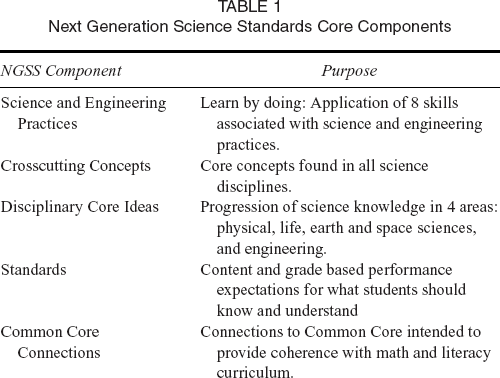
Implementation of the NGSS within an inquiry approach poses a new set of opportunities and challenges for students with LD and their teachers. Similar to others, students with LD are likely to benefit from the focus on big ideas (instead of disconnected facts) emphasized in the disciplinary core ideas and cross–cutting concepts. They also may benefit from the across K–12 focus on the application of essential scientific practices. Despite these potential benefits, students with LD are still likely to be hampered by difficulties they have experienced previously in science, and new potential problem areas (e.g., effectively engaging in scientific argument, collaboratively working in groups) will likely arise.
Explicit Instruction and Science Education
Instructional methods for students with LD, including explicit instruction, are understudied in science (Therrien, Taylor, Hosp, Kaldenberg, & Gorsh, 2011). There is, however, clear evidence for the efficacy of explicit instruction within the area of reading in science. In two literature reviews on this topic (Kaldenberg et al., 2015; Mason & Hedin, 2011), core elements of explicit instruction were consistently found to improve students’ with LD comprehension of science texts. Effective explicit instruction within the area of reading science expository texts includes explicitly teaching core vocabulary (Spence, Yore, & Williams, 1999), using explicit instruction to teach students how to implement reading strategies (e.g., main idea and summarization; Bakken, Mastropieri, & Scruggs, 1997), and use of graphic organizers while reading with scaffolded supports (Bos & Anders, 1992; Woodward, 1994).
Research outside of special education has examined the relative efficacy of explicit instruction compared to less directed approaches often associated with the term “inquiry instruction.” In a meta–analysis of 164 studies, Alfieri and colleagues (2011) found that explicit instruction was significantly more effective than unassisted discovery learning across a range of outcomes. Klahr and Nigam (2004) directly compared the efficacy of explicit instruction and discovery learning when teaching 3rd and 4th grade students about ramps and friction (e.g., does a ball go further after traveling on a smooth or rough incline?). They found that students in the explicit instruction condition outperformed those in discovery learning on all measures, including on a scientific judgement measure. Explicit instruction has also been found to be more effective than discovery learning when the target is a performance task such as those found within the NGSS essential scientific and engineering practices. Toth, Klahr, and Chen (2000) examined the efficacy of discovery learning and explicit instruction when teaching students the scientific practice of controlling extraneous variables when conducting an experiment. Students in the explicit instruction condition scored significantly higher than students in the discovery learning condition on the immediate posttest as well as on two transfer tasks. Therefore, while more research is needed, there is a growing body of evidence indicating that explicit instruction is more effective than discovery learning in education at large and in science specifically.
The effectiveness of explicit instruction embedded within an inquiry instructional paradigm has also been investigated in the education field at large. Along with directly comparing explicit instruction and pure discovery learning, Alfieri and colleagues (2011) compared the efficacy of what they termed “enhanced discovery learning” to all other forms of instruction. Meta–analytic results significantly favored enhanced discovery learning approaches. Interestingly, the enhanced discovery approaches were also generally more effective than explicit instruction approaches on their own. This indicates that perhaps a combination of hands–on inquiry instruction with embedded explicit instruction might be the most effective instructional approach, particularly in science. This finding, however, in no way discounts the potential importance of explicit instruction in science because the key instructional components Alfieri and colleagues identified as important to maximize the effectiveness of enhanced discovery learning all fit within the definition of explicit instruction. Specifically, they indicated that the following instructional components optimized the effectiveness of enhanced discovery: guided tasks with scaffolds, having learners explain their own ideas with teacher feedback, and providing worked examples (Alfieri et al., 2011, p. 13).
While there have not been many investigations on the effectiveness of inquiry science instruction for students with LD, most results align with those reported in the education field at large. In a meta–analysis of science instruction for students with LD, Therrien et al. (2011) reported that inquiry instruction was effective for students with LD if the approach implemented was structured. Structured supports described by Therrien et al. include many of the instructional components (e.g., chunking content for instruction, providing scaffolds and formative feedback) essential to explicit instruction. Along with the meta–analysis, individual studies found that students with LD did significantly better within inquiry units when explicit instruction was added (McCleery & Tindal, 1999) or embedded throughout the entire inquiry lesson (Dalton, Morocco, Tivnan, & Rawson Mead, 1997).
Essential Explicit Instructional Components in Science Instruction
While there remains a paucity of explicit instruction research in science education for students with LD, preliminary results indicate that explicit instruction has the potential to be effective within science instruction. Below we take, in turn, the five core explicit instructional components delineated in Hughes, Morris, Therrien, and Benson (this issue), discuss a previously validated approach that includes the explicit instruction component of interest, and then detail how that approach might be embedded in inquiry science instruction aligned to the NGSS.
Segment Complex Skills/Knowledge into Smaller Chunks for Instruction
Breaking down content, skills and/or strategies into teachable chunks and then teaching these chunks in a logical order is a critical component of explicit instruction. In previous work, Dalton et al. (1997) utilized chunking in a study where they compared hands–on activity–based instruction to an approach they titled “the supported inquiry method.” Included in the supported inquiry method was a focus on arranging instruction around a unifying concept, thereby encouraging students to see connections between the overall topic and discrete facts under study. Specifically, the authors centered their instruction around the big idea of “pathways” within a unit on circuits and electricity. They then used specific strategies such as questioning and writing to ensure that learners saw the connections between underlying concepts and the big idea. Along with chunking, the supported inquiry method included an emphasis on dispelling misconceptions and utilization of drawing to demonstrate student understanding. All students, including students with LD, in the supported inquiry condition significantly outperformed students in the control condition (inquiry with no supports).
The NGSS lend themselves nicely to the explicit instruction core component of chunking content for instruction because they provide clear in–depth guidance for teachers on how to organize core concepts and scientific practices across the entire K–12 grade span (NGSS, 2013). Within each grade level, content strands (e.g., physical sciences, life sciences) are provided. Each strand includes performance expectations as well as scientific practices, disciplinary core ideas, and crosscutting concepts to highlight within the instruction unit(s) associated with that particular strand. Because they are grouped around big ideas, the content and practices associated with each strand lend themselves well to chunking. Graphic organizers, because they enable learners to see the connections between concepts, may be well–suited chunking strategies to implement in order to increase the likelihood that students with LD master core concepts delineated in the standards. Two recently published meta–analyses (Dexter & Hughes, 2011; Dexter, Park & Hughes, 2011) found that graphic organizers are consistently effective in helping students with LD acquire core science knowledge as well as facilitating retention.
Design Lessons that Intentionally Draw Student Attention to Important Features of the Content through Modeling
Providing students with clear and concise student–friendly descriptions of the content or skill at hand and imparting this information via modeling and demonstration significantly increase the likelihood that students will attend to the critical aspects of the lesson. The importance of drawing students’ attention to critical features of a concept was demonstrated by Mastropieri, Scruggs, and Butcher (1997) via an application lesson on inductive reasoning. In this study, the authors implemented a guided model that provided progressively more assistance to students until they were able to induce a general rule for swinging pendulums of different string lengths. The tiers of the guided modelling progressed from a simple prompt, “Can you think of a general rule about pendulums?”, to more detailed prompts that specifically drew students’ attention to the critical features needed to develop the general rule (e.g., “… as we go from left to right, what happens to strings?…to number of swings?”) (p. 206). Students continued to receive higher levels of prompting until they were able to infer the general rule. Results indicated that students with LD needed more detailed prompts to infer the rule than their peers without disabilities, thus demonstrating the importance of explicitly drawing students’ with LD attention to critical features of the concept at hand via modeling and prompting.
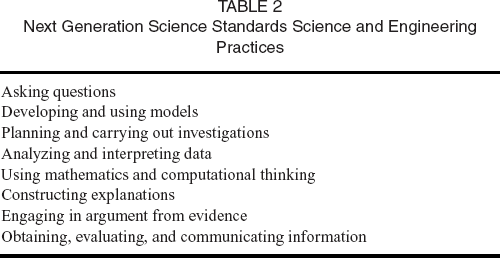
The NGSS delineate eight scientific and engineering practices that students learn across the grade span. See Table 2 for NGSS practices. Similar to the study above, teachers can model components of the NGSS practices. During modeling, clear and concise directions should be provided, thus ensuring that students attend to the critical features of the task. For example, when targeting the scientific practice of planning and carrying out investigations, teachers can model how to control extraneous variables in an experiment during their demonstration. They then can provide, via a strategy or heuristic, the steps to execute in an applied experiment. The level of explicitness provided in the strategy or heuristic can be differentiated based on students’ needs. For example, for high achieving students, no prompt may be needed to ensure that students control extraneous variables, while for struggling students, a direct prompt may be needed (e.g., be sure the surfaces of your ramp are the same because that may affect how far the ball rolls).
Next Generation Science Standards Science and Engineering Practices
Promote Successful Engagement by using Systematically Faded Supports or Prompts
Research indicates that providing scaffolded supports to ensure accurate performance for students with LD results in greater achievement in science classrooms (Therrien et al., 2011). Mastropieri et al. (2006) provided students with an extensive amount of practice using scaffolded materials. They accomplished this by designing three levels of differentiated materials geared to align to students’ ability level. They compared this condition to instruction that included undifferentiated worksheets provided by the textbook. Both conditions included the same lectures and laboratory experiments. Students, including students with LD, in the differentiated materials condition significantly outperformed students in control. This difference was particularly notable because it was achieved on the end–of–the–year high stakes science assessment.
There are numerous other ways to provide students with scaffolded supports during science instruction using differentiated materials. One potential means, particularly in elementary classrooms, is by utilizing stations and small group activities. During these center and small group activity times, teachers can provide leveled material/support for students with a particular focus on increasing students’ background knowledge and/or grasp of disciplinary core ideas and cross cutting concepts found in the NGSS. Potential levelled station activities can include applying disciplinary core ideas in context, generating research questions, or completing other small–scale research activities that target a scientific practice of interest (e.g., Developing and using models; Analyzing and interpreting data) to a particular unit. Keys to effective scaffolding are ensuring that students receive timely feedback and utilizing student responses to determine whether and/or when to fade scaffolds.
Provide Frequent Opportunities for all Students to Respond and Receive Feedback
Ensuring that students have frequent opportunities to respond and receive feedback increases engagement and provides teachers with critical information on student performance that can then be used to alter instruction. McCleery and Tindal (1999) provided pullout instruction that included many of the core components of explicit instruction, with particular emphasis on frequent opportunities for guided practice with immediate feedback. Specifically, students were explicitly taught core concepts (e.g., experiment, hypothesis) of a unit using examples and non–examples, and then were provided with progressively more difficult opportunities to practice, with feedback provided throughout the entire instructional sequence. Students were also taught a series of rules related to the scientific method, and were given an outline used to visually guide them through implementation of the inquiry steps. Students with LD in the pullout explicit instruction group performed significantly better on measures of conceptual knowledge and detail of scientific explanations than peers who did not receive the supplemental instruction.
Along with individual or small group instruction, there are many ways for teachers to provide additional practice opportunities with feedback during NGSS aligned science instruction. During whole group lessons on disciplinary core ideas (e.g., seasonal patterns of the sun), unison responses (e.g., choral, written) are an effective means to ascertain students’ understanding of core scientific concepts and provide immediate feedback (Nagro, Hooks, Fraser, & Cornelius, 2016). Peer tutoring is another means to provide extra practice opportunities with feedback (Brigham, Scruggs, & Mastropieri, 2011). To maximize effectiveness, peer tutoring activities need to be structured, providing students with differentiated materials to use and a set routine to follow (Mastropieri, Scruggs, & Graetz, 2005).
Create Purposeful Practice Opportunities
In order to master content and skills, students need extensive practice. This is particularly the case for students with LD because the cognitive demands placed on working memory during independent practice are high. Supports, therefore, are often needed during independent practice opportunities in order to reduce cognitive load and enable students with LD to be successful (Dexter & Hughes, 2011). One evidence–based support that increases the likelihood that students will acquire and retain science conceptual knowledge while studying (i.e., practicing) is mnemonics. Research on keyword and pegword mnemonics is clear; their usage results in a significant increase in students’ with LD acquisition, retention and recall of scientific concepts and facts (Therrien et al., 2011). Previous research also indicates that students with LD need additional supports when practicing inquiry skills (e.g., scientific practices). Along with providing structured support during group experimental lessons, Palincsar, Magnusson, Collins, and Cutter (2001) provided students with rehearsal and mini–conferencing opportunities to ensure that they were ready to present their scientific reports to the class. All students who received the support package made large gains in achievement.
One way to provide structured practice opportunities to ensure student mastery of disciplinary core ideas and scientific practices found in NGSS is by using instructional technology. There are many websites and apps that can help teachers and students generate mnemonics. In the area of scientific practices, there are numerous computer programs and websites, such as the web–based inquiry science environment, WISE (https://wise.berkeley.edu). At this website, teachers can create scaffolded practice opportunities targeting individual scientific practices (e.g., asking questions) or the entire inquiry process. Because the experiments are simulated, students can practice en masse and/or over a distributed amount of time, and teachers have the ability to individualize the practice opportunities based on student performance.
Conclusion
The potential role for explicit instruction within the content area of science has been called into question because of science education's transition to inquiry–based approaches and the adoption of the NGSS in many states. We contend that based on the overarching definition of inquiry instruction (Minner et al., 2010) and the guidance provided in the NGSS, explicit instruction is a viable instructional paradigm to adopt within an inquiry–based approach. In fact, while more research is needed, current evidence clearly suggests that explicit instruction, particularly when embedded within hands–on inquiry instruction, is more effective than discovery learning approaches for all students, including students with LD. Returning to our article title, we contend that explicit instruction is indeed a fit, not a split, when it comes to providing effective instruction in NGSS–aligned science classrooms.