







Abstract
Self–advocacy is an important skill, especially as students transition from high school to postsecondary settings. In this study, five high–school students with specific learning disabilities (SLD) were taught to use a self–advocacy intervention to learn to request academic accommodations. A multiple–baseline across participants design was used to examine the functional relation between the intervention and students’ performance. Students learned the self–advocacy intervention, consisting of 17 target behaviors, during after–school sessions across approximately 6 weeks. Based on the visual analysis and percentage of nonoverlapping data, there was strong evidence of a functional relation between the self–advocacy intervention and an increase in participants’ performance for requesting academic accommodations during role–play scenarios. Participants maintained self–advocacy skills 2 weeks after mastery and generalized accommodation requests with other school–based personnel. Social validity data indicated that participants valued the intervention. Implications for practitioners are discussed for transition and self–advocacy skills as well as future research opportunities.
High School Students with Learning Disabilities: Requesting Accommodations in Role–Play
High school students with specific learning disabilities (SLD) make transition decisions about employment or postsecondary education (Cavendish & Connor, 2018), with increasing numbers pursuing postsecondary degrees (Hadley, 2018). Students transitioning to either employment or college should be confident discussing their disability and alerting employers and instructors about requirements for accommodations (Collier et al., 2017; Fullarton & Duquette, 2015; Stang et al., 2009; Wehmeyer, 2015). Prior to high school graduation, students should be well aware of the effective accommodations that they need, so they will know what to advocate for and why (Roberts et al., 2016). Although teachers value self–advocacy skills, they prioritize other competencies, and lack training and time for such instruction (Cho et al., 2011; Wehmeyer, 2015). Hence, students lack self–advocacy skills (Banks, 2017; Collier et al., 2017).
Self–Advocacy
Self–advocacy is about “taking action on one's behalf” (Field, 1996, p. 42), through actions such as advocating for one's needs, desires, or aspirations toward achieving preset goals. Advocacy begins with gaining self–knowledge by recognizing strengths and areas of need, and by seeing how to mitigate needs related to targeted goals. For students with SLD, one way of using self–advocacy skills is through clearly explaining their disability, relating the disability to needs and interests, with the goal of obtaining corresponding accommodations (Mishna et al., 2011; Wehmeyer et al., 2013). Students with a range of disabilities, including SLD, who learn self–advocacy skills while in school experience stronger outcomes (e.g., employment) after graduation (Shogren et al., 2015). In addition, students with SLD who self–advocate can successfully accomplish transition goals (Fullarton & Duquette, 2015), whereas other students lack self–advocacy skills and are reluctant to disclose their disability (Collier et al., 2017). Still other students may have high aspirations and yet may be unclear about the skills needed to reach those goals (Trainor, 2007).
Banks (2017) examined the learning experiences of students with SLD from minority groups, who reported they received instruction unrelated to their learning needs. Banks contended they needed to learn self–advocacy skills to appropriately address current as well as future learning issues; self–advocacy does not end once students graduate. Furthermore, learning self–advocacy overlaps with academic goals, such as a 9th–grade literacy common core standard for students to present information and findings clearly (Collins & Wolter, 2018).
In order for students with SLD to be effective self–advocates, they must (a) have an accurate understanding of their disability; (b) know their rights under the law; (c) know their personal strengths, areas of need, and abilities; and (d) be aware of the services or accommodations they need (Cawthon & Cole, 2010; Lightner et al., 2012; White et al., 2014). Self–advocacy builds self–confidence in students’ capacity to learn, promotes their ownership over their education, and focuses them on solutions to challenges (Goodley, 2005). Students with SLD who effectively self–advocate can state and negotiate their needs in educational, employment, and social settings (Stuntzner & Hartley, 2015). Among their needs are accommodations.
Accommodations
Accommodations for students with SLD are intended (or designed) to promote access to and understanding of content without changing the required outcome. For example, if all students read the same World History chapter and then answer comprehension questions, but students with SLD listen to the chapter digitally, the digital text accommodation enables students to access that content so they can answer the same questions as their peers. In order for general education teachers to provide such accommodations, as listed on students’ Individualized Education Program (IEP), the teachers need to be aware which students need which accommodations. If, however, general education teachers are unaware of students’ accommodations, students may not receive them (Spektor–Levy & Yifrach, 2019). Therefore, students with SLD need to know how to inform teachers about their accommodations.
Significantly, accommodations should have differential effects such that the barriers students experience due to the disability (e.g., problems decoding multisyllable words) are removed (e.g., for comprehension, passages orally read) (Elbaum, 2007; Meyer & Bouck, 2017; Witmer et al., 2018). The effect of using accommodations is one of eliminating impediments for impacted students, so that a previously unattainable task (e.g., comprehension) becomes attainable (e.g., passages orally read). For example, when students with SLD have problems writing, accommodations may include dictating responses or using text–to–speech technology (Young et al., 2019). For other students with SLD who are experiencing difficulties with math calculations when solving word problems (Billingsley et al., 2018), calculators may be among the accommodations included in their IEPs.
Given the advantages afforded to students with SLD who access and use appropriate individualized accommodations, students must know both how to effectively request them and which accommodations work best for them. Interestingly, however, when students with different disabilities were queried about their use of accommodations, their responses differed from teachers’ responses; students’ responses indicated specific accommodations, such as directions read aloud and extended time, were needed more frequently than teachers were providing them (Witmer et al., 2018). Consequently, students may need accommodations they are not receiving, and may not be requesting them.
The Current Study
Because self–advocacy skills are necessary for career and postsecondary success (Richman et al., 2014; Weis et al., 2016; White et al., 2014), high school students with SLD should receive this instruction (Goegan & Harrison, 2017; Hadley, 2018). Research has demonstrated positive effects on secondary students’ IEP participation and transition planning, along with increased access to the general education curriculum (Doren et al., 2013; Powers et al., 2012; Shogren et al., 2012; Wehmeyer et al., 2012). Researchers also examined the effects of different approaches to teaching self–advocacy skills to postsecondary students with SLD, including online tutorials, group instruction, and individualized coaching. The outcomes included improved academic, self–awareness, and self–advocacy skills (White et al., 2014; Harrison et al., 2012; Troiano et al., 2010). Walker and Test (2011) used the Self–Advocacy and Conflict Resolution (SACR) training program (Roessler et al., 1998) to teach college students how to request academic accommodations. Findings demonstrated a functional relation between the self–advocacy intervention and students’ requests for academic accommodations in role–play situations. In addition, data supported students’ generalization of requests during meetings with instructors. Furthermore, students reported high social validity for outcomes and procedures. The purpose of this study was to extend the findings of the SACR (Roessler et al., 1998; Walker & Test, 2011) training program, and to test it with students with SLD in a high school setting when requesting academic accommodations in a role–play situation. Specific research questions included:
Is there a functional relation between a self–advocacy intervention and the performance of high school students with SLD requesting academic accommodations in a role–play situation? Do high school students with SLD generalize the self–advocacy skills learned in a role–play situation to interactions with other school–based personnel? Do high school students with SLD maintain self–advocacy skills 2 weeks after mastering the skills in a role–play situation?
Method
Participants
Following approval from the Institutional Review Board, participants were recruited based on the following inclusionary criteria: (a) be a sophomore, junior, or senior in high school; (b) have a specific learning disability, as reported in their files and on their IEP, determined by a psycho–educational assessment (e.g., Wechsler Intelligence Scale for Children); (c) have at least a 2.0 grade point average (C grade) on a 4.0 grading scale, indicating that overall, they were not failing school subjects; (d) either have experienced problems in the past requesting academic accommodations, or have never requested academic accommodations from a teacher (based on student's self–report); (e) have accommodations on a current IEP; and (f) plan to attend college. Five students with SLD participated in this study (see Table 1 for characteristics). All participants received special education services and spent the majority of their time in self–contained classrooms.
Participant Demographic Characteristics
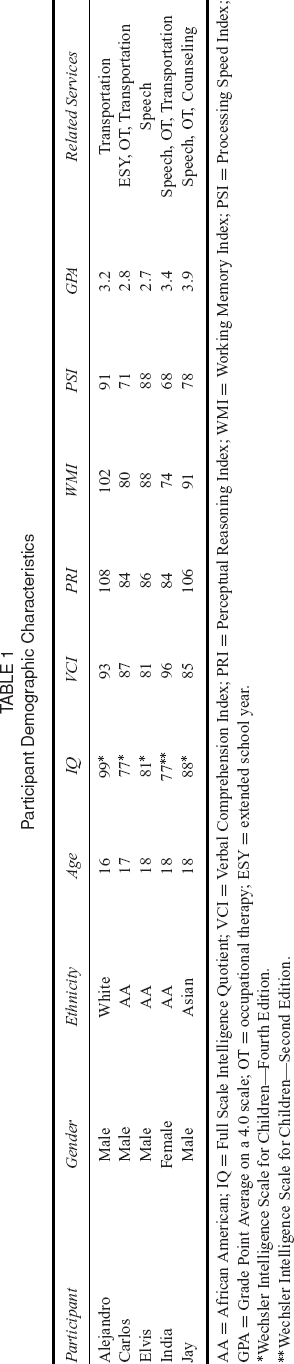
AA = African American; IQ = Full Scale Intelligence Quotient; VCI = Verbal Comprehension Index; PRI = Perceptual Reasoning Index; WMI = Working Memory Index; PSI = Processing Speed Index; GPA = Grade Point Average on a 4.0 scale; OT = occupational therapy; ESY = extended school year.
Wechsler Intelligence Scale for Children—Fourth Edition.
Wechsler Intelligence Scale for Children—Second Edition.
Carlos
Carlos was a 17–year–old African American high school senior. He was diagnosed with SLD when he was 9 years old. His IQ score, Verbal Comprehension Index (VCI), Perceptual Reasoning Index (PRI), and Working Memory Index (WMI) placed him in the low–average range compared to other adolescents his age. His Processing Speed Index (PSI) placed him in the borderline range (see Table 1). He exhibited low academic achievement in reading, mathematics, and written expression in comparison to his overall IQ. His accommodations, noted on his IEP, included extended time on tests and assignments, multiple or frequent breaks, note–taking support, access to an electronic speller or word processor, access to a human reader, and graphic organizers. Carlos seemed to be a shy and quiet young man. He reported that he has never asked teachers for accommodations. After graduating from high school, Carlos planned to major in Business Administration, and was exploring degree programs at a college and two universities in the Northeast.
Alejandro
Alejandro was a 16–year–old Caucasian high school junior. His mother reported that he was diagnosed with SLD at the age of 4. His IQ, VCI, PRI, WMI, and PSI placed him in the average range (see Table 1). He exhibited low academic achievement in reading, mathematics, and written expression in comparison to his overall IQ. His accommodations, as noted on his current IEP, included access to a human reader, note–taking support, text–to–speech software, use of a calculator, graphic organizers, extended time on tests and assignments, multiple or frequent breaks, and reduced distractions. Alejandro was a very confident and enthusiastic young man with an outgoing personality, although he self–described as shy. Alejandro acknowledged that he had never requested accommodations from his teachers, and said that he believed that he would benefit from participating in the study. After graduating from high school, he planned to attend a university in the Mid–Atlantic and major in Business, Nursing, or Computer Technology.
India
India was an 18–year–old African American high school senior. She was diagnosed with SLD when she was 8 years old. Her IQ, VCI, PRI, WMI, and PSI were in the borderline to low–average range compared to other adolescents her age. She exhibited low academic achievement in reading, mathematics, and written expression in comparison to her overall IQ. Her accommodations, as noted on her current IEP, included access to a word processor, use of a calculator, access to a human reader, text–to–speech software, graphic organizers, extended time on tests and assignments, reduced distractions, and note–taking support. India was a soft–spoken young woman with a genuinely friendly disposition. She reported having difficulty requesting accommodations. After graduating from high school, she planned on attending a college in the Mid–Atlantic, majoring in Hospitality Management with a minor in Baking and Pastry.
Jay
Jay was an 18–year–old Vietnamese high school senior. It is not clear when Jay was diagnosed, but he was re–evaluated in 2010 to determine continued eligibility for SLD support services. His IQ and VCI placed him in the low–average range, while his performance on the PRI and WMI placed him in the average range, and his PSI placed him in the borderline range. He exhibited low academic achievement in reading and written expression in comparison to his overall IQ. His accommodations, as noted on his current IEP, included extended time on tests and assignments, a reader for exams, note–taking support, multiple or frequent breaks, preferential seating, and graphic organizers. Jay was a serious young man who was eager to learn the intervention. Jay reported that his accommodations were mostly provided to him, and that he asked for help when needed. Upon graduating from high school, he anticipated taking a “gap” year off from school before pursuing postsecondary education. He planned to attend a local community college and major in Information Technology and Film Studies.
Elvis
Elvis was an 18–year–old African American high school senior. His mother reported that Elvis was diagnosed with SLD when he was 7 years old. His IQ, VCI, PRI, WMI, and PSI placed him in the low–average range compared to other adolescents his age. He exhibited low academic achievement in reading, mathematics, and written expression in comparison to his overall IQ. His accommodations, as noted on his current IEP, included use of a calculator, text–to–speech software, access to an electronic speller or word processor, graphic organizers, preferential seating, and note–taking support. He was a very enthusiastic young man. Elvis reported that he had never asked teachers for accommodations, but added that he had always been told that he had accommodations and could take his time with class assignments. After graduating from high school, he planned on attending college. At the time of this study, he had applied to two universities and two colleges in the Mid–Atlantic, where he was exploring degree programs in Communications, Psychology, and Photography.
Setting
The setting was a private special education secondary school located in a suburban community with a diverse population in the Mid–Atlantic region of the United States. This school adopted the federal guidelines of IDEIA in educating students in a way that addressed their individual learning differences. The study was conducted after school hours on weekdays and weekends. If the participants had a scheduling conflict with other extracurricular activities during the week, the intervention took place at a public library or community center during the weekend.
Independent Variable
The purpose of the self–advocacy instruction was to teach students about their accommodations and how to request them. Participants learned to (a) state their disability and explain it in functional terms, (b) reference accommodations they used in the past that aided in their success, (c) explain the benefits of those accommodations, and (d) exhibit confidence in asking for the accommodations to which they are entitled under the law. Specifically, the independent variable in this study was a modified version of the SACR (Rumrill et al.,1999). Modifications focused on operationalizing the definitions of 17 target behaviors, including examples for each target behavior, and on creating individualized role–play situations, based on participants’ needs.
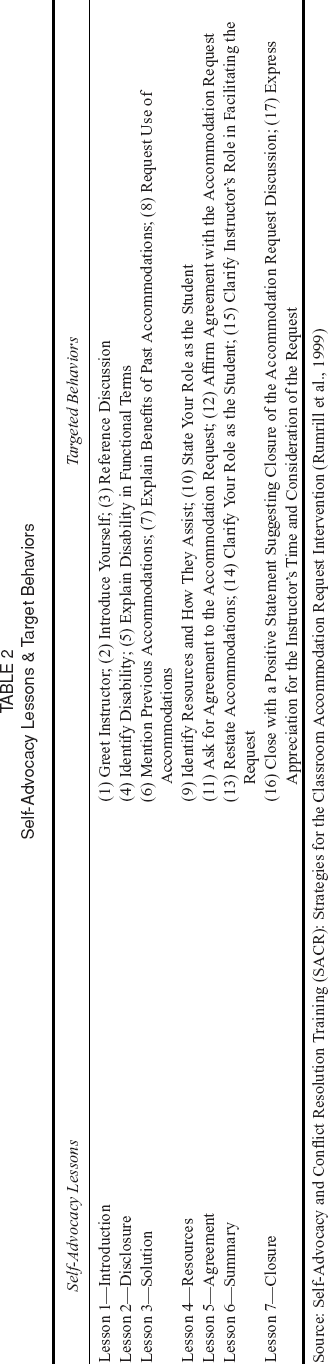
This intervention consisted of seven scripted lessons (see Table 2). Each lesson focused on subsets of the 17 targeted behaviors identified by Rumrill et al. (1999). Each scripted lesson included the following seven components: (a) advance organizer (to review previous lessons and introduce the new lesson); (b) skill description (to describe the specific skill associated with the target behavior); (c) goal of the skill, or of a target behavior; (d) skill examples; (e) modeling (to verbalize the skill/target behavior and model the appropriate matter and tone); (f) role playing (to practice the skill/target behavior); and (g) summary of the lesson (to summarize the new skill/target behavior). These components occurred in sequential order during each of the seven lessons. In treatment Subphase I, Lessons 1–3 were taught, focusing on target behaviors 1–8. In treatment Subphase II, Lessons 4–5 were taught, covering target behaviors 9–12. In treatment Subphase III, Lessons 6–7 were taught, targeting behaviors 13–17. The subphases were established based on the grouping of the skills taught and were validated during a pilot study.
Self–Advocacy Lessons & Target Behaviors
Source: Self–Advocacy and Conflict Resolution Training (SACR): Strategies for the Classroom Accommodation Request Intervention (Rumrill et al., 1999)
Materials
Scripted lesson plans, PowerPoint presentations, and participant workbooks were created. There were seven scripted lessons introducing 17 target behaviors for effectively requesting academic accommodations. They consisted of presentation of information (didactic training), modeling, and role playing. The content of the scripted lesson plans was used in PowerPoint presentations and in the participant workbook. A 13–in Dell laptop was used to display the presentations and video–record the instructional sessions. In addition, an iPad Pro was used to video–record the participants during role–plays.
Dependent Variable
The dependent variable in this study was the number of correctly demonstrated target behaviors out of a total of 17 behaviors that participants performed during a role–play situation. For example, as a part of lesson one, Introducing Yourself to Others, the student greets the instructor by saying “Good morning” or “Good afternoon.” The student then states his or her name and refers to the class that the student is taking with the instructor. The student smiles and makes eye contact and extends his or her hand for a handshake if deemed appropriate. The 17 targeted behaviors are listed in Table 2. Each targeted behavior included an operational definition and was scored as “occurrence” or “nonoccurrence.”
Research Design
A multiple–baseline across participants research design was used in this study in order to examine the functional relation between the dependent and independent variables across participants (Gast et al., 2018). In addition, due to the multistep nature of the SACR, the intervention was introduced to the participants in manageable chunks across treatment subphases. Following a changing–criterion logic, the researchers were able to evaluate a gradual change in a new academic behavior through instruction and modeling (Klein et al., 2017). When the first participant reached stable and consistent baseline demonstrated by low variability (e.g., 80% of data points falling within 20% of the trend or level line; Gast et al., 2018) for three consecutive role–play situations, he or she was introduced to the first subphase of the intervention, while the rest of the participants remained in baseline. The second participant was then introduced to the first subphase of the intervention. This process continued until all participants had been introduced to all three subphases of the intervention. The criterion for each treatment subphase was established prior to the study, using a professional estimate (Klein et al., 2017). The mastery criterion was 100% for Subphase I, 92% for Subphase II, and 88% for Subphase III, to reflect the number of essential behaviors that had to occur in order to successfully request an accommodation. Finally, generalization and maintenance phases were included. The study met the design standards (Kratochwill et al., 2010).
Data Collection Procedures
The first author provided instruction to all the participants and collected all data in this study. He is a fully certified and highly qualified special education teacher for K–12 students in multiple disability categories. He has more than 12 years of experience providing educational services to students with learning disabilities in classroom and work settings. He also has 3 years of experience as a secondary transition teacher providing transition support services to students with high– and low–incidence disabilities. He has taught students in multiple disability categories in both team–taught and self–contained special education classes. He has also taught general education courses. The data were collected before, during, and after the intervention. All sessions were completed in one–on–one settings.
Initial Interview
The participants each completed a 30– to 45–minute in–person interview with the researcher at the beginning of the study. The purpose of the interviews was to establish rapport between the researcher and the participants, to determine whether the participants met the participation criteria, and to gauge their commitment to completing the study. The participants were also invited to ask any questions about the study. All potential participants met the inclusion criteria. The researcher then obtained written consent to participate in the study from parents and participants.
Baseline
During baseline, participants were asked to role–play how they would request an academic accommodation, to the best of their ability. During each role–play situation, the researcher played the role of a teacher who was unfamiliar with the participant requesting the accommodation. No instruction or feedback was provided during baseline. Each baseline session lasted for 1.5 to 2 minutes on average per participant. The targeted behaviors that the participant demonstrated during baseline were measured under preintervention conditions, until a stable trend and level were established for each. Stability was defined by low variability (e.g., 80% of data points falling within 20% of the trend or level line; Gast et al., 2018) for three consecutive role–play situations. Once an acceptable level and trend were established with one participant, the researcher then introduced the intervention to that participant. The other participants remained in baseline under preintervention conditions.
Treatment Subphase I
The criterion for the three treatment subphases in this study was predetermined based on data collected during the pilot study. During treatment Subphase I, the researcher taught Lessons 1–3, focusing on the first eight target behaviors (see Table 2). On average, the instructional time in Subphase I was 62 minutes (range = 59–68 minutes). Immediately after the lessons, each participant was asked to complete role–play probes using behaviors 1–8 while requesting an accommodation. Treatment Subphase I lasted until 100% criterion (8 out of 8 correctly demonstrated target behaviors) was reached for three consecutive role–plays. If the participant did not reach 100% criterion for three consecutive role–plays within the five sessions in Subphase I, then the instruction was continued until the criterion was met.
Treatment Subphase II
Treatment Subphase II began with the review of the first eight target behaviors taught in the previous subphase. The researcher then taught Lessons 4–5, focusing on target behaviors 9–12 (see Table 2). On average, the instruction in Subphase II lasted for 64 minutes (range = 55–73 minutes). After the instruction, participants completed role–play probes requesting accommodations, using 12 target behaviors (eight taught in Subphase I and four taught in Subphase II). Treatment Subphase II lasted until a 92% criterion (11 of the 12 targeted behaviors; high criterion set prior to study) was reached for three consecutive role–plays. The target behaviors were rated equally. Each time a participant exhibited a targeted behavior, one point was awarded. If the participant did not reach a 92% criterion for three consecutive role–plays within five sessions in Subphase II, then the instruction was continued until the criterion was met.
Treatment Subphase III
Treatment Subphase III began with the review of the 12 targeted behaviors taught in the previous subphases. The researcher then taught Lessons 6–7, focusing on target behaviors 13–17 (see Table 2). On average, the instruction in Subphase III lasted for 52 minutes (range = 43–61 minutes). After the instruction, participants completed role–play probes requesting accommodations, using 17 target behaviors (12 taught in Subphases I and II, as well as five taught in Subphase III). Treatment Subphase III lasted until an 88% criterion (15 of the 17 correctly demonstrated target behaviors; high criterion set prior to study) was reached for three consecutive role–plays. The target behaviors were rated equally. Each time a participant exhibited a targeted behavior, one point was awarded. If the participant did not reach an 88% criterion for three consecutive role– plays, then the instruction was continued until the criterion was met.
Generalization
One week after the last participants finished treatment Subphase III, four different generalization probes were administered across two school–based personnel. For each generalization probe, each participant was given a role–play situation and was asked to role–play requesting the academic accommodation to the best of his or her ability. In the first two sessions, participants’ current teachers facilitated role–plays. A special education coordinator facilitated role–plays in the next two generalization sessions. No instruction or feedback was provided during generalization.
Maintenance
Two weeks after the intervention, two maintenance probes were given. The purpose of the maintenance probes was to determine whether the participants remembered the advocacy skills after 2 weeks. The maintenance probes followed the same procedures as the baseline probes. The researcher facilitated the role–plays in the maintenance phase.
Interobserver Agreement
Two observers scored the participants’ performance of the 17 target behaviors during role–play situations. The first author and a doctoral student scored 30% of video–recorded role–play situations for baseline, each of the three treatment subphases, generalization phase, and maintenance phase across five participants. The training involved the first author discussing each of the target behaviors, providing operational definitions for each target behavior, and providing examples and nonexamples of the skills associated with each of the target behaviors. The independent observer was trained to a criterion of 100% using a sample video–recorded role–play situation made during the researcher's pilot study. Interobserver agreement (IOA) was calculated by dividing the number of agreements by the total number of agreements and disagreements. IOA was calculated at 99.82% agreement across all phases and all participants.
Fidelity of Treatment
The extent to which the intervention was implemented as intended, and how closely the researcher followed the self–advocacy scripted lesson plans, was measured. An independent observer was trained on the seven instructional components of each lesson. They used the Fidelity of Treatment Checklist to observe 30% of all lessons with each participant. The checklist listed the instructional components: (a) advance organizer (the researcher activated prior knowledge by stating the objective of the lesson), (b) a detailed description of the skill to be taught (the researcher verbally described the skill), (c) the goal of the skill (the researcher verbally stated the goal of the skill), (d) skill examples (the researcher verbally provided examples of the skill), (e) modeling (the researcher verbally modeled the skill), (f) role playing (the researcher verbally requested that the participant practice the skill with the researcher), and (g) the researcher made a brief statement summarizing the skill that was taught. Fidelity was calculated by dividing the number of steps completed by the seven steps planned, resulting in 100% fidelity of treatment across all treatment subphases and across all participants.
Social Validity
The social validity of the intervention was assessed by using a two–part feedback form to elicit the participants’ perception of the intervention. In Part I of the social validity survey, 1
The social validity survey document can be requested from the first author.
Data Analysis
Visual analysis was used to examine the functional relation between self–advocacy intervention and participants’ performance in requesting accommodations in role–plays. The following six components of visual analysis were analyzed (Kratochwill et al., 2010): (a) level (the mean of the last three data points within each phase; Gast & Ledford, 2014), (b) trend (the best–fitting line for data within each phase), (c) variability (the range of data along the best–fitting line), (d) immediacy of the effect (magnitude of change between the last data point in one phase and the first data point in the next phase), (e) overlap (percentage of data from each phase that enters the range of data from the previous phase), and (f) consistency of data (extent to which data patterns are similar in each phase). In addition, the percentage of nonoverlapping data (PND) was calculated and reported for each participant's data to support visual analysis. PND scores are represented by the proportion of nonoverlapping data between adjacent phases (Scruggs et al., 1987). Despite its limitations, it has been the most frequently used and validated overlap metric in the field of special education. Since the data in the current study were not characterized by the problematic trends associated with PND (the orthogonal slope changes, inappropriate baseline trends, or “floor”/“ceiling” effects), a decision was made to use this metric (Scruggs & Mastropieri, 2013). PND scores were calculated by dividing the number of data points in each treatment subphase that did not overlap with the highest baseline data point, or with the highest data point in the previous subphase, by the total number of data points in each treatment subphase. PND higher than 90% indicates high effectiveness, PND of 70–90% represents fair effectiveness, PND of 50–70% indicates questionable effectiveness, and a PND of less than 50% suggests that the intervention was ineffective.
Results
The results of a multiple baseline across participants single–subject study are presented by research question.
Students with SLD Requesting Accommodations
Table 3 presents the means, standard deviations, and PND scores for each participant. During the initial baseline phase, all participants demonstrated low levels of performance—mostly flat trends and low variability. Data points ranged from 0 to 2. All participants demonstrated an immediate change in level upon introduction of each treatment subphase. There was no overlap of data points between adjacent phases across all the participants. PND was 100% across all participants, indicating high effectiveness for the intervention. As seen in Figure 1, there was strong evidence of a functional relation between the self–advocacy intervention and the increase in participants’ performance requesting academic accommodations in role–play situations.
Levels and PND of Individual Participant Performance Requesting Academic Accommodations

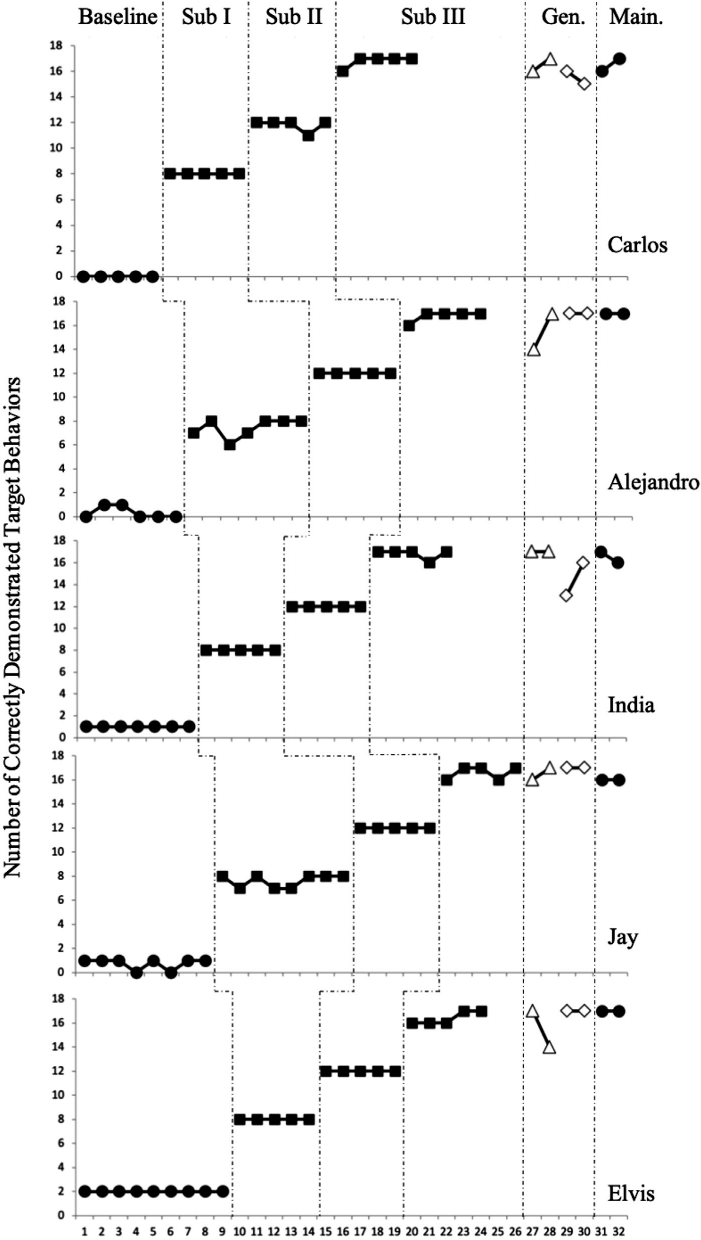
Multiple baseline across participants and changing criterion single–subject design to examine the number of correctly demonstrated target behaviors for requesting academic accommodation for five high school students across baseline (closed circles), three treatment subphases (closed squares), generalization with the teacher (open triangles), generalization with the special education coordinator (open diamonds), and maintenance (closed circles) phases.
Carlos
Carlos demonstrated consistently low performance across five baseline sessions (M = 0.00, SD = 0.00), with a flat trend and no variability. Upon introduction of treatment Subphase I, Carlos demonstrated an immediate change in level (M = 8.00, SD = 0.00), with flat trend and no variability. PND was 100% from baseline to Subphase I. Within five sessions in Subphase I, Carlos reached the 100% criterion and moved to treatment Subphase II. He demonstrated an immediate change in level (M = 11.80, SD = 0.44) with flat trend and low variability. PND was 100% from Subphase I to Subphase II. Within five sessions in Subphase II, Carlos reached the 92% criterion (11 out of 12 correctly demonstrated targeted behaviors), and moved to Subphase III. He demonstrated an immediate change in level (M = 16.80, SD = 0.44), with upward trend and low variability. PND was calculated to be 100% from Subphase II to Subphase III. Within five sessions in Subphase III, Carlos surpassed the 88% criterion (15 out of 17 correct targeted behaviors). Across all treatment subphases, Carlos consistently performed above the criteria.
Alejandro
Alejandro demonstrated low performance across six baseline sessions (M = 0.33, SD = 0.51), with a downward trend and low variability. Upon introduction of treatment Subphase I, Alejandro demonstrated an immediate change in level (M = 7.43, SD = 0.78), with an upward trend and low variability. PND was 100% from baseline to Subphase I. After seven sessions in Subphase I, Alejandro reached the 100% criterion for three consecutive sessions and moved to treatment Subphase II. He demonstrated an immediate change in level (M = 12.00, SD = 0.00), with flat trend and no variability. PND was 100% from Subphase I to Subphase II. Within five sessions in Subphase II, Alejandro surpassed the 92% criterion (11 out of 12 correctly demonstrated targeted behaviors), and moved to treatment Subphase III. He demonstrated an immediate change in level (M = 16.80, SD = 0.44), with upward trend and low variability. PND was calculated to be 100% from Subphase II to Subphase III. Within five sessions in Subphase III, Alejandro surpassed the 88% criterion (15 out of 17 correctly demonstrated targeted behaviors). Across all treatment subphases, Alejandro consistently performed above the criteria.
India
India demonstrated low performance across seven baseline sessions (M = 1.00, SD = 0.00), with flat trend and no variability. Upon introduction of treatment Subphase I, India demonstrated an immediate change in level (M = 8.00, SD = 0.00), with flat trend and no variability. PND was 100% from baseline to Subphase I. Within five sessions in Subphase I, India reached the 100% criterion and moved to treatment Subphase II. She demonstrated an immediate change in level (M = 12.00, SD = 0.00), with flat trend and no variability. PND was calculated to be 100% from Subphase I to Subphase II. Within five sessions in Subphase II, India surpassed the 92% criterion (11 out of 12 correctly demonstrated targeted behaviors), and moved to treatment Subphase III. She demonstrated an immediate change in level (M = 16.80, SD = 0.44), with flat trend and low variability of data. PND was 100% from Subphase II to Subphase III. Within five sessions in Subphase III, India surpassed the 88% criterion III (15 out 17 correct targeted behaviors). Across all treatment subphases, India consistently performed above the criteria.
Jay
Jay demonstrated low performance across eight baseline sessions (M = 0.75, SD = 0.46), with flat trend and low variability. Upon introduction of treatment Subphase I, Jay demonstrated an immediate change in level (M = 7.63, SD = 0.51), with flat trend and low variability. PND was calculated to be 100% from baseline to Subphase I. After eight sessions in Subphase I, Jay reached the 100% criterion for three consecutive sessions and moved to treatment Subphase II. He demonstrated an immediate change in level (M = 12.00, SD = 0.00), with flat trend and no variability. PND was 100% from Subphase I to Subphase II. Within five sessions in Subphase II, Jay surpassed the 92% criterion (11 out of 12 correctly demonstrated targeted behaviors), and moved to treatment Subphase III. He demonstrated an immediate change in level (M = 16.60, SD = 0.54), with flat trend and low variability. PND was 100% from Subphase II to Subphase III. Within five sessions in Subphase III, Jay surpassed the 88% criterion (15 out 17 correct targeted behaviors). Across all treatment subphases, Jay consistently performed above the criteria.
Elvis
Elvis demonstrated low performance across nine baseline sessions (M = 2.00, SD = 0.00), with flat trend and no variability. Upon introduction of treatment Subphase I, Elvis demonstrated an immediate change in level (M = 8.00, SD = 0.00), with flat trend and no variability. PND was calculated as 100% from baseline to Subphase I. Within five sessions in Subphase I, Elvis reached the 100% criterion and moved to treatment Subphase II. He demonstrated an immediate change in level (M = 12.00, SD = 0.00), with flat trend and no variability. PND was calculated to be 100% from Subphase I to Subphase II. Within five sessions in Subphase II, Elvis surpassed the 92% criterion (11 out of 12 correctly demonstrated targeted behaviors), and moved to treatment Subphase III. He demonstrated an immediate change in level (M = 16.40, SD = 0.54), with upward trend and low variability. PND was 100% from Subphase II to Subphase III. Within five sessions in Subphase III, Elvis surpassed the 88% criterion (15 out of 17 correct targeted behaviors). Across all treatment subphases, Elvis consistently performed above the criteria.
Generalization
During the generalization phase, 1 week after the last participant finished treatment Subphase III, students engaged in role–play situations with their current teachers (open triangles: Figure 1). In the first role–play probe, data points for all participants ranged from 14 to 17 (M = 16.00, SD = 1.22). Two of the five participants (India and Elvis) generalized their self–advocacy skills to 100% (17 out of 17 correctly demonstrated targeted behaviors). In the second role–play with the teachers, data points for all participants again ranged from 14 to 17 (M = 16.40, SD = 1.34), but there was a slight increase in their overall performance. Four of the five participants (Carlos, Alejandro, India, and Jay) generalized their self–advocacy skills to 100% (17 out of 17 correctly demonstrated targeted behaviors) in the second role–play.
During the first generalization role–play with the special education coordinator, data points for all participants ranged from 13 to 17 (M = 16.0, SD = 1.73; open diamonds: Figure 1). Three of the five participants (Alejandro, Jay, and Elvis) generalized their self–advocacy skills to the 100% criterion (17 out of 17 targeted behaviors) in the first role–play. In the second role–play with the special education coordinator, data points for all participants ranged from 15 to 17 (M = 16.40, SD = 0.89). Three of the five participants (Alejandro, Jay, and Elvis) generalized their self–advocacy skills to 100% criterion (17 out of 17 targeted behaviors) in the second role–play.
Maintenance
Two weeks after the last participant finished treatment Subphase III, maintenance phase was conducted (see closed circles in Figure 1). Participants completed role–plays with the researcher. In the first maintenance probe, data points for all participants ranged from 16 to 17 (M = 16.6, SD = 0.54). Three of the five participants (Alejandro, India, and Elvis) generalized their self–advocacy skills to the 100% criterion (17 out of 17 targeted behaviors). In the second maintenance probe, data points for all participants again ranged from 16 to 17 (M = 16.6, SD = 0.54). Three of the five participants (Carlos, Alejandro, and Elvis) generalized their self–advocacy skills to the 100% criterion in the second maintenance probe.
Social Validity
According to social validity data, all participants agreed that they can be more effective talking with instructors about accommodations they need in their class, can explain their disability and academic needs, and can be more comfortable requesting academic accommodations. The participants rated Target Behavior 1 (greet instructor) and Target Behavior 3 (reference discussion) as the most important target behaviors. Based on the results, the effects of the self–advocacy intervention were socially important. Comments from students included “self–advocacy is an important life skill” and “self–advocacy can help students succeed in college.” In addition, all students reported being more confident advocating for their academic needs, and being more comfortable requesting academic accommodations, than they were before learning the self–advocacy intervention. They acknowledged that the self–advocacy intervention increased their confidence and helped them understand what is meant by accommodations on their IEP, and that they now have a clearer understanding as to why they have accommodations.
Discussion
The purpose of this study was to examine the effects of the SACR self–advocacy intervention (Roessler et al., 1998) on the performance of five high school students with SLD requesting academic accommodations during role–play situations. All participants acquired, maintained, and generalized use of the self–advocacy skills. Participants’ data indicate that they maintained self–advocacy skills 2 weeks after explicit instruction ended, with data ranging from 16 to 17 out of 17 points. Moreover, participants generalized four different accommodation requests with two different school personnel. Social validity data indicate they believed self–advocacy was important and beneficial for learning an important life skill. Their confidence about understanding accommodations on their IEP increased, and students commented they acquired a clearer understanding about why they have accommodations.
The findings in this study are consistent with previous research about the SACR (Rumrill et al., 1999) with college students with SLD (Palmer & Roessler, 2000; Roessler et al., 1998; Walker & Test, 2011). The current study, however, is the first to use this self–advocacy intervention with high school students with SLD.
The importance of systematic instruction when teaching self–advocacy skills is emphasized by others (e.g., Mishna et al., 2011; Wehmeyer et al., 2013). Similarly, the self–advocacy instruction delivered in the current study was explicit, as evidenced by demonstration, modeling, and guided practice with role–playing opportunities during sessions. Immediately after each session, independent practice occurred via the sequential probes. The preestablished criterion for mastery supported participants’ sequential acquisition of self–advocacy steps, with high mastery per instructional phase (i.e., 100% for 8/8 steps; 92% for 11/12 steps; 82% for 15/17 steps). Mastery during instruction increases the probability of appropriately using self–advocacy for other circumstances in new settings. For example, college students with SLD significantly increased their knowledge and application of self–advocacy skills (White et al., 2014), although they did not master all skills. The researchers posit that the self–advocacy instruction was “necessary, but not sufficient. Future training might increase practice opportunities until a specified criterion for mastery was achieved” (p. 235).
Criterion for mastery was targeted in the current study. Additionally, the researchers mitigated cognitive load by teaching the 17 target behaviors in three subphases, and by focusing on one accommodation throughout instruction. Consistent with cognitive load theory (Park et al., 2015; Plass et al., 2010; Sweller et al., 2011), cognitive capacity is limited, and intrinsic cognitive load depends on the quantity of elements. When working memory is taxed with combining larger numbers of elements that have increasingly complex relationships to each other, the intrinsic load is higher. For students with SLD whose characteristics frequently include deficits in working memory, accommodating their cognitive load by chunking the 17 sequential steps into subphases proved effective. Even so, participants’ progress from acquisition to fluency was arduous at times, as evidenced by the range of time performing steps (i.e., 45 seconds to 3 minutes). Possibly, participants with lengthier performances were processing the content, thus requiring the accommodation of more time. This finding is consistent with use of extended time, an accommodation that some students with SLD need more frequently than provided (Witmer et al., 2018).
The participants’ report of increased confidence after the self–advocacy intervention is corroborated by previous research (Lee et al., 2008; Wood et al., 2010). Interestingly, the participants reported that prior to this study, they were not asking their instructors for, nor were they using, their accommodations. This finding is of particular concern because the participants identified attending college as a future goal; there, they will need to request and then subsequently use accommodations. Roberts et al. (2016) maintain the most efficient and effective way to ensure students receive accommodations is to teach students how to ask for them. Future research should also focus on teaching self–advocacy skills to younger students who would benefit from knowing this technique.
Implications for Practice
This study's findings revealed several implications for teachers who desire to teach students self–advocacy skills. One implication is that the SACR intervention (Rumrill et al., 1999) could be a blueprint for teachers to use with students at different levels of their academic careers. Using the self–advocacy intervention with elementary and middle school students gives them an opportunity to learn about their SLD, and to begin to ask for and use the accommodations noted on their IEP at a level earlier than high school. Further use of the self–advocacy intervention with high school students can support their becoming self–reliant, preparing them well for self–advocacy in postsecondary education, leisure, and employment. The individualized nature of ensuring a match of accommodation to student is also noteworthy as occurred in the current study, inasmuch as students should be advocating for accommodations that differentially empower them toward meeting targeted goals. For example, although college students with SLD who received extended time as a writing accommodation wrote more, their organization and content coherence did not improve (Goegan & Harrison, 2017). Therefore, students with SLD should be aware of how accommodations benefit them, and of when other strategies are necessary. Teachers and students should be mindful about which accommodations impact students’ desired performance so that self–advocacy content is well–matched, and yields intended benefits.
Limitations and Recommendations for Future Research
Several limitations are noted. First, the effects of the intervention were only investigated during role–play scenarios. It is difficult to determine the generalization of the effects of the intervention to actual situations in which students would need to self–advocate for accommodations. Future research should include opportunities for students to generalize their self–advocacy skills in real–life situations. Second, the multistep nature of the SACR intervention was introduced to the participants in manageable chunks across treatment subphases. Future research could investigate the effects of the SACR intervention on behavior if the intervention is presented as a whole lesson. Lastly, the participants in this study were high school students, ranging in age from 16 to 18. Future research should include elementary and middle school students. Using the self–advocacy intervention with students early in their academic careers gives them an opportunity to learn about their SLD, and to begin to ask for and use accommodations noted on their IEP at a level earlier than high school. Moreover, students are learning critical self–advocacy skills for current and future use. Future research could investigate the students’ self–determination skills by allowing them to figure out how to access their own accommodations.