






Abstract
We study buyer‐determined procurement auctions where both price and non‐price characteristics of bidders matter for being awarded a contract. Although, in scoring auctions bidders perfectly know how price and non‐price attributes determine the awarding of the contract, this remains uncertain in buyer‐determined auctions where the buyer is free to choose once all bids have been submitted. We analyze the impact of information bidders have with respect to the buyer's awarding decision. As we show theoretically whether it is in the buyer's interest to conceal the impact of non‐price characteristics depends on how important the quality aspects of the procured good are to the buyer: The more important quality aspects are, the more interesting concealment becomes. In a counterfactual analysis using data from a large European procurement platform, we analyze the reduction of non‐price information available to the bidders. Confirming our hypothesis, for auction categories where bidders’ non‐price characteristics strongly influence buyers’ decisions concealment of non‐price information leads to an increase in buyers’ surplus of up to 15% due to higher competitive pressure and lower bids. Conversely, for categories where bidders’ non‐price characteristics are of little importance concealment of non‐price information leads to a decrease in buyers’ surplus of up to 6%.
Introduction
When procuring a contract, often the buyer is not only interested in the price of an offer but also in other non‐price dimensions, such as technical characteristics of the good or time of delivery. A by now quite well‐studied multidimensional auction format is given by scoring auctions where prior to the bidding process buyers establish a binding scoring rule. Besides such highly structured auctions, recently “buyer‐determined” or “non‐binding” auctions became increasingly important. In these auctions, buyers can freely assign the contract after bidding has taken place. Currently, this auction format seems to establish as the most prominent one on online marketplaces both for private and commercial contractors. 1
When designing buyer‐determined procurement auctions, typically no structure is imposed on the buyer's decision process ‐ he is entirely free to choose any of the submitted bids. Important design questions arise, however, with respect to the optimal information structure for the bidding process. That is, bidders can be provided with different levels of information regarding prices and non‐price characteristics of rival offers. This question is of particular importance given that the buyer‐determined auction format plays an increasingly important role for online auction platforms. The anonymized interaction on online platforms allows, furthermore, for an effective control of the information disseminated among bidders.
In the present article, we shed light on the optimal design of the information structure with respect to non‐price information of open buyer‐determined reverse auctions. That is, we analyze under which conditions it is beneficial for the buyer or the auction platform to conceal non‐price information such that bidders have a less precise idea of the impact of their own non‐price characteristics on indeed winning the auction.
Our analysis proceeds as follows: First, we establish a theoretical framework for the description of open buyer‐determined auctions. For this framework, we show that there exists an equilibrium in bidders’ price quotes which, albeit resulting from a dynamic bidding game, lends itself to a convenient characterization by a system of static first‐order conditions. In order to analyze how transparency of the auction design with respect to bidders’ non‐price characteristics affects auction outcomes, we then compare two limiting cases of information structures. In the first case, bidders are fully informed about all available non‐price characteristics of their rivals and the buyer's respective preferences. In the second case, bidders do not have any non‐price information at all. We show that whether it is beneficial for the buyer to reveal non‐price information depends on how strong the influence of bidders’ non‐price characteristics on the buyer's decision is relative to the influence of bidders’ price quotes. When there is variation in bidders’ non‐price characteristics, and when the influence of bidders’ non‐price characteristics on the buyer's decision is strong relative to that of bidders’ price quotes, then concealment of non‐price information is beneficial for the buyer. The main intuition here is that concealment of non‐price information makes bidders appear more similar than they actually are, which toughens competition among bidders, leads to lower prices, and, in turn, increases the buyer's surplus.
To assess the relevance of our insights into applications in the field, we perform a counterfactual analysis based on a detailed dataset of a large European online procurement platform. 2 On this platform subscribed buyers post tenders in which they describe a job contract they offer. The contracts offered vary in the skill‐sets required (ranging from moving furniture between apartments to repairing a car engine), and are grouped into different categories ‐ the largest ones being “moving”, “painting” and “car”. We focus our analysis on the nearly 17,000 auctions which were conducted in these three categories in 2008. In each auction, during a predefined time period contractors can put forward price quotes. Prices and non‐price characteristics are observed by the buyer and all bidders. At the end of an auction, the buyer can choose whether to assign the contract to one of the posted bids.
As a first step of our empirical analysis, for different auction categories we analyze how buyers value bidders’ non‐price characteristics relative to bidders’ price quotes. In line with expectations, we find that for auction categories where jobs with low skill requirements are auctioned off (categories “moving” and “painting”), buyers’ decisions are mainly influenced by bidders’ prices. In contrast, for auction categories where jobs with higher skill requirements are auctioned off (category “car”), the influence of bidders’ non‐price characteristics on buyers’ decisions is relatively strong. Clearly, those characteristics do not allow to perfectly predict the buyer's awarding decision. From the perspective of the bidders, even under full information with respect to all available non‐price characteristics and their impact on the buyer's awarding decision, there remains uncertainty with respect to the final choice of the buyers. Our framework takes this uncertainty into account for all information regimes considered.
After analyzing the buyers’ decisions in our data, we perform a counterfactual analysis to assess whether concealment of quality information has an economically significant effect for applications in the field. Based on our framework, we first derive estimates of bidders’ cost for the observed dataset. We find that bidders’ markups which we compute using our cost estimates are of expected size and in line with economic intuition. We then use these cost estimates together with our model for the case of concealed non‐price information to compute bidders’ counterfactual prices. With these, we finally calculate the change in buyers’ surplus in case non‐price information gets concealed from the bidders. We do this for several job‐categories which differ with respect to the relevance of non‐price characteristics for buyers’ awarding decisions. We find that our theoretical predictions are of direct practical relevance for the dataset considered: For job‐categories where non‐price characteristics are of rather low importance for buyers’ awarding decisions (“moving” and “painting”), our counterfactual results show that in case non‐price information were concealed, bidders’ prices would increase and the number of closed deals would decrease. With respect to buyers’ surplus, these changes translate into a decrease in surplus of up to 6%. With respect to turnover created in all auctions, the decrease in the number of closed deals outweighs the increase in bidders’ prices, resulting in a decrease in turnover of up to 2%. For job‐categories where non‐price characteristics are highly relevant (“car”), our counterfactual analysis predicts that in case non‐price information were concealed prices would not significantly change but the number of closed deals would increase. In result, buyers’ surplus would increase by up to 15%, and turnover would increase by up to 13%.
Our work adds to a relatively new strand of literature which analyzes buyer‐determined auctions. From a more general perspective, this clearly contributes to the literature which analyzes efficient ways to procure contracts when the buyer's valuation of an offer depends on additional dimensions besides price. In this context, scoring auctions have already received significant attention in the literature. In this format, deterministic and binding scoring rules are announced which bidders take into account when placing their bids. Seminal work showing the advantages of scoring auctions dates back to Che (1993) and Branco (1997). Chen‐Ritzo et al. (2005) conduct laboratory experiments to analyze the performance of a price‐only auction as compared to a scoring auction. As they find, the latter is effective in increasing buyer utility and bidder profits. Asker and Cantillon (2008, 2010) show that for the case when suppliers have multi‐dimensional private information, this procurement mechanism dominates others like sequential bargaining and price‐only auctions. Empirical analyses of scoring auctions can be found in Athey and Levin (2001) and Lewis and Bajari (2011), the first using data from US timber auctions, the latter using data from US highway procurement auctions. Practical implementability of scoring auctions through iterative process is analyzed, for example, in Bichler and Kalagnanam (2005) or Parkes and Kalagnanam (2005).
Note that our work is only indirectly linked to the contributions on scoring auctions, where deterministic and binding scoring rules are announced by the buyer prior to the beginning of an auction. In a non‐binding auction the buyer selects the winner after bidding has taken place. Typically, bids and available non‐price information do not allow to fully predict the buyer's awarding decision. From the perspective of the bidder, the precise value each buyer associates with each of the bids thus always remains uncertain. This precisely conforms to our data and is explicitly considered in our framework. In our work, the amount of information bidders hold with respect to non‐price characteristics changes. This induces varying but never vanishing uncertainty with respect to the buyer's awarding decision. As compared to an auction with deterministic scoring rule, this uncertainty induces bidders in equilibrium to charge larger markups on cost. None of the cases analyzed in our work thus directly corresponds to a scoring auction.
Several articles compare non‐binding auctions where buyers can freely choose among all bids submitted according to their preferences with binding auctions where buyers ex ante commit to an awarding rule that only partially reflects their preferences. Engelbrecht‐Wiggans et al. (2007) analyze both analytically and experimentally under which conditions the buyer would want to commit to a price‐only mechanism which intentionally ignores all bidders’ non‐price characteristics. As the authors establish, such commitment is only desirable when competitive pressure is important (few bidders) and expected quality of the low‐cost bidders is not too low (limited negative correlation between cost and quality). In all other cases, the negative impact of potentially forgone quality due to an ex post incomplete scoring rule outweighs the positive impact of enhanced competition. Rezende (2009) analyzes a closely related problem, he compares the case where the buyer commits to a specific scoring rule with the case where such commitment does not take place but the buyer engages in a bargaining process. In a recent experimental study, Brosig‐Koch and Heinrich (2014) show that buyers prefer buyer‐determined auctions over price‐only auctions. Fugger et al. (2016) also compare an open price‐only auction with an open non‐binding auction both theoretically and based on laboratory experiments. However,the price‐only auction can be shown to have a unique equilibrium in their setting, the open non‐binding auction exhibits multiple equilibria. As they show for the latter case, there always exists a collusive equilibrium, which can induce lower expected benefits for the buyer. In line with those theoretical findings their laboratory experiments show that the non‐binding auction format indeed always leads to higher expected procurement cost. In all those studies, buyers face the trade‐off between the potentially competition enhancing impact of clear awarding rules on the one hand and the obligation to choose an ex post possibly less desirable offer. 3 Note that our approach is fundamentally different. In our setting, the buyer always does choose the ex post optimal offer. For our analysis, we vary the degree of uncertainty bidders associate with the buyer's awarding decision which has an impact on bidders’ bidding behavior.
Besides our work, few recent articles explicitly analyze the impact of changing non‐price information in non‐binding auctions. Haruvy and Katok (2013) analyze both open‐bid and sealed‐bid buyer‐determined auctions and also assess the impact of non‐price information revelation on bids submitted. For the parameter environments chosen in their laboratory experiments, they find that in their open auction design, due to more aggressive bidding, buyers are better off if they keep information about bidders’ qualities concealed. This is in line with our results obtained for the case of car repairs in category “car”. As their analysis reveals, furthermore, the sealed bid format generates much higher buyer surplus than the open bid format, independently of the information structure chosen. Also Hong et al. (2016) empirically compares the sealed bid and the open bid format for buyer–determined auctions in online labor markets. Their empirical results reveal that open bid buyer–determined auctions yield higher buyer surplus. Note that our analysis only considers the open format where prices are posted publicly and only the availability of non‐price information varies.
Santamaria (2015) compares open scoring auctions with open non‐binding auctions in a theoretical contribution based on numerical simulations. In the binding scoring auction, the buyer is able to fully announce his preferences in form of a deterministic scoring rule. In the case of the non‐binding auction non‐price information is not available to the bidders. As the results of the numerical simulations reveal, in case non‐price characteristics can be easily observed and announced, the buyer prefers to fully reveal his preferences and to conduct a scoring auction. 4
Our work adds to those contributions in several ways: First, we introduce field data of indeed conducted auctions to analyze the impact of information revelation in buyer‐determined auctions. Second, we offer a theoretical framework compatible with our data which allows us to identify under which conditions information revelation indeed is desirable in open buyer‐determined auctions. And finally, by applying our framework to the analysis of the field data, we have available, we demonstrate that the effect of information revelation depends on what kind of service is procured: For the categories “moving” and “painting” our results are in line with those obtained by Santamaria (2015), where provision of information has been found to be beneficial for the buyer. We obtain opposite results for the category “car”, however, which in turn is directly in line with the results obtained by Haruvy and Katok (2013). According to our analysis, these differing findings intuitively originate in the differing importance buyers associate with non‐price characteristics. That is, if bidders’ non‐price characteristics are more important for the buyer (i.e., “car”), then concealment of non‐price information tends to increase competition among bidders. This in turn decreases prices and thus benefits the buyer. This channel apparently is of less importance if non‐price characteristics are less important for the buyer (i.e., “moving” and “painting”).
General Framework and Equilibrium
General Framework
We consider a buyer‐determined and open procurement situation where a buyer wants to procure some contract among J participating bidders. We assume that each bidder has some cost c
j
for providing the service, those are private information. Price bids can be submitted and updated at any point in time t throughout a given period, t ∈ [0; T]. That is, bidders j = 1, …, J observe the current bids of all players and are free to update their bids b
j
(t) whenever they want to. We denote the vector of final bids b
j
(T) quoted by each bidder once bidding has stopped by
For the buyer's decision not only the final price p
j
quoted by bidder j matters but also its non‐price characteristics which we denote by
We assume that the buyer can choose among J bidders.
5
He receives a certain utility u
j
when he chooses bidder j. u
j
depends on the price p
j
put forward by bidder j and its exogenous non‐price characteristics
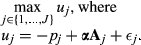
We assume that each bidder maximizes its expected profit which is given by

We assume that bidders are informed about the structure Equation 1 of the buyer's decision process. That is, most generally both the buyer and the bidders compute the probability of bidder j winning the auction as

The buyer is assumed to be fully informed about all bidders’ price quotes, all bidders’ non‐price characteristics
As we analyze bidding in an open auction, we assume that during the bidding process, bidders are always informed about all other bidders’ price quotes. However, bidders might not be fully informed about the buyer's preferences


Equilibrium
After establishing our basic framework, we now turn to the determination of the equilibrium of the dynamic bidding game. Recall that bids b
j
(t) can be submitted and updated at any point in time t throughout a given period, t ∈ [0; T], that at any point in time each bidder observes the current bids of all rivals, and that each bidder is free to update its bid b
j
(t) whenever it wants to. We will denote the vector of final bids b
j
(T) quoted by each bidder once bidding has stopped by

We now proceed and determine an equilibrium for the dynamic bidding game. Due to the dynamic nature of the bidding game and the fact that cost of rival bidders are unknown, for the case of fully rational bidders different perfect Bayesian equilibria of the above specified auction framework involving different equilibrium outcomes can be obtained. For our analysis, we focus on an intuitively appealing perfect Bayesian equilibrium which will allow for a straightforward characterization of the equilibrium outcome: We impose mild regularity conditions on the equilibrium considered which allows us to focus on the most plausible of possibly arising equilibria by identifying the rest points of the induced bidding process. Since bids can be updated at any time, thus, only those bid profiles can be stable which are a best response to each other. 6
We denote the resulting equilibrium which arises as mutually best responses as stable Nash equilibria (SNE). As it has already been shown in the literature, moreover, the vector of final price quotes
For open buyer‐determined auctions with public information about price bids and private information about cost, there exists a perfect Bayesian Nash equilibrium where a bidder's final bid is a best‐response to its rivals’ final bids. The corresponding equilibrium outcome in prices,


Notice that the outcome of the stable Nash equilibrium of the dynamic‐bidding game with incomplete information as established in proposition 1 corresponds to the prediction obtained from static Bertrand competition with differentiated products. Demand in the Bertrand context corresponds to the winning probability perceived by each bidder and specified in the choice model, formulated in expression 4. Our assumptions in some sense thus take the tatonnement process in the theory of general equilibrium (see Mas‐Colell et al. 1995, section 17.H) or the salary adjustment process in the theory of matching in the labor market (see Crawford and Knoer 1981) literally and provide a useful approximation which allows analyzing the open bidding process. Let us emphasize again that, from a purely theoretical perspective, based on the refinement concept chosen the dynamic bidding game can have many and potentially very complicated equilibria. The equilibrium outcome established above clearly arises from a subset of those.
Finally, to also empirically enhance the equilibrium proposed in proposition 1, let us briefly highlight some stylized facts of equilibrium bidding behavior identified in recent experimental work on open buyer–determined auctions by Fugger et al. (2016). Most interestingly, all empirically observed properties of equilibrium behavior which are applicable to our setup are fully matched. More specifically, bidders are observed to bid below the perfectly collusive outcome and a higher number of bidders leads to lower bids (results 1 and 4 in Fugger et al. (2016)). Furthermore, an increased variance of non‐price value leads to increased equilibrium bids (result 6 in Fugger et al. (2016)). Moreover, higher cost induce higher equilibrium bids, for higher variance of non‐price value this relationship is weaker (result 11 in Fugger et al. (2016)). All those empirical observations are also obtained in the equilibrium proposed in proposition 1, this allows to further support its empirical relevance.
Analysis of the Effect of Concealment of Non‐Price Information
In an open buyer‐determined auction, the buyer can base his decision on submitted prices and on observed non‐price characteristics of the participating bidders. We are interested in the effects availability of non‐price information has on bidders’ behavior and on auction outcomes. To approach this question, we look at two limiting cases: one in which information on bidders’ non‐price characteristics and the way they influence the buyer's decision is public, and one in which this information is private. For the sake of brevity, we will call the former “information case” and the latter “no information case”.
Characterization of Two Limiting Information Regimes
In the information case, bidders’ non‐price characteristics


In the no information case, not only the bidder specific error term but also the impact of non‐price characteristics is unknown by the bidders. We assume that in the no information case bidders form symmetric prior beliefs on


Note at this point that technically by their definition, the distribution of the error terms


From an intuitive perspective, in the NIC case bidders’ information with respect to the buyer's preferences is too diffuse as to allow for any prediction of the impact of non‐price characteristics when forming beliefs about the buyer's decision.
Note that the winning probabilities Equations 7 and 8 reflect two limiting cases with respect to the amount of non‐price information available to the bidders: the case where bidders have all available information regarding non‐price characteristics and the case where bidders do not have any non‐price information. Observe that, according to expression 6 in both cases uncertainty with respect to the buyer's decisions persists, in the no information case this uncertainty is larger, however. Bidding in equilibrium thus is not based on a wrong but on a more uncertain perception of the buyer's decision in the two cases analyzed. Since in both cases analyzed bidders do hold symmetric information at the beginning of the auction, bidders are not facing problems of signaling and learning during the auction.
Note that our analysis considers two extreme cases, both allow to obtain well‐defined equilibria of the induced market game. In the information case, bidders hold all available information regarding quality characteristics and buyer's preferences. In the no information case, bidders are assumed to be entirely unable to form any belief regarding non‐price characteristics. We are aware that especially the no information case indeed is a stylized limiting case. For example, in the case of unknown buyer's preferences, bidders are assumed to be entirely unable to assess the impact of their own quality characteristics and potentially observed rivals’ characteristics on the buyer's decision. Intuitively, from a more applied perspective, bidders should always hold at least some very coarse prior regarding the buyer's preferences, e.g., allowing to infer that better quality characteristics result in a higher awarding probability. In a robustness check of our counterfactual analysis conducted in chapter 4, we do quantitatively analyze such intermediate information cases. Our scenario


Analytical Comparison of the Two Limiting Information Regimes
In the following, we introduce stylized distributional assumptions to get insights into the mechanisms which determine whether the buyer is better off in case non‐price information is disclosed or in case it is concealed. We analyze bidding in an auction where the buyer can choose among two bidders.
9
Each bidder has non‐price characteristics


When we assume that an auction with concealed non‐price information was repeated by bidders with identical cost and qualities but disclosed non‐price information, the relationship between the expected utility of the buyer in the information case, U
IC
, and that in the no information case, U
NIC
, turns out to be
11
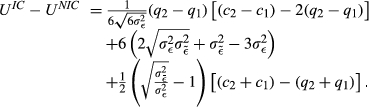
Equation 9 describes the change in the buyer's expected utility for the hypothetical case that an auction with concealed non‐price information was repeated by bidders with identical cost and qualities but disclosed non‐price information. When instead we adopt a perspective where the actual realizations of bidders’ cost and qualities are unknown ex ante, we can state that in expectation the buyer is better off in the information case if the following condition holds:
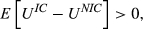

From the buyer's perspective, in open buyer‐determined auctions there is no dominant information structure with respect to the availability of non‐price information. For the case that ε
j
and

The central intuition here is that the informational arrangement which creates the highest competitive pressure among bidders is best for the buyer. And which information regime creates more competitive pressure as perceived by the bidders depends on the specific situation considered: First, consider a situation where bidders have similar production cost but are quite heterogenous with respect to how the buyer values their non‐price characteristics. In short, using the definition of a bidder's quality as the buyer's valuation of its non‐price characteristics, that means a situation where bidders have similar production cost but very different qualities. A regime which conceals non‐price information suggests tough competition and induces more aggressive bidding. Second, consider a situation where bidders have quite different production cost, but quality differences are such as to compensate for those differences (that is, the more expensive producer also has higher quality). In this case, full revelation of non‐price information induces more aggressive bidding. 12
Counterfactual Analysis
In this section, we perform a counterfactual analysis to verify the generality of the results derived in section 2 and to assess the (expected) economic impact of concealment of non‐price information. For our counterfactual analysis we have available data from a large European online procurement platform, which we present in the next subsection (see section 4.1). Our counterfactual analysis then proceeds in three steps: First, we analyze how buyers make their decisions at the end of the auctions after bidding has stopped (see section 4.2). Second, we use our framework for the case that non‐price information is fully disclosed which allows us to determine bidders’ cost (see section 4.3). Third, we use these cost estimates and our framework for the case that non‐price information is concealed to determine counterfactual final price quotes. We then compare bid amounts, buyers’ expected surplus and platform turnover in the case of disclosed non‐price information to that in the case of concealed non‐price information (see section 4.4).
Data Description
We have available an extensive dataset from a popular European online procurement platform. On this platform, private customers tender jobs ranging from construction over general repair and renovation to teaching. Jobs are awarded through an open buyer‐determined auction. In detail, the procedure is as follows: A private customer (the buyer) posts a description of the job he wants to procure. This description is entered into a free‐text field and usually contains job details (e.g., the area to be painted, whether or not cleaning is required, and so on), the job site, a price expectation (termed “startprice” in the following), and an announcement of the time span during which tradesmen (the bidders) can put forward quotes. All this information is available to all tradesmen registered at the platform. During the defined time span all interested tradesmen can publicly announce prices for which they are willing to do the offered job. Announced prices can be changed at any point during the auction. The current price quote of each bidder and all his non‐price characteristics are publicly observable on the web page. The non‐price characteristics of a bidder include the number of positive and negative ratings the bidder received so far, his home location, qualifications like the possession of certain degrees, his area of expertise, and so on. At the end of the auction, the buyer is free to award the job to one of the bidders or to withdraw his offer. In case of an award the platform obtains a certain percentage of the successful bid as commission.
We have available data on auctions which were conducted during the years 2007 and 2008. In this time span, the auction platform experimented with some rule changes. In order to exclude the possibility that our results are influenced by these rule changes, we focus our analysis on auctions that took place during the second half of the year 2008. In this period, there were only minor rule changes, like for example a slight reduction of the time span after which the buyer has to decide whether to withdraw his offer or award the job to one of the participating bidders. Minor changes like this should have no effect on our results.
The auctions we observe in the second half of 2008 are grouped into 32 job‐categories. The three most frequent job‐categories are “moving” (14.1% of all auctions), “painting” (8.4% of all auctions) and “car” (7.0% of all auctions). We concentrate our analysis on these three job‐categories, we furthermore consider clusters for the value of the jobs offered. We use the price expectation the buyers state at the beginning of the auctions (the startprice) as a proxy for the value of the jobs offered. 13 We cluster the auctions into different startprice‐categories: Category 1 ranges from €1–100, category 2 from €101–200, and so on. 38% of all auctions have startprices between €1–100, and of these auctions again 60% have a startprice of €50 or less. We expect bidding behavior in these very low valued auctions to be fundamentally different from bidding behavior in auctions with higher stakes and thus drop all auctions with startprices less or equal to €100 from our analysis. According to the auction rules, bidding takes place in an open format. The average number of bids posted in an auction ranges from 4 to 9, implying that the average number of bids submitted as a reaction to previously submitted bids ranges from 3 to 8. In approximately half of the auctions, we observe direct updating of bids originally submitted by bidders.
For every auction in each job‐startprice‐category we have available information about the number and the identities of the participating bidders, the prices put forward, the bidders’ non‐price characteristics (like the number of positive and negative ratings, the possession of certain degrees and qualifications, and so on) and the final awarding decision of the buyer (including whether he chose to withdraw his job offer). We use only auctions in which at least two bidders participate. Descriptive statistics for each auction‐category are given in Table 1.
Descriptive Statistics for Auctions from Job Categories “Moving”, “Painting”, and “Car”
Notes. The table displays descriptive statistics for auctions from the three most popular job categories (“moving”, “painting”, and “car”). Considered are all auctions with startprices ranging from €1–2000 and with at least two participating bidders (outliers with bid amounts larger than € 4000 were removed).
We think it is reasonable to expect buyers’ preferences
Analysis of the Buyers’ Awarding Decision
Econometric Model
We estimate buyers’ preferences along the lines of the model, we developed in section 2: In a given auction n, a buyer's utility from choosing bidder j is assumed to be linearly dependent on the bidder's price p
nj
, how he values the bidder's non‐price characteristics, and an error term ε
nj
. We assume that the buyers’ valuation of bidders’ non‐price characteristics is a linear function of bidders’ non‐price characteristics and the buyers’ preferences (

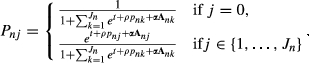

Identification in our discrete choice setting hinges on the assumption that the error terms ε
nj
in Equation 11 are neither correlated with bidders’ prices p
nj
nor with bidders’ non‐price attributes
In contrast to the settings in Berry et al. (1995) and others, however, in our application there is no link through brands (or other identifiers) between alternatives among the different choice occasions ‐ as Table 1 shows, typically buyers take part in only few auctions. Thus, the existence of unobservables which are “specific to alternatives” and which influence the buyers’ decisions throughout all auctions in a certain and systematic way should be unlikely. Also, as we analyze auctions conducted on an online marketplace, and as we were provided with very detailed recordings of these auctions, we are able to control for all factors which have a systematic influence on the buyers’ utilities: Our data contains exactly the amount of information about bidders the buyers have available when making their decisions. Thus, we argue that for our application the assumption that the error terms are uncorrelated with the observables holds and that our discrete choice model is identified.
Estimation Results
We estimate our model for each combination of the job categories “moving”, “painting”, “car” and the startprice‐categories 2, 3, 5 (€101–200, €201–300 and €401–500). Table 2 displays the results for startprice category 2 and all job categories. Table 3 displays the results for job category “moving” and all startprice‐categories. The results for all other job‐startprice‐categories considered are similar and due to reasons of brevity not displayed here. In our estimations, we included the same amount of information on bidders’ non‐price characteristics which is provided to the buyers by the auction platform. Bidders’ non‐price characteristics comprise binary characteristics indicating, for example, the possession of certain degrees, discrete characteristics, like the number of positive and negative ratings, and a continuous measure for the distance between a bidder's home location and the job site. 17
Preference Estimates for Startprice‐Category 2 and all Job‐Categories
***:1%, **: 5%, *: 10%.
Preference Estimates for Job‐Category “Moving” and all Startprice‐Categories
***:1%, **: 5%, *: 10%.
The estimates for all job‐startprice‐categories exhibit the same general pattern: The coefficients on the price coefficient, the ratings coefficients and the constant are highly significant, while the coefficients on the other covariates are mostly insignificant. That does not come as a surprise, as the information about bidders most prominently displayed in the auction overview screen are bidders’ prices and the number of their positive and negative ratings. The constant is highly significant, because in about half of all auctions buyers choose to withdraw their job offers. It holds that the higher the value of the constant (which appears in the utility a buyer derives from a certain bidder), the lower is the value of the outside option.
The numbers given in Tables 2 and 3 are coefficient estimates and as such have no direct interpretation. In order to get an impression of the effect of a decrease of a bidder's price by €10 or an increase in his positive or negative ratings, we computed average marginal effects. For startprice‐category 2 (Table 2), we find that a decrease of a bidder's price by €10 increases his winning probability by around 2%. This holds for all job‐categories. Over all job‐categories, one additional positive rating increases a bidder's winning probability by around 1%, while an additional negative rating decreases a bidder's winning probability by around 2%. The influence of the number of ratings is most pronounced for category “car”, where one additional negative rating lowers a bidder's winning probability by around 4%.
For job‐category “moving” (Table 3), with respect to ratings we get the result that for all startprice‐categories an additional positive rating increases a bidder's winning probability by around 1%, whereas an additional negative rating decreases a bidder's winning probability by around 2%. As be expected, we find that the effect of a decrease in a bidder's price depends on the value of the auction (proxied by the startprice) ‐ the higher the value of the auction, the lower the effect of a certain price decrease. In particular, we find that while a price decrease of €10 increases a bidder's winning probability by 2% for startprice‐category 2, it only increases a bidder's winning probability by less than 1% for startprice category 5.
We think it is reasonable to assume that, on average, jobs from categories “moving” and “painting” require less skills than jobs from the category “car”. That is, for the latter category we expect bidders’ non‐price characteristics to be more important for the buyers’ awarding decision. This presumption is confirmed by our results ‐ a look at Table 2 shows that the influence of a bidder's ratings relative to his price (as expressed by the relationship between the coefficient on a bidder's positive respectively negative ratings and the price coefficient) is indeed significantly higher for category “car” than for categories “moving” and “painting”.
Estimation of Bidders’ Cost
We apply our model for the information case to our data to estimate each bidders’ specific cost c
nj
. More specifically, we use the observed equilibrium price bids as input for the bidders’ first‐order conditions and then solve these first‐order conditions after bidders’ cost c
nj
. Bidders’ first order conditions for the information case are given as

Bidders winning probabilities 
Technically, we assume that the discrete choice model bidders used for estimation and prediction is a logit discrete choice model with u
n0 = ε
n0 and u
nj
= t + ρp
nj
+ 


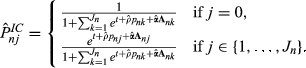

Table 4 displays summary statistics of our cost estimates for startprice‐category 2 and all three job‐categories. To account for the fact that our cost estimates are based on estimates of the buyers’ preferences, we computed bootstrapped standard errors. The standard error of the mean of our cost estimates ranges from €4–9. Thus, the estimates of bidders’ cost are quite precise. The cost estimates become more meaningful if we look at the markup bidders demand on their cost. Figure 1 displays the estimated distribution of bidders’ markups on their cost for startprice‐category 2 and all three job‐categories. 18 The median markup in the “painting” category is 46%, in the “moving” category it is 59%, and in the “car” category it is 77%.
Estimated Cost and Counterfactual Bid Amounts for Startprice‐Category 2 and All Job‐Categories
Notes. Displayed are summary statistics for actual bid amounts, estimated cost, and estimated counterfactual bid amounts for all three job categories and for startprice‐category 2 (which includes startprices from €101–200). The results are based on 2418 auctions for job category “moving”, on 1509 auctions for job category “painting”, and on 700 auctions for job category “car”. Bootstrapped 95% confidence intervalls for means are given in parentheses.
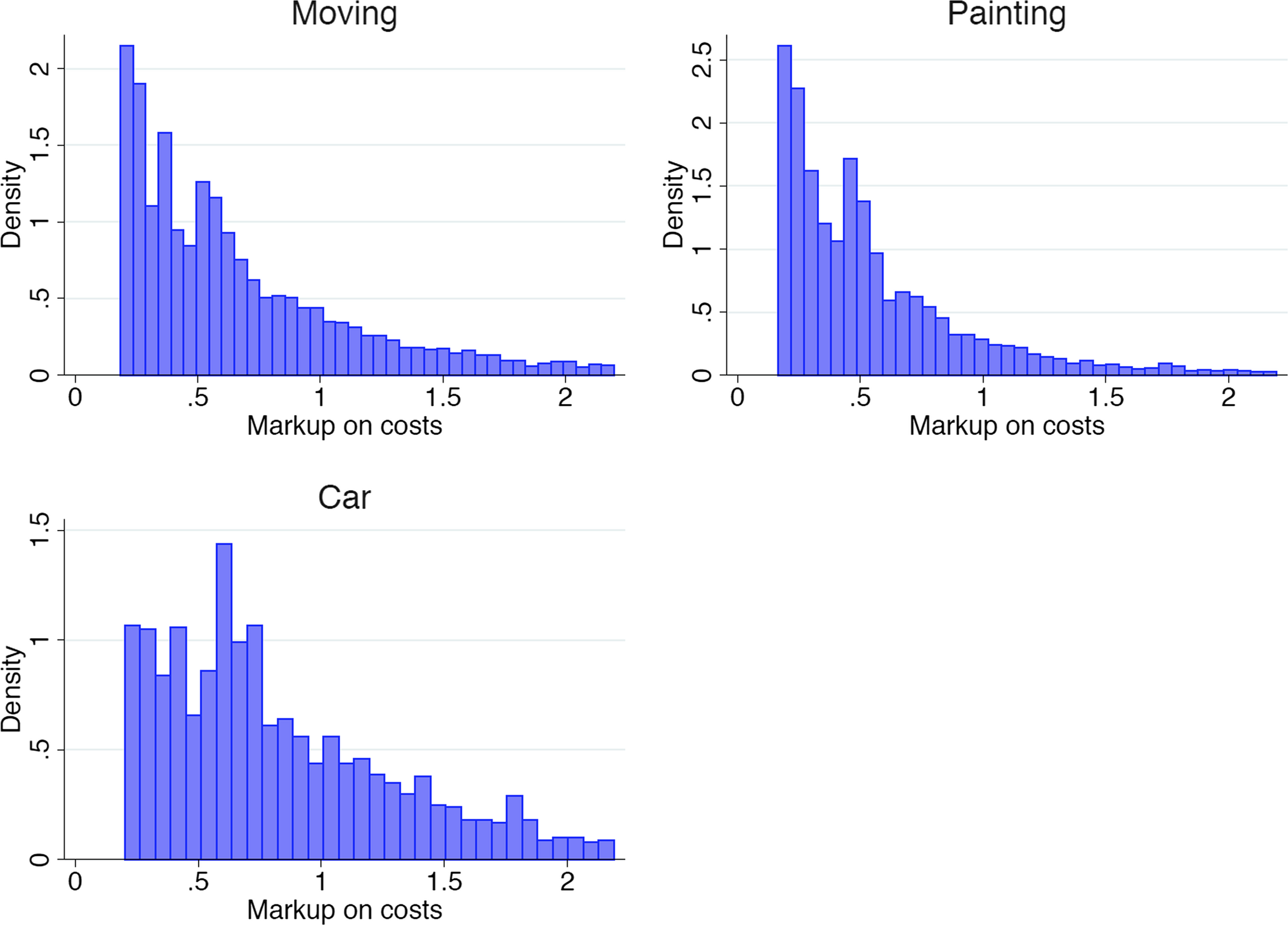
Distribution of Bidders’ Markups [Color figure can be viewed at
Now, are these markups of a sensible order of magnitude? From the cost Information, we manually collected for a part of the auctions from category “painting”, we know that for auctions from startprice‐category 2 the average area to paint equals around 80 m2. In more illustrative terms that could mean painting the walls and the ceilings of two small rooms of around 16 m2 floor space each. We assume that, depending on the level of practice, a job like this could be done by one person in around six hours. Startprice‐category 2 includes auctions with startprices ranging from €101–200, and the level of bidders’ prices is highly correlated with the level of the startprice. (Most of the auctions in this category have a startprice of €200.) Given a markup of 46%, this roughly amounts to an hourly profit of around €10, which seems to be sensible.
It is important to note that our cost estimates do not suffer from bias due to unobserved auction heterogeneity, as discussed in general by Athey and Haile (2007) and, for the case of sealed bid procurement auctions, by Krasnokutskaya (2011) and Yoganarasimhan (2015). In our setting, unobserved auction heterogeneity due to common cost components (which are observed by the bidders but unobserved by econometricians) are indeed likely to exist. However, our setting differs fundamentally from that of Krasnokutskaya (2011) and Yoganarasimhan (2015) since we analyze open‐bid auctions. In sealed‐bid auctions, bidders’ beliefs with respect to the distribution of cost and, thus, the distribution of sealed bids submitted determines the perceived winning probability of each bidder. In the equilibrium of the open‐bid auction considered in this article (compare proposition 1), the perceived winning probability of each bidder only depends on the open bids submitted by all bidders. Notice those bids are observed by all bidders and the econometrician. Bidders’ beliefs with respect to the distribution of rivals’ cost are thus irrelevant, and, in consequence, cost components which are not observed by the econometrician do not give rise to biased cost estimates. In sum, since we consider equilibrium bids of an open‐bid auction where the perceived winning probability only depends on the bids submitted but not on the cost incurred by each bidder, problems of biased cost estimates due to unobserved auction heterogeneity do not arise.
Counterfactual Analysis – The Effects of Concealment of Non‐Price Information
Procedure of the Counterfactual Analysis
In the counterfactual analysis we determine the impact of concealing all non‐price information from the bidders based on our framework established in section 2. Our analysis now proceeds based on the cost estimates 



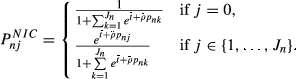
Bidders’ winning probabilities 

In analogy to the actual setting with full non‐price information, we make the technical assumption that the discrete choice model bidders use for estimation and prediction is a logit discrete choice model. As in our counterfactual scenario non‐price information shall not be available, the structure of the choice model now is 



Note that bidders in the counterfactual analysis are assumed not to hold any non‐price information. As a direct consequence, when assessing buyers’ price‐preferences based on the above choice model, by construction an omitted variable problem occurs. That is, the omitted non‐price variables not only do preclude an assessment of buyers’ non‐price preferences, but might also induce a biased assessment of buyers’ price‐preferences. Without further non‐price information available, bidders by assumption are not in a position to improve their biased assessment of buyers’ price preferences, however. 19
Given the estimates 



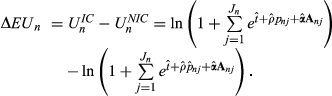
With estimates 

Results
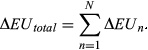
For each job‐startprice category considered, we derive counterfactual estimates of prices, probabilities of unclosed deals, 20 the buyers’ surplus, and the turnover created in all auctions in this job‐startprice category. Tables 5 and 6 report our results. 21 All our counterfactual results are based on estimates of the preferences of the buyers. To account for errors in these first‐step estimations, we computed bootstrapped standard errors.
Estimated Changes in Mean Bid Amount and the Probability of an Unclosed Deal
Notes. For all job‐startprice categories considered, the tables display the expected changes in bidders’ mean bidamount and in the probability of an unclosed deal in case non‐price information gets concealed. All auctions were conducted during the second half of 2008. The number of auctions and bootstrapped 95% confidence intervals are given in parentheses. Changes which are significantly different from zero on a 5% significance level are marked in bold.
Estimated Changes in Buyers’ Surplus and Platform Turnover in Case Non‐Price Information Gets Concealed from the Bidders
Notes. For all job‐startprice categories considered, the tables display the expected changes in buyers’ surplus and in platform turnover in case non‐price information gets concealed. The percentage changes in surplus were derived by computing the monetary equivalent of the total change of buyers’ surplus and then relating it to total auction turnover in the job‐startprice‐category considered. All auctions were conducted during the second half of 2008. The number of auctions and bootstrapped 95% confidence intervals are given in parentheses. Changes which are significantly different from zero on a 5% significance level are marked in bold.
Table 5 shows that in case non‐price information gets concealed we expect bidders’ prices to increase significantly in categories “painting” and “moving”. These results are in line with intuition: In categories “painting” and “moving”, buyers’ decisions are mainly influenced by bidders’ prices and not so much their qualities (see Table 2). In case information about bidders’ quality gets concealed, the advantage of low‐cost bidders is no longer mitigated by quality information (the assumption here is that low quality correlates with low cost). Thus, competitive pressure decreases and prices increase. In category “car”, where quality information strongly influences buyers’ decisions (see Table 2), prices do not change significantly. The reason is that in case non‐price information gets concealed, bidders are no longer aware of their relative strength respectively weakness with respect to their quality. This leads to lower prices of high‐quality bidders and higher prices of low‐quality bidders. Due to this opposite development the average price does not change significantly.
In categories “painting” and “moving”, in case non‐price information gets concealed the outside option is likely to be chosen more often. The reason is that with increasing prices the outside option becomes more attractive to buyers. In contrast, in category “car” there is a pronounced decrease in the probability of unclosed deals. As just mentioned, concealment of non‐price information leads to lower prices of high‐quality bidders and higher prices of low‐quality bidders. Thus, high‐quality bidders become “cheaper” for the buyers, which renders the outside option relatively less attractive. Therefore, the relative number of auctions in which deals remain unclosed drops.
So far, our results show that in categories where the influence of bidders’ non‐price characteristics on buyers’ decisions are weak (“painting” and “moving”), concealment of non‐price information leads to an increase in average prices and a decrease in the rate of successfully closed deals. In categories where bidders’ non‐price characteristics are of quite strong influence on buyers’ decisions (“car”), concealment of non‐price information decreases prices of high‐quality bidders which in turn fosters deals between buyers and bidders. Accordingly, as shown in Table 6, when non‐price information is concealed buyers’ surplus in categories “moving” and “painting” decreases, whereas it increases in category “car”. 22
The online auction platform on which the auctions in our sample are conducted charges a certain percentage of the price at which a deal is closed between a bidder and a buyer as commission. That is, the earnings of the platform increase with the turnover created in the auctions. The effect of concealment of non‐price information on auction turnover is ambiguous: In categories where bidders’ non‐price characteristics are only of small influence on buyers’ decisions (“painting” and “moving”), concealment of non‐price information increases prices but decreases the rate of successfully closed deals. In categories where bidders’ non‐price characteristics strongly influence buyers’ decisions (“car”), concealment of non‐price information increases the rate of successfully closed deals but decreases the prices of high‐quality bidders. The results displayed in Table 6 show that for categories “painting” and “moving”, where bidders’ non‐price characteristics are only of small influence on buyers’ decisions, the effect of a decrease in the rate of successfully closed deals seems to be balanced by that of an increase in prices. For category “car”, where bidders’ non‐price characteristics are of high importance for buyers’ decisions, the increase in the rate of successfully closed deals outweighs the decrease in high‐quality bidders’ prices, and turnover thus increases by up to 13%.
Discussion
The results of our counterfactual analysis have been obtained based on several central assumptions which allowed formulating and pinning down equilibrium bidding behavior specified in proposition 1. We subsequently discuss several of the issues which go beyond the scope of the framework analyzed in this work.
Our analysis abstracts from inter‐auction dynamics, that is, we assume both buyers and bidders to not behave strategically across auctions. We think this a reasonable assumption for our application for two reasons: First, as during the time period considered each buyer on average auctions off only one contract, we can exclude strategic inter‐auction behavior of buyers. Second, the probability of repeated encounters between bidders is quite low: On average, a given bidder encounters only 12% of his rivals at least twice. Thus, it should be reasonable to assume that phenomenons like tacit collusion play a negligible role. We also do not think that explicit collusion in a given auction matters: For once, bidders are not able to communicate with each other on the online platform. Then, as shown on the map in Figure A1, most auctions are procuring jobs in large cities respectively metropolitan areas. There, in contrast to rural areas, bidders should not be well informed about the pool of potential rivals, what makes interactions between them apart from that on the platform unlikely.
In our counterfactual analysis, we determine opportunity cost of bidders for providing the job offered (see section 4.3). In our framework, opportunity cost are assumed to be exogenously given and thus are not subject to changes due to changed auction rules or previous auction outcomes. Clearly, this assumption is standard in most of the auction literature, in particular in the literature on non‐binding auctions where this article wants to contribute to. However, in principle, if bidders participate in several auctions and capacity constraints are relevant, then changed market outcomes in one auction might induce changed opportunity cost in other auctions. This has been pointed out, for example, by Jofre‐Bonet and Pesendorfer (2000). Whereas we cannot fully rule out interdependencies of bidding behavior across auctions in our dataset, we are confident that if at all this only poses moderate problems. The auctions we consider are about smaller jobs which take about one to at most three days to complete, and in the time span we consider (half a year) the average number of auction participations on our platform is around four. This directly implies that almost all of the bidders’ overall professional activity occurs off the online‐platform. Changed platform rules thus have no direct impact on the major part of bidders’ overall professional activity. That is, even though companies might be subject to capacity constraints for their overall workload, the impact of changed platform rules on bidders’ opportunity cost seems to be rather limited since only a very small fraction of their overall activity is indeed procured on the platform. In sum, we feel comfortable that the usual assumption of exogenously given opportunity cost of bidders is not crucially questioned by potentially occurring capacity constraints since most of bidders’ activities does not take place on the platform considered.
We further made the assumption that a bidding equilibrium emerges in each auction. In particular, this assumption implies that dynamic phenomenons like sniping do not occur in our application. Given the numbers in Table 1, this assumption seems to be justified: On average, the last bid is placed well before the end of an auction implying that sniping seems to play no role in our data. Thus, the assumption that in each auction in our application an equilibrium is achieved should be justified.
We have furthermore assumed that bidding occurs according to the equilibrium specified in proposition 1. In principle, however, also other equilibria of the open buyer–determined auction could obtain. Fugger et al. (2016) determine a collusive equilibrium that might obtain whenever bidders are to some extent uncertain with respect to the final decision of the buyer. In our setting, this obtains both in the information and in the no information case. If bidders manage to coordinate on such a collusive outcome, expected purchase cost of the buyer in principle is independent of the information regime chosen. Moreover, according to the intuition provided by Fugger et al. (2016) collusion might be more likely in the no information case due to the larger uncertainty bidders are facing in this case.
Another important implicit assumption in our model is that a change in the information structure does not affect the composition of auction participants. This assumption is very much in line with the literature on non‐binding auctions. An explicit consideration of bidders’ entry decision is beyond the scope of the current work. In the following, we briefly discuss how our results might change if participation indeed changes for changed auction rules. For categories where bidders’ non‐price characteristics are of low importance for the buyer's awarding decision an increase in prices due to concealed non‐price information might attract additional bidders. This would intensify competition which in turn would overall imply a softer price increase. Similarly, in categories where bidders’ non‐price characteristics are of high importance for the buyer's awarding decision, intensified price competition due to concealed non‐price information might lead to bidders dropping out of auctions leading only to a soft price reduction. In both cases, a change of auction composition would thus tend to a reduction but not a reversion of the quantitative effects previously identified.
Let us finally recall that our analysis focusses on short‐run market interaction. In our counterfactual analysis bidders’ quality is thus assumed to be exogenously fixed. Clearly, in the long‐run changed information regimes can have an impact on bidders’ incentives to build up a certain quality standard. For the case where bidders’ non‐price characteristics are of little importance for buyers (e.g., “moving”, “painting”), revelation of non‐price information has been identified to be beneficial for buyers in the short run. Moreover, revealed non‐price information from a long‐run perspective should increase bidders’ incentives to provide quality. That is, in this case the resulting long run incentives enhance our short‐run results. However, for the case where bidders’ non‐price characteristics are of high importance for buyers (e.g., “car”), concealment of non‐price information has been identified to be beneficial for buyers in the short run. In the long run, such policy might lead to reduced incentives for bidders, however. In this latter case, our results should thus rather be seen as a first step which allows highlighting potential tradeoffs which arise between the long‐run and the short‐run perspective.
To conclude this section, remember that conforming with our data, our analysis focusses on the impact of information provision in open non binding auctions. In principle, buyer‐determined procurement auctions can also be conducted as sealed‐bid auctions where prices posted by rivals are kept secret. In our setting revenue, equivalence fails to hold for the open and the sealed bid format since non‐price aspects which influence the buyer's awarding decision in our article are typically asymmetric (see Maskin and Riley (2000)). This lack of a generally valid result would indeed call for a detailed quantitative analysis to study the impact of changing the auction format in the case of our data. Based on previous results, one could already at this point form some hypothesis on the potential impact of introducing a sealed bid format in the case of our data. As Maskin and Riley (2000) argue, in markets with fewer bidders and larger idiosyncrasies with respect to production cost, sealed bid auctions might induce lower expected procurement cost for the buyers. Applying those insights to our setting would imply that potentially in the case of “car” introduction of a sealed bid format might be beneficial for the buyers, whereas in the cases of “moving” and “painting” this might not be true. Most interestingly, for the case of “car”, this intuition would be perfectly in line with the results obtained by Haruvy and Katok (2013) where the sealed bid format always induces higher buyer surplus. This perspective is further supported by the fact that the results obtained by Haruvy and Katok (2013) for the open bid format are perfectly in line with our results obtaining for the case of “car”. As a consequence, the settings considered by Haruvy and Katok (2013) seem to resemble our case of “car”. However, for the cases of “moving” and “painting” different results should be expected when introducing a sealed bid format.
Conclusion
Buyer‐determined reverse auctions are establishing as one of the most prominent tools for electronic procurement activities both of bidders and government organizations. Whereas in buyer‐determined auctions typically no structure is imposed on the buyer's decision process, important design questions arise, however, with respect to the information regime throughout the bidding process. We added to the understanding of this auction format by analyzing the effects of different designs of the information structure of an open buyer‐determined auction. In particular, we analyzed under which conditions it is beneficial for the buyer or the auction platform to indeed conceal buyers’ non‐price preferences such that bidders have a less precise idea on the impact of their non‐price characteristics on winning the auction. For very precise information, bidders hold with respect to the buyer's decision, the resulting auction setup is very close to a regular scoring auction with publicly known scoring rule. For larger uncertainty with respect to the buyer's decision, the aspects of the buyer‐determined auction are more pronounced. Our analysis thus tries to disentangle under which conditions either format is more desirable from the buyer's or the auction platform's perspective.
For our analysis, we established a framework for the description of open buyer‐determined auctions. We found that there is a unique equilibrium outcome of the dynamic bidding game, and that this outcome can be conveniently described by a system of static first‐order conditions. Using our framework, we compared two limiting cases with respect to the distribution of non‐price information among bidders: the case where bidders have all information regarding non‐price characteristics and the buyer's preferences and the case where all non‐price information is concealed from the bidders. We observed that the buyer prefers that informational arrangement which creates higher competitive pressure among bidders. As we showed, which of the informational regimes indeed induces more competitive pressure crucially depends on the precise situation considered. In particular, the more important non‐price characteristics relative to prices for the buyer's awarding decision are, the more likely the buyer is better off in case non‐price information is concealed. Thus, from a theory point of view none of the regimes dominates.
To verify the generality of our theoretical results and to obtain insights into the (expected) economic impact of a change of the information structure in buyer‐determined auctions for real market situations, we then conducted an empirical analysis based on an extensive dataset from a large European online procurement platform. The informational setup on this platform is such that bidders are informed about each other's non‐price characteristics. Building on our formal framework, we performed a counterfactual surplus analysis to assess the consequences of concealing non‐price information from the bidders. We find that our theoretical result ‐ that the effect of concealment of non‐price information depends on how strong buyers weigh bidders’ non‐price characteristics relative to bidders’ prices ‐ can be expected to be of economic significance for applications in the field. For auction categories where bidders’ non‐price characteristics are of high importance for the buyers’ awarding decision, in case non‐price information was concealed our counterfactual analysis predicts an increase in buyers’ surplus of up to 15% and an increase in platform turnover of up to 13%. Conversely, for auction categories where bidders’ non‐price characteristics are of low importance for the decisions of the buyers, in case non‐price information was concealed, our counterfactual analysis predicts a decrease in buyers’ surplus of up to 6% and a decrease in platform turnover of up to 2%.
The final policy recommendation implied by those results clearly depends very much on the final objectives of the online platform. Especially for business models in the very dynamic online markets, often rapid growth is much more important than instantaneous profits. In an interview for HBR IdeaCast from Harvard Business Review, Jeff Bezos, CEO of Amazon.com, for example states: “Percentage margins are not one of the things we are seeking to optimize. It's the absolute dollar‐free cash flow per share that you want to maximize, […]” And later on: “[W]e believe by keeping our prices very, very low, we earn trust with customers over time, and that actually does maximize free cash flow over the long term.” 23 A formal consideration of the dynamic aspects such as the long‐run profitability of firm growth in a specific sector by far exceeds the bounds of our structural analysis. Nevertheless, our analysis can contribute to questions arising in this broader context. If the most challenging task to achieve the long‐run growth objectives of the online platform indeed is to attract as many buyers as possible (even at the expense of smaller short‐run profits), then our results clearly show that the current information regime to reveal all non‐price information is the one to best implement this objective, as it maximizes buyers’ surplus in the most popular auction categories.
Footnotes
Acknowledgments
The authors thank Klaus Schmidt, Achim Wambach, Dietmar Harhoff and Rainer Opgen–Rhein for numerous fruitful discussions on the topic. We also thank the editors and two anonymous referees for their careful comments. Sebastian Stoll acknowledges financial support by DFG under the auspices of its collaborative research programme SFB/TR 15. Gregor Zöttl also has been a member of the collaborative research programme SFB/TR 15 and acknowledges the support received from DFG.
Derivation of Analytical Results
Geographical Distribution of Auctions and Exemplary Bidding Process
Sketch of Course of Counterfactual Analysis
Counterfactual Estimates
Robustness: Intermediate Information Regimes
Also other recent contributions have studied field data of non‐binding auctions, however, with different research questions in mind. Based on data from the same platform and a similar time period as in this article, Heinrich (2011) analyzes the impact of reputation and of buyer seller communication on awarding probabilities. Elfenbein and Zenger ( ) analyze the impact of potentially repeated communication prior to and during the procurement process based on procurement data of a large manufacturing company in the midwestern United States.
Wan and Beil () and Wan et al. (2012) analyze related but slightly different problems. They study purely price‐based auctions where bidders in order to win an auction additionally have to meet certain quality standards. Those articles explore theoretically and experimentally under which conditions it is optimal to provide information with respect to the screening among bidders either prior or after bidding has taken place.
For the sake of exposition, in our theoretical analysis we do not explicitly account for the existence of an outside option (that is, the possibility of the buyer to withdraw his job offer).
Our approach follows Edelman et al. (2007), who analyze the bidding process in sponsored search auctions. We are considering a reverse auction, the fundamental problem to identify most plausible equilibrium predictions is analogous, however. In a recent article, Nisan et al. () propose this equilibrium selection in the procurement context. In a recent experimental study, Che et al. (2011) test those theoretical results and obtain very similar equilibrium outcomes of the dynamic bidding game with private information and the corresponding static game where the equilibrium obtains as a mutually best response of bids submitted.
Note that also in the no information case when making his decision the buyer will take into account bidders’ characteristics. However, as the buyer's awarding decision is made after bidding has stopped, uncertainty regarding the impact of bidders’ characteristics on the buyer's decision is not resolved in the equilibrium of the bidding game.
We furthermore assume that the value of the outside option is so low that the induced upper limit of the prices of bidder 1 and 2 is above the equilibrium prices and the outside option is never chosen. An explicit consideration of the outside option would make our analysis more complicated without delivering further insights.
Standard assumptions in discrete choice settings are that the error terms are normal, respectively, type I extreme value distributed, which means that their differences follow normal, respectively, logit distributions. However, with these standard assumptions, bidders’ winning probabilities cannot be solved analytically but have to be solved numerically.
Notice that the fundamental tradeoffs in our setting are different from those occurring when comparing buyer‐determined auctions with price‐only mechanisms, as, for example, in Engelbrecht‐Wiggans et al. (). Desirability in this case is strongly dependent on the correlation between cost and quality, since for the price‐only mechanism considered buyers might be obliged to choose ex post suboptimal offers of low quality. In our setting, buyers always choose the ex post optimal offers once bidding has stopped.
The level of the start prices put forward by the buyers is highly correlated with the level of the prices the bidders put forward, which reassures us that startprices are indeed good proxies for the value of the jobs procured. Note also that the startprice is set purely for informational reasons, it neither puts any restriction on bids submitted nor on the awarding decision of the buyers.
For simplicity, we assume that each buyer has the same preferences
We use a logit discrete choice model to elicit the preferences of the buyers. The scale of the logit discrete choice model is determined by the variance of the error terms ε j . Thus, for our empirical analysis, we can no longer use the convenient normalization of the price coefficient ρ to ‐1 (as in section 2). Also, for our empirical analysis, we take the outside option explicitly into account. (In our theoretical analysis in section 2, for notational simplicity we refrained from an explicit treatment of the outside option.)
The distance measure is constructed from the buyers’ and the bidders’ zip‐codes.
Note that the assumption of bidders holding virtually no non‐price information is extreme and also intermediate cases might be of interest. As a robustness check we analyse intermediate cases in Appendix A5. In scenario
By “unclosed deals” we understand auctions where the contract is not awarded to a participating bidder (in more technical terms, auctions where buyers choose the outside option).
A more detailed overview of all our results is given in Tables A1 and in the Appendix A.
The surplus changes displayed in Table are expressed in percentages of total revenues made (in monetary terms) in the respective category during the observation period. Total revenues range from around €360,000 in job‐category “moving”, startprice‐category 5, to around €34,000 in job‐category “car”, startprice‐category 5.
Source: Interview with Jeff Bezos, HBR IdeaCast from Harvard Business Review, January 3, 2013.